


The Underground Cleanup Crew: Soil Microbes, Fungi & Nematodes | Dr. Mani's Magic
The Underground Cleanup Crew: How Soil Microbes, Fungi, and Nematodes Rebuild Living Soil
Picture this. You're walking barefoot across your backyard lawn on a warm Saturday morning. The grass is thick and springy under your feet. Your lemon tree is heavy with fruit. Your tomatoes are bursting red on the vine. You reach out and pull one off. Still warm from the sun. You bite into it and the juice runs down your chin.
Now picture the opposite. Yellowing leaves. Stunted growth. Soil that smells off. A plant that looks like it's barely hanging on no matter what you do. You've tried the fertilizers from the big box store. You've tried the sprays. You've Googled at midnight. And nothing works. Here's what nobody told you: the problem isn't above the ground. It never was. The problem is what's happening six inches below your feet right now. Or more precisely, what's not happening.
There is a whole civilization living in healthy soil. Billions of tiny workers. They clean up waste. They unlock nutrients your plant can't reach alone. They fight off disease. They build tunnels for roots to breathe. They have been doing this work since long before humans ever picked up a garden trowel. We call them the Underground Cleanup Crew. And when they disappear, your plants suffer in ways no bottle of blue fertilizer can fix. This article is about who they are, what they do, why they vanish, and exactly how to bring them back.

Plant Super Boost
Key Takeaways
- Healthy soil is a living food web with bacteria, fungi, protozoa, nematodes, and more working together as an interdependent crew.
- Mycorrhizal fungi act as a second root system, dramatically increasing what your plant can absorb from the soil.
- Salt-based synthetic fertilizers, herbicides, pesticides, and fungicides kill the very microbes your plant depends on.
- Sterile potting mixes and fumigated garden beds have no cleanup crew at all. You must add biology back in deliberately.
- Dried powder microbe products and smelly liquid composts are largely ineffective. Live, stabilized microbes are what actually work.
- Damaged soil can be revived with the right steps: fix structure, add organic matter, stop the killers, and reintroduce living biology.
- The Three Plant Pillars (mineral soil, live microbes, organic fertilizer) work together to create a self-sustaining growing system.
What Exactly Is the Soil Food Web and Why Should You Care?
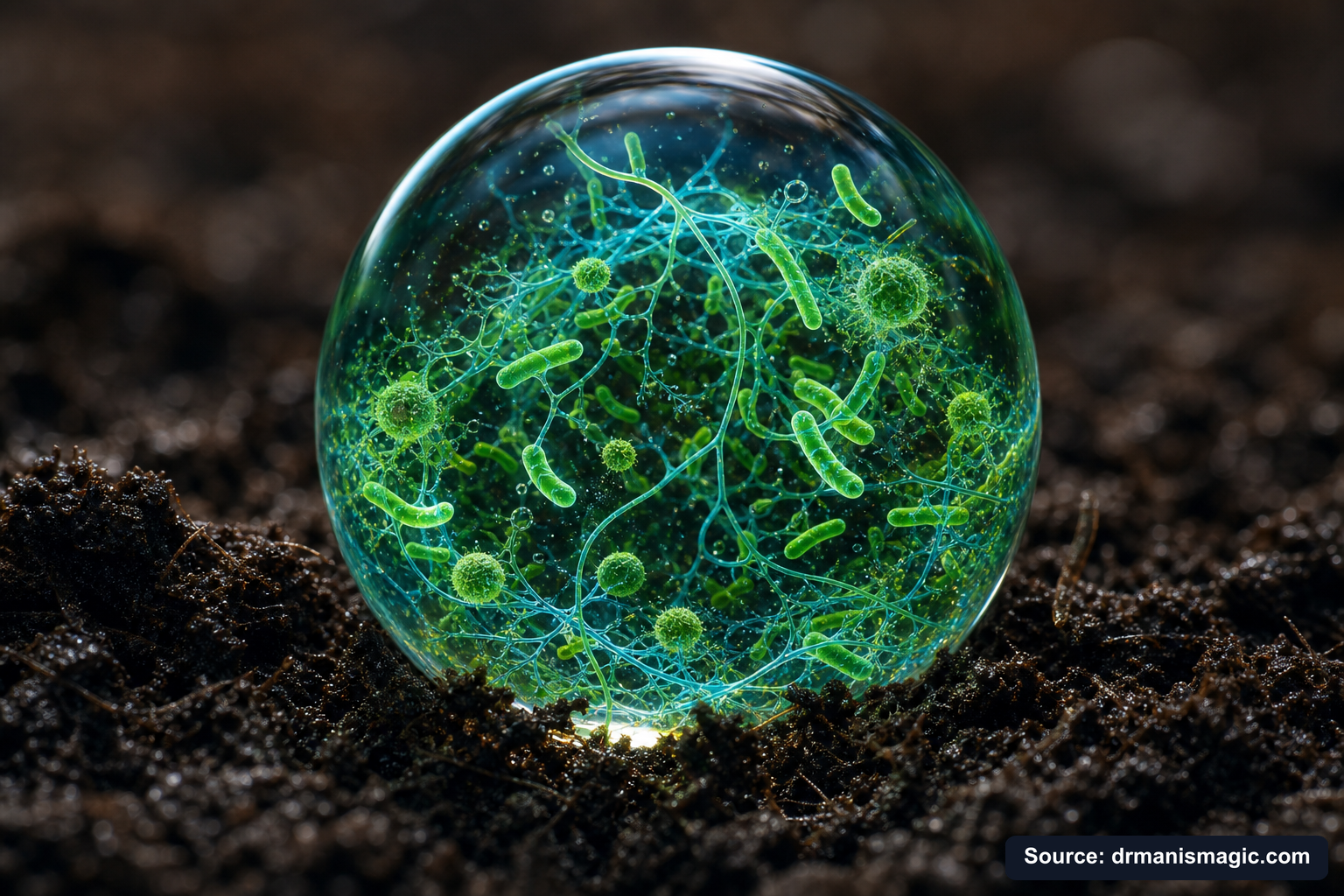
Quick Answer: The soil food web is the community of living organisms in healthy soil that break down waste, recycle nutrients, build structure, and protect plant roots. Without it, your soil is just dirt. With it, your soil becomes a self-feeding, self-defending engine that makes plants thrive naturally.
Think about a forest. Nobody fertilizes it. Nobody waters it. Nobody sprays it with fungicide. Yet massive trees grow hundreds of feet tall. Fruit falls. Seeds sprout. The whole thing hums along just fine.
Why? Because underneath the forest floor, there is a workforce running 24 hours a day. Scientists call it the soil food web. We call it the Underground Cleanup Crew. And it is made up of several distinct teams, each with a specific job.
According to Colorado State University Extension, a single teaspoon of healthy garden soil contains more microorganisms than there are people on Earth. Most of them are invisible. All of them are essential.
Here is how the crew breaks down:
| Crew Member | Their Job | What Happens Without Them |
|---|---|---|
| Bacteria (decomposers) | Break down organic matter, release nutrients, fix nitrogen from the air | Nutrients stay locked up, unavailable to roots |
| Mycorrhizal Fungi | Extend root reach 100x, mine phosphorus and micronutrients, build drought resistance | Plant starves even in fertilized soil |
| Protozoa | Eat bacteria and release plant-available nitrogen near roots | Nitrogen stays trapped in microbial bodies |
| Beneficial Nematodes | Graze on bacteria and fungi, cycle nutrients, suppress harmful nematodes | Pest nematodes go unchecked, damage roots |
| Fungi (general decomposers) | Break down tough plant residues, build soil aggregates with glomalin | Soil compacts, drainage fails, roots suffocate |
| Earthworms and Arthropods | Shred organic matter, aerate soil, create channels for water and roots | Compaction increases, water pools or runs off |
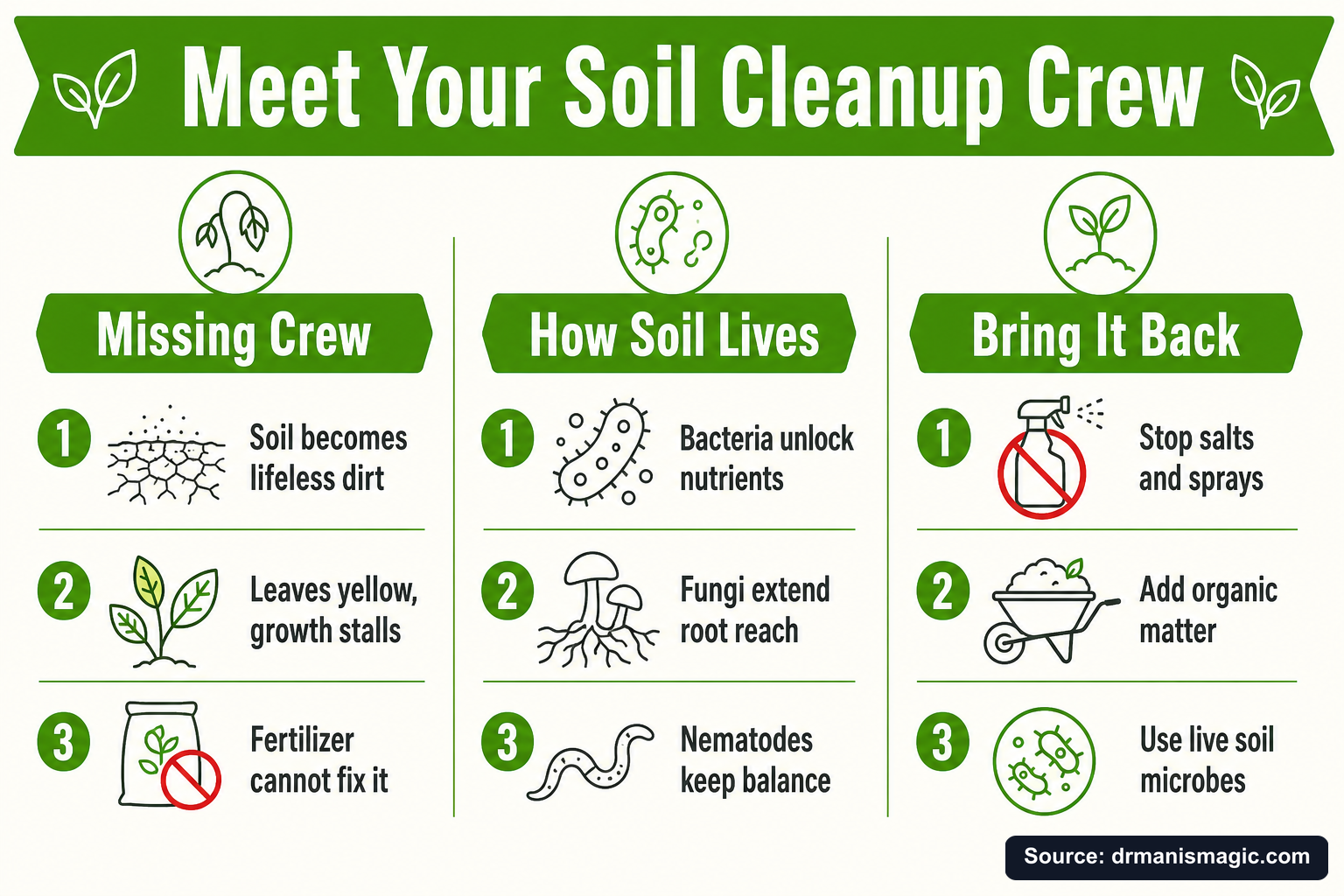
Every member of this crew depends on the others. Bacteria decompose organic matter. Protozoa eat the bacteria and drop plant-available nutrients near roots like tiny nutrient bombs. Fungi weave through the gaps and connect everything. Nematodes keep the balance. When one team goes missing, the whole system strains. When multiple teams disappear, plants begin to fail in ways that look mysterious but are actually very predictable.
This is the root cause behind most plant problems that have stumped gardeners for decades. Not bad luck. Not a brown thumb. A missing crew.
What Do Mycorrhizal Fungi Actually Do for Plant Roots?
Quick Answer: Mycorrhizal fungi attach to plant roots and grow a web of threads called hyphae that can extend the root's reach up to 100 times wider. They mine phosphorus, nitrogen, and micronutrients the root can't find alone. They also help plants survive drought, resist disease, and tolerate salty soil conditions.
Pull a healthy weed out of the ground sometime. Look at the roots. If you see fuzzy white threads clinging to them, that is not mold. That is mycorrhizal fungi, and it is the reason that weed is thriving while your expensive plant next to it is struggling.
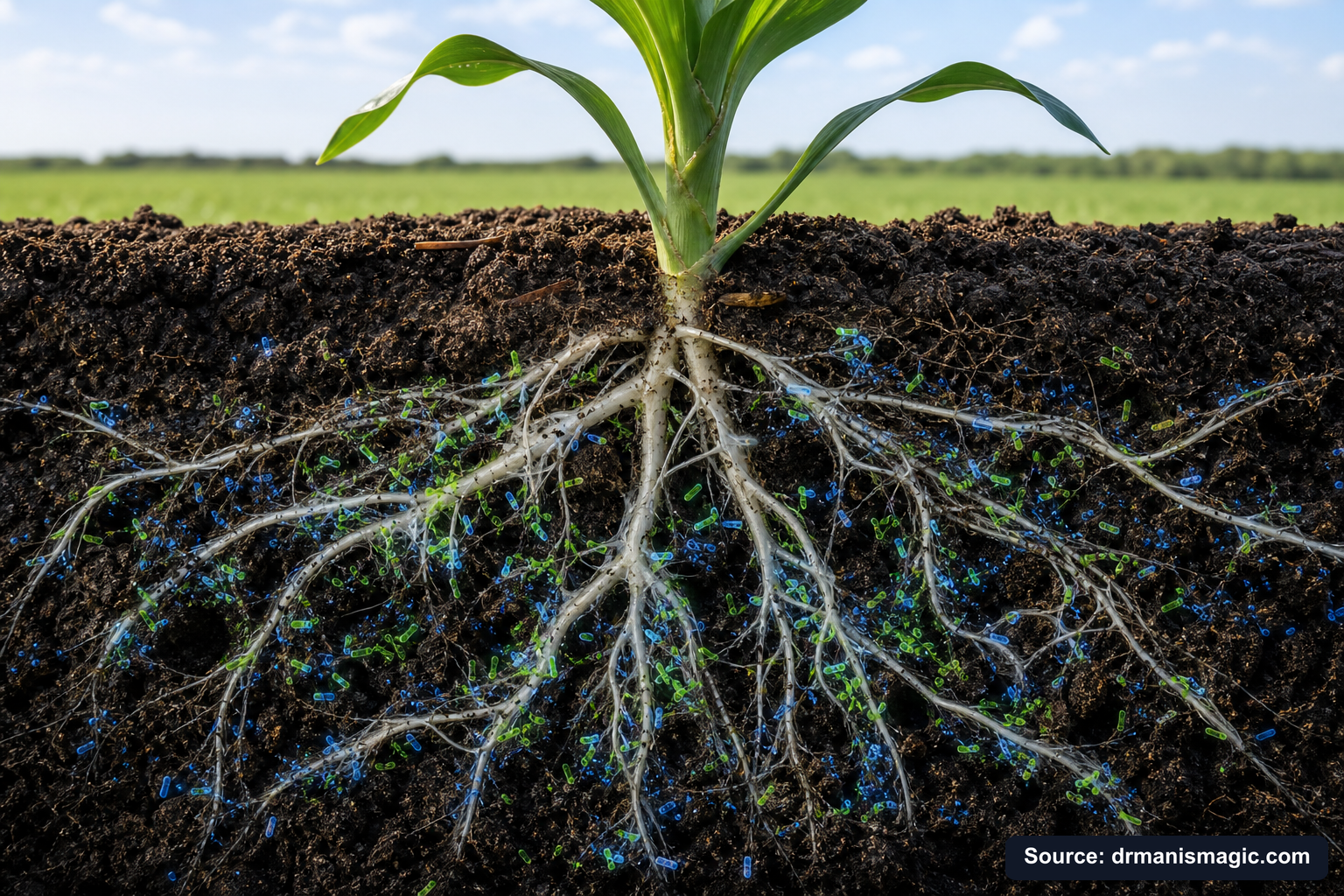
The word mycorrhizal comes from the Greek for fungus and root. That is exactly what it is. A fungus that lives in partnership with a plant root. The plant feeds the fungus sugars through its roots. The fungus goes out and finds nutrients the plant root can never reach on its own.
Those fungal threads, called hyphae, are thinner than a human hair. They can slip into tiny pockets of soil that roots cannot enter. They find phosphorus that is chemically locked up. They find water that is sitting too far away for roots to reach. They carry it all back to the plant. University of Florida IFAS researchers describe mycorrhizal fungi as a natural extension of the root system that dramatically improves plant nutrition, drought tolerance, and resilience.
Here is what mycorrhizal fungi specifically do:
- Extend the effective root zone up to 100 times larger
- Unlock phosphorus that is bound to soil particles
- Improve water uptake during dry spells
- Produce a sticky substance called glomalin that glues soil particles together, creating structure and drainage
- Suppress root pathogens by physically occupying root surfaces so harmful organisms cannot attach
- Stimulate root branching and hormone production
Now here is the painful part. Most potting mixes are sterile. Zero mycorrhizal fungi. Most fumigated garden beds are sterile. Zero mycorrhizal fungi. And when you pour synthetic fertilizer on soil, especially the salt-based kind sold everywhere, you wipe out the fungi that were trying to come back. You are essentially firing your best worker every time you reach for that blue powder.
At our South Texas nursery, after growing over 250,000 trees, we can tell you this with complete confidence: the trees with a healthy fungal network in their root zone are in a completely different category from the ones without it. Stronger. Faster. More resistant to stress. The difference is visible.
How Does the Underground Crew Actually Feed Your Plant? (The Nutrient Cycle Explained Simply)
Quick Answer: The crew breaks down organic matter into simple forms plants can absorb. Bacteria fix nitrogen from the air. Protozoa release nutrients near roots when they eat bacteria. Fungi mine minerals from deep in the soil. Together they deliver a slow, steady, complete meal to plant roots, all for free, as long as you do not kill them.
Here is the simple version of how it works. Leaves fall. Grass clippings decompose. Old roots die back. That is raw material. Bacteria and fungi break it down into smaller and smaller pieces. They release nitrogen, phosphorus, potassium, and dozens of trace minerals as they work. Then protozoa come along and eat the bacteria. When protozoa eat bacteria, they release nitrogen in a form the plant root can grab immediately. Right there in the root zone. No need to buy it. No need to spray it.
Nitrogen-fixing bacteria do something even more remarkable. They pull nitrogen directly out of the air and convert it into plant food. The atmosphere is 78 percent nitrogen. Most plants cannot touch it. But certain bacteria can. And they do. Every day. For free. As long as they are alive.
This is why a forest floor is so rich and self-sustaining. Nothing is wasted. Every dead leaf becomes food. Every microbe that dies becomes food for the next microbe. The whole thing cycles continuously. Your job as a gardener is not to replace this system with chemicals. Your job is to protect it and, when it has been damaged, restore it.
See also: The Hidden Reason Synthetic Fertilizers Cause Root Rot
What Kills the Underground Cleanup Crew?
Quick Answer: The biggest killers are salt-based synthetic fertilizers, broad-spectrum herbicides like glyphosate, synthetic fungicides, and pesticides. Compaction, flooding, over-fertilization, and sterile potting mixes also wipe out the crew. Each of these disrupts the soil food web in different ways, and the damage can linger for months or years.
Nobody sets out to destroy their soil biology. But it happens constantly. And the products sold at every big box store are, unfortunately, very good at doing it.
Salt-based fertilizers are the most common offender. When you pour a high-salt fertilizer into your soil, the salt draws water out of microbial cells the same way it draws water out of a slug. Beneficial bacteria shrink and die. Fungi retreat. The root zone becomes a quieter, more dangerous place. The plant gets a quick jolt of nutrients but loses the crew that was delivering nutrition for free.
Synthetic herbicides like glyphosate disrupt microbial communities in ways researchers are still studying. Penn State Extension has documented that microbial breakdown is one of the main routes by which soils naturally detoxify herbicide residues, but that process requires warm, moist, well-aerated, organic-matter-rich soil with a near-neutral pH. When those conditions are gone, herbicide residues can persist much longer.
Fungicides are especially destructive because they do not distinguish between pathogenic fungi and beneficial mycorrhizal fungi. You spray to kill a bad fungus. You also kill the good fungus that was extending your root system. Both are gone now.
Here is what we have seen after 30 years of growing in South Texas. Growers who rely heavily on synthetic inputs end up in a cycle. More fertilizer to compensate for lost biology. More fungicide to fight disease that biology used to prevent. More pesticide to fight pests that biology used to suppress. The bills keep going up. The plants keep getting weaker. And nobody connects the dots because the damage happens underground where you cannot see it.
That is not a brown thumb. That is a rigged game. And you did not rig it.
Can Sterile or Damaged Soil Actually Come Back to Life?
Quick Answer: Yes, but it takes deliberate steps and time. Sterile or damaged soil does not magically recolonize on its own, especially in containers or fumigated beds. You need to correct structure and pH first, then add organic matter, then reintroduce live biology through quality microbial inoculants, and stop the inputs that killed it in the first place.
This is one of the most underexplained topics in all of gardening. The answer is yes. Damaged soil can come back. But it does not happen by accident. And it does not happen overnight.
Think of it like rebuilding a team after every player quit. You cannot just put them back on the field once. You have to create conditions where they want to stay. You have to give them food and shelter. You have to stop doing the things that made them leave in the first place.
Here is a practical recovery checklist you can follow right now:
- Stop the killers first. No more salt-based fertilizers. No more broad-spectrum herbicides or fungicides if you can avoid them. You cannot rebuild while you are still destroying.
- Check your soil structure. Compacted soil has no air pockets for microbes to live in. Roots cannot breathe. If your soil clumps into hard clay or floods easily, address drainage before anything else. This is where mineral-based soil makes an enormous difference in containers.
- Add organic matter. Compost, mulch, and organic material give the incoming crew something to eat. Without food, they will not stay.
- Check pH. Most beneficial soil microbes thrive between 6.0 and 7.0 pH. Very acidic or very alkaline soil slows them down dramatically.
- Reintroduce living microbes. This step is where most gardeners give up too early or buy the wrong product. More on this below.
- Apply organic fertilizer. Slow-release organic nutrients feed both the plant and the microbial crew. Salt-based fertilizers undo your progress at this exact step.
- Repeat monthly and be patient. Biology takes time to establish. One application is a start. Consistent applications build a lasting community.
We have watched this process work on trees that looked nearly dead. The recovery is not dramatic overnight. But within a few weeks of consistent biology, you start to see it. New leaf color. New root growth. A plant that looks like it finally woke up.
You Never Had a Brown Thumb.
You were handed the wrong tools. This free guide hands you the right ones.
You watered it. You fed it. It died anyway.
It was never you. It was the dirt, the salt food, and the bad advice.
This guide shows you what really went wrong, and how to fix it for good.
- Why your plants really died, and why it was never your fault
- The salt hiding in your plant food that quietly burns the roots
- The hidden killer in almost every bag of store soil
- The tiny helpers that grow a whole forest for free
- The rescue trick that brings a half dead plant back to life

Are All Nematodes Bad? (The Truth About Soil Predators)
Quick Answer: No. Most nematodes in healthy soil are actually beneficial. They graze on bacteria and fungi, cycling nutrients near plant roots. Harmful root-feeding nematodes are kept in check by the predatory members of the soil food web. When the food web collapses, harmful nematodes can dominate unchecked.
Most gardeners hear the word nematode and cringe. They think of root knot nematodes. The ones that cause knobby, damaged roots. The ones that destroy tomato crops. And yes, those exist and they are a problem.
But here is what most people do not know. The vast majority of nematodes in healthy soil are beneficial. They eat bacteria. They eat fungi. When they digest those microbes and release waste, that waste lands right in the root zone as plant-available nitrogen. They are tiny nutrient delivery machines.
Even better, a healthy soil food web keeps the bad nematodes under control. Predatory fungi trap them. Predatory nematodes hunt them. Bacteria produce compounds that suppress them. This is biological pest control happening silently in your soil every day.
When you wipe out the food web with chemicals, the beneficial nematodes go first because they are the most sensitive. The harmful root-feeding nematodes are tougher. They survive longer. With their natural predators gone, they multiply unchecked. Your roots suffer. And you never see why because it is all happening underground.
This is exactly why rebuilding a full-spectrum soil food web matters so much. You are not just feeding your plant. You are restoring a whole system of checks and balances that has protected plant roots for millions of years.
Live Microbes vs. Dead Powder: Why Most Products on the Shelf Do Not Work
Quick Answer: Most commercial microbial products are either dried powders with low viability or smelly liquids that have already gone anaerobic and lost their living population. Neither works reliably. Effective microbial products must contain genuinely live, stable organisms harvested from real compost, not grown in a factory vat and dried into a powder.
Walk into any garden center and you will find shelves full of products with words like "beneficial microbes" and "mycorrhizal blend" on the label. They look impressive. The ingredient lists are long. The claims are bold.
We have tested dozens of them. After growing 250,000 trees at US Citrus Nursery, we can tell you plainly: most of them do not work.
Here is why. There are basically three ways microbial products are made, and only one of them actually delivers living biology to your soil.
| Product Type | How It Is Made | Is It Alive When You Use It? | Does It Work? | How to Recognize It |
|---|---|---|---|---|
| Dried powder (lab-grown) | Microbes brewed in factory vats, then dried into powder form | Mostly not. Spores may partially reactivate. | We have seen no reliable results across dozens of tests | Fine powder in a bag or jar; lists specific species and CFU counts |
| Liquid with dried powder added | Same factory microbes suspended in liquid | Low viability | Minimal results | Clear or lightly cloudy liquid; no strong smell; narrow species list |
| Compost tea (old or poorly made) | Compost soaked in water, but not kept aerated | Microbes are dying; gone anaerobic | Some humic benefit but live biology is gone | Strong foul smell; may fizz when opened |
| Compost tea (fresh, under 24 hours, actively aerated) | Properly brewed compost tea used immediately | Moderate viability | Works if used immediately; not practical for most people | Earthy smell; must be used right away |
| Plant Super Boost (stabilized, full-spectrum) | Harvested from hand-crafted compost using a proprietary all-natural stabilization method | Yes. Visibly alive under microscope. Lab-verified. | Yes. Proven across 250,000+ trees and diverse plant types. | Earthy smell only; no foul odor; liquid; 2,000+ bacteria species, 400-500 fungi including mycorrhizae, plus protozoa and nematodes |
The problem with dried powder products is simple physics. Bacteria are living things. They need water, oxygen, and warmth to survive. When you dry them into powder and seal them in a bag, most of them die. The label might say one billion CFU. By the time you pour it on your soil, you may be getting a fraction of that. And even the survivors are stressed and weakened.
The problem with most liquid products is equally simple. Microbes need oxygen. When you put them in a sealed bottle without proper stabilization, they use up the available oxygen and start to die. The bottle goes anaerobic. The contents begin to ferment and rot. That strong smell is not a sign that the product is working. It is a sign that the microbes are dying.
You can actually smell the difference. Healthy, living microbial products smell like fresh earth. Like the air right after rain. Dead, anaerobic products smell like sewage. If your microbe bottle makes you gag when you open it, the biology inside is compromised.
Dr. Mani's Magic Plant Super Boost is different because of how it is made. It is harvested from our own hand-crafted compost using a proprietary natural stabilization technique developed by a world-renowned compost expert. The microbes stay alive without going anaerobic. You can place a drop under a microscope and watch them move. We have lab analyses that confirm it. And it does not stink because it is not rotting.
It contains over 2,000 species of bacteria, 400 to 500 fungal species including mycorrhizae, plus protozoa and beneficial nematodes. Not a narrow selection of factory-brewed organisms. The full spectrum. The whole crew. Delivered alive.
Why Do You Need to Keep Adding Microbes Instead of Just Once?
Quick Answer: Because our growing environments are not like a natural forest. Containers have no underground fungal networks. Garden beds have been damaged by decades of synthetic inputs. Without ongoing additions, the beneficial population gets outcompeted by pathogens or wiped out by environmental stressors. Monthly applications rebuild and maintain a living community.
This is a fair question. If microbes multiply, why do you need to keep adding them?
In a wild forest, you do not. The system is closed and self-sustaining. Leaf litter adds organic matter constantly. No chemicals disturb the community. The network of fungal threads connects trees across acres. The system feeds itself.
Your garden or container is not that. It is a managed environment. Potting mix starts sterile. Garden beds have been sprayed, tilled, salted, and compacted for years. There is no underground fungal network connecting your pots. There is no continuous leaf litter cycle feeding the bacteria. Every time you water, you dilute and displace microbial populations. Every application of synthetic input sets them back.
In that kind of environment, beneficial microbes need regular reinforcement. Think of it like tending a fire. You light it once. But if you do not keep feeding it, it goes out. Monthly applications of live biology keep the community robust, diverse, and working for your plant.
Also, there is another force working against you. Pathogenic microbes do not take breaks. The harmful bacteria, fungi, and nematodes that damage roots are multiplying too. A strong, diverse beneficial community competes with them, crowds them out, produces natural antibiotics against them. A thin, depleted community cannot hold the line. Regular applications of full-spectrum live microbes tip that balance in your favor.
What Is the Three Plant Pillars System and How Do Microbes Fit In?
Quick Answer: The Three Plant Pillars are the foundation Dr. Mani developed after 30 years of growing. Pillar One is mineral-based soil for drainage and root breathing. Pillar Two is live microbial biology for nutrient cycling and disease resistance. Pillar Three is organic fertilizer that feeds both the plant and the microbes without burning either. Miss one pillar and the other two underperform.
Dr. Mani Skaria is a Professor Emeritus of Plant Pathology and the founder of the Clean Citrus Program in Texas. He spent 40 years at the Texas A&M Citrus Center before creating Dr. Mani's Magic. He did not invent the Three Plant Pillars as a marketing idea. He discovered them through decades of hard lessons in the field.
Here is what he found. You can have the best microbes in the world, but if your soil is compacted and waterlogged, those microbes suffocate. You can have perfect mineral soil, but if you pour salt-based fertilizer on it every month, you wipe out the biology you worked to build. You can have live microbes in beautiful soil, but if there is no slow-release nutrition feeding them and the plant, growth stalls.
The three pillars work together or they do not work at all. That is the insight that changes everything.
Most potting mixes fail Pillar One from the start. They are loaded with pine bark and wood fiber that decomposes quickly. As it breaks down, it steals oxygen from roots and compacts into sludge. It also starts with zero biology, which fails Pillar Two. And the fertilizers recommended with them are almost always salt-based, which fails Pillar Three.
You are set up to fail before you even bring the plant home. And when it struggles, you blame yourself. That is not fair.
The Three Plant Pillars system was built to solve this at the foundation level, not symptom by symptom. Get the base right and a remarkable number of plant problems simply stop happening.
What Happens When You Keep Using Salt-Based Fertilizers Over Time?
Quick Answer: Salt-based fertilizers give a quick green flush but kill beneficial microbes, damage root cell walls through osmotic pressure, and cause nutrient imbalances over time. The plant becomes dependent on ever-increasing doses while the soil biology that would naturally provide nutrition continues to decline. It is a cycle that ends badly.
Here is a picture many gardeners recognize. You fertilize. The plant looks great for a few weeks. Then it starts looking worse than before. So you fertilize again. It perks up. Then declines faster. The cycle repeats. The doses go up. The results get worse.
That is salt dependency. And it is not your fault. It is by design.
Salt-based fertilizers work by flooding the root zone with nutrients in high-salt forms. The plant absorbs them fast. But the salt also draws water out of microbial cells and root cells through osmosis. Beneficial bacteria shrink and die. Root tips get scorched. The underground crew takes another hit. So now the plant is even more dependent on you to deliver nutrition because the crew that was doing it for free is smaller than before.
Add this up over months and years. The biology in your soil declines steadily. Disease pressure increases because the biological defenses are gone. You start needing fungicide. Then pesticide. Then the soil becomes a kind of chemical battleground where the only thing keeping the plant alive is your wallet.
We have seen this pattern play out on trees that cost hundreds of dollars and years of care. All that time. Gone. You cannot get that time back. You can get money back. You cannot get years of stunted growth back.
The number one thing people tell Dr. Mani when they first reach out is that they want to see real results from their plant. Not someday. In their lifetime. That desire is completely reasonable. It is also completely achievable, but not with a system that is slowly poisoning the biology your plant needs. See also: Why Most Fertilizers Are Actually Salt in Disguise
What Can You Do Right Now to Feed Your Underground Crew?
Quick Answer: Start by stopping what kills them. Switch to organic fertilizer, reduce synthetic chemical use, and improve soil structure. Then add live, full-spectrum microbial biology monthly. Give the crew organic matter to eat. Be patient and consistent. The results compound over time as biology rebuilds.
Alright. You know who the crew is. You know what kills them. You know why most products fail. Now let us talk about what you can actually do today.
The good news is that the steps are not complicated. They are just different from what most people have been told.
First, stop the killers. Evaluate what synthetic inputs you are using. Salt-based fertilizer, broad-spectrum herbicide, synthetic fungicide. These are the most common crew killers. You do not have to throw everything away overnight. But awareness is step one. Every time you reach for one of those products, you are choosing to set the crew back.
Second, fix your soil structure. If you are using a standard potting mix, understand that it is likely compacting already. Mineral-based soil gives roots the air pockets they need and gives microbes a stable home. It does not decompose and choke out oxygen the way pine bark mixes do.
Third, feed the crew organic matter. Mulch on top of garden beds. Compost mixed into beds before planting. Slow-release organic fertilizer like crab meal, kelp, and amino acids that nourishes both the plant and the biology in the soil simultaneously. None of the salt. None of the burn. Just nutrition that works the way nature intended.
Fourth, add live biology. This is the step that changes things fastest. When you pour a genuinely live, full-spectrum microbial product onto your soil monthly, you are restocking the crew. You are replacing what the chemicals, the sterile mixes, and the synthetic inputs took away. Over time, the crew grows. The soil comes alive. The plant starts to look and behave differently. Stronger. Greener. More resilient.
Fifth, use the Free Plant Care Field Guide from Dr. Mani's Magic. It walks you through the Three Plant Pillars step by step. No guesswork. No conflicting advice from five different internet forums. Just the system that has been proven on over 250,000 trees and countless houseplants, gardens, lawns, and fruit trees.
Zero PFAS. Zero biosludge. Zero synthetic salts. That is the standard every product in the Dr. Mani's Magic line meets. Because the goal was never to sell you more products. The goal was to hand you a system that actually works so you stop needing to buy more products forever.
The Underground Cleanup Crew has been doing this work since before there were gardens. They do not need your help running. They just need you to stop running them off. Give them the right soil to live in. Feed them the right way. Reintroduce them when they are gone. And then step back and let them do what they have always done.
Your plant has been waiting for this. And so have you.
If you are ready to give your plants a living foundation they have never had before, start with Plant Super Boost. One bottle. One monthly application. The whole crew, alive and working, delivered straight to your roots. That is where the magic starts.
Frequently Asked Questions
If your plants keep struggling no matter what you try, the answer is probably underground. These questions come up again and again from gardeners just like you. Read through them and you will start to see why your soil holds the real key to everything growing strong.
What exactly does the underground cleanup crew do for my plants?
The underground cleanup crew is the team of bacteria, fungi, and other tiny organisms living in healthy soil. They break down dead matter, unlock nutrients your plant cannot reach alone, fight off disease, and build air pockets so roots can breathe. Without them, your soil is just dead dirt. Dr. Mani proved this across 250,000 citrus trees at US Citrus Nursery. When the crew is alive and working, plants grow faster, fight harder, and need far less help from you.
Why do the microbes in my soil disappear in the first place?
Salt-based synthetic fertilizers are the main killer. They burn the soil and wipe out the very microbes your plants depend on. Pesticides, herbicides, and fungicides do the same thing. Even most store-bought potting mixes come completely sterile with zero living biology inside. Big box stores never tell you this because they profit when your plant struggles and you keep buying more products. The underground crew does not die on its own. We kill it without knowing.
Can I just buy any microbe product and fix the problem?
Most microbe products on the shelf are already dead by the time you open them. Dried powders lose their potency fast. Smelly liquid composts go anaerobic and the biology breaks down. Dr. Mani spent years searching for a solution to this exact problem. Plant Super Boost uses a special stabilization method that keeps the microbes alive in the bottle. You can actually smell the difference. It smells like fresh earth, not sewage. Live microbes are the only kind that actually work.
What are mycorrhizal fungi and why do my plants need them?
Mycorrhizal fungi attach to your plant roots and act like a second root system. They reach out into the soil 100 times farther than your roots ever could. They mine phosphorus and other nutrients your plant cannot grab alone. They also help your plant survive dry spells by pulling in water from a much wider area. When these fungi are missing, your plant starves even if you fertilize it. Plant Super Boost delivers live mycorrhizae straight to your roots the moment you water it in.
Does the type of soil I use really matter that much?
It matters more than almost anything else. Most potting mixes are made from pine bark and wood that rot over time. As they break down, they compact around roots and block oxygen. Roots cannot breathe and the whole system suffocates. Dr. Mani built Super Soil on a mineral base of silica-rich sandy loam from South Texas. It does not decompose. It does not compact. It drains perfectly and lets roots push deep and wide. This is Pillar One of the Three Plant Pillars, and nothing works right without it.
How do I know the Three Plant Pillars will actually work for my plants?
Dr. Mani did not invent the Three Plant Pillars in a lab on paper. He tested them on his own citrus trees, his grove, his houseplants, and his tropical trees over 30 years in South Texas. US Citrus Nursery has sold 250,000 trees to over 10,000 growers with a 4.9 out of 5 star rating from more than 2,400 real reviews. The three pillars are mineral soil, live microbes, and organic fertilizer. They work together as one system. When all three are in place, plants stop struggling and start thriving on their own.
How long before I see real results after rebuilding my soil biology?
Most gardeners using the Three Plant Pillars start seeing a real difference within 30 days. Leaves get greener. New growth pushes out faster. The soil starts to smell alive again. The longer you stay consistent, the stronger the results get. Here is the hard truth though. Every month you spend using salt fertilizers and dead soil is a month you cannot get back. Time is the one thing money cannot replace. The best time to start was years ago. The second best time is right now.
About the Author
Ron Skaria, MD
Ron Skaria, MD, is the co-founder of Dr. Mani's Magic and the son of Dr. Mani. He trained as a medical doctor at Baylor College of Medicine, did his residency at UT Health Science Center - San Antonio and fellowship training at Texas Tech University. He now works full time on the family farm at US Citrus and US Citrus Nursery in Hargill, Texas, building Dr. Mani's Magic alongside his dad. He wrote the Brown Thumb Field Guide to put his father's 48 years of plant science into plain words any gardener can use. His belief is simple. You never had a brown thumb. You just never had the right help.


