


Why Protozoa Are the Most Overlooked Soil Organisms | Dr. Mani's Magic
Why Protozoa Are the Most Overlooked Soil Organisms (And Why Your Plants Are Paying the Price)
Picture this. You did everything right. You bought the fertilizer. You watered on schedule. You even sprinkled in some powdered bacteria from that little packet that came with your plant. And still, your tomatoes look tired. Your fruit tree barely grew three inches all season. Your lawn has that dull, yellowish tint no matter what you do.
You start wondering if you have a brown thumb. You don't. Here's the real problem: everyone talks about bacteria. Everyone talks about fungi. Garden centers sell mycorrhizae. YouTube is full of videos about earthworms. But there's one tiny organism quietly running the show that almost nobody mentions. It's not on the bag. It's not in the commercial. It barely shows up in gardening books. And without it, the nutrients in your soil stay locked up tight, completely out of reach for your plant's roots.
That organism is the protozoa. And after growing over 250,000 trees at our South Texas nursery, we can tell you with confidence: ignoring protozoa is one of the biggest hidden reasons gardens underperform. Today, we're going to change that. We'll show you exactly what protozoa do, why they've been left out of the conversation, and what you can do right now to bring them back.

Organic Fertilizer | Crab, Kelp & Amino Acids
Key Takeaways
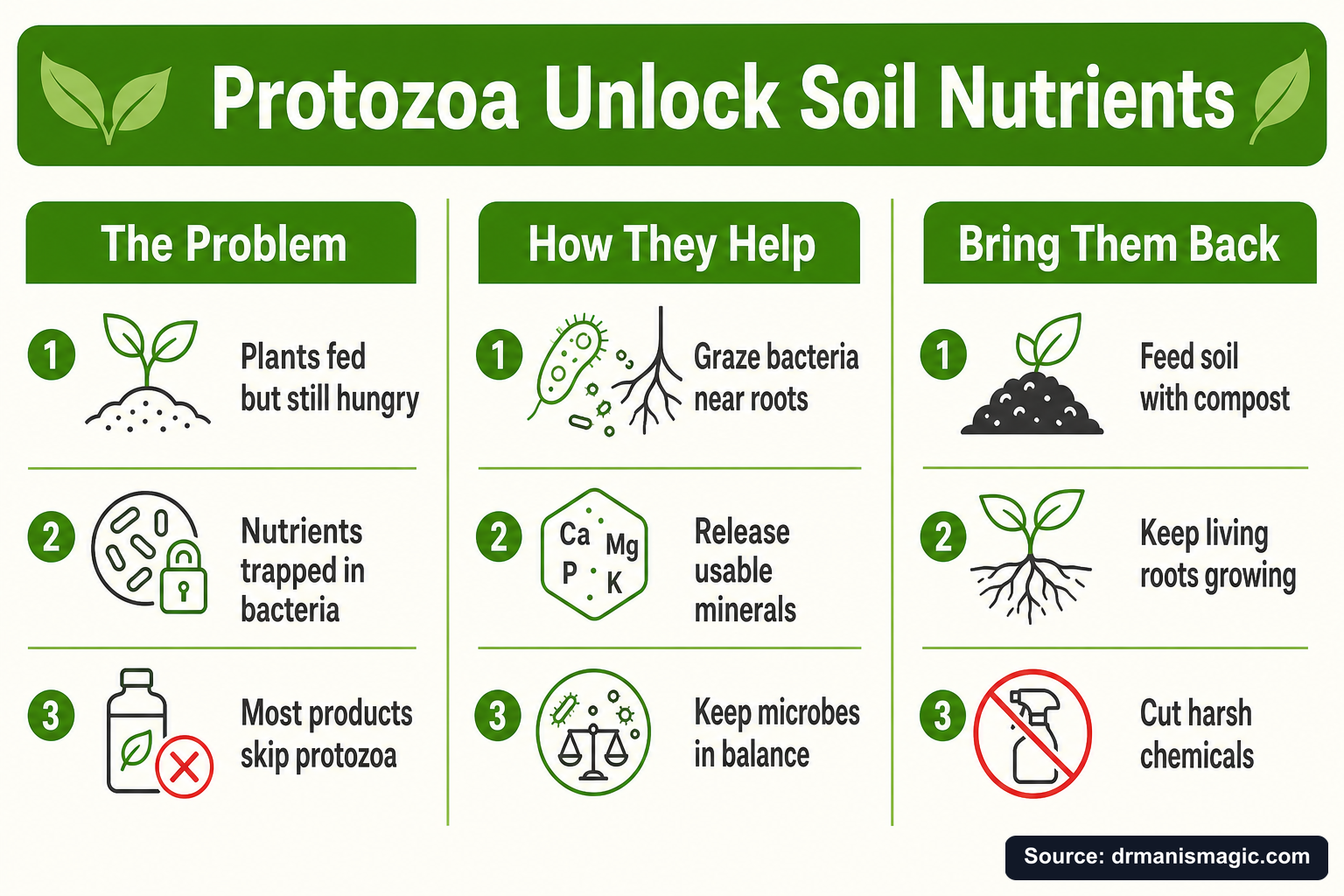
- Protozoa are microscopic grazers that eat bacteria and release plant-available nutrients directly at the root zone, making them essential nutrient unlockers in healthy soil.
- The rhizosphere (the soil zone right around your roots) has up to 2,000 times more bacteria than surrounding soil, making it the hottest hunting ground for protozoa and the most critical zone for plant nutrition.
- Without protozoa, nutrients stay trapped inside bacteria and never reach your plant, no matter how much fertilizer you pour on.
- Most commercial microbial products contain zero living protozoa because they are nearly impossible to stabilize in a bottle using standard lab methods.
- Pesticides, herbicides, synthetic fertilizers, and sterile potting mixes all destroy protozoa populations, leaving your soil biologically incomplete.
- You can restore protozoa naturally by feeding the soil food web with compost, living roots, organic matter, and full-spectrum live microbials.
- The Three Plant Pillars (mineral soil, live microbials, organic fertilizer) create the exact conditions protozoa need to thrive and do their job.
What Are Soil Protozoa and What Do They Actually Do?
Quick Answer: Soil protozoa are single-celled microscopic organisms that eat bacteria near plant roots and release the nutrients locked inside as plant-available food. They are not decomposers or symbionts. They are nutrient unlockers and population managers, making them a critical but invisible link in the soil food web.
Most people hear the word "protozoa" and think of something dangerous. Parasites. Pond scum. The kind of thing you don't want near your drinking water. And yes, some protozoa do cause disease in humans and animals. But the protozoa living in healthy soil are a completely different story. They are allies, not enemies.
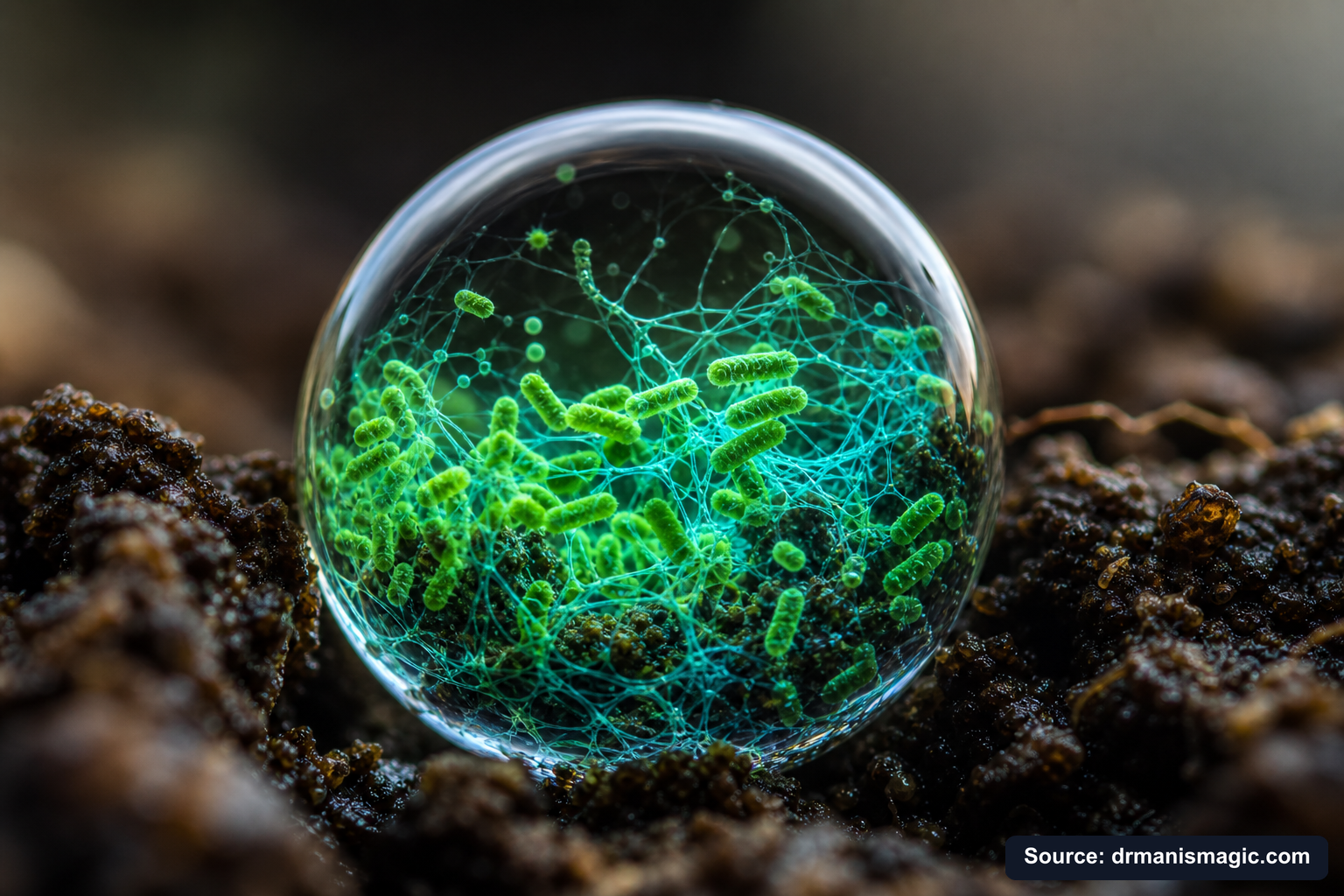
Soil protozoa are single-celled organisms. Tiny enough that you'd need a microscope to see them. They live in the thin film of water that coats soil particles. They swim, they hunt, and they eat. And what they eat is bacteria.
Here's why that matters. Bacteria are nutrient holders. When bacteria consume organic matter, they pull nitrogen, phosphorus, and other nutrients inside their cells. Those nutrients are now locked up. Your plant's roots cannot grab them. They're stuck inside a microscopic package.
Then a protozoa comes along and eats that bacteria. The nutrients inside the bacteria are released. But protozoa don't need all of it. They use what they need and excrete the rest as plant-available minerals, right there in the root zone. Think of it as nature's own slow-release fertilizer system, except the release happens in the exact spot where your roots are waiting.
According to the USDA Natural Resources Conservation Service, this process is called the microbial loop, and it is one of the primary ways plants get nitrogen and other nutrients from the soil. Without protozoa grazing on bacteria, that loop breaks. Nutrients stay locked. Plants go hungry. And no amount of synthetic fertilizer fixes the root cause.
Why Are Protozoa the Most Overlooked Soil Organisms?
Quick Answer: Protozoa are overlooked because they are invisible, hard to photograph, difficult to sell in a bottle, and play a "secondary" grazing role that gets less attention than bacteria or mycorrhizal fungi. But secondary does not mean optional. Without protozoa, the soil food web breaks at its most critical link: nutrient delivery to roots.
There's a simple reason protozoa never make the label. You can't see them. You can't photograph them doing something dramatic. And they are incredibly hard to keep alive in a commercial product.
Bacteria can form spores and survive in dry powder for months. Mycorrhizal fungi have propagules that can handle storage. But protozoa? They need moisture. They need specific temperatures. They need living prey. Pull them out of their environment and they die fast. That makes them nearly impossible to bottle and sell at a profit.
So the industry ignores them. Not because they don't matter. Because they can't make money selling them.
Meanwhile, bacteria and fungi get all the attention. They're on every garden center shelf. They're in the YouTube videos. They're in the ads. And they do matter, genuinely. But if your soil only has bacteria and fungi without the grazers that regulate them and unlock their nutrients, you've got a story with a missing chapter.
The marketing machine also loves visible results. Mycorrhizae produce those beautiful white threads you can see when you pull up a plant. Earthworms are big enough to hold in your hand. But protozoa? They do their best work completely out of sight, in the water film around a soil particle, eating microscopic meals that never make a good photo.
That invisibility is exactly why most gardeners never hear about them. And it's exactly why so many fertilizer-fed gardens still underperform. The nutrient-unlocking step is missing.
What Is the Rhizosphere Microbial Loop and Why Should You Care?
Quick Answer: The rhizosphere is the thin zone of soil surrounding your plant's roots. Plant roots release sugars that feed bacteria, bacteria multiply rapidly, protozoa eat the bacteria and release nutrients, and roots absorb those nutrients. This loop is how plants feed themselves in nature. When protozoa are missing, the loop breaks and plants go hungry even in nutrient-rich soil.
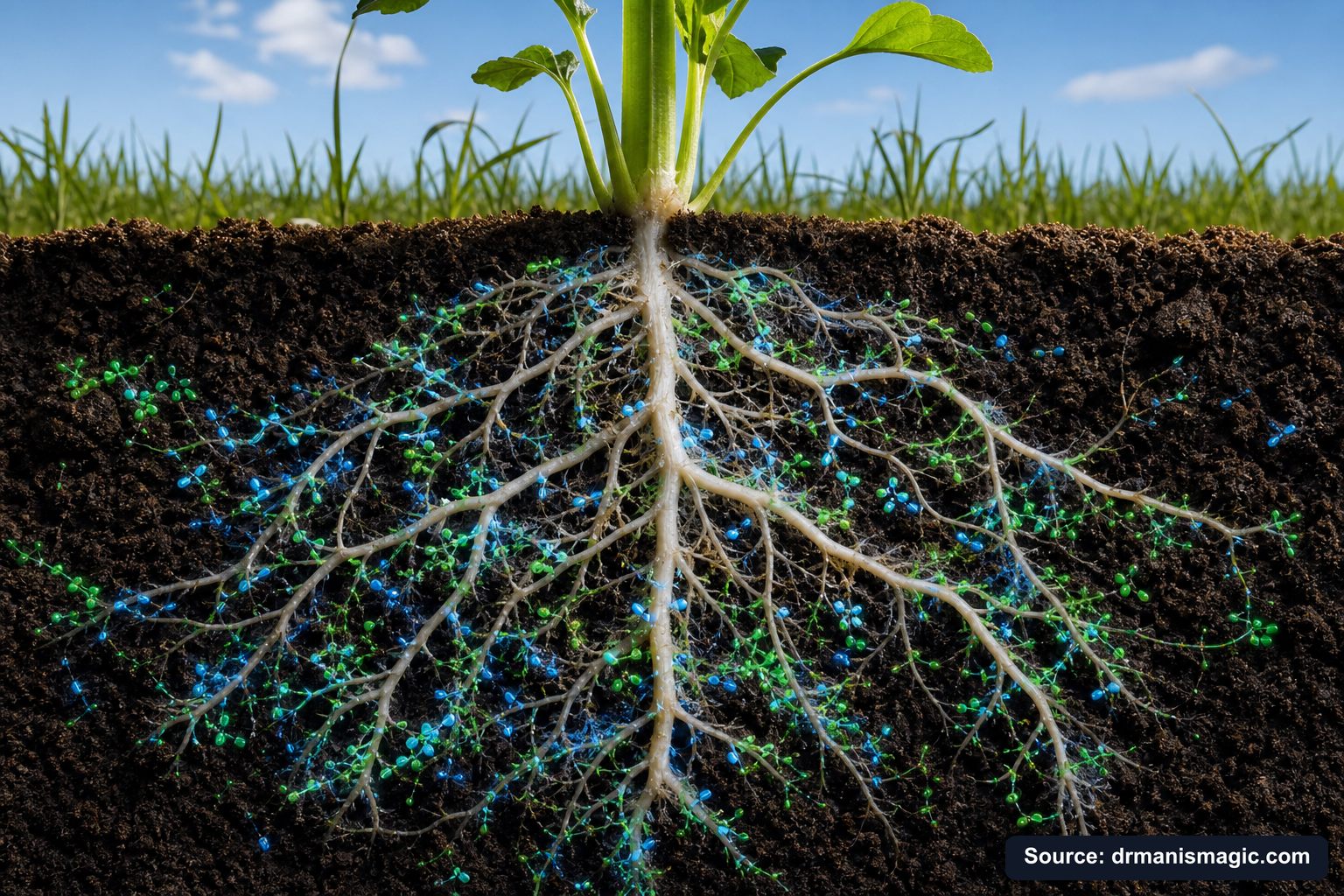
Here's one of the most surprising facts we've ever come across in 30 years of growing. The soil right next to your plant's roots can have up to 2,000 times more bacteria than the soil just a few inches away. Two thousand times. That's not a small difference. That's a different world entirely.
Why? Because plant roots are constantly releasing sugars, proteins, and other compounds into the surrounding soil. This is called root exudate. It's the plant feeding the soil on purpose. Roots are not passive tubes that just suck up water. They are active, broadcasting food into the soil to attract and feed the microbial community they depend on.
All those bacteria rush in to eat the sugars. The bacterial population explodes. And then protozoa move in to graze. They eat the bacteria. They release the nutrients. The roots pick up those nutrients. The plant grows. And then the roots release more sugars to keep the cycle going.
This is the rhizosphere microbial loop. It's the engine of plant nutrition in natural ecosystems. It's why forests grow without fertilizer bags. It's why prairies stay green without irrigation schedules. The loop runs itself, as long as all the players are present.
Remove the protozoa and the loop stalls. Bacteria still eat. Bacteria still multiply. But nutrients stay locked inside bacterial cells. The roots keep releasing sugars, but they get less and less back. Over time, the plant struggles. It gets weaker. It becomes vulnerable to pests and disease. And the gardener keeps adding more fertilizer, wondering why nothing is working.
The University of California Agriculture and Natural Resources extension program confirms that protozoa and nematodes play a key role in nutrient cycling by releasing plant-available nitrogen as they feed on bacteria, particularly in the root zone where plant demand is highest.
Are Soil Protozoa Good or Bad? (The Honest Answer)
Quick Answer: Soil protozoa are overwhelmingly beneficial for plant growth. Some protozoa cause disease in animals and humans, but those species are entirely different from the ones that live in healthy garden soil. Beneficial soil protozoa eat bacteria, release nutrients, and regulate the microbial population. They are a sign of healthy, living soil, not a hazard.
We get this question a lot. And it's a fair one. The word "protozoa" comes with baggage. We learned in school that protozoa can make you sick. Giardia is a protozoa. Malaria is caused by a protozoa. So when someone tells you to celebrate protozoa in your garden, it's natural to flinch.
But here's the thing. The world of protozoa is enormous and diverse. There are tens of thousands of species. The ones that cause human disease are a tiny, specific group. They live in very different conditions than your garden soil. The protozoa in healthy soil, such as amoebae, flagellates, and ciliates, are not parasites. They are grazers. They eat bacteria. They are completely harmless to you, your children, and your pets.
In fact, a soil rich in beneficial protozoa is a sign of health. It means the food web is intact. It means nutrients are cycling. It means your plant has access to a living, breathing system that is working on its behalf 24 hours a day.
A soil with no protozoa is a broken system. Nutrients pile up in bacterial cells and go nowhere. The microbial population gets out of balance. Pathogens find it easier to move in because there's nothing keeping the ecosystem in check.
Good protozoa are the regulators. They keep bacterial populations from getting too crowded. They unlock nutrients. They connect the bottom of the food web to the top. Without them, the whole thing tilts.
Protozoa vs Bacteria and Fungi: What's the Real Difference?
Quick Answer: Bacteria decompose organic matter and hold nutrients. Fungi break down tough materials, form mycorrhizal networks, and extend root reach. Protozoa graze on bacteria, release locked nutrients, and manage the microbial population. Each plays a different role. All three are necessary. Missing any one of them creates a gap that fertilizer cannot fill.
Think of it like a kitchen crew. Bacteria are the prep cooks. They break down raw ingredients (organic matter) into smaller components. Fungi are the sous chefs who handle the tougher jobs, like breaking down wood fiber, building structure, and connecting the kitchen to the supply chain through their vast root-extending networks. Protozoa are the plating team. They take what the prep cooks assembled, process it one more time, and deliver it in a form the customer (your plant) can actually use.
If the plating team never shows up, the food never makes it to the table. The kitchen is still busy. Lots of activity. But nothing is getting served.
| Organism | Primary Role | What They Need | What They Deliver to Plants |
|---|---|---|---|
| Bacteria | Decompose organic matter; fix nitrogen from air; hold nutrients in their cells | Carbon (sugars), moisture, oxygen or anaerobic zones | Nutrients available only after being grazed by protozoa or nematodes |
| Mycorrhizal Fungi | Extend root network; deliver water and phosphorus; build soil structure with glomalin | Living plant roots; no synthetic fungicides | Phosphorus, water, disease resistance, structural soil aggregation |
| General Fungi | Break down tough organic matter (lignin, cellulose); recycle carbon | Organic matter; low disturbance | Carbon cycling; habitat for other microbes |
| Protozoa | Graze on bacteria; regulate microbial populations; mineralize nutrients | Moisture; living bacteria to eat; warm temperatures | Plant-available nitrogen, phosphorus, and other minerals released at the root zone |
| Beneficial Nematodes | Graze on bacteria and fungi; control pest insect larvae | Moisture; prey organisms | Nutrient release; pest suppression |
| Earthworms | Physically mix soil; accelerate decomposition; improve drainage | Organic matter; moisture; loose soil | Improved soil structure; nutrient-rich castings |
Notice something in that table. Bacteria deliver their nutrients only after being grazed by protozoa or nematodes. That's the key insight most gardening content skips entirely. You can have billions of bacteria in your soil and still have a nutrient-starved plant. The grazing step is not optional. It is the delivery mechanism.
You Never Had a Brown Thumb.
You were handed the wrong tools. This free guide hands you the right ones.
You watered it. You fed it. It died anyway.
It was never you. It was the dirt, the salt food, and the bad advice.
This guide shows you what really went wrong, and how to fix it for good.
- Why your plants really died, and why it was never your fault
- The salt hiding in your plant food that quietly burns the roots
- The hidden killer in almost every bag of store soil
- The tiny helpers that grow a whole forest for free
- The rescue trick that brings a half dead plant back to life

Why Do Most Microbial Products Skip Protozoa?
Quick Answer: Protozoa cannot survive the drying, heat, and storage conditions used to make most commercial microbial products. They need living prey, moisture, and stable conditions to survive. This is why nearly every off-the-shelf microbial inoculant is missing them, regardless of what the label says about "diverse microbial communities."
Walk into any garden center and look at the microbial products. Read the labels carefully. You'll see lists of bacteria species. You'll see mycorrhizae. You might even see claims about "diverse soil biology." But look for protozoa. You almost certainly won't find them listed, and even if you do, they almost certainly aren't alive.
Here's why. Most commercial microbial products are made one of two ways. First, they are brewed in giant factory vats, dried into powder, and shipped. The hope is that the bacterial spores will "wake up" when water is added. But protozoa don't form the kind of long-lasting spores that survive industrial drying. They need moisture, prey, and a living environment. The factory process kills them.
Second, some companies create liquid compost-tea style products. These start with real biology. But by the time they travel from a warehouse to a distribution center to a store shelf to your home, the microbes have gone anaerobic. They've run out of oxygen. They're dying or dead. The telltale sign? The bottle smells like a swamp. That smell is the stench of biology breaking down.
We spent years testing dozens of these products on our own citrus trees at US Citrus Nursery. The dry powders showed no meaningful benefit. The smelly liquid products showed minimal results, mostly from the humic acids and fulvic acids in the base, not from living microbes.
That's why Dr. Mani and our team spent years developing a different approach. Our Plant Super Boost is harvested from our own hand-crafted compost using an all-natural stabilization technique developed by a world-renowned compostologist. It keeps the full spectrum of microbes alive without going anaerobic. It smells like earth, not sewage. And if you put a drop under a microscope, you can actually watch the microbes move.
| Product Type | Likely Viability | Contains Protozoa? | Odor | What You Actually Get |
|---|---|---|---|---|
| Dry / powdered lab microbes | Very low | No | Minimal | Mostly dormant or dead spores; limited real-world benefit |
| Dry microbes rehydrated into liquid | Very low | No | Minimal | Same problem; water doesn't revive dead biology |
| Compost tea (fresh, under 24 hours) | Moderate (if aerated) | Sometimes | Earthy turning sour | Real biology but degrades fast; must use immediately |
| Compost tea (old, over 24 hours) | Low to none | No | Strong stench | Anaerobic; microbes dying; not recommended |
| Lactobacillus-based products | High (for lactobacillus) | No | Sour / fermented | Lactobacillus crowds out beneficial microbes; belongs in yogurt, not soil |
| Plant Super Boost (stabilized, full-spectrum) | High | Yes | Earthy, not offensive | 2,000+ bacteria species, 400-500 fungi including mycorrhizae, plus protozoa and nematodes; visible under microscope |
What Kills Protozoa in Your Soil?
Quick Answer: Synthetic herbicides, salt-based fertilizers, pesticides, and synthetic fungicides all damage or destroy soil protozoa populations. Sterile potting mixes contain none to begin with. Compaction, drought, and soil disturbance also reduce protozoa. Once gone, they can take months or years to return without active restoration.
This is where the story gets painful. Because the very products most people use to help their plants are often quietly destroying the soil biology those plants depend on.
Salt-based synthetic fertilizers are one of the biggest culprits. High salt concentrations pull water out of microbial cells through osmosis. Bacteria, fungi, and protozoa all suffer. The salt doesn't discriminate. It kills the beneficial biology right alongside any pathogens. See also: The Hidden Reason Synthetic Fertilizers Cause Root Rot for a deeper look at how this plays out in the root zone.
Glyphosate and other synthetic herbicides disrupt microbial communities in ways that research is still uncovering. Broad-spectrum pesticides wipe out the prey organisms that protozoa depend on. Synthetic fungicides are designed to kill fungi, but they don't stop at pathogens. They hit the mycorrhizal partners and the beneficial fungi that make up the foundation of the food web.
And then there's the potting mix in nearly every plant you buy from a big box store. It's a sterile mix of pine bark, peat, and filler. No biology. No protozoa. No bacteria worth mentioning. Roots sit in a biologically empty medium and wonder where the food web went.
The damage compounds over time. Each application of salt fertilizer pushes the microbial community further toward collapse. Each spray of pesticide reduces the diversity that keeps the system stable. And because protozoa need living bacteria to eat, once the bacterial population crashes, the protozoa follow. When the protozoa disappear, nutrients stop cycling. The plant's root zone goes quiet. Growth slows. Fruit production drops. The gardener adds more fertilizer. The cycle continues.
How Do You Rebuild Protozoa and Restore Soil Biology?
Quick Answer: You rebuild protozoa by restoring the conditions they need: living bacteria to eat, moisture, organic matter, reduced chemical inputs, and minimal soil disturbance. Adding a full-spectrum live microbial inoculant jumpstarts the process. Recovery takes consistent effort over several months, especially in severely damaged soils.
Here's the good news. Protozoa are resilient. Given half a chance and the right conditions, they come back. And when they do, the whole food web starts humming again. Nutrients flow. Roots thrive. Plants grow the way they were designed to grow.
The key word is habitat. You can't just pour protozoa into a bucket and dump them on your garden. They need a living ecosystem to survive in. Your job is to build that ecosystem. Once it's built, the protozoa will find their place in it.
Here is a step-by-step recovery protocol for damaged or biologically depleted soils:
- Stop the damage first. Reduce or eliminate synthetic herbicides, salt-based fertilizers, and broad-spectrum pesticides. Every application sets recovery back. You can't fill a leaking bucket.
- Add organic matter. Compost, mulch, and organic surface cover feed bacteria, which then feed protozoa. No organic matter means no food chain. Aim for a 2-3 inch layer of organic mulch on top of garden soil.
- Keep soil moist but not waterlogged. Protozoa need the water film around soil particles to move and hunt. Dry soil kills them. Waterlogged soil suffocates them. Consistent moisture is the goal.
- Minimize soil disturbance. Tilling and digging destroys the physical structure that protozoa live in. Reduce tillage where possible. Let the soil architecture rebuild itself.
- Add a full-spectrum live microbial inoculant monthly. This restores bacteria, fungi, mycorrhizae, protozoa, and nematodes simultaneously, rebuilding the whole web instead of one strand at a time.
- Switch to organic fertilizer. Organic slow-release fertilizers like our Crab, Kelp and Amino Acids feed the soil ecosystem without the salt spike that kills biology. They work with the microbes, not against them.
- Give it time and be consistent. Badly damaged soils can take 6-12 months of consistent care to show meaningful biological recovery. Don't stop after one application. The food web rebuilds layer by layer, and every month you stay consistent is a month closer to a fully functioning system.
The Three Plant Pillars framework exists precisely to address this recovery in a systematic way. Mineral-based soil gives roots the structure and drainage they need. Live microbials restore the food web. Organic fertilizer feeds both the plant and the biology simultaneously. When all three are in place, recovery accelerates dramatically.
Can You Add Protozoa to Soil? (And Does It Work?)
Quick Answer: You cannot easily buy and add isolated protozoa to soil because they do not survive the manufacturing and storage process in most commercial products. The most effective approach is to add a full-spectrum live microbial product that includes protozoa alongside the bacteria they need to eat, and then build the habitat conditions that keep them alive and reproducing.
People ask us this all the time. "Can I just buy protozoa and add them?" It's a logical question. If protozoa are what's missing, why not just add them?
The problem is the supply chain. As we discussed, protozoa need moisture, prey, and the right temperature to survive. They can't be dried, powdered, or stored on a shelf. By the time most products travel from a manufacturer to your doorstep, any protozoa that were present are dead.
The real answer is to restore the ecosystem, not just one species. When you add a genuinely alive, full-spectrum microbial product that includes the bacteria protozoa eat, the protozoa have something to work with. They multiply. They establish. They start grazing and releasing nutrients. The loop closes.
This is exactly why the protozoa and nematodes in Plant Super Boost are included alongside over 2,000 species of bacteria and 400-500 species of fungi including mycorrhizae. It's not just a list of ingredients. It's a functioning community delivered in a stable, living form directly to your root zone.
North Carolina State University Extension research on the soil food web confirms that a diverse and active microbial community, including bacterial grazers like protozoa, is one of the strongest indicators of long-term soil health and sustainable plant productivity.
The Three Plant Pillars and Where Protozoa Fit In
Quick Answer: Protozoa thrive under the Three Plant Pillars because mineral-based soil provides the pore space and drainage they need to move, live microbials restore the full food web including protozoa, and organic fertilizer feeds bacteria without the salt shock that wipes protozoa out. All three pillars work together to create the conditions protozoa need to do their job.
Here's something that took Dr. Mani and our team years to fully understand. You can't fix one pillar and expect everything to work. It's a system. And protozoa are a perfect example of why.
Give protozoa the right microbes but put them in compacted, waterlogged potting mix? They can't move. The pore spaces are clogged with decomposing bark. The water doesn't drain. The oxygen disappears. They die.
Give protozoa great mineral soil but feed the plant with salt-based synthetic fertilizer? The salt kills the bacteria they depend on. No bacteria, no food. No food, no protozoa. The nutrient loop breaks again.
Give protozoa great soil and organic fertilizer but never add live microbials? You're waiting for nature to slowly repopulate a biologically depleted soil on its own. In a container or in chemically damaged ground soil, that can take years.
But when all three pillars are in place? The mineral soil provides perfect drainage and aeration. The live microbials rebuild the full food web, bacteria, fungi, mycorrhizae, protozoa, nematodes, and all. The organic fertilizer slowly feeds the bacteria that feed the protozoa, without the salt that would kill them. Everything connects. The rhizosphere microbial loop runs the way it was designed to run. Nutrients flow. Roots grow. Plants thrive.
We've watched this happen across 250,000 citrus trees in South Texas. We've watched it happen in houseplants, tropical trees, vegetable gardens, and lawns. The system works because it mirrors what nature already does, just in a form you can apply from a bottle.
See also: Why Most Fertilizers Are Actually Salt in Disguise

What Can You Do Right Now to Help Your Soil?
You've just learned something most gardeners never find out. Your soil is supposed to be alive. Not just with bacteria and fungi, but with protozoa, nematodes, and an entire food web working together to feed your plants from the inside out. When that web is intact, plants grow the way you always imagined they could. Strong. Healthy. Producing the fruit, the flowers, the green you've been chasing.
The truth is, most of us have been working against that web without knowing it. The salt fertilizers. The chemical sprays. The sterile bagged soil. All of it quietly dismantling the invisible workforce that was supposed to do the heavy lifting for us.
But here's what's exciting. You can start rebuilding today. Not next season. Today. Every month you add a full-spectrum live microbial to your soil, you're restoring one more strand of the food web. Every time you switch from salt-based fertilizer to slow-release organic, you're protecting the bacteria that protozoa depend on. Every layer of mulch you lay down is a meal for the system that feeds your plant.
Time is the one thing you can't get back. We mean that sincerely. The number one thing people tell us, more than anything else, is that they want to see their garden truly flourish, their fruit tree actually produce, their lawn actually look alive, while they still have the time and health to enjoy it. Every month you spend on a system that isn't working is a month you don't get back.
The Three Plant Pillars give you a foundation built on how nature actually works. Mineral soil. Live microbes. Organic fertilizer. Get all three in sync and your plants stop struggling and start performing. It really is that straightforward.
If you'd like to start with a clear, no-guesswork plan, our Free Plant Care Field Guide walks you through the Three Plant Pillars step by step, for any plant, any garden, any soil. It's the same system we use on our own trees in South Texas, and it works. If you're not happy within 30 days, we'll refund your money with no questions asked. Zero PFAS. Zero biosludge. Zero synthetic salts. Just real biology doing what it was always meant to do.
Frequently Asked Questions
Most gardeners never hear the word "protozoa" until their plants are already struggling. These tiny organisms are the missing link in almost every underperforming garden. The questions below cut straight to what you need to know, grounded in over 30 years of real growing experience across 250,000 trees in South Texas.
Why are protozoa so important in soil?
Protozoa are microscopic hunters that eat bacteria in the soil. When they eat bacteria, they release locked-up nutrients right at the root zone where your plant can actually grab them. Without protozoa, those nutrients stay trapped inside bacteria cells forever. Your plant starves even when the soil is full of food. That is why the Three Plant Pillars include live microbials, not just bacteria alone.
What do protozoa actually do for my plants?
Think of protozoa as tiny nutrient delivery drivers. Bacteria store nitrogen and phosphorus inside their cells. Protozoa eat the bacteria, keep what they need, and release the rest as plant-ready minerals right next to the roots. No protozoa means no delivery. Your plant pours energy into roots searching for food it can never find. That is a slow drain on growth, color, and fruit production.
Why does almost nobody talk about protozoa in gardening?
Big chemical companies and big box stores profit from selling you fertilizer over and over. Protozoa are part of a living soil system that, once healthy, feeds your plants naturally. That cuts into repeat sales. So the conversation stays focused on synthetic fertilizers that actually kill protozoa populations. At Dr. Mani's Magic, we built our entire Plant Super Boost system around supporting the full soil food web, protozoa included.
Do synthetic fertilizers hurt protozoa?
Yes, and badly. Salt-based synthetic fertilizers wipe out the bacteria that protozoa depend on for food. No bacteria means no protozoa. No protozoa means nutrients stay locked up no matter how much fertilizer you pour on. This is the hidden cycle that keeps your lawn dull and your fruit trees barely growing. It is not bad luck. It is a broken soil food web caused by the wrong inputs.
Who first discovered protozoa?
A Dutch scientist named Antonie van Leeuwenhoek first spotted protozoa in 1674. He used a powerful handmade microscope to look at pond water and saw tiny swimming organisms he called "animalcules." He had no idea he was looking at one of the most important players in plant nutrition. The formal name "Protozoa" came later in 1818. Dr. Mani spent decades uncovering how these ancient organisms connect directly to plant health.
Can I restore protozoa to my soil at home?
Yes. You restore protozoa by feeding the whole soil food web, not just dumping in one product. That means mineral-based soil that does not compact and choke life, live microbials that bring a full spectrum of organisms, and organic fertilizer that feeds the system without burning it. That is exactly what the Three Plant Pillars do. We proved this approach across 250,000 trees before we ever put it in a bottle for you.
Are protozoa found in most commercial microbial products?
Almost never. Protozoa are extremely hard to keep alive in a bottle using standard lab methods. Most products on store shelves contain zero living protozoa. That is a major gap. At Dr. Mani's Magic, our Plant Super Boost uses a special stabilization method developed by our compost expert to keep a full living microbial community active and ready to work the moment it hits your soil. That is a real difference you can see in your plants.
About the Author
Dr. Mani Skaria, PhD
Dr. Mani Skaria, PhD, is a plant pathologist and the scientific founder of Dr. Mani's Magic. He earned his doctorate at Purdue University and spent 48 years studying how plants, soil, and living microbes work together, including his years as Professor Emeritus at Texas A&M and as a member of the USDA NAREEE Advisory Board. He invented micro-budding, a method for growing healthier, stronger trees, and has grown more than 250,000 trees on the family farm in Hargill, Texas - US Citrus Nursery. His life's work takes real lab science and practical experience and turns it into simple, safe, organic plant care anyone can use at home.


