


The Invisible Workforce Beneath Your Garden Explained | Dr. Mani's Magic
The Invisible Workforce Beneath Your Garden (And Why Your Plants Are Starving Without Them)
Close your eyes for a second. Picture the deepest, oldest forest you have ever seen. Massive trees. Thick roots. Green everywhere. Nobody waters those trees. Nobody sprays them with fertilizer. Nobody drives to the garden center to buy potting mix. Yet they grow. They thrive. They push up through rock, survive drought, fight off disease, and live for hundreds of years.
Now look at your backyard. Your potted lemon tree. Your garden bed. Your lawn. You water. You fertilize. You Google at midnight. You try one product, then another. And something still feels... off. The leaves yellow. The fruit never comes. The grass looks tired. You start to wonder if you just have a brown thumb. Here is the truth nobody at the big box store will ever tell you: the forest has something your garden probably does not. Something you cannot see. Something alive. Something working day and night in the dirt beneath every healthy plant on this planet.
We call it the invisible workforce. Scientists call it the soil food web. After growing over 250,000 trees at our South Texas nursery, we call it the single most important thing most gardeners know nothing about. And once you understand it, everything changes. You stop fighting your plants. You start working with the invisible army that was always supposed to be there. Your garden wakes up. Your roots grow deep. Your fruit actually arrives. This article is your introduction to the crew underground. Meet them. Understand them. And never garden the same way again.

Plant Super Boost
Author
By Dr. Mani Skaria, PhD · Plant Pathologist · Professor Emeritus, Texas A&M University–Kingsville · USDA NAREEE Advisory Board Member · Founder, Texas Clean Citrus Program · Inventor of Micro-Budding
Key Takeaways
- Healthy soil is not dirt. It is a living city packed with bacteria, fungi, protozoa, nematodes, and more, all working together to feed your plants for free.
- The soil food web cycles nutrients, fights disease, builds root systems, and manages water, all without a single bottle of synthetic fertilizer.
- Salt-based chemical fertilizers, synthetic herbicides, and broad-spectrum pesticides kill the invisible workforce and leave your plants defenseless.
- Most commercial microbial products use dead or dying microbes. Dried powders rarely reactivate. Smelly liquids have already gone anaerobic. Neither works the way fresh, live biology does.
- Damaged or sterile soil can recover, but it takes repeated inoculation, organic matter, and time. There are no shortcuts, only smart steps.
- Dr. Mani's Magic Plant Super Boost delivers genuinely live, full-spectrum microbes stabilized by an all-natural technique so they arrive alive and ready to work.
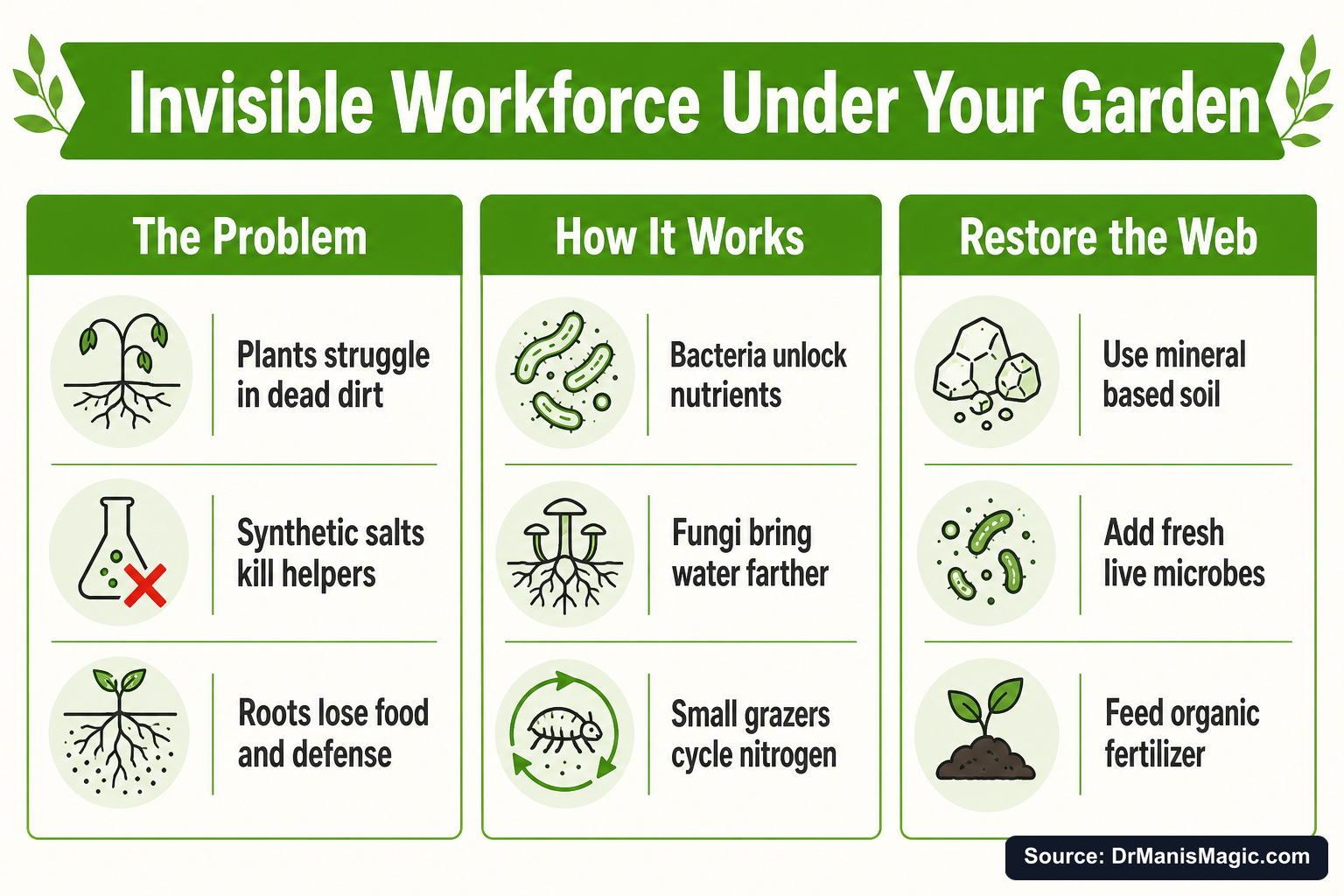
- The Three Plant Pillars (mineral-based soil, live microbes, organic fertilizer) are the foundation every plant needs, whether it is a lawn, a houseplant, a fruit tree, or a flower bed.
What Exactly Is the Soil Food Web?
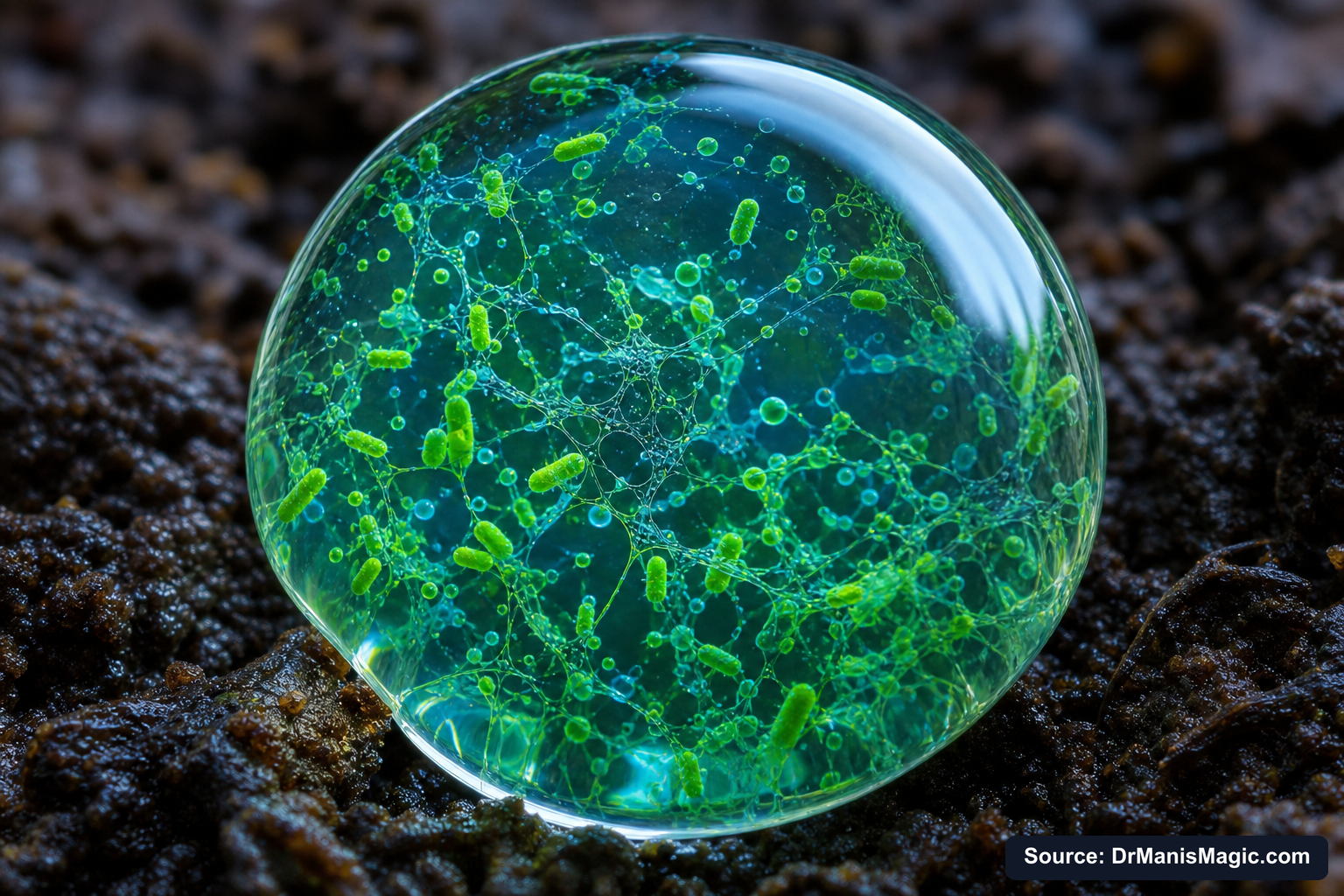
The soil food web is the full community of living things underground that keep plants healthy, fed, and protected. Think of it as a city beneath your feet. Bacteria are the factory workers. Fungi are the engineers and road builders. Protozoa and nematodes are the managers who keep everyone moving. Arthropods and earthworms are the heavy equipment. And the plant roots? They are the mayor. They call the shots by releasing sugars that attract the workers they need most.
Every single layer of this city does a job. Remove one layer and the whole system slows down. Remove several layers and the city collapses. That is exactly what happens in soil that has been hit with synthetic fertilizers, herbicides, and fungicides year after year. The city does not disappear overnight. It just gets quieter. Slower. Weaker. Until one day your plants look exhausted and you cannot figure out why.
University research from Penn State, University of Minnesota, Colorado State, and others all confirm the same thing: soil biology is the engine behind nutrient cycling, water movement, disease suppression, and root development. The microbes are not a nice bonus. They are the system itself.
Who Are the Bacteria, and What Do They Actually Do?
Bacteria are the fastest workers in the soil, and they are everywhere. A single teaspoon of healthy garden soil holds somewhere between 100 million and 1 billion bacteria. They are so small you could fit thousands across the width of one human hair. But do not let the size fool you.
Different bacteria do different jobs. Some break down dead plant material and turn it into forms your roots can absorb. Some pull nitrogen straight out of the air and lock it into the soil, nitrogen your plants desperately need to grow green and strong. Some dissolve minerals that are stuck in the soil in a form plants cannot use, unlocking phosphorus and other nutrients that would otherwise just sit there doing nothing. And some bacteria are fighters. They crowd out harmful pathogens, compete for space, and produce natural compounds that suppress disease.
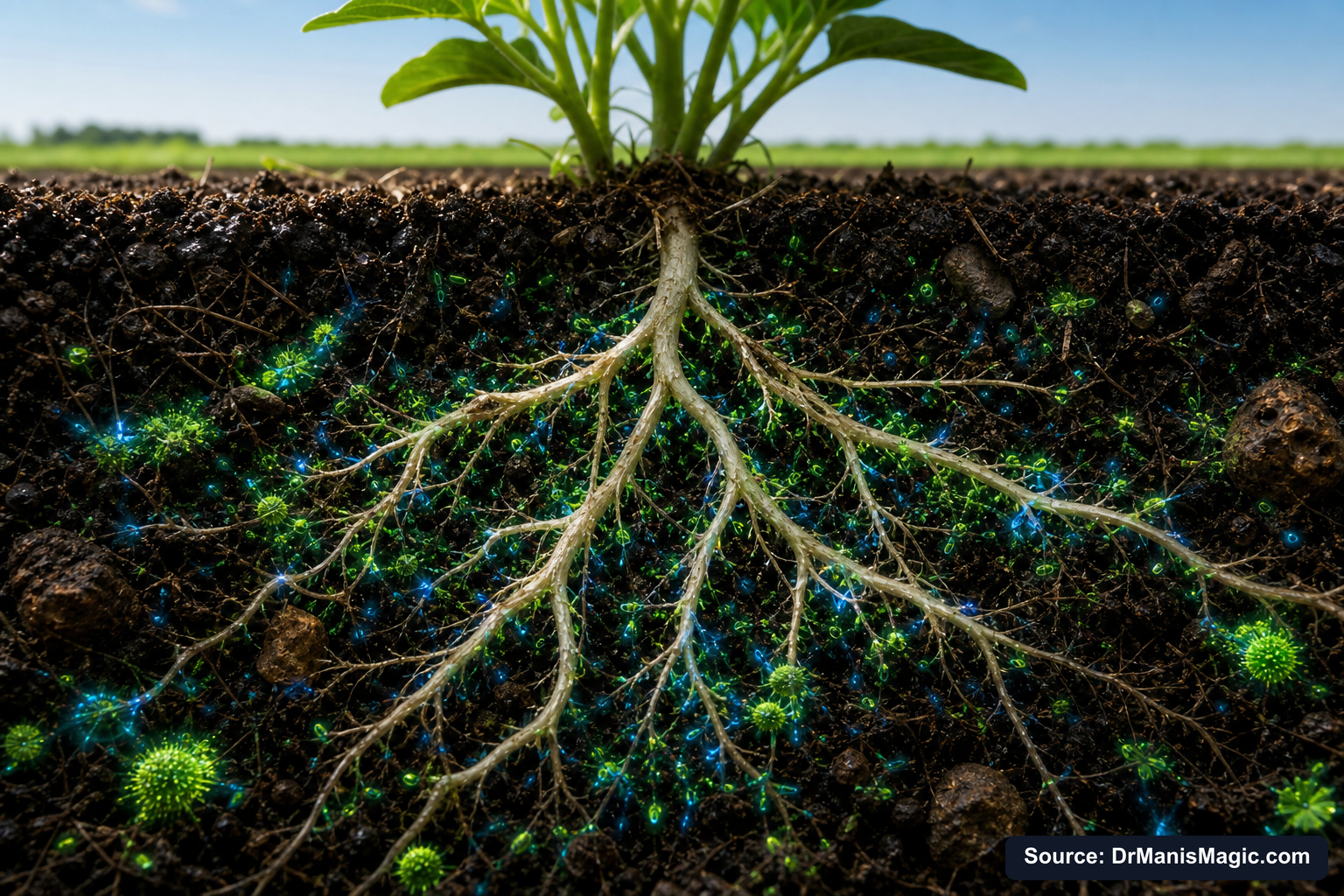
Bacteria concentrate most heavily in the rhizosphere. That is the thin zone of soil right around your roots. The plant feeds them sugars through its roots. In return, the bacteria deliver nutrients and protection. It is one of the most elegant partnerships in all of nature. And most gardeners have never heard of it.
What Do Fungi Do That Bacteria Cannot?
Fungi are the long-distance builders of the underground city. While bacteria tend to cluster close to roots, fungi send out thin threads called hyphae that travel far through the soil, sometimes many feet in every direction. Those threads form a web that connects the plant to nutrients and water far beyond where its roots could ever reach on their own.
The most important fungi for your garden are mycorrhizal fungi. The name comes from Greek words meaning fungus and root. That is exactly what they are: a fungus that fuses with the root to form one extended system. Pull a healthy weed out of the ground and look at the roots. See those fuzzy white threads clinging to them? That is mycorrhizae. That is why weeds grow so aggressively. They have a fungal partner extending their reach.
Mycorrhizal fungi increase the effective surface area of a root system dramatically. They bring in water during dry spells. They unlock phosphorus and other minerals. They improve the plant's ability to handle stress, whether from heat, salt, or drought. They also produce a sticky protein called glomalin that glues soil particles together into clumps called aggregates. Those clumps create the air pockets that roots need to breathe. Without glomalin, soil compacts. Roots suffocate. Plants fail.
Other fungi are decomposers. They break down tough materials like wood and bark that bacteria cannot easily process. They make those nutrients available to the rest of the food web. Every fallen leaf, every dead root, every piece of organic matter eventually passes through the fungal network on its way to becoming plant food.
Why Do Protozoa and Nematodes Matter If They Are Not Plants?
This is the part most garden articles skip entirely, and it is one of the most important pieces of the whole puzzle. Protozoa and beneficial nematodes are grazers. They eat bacteria and fungi. And when they do, something remarkable happens.
Bacteria and fungi store nutrients inside their bodies. Nitrogen especially. When a protozoan eats a bacterium, it absorbs some of what it needs and releases the rest as waste. That waste is plant-available nitrogen, right there in the root zone, right when the plant needs it. University of Minnesota research describes this as the grazing cycle, and it is one of the primary ways plants get fed in natural ecosystems.
Think about that for a moment. The plant does not need a bag of synthetic fertilizer dumped on it. It needs a living, breathing food web where bacteria and fungi grow, get eaten by protozoa and nematodes, and release nutrients as a byproduct. The plant gets fed, the workers multiply, and the cycle keeps going. All on its own. All for free.
Beneficial nematodes also hunt and kill soil-dwelling pests. Grubs. Fungus gnat larvae. Other harmful insects hiding underground. They are nature's pest control, already in the soil of a healthy garden, doing a job most gardeners pay expensive chemical companies to do poorly.
What Do Arthropods and Earthworms Add to the Mix?
Arthropods are the shredders. Tiny beetles, mites, springtails, and other small creatures chew up large pieces of organic matter and break them into smaller pieces. This gives bacteria and fungi a much bigger surface area to work on. More surface area means faster decomposition. Faster decomposition means more nutrients cycling through the system sooner.
Earthworms are the heavy equipment operators. They tunnel through soil, creating channels that let air and water move. They eat organic matter and bacteria, passing them through their bodies and leaving behind castings that are extraordinarily rich in plant-available nutrients. Earthworm castings have been called the world's best soil amendment, and they are produced for free by an animal that needs nothing from you except a living soil to eat.
No earthworms in your soil? That is a sign. Healthy, biologically active soil is full of them. Soil that has been hit hard with chemicals tends to be empty. Compacted. Silent. The heavy equipment left because there was nothing left to eat.
Can Soil Really Be Dead?
Yes. Soil can be functionally dead, meaning the biology that makes it work has been stripped away. And it happens more often than most gardeners realize.
Synthetic herbicides like glyphosate disrupt microbial communities in ways that are still being studied. Salt-based fertilizers, which are the foundation of almost every product sold at big box stores, damage beneficial bacteria because high salt concentrations pull water out of microbial cells through osmosis. The bacteria shrivel and die. Broad-spectrum pesticides kill indiscriminately. Synthetic fungicides wipe out beneficial fungi along with the harmful ones. Soil solarization, fumigation, flooding, and construction disturbance can sterilize a growing medium entirely.
Container potting mixes start out sterile by design. There are no microbes in the bag. None. That is why plants in containers so often struggle after the first flush of growth. The nutrients in the mix run out. There is no living biology to cycle more. The plant is on its own, and it starts to show.
After growing over 250,000 trees at our US Citrus Nursery in South Texas, we learned this lesson the hard way. When we started understanding the biology, we stopped seeing the same root problems, the same yellowing, the same slow decline that plagued trees grown in conventional media with conventional inputs. The biology changed everything.
How Do You Know If Your Soil Is Alive?
There are simple signs to look for. Healthy, biologically active soil smells earthy. Almost sweet. That smell comes from a compound called geosmin, produced by soil bacteria called actinomycetes. If your soil smells like nothing, or smells like chemicals, or smells sour and rotten, those are clues about what is or is not living there.
Healthy soil has structure. It clumps gently when you squeeze it and breaks apart without being dusty or sticky. That structure comes from glomalin produced by mycorrhizal fungi. Soil without fungal activity tends to be either powdery or compacted, neither of which lets roots breathe.
Earthworms are a fast indicator. Dig six inches down in a healthy garden bed. In a space the size of a shoebox, you should find at least a few earthworms. If you find none at all, the soil biology needs attention.
And look at your plant roots when you repot. White, firm roots with fuzzy threads attached are a healthy sign. Brown, mushy, bare roots with no biological activity around them are a sign the soil environment has broken down.
Does Salt Kill Soil Microbes?
Yes, and this is one of the most important things we want every gardener to understand. Most synthetic fertilizers are salt-based. That includes the big national brands that have been advertised since the 1950s. When you pour a salt-based fertilizer into your soil, you are not just feeding your plant. You are raising the salt concentration around your roots and in the microbial zone.
High salt pulls water out of bacterial and fungal cells through a process called osmotic stress. The cells dehydrate. Many die. The community shrinks. Nutrient cycling slows. Disease suppression weakens. And then, because the plant is no longer getting fed by a living soil, it becomes dependent on the next application of synthetic fertilizer. The cycle repeats. The soil gets weaker. The plant gets more fragile. The company sells more bags.
This is not a conspiracy theory. It is basic soil science. And it is why organic, slow-release fertilizers that work with biology instead of against it produce different long-term results. Salt-based inputs are a shortcut that costs you more over time. Not just money. Time. And time is the one thing you cannot get back.
Do Mycorrhizal Fungi Products Actually Work?
This is the question that most product pages are designed to avoid answering honestly. Here is the truth, and it is nuanced.
Mycorrhizal fungi can be genuinely helpful when the biology is missing. In sterile container media, in recently fumigated soil, in construction-disturbed ground, in soil that has been hammered with chemicals for years, introducing mycorrhizae gives the plant a partner it would not otherwise have. That matters. Extension research from Oklahoma State, Colorado State, Purdue, and others confirms that mycorrhizal partnerships can meaningfully improve water uptake, nutrient access, and stress tolerance when the fungi are the right species, alive, and matched to the host plant.
The problem is most products on the shelf do not deliver what they promise. Here is how the industry actually works.
| Microbial Product Type | How It Is Made | Are Microbes Alive at Application? | Does It Work? | Telltale Sign |
|---|---|---|---|---|
| Dry powder (lab-grown) | Bacteria brewed in vats, then dried into spores | Rarely. Spore reactivation is unreliable. | We tested dozens. Results were flat. | Comes as a powder or dusty granule |
| Rehydrated dry powder in liquid | Same lab-grown powder added to water | Low. Same reactivation problem. | Minimal at best. | Lists species and counts but no smell, no life |
| Compost tea (fresh, under 24 hours) | Brewed from compost, actively aerated | Moderate. Time-sensitive. | Good when fresh. Hard to maintain at home. | Earthy smell, used immediately |
| Compost tea (old, over 24 hours) | Same as above but gone anaerobic | Very low. Microbes dying or dead. | Poor. Some humic compounds remain. | Smells terrible. Sometimes fizzes. |
| Plant Super Boost (stabilized, full-spectrum) | Harvested from real compost, stabilized naturally | High. Visibly alive under a microscope. | Proven on 250,000+ trees. Smells earthy, not foul. | Earthy smell, no fizz, no stench |
The key issue with dried powders is simple. You cannot easily bring a dried organism back to full function in a strange new soil environment. It is like trying to revive a freeze-dried meal and expecting it to taste like a home-cooked dinner. The biology just does not work that way.
And the smelly liquid products? That smell is the scent of death. Anaerobic fermentation. The microbes ran out of oxygen, went into a dying cycle, and the liquid turned rancid. Some people see a small response from the humic compounds in these products, and they assume the microbes worked. The microbes were gone before the bottle even arrived.
What Makes Plant Super Boost Different From Everything Else on the Market?
Plant Super Boost is genuinely different because of how it is made and because the microbes inside it are genuinely alive when they reach your garden. The microbes are harvested from real, active compost, not grown in a factory vat and dried into powder. A world-renowned compostologist, someone who has advised royal families and governments on agricultural practices, developed an all-natural stabilization technique that keeps the full spectrum of microbes alive without letting them go anaerobic.
That is why it does not smell like sewage. That is why it does not fizz when you open it. And that is why you can put a drop under a microscope and actually watch the microbes moving. We have lab analyses that confirm it. We have tested it on our own trees, our own grove, our own houseplants and tropical trees in South Texas for years. And we have seen the results on over 250,000 trees at US Citrus Nursery.
Plant Super Boost contains over 2,000 strains of bacteria, 400 to 500 species of fungi including mycorrhizae, plus protozoa and nematodes. It is the full workforce, not just one or two species selected off a factory checklist. And it smells earthy. Like good soil. Because that is what it comes from.
Should You Buy Mycorrhizal or Microbial Products? Here Is the Honest Decision Framework.
Here is a plain-English guide to help you decide when biology products genuinely help and when you should focus on habitat first.
| Your Situation | Does Biology Inoculation Help? | Best Action |
|---|---|---|
| Sterile potting mix or container | Yes, strongly | Inoculate at planting and monthly after |
| Transplanting a high-value tree or plant | Yes | Apply at root zone during transplant |
| Soil recently hit with herbicides or fungicides | Yes | Inoculate repeatedly, add compost, reduce chemical use |
| New construction site or disturbed ground | Yes, strongly | Inoculate, mulch, plant cover crops, reduce compaction |
| Salt buildup from synthetic fertilizers | Yes, after flushing | Flush salts with water, switch to organic fertilizer, inoculate |
| Healthy, established native garden bed | Less urgent, but still beneficial | Focus on compost and organic inputs, inoculate seasonally |
| Using expired or smelly microbial products | No, those microbes are dead | Switch to genuinely live biology |
How Long Does It Take to Restore Dead or Damaged Soil?
Restoring soil biology takes time. There is no miracle spray that turns dead dirt into living soil overnight. But the process is faster than most people expect when you do the right things in the right order.
Here is a practical recovery plan we have used and recommended based on our nursery experience.
- Stop the damage first. Identify what has been harming the biology. Salt-based fertilizers, synthetic herbicides, broad-spectrum pesticides, synthetic fungicides. Eliminate or sharply reduce those inputs before anything else.
- Check your pH and salt levels. High salt or extreme pH locks out biology and nutrients. A simple soil test gives you a starting point.
- Flush accumulated salts. If you have been using synthetic fertilizers, a deep, slow watering will help push excess salts below the root zone.
- Add mature compost. Real, finished compost introduces organic matter and some biology. It feeds the microbes you are about to introduce.
- Inoculate with live, full-spectrum microbes. This is where a genuinely alive product makes a real difference. Apply monthly. Do not expect one application to do everything.
- Mulch the surface. Mulch holds moisture, moderates temperature, and feeds surface biology as it slowly breaks down. Bare soil dries out fast and loses microbes to UV exposure.
- Keep living roots in the ground. Roots feed the microbial community. The rhizosphere is where the magic concentrates. Cover crops, perennials, and groundcovers keep biology active between main plantings.
- Reduce tillage. Every time you till, you destroy fungal networks and disrupt the structure of the soil city. Till only when necessary.
- Switch to organic, slow-release fertilizer. Feed the plant and the soil together without burning the biology with salt.
- Be patient and consistent. Signs of improvement often show up within the first growing season. Full biological recovery in heavily damaged soil can take one to three years of consistent effort.
You will start to notice the signs. Earthworms returning. Soil structure improving. Roots looking healthier at repotting. Leaves getting a richer green. Fruit setting where it would not before. The city underground comes back to life one worker at a time.
What Are the Three Plant Pillars and Why Do They Matter for Every Gardener?
The Three Plant Pillars are the framework Dr. Mani Skaria developed over 40 years of working with plants in South Texas. He is a Professor Emeritus of Plant Pathology, the inventor of micro-budding, and the founder of the Clean Citrus Program in Texas. He did not develop the Three Pillars by reading about plants. He developed them by watching 250,000 trees respond to every possible input, every possible soil, every possible mistake.
The Three Pillars are simple. Every plant needs three things to thrive at the root level.
Pillar One: Mineral-Based Soil. Most potting mixes are made from bark, sawdust, and organic materials that break down over time. As they break down, they compact. They steal oxygen from roots. They become a breeding ground for root rot. Mineral-based soil made from silica-rich sandy loam does not break down. It maintains structure. Roots can breathe. Water drains. The environment stays stable for years, not months.
Pillar Two: Live Microbials. This is the invisible workforce. Bacteria, fungi, protozoa, nematodes, the full community described in this article. Without them, the soil is a chemistry problem. With them, it is a living system that solves problems on its own.
Pillar Three: Organic Fertilizer. Slow-release nutrients from natural sources like crab, kelp, and amino acids feed the plant gently and completely without burning the biology. No salt. No synthetic coatings. No toxins leaching into your yard, your water, or your family's barefoot grass.
When all three pillars are in place, the plant has what it needs at the root level. Everything above ground, the watering schedule, the pruning, the sunlight choices, becomes much more forgiving. The plant has a foundation. It becomes resilient. It stops barely surviving and starts genuinely thriving.
What Can You Do Right Now to Help Your Plants?
You do not have to overhaul everything today. Start with one honest step.
Look at what you are currently putting in your soil. Is it salt-based? Is it a synthetic fungicide? Is it a potting mix full of bark and sawdust that has been in the container for two or three years? Those are the things quietly working against you.
Then think about what is missing. Is there any living biology in that soil? Has it ever been inoculated with real, live microbes? Has it ever had a source of slow-release organic nutrition that does not burn the bacteria and fungi working alongside the roots?
The plants you are growing right now, whether it is a lemon tree on your patio, a rose in your garden bed, a lawn you want to walk barefoot on, or a vegetable plot you want to harvest from this season, all of them respond to the same laws. The laws of biology. The laws of nature. You cannot override those laws with a bag of blue crystals or a spray bottle of chemicals. You can only work with them or against them.
The number one thing people tell us they want, more than anything, is to see fruit on a tree they planted with their own hands. Not someday in a vague future. In their lifetime. In their backyard. That desire is ancient. It is wired into us. We were meant to tend a garden. And the heartbreak of watching that tree sit there, year after year, barely hanging on, is real. Time is the one thing you cannot buy back. The best time to start doing this right was ten years ago. The second best time is right now.
If you want to learn more about Plant Super Boost and how genuinely live, full-spectrum microbes can wake up the invisible workforce in your soil, visit drmanismagic.com. No hard sell. No pressure. Just the same honest information we share with every grower who walks through our nursery in South Texas. Your garden deserves a real foundation. And the invisible workforce beneath it deserves a real chance to do its job.
Frequent Asked Questions (FAQ)
Q1. What is the soil food web and why is it essential for healthy plant growth in home gardens?
The soil food web is the complete community of living organisms beneath the soil surface that work together to keep plants healthy, fed, and protected without synthetic inputs. It functions like an underground city where bacteria serve as factory workers breaking down organic matter and fixing atmospheric nitrogen, fungi act as engineers building extended root networks through thread-like hyphae, protozoa and beneficial nematodes act as managers that graze on bacteria and fungi and release plant-available nutrients as a byproduct, and arthropods and earthworms serve as heavy equipment operators that shred organic matter and create drainage channels. University research from Penn State, the University of Minnesota, and Colorado State University all confirm that soil biology is the primary engine behind nutrient cycling, water movement, disease suppression, and root development in every growing environment — meaning the invisible workforce underground is not a supplementary benefit but the fundamental system that makes plant nutrition and resilience possible.
Q2. Why do natural forests thrive without fertilizer or watering while home garden plants struggle?
Natural forests thrive without synthetic inputs because they maintain an intact, fully functioning soil food web that continuously cycles nutrients, manages water, suppresses disease, and extends root reach — the same biological system that is typically absent or severely degraded in home garden soil. In a healthy forest, bacteria fix nitrogen from the atmosphere and unlock bound soil minerals, mycorrhizal fungi extend root reach by many feet in every direction to access water and phosphorus, protozoa graze on bacteria and release plant-available nutrients directly in the root zone, and earthworms continuously create drainage channels and nutrient-rich castings. Home garden soil — particularly container potting mixes, which are sterile by design and contain no microbes at all, and soil that has been treated with salt-based synthetic fertilizers, synthetic herbicides, or broad-spectrum pesticides over multiple seasons — lacks this biological infrastructure entirely, leaving plants dependent on external chemical inputs that address symptoms rather than restoring the underlying living system the plant requires to thrive independently.
Q3. How do mycorrhizal fungi improve plant root systems and why are they critical for citrus and fruit trees?
Mycorrhizal fungi improve plant root systems by physically fusing with root tissue to form one extended biological system that increases the effective surface area of the root dramatically beyond what the plant could achieve alone. The fungal threads called hyphae travel many feet through soil in every direction, accessing water during dry periods, unlocking phosphorus and other minerals from soil particles, and improving the plant's capacity to tolerate heat, salt, and drought stress. Mycorrhizal fungi also produce a sticky protein called glomalin that binds soil particles into aggregates, creating the air pockets roots require for oxygen — without which compaction occurs and roots suffocate. For citrus and fruit trees specifically, mycorrhizal partnerships are critical because the fine feeder roots responsible for most nutrient absorption are concentrated in the top twelve inches of soil, and an extended fungal network multiplies the reach and efficiency of those feeder roots across a dramatically larger soil volume than the roots alone could access.
Q4. How do protozoa and beneficial nematodes feed plants without any fertilizer being applied?
Protozoa and beneficial nematodes feed plants through a biological mechanism called the grazing cycle, in which these organisms consume bacteria and fungi that have stored nutrients — particularly nitrogen — inside their cells, then release the excess as waste products directly into the root zone in a plant-available form. University of Minnesota research identifies this grazing cycle as one of the primary mechanisms through which plants receive nutrition in natural ecosystems, entirely without synthetic fertilizer input. When a protozoan consumes a bacterium, it absorbs what its own biology requires and excretes the remainder as plant-available nitrogen precisely where and when the plant needs it. This continuous, self-sustaining cycle operates as long as the soil food web remains intact — meaning a garden with thriving protozoa and beneficial nematode populations is receiving a constant, free supply of cycling nutrients produced entirely by the living biology underground, without any bags of fertilizer involved.
Q5. What are the signs that garden soil has dead or severely damaged biology and how can a gardener identify them?
Dead or severely damaged soil biology produces several observable signs that distinguish it from healthy, biologically active growing medium. Healthy soil smells earthy and almost sweet due to a compound called geosmin produced by actinomycetes bacteria — soil that smells like nothing, like chemicals, or sour and rotten indicates absent or dying microbial communities. Healthy soil has a crumbly, gently clumping structure created by glomalin produced by mycorrhizal fungi — soil that is either powdery or compacted without structure indicates absent fungal activity. Earthworm populations are a fast field indicator: digging six inches deep in a shoebox-sized area of healthy garden soil should reveal at least several earthworms, and finding none at all indicates the soil biology has been sufficiently degraded that the organisms supporting earthworm populations are no longer present. Plant roots at repotting tell the same story — white, firm roots with fuzzy thread-like attachments indicate healthy mycorrhizal colonization, while brown, mushy, bare roots with no biological activity indicate a collapsed soil environment.
Q6. Why do most commercial mycorrhizal and microbial fertilizer products fail to deliver results?
Most commercial mycorrhizal and microbial products fail because the organisms they contain are dead or non-viable by the time they reach the gardener's soil, either through the manufacturing process or through shelf degradation. Dry powder products are made by brewing bacteria in laboratory vats and then drying them into spores — spore reactivation in unfamiliar soil environments is unreliable, and independent testing of dozens of dried powder products has shown flat results. Rehydrated dry powder liquids carry the same fundamental reactivation problem despite appearing different. Liquid products that smell foul or rotten have gone anaerobic — the microbes have consumed available oxygen, entered a dying cycle, and the liquid has fermented, meaning the organisms are dead before the bottle is opened. Any response gardeners observe from these products is typically attributable to the humic compounds that remain rather than live microbial activity. The honest industry-wide problem is that genuinely live, full-spectrum soil biology is technically difficult and expensive to stabilize and deliver, so most products substitute spore counts and species lists for actual living organisms.
Q7. What makes genuinely live microbial products different from dried powder or smelly liquid alternatives?
Genuinely live microbial products differ from dried powders and liquid alternatives in their source material, stabilization method, and the verifiable biological activity of the organisms at the point of application. Rather than growing single selected strains in laboratory vats and drying them into spores, a genuinely live product harvests microbes from real, active compost — delivering the full spectrum of organisms including over 2,000 bacterial strains, 400 to 500 fungal species including mycorrhizae, plus protozoa and nematodes, rather than a narrow factory-selected list. Natural stabilization techniques maintain biological activity without allowing the anaerobic fermentation that produces foul-smelling, dying liquid products. A genuinely live product smells earthy rather than foul, does not fizz when opened, and contains microbes that are visibly active under a microscope — observable biological activity that dried powder and anaerobic liquid products cannot demonstrate. The full workforce rather than one or two selected species also means the complete soil food web community is being introduced rather than a single functional layer.
Q8. How do salt-based synthetic fertilizers kill beneficial soil microbes and create long-term soil dependency?
Salt-based synthetic fertilizers kill beneficial soil microbes through osmotic stress — the same mechanism by which they cause physiological drought in plant roots. When high salt concentrations enter the root zone from soluble synthetic fertilizer, the elevated osmotic pressure pulls water out of bacterial and fungal cells, dehydrating and killing them in the same way it pulls water out of root tip cells. As the microbial community shrinks, the nutrient cycling system that naturally converts organic matter into plant-available nutrition breaks down — protozoa have fewer bacteria to graze and release as plant-available nitrogen, mycorrhizal networks contract and stop extending root reach, and the disease-suppressive competition that healthy microbial populations provide against pathogens disappears. The plant then becomes entirely dependent on the next synthetic fertilizer application for nutrition, because the living system that would otherwise feed it continuously has been eliminated. Each subsequent application adds more salt, kills more microbes, and deepens the dependency — a cycle that benefits fertilizer sales while progressively degrading the soil's capacity to support plant life independently.
Q9. What is the step-by-step process for restoring dead or damaged garden soil biology?
Restoring damaged soil biology requires a sequenced approach that addresses the sources of biological damage before attempting to reintroduce living organisms, since introducing microbes into soil that still contains salt accumulation or active chemical inputs will simply kill the new biology. The recovery sequence begins with identifying and eliminating or sharply reducing all inputs damaging the biology — salt-based fertilizers, synthetic herbicides, broad-spectrum pesticides, and synthetic fungicides. A soil test to check pH and salt concentration provides the baseline for what needs correction. Deep, slow watering flushes accumulated salt below the root zone before new biology is introduced. Adding mature, finished compost provides both organic matter and some native biological diversity to support incoming microbes. Inoculating with genuinely live, full-spectrum microbes monthly — not as a single application — begins rebuilding the workforce. Surface mulch holds moisture, moderates temperature, and feeds surface biology as it breaks down. Maintaining living roots in the soil between main plantings, reducing tillage that destroys fungal networks, and switching to organic slow-release fertilizer complete the transition. Observable signs of recovery including earthworm return, improved soil structure, healthier roots at repotting, and richer leaf color typically appear within the first growing season, with full biological recovery in heavily damaged soil requiring one to three years of consistent practice.
Q10. What are the Three Plant Pillars and why does every plant from container citrus to lawn grass require all three?
The Three Plant Pillars are a root-level framework developed by Dr. Mani Skaria, Professor Emeritus of Plant Pathology at Texas A&M University-Kingsville, based on the results observed across more than 250,000 trees grown at a South Texas nursery. Every plant in every growing environment — container citrus, fruit trees, lawn grass, vegetable gardens, houseplants, and ornamental shrubs — requires all three pillars simultaneously because each addresses a distinct and non-substitutable root zone requirement. Pillar One is mineral-based soil made from silica-rich material that does not break down, compact, or steal oxygen from roots over time the way bark and sawdust-based potting mixes do, maintaining stable drainage and aeration for years. Pillar Two is live microbials — the full invisible workforce of bacteria, fungi, protozoa, and nematodes that cycle nutrients, suppress disease, extend root reach, and build soil structure. Pillar Three is organic fertilizer from sources such as crab shell, kelp, and amino acids that feeds both the plant and the microbial community slowly and continuously without salt damage. When all three pillars are in place, the root environment becomes stable and self-sustaining — making everything above ground including watering schedules, pruning decisions, and sun exposure significantly more forgiving because the plant has a functioning biological foundation rather than a chemistry-dependent life support system.


