


The Microbiology Behind Rotten-Fish Fertilizer Explained | Dr. Mani's Magic
The Microbiology Behind Rotten-Fish Fertilizer: How Dead Fish Become Living Plant Food
Picture this. You're standing in your backyard on a warm Saturday morning. You've got a bag of fish fertilizer in your hand. The smell hits you first. Sharp. Fishy. Almost wrong. You wonder for a second if something went bad. But you've heard this stuff works. You've read the forums. You've watched the videos. So you sprinkle it around your tomatoes, your lemon tree, your flower beds, and you wait.
Nothing seems to happen. Not right away. But something is happening. Under your feet. In the dark. In a world you can't see with your naked eye. Billions of microscopic creatures are waking up. They are eating. They are working. And if the conditions are right, they are turning that stinky fish into exactly what your plant's roots are hungry for. This is not magic. This is biology. And understanding it will change how you grow everything from your backyard citrus tree to the grass under your kids' feet.
But here's the twist most articles never tell you. Not all "fish fertilizer" is the same thing. Not all rot is good rot. And the smell coming from that bag is actually a clue about whether your soil life is about to thrive or about to suffer. Let's open this up and look at what's really going on underground.

Organic Fertilizer | Crab, Kelp & Amino Acids
Key Takeaways
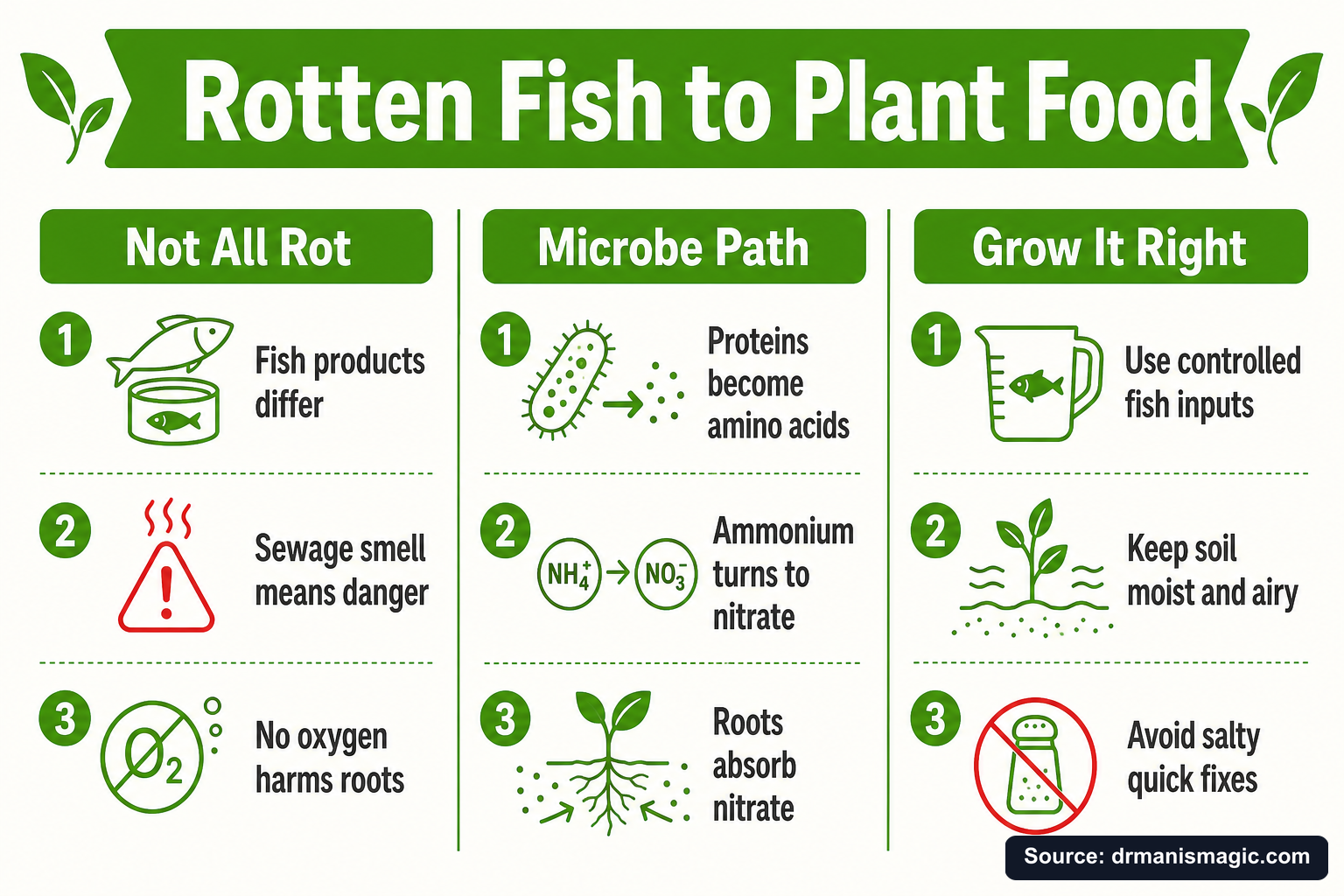
- Fish fertilizer works because soil microbes break down fish proteins into nitrogen, phosphorus, and other nutrients your plant can actually use.
- The real magic is a step-by-step process called mineralization: proteins become amino acids, amino acids release ammonium, and nitrifying bacteria convert that ammonium into nitrate for plant roots.
- Controlled fish hydrolysate and fish meal are very different from uncontrolled rotting fish scraps buried in your garden. The microbiology, the smell, and the safety are not the same.
- Salt-based synthetic fertilizers skip the biology entirely and feed the plant directly, but they also burn roots and kill the very microbes that make your soil work long-term.
- Oxygen matters. These microbial pathways only work well in aerated, moist soil. Waterlogged, anaerobic soil produces the wrong kind of breakdown and can hurt your plants.
- There is a cleaner, odor-free way to get all the amino acid nitrogen and biological benefit of fish-based inputs without the smell, the salt risk, or the contamination concerns.
- The Three Plant Pillars framework, developed at US Citrus Nursery after growing over 250,000 trees, gives you a complete system that makes all of this biology work for you automatically.
What Actually Happens When Fish Fertilizer Breaks Down in Soil?
Quick Answer: When fish fertilizer hits your soil, bacteria and fungi start breaking down fish proteins into amino acids. Those amino acids release ammonium. Then a second group of bacteria converts that ammonium into nitrate, which is the form of nitrogen your plant roots can actually absorb and use for growth.
Fish proteins are built from long chains of amino acids. Think of it like a pearl necklace. The whole necklace is the protein. Each pearl is an amino acid. Your plant cannot use the necklace. It needs the individual pearls.
So the first job falls to a group of soil bacteria called proteolytic bacteria. Their whole purpose is to break protein necklaces apart. They produce enzymes that chop those long chains into smaller peptides and then into individual amino acids. This process is called proteolysis. It happens fast when the soil is warm, moist, and full of oxygen.
Once you have free amino acids floating in the soil, a second step begins. This one is called ammonification. Bacteria strip the nitrogen-containing part off each amino acid and release it as ammonium (NH4+). Ammonium is the first form of nitrogen that starts to become useful. Plants can absorb some ammonium directly. But most plants prefer the next form even more.
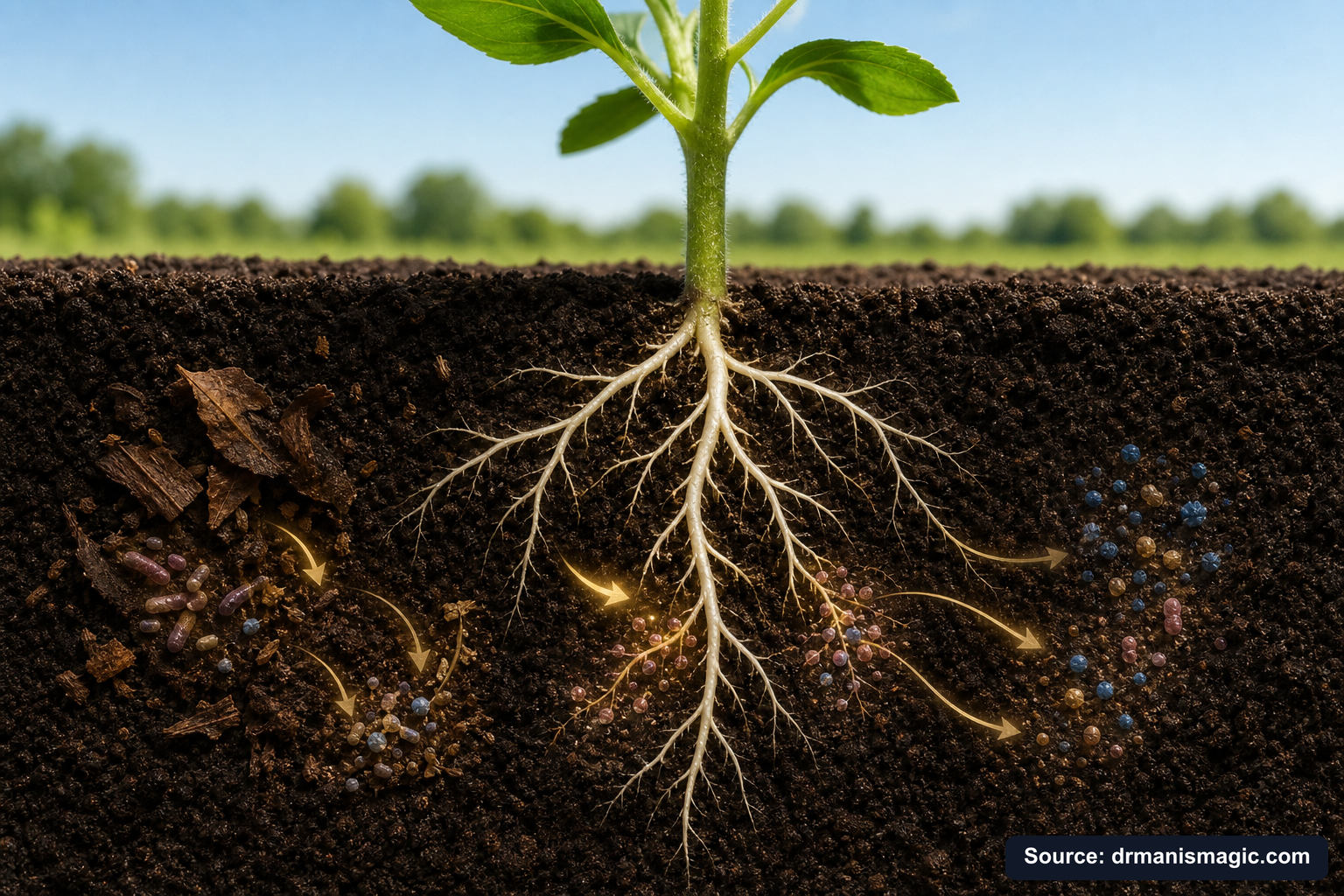
That is where nitrifying bacteria take over. In well-aerated soil with good oxygen flow, a bacterium called Nitrosomonas converts ammonium into nitrite. Then another group called Nitrobacter converts nitrite into nitrate (NO3-). Nitrate is highly mobile. It moves through soil water easily. Plant roots absorb it quickly. This whole journey, from fish protein to plant-ready nitrate, is called the nitrogen cycle. The USGS has mapped this cycle and shows how dependent it is on living organisms at every stage.
So when someone says fish fertilizer "feeds your plants," they are actually leaving out the most important part of the story. Fish fertilizer feeds your microbes first. The microbes do the converting. Then the plant gets to eat. This is not a shortcut. This is the whole point. And it is exactly why this approach builds lasting soil health instead of just a temporary green-up.
Here is the part that truly changes how you think about soil. When those microbes die, they release every nutrient stored inside their tiny bodies. Nitrogen, phosphorus, sulfur, trace minerals, all of it dumps right into the root zone. Scientists call this microbial biomass turnover. You can think of it as nature's time-release capsule. The microbes eat the fish, the plant feeds on the microbes, and the cycle keeps going. No plastic coating needed. No synthetic salt required. Just life feeding life.
Why Does Fish Fertilizer Smell So Bad, and Does That Mean It Is Working?
Quick Answer: The smell tells you what kind of breakdown is happening. A sharp, fishy ammonia smell usually means aerobic decomposition is underway, which is good. A deep sewage or rotten-egg smell means anaerobic (no-oxygen) breakdown is happening, which produces compounds that can actually harm your roots and drive away helpful microbes.
Smell is your nose's way of reading the invisible world. And in the world of fish fertilizer, your nose is a pretty good scientist.
When fish breaks down in the presence of oxygen, the dominant microbes are aerobic bacteria. These are the helpful kind. They produce some ammonia smell as they release ammonium from amino acids, but the overall process is relatively clean. The byproducts are nutrients. The soil stays healthy. This is what a quality fish-based fertilizer smells like when it is working correctly.
But when fish breaks down without oxygen, a completely different crowd of microbes takes over. Anaerobic bacteria produce sulfur compounds, amines, and other volatile chemicals that smell like raw sewage, rotten eggs, or death. These compounds are not just unpleasant. Some of them are actually toxic to plant roots at high concentrations. They can also create conditions that favor root rot pathogens like Pythium and Phytophthora, two of the most destructive root diseases in gardening.
This is the core reason why burying raw fish scraps in your garden is a gamble. In the right conditions, with good drainage and aeration, it can work beautifully. In waterlogged, compacted, poorly drained soil, you are creating an anaerobic pocket that generates the wrong kind of chemistry around your roots.
It is also why we spent years at US Citrus Nursery developing a fertilizer that captures all the biological benefit of amino acid nitrogen without any of the smell or the anaerobic risk. More on that in a moment. But first, let's look at the actual pathway from fish to plant and why every step depends on oxygen.
What Is the Difference Between Fish Emulsion, Fish Hydrolysate, and Buried Fish Scraps?
Quick Answer: Fish emulsion is heat-processed and loses many beneficial compounds. Fish hydrolysate is cold-processed and keeps amino acids, oils, and growth factors intact. Buried fish scraps depend entirely on your soil conditions. These three things have very different smells, safety profiles, speeds, and effects on soil biology.
Most gardeners treat all fish-based inputs like they are the same thing. They are not. The processing method changes everything about how a product behaves in your soil.
Fish emulsion is made by cooking fish at high heat, removing most of the oils, and concentrating the liquid. The heat destroys many of the amino acids and biological compounds that make fish inputs so valuable. What you are left with is a fast-acting nitrogen source that still smells strongly but has lost much of its biological feeding value. It is better than synthetic salt fertilizer, but it is not the most you can get from fish.
Fish hydrolysate is made through cold processing, using enzymes or mild acid to break down fish proteins without heat. This preserves the amino acids, the omega oils, and many of the biostimulant compounds that are present in fresh fish. Cold-processed hydrolysate is the most biologically active form of liquid fish fertilizer. It feeds the soil microbes with a richer substrate and tends to produce more sustained results. According to research from the University of Georgia Extension, organic nitrogen sources like hydrolysate improve both nitrogen availability and long-term soil biology when applied to biologically active soil.
Buried fish scraps are the oldest method on Earth. Native American farmers buried a fish with every corn seed they planted. In the right soil, this works remarkably well. The fish decomposes over weeks, releasing nutrients slowly as soil microbes do their work. But in compacted, waterlogged, or low-oxygen soil, the same buried fish can create anaerobic pockets, attract pests, and generate the wrong kind of microbial activity.
Here is the comparison table you need to make a smart decision.
| Fish Input Type | Odor Level | Speed of Release | Amino Acid Preservation | Microbial Feeding Value | Salt Risk | Pest / Pathogen Risk | Best Use |
|---|---|---|---|---|---|---|---|
| Fish Emulsion (heat-processed) | Strong / fishy | Moderate-fast | Low (heat destroys many) | Moderate | Low-moderate | Low if diluted | Quick nitrogen boost for outdoor gardens |
| Fish Hydrolysate (cold-processed) | Moderate / fishy | Moderate | High (preserved by enzymes) | High | Low | Low if diluted | Soil biology feeding, root zone drench |
| Fish Meal (dried, granular) | Moderate when wet | Slow | Moderate | High | Low | Low | Long-season soil amendment, top-dress |
| Fish Bone Meal | Low-moderate | Very slow | Low (mostly mineral) | Low-moderate | Low | Low | Phosphorus and calcium source |
| Buried Fish Scraps | Very strong | Variable (weeks) | Moderate (if aerobic) | High (if aerobic) | Low | High (pests, anaerobic rot risk) | In-ground planting only, good drainage required |
| Homemade Fermented Fish Amino Acid | Very strong | Moderate | High (if made correctly) | High | Low | Moderate (contamination risk if made poorly) | DIY soil drench, experienced growers only |
| Crab / Shrimp Meal (chitin-based) | Low-moderate | Slow | Moderate | Very High (chitin activates biology) | Low | Very Low (chitin suppresses pathogens) | Soil biology activation, disease suppression, all plant types |
Why Does Oxygen Matter So Much in Fish Fertilizer Decomposition?
Quick Answer: The helpful bacteria that convert fish proteins into plant-available nitrogen need oxygen to do their job. Without oxygen, different bacteria take over and produce toxic compounds instead of nutrients. This is why waterlogged, compacted soil turns fish fertilizer into a problem instead of a solution.
Oxygen is the invisible ingredient that most gardening guides skip right over. But it is the single biggest factor in whether your fish fertilizer creates nutrients or creates problems.
Think about it this way. Your soil is not just dirt. It is a city. A living city with billions of residents. Some of those residents are aerobic. They need oxygen like you do. These are the good guys. They eat fish proteins, they release nutrients, they build healthy soil structure, and they protect roots from disease.
Some soil residents are anaerobic. They thrive where there is no oxygen. Waterlogged corners. Compacted layers. The bottom of a pot that never drains. These bacteria are not bad in small numbers. But when they take over, they produce compounds like hydrogen sulfide, butyric acid, and various amines. These compounds smell awful. They can acidify the soil in harmful ways. And they create the exact conditions that disease-causing organisms like Pythium and Phytophthora love.
This is why the first of our Three Plant Pillars is mineral-based soil. Not bark. Not sawdust. Not peat moss that compresses over time. Mineral-based, permanently structured soil that keeps oxygen flowing to the root zone at all times. When oxygen gets to the roots, the aerobic microbes thrive. When aerobic microbes thrive, fish-based organic inputs work the way they are supposed to. The whole system depends on this foundation.
We learned this the hard way at our South Texas nursery. After growing over 250,000 citrus trees, we saw exactly what happens when organic inputs meet poorly aerated soil. The roots suffer. The plant yellows. The grower blames the fertilizer. But the real problem was the oxygen, not the fish.
How Do Salt-Based Synthetic Fertilizers Compare to Fish-Based Organic Inputs?
Quick Answer: Synthetic fertilizers are made from salts that dissolve fast and deliver nitrogen directly to plant roots, bypassing soil biology entirely. This creates a quick green-up but burns roots, kills beneficial microbes, and leaves your soil more dependent on chemicals over time. Organic fish-based inputs do the opposite: they feed the biology first, and the biology feeds the plant.
This is the comparison that changes how you see fertilizer forever.
Walk into any big box store. Grab a bag of the most popular synthetic fertilizer on the shelf. Look at the label. That product is a salt. Not table salt, but chemically, it behaves the same way. When you dissolve it in water or apply it to wet soil, it creates a high-salt environment around your plant's roots.
Here is what high salt does to a root. It reverses osmosis. Instead of water flowing from the soil into the root, water flows from the root into the soil. The root literally dries out from the inside. Scientists call this osmotic stress. Growers call it fertilizer burn. Your plant calls it pain. The leaves scorch at the edges. The roots shrivel. The plant looks like it is thirsty even when the soil is moist. This is sometimes called physiological drought, because the plant is drought-stressed even when water is present.
Now here is the part the fertilizer companies hope you do not connect. Those same salts that burn roots also kill your soil microbes. The beneficial bacteria and fungi that convert organic matter into plant food, that protect roots from pathogens, that build long-term soil health, they are wiped out by high salt concentrations. And when the microbes die, the soil becomes dead chemistry. It cannot heal itself. It cannot buffer stress. It cannot protect your plants. So you need more fertilizer. More salt. More damage. The cycle continues.
Fish-based organic inputs work in the opposite direction. They do not dissolve instantly. They do not create a salt spike. They arrive as complex proteins and biological compounds that soil microbes recognize and begin consuming. The salt index of a quality organic input is a fraction of a synthetic fertilizer's salt index. This means no osmotic shock. No root burn. No microbial massacre.
See also: The Hidden Reason Synthetic Fertilizers Cause Root Rot
| Feature | Synthetic Fast-Release (Salt-Based) | Synthetic Slow-Release (Coated) | Organic Fish / Crab / Kelp-Based |
|---|---|---|---|
| Nitrogen Form | Soluble salts (immediate) | Coated soluble salts (timed) | Protein-bound, amino acid nitrogen |
| Salt Index | Very High | Moderate-High | Very Low |
| Root Burn Risk | High | Moderate | Very Low |
| Effect on Soil Microbes | Kills beneficial microbes | Damages microbes over time | Feeds and multiplies microbes |
| Plastic / Residue Risk | Low | High (plastic coating shells remain in soil) | None |
| PFAS / Biosludge Risk | Some products use biosludge fillers | Some products use biosludge fillers | Zero PFAS, Zero Biosludge (clean-source organic) |
| Long-Term Soil Health | Degrades over time | Degrades over time | Improves over time |
| Speed of Nutrient Delivery | Very Fast | Moderate | Slow and steady (mirrors nature) |
| Works With Soil Biology | No (bypasses biology) | Partially | Yes (biology-first system) |
We have tested this across more than 250,000 trees at US Citrus Nursery. The trees grown on salt-based programs show faster initial growth and then a plateau, followed by increasing sensitivity to disease, root issues, and stress. The trees grown on biology-first, organic programs start a little slower, but they accelerate. They thicken. They resist disease. They produce more fruit over more years. Time always reveals the truth.
See also: How Salt-Based Feeding Quietly Destroys Root Systems
You Never Had a Brown Thumb.
You were handed the wrong tools. This free guide hands you the right ones.
You watered it. You fed it. It died anyway.
It was never you. It was the dirt, the salt food, and the bad advice.
This guide shows you what really went wrong, and how to fix it for good.
- Why your plants really died, and why it was never your fault
- The salt hiding in your plant food that quietly burns the roots
- The hidden killer in almost every bag of store soil
- The tiny helpers that grow a whole forest for free
- The rescue trick that brings a half dead plant back to life

What Is the Real Risk of PFAS and Biosludge in Fish and Organic Fertilizers?
Quick Answer: Some fertilizers labeled "organic" are actually made from treated municipal sewage waste, called biosludge. This waste can contain PFAS, which are man-made chemicals that do not break down in soil, water, or your body. These are sometimes called "forever chemicals." A clean organic fertilizer uses food-grade or marine-sourced ingredients, not municipal waste.
This is the part of the organic fertilizer conversation that almost nobody talks about. And it matters a lot if you are growing food, or if you have children and pets in your garden.
When companies say "organic fertilizer," many people picture something pure and natural. Compost. Seaweed. Fish. But some of the most widely used "organic" fertilizers on the market are made from biosolids. That is the polite name for treated municipal sewage sludge. Human waste, industrial runoff, and pharmaceutical residues all pass through municipal water treatment. The solid waste that comes out is processed and often sold as fertilizer filler.
Research from multiple university labs has detected PFAS compounds in biosolid-based fertilizers. PFAS stands for per- and polyfluoroalkyl substances. These are synthetic chemicals used in non-stick coatings, firefighting foam, and hundreds of industrial applications. They are called forever chemicals because they do not break down. They accumulate in soil. They leach into groundwater. They build up in living tissue.
You can walk barefoot on your lawn, pick fruit from your tree, or let your dog run through your garden, and you should be able to do that without worry. That is exactly the kind of safety we build toward at Dr. Mani's Magic. Our Crab, Kelp & Amino Acids fertilizer contains zero biosludge, zero PFAS, and zero synthetic salts. Every ingredient is sourced from food-grade and marine origins. Crab shells. Cold-processed kelp. Amino acids from clean animal sources. Volcanic ash for trace minerals. That is the complete input list.
When you are evaluating any fish or organic fertilizer, the question to ask is simple: where did this nitrogen actually come from? If the label says "processed sewage biosolids" or the company cannot tell you the source, that is your answer.
What Does Chitin From Crab Shells Actually Do for Your Soil Biology?
Quick Answer: Chitin is a natural fiber found in crab shells, shrimp shells, and insect exoskeletons. When it enters your soil, specific bacteria and fungi start producing chitinase enzymes to break it down. This same enzyme happens to destroy the outer shell of many soil-dwelling pest larvae and fungal pathogens, giving your plants a natural defense system without any chemical sprays.
This is one of the most underappreciated mechanisms in all of organic growing. And it is one of the main reasons we built crab shell meal into our fertilizer formulation.
Chitin is structurally similar to the outer shell of many soil-dwelling insects and root pathogens. When chitin-eating bacteria and fungi multiply in your soil, their population explosion creates a standing army of chitinase enzyme production. That enzyme does not just break down the fertilizer ingredient. It attacks the same material found in the protective coating of fungal pathogens and pest larvae living near your roots.
Think of it this way. Imagine you fed a guard dog a diet that made it specifically aggressive toward burglars wearing one particular type of jacket. Every burglar in that jacket who came near your house would be immediately neutralized. That is roughly what happens in your root zone when chitin-feeding biology builds up. The same microbes that eat your fertilizer also dismantle the protective structure of your plant's enemies.
This is why crab meal has a long history in organic farming as a tool for suppressing root-knot nematodes and soilborne fungal disease. It is not a pesticide. It is a biological signal that shifts the entire microbial community in your soil toward a more protective state. Combined with live microbials from Plant Super Boost, the effect compounds dramatically.
What Do Kelp and Amino Acids Contribute That Fish Protein Alone Cannot?
Quick Answer: Kelp brings natural plant growth hormones called auxins and cytokinins, plus dozens of trace minerals and carbohydrates that feed soil biology. Amino acids provide pre-built nitrogen that both microbes and plant roots can absorb directly, bypassing several steps in the normal nitrogen cycle. Together they create faster root development, stronger flowering, and better fruit quality than nitrogen alone.
Fish is great. But fish alone is mostly a nitrogen source. To grow a complete, resilient plant, you need the full orchestra, not just one instrument.
Kelp is harvested from the ocean and cold-processed to preserve the biological compounds inside. One of the most important groups are auxins and cytokinins. These are natural plant hormones that regulate root branching, cell division, and shoot elongation. When you apply kelp to your soil, you are essentially sending a hormonal signal to your plant's roots to grow more aggressively, branch more widely, and develop more surface area for nutrient absorption. More root surface means more eating. More eating means faster growth and better fruiting.
Kelp also brings a spectrum of trace minerals from the ocean that most land-based soils are increasingly depleted of. Zinc, boron, manganese, iodine, and dozens of other micronutrients arrive in forms that soil microbes can immediately process and pass along to plant roots. This is why kelp-fed plants often show improved color and vigor even when the macronutrient numbers look similar to a synthetic program.
Amino acids take this even further. When amino acid nitrogen arrives in your soil, something interesting happens. Some of it gets consumed by microbes immediately. Some of it is taken up directly through plant roots, bypassing the normal protein-to-ammonium-to-nitrate pathway entirely. Plant roots have specific transporters for certain amino acids. When those transporters are active, the plant is getting nitrogen in the most efficient form possible. Less energy spent. Faster incorporation. More growth with less input.
This is the philosophy behind our Crab, Kelp & Amino Acids formulation. It is not designed to push one nutrient fast. It is designed to nourish the entire biological system, from the microbes in the soil to the hormonal signaling in the roots to the trace mineral balance in the leaves. Everything working together, the way nature designed it.
When Does Fish Fertilizer Go Wrong? A Troubleshooting Guide
Quick Answer: Fish fertilizer goes wrong when it is applied to waterlogged, anaerobic, or cold soil where the right microbes cannot work. It also goes wrong when overused in containers where there is no microbial population large enough to process it quickly. Knowing the warning signs lets you fix the problem before your plant suffers.
Even a good input can cause problems in the wrong conditions. Here is how to recognize what is going wrong and what to do about it.
The table below compares three conditions that look similar but have different causes and different solutions.
| Symptom | Salt / Fertilizer Burn | Overwatering | True Root Rot (Pythium / Phytophthora) |
|---|---|---|---|
| Leaf Appearance | Brown, scorched edges; crispy tips | Yellow, limp, pale overall | Yellow, wilting even in moist soil |
| Root Appearance | Brown, dry, shrunken fine roots | Brown, soft, mushy roots | Black, slimy, foul-smelling roots |
| Soil Smell | Normal or slightly chemical | Slightly sour | Strong sulfur, sewage, or rotting smell |
| Soil Condition | May look normal; white crust on surface | Stays wet for days | Wet, compacted, poor drainage |
| Primary Cause | Osmotic stress from high salt index | Insufficient oxygen from excess water | Anaerobic conditions plus pathogen activity |
| First Fix | Flush soil with clean water; switch to organic input | Improve drainage; reduce watering frequency | Repot with mineral-based soil; apply beneficial microbes; remove dead roots |
If your plant is showing any of these symptoms after applying fish fertilizer, here is a simple recovery checklist.
- Stop all fertilizer applications immediately. Give the soil a chance to reset.
- Check your drainage. Lift the pot or dig near the roots. If water pools, your soil structure is the problem. See also: Why Most Fertilizers Are Actually Salt in Disguise
- If you suspect salt buildup, flush the soil with two to three times the pot volume of plain clean water over several hours.
- Check the roots. Trim any black, slimy, or foul-smelling roots with clean scissors. Healthy roots are white or light tan and firm.
- If root rot is present, repot into fresh mineral-based soil with good drainage and aeration. Bark-heavy potting mixes hold too much moisture and compress over time.
- Apply live beneficial microbes as a soil drench to reintroduce the biology that protects against Pythium and Phytophthora.
- Resume feeding only after the plant shows new green growth. Start at half the normal rate and build up gradually.
How Does the Three Plant Pillars System Use All of This Biology Together?
Quick Answer: The Three Plant Pillars system combines mineral-based soil for oxygen flow, live microbials for biological activity, and organic slow-release fertilizer for clean nutrition. Each pillar supports the others. The soil keeps microbes alive, the microbes convert organic inputs into plant food, and the organic inputs keep feeding the microbes. It is a self-reinforcing cycle that gets stronger every season.
Here is the thing about fish fertilizer, crab meal, kelp, and amino acids. They are not products. They are tools. And tools only work when the underlying system is set up correctly.
Dr. Mani Skaria spent 35 years as a plant pathology professor at the Texas A&M Citrus Center before developing the Three Plant Pillars framework. He watched chemical companies push salt-based programs for decades. He watched growers spend more and more money and get less and less results. And he went back to first principles. What does a plant actually need? What does a root zone actually need? What does soil biology actually need to thrive?
The answer was always the same three things. Structure. Life. Nutrition.
Structure means mineral-based soil that drains perfectly, never compacts, never robs oxygen from roots, and never breaks down into root-choking sludge. This is Pillar One. Without it, the microbes cannot breathe. Without oxygen, you get anaerobic breakdown. You get the wrong smell. You get root rot. You get the exact failure mode of uncontrolled rotten fish in waterlogged soil.
Life means a living population of bacteria, fungi, and mycorrhizae in the root zone at all times. This is Pillar Two. These organisms are the ones doing the mineralization work we described earlier. They break down the fish proteins. They run the nitrogen cycle. They produce chitinase enzymes against pathogens. They are the engine that makes everything else work. Without them, even the best organic fertilizer just sits there.
Nutrition means clean, biology-friendly organic inputs that feed the microbes first and the plant second through the slow, natural release process. This is Pillar Three. This is where fish-derived amino acids, crab chitin, kelp hormones and trace minerals, and volcanic ash all come together. Not as a spray-and-pray chemical fix. As food for a living system.
We have tested this system on over 250,000 trees. On citrus, tropical trees, houseplants, vegetables, and flowers. On container plants and in-ground orchards. The results are consistent. When all three pillars are in place, plants become nearly bulletproof. They resist disease. They produce more abundantly. They do not need emergency interventions. They just grow.
And here is the time truth that we share with every grower who asks us about this. You can get money back. You cannot get time back. Every season spent on a salt-based program that slowly destroys your soil biology is a season you will never recover. Every year your tree spends in bark-heavy potting mix that is slowly compressing and starving the roots of oxygen is a year of growth you lost forever. The number one thing people tell us they want is to see fruit on their own tree while they still have the health and the years to enjoy it. That is not a small desire. That is a deeply human one. And it is exactly what the Three Plant Pillars system is designed to deliver, not someday, but as fast as nature allows when you stop fighting it and start working with it.
You can read our full Free Plant Care Field Guide to see exactly how these three pillars work together for every type of plant, from grass to fruit trees to houseplants.

What Is the Cleanest, Odor-Free Alternative That Captures All the Benefits of Fish-Based Nutrition?
Quick Answer: A granular organic fertilizer built from crab shell meal, cold-processed kelp, and amino acid nitrogen delivers everything fish fertilizer does, without the strong odor, the anaerobic risk, or the PFAS and biosludge contamination concerns. It feeds the same microbial pathways, releases nitrogen at the same slow-and-steady pace, and adds biological benefits that fish emulsion alone cannot provide.
If you have ever tried fish emulsion on an indoor plant and had your whole room smell like the inside of a bait shop for three days, you already know the problem. If you have read the forums where pet owners describe their dogs rolling in, or worse eating, the freshly fertilized garden, you know the problem too.
The smell is not just unpleasant. It is a sign that volatile ammonia and amines are escaping into the air instead of staying in the soil where they can do good. Every molecule of nitrogen that escapes as smell is a molecule that never made it to your plant's roots.
A stabilized, granular formulation based on crab meal, kelp, and amino acids solves this entirely. The nitrogen is bound in protein and chitin structures that microbes break down at a controlled pace. There is no sudden release of volatile compounds. There is no sewage smell. There is no reason your garden cannot smell like soil after rain instead of a fish market.
This is the reasoning behind how we formulated our own fertilizer at Dr. Mani's Magic. We needed something we could use in our nursery every single day, on thousands of plants, without our team being driven out of the greenhouse by the smell. We needed something safe for the families who receive our trees and use our products at home. We needed something that would not introduce PFAS or biosludge into the food they grow for their children.
And we needed it to work as well as or better than anything else on the market, because we had 250,000 trees and our own reputation on the line.
If you want to experience what biology-first, clean-input nutrition feels like in your garden, your lawn, your flower beds, or your fruit trees, the system starts with our Three Plant Pillars bundle and the philosophy behind it. The science is not complicated once you see it clearly. Healthy microbes plus oxygen plus clean nutrition equals thriving plants. Every time. For every plant type. In every season.
That is not a promise we make lightly. It is one we back with a 30-day money-back guarantee. If your plants are not responding within 30 days, we will refund you. No arguments. No runaround. Real people, real answers, real accountability.
If you want to start simple, explore the Free Plant Care Field Guide and see exactly what to do first, second, and third to get your soil biology working for you. Your plants have been waiting for this. And so have you.
Frequently Asked Questions
Fish fertilizer sounds simple. You put it on your plants and wait. But what is actually happening in your soil? And is all fish fertilizer created equal? These are the questions that separate gardeners who get real results from gardeners who keep starting over. Here is what Dr. Mani learned after 35 years of growing plants and testing over 250,000 citrus trees in South Texas.
Do fish carcasses actually make good fertilizer for garden plants?
Yes, but only when the biology works in your favor. Dead fish are packed with nitrogen, phosphorus, and trace minerals. The problem is uncontrolled burial. Bury fish too shallow and you attract pests. Bury too much in one spot and you burn roots with a sudden nitrogen spike. The real power is not in the fish itself. It is in the soil microbes that break it down. No microbes, no results. That is Pillar Two of the Three Plant Pillars.
Why does fish fertilizer smell so bad and is that a warning sign?
That rotten smell is a clue. It tells you anaerobic bacteria are doing the breaking down, not the beneficial aerobic microbes your plant roots actually need. Anaerobic breakdown produces ammonia and sulfur compounds. That is the stink. It also means the soil is oxygen-starved. Healthy soil smells earthy, not fishy or sour. If your fertilizer smells like something died, your soil biology may be heading in the wrong direction.
Which plants should not get fish fertilizer?
Onions, garlic, carrots, and radishes do not respond well. High nitrogen from fish emulsion pushes leafy top growth and stunts the bulbs and roots you actually want to harvest. Lettuce and spinach bolt fast and turn bitter. Indoor houseplants are a bad match too because fish emulsion can linger indoors for days and over-fertilize slow-growing plants. For all of these, a slow-release organic fertilizer like Dr. Mani's Crab, Kelp, and Amino Acids formula is a much cleaner fit.
What is the cleanest way to get fish-based amino acid benefits without the smell?
This is exactly what Dr. Mani solved. His Crab, Kelp, and Amino Acids fertilizer delivers the same slow-release nitrogen and trace mineral benefits you get from fish-based inputs, but without the rotting smell. It uses stabilized organic sources including crab and kelp meal plus amino acids. It does not go anaerobic. It does not stink up your garden or your indoor space. It feeds your soil microbes the clean way, which is what Pillar Three of the Three Plant Pillars is all about.
What do traditional farmers use instead of synthetic fertilizer?
Traditional and Amish farmers have always leaned on animal manure, cover crops, wood ash, and compost to feed their soil. These methods work because they feed the soil's living biology first, not the plant directly. That is the same principle behind the Three Plant Pillars. The goal is a living, breathing soil ecosystem. When your microbes are thriving, they unlock nutrients naturally. Dr. Mani proved this across 250,000 trees at US Citrus Nursery in South Texas.
Is synthetic fertilizer like urea actually feeding your plants or hurting them long-term?
Urea and other salt-based synthetic fertilizers deliver nitrogen fast. That is why they are popular. But they are also salt bombs. They burn roots. They wipe out the beneficial bacteria and fungi in your soil. Over time, your soil becomes dependent on more and more synthetic input while producing less and less on its own. You spend more money, lose more time, and your plants get weaker. That is the cycle Dr. Mani spent decades helping gardeners break free from.
How do you use fish scraps as fertilizer without attracting pests or burning your plants?
Bury fish scraps at least 12 inches deep, well away from young roots. This slows decomposition and keeps the smell underground so animals do not dig it up. You can also ferment scraps into a liquid, dilute it heavily, and water the soil around the base of the plant. Never spray it on leaves or fruit. The safer, simpler option is a pre-formulated organic fertilizer like Dr. Mani's Crab, Kelp, and Amino Acids blend, which gives you the same nutrients with zero guesswork and no odor.
About the Author
Dr. Mani Skaria, PhD
Dr. Mani Skaria, PhD, is a plant pathologist and the scientific founder of Dr. Mani's Magic. He spent 48 years studying how plants, soil, and living microbes work together, including his years as Professor Emeritus at Texas A&M and as a member of the USDA NAREEE Advisory Board. He invented micro-budding, a method for growing healthier, stronger trees, and has grown more than 250,000 trees on the family farm in Hargill, Texas - US Citrus Nursery. His life's work takes real lab science and turns it into simple, safe, organic plant care anyone can use at home.


