


Why Odor Often Means Unstable Compounds in Soil and Fertilizer | Dr. Mani's Magic
Why Odor Often Means Unstable Compounds — And What Every Gardener's Nose Is Really Telling Them
You're out in the backyard on a warm Saturday morning, coffee in hand, ready to do something good. You rip open a bag of compost. Or maybe you scoop out a cup of that granular fertilizer you grabbed at the big box store. And then it hits you. That smell. Sharp, eye-watering, almost like a public restroom. Or rotten eggs. Or sour milk left in the sun.
Your gut says something is wrong. And your gut is right.
Here's something almost nobody in the gardening world will tell you straight: that smell is chemistry talking. It is your nose detecting molecules that have escaped into the air — molecules that were supposed to stay in the soil and feed your plants. When nutrients escape into the air as gas, they are gone. They are not feeding your roots. They are not building your fruit. They are wafting past your nose and disappearing into the sky. And if those same unstable compounds reach your roots before they escape? They can burn them. Kill beneficial microbes. Start a chain reaction that leads to root rot, yellowing leaves, and a plant that slowly gives up on you. That smell is a warning. And once you learn to read it, you will never look at a bag of fertilizer or a pile of compost the same way again.

Plant Super Boost
Key Takeaways
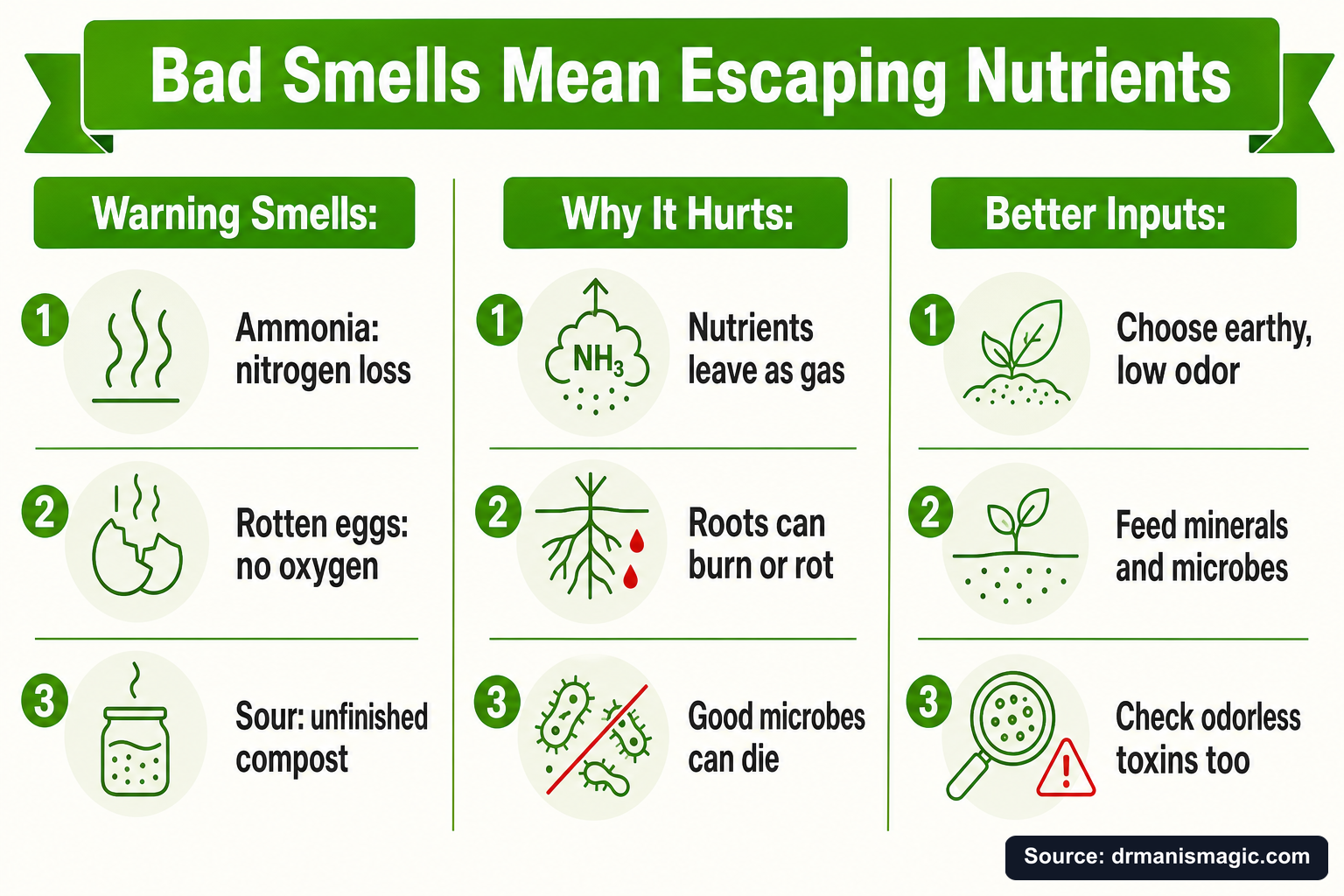
- Strong odors in soil, compost, or fertilizer almost always signal unstable chemistry — nutrients escaping as gas instead of feeding your plants.
- Ammonia smell means nitrogen is leaving. Rotten-egg smell means oxygen is gone and sulfur-reducing bacteria have taken over. Sour smell means incomplete decomposition.
- Unstable compounds can burn roots, kill beneficial microbes, and create the same root-suffocating conditions as salt-based synthetic fertilizers.
- Healthy, biology-friendly amendments smell earthy — not sharp, not sulfuric, not sour — because stable compounds stay put and feed the soil food web.
- PFAS, heavy metals, and biosludge contamination are odorless threats — meaning no smell does not automatically mean safe.
- The Three Plant Pillars system — mineral soil, live microbes, and organic fertilizer — is designed around stable, low-odor, biology-friendly inputs that work with your roots, not against them.
- Dr. Mani's Magic Crab, Kelp & Amino Acids was specifically formulated to be odor-stable, PFAS-free, and biosludge-free — because what you cannot smell can still hurt you.
What Does It Actually Mean When Fertilizer or Compost Smells Bad?
Quick Answer: A bad smell in fertilizer or compost means unstable chemical compounds are turning into gas and escaping into the air. Those escaping molecules are nutrients your plants will never receive. Depending on the compound, they can also directly damage roots, burn seedlings, and wipe out the beneficial microbes your soil depends on.
Think of it this way. When chemistry is stable, it stays put. It holds together. It does its job slowly and quietly. But when chemistry is unstable, it falls apart. Pieces break off and float away as gas. You can smell those pieces.
In the garden world, the three most common smells — and the three most common warnings — are ammonia, hydrogen sulfide, and volatile organic acids. Each one is a different chemistry story. Each one tells you something different about what is happening underground.
Ammonia is the sharp, eye-stinging smell. It is nitrogen leaving. Specifically, it is ammonium (NH₄⁺) turning into ammonia gas (NH₃) and floating off into the atmosphere. University of Maryland Extension explains that nitrogen volatilization can rob a compost pile or fertilizer application of a significant portion of its total nitrogen before any plant root ever gets a chance to use it. You paid for that nitrogen. Your plant needed that nitrogen. And it just flew away.
The rotten-egg smell is hydrogen sulfide (H₂S). This one is more serious. It means the soil or compost has gone anaerobic — the oxygen is gone. When that happens, a different class of bacteria takes over. These bacteria do not need oxygen. They breathe sulfur compounds instead, and hydrogen sulfide is their exhaust. Anaerobic soil is not just smelly. It is actively hostile to plant roots. Roots need oxygen to breathe. When the oxygen is gone and hydrogen sulfide is present, roots suffocate and rot. This is the same environment that allows Pythium and Phytophthora — the two most common root-rot pathogens — to explode in population.
The sour or vinegar smell is volatile organic acids. These form when decomposition is incomplete — when a pile or product has not finished breaking down. The organic matter is still in the middle of its chemistry. Using it on your plants in this state is like eating food that is half-cooked. It can cause direct root damage and create a temporarily toxic environment in the root zone.
Why Does Ammonia Smell Mean Nitrogen Is Escaping From Your Compost or Fertilizer?
Quick Answer: Ammonia smell means nitrogen is converting to gas and leaving your soil or compost pile. This happens when there is too much nitrogen relative to carbon, when pH is too high, or when conditions are too warm and wet. Every whiff of ammonia is nitrogen that will never reach a plant root.
The chemistry is simple once you picture it. Nitrogen loves to move. In its most plant-available form, it exists as ammonium (NH₄⁺) or nitrate (NO₃⁻). Both are water-soluble. Both can be grabbed by plant roots. But ammonium has a problem. When conditions are right — high pH, warm temperature, high moisture — it converts to ammonia gas and floats away.
This is called nitrogen volatilization. And it is one of the most common reasons that heavily fertilized gardens still show nitrogen deficiency symptoms. The pale, washed-out older leaves. The slow growth. The disappointment. You added plenty of nitrogen. But a lot of it left as gas before your roots could grab it.
According to research from the University of Wisconsin-Madison Soil Science Extension, nitrogen volatilization losses from urea and ammonium-based fertilizers can reach 30% or more under warm, moist, high-pH conditions — without any incorporation into the soil. That is a third of your fertilizer, gone as smell.
The fix in a compost pile is always carbon. Add leaves. Add straw. Add wood chips. Carbon-rich materials balance the excess nitrogen, slow the volatilization, and feed the microbes that can stabilize the nitrogen into organic forms that do not escape. This is not a theory. It is basic compost chemistry. The ideal carbon-to-nitrogen ratio in a working compost pile is roughly 25:1 to 30:1. When it drops too far toward nitrogen, the pile overheats, goes anaerobic, and starts smelling like a feedlot.
In a fertilizer product, ammonia smell tells you the product is not stable. The nitrogen is in a form that wants to leave. That is the opposite of what you want from a fertilizer. You want nitrogen that stays put. That bonds with the soil. That feeds microbes first and then slowly releases into plant-available forms over weeks and months. See also: Why Most Fertilizers Are Actually Salt in Disguise
Why Does Rotten-Egg Smell in Soil Mean Your Roots Are in Danger?
Quick Answer: Rotten-egg smell means hydrogen sulfide gas is being produced by anaerobic bacteria. This only happens when oxygen has been depleted from the soil. Without oxygen, roots suffocate. Hydrogen sulfide itself is directly toxic to roots at even low concentrations, and this anaerobic environment is the perfect breeding ground for the root-rot pathogens Pythium and Phytophthora.
Roots breathe. This surprises a lot of people. We know plants breathe carbon dioxide through their leaves. But the roots down in the dark soil are doing something different — they are consuming oxygen and releasing carbon dioxide, just like we do when we breathe. Roots need a constant supply of oxygen to generate the energy they use for nutrient uptake, cell division, and growth.
When soil becomes waterlogged, compacted, or filled with decomposing organic matter that is consuming oxygen faster than it can be replenished, the aerobic bacteria — the good ones — die off or go dormant. The anaerobic bacteria take over. Their metabolic byproduct is hydrogen sulfide. And hydrogen sulfide is directly toxic to plant roots even in small concentrations.
But it gets worse. The same waterlogged, oxygen-depleted, warm, wet conditions that produce hydrogen sulfide are the exact conditions that Pythium and Phytophthora — the most destructive root-rot pathogens in horticulture — need to reproduce and spread. These two pathogens are technically water molds, not true fungi. They produce mobile spores that swim through water films in the soil. No oxygen, standing water, warm temperature: you have just created their perfect world.
After growing and shipping over 250,000 trees at our South Texas nursery, we saw this pattern over and over. Trees in poorly draining, organically heavy potting mixes would start showing rotten-egg odor in the root zone, and within weeks, the roots would turn brown, mushy, and hollow. The plant above ground would look fine for a while — plants are optimists — and then suddenly drop. By the time the leaves showed symptoms, the roots were already gone.
This is exactly why Pillar One of the Three Plant Pillars is mineral-based soil. Mineral soil drains. It does not compact. It does not decompose and steal oxygen. It keeps the root zone aerobic — oxygenated — which keeps the anaerobic bacteria, the hydrogen sulfide, and the Pythium and Phytophthora from ever getting a foothold. If your soil smells like rotten eggs, the first thing to do is fix the drainage. Add oxygen. The smell will guide you to the problem. See how Super Soil solves this at the root level.
What Does Sour or Vinegar Smell in Compost or Mulch Actually Mean for Your Plants?
Quick Answer: Sour or vinegar smells come from volatile organic acids produced during incomplete decomposition. This means the material has not finished breaking down. Applying it to your garden in this state can create a temporarily toxic root zone, lower soil pH unexpectedly, and damage seedlings or fine root hairs — especially in containers where there is nowhere for the acids to dilute.
Imagine stopping a batch of bread halfway through baking. The flour is not bread yet. The yeast is still working. The chemistry is unfinished. If you tried to eat it, it would not nourish you the way finished bread does. In fact, it might make you sick.
Compost and organic amendments work the same way. The microbes doing the decomposition work go through stages. In the early, active stage, they produce heat, acids, and gases as they break down raw materials. As decomposition completes and the pile matures, the chemistry stabilizes. The organic matter transforms into humus — stable, earthy-smelling, nutrient-rich material that acts like a slow-release bank account for your soil.
Sour smell means you are working with stage-one material. The volatile organic acids — acetic acid (vinegar), butyric acid (rancid butter), propionic acid — are present at concentrations that can directly harm fine root hairs and disrupt the soil microbiome. In a large garden bed with lots of soil volume, this might dilute out quickly. In a container, it can be devastating.
The fix is time and oxygen. Turn the pile. Add air. Allow aerobic bacteria to complete their work. A mature, finished compost will smell like forest floor. Rich. Deep. Earthy. That is the smell of stable chemistry. That is the smell of biology doing its job correctly.
Synthetic Fertilizers vs. Organic Fertilizers vs. Salt-Free Organic Fertilizers: A Side-by-Side Look
Quick Answer: Synthetic fertilizers are salt-based and release nutrients all at once, which creates osmotic stress that burns roots and kills beneficial microbes. Organic fertilizers release slowly and feed the soil food web — but some use biosludge fillers that carry PFAS forever chemicals. Clean organic fertilizers made from crab, kelp, and amino acids deliver all the slow-release benefits with none of the toxic risks.
This is the comparison most fertilizer companies do not want you to make. Because when you see it side by side, the choice becomes obvious.
| Feature | Synthetic Fast-Release | Slow-Release Synthetic (Coated) | Clean Organic (Crab, Kelp, Amino Acids) |
|---|---|---|---|
| Release speed | Immediate — all at once | Weeks — but plastic-coated | Weeks to months — microbe-mediated |
| Salt index | High — osmotic stress on roots | Moderate — still salt-based | Very low — protein-based, not salt |
| Effect on microbes | Burns and kills beneficial bacteria and fungi | Damages microbes over time | Feeds microbes — they do the digesting |
| Root burn risk | High — especially in containers | Moderate if overused | Very low — almost impossible to overfeed |
| PFAS / Biosludge risk | Some products use biosludge fillers | Plastic coating leaches into soil | Zero — no biosludge, no PFAS, no plastic |
| Odor profile | Chemical, sharp, or ammonia-like | Chemical | Earthy — stable, low-odor chemistry |
| Long-term soil health | Degrades over time — addictive cycle | Neutral at best | Builds soil health with every application |
The salt index number is the one most people have never heard of. It is a measurement of how much osmotic pressure a fertilizer creates in the soil solution. High osmotic pressure is called osmotic stress or physiological drought. Even when there is plenty of water in the soil, high salt concentrations pull water out of root cells through osmosis. The roots dehydrate. The fine root hairs die. The plant wilts — even in wet soil. This is the hidden mechanism behind fertilizer burn, and it explains why plants can look overwatered and underwatered at the same time after a heavy synthetic application.
See also: The Osmotic Shock Your Plants Feel From Synthetic Nutrients
Does Odorless Always Mean Safe? The Hidden Dangers No Nose Can Detect
Quick Answer: No. Odorless does not mean safe. Soluble salts, PFAS forever chemicals, heavy metals, and accumulated sodium are all completely odorless. They can destroy your root zone, contaminate your soil for years, and pass into vegetables and fruit without any warning smell. A nose is a good first filter — but it is not a lab test.
This is the part most gardening articles skip. They give you the smell guide — ammonia means this, rotten egg means that — and send you on your way. But the most dangerous things in some fertilizers and soil amendments have no smell at all.
PFAS — per- and polyfluoroalkyl substances — are called forever chemicals because they do not break down. They persist in soil, water, plants, and human tissue for decades. They have been linked to serious health concerns including hormone disruption and certain cancers. And some of the most common sources in garden products are biosolid-based fertilizers — products made from treated municipal sewage waste, also called biosludge.
Biosludge is legal to use in garden products. It is sold in some of the most popular organic fertilizer brands in the country. It has no distinctive smell once processed. You would not know it was there. But it can carry PFAS, heavy metals like cadmium and lead, and pharmaceutical residues into your garden soil — where they accumulate over years of repeated applications.
The safe amendment checklist every homeowner should run through before using any fertilizer or compost:
- Ask the manufacturer directly: does this product contain biosolids or biosludge?
- Check for PFAS testing documentation — not just a label claim, but actual test data.
- Look at the feedstock list: what are the source materials? Crab shells, kelp, feather meal, and volcanic ash are traceable and clean. "Processed poultry manure" or "sewage sludge" are red flags.
- Check the electrical conductivity (EC) or soluble salt level if listed — this tells you the salt index risk.
- Check the C:N ratio and maturity level for compost — immature compost is the source of the sour smell problem.
- For food gardens especially: if in doubt, request a Certificate of Analysis from the manufacturer.
Dr. Mani's Magic Crab, Kelp & Amino Acids contains zero biosludge, zero PFAS, and zero synthetic salts. The feedstocks are crab shells, cold-processed kelp, amino acids from clean animal protein sources, and volcanic ash. Every ingredient is traceable. Every ingredient is there for a biological reason. And because the chemistry is stable, it smells earthy — not sharp, not sulfuric, not sour. The smell tells you the chemistry is right.
You Never Had a Brown Thumb.
You were handed the wrong tools. This free guide hands you the right ones.
You watered it. You fed it. It died anyway.
It was never you. It was the dirt, the salt food, and the bad advice.
This guide shows you what really went wrong, and how to fix it for good.
- Why your plants really died, and why it was never your fault
- The salt hiding in your plant food that quietly burns the roots
- The hidden killer in almost every bag of store soil
- The tiny helpers that grow a whole forest for free
- The rescue trick that brings a half dead plant back to life

How Does Organic Fertilizer Actually Feed Plants Through Microbes — and Why Is That Better?
Quick Answer: Organic fertilizer does not go straight from the bag into your plant. First, soil bacteria and fungi eat it. They digest it and convert it into plant-available forms of nitrogen, phosphorus, and other nutrients. When those microbes die, they release all of that nutrition directly into the root zone. This creates a living, self-regulating, slow-release feeding system that mirrors exactly how plants evolved to eat in nature.
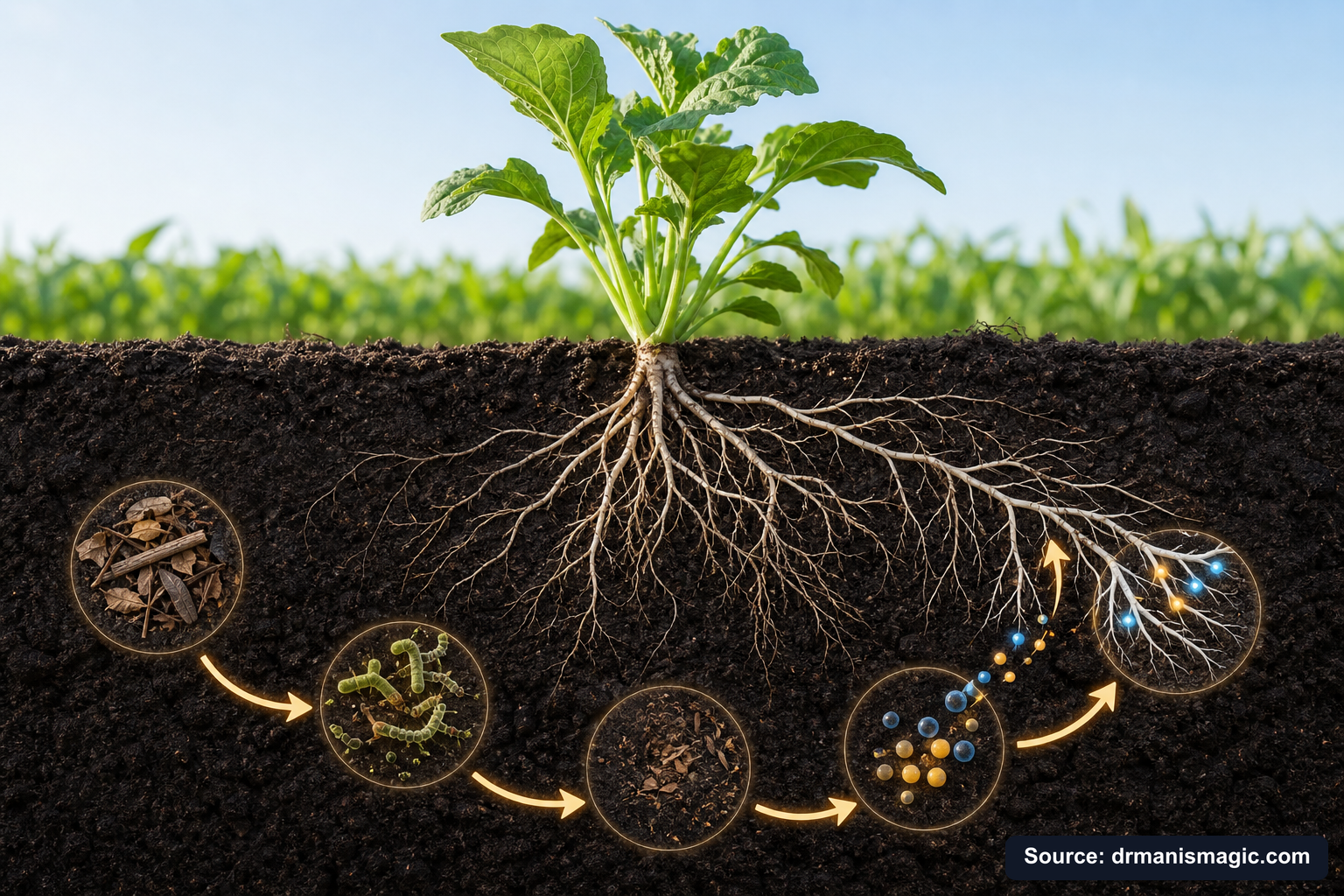
Here is the most important thing almost nobody explains about organic fertilizer. It is not a direct transaction. You do not pour it on the soil and have it zip straight into the root. There is a middleman. And that middleman is alive.
When you apply an organic fertilizer made from crab shells, kelp, and amino acids, here is what actually happens:
The bacteria and fungi in your soil detect the new food source. They colonize it. They start digesting it — breaking down the proteins, chitin, and carbohydrates into smaller and smaller molecules. As they work, they convert the nitrogen locked in amino acids and chitin into ammonium, and then into nitrate — the form plant roots prefer. They do the same with phosphorus, potassium, calcium, and trace minerals. The nutrients that were locked inside the organic material become plant-available, a little at a time, as the microbial digestion proceeds.
Then those microbes die — as all living things do — and their bodies release everything they have been holding. More nitrogen. More phosphorus. More trace minerals. Right into the root zone. Right where the plant can grab it.
This is a natural, biological slow-release system. It has no plastic coating. It has no salt spike. It cannot burn roots because the release rate is controlled by microbial activity, which is controlled by temperature and moisture — the same variables that control plant growth. When the plant is growing fast in warm weather, microbial activity speeds up and more nutrients release. When the plant slows down in cool weather, microbial activity slows too. The system self-regulates. It mirrors what happens in a healthy forest floor. It is the way plants evolved to eat over millions of years.
Synthetic fertilizers skip all of this. They dissolve immediately. The full dose hits the root zone at once. The salt index spikes. Osmotic stress begins. The microbes that were doing the slow, steady, beneficial work of a healthy soil food web are burned by the sudden salt surge. And now you have more nutrients in the water than the roots can handle, and fewer microbes left to keep the system running. You have just spent money to make your soil worse. See also: The Hidden Reason Synthetic Fertilizers Cause Root Rot
What Makes Chitin From Crab Shells Such a Powerful Soil Amendment?
Quick Answer: Chitin is the structural material in crab shells. When it breaks down in soil, it feeds a specific group of bacteria that also produce enzymes to break down chitin in pest exoskeletons and fungal cell walls. This activates a natural immune response in plants and suppresses soil-borne pathogens — all without any synthetic chemical.
Crab shells are not just a nitrogen source. They are a biological signal.
When chitin — the tough structural polymer in crab shells — enters the soil, a specific class of bacteria called chitinolytic bacteria multiply rapidly to digest it. These bacteria produce chitinase enzymes. And here is where it gets interesting: the cell walls of many soil-borne fungal pathogens, including some species in the Pythium and Phytophthora families, are made partly of chitin or chitin-like compounds. The same bacteria that digest crab shell chitin also attack the cell walls of these pathogens.
At the same time, when plant roots detect chitin fragments in the soil — a chemical signal that says "there are fungi and insects nearby" — they activate their own systemic resistance pathways. The plant's immune system goes on alert. It starts producing its own defense compounds. This is called induced systemic resistance, and it is one of the reasons that gardens and orchards with consistent chitin inputs tend to have fewer pest and disease problems over time — not because of any chemical kill, but because the biology of the soil and the plant both shift toward defense.
Calcium from crab shells also builds cell wall strength in the plant itself. Cell walls made with adequate calcium are physically harder for pathogens to penetrate and harder for insects to chew through. The woody mass of a mature fruit tree or hedge is largely calcium-based structure. Feeding calcium organically and consistently through crab shell inputs is one of the most overlooked strategies in home gardening.
What Does Kelp Actually Do That Regular Fertilizers Cannot?
Quick Answer: Kelp provides natural plant growth hormones called auxins and cytokinins, along with carbohydrates, trace minerals, and biostimulants that regulate cell division, root branching, stress tolerance, and flowering. These compounds cannot be replicated by synthetic NPK fertilizers because they are complex biological molecules, not simple mineral salts.
There is a reason kelp has been used as a soil amendment by coastal farmers for thousands of years. Long before chemistry labs existed, growers near the ocean noticed that fields fed with seaweed produced stronger plants, better fruit, and more drought-tolerant crops. They did not know why. Now we do.
Cold-processed kelp — meaning it is extracted at low temperatures to preserve the biological activity — contains natural plant hormones. Auxins regulate root elongation and branching. Cytokinins regulate cell division and delay leaf aging. Together, these hormones signal the plant to build more root mass, hold onto its leaves longer in stress, and set more flowers and fruit. These are not nutrients in the traditional sense. They are biological signals. They tell the plant what to do, not just what to eat.
Kelp also carries a broad spectrum of trace minerals drawn from ocean water — including iodine, selenium, and dozens of micronutrients that are often completely absent from synthetic fertilizer programs. Plants evolved in a world where soil minerals were continuously replenished by weathering rock, decomposing organic matter, and the biological cycling done by microbes. Modern synthetic fertilizers typically deliver only three or four elements. The rest of the periodic table of plant nutrition gets ignored. Kelp fills those gaps in a form that microbes can process and plants can use.
The carbohydrates in kelp — particularly alginic acid and mannitol — also feed soil bacteria directly. They are a direct food source for the microbial community. This is why kelp-fed soils tend to show rapid increases in microbial biomass and activity after application. You are not just feeding the plant. You are building the living system that feeds the plant.
What Is the Odor Diagnostic Guide Every Gardener Should Know?
Quick Answer: Each smell in compost, soil, or fertilizer maps to a specific chemistry problem. Sharp ammonia means nitrogen is escaping. Rotten eggs means anaerobic, oxygen-depleted conditions. Sour or vinegar means incomplete decomposition. Sewage smell means possible biosludge contamination. Earthy, forest-floor smell means healthy, stable, biology-friendly chemistry.
Print this table. Tape it inside your potting shed. Your nose is now a diagnostic instrument.
| What You Smell | What It Likely Means | Likely Compounds | Plant Risk Level | What To Do |
|---|---|---|---|---|
| Sharp, eye-watering, like public restroom | Nitrogen volatilizing as gas — you are losing fertilizer value | Ammonia (NH₃) | Medium — can burn fine roots and seedlings directly | Add carbon (leaves, straw, wood chips). Allow curing. Do not apply directly to roots. |
| Rotten eggs | Anaerobic conditions — oxygen gone, sulfur-reducing bacteria active | Hydrogen sulfide (H₂S), mercaptans | High — toxic to roots, ideal conditions for Pythium and Phytophthora | Restore oxygen immediately. Turn compost. Improve soil drainage. Check for compaction or overwatering. |
| Sour, vinegar, or rancid | Incomplete decomposition — volatile organic acids still present | Acetic acid, butyric acid, propionic acid | Medium to high in containers — toxic to fine root hairs | Allow more curing time. Turn pile, add air, reduce moisture. Do not apply to seedlings or containers. |
| Sewage or fecal | Possible biosludge-derived inputs — municipal waste processing | Indole, skatole, various organic compounds | High — potential PFAS, heavy metal, pathogen contamination | Do not use on food gardens. Request Certificate of Analysis. Consider returning product. |
| Strong fish or marine | Unstabilized fish emulsion or fish meal — going anaerobic | Trimethylamine, putrescine | Low to medium — nutrient value intact but unpleasant and attracts pests | Dilute well. Apply to soil only, not leaves. Bury or incorporate to reduce odor and pest attraction. |
| Musty, basement-like | Fungal activity — can be beneficial or indicate Actinomycetes | Geosmin, various fungal metabolites | Low — usually a sign of active biological decomposition | Generally safe. Monitor for other symptoms. Earthy musk is often a good sign. |
| Rich, forest floor, earthy | Stable, mature, biologically active amendment — chemistry is complete | Humic acids, stable organics, geosmin | None — this is what healthy soil smells like | Use it. This is the target smell for any soil amendment or organic fertilizer. |
Notice the last row. Rich, earthy, forest-floor smell means the chemistry is stable. The compounds are not escaping. The biology is healthy and aerobic. The nutrients are bound in forms that will release slowly through microbial activity. That smell is the goal. It is what Dr. Mani's Magic Plant Super Boost smells like. It is what finished, mature compost smells like. It is the smell of a living soil that is ready to feed your plants.
You can explore the full Free Plant Care Field Guide to learn how to build that kind of biology in your own containers and garden beds.
Salt Damage vs. Overwatering vs. True Root Rot: How to Tell the Difference
Quick Answer: Salt damage causes wilting and brown leaf edges even in moist soil. Overwatering causes yellowing and soft stems with wet soil. True root rot from Pythium or Phytophthora causes sudden collapse with brown, mushy, hollow roots — often after a period that looked like slow decline. All three can occur together when synthetic fertilizers are used in poorly draining soil.
These three conditions are constantly confused with each other. And treating the wrong one makes the other two worse.
| Symptom | Salt / Osmotic Stress | Overwatering | True Root Rot (Pythium / Phytophthora) |
|---|---|---|---|
| Leaf appearance | Brown tips and edges, crispy, leaf scorch | Yellow, limp, pale overall | Sudden wilting, yellowing, leaf drop |
| Soil moisture | Moist or dry — does not matter | Consistently wet | Often wet, poor drainage, anaerobic |
| Root appearance | Brown fine root hairs, some root tip death | White to light brown, somewhat soft | Brown to black, mushy, hollow, foul-smelling |
| Soil smell | Chemical, or no distinctive smell | Earthy but stale, possibly sour | Rotten eggs, sulfur, putrid |
| Cause | High salt index from synthetic fertilizer, accumulated sodium | Insufficient drainage, organic soil compaction | Anaerobic conditions plus Pythium or Phytophthora infection |
| Recovery possible? | Yes — flush salts, switch to organic fertilizer | Yes — improve drainage, reduce watering | Sometimes — remove affected roots, treat with beneficial microbes, repot in mineral soil |
The overlap between these three conditions is why so many gardeners feel like they cannot win. They water less and the plant still wilts — because salt stress makes the roots unable to absorb water even when it is there. They add more fertilizer to "help" a struggling plant — and the extra salt makes the root zone more toxic. They repot into new organic potting mix — and within months the new mix compacts, goes anaerobic, and the rotten-egg smell returns.
The root-cause fix is always the same: remove the salt, restore the oxygen, rebuild the microbes. That is the Three Plant Pillars in one sentence. Mineral soil that drains and stays aerobic. Live microbes that rebuild the biological buffer. Organic fertilizer with a near-zero salt index that feeds the soil food web instead of burning it. You can explore the complete Three Plant Pillars system here.
Root Recovery Checklist: When Your Soil Smells Wrong and Your Plant Is Struggling
Quick Answer: If your soil smells like rotten eggs, ammonia, or sour milk, follow these steps in order. The goal is to restore oxygen, remove toxic compounds, rebuild microbial life, and switch to stable, biology-friendly nutrition. Most plants can recover if the root damage is caught before it is total.
- Stop all synthetic fertilizer immediately. Adding more salt to a stressed root zone is the most common mistake. Nothing new goes in until the root zone is stable.
- Check drainage first. If water sits in the pot or bed for more than a few minutes, the soil structure is the problem. Organic potting mixes compact and hold water. Mineral-based soil drains freely and stays aerobic.
- Remove the plant and inspect roots if possible. Black, mushy, hollow roots with a foul smell confirm Pythium or Phytophthora. Trim affected roots with clean, sterile pruners. Brown but firm roots may still be viable.
- Repot into mineral-based, well-draining soil. Organic potting mixes that smell sour or earthy-stale have gone anaerobic. They need to be replaced, not just amended.
- Apply live beneficial microbes immediately. The biological competition that beneficial bacteria and mycorrhizal fungi provide is one of the most powerful natural defenses against Pythium and Phytophthora. Drench the new root zone. Plant Super Boost delivers live bacteria, fungi, and mycorrhizae in a single liquid application.
- Wait two to four weeks before resuming fertilizer. Let the microbes establish. Let the roots heal. Then introduce organic, low-salt fertilizer at half rate to begin rebuilding nutrition slowly.
- Monitor smell going forward. A recovered root zone should smell earthy. If rotten-egg or sour smells return within weeks, drainage or watering frequency still needs adjustment.

Why the Three Plant Pillars Were Built Around Odor-Stable, Biology-Safe Chemistry
Quick Answer: The Three Plant Pillars — mineral soil, live microbes, and organic fertilizer — were designed to eliminate the root causes of bad soil chemistry, not just treat symptoms. Mineral soil stays aerobic and never goes anaerobic. Live microbes stabilize nitrogen and suppress pathogens. Organic fertilizer feeds the biology without salt spikes. Together, they create conditions where the soil smells right because the chemistry is right.
Dr. Mani Skaria spent 35 years as a Professor Emeritus of Plant Pathology at the Texas A&M Citrus Center watching plants fail. Not because their owners did not care. Not because the climate was wrong. But because the chemistry underneath the soil was unstable. Because the salt-based fertilizer programs were burning the microbes that those plants needed. Because the organic potting mixes were compacting and going anaerobic and producing exactly the rotten-egg chemistry that tells you the root zone has become hostile.
He tested the Three Plant Pillars system on over 250,000 citrus trees at US Citrus Nursery in South Texas. Not a few test pots. Not a university greenhouse experiment. Real trees, real climate, real conditions. The results were consistent: mineral soil that never compacts, live microbes that stabilize the root zone biology, and organic fertilizer that feeds the system without salt spikes produced trees that were healthier, more disease-resistant, and more productive than anything grown in conventional synthetic programs.
And here is what he noticed about smell. The healthy trees, the ones growing in the Three Pillars system, had root zones that smelled like forest floor. Rich. Deep. Earthy. The trees in conventional programs — the ones getting regular synthetic fertilizer in organic potting mix — often had root zones that smelled off. Chemical. Sometimes sulfuric. Sometimes sour. The smell was the early warning. The smell was the chemistry telling the story before the plant showed it in its leaves.
Theme 7 from Dr. Mani's original brand notes says it plainly: "If you smell our Plant Super Boost, it just smells earthy. That is the beauty of a stabilized microbe." That single sentence contains the entire philosophy. Stability smells like earth. Instability smells like everything else on the diagnostic table above.
One more thing worth saying out loud: you cannot get time back. Every season you spend fighting root rot, chasing nutrient deficiencies, and buying bags of synthetic fertilizer that burn your microbes is a season your fruit tree did not produce, your garden did not flourish, your lawn did not thrive. The number one thing people tell Dr. Mani they want — and he hears it over and over — is that they want to see fruit on their tree while they still can. While their kids are still young. While they still have the energy to walk out to the backyard and pick something they grew themselves. That is not a small thing. That is one of the most human things there is. And every year of unstable chemistry, every year of salt-based feeding and anaerobic soil, is a year taken off that timeline.
The right foundation does not just grow better plants. It grows them faster. Because when the soil smells right, the chemistry is right. And when the chemistry is right, everything else follows.
If you are ready to stop guessing and start building a root zone that smells the way healthy soil should smell — earthy, stable, alive — the best place to start is the Free Plant Care Field Guide. It walks you through the Three Plant Pillars step by step, in plain language, for any plant you are growing. No jargon. No guesswork. Just the foundation that 250,000 trees proved works.
Frequently Asked Questions
Your nose is one of the best gardening tools you own. Most gardeners ignore what bad smells are really saying about their soil and fertilizer. These questions help you understand what those odors mean, why they matter, and how the Three Plant Pillars system keeps your plants safe from chemistry that works against them.
What does a bad smell in fertilizer or compost actually mean?
It means chemistry is falling apart. Stable compounds stay in the soil and feed your plants. Unstable compounds break apart and float away as gas. That gas is what you smell. When nutrients escape into the air, your roots never get them. Worse, those same unstable compounds can burn roots and wipe out the beneficial microbes your soil depends on. We tested this across 250,000 citrus trees at US Citrus Nursery. Stable inputs win every time.
Why does fertilizer smell like ammonia?
That sharp, eye-stinging smell is nitrogen leaving your soil. Ammonium converts to ammonia gas and floats into the air instead of feeding your plant roots. You paid for that nitrogen. Your plant needed that nitrogen. It is just gone. This is one reason Dr. Mani's Magic Crab, Kelp and Amino Acids fertilizer was built to be odor-stable. The nutrients stay put. They feed the soil food web slowly and quietly, the way nature intended.
What does a rotten egg smell mean in garden soil?
That rotten egg smell is hydrogen sulfide gas. It means oxygen is gone from your soil. When soil loses oxygen, harmful bacteria take over. They produce hydrogen sulfide as a byproduct. This is a serious warning. It often points to compacted, waterlogged soil that is suffocating your roots. This is exactly why Pillar One of the Three Plant Pillars is mineral-based soil. Good drainage keeps oxygen in. Oxygen keeps the right bacteria alive and the wrong ones out.
Why does healthy soil smell earthy instead of sharp or sour?
Healthy soil smells like fresh earth because the chemistry is stable. A compound called geosmin, made by beneficial bacteria called actinomycetes, creates that clean dirt smell. When you smell that, beneficial microbes are alive and working. Sharp, sour, or sulfur smells mean something has gone wrong. Dr. Mani's Magic Plant Super Boost is packed with live, stabilized microbes. When you open the bottle, it smells like earth, not sewage, because the biology inside is alive and healthy.
Can a fertilizer hurt my plants even if it does not smell bad?
Yes. Some of the most dangerous things in cheap fertilizers have no smell at all. PFAS chemicals, heavy metals, and biosludge contamination are odorless. No smell does not mean safe. This is why Dr. Mani's Magic Crab, Kelp and Amino Acids was specifically formulated to be PFAS-free and biosludge-free. Your nose catches some problems. But you need clean, verified inputs to catch the ones your nose misses.
Why do salt-based synthetic fertilizers cause so much damage underground?
Salt pulls water out of roots through osmosis. It is the same reason you would not water your plants with ocean water. Salt-based fertilizers also kill the beneficial bacteria and fungi your soil depends on. Once those microbes are gone, your soil becomes dead dirt. Plants stall. Then they go backwards. Pillar Two of the Three Plant Pillars puts those living microbes back in your soil. Pillar Three feeds them with organic inputs that do not burn or destroy what you just built.
How do the Three Plant Pillars protect against unstable soil chemistry?
Each pillar blocks a different failure point. Mineral-based Super Soil drains well and keeps oxygen in the root zone, stopping the conditions that create rotten egg smells and root rot. Plant Super Boost adds live bacteria, fungi, and mycorrhizae that stabilize your soil food web and outcompete harmful organisms. Crab, Kelp and Amino Acids delivers slow-release organic nutrients that stay in the soil instead of escaping as gas. All three work together. That is the whole point of the system.
About the Author
Ron Skaria, MD
Ron Skaria, MD, is the co-founder of Dr. Mani's Magic and the son of Dr. Mani. He trained as a medical doctor and now works full time on the family farm in Hargill, Texas, building Dr. Mani's Magic alongside his dad. He wrote the Brown Thumb Field Guide to put his father's 48 years of plant science into plain words any gardener can use. His belief is simple. You never had a brown thumb. You just never had the right help.


