


Why Gardeners Accept Smells They Should Question | Dr. Mani's Magic
Why Gardeners Accept Smells They Should Question (And What Those Smells Are Really Telling You)
You tear open the bag of fertilizer. The smell hits you like a wall. Sharp. Sour. Something between a barnyard and a locker room. You wrinkle your nose, hold your breath, and scatter it around your roses anyway. Because that's what you're supposed to do, right? Strong smell means strong stuff. Powerful odor means powerful results.
That's what most of us were taught. Or at least what we assumed. The guy at the garden center didn't say anything. The bag didn't warn you. And the forums are full of people saying "yeah it smells awful but it works." So you go along with it. You accept the smell as the price of a healthy garden. You trust the stink.
Here's the thing nobody tells you: that smell is often your plants screaming for help. Not proof that something powerful is working. A warning that something is going wrong. After growing over 250,000 trees at our South Texas nursery, we learned that the nose knows. And most gardeners have been trained to ignore exactly the signal that could save their plants, their soil, and their time.

Plant Super Boost
Key Takeaways
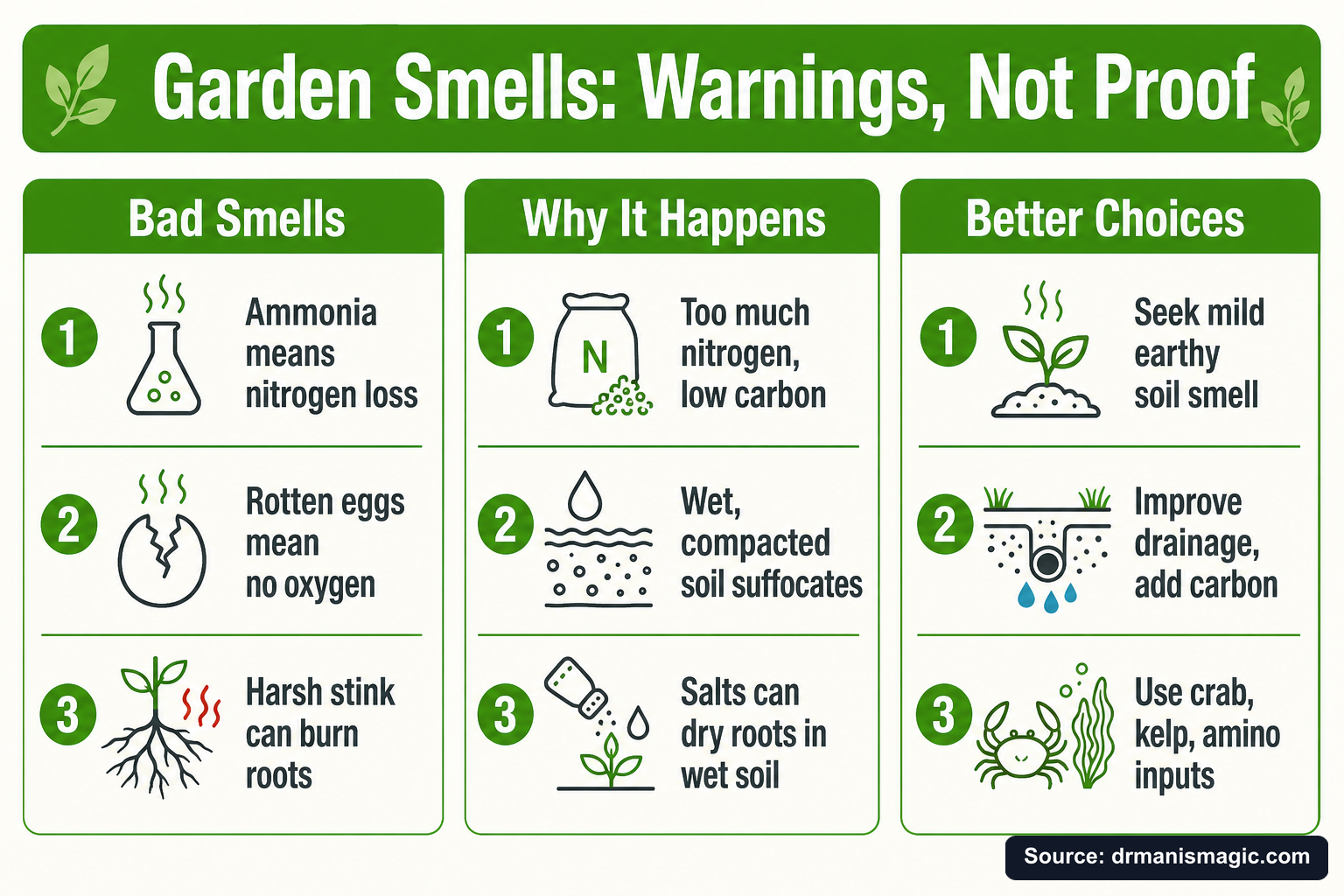
- Strong, offensive odors from fertilizer, compost, or soil are often a sign of nitrogen loss, anaerobic conditions, or root damage — not proof of potency.
- Ammonia smell means nitrogen is escaping into the air instead of feeding your plants.
- Rotten egg and sewer smells signal oxygen-starved, waterlogged soil where root rot pathogens thrive.
- Salt-based synthetic fertilizers can scorch roots, kill beneficial microbes, and cause "physiological drought" even in wet soil.
- Some smelly products, including certain organic fertilizers made from biosludge, may contain PFAS "forever chemicals" unsafe for food gardens.
- Earthy, soil-like smell is the good smell. It means aerobic microbes are alive and working.
- Biology-friendly inputs like crab meal, kelp, and amino acids can feed your plants without the harsh odor or the salt damage.
What Does It Mean When Your Compost or Fertilizer Smells Like Ammonia?
Quick Answer: An ammonia smell means nitrogen is escaping into the air as gas instead of reaching your plant roots. This happens when a fertilizer or compost has too much nitrogen and not enough carbon to balance it out. You are literally watching your plant food evaporate. The smell is proof of waste, not strength.
Ammonia is nitrogen leaving the building.
Picture a bucket full of water with a hole in the bottom. That's what ammonia smell means for your nitrogen. According to Cornell University's Composting Science program, ammonia odor during decomposition is a clear signal that nitrogen is volatilizing — converting from a usable form into a gas that drifts away into the atmosphere instead of feeding your soil. (Cornell Composting, compost.css.cornell.edu)
This happens when the carbon-to-nitrogen ratio is too low. Too much nitrogen, not enough carbon to slow it down and stabilize it. The microbes in your soil can't process it fast enough, so it off-gasses. Gone. Wasted.
Meanwhile, that ammonia is doing something else. It's toxic to plant roots in high concentrations. Fresh manure, poorly stabilized compost, and some fast-release fertilizers can push ammonia levels high enough to burn the fine root hairs your plants depend on for water and nutrient uptake. You paid for fertilizer, but your plant's roots got burned instead of fed.
The lesson? If it smells like a cat litter box or a stable that hasn't been cleaned, don't put it straight on your roots. Especially not on seedlings, vegetables, or anything in a container where the roots have nowhere to run.
Why Does Soil Smell Like Rotten Eggs — And Is It Dangerous?
Quick Answer: Rotten egg smell in soil is hydrogen sulfide gas, which is produced by anaerobic bacteria working in oxygen-starved, waterlogged conditions. It signals compacted, suffocating soil where root rot pathogens like Pythium and Phytophthora love to grow. This is a serious warning sign for your plant's root system.
That rotten egg smell is hydrogen sulfide. And it tells you one very specific thing: the oxygen is gone.
Healthy soil breathes. The microscopic spaces between soil particles carry oxygen down to the roots. When soil gets waterlogged, compacted, or packed with decomposing organic matter, those spaces close off. The good aerobic bacteria — the ones that unlock nutrients and protect roots — start to die. The bad anaerobic bacteria take over. And those bacteria produce hydrogen sulfide as a byproduct.
This is the same gas that makes sewers and swamps smell the way they do. When you smell it in your garden bed or your pot, your roots are sitting in essentially the same conditions.
Here's where it gets worse. Pythium and Phytophthora — two of the most destructive root rot pathogens in gardening — thrive in exactly these wet, oxygen-starved conditions. They travel through waterlogged soil and attack root tips. Once they're established, a plant can look fine on top for weeks. Then one warm morning you walk outside and the whole thing has collapsed. Wilted. Soft at the base. Beyond saving.
Oregon State University Extension notes that anaerobic soil conditions are a major contributing factor to soil-borne disease pressure, including Phytophthora root rot in ornamentals and trees. (Oregon State University Extension, extension.oregonstate.edu)
The rotten egg smell is not something to push through. It is a red flag that your drainage is failing and your roots are in danger.
See also: The Hidden Reason Synthetic Fertilizers Cause Root Rot
Is "Smells Powerful = Works Powerfully" Actually True?
Quick Answer: No. This is one of the most widespread myths in gardening. Strong offensive odors from fertilizer or compost usually indicate nitrogen loss, anaerobic decomposition, or unstabilized materials that can harm roots. The smell you want is earthy and mild, like forest floor after rain. That smell means biology is working correctly.
This myth has cost gardeners more time and money than almost any other idea in the garden center.
We've been trained to associate pungent smell with potency. Strong fish emulsion must mean strong nitrogen. Sour-smelling manure must be rich and fertile. Ammonia-reeking compost must be packed with plant food. It feels logical. It smells intense. It must be intense.
But think about what's actually happening. Ammonia smell means nitrogen is escaping as gas. Rotten egg smell means the soil has no oxygen. Sour, putrid smell means volatile organic acids are building up from unstable fermentation. None of those processes are feeding your plants. All of them can damage your roots.
The smell you actually want from your soil and your organic inputs is the smell of good forest dirt. Rich. Earthy. Almost sweet. That smell is produced by a compound called geosmin, which is released by thriving populations of actinomycetes bacteria. That smell is the sound of a healthy soil ecosystem doing exactly what it should.
Earthy equals alive. Alive equals working. Everything else is a warning.
The Smell Diagnostic: What Each Odor Is Actually Telling You
Quick Answer: Different odors from your soil, compost, or fertilizer map to specific problems. Ammonia means nitrogen loss. Rotten egg means anaerobic conditions. Sour means unstable fermentation. Rotten roots mean oxygen stress plus decay pathogens. Earthy is the only smell that signals healthy biology at work.
Use this table as your nose-to-action guide. The next time something smells wrong in your garden, come back here first.
| Smell | Likely Cause | Risk to Plants | Affected Plant Types | What to Do |
|---|---|---|---|---|
| Earthy, rich, after-rain | Thriving aerobic microbes (actinomycetes, geosmin) | None — this is the goal | All plants | Keep doing what you're doing |
| Ammonia / urine / sharp | Excess nitrogen, low carbon-to-nitrogen ratio, volatilization | Root burn, nitrogen waste, toxic to seedlings | Vegetables, seedlings, containers, houseplants | Add carbon (mature compost, wood chip), do not apply near roots until stabilized |
| Rotten egg / sulfur / sewer | Anaerobic bacteria, hydrogen sulfide, waterlogged or compacted soil | Root rot (Pythium, Phytophthora), oxygen deprivation, root death | All plants, especially trees, shrubs, citrus, ornamentals | Improve drainage immediately, aerate soil, stop watering until soil dries, check roots |
| Sour / vinegar / putrid | Unstable fermentation, volatile organic acids, immature compost | Root toxicity, pH imbalance, suppression of beneficial microbes | All plants, especially those in containers | Do not apply; allow full composting / curing before use |
| Strong fish / intense fish emulsion | Anaerobic fish hydrolysate, unstabilized liquid organics going rotten | Attracts pests, can go anaerobic, unpleasant near food gardens | Vegetables, indoor plants, flower beds near living spaces | Use stabilized, non-anaerobic alternatives; check product processing method |
| Sludge-like / sewage / chemical undertone | Biosolids / municipal waste filler (biosludge), possible PFAS contamination | PFAS "forever chemical" accumulation in soil and food crops | Vegetables, fruits, food gardens, lawns children play on | Stop using immediately; check product label for biosolid content; switch to clean inputs |
| Rotten roots / sweet-sour decay at soil line | Active root rot, Pythium or Phytophthora infection, oxygen stress | Root system collapse, plant death, spreads to neighboring plants | Trees, shrubs, citrus, tropicals, houseplants | See recovery checklist below; repot, trim affected roots, restore drainage |
What Is Biosludge and Why Should Gardeners Care About It?
Quick Answer: Biosludge is treated municipal wastewater waste — essentially processed human and industrial waste — used as a filler in some fertilizers, both synthetic and organic. It can contain PFAS "forever chemicals" that accumulate in soil and food crops. Most gardeners have no idea it is in products they buy and use on their vegetables.
This is the part of the fertilizer conversation that almost nobody talks about at the garden center.
When you buy a bag of fertilizer, you assume you know what's in it. Nitrogen, phosphorus, potassium. Maybe some compost. Maybe some bone meal. You trust the label.
But some fertilizers — both synthetic and certified organic — use a filler called biosolids. That's the official term. The plain-English term is treated municipal waste. Sewage sludge. The processed output from water treatment plants, including industrial runoff, pharmaceutical residues, and household chemical waste.
This material has been legally applied to agricultural land for decades. The argument is that it is "treated" and safe. But research from university and government sources has found that biosolids are a primary pathway for PFAS — per- and polyfluoroalkyl substances — to enter garden soil and food crops. PFAS are called "forever chemicals" because they do not break down. They accumulate.
If you are growing food. If your children play in the yard. If your pets roll in the grass. This matters.
Dr. Mani's Magic Crab, Kelp & Amino Acids contains zero biosludge, zero PFAS, and zero synthetic salts. That was a deliberate choice, made in South Texas, for exactly this reason. Clean inputs for clean gardens.
How Do Synthetic Salt-Based Fertilizers Damage Roots Without You Knowing?
Quick Answer: Synthetic fertilizers are salt-based. When salt concentration around roots gets higher than inside the root cells, water is pulled out of the roots by osmotic pressure. This is called osmotic stress or physiological drought. The plant wilts even in wet soil. Roots shrink, crack, and become vulnerable to rot pathogens. The damage often looks like overwatering.
Here is something that will change how you see fertilizer forever.
Salt pulls water. That is what salt does. If you have ever seen what happens when you pour salt on a slug, you have seen osmosis in action. The water inside the slug gets drawn out toward the higher salt concentration on the outside. The slug shrivels.
Your plant roots are not slugs. But the physics is the same.
When salt accumulates in the soil around your roots — from synthetic fertilizer, from overapplication, from years of buildup — the salt concentration outside the root cells becomes higher than inside them. Water moves out of the roots and into the soil, following the concentration gradient. The plant experiences what researchers call osmotic stress, or physiological drought.
The plant is wilting from thirst. In wet soil. While sitting in fertilizer. It is being fed and dehydrated at the same time.
University of Maryland Extension documents this pattern clearly, noting that soluble salt damage from excess fertilizer causes leaf scorch, wilting, and root toxicity in flowers and ornamentals, especially under hot, dry conditions or in soils that do not drain well. (University of Maryland Extension, extension.umd.edu)
And here is the second punch: salt kills microbes. The beneficial bacteria and fungi in your root zone — the microscopic workforce that unlocks nutrients, fights pathogens, and builds soil health — are extremely sensitive to salt. One heavy application of a fast-release synthetic fertilizer can wipe out populations of beneficial organisms that took months or years to build. The soil goes quiet. And a quiet soil is a vulnerable soil.
See also: How Salt-Based Feeding Quietly Destroys Root Systems
Synthetic vs Organic Fertilizer: What Is Actually Happening at the Root Zone?
Quick Answer: Synthetic fertilizers dump immediately soluble, high-salt nutrients into the soil all at once, which can overwhelm roots and kill microbes. Organic fertilizers feed the microbes first. The microbes process the nutrients slowly, then release them in a form the plant can easily absorb. It is a living, self-regulating system that mirrors how nature feeds plants.
Let's talk about what actually happens underground when you fertilize.
When you pour a fast-release synthetic fertilizer onto your soil, you are essentially dumping a concentrated salt solution into the root zone. It is immediately available. It is also immediately risky. A spike of soluble nitrogen floods the system. If the plant can't absorb it fast enough — and in cold weather, dry weather, or stressed conditions, it often can't — the excess salt sits in the soil and starts doing damage.
Organic fertilizer works completely differently. And this is the part most people have never heard explained.
When you apply an organic fertilizer like crab meal, kelp, and amino acids, the microbes in your soil eat it first. They break it down. They convert it into forms the plant can absorb. Then, when those microbes die, they release all of that stored nutrition directly into the root zone. It is a living, slow time-release system. The plant gets fed at a pace it can actually use. The microbes are not casualties of the process — they are the engine of the process.
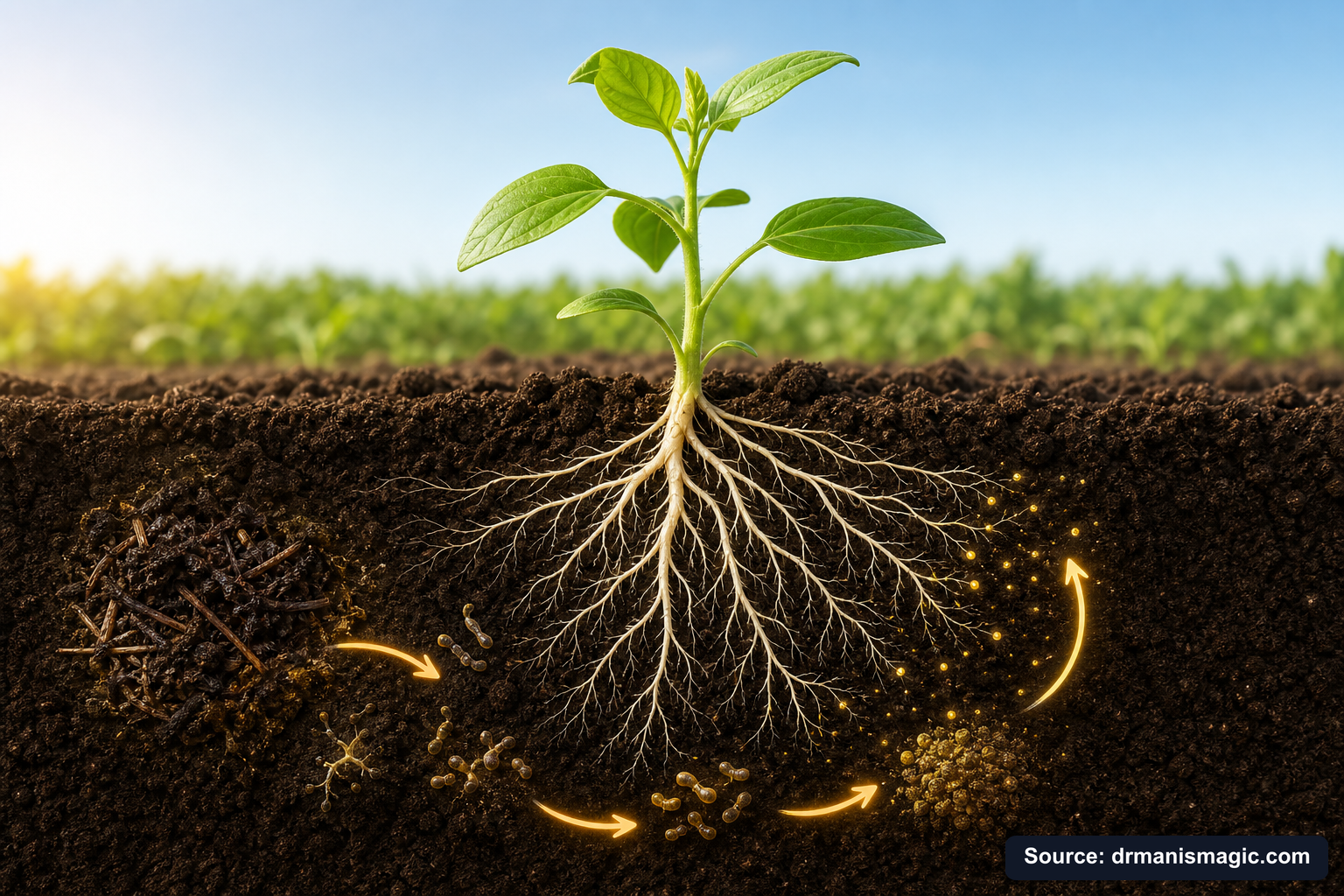
This is how every forest on earth feeds itself. Lightning fixes nitrogen. Bacteria and fungi process organic matter. Roots absorb what the biology makes available. No salt. No burn. No crash.
| Feature | Synthetic Fast-Release | Synthetic Slow-Release (Coated) | Organic (Crab, Kelp, Amino Acids) |
|---|---|---|---|
| Salt Index | High — root burn risk | Medium — plastic coating delays but doesn't remove salt | Low — no synthetic salts |
| How nutrients are released | Immediately soluble, flood-then-crash | Temperature-dependent plastic shell breakdown | Microbe-mediated, steady and self-regulating |
| Effect on soil microbes | Salt kills beneficial bacteria and fungi | Plastic residue in soil; still salt-based at release | Feeds microbes first; supports microbial populations |
| PFAS / Biosludge risk | Some products contain biosolid fillers with PFAS | Plastic coating can leach into soil and waterways | Zero PFAS, zero biosludge (Dr. Mani's Magic) |
| Risk of overfeeding | High — especially in containers | Moderate — harder to control actual delivery | Very low — plant regulates its own uptake |
| Long-term soil health | Degrades over time, creates dependency | Mixed — still disrupts biology | Builds soil biology and structure over time |
| Smell | Chemical or none | Chemical or plastic | Mild earthy (healthy biology signal) |
You Never Had a Brown Thumb.
You were handed the wrong tools. This free guide hands you the right ones.
You watered it. You fed it. It died anyway.
It was never you. It was the dirt, the salt food, and the bad advice.
This guide shows you what really went wrong, and how to fix it for good.
- Why your plants really died, and why it was never your fault
- The salt hiding in your plant food that quietly burns the roots
- The hidden killer in almost every bag of store soil
- The tiny helpers that grow a whole forest for free
- The rescue trick that brings a half dead plant back to life

Why Does Crab Meal Help Plants Fight Disease and Pests?
Quick Answer: Crab shells are rich in chitin, a natural compound that triggers a plant's own immune response. When chitin-eating microbes multiply in the soil to process the crab meal, they also attack chitin-containing organisms like fungal pathogens and harmful nematodes. The plant gets stronger from the inside out, without any synthetic pesticide.
Most people have never heard of chitin in a gardening context. That's one of the things the big chemical companies were perfectly happy to leave out of the conversation.
Chitin is the structural material in crab shells, shrimp shells, and the cell walls of many harmful fungi. When you add crab meal to your soil, the microbes that break it down — chitinase-producing bacteria and fungi — multiply fast. And here is the beautiful part: those same microbes also attack chitin-containing pathogens in the soil. Harmful nematodes. Fungal disease organisms. They get broken down by the same army that was called up to process your crab meal.
At the same time, chitin signals the plant's own immune system. The plant detects chitin fragments in the root zone and responds by activating its natural defenses. It is priming itself for attack before the attack comes.
This is one of the reasons Dr. Mani, after 40 years of plant pathology research and 250,000 tested trees at US Citrus Nursery, built crab meal into the foundation of his organic fertilizer formula. Not as a gimmick. As a mechanism. Crab meal does not just feed the plant. It builds the plant's immune system from the soil up.
What Does Kelp Actually Do for Your Plants?
Quick Answer: Kelp is not just a source of trace minerals. It contains natural plant hormones called auxins and cytokinins, plus carbohydrates and biostimulants that accelerate root growth, improve stress tolerance, and support flowering and fruiting. Cold-processed kelp preserves these active compounds so they actually reach your roots intact.
Kelp is one of the most misunderstood inputs in the garden. People think of it as a trace mineral supplement. A nice extra. Something fancy that maybe helps a little.
It is much more than that.
Kelp contains natural plant hormones — primarily auxins and cytokinins — that regulate root development, cell division, and how the plant responds to stress. When a plant gets drought stress, cold stress, or transplant shock, kelp biostimulants help it recover faster and maintain normal function. They are not nutrients in the traditional sense. They are biological signals.
Kelp also carries complex carbohydrates that feed soil microbes directly. These compounds act as a food source that helps beneficial bacteria and fungi thrive in the root zone. More microbes, more nutrient cycling, more plant health.
The critical word in "cold-processed kelp" is cold. Heat destroys the active hormones and biostimulants. If kelp is processed at high temperatures to dry and grind it faster, you are left with trace minerals and very little of the biological activity. Cold processing preserves what makes kelp worth using in the first place.
What Do Amino Acids Do for Soil and Plant Health?
Quick Answer: Amino acids are the building blocks of proteins. When delivered directly to the root zone, plants can absorb them without having to build them from scratch. This saves the plant enormous energy. Amino acids also serve as a nitrogen source that microbes can process gently, without the salt spike of synthetic nitrogen. They support both the plant and the soil biology simultaneously.
Think of amino acids as pre-digested nutrition.
Normally, a plant has to do a tremendous amount of work to build proteins. It absorbs nitrogen. It uses energy from photosynthesis to convert that nitrogen into amino acids. The amino acids then become the proteins that run every biological process in the plant — enzymes, cell structures, hormones, everything.
When you supply amino acids directly, you skip several steps in that chain. The plant can absorb them through the roots and use them almost immediately. The energy that would have gone into building them from scratch gets redirected into growth, fruiting, and stress response.
For the microbes in your soil, amino acids are a gentle, highly bioavailable nitrogen source. They do not carry the salt load of synthetic ammonium nitrate or urea. The microbes can process them without being overwhelmed. The plant gets fed. The biology stays intact. Everyone wins.
This is one of the reasons Crab, Kelp & Amino Acids was designed the way it was — not as three random ingredients thrown together, but as a system where each component supports the others and the whole soil ecosystem at the same time.
How Do You Know If Your Plant Has Salt Damage vs. Overwatering vs. Root Rot?
Quick Answer: Salt damage causes leaf scorch and tip burn with firm roots. Overwatering causes yellowing and soft, wet soil but roots may still be intact. True root rot causes brown, mushy roots with a rotten smell and plant collapse even after the soil dries. The smell at the root zone is one of the clearest diagnostic clues available to you.
These three problems look almost identical from above the soil. Wilting. Yellow leaves. Slow growth. The plant is clearly struggling. But what you do next depends entirely on which problem you actually have.
| Symptom | Salt Damage (Osmotic Stress) | Overwatering | True Root Rot (Pythium / Phytophthora) |
|---|---|---|---|
| Leaf appearance | Brown tips and edges, leaf scorch, crispy margins | Yellow leaves, sometimes soft and limp | Yellow to brown, wilted even after watering |
| Soil smell | Chemical or neutral, maybe ammonia | Slightly earthy, possibly sour if prolonged | Rotten egg, sewer, or sweet decay smell |
| Root appearance | Roots may look shrunken or browned at tips | Roots may be white but waterlogged | Brown to black, mushy, no firm white tips |
| Soil condition | Dry crust, white salt deposits on pot rim or soil | Consistently wet, poor drainage | Wet and anaerobic, possible mold at soil line |
| Recovery response | Flush soil with water, stop fertilizer, switch to organic | Let dry out, improve drainage, reduce watering frequency | Repot immediately, trim rotten roots, restore oxygen to root zone |
| Primary cause | Salt-based fertilizer, over-application, poor leaching | Too much water, poor drainage, dense soil | Anaerobic conditions plus pathogen (Pythium, Phytophthora) |
What Is the Recovery Plan If Your Roots Already Smell Like Rot?
Quick Answer: If your plant's root zone smells like rotten eggs or decay, act immediately. The root system is in active distress. You need to restore oxygen, remove damaged tissue, rebuild drainage, and reintroduce beneficial biology. The faster you move, the more of the plant you can save.
You pull the plant out of the pot. The roots look brown. Some are mushy. It smells like something died down there. Your stomach drops.
This is not the end. But you need to move now.
- Stop watering immediately. The root zone needs oxygen before it needs anything else. Let the soil dry enough to breathe.
- Unpot the plant. Shake away as much of the old soggy soil as you can. Get a look at the roots.
- Trim the damaged roots. Brown, mushy, or black roots are dead or dying. Cut them back to healthy white tissue with clean scissors. If more than half the roots are gone, cut the plant back proportionally to reduce what the remaining roots have to support.
- Let the roots air dry briefly. Fifteen to thirty minutes in open air helps before repotting.
- Repot into well-draining, mineral-based soil. Dense, bark-heavy potting mix that holds moisture is what created the problem. Mineral-based soil with proper aeration lets roots breathe and water move through. See our Super Soil for a permanent, non-decomposing option.
- Reintroduce beneficial microbes. Live bacteria and mycorrhizal fungi help colonize the recovering root zone and outcompete the pathogens that caused the rot. Apply a microbial drench at repotting and again one week later. Learn more at our Plant Super Boost page.
- Hold fertilizer for two to three weeks. Give the root system time to recover before asking it to process nutrition. When you restart, use a low-salt organic fertilizer only.
Do Not Put These Things Straight on Your Roots
Quick Answer: Fresh manure, ammonia-smelling compost, anaerobic compost, salty synthetic fertilizers, biosolids-based products, and concentrated liquid feeds can all damage roots, kill microbes, or introduce contaminants when applied directly. The root zone is sensitive. What goes in matters as much as what you leave out.
This is the checklist the bag label will never give you.
These materials should never go directly against roots, into seedling trays, or into containers without curing, dilution, or a protective layer of mature compost between the material and the root zone:
- Fresh manure — too high in ammonia and unstabilized nitrogen; can burn roots and introduce pathogens
- Ammonia-smelling compost — still off-gassing nitrogen; not mature enough to apply safely near roots
- Anaerobic compost (rotten egg smell) — oxygen-starved, potentially pathogen-loaded, can introduce Pythium-friendly conditions
- High-salt synthetic fertilizers — especially in containers or near seedlings; osmotic stress and root burn risk
- Biosolids-based fertilizers without PFAS testing — potential forever chemical contamination in food gardens
- Untested municipal compost — source materials vary widely; PFAS and heavy metal content is rarely disclosed to consumers
- Concentrated liquid feeds applied undiluted — even organic concentrates can be too strong at full strength near fine root hairs
What Are the Three Plant Pillars and Why Do They Matter for Smell, Safety, and Results?
Quick Answer: The Three Plant Pillars — mineral-based soil, live microbials, and organic fertilizer — work together to create a root environment where oxygen flows freely, beneficial biology thrives, and nutrition arrives slowly and safely. This foundation eliminates the conditions that create bad smells, root rot, and salt damage in the first place.
Dr. Mani Skaria spent 40 years as a Professor of Plant Pathology at the Texas A&M Citrus Center. He tested, failed, studied, and eventually cracked a code that the industry had spent decades burying under the noise of synthetic quick-fix products.
The code is simple. Three things. In harmony. Every time.
Pillar 1: Mineral-Based Soil. Most potting mix is made from bark, peat, and decomposing organic matter. It breaks down. As it breaks down, it compacts. As it compacts, it blocks oxygen. Blocked oxygen means anaerobic conditions. Anaerobic conditions mean that rotten egg smell. Mineral-based soil — silica-rich sandy loam that does not decompose — keeps the root zone open, oxygenated, and draining properly. Permanently.
Pillar 2: Live Microbials. Bacteria, fungi, and mycorrhizae form the living engine of healthy soil. They unlock nutrients. They outcompete pathogens. They build the biological network that connects your fertilizer inputs to your plant's roots. Without them, you are farming in dead dirt. With them, you are working with the same system that has grown forests for millions of years.
Pillar 3: Organic Fertilizer. Not synthetic. Not salt-based. Not loaded with biosludge. Slow-release nutrition from real, whole-food ingredients — crab, kelp, amino acids — that feeds the microbes, which then feed the plant, which then feeds you with fruit, flowers, and green growth that lasts. No crash. No burn. No ammonia cloud drifting off your garden bed.
These three pillars apply to every plant you grow. Lawn grass. Tomatoes. Roses. Houseplants. Mango trees. Citrus in containers. When the pillars are in place, the bad smells stop appearing. Because the conditions that create bad smells — oxygen deprivation, salt stress, unstable nitrogen — simply do not exist anymore.
You can explore the complete system at the Three Plant Pillars guide.
See also: Why Most Potting Mix Collapses Within 6-12 Months
A Note on Time — The Thing You Cannot Buy Back
Money is replaceable. Time is not.
We hear it from gardeners constantly. The number one thing people want — more than any specific plant variety, more than any feature — is to see fruit on a tree they planted with their own hands. To pick something from a branch in their own backyard. To taste what they grew.
That desire is not trivial. It is ancient. We were made to tend growing things. The drive to nurture is in us as deep as anything else.
And the saddest thing we see — after 30 years of growing in South Texas, after 250,000 trees tested and shipped — is gardeners who spent years doing it the old way. Salt-based fertilizer in bark-heavy soil with no living biology. The plant grows a little, then stalls, then starts circling the drain. A few more months pass. A year. The gardener thinks they have a brown thumb. They give up. They lose the time.
The truth is the deck was stacked against them. Not by bad luck. By bad information, pushed by companies that profit when your plants struggle and you have to keep buying.
The good news is the fix is not complicated. It is three pillars. Real soil. Live microbes. Clean organic nutrition. Get those right and plants respond fast. Within weeks, the root zone wakes up. Within months, you see growth you have not seen before. Within a season, you start to believe that the fruit-on-the-tree dream is real and within reach.
The best time to start was years ago. The second-best time is right now.
If you want to see exactly how the system works — for your specific plants, your specific soil, your specific situation — the Free Plant Care Field Guide walks you through it all, step by step, in plain language anyone can follow. No jargon. No upsell. Just the information that actually works.
Frequently Asked Questions
Most gardeners never stop to ask why their fertilizer smells so bad. They just hold their breath and keep going. These questions cut through the noise and tell you what those smells are really saying about your soil, your plants, and your results.
What does a bad smell from fertilizer actually mean for your plants?
It usually means something is going wrong, not right. A sharp ammonia smell means nitrogen is escaping into the air instead of feeding your roots. A rotten egg smell means your soil has no oxygen and root rot is likely close behind. At Dr. Mani's Magic, we tested this across more than 250,000 trees. Bad smells are warnings. The goal is inputs that smell like clean earth, because that means living microbes are doing their job.
Do plants actually respond to what is happening in their soil?
Yes, and faster than most people realize. Plants pick up chemical signals from their environment and shift how they grow. Healthy soil packed with live bacteria and fungi sends the right signals. Burned, compacted, or oxygen-starved soil sends stress signals. That is exactly why the second of Dr. Mani's Three Plant Pillars is microbial muscle. When your soil is alive, your plants respond with stronger roots, brighter color, and real growth you can see and touch.
What common mistakes cause most gardeners to fail without knowing it?
The biggest one is starting with the wrong foundation. Most people grab a bag of potting mix loaded with decomposing wood and pine bark, add a salt-based fertilizer from the big box store, and wonder why their plant stalls out after a few months. The soil compacts, the roots suffocate, and the microbes die. Dr. Mani built the Three Plant Pillars specifically to fix this from the ground up, starting with mineral-based soil that never breaks down.
Are there plants that can help clear bad smells in a garden or home?
Yes. Lavender, jasmine, and peace lily are known for absorbing or masking unpleasant odors. But here is the deeper truth: if your garden smells bad, the soil itself is likely the source. Anaerobic, waterlogged, or chemically burned soil produces foul gases. Fix the soil first with proper drainage and living microbes, and the smell problem often disappears on its own. Fragrant plants are a bonus, not a fix.
Why does smell matter more than most gardeners think?
Your nose is telling you something your eyes cannot see yet. The smell of rotten eggs, ammonia, or sour soil is a signal that roots are in danger right now, before you see a single yellow leaf. Dr. Mani spent over 30 years learning to read these signals in his South Texas nursery. That is why Dr. Mani's Magic Plant Super Boost is stabilized to smell like clean earth. If your inputs smell healthy, your soil is likely healthy too.
What is the difference between a good soil smell and a bad one?
Good soil smells like fresh earth after rain. That smell comes from aerobic microbes doing exactly what they should. Bad soil smells like sewage, rotten eggs, or a barnyard. That comes from anaerobic bacteria thriving in oxygen-starved, waterlogged conditions. Dr. Mani's Super Soil is mineral-based sandy loam that drains perfectly and stays loose so roots can breathe. Good drainage means good smell. Good smell means good growth.
Why do so many organic fertilizers smell terrible, and is there a better option?
Most liquid organic fertilizers use fish emulsion or biosludge that goes anaerobic in the bottle. They rot. That rotting is what you smell. Some even carry PFAS chemicals that are unsafe around food gardens. Dr. Mani's Magic Crab, Kelp, and Amino Acids fertilizer was built to avoid all of that. It uses slow-release, earth-born nutrients that feed your plants and protect your microbes without the toxic burn, the salt damage, or the smell that clears a room.
About the Author
Ron Skaria, MD
Ron Skaria, MD, is the co-founder of Dr. Mani's Magic and the son of Dr. Mani. He trained as a medical doctor and now works full time on the family farm in Hargill, Texas, building Dr. Mani's Magic alongside his dad. He wrote the Brown Thumb Field Guide to put his father's 48 years of plant science into plain words any gardener can use. His belief is simple. You never had a brown thumb. You just never had the right help.


