


Why Clean Organic Nutrition Shouldn't Smell (And What Odor Signals) | Dr. Mani's Magic
Why Clean Organic Plant Nutrition Shouldn't Smell (And What the Odor Is Really Telling You)
Picture this. You finally do it. You order a bag of organic fertilizer, feeling good about the choice. Natural. Earth-friendly. The right thing for your lawn, your fruit trees, your raised beds. The bag arrives. You cut it open. And then the smell hits you like a wall.
It's not just strong. It's rotten. Like the bottom of a dumpster on a hot August afternoon in South Texas. Your neighbor walks by. Your dog goes absolutely insane. You slap the bag shut and wonder: Is this stuff even working? Or is something very wrong here? That question matters more than you think. Because that smell is not a badge of honor. It is not proof the fertilizer is "natural" or "active." In most cases, that smell is a warning signal. It means something inside that bag has already gone sideways before it ever touched your soil.
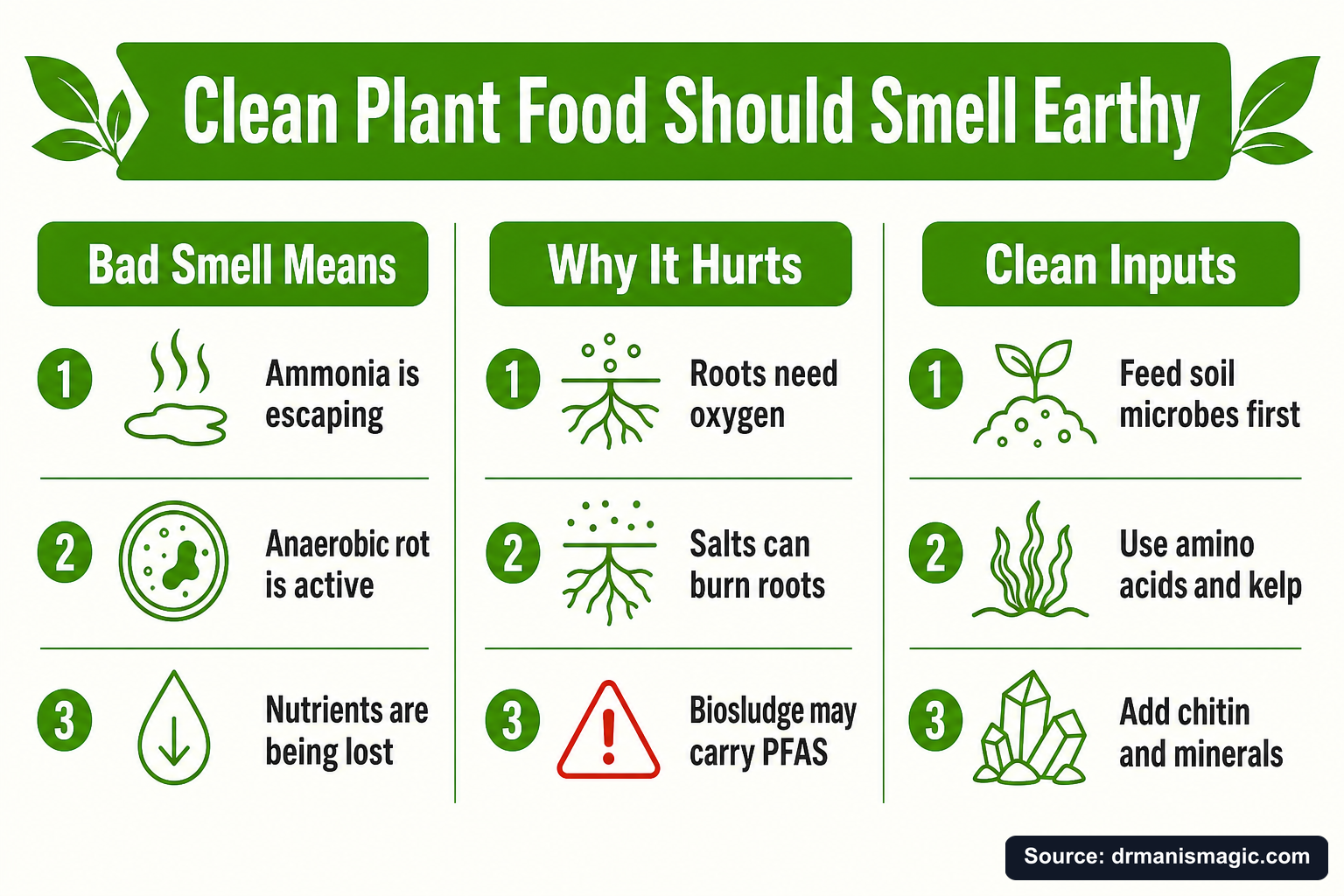
After growing over 250,000 trees at our South Texas nursery and testing inputs across lawns, gardens, houseplants, and orchards, we learned something that most fertilizer companies will never tell you: clean organic nutrition should smell like earth, not like sewage. And if it doesn't, your roots, your microbes, and your time are all at risk. Let's break down exactly why.

Organic Fertilizer | Crab, Kelp & Amino Acids
Key Takeaways
- Strong fertilizer odor is usually a sign of ammonia loss, anaerobic decomposition, manure, fish, or sewage-based ingredients — not a sign the product is working.
- Salt-based synthetic fertilizers can draw water out of roots and kill the beneficial microbes your plants depend on.
- Many "organic" fertilizers still use biosludge (treated municipal waste) that may contain PFAS "forever chemicals."
- Clean organic nutrition feeds the microbes first, and the microbes convert it into food the plant can actually absorb — a built-in slow-release system.
- Amino acid nitrogen, chitin from crab shells, cold-processed kelp, and volcanic minerals are clean, low-odor inputs that support biology instead of fighting it.
- The Three Plant Pillars — mineral soil, live microbes, and organic fertilizer — work together as a system. Pull one out and the whole thing wobbles.
- You can't get time back. The right foundation, started today, is the fastest path to fruit on your trees and life in your garden.
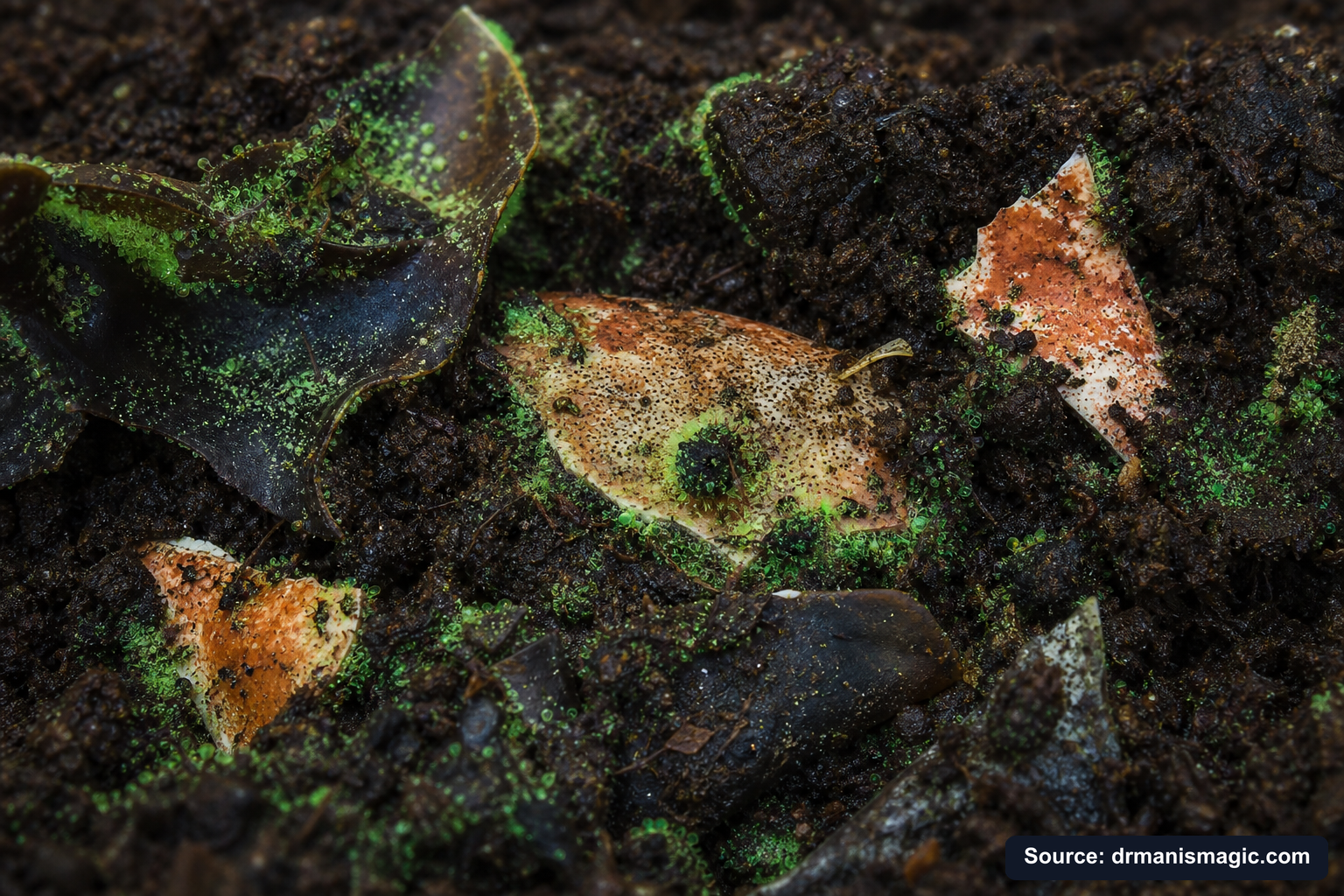
Why Does Organic Fertilizer Smell So Bad in the First Place?
Quick Answer: Most fertilizer odor comes from three sources: ammonia escaping from high-nitrogen materials, anaerobic (oxygen-starved) decomposition of raw inputs like manure or fish, and unstable or poorly processed feedstocks. A strong smell means nitrogen is literally evaporating into the air instead of going into your soil where it belongs.
Let's make this simple. Smell is chemistry you can detect with your nose.
When raw manure, fish meal, or sewage-based materials break down without enough oxygen, they go anaerobic. That word just means "no air." And when organic matter breaks down without air, it produces the same gases you'd find in a swamp or a backed-up sewer line. Hydrogen sulfide. Ammonia. Volatile compounds that make your eyes water.
NC State University Extension explains it clearly: compost odors come from three main sources — the odorous raw materials themselves, ammonia released from high-nitrogen inputs, and anaerobic pile conditions caused by low oxygen levels. NC State Extension notes that odors become perceptible at very low oxygen levels, and that ideal composting requires active oxygen management.
Here is what that means for you as a plant owner.
If your fertilizer bag smells like ammonia or rotten fish, the nitrogen inside it is unstable. It is literally flying off into the air. That nitrogen never reaches your roots. You paid for it. You just can't use it. Worse, when that unstable material hits your soil, it can continue the anaerobic process underground — stealing oxygen from the very root zone your plants need to breathe.
Roots need oxygen. This is one of the most overlooked facts in all of gardening. Your plant breathes carbon dioxide above ground. But below ground, the roots breathe oxygen just like you do. When you pour an anaerobic, oxygen-stealing slurry into your soil, you are not feeding your plant. You are suffocating it slowly.
Is Smelly Organic Fertilizer Actually Safe for Lawns, Kids, Pets, and Edible Gardens?
Quick Answer: Not always. Strong-smelling fertilizers often signal manure, fish emulsion, or biosludge inputs that can carry pathogens, heavy metals, or PFAS forever chemicals. Beyond safety, the smell itself can persist for days, attract pests, and make your yard unusable after application — which defeats the whole point of a beautiful garden.
Think about what you actually want from your yard. You want to walk barefoot on the grass. You want your kids to roll around in it. You want your dog to sniff through the flower beds without you panicking. You want to pick a tomato off the vine, wipe it on your shirt, and eat it right there.
That dream is hard to hold onto when your lawn smells like a barn for three days after every feeding.
But smell is only the surface problem. The deeper issue is what caused the smell.
Many organic fertilizers on the market use what the industry quietly calls "biosludge." That is the polite word for treated municipal wastewater solids. In plain English: processed human waste. It is legal to use in fertilizers. It is even labeled as organic in some cases. But research has linked biosludge inputs to PFAS contamination — the so-called "forever chemicals" that do not break down in soil or in your body.
Utah State University Extension warns that improper organic fertilizer use can still cause nutrient toxicity, salt burn, and even pollution if the inputs are not carefully sourced and managed. Utah State Extension recommends carefully evaluating organic fertilizer sources before applying them to edible gardens or lawns where children and pets play.
Dr. Mani's Magic Crab, Kelp & Amino Acids contains zero biosludge, zero PFAS, and zero synthetic salts. That is not a marketing claim. It is a sourcing decision. When you know what is actually in the bag, you can feel good about what goes into your soil.
What Does Salt-Based Synthetic Fertilizer Actually Do to Your Roots and Microbes?
Quick Answer: Salt draws water out of roots and leaves through osmotic pressure — the same process that makes saltwater dehydrating to drink. It also kills the beneficial soil microbes your plants depend on for nutrient cycling, root protection, and disease resistance. The short-term green-up comes at the cost of long-term soil health.
Here is a story that explains salt damage better than any textbook.
Imagine you are very thirsty. Someone hands you a glass of seawater. You drink it. But instead of feeling better, you feel worse. That is because the salt in the water is pulling moisture out of your body through osmotic pressure. You end up more dehydrated than before.
That is exactly what happens to your plant roots when you apply a salt-based synthetic fertilizer.
Maryland Extension describes this process precisely: excess fertilizer salts draw water out of roots, leaves, and needles, causing marginal browning, scorch, and visible stress symptoms. Maryland Extension calls this physiological drought — the plant looks thirsty even when the soil is wet, because the salt is blocking water from entering the roots.
That is the visible damage. The invisible damage is worse.
Your soil is not just dirt. It is a living city. Billions of bacteria, fungi, and mycorrhizal networks live in a single handful of healthy soil. These microbes are your plant's immune system. They unlock nutrients. They fight off root pathogens like Pythium and Phytophthora — the organisms behind most cases of root rot. They fix nitrogen from the air. They build soil structure.
Salt kills them. Not slowly. Quickly. Every time you apply a high-salt-index synthetic fertilizer, you are pouring a microbial massacre into your garden. The plants green up for a few weeks because the soluble nitrogen hits fast. Then the microbes die. The roots weaken. The soil compacts. And in a few months, you are back at the garden center buying more fertilizer to chase the same short-lived green.
This is not an accident. It is a business model.
See also: The Hidden Reason Synthetic Fertilizers Cause Root Rot
What Is the Difference Between Smelly Organic Fertilizer, Clean Organic Nutrition, and Salt-Based Synthetics?
Quick Answer: Smelly organic fertilizers use raw, unstable, or anaerobic inputs like manure, fish emulsion, or biosludge. Clean organic nutrition uses stable, low-odor inputs like amino acids, chitin, and cold-processed kelp that feed soil biology without offensive smells. Salt-based synthetics skip biology entirely and feed plants directly — but damage roots, microbes, and long-term soil function in the process.
Here is the comparison that most fertilizer content never gives you.
| Feature | Smelly Organic Fertilizer | Clean Organic Nutrition | Salt-Based Synthetic Fertilizer |
|---|---|---|---|
| Odor | Strong — manure, fish, ammonia, or sewage | Mild — earthy, like healthy soil | Minimal to none (but that is not reassurance) |
| Nitrogen source | Manure, fish meal, biosolids, sewage sludge | Amino acids, chitin, crab meal, plant-based | Urea, ammonium nitrate, ammonium sulfate |
| Salt index / root safety | Low to moderate | Very low — root-safe | High — osmotic stress risk |
| Microbial impact | Neutral to mildly positive if aerobic; negative if anaerobic | Positive — feeds and supports microbes | Negative — salt kills microbes |
| PFAS / biosludge risk | High if biosolids are used | None (when sourced cleanly) | Some products contain biosolid fillers |
| Release speed | Variable — often uneven | Slow, steady, microbe-mediated | Fast — spike then crash |
| Safe for lawns, kids, pets, edibles? | Depends on inputs — often questionable | Yes | Use with caution — re-entry warnings apply |
| Long-term soil health | Mixed | Builds soil biology over time | Degrades soil biology over time |
The difference between the second and third column is everything. Clean organic nutrition is not just "less bad" than synthetics. It is built on a completely different logic. It works with your soil's biology. Salt-based nutrition works against it.
How Does Organic Fertilizer Actually Feed Your Plants? (The Microbe Secret No One Explains)
Quick Answer: Organic fertilizer does not feed your plant directly. It feeds the microbes in your soil first. The microbes eat it, break it down, and convert it into forms the plant can absorb through its roots. When those microbes eventually die, they release even more nutrition directly into the root zone. It is nature's original slow-release system — built-in, automatic, and self-renewing.
This is the mechanism most fertilizer content skips right over. And it is the most important thing to understand about why clean organic nutrition works so differently from a bag of blue crystals.
Colorado State University Extension explains it this way: organic nutrients are often not immediately plant-available. They must be mineralized by soil microorganisms before plants can use them. Colorado State Extension notes that healthy soils need organic matter, moisture balance, aeration, and oxygen because most beneficial microbial processes are aerobic. This is exactly why a low-odor, oxygen-friendly fertilizer supports better nutrient cycling than an anaerobic, smelly one.
Here is how to picture the process.
You sprinkle organic fertilizer on your soil. The bacteria and fungi in the root zone recognize it as food. They move toward it and start breaking it down — converting proteins and chitin into simpler nitrogen compounds the plant can absorb. The plant's roots pick up what they need, when they need it. No spike. No crash. No flood of salt burning the fine root hairs.
Then, when those microbes complete their life cycle and die, their bodies release all the nutrients they had stored. Right there in the root zone. For free. An extra feeding you did not have to pay for or schedule.
This is why organic feeding works long after you apply it. The soil keeps working for you. It compounds. Like interest in a savings account that you funded once and that keeps paying out.
Synthetic fertilizer is the opposite. It is like spending your paycheck the moment it arrives. Everything goes out at once. The plant spikes green. Then the salts accumulate. The microbes weaken. The roots thin out. And now you need to feed again — except the soil is worse than before.
We have watched this cycle play out across 250,000 citrus trees at our South Texas nursery. The trees fed with salt-based synthetics looked great for a season. Then they stalled. Then they went backwards. The trees fed on clean organic inputs with live microbes just kept getting stronger, year after year.
What Makes Amino Acid Nitrogen Different From Other Nitrogen Sources?
Quick Answer: Amino acid nitrogen is already in a partially broken-down protein form that is close to what plant roots actually absorb. Microbes can process it quickly and efficiently. It does not spike soil salt levels. It does not volatilize (escape into the air as ammonia) the way raw manure does. It is the cleanest, most efficient form of organic nitrogen available.
Nitrogen is the nutrient plants need most. It drives leaf growth, chlorophyll production, and the amino acids inside every cell of your plant. Without enough nitrogen, leaves go pale and yellow. Growth slows. The plant looks tired.
But not all nitrogen sources are equal. Not even close.
When manure or fish emulsion hits the soil, the nitrogen inside is in a raw, unstable form. Microbes have to do a lot of work to process it. In the meantime, some of it escapes into the air as ammonia — which is exactly what you are smelling. That is nitrogen you paid for, gone. Into the sky. Not into your plant.
Amino acid nitrogen is different. Amino acids are already the building blocks of protein. They are partway down the processing chain. Microbes recognize them immediately. They convert them into plant-available nitrogen faster, more completely, and with far less volatile loss. No big ammonia spike. No neighborhood-offending smell. No nitrogen wasted in the air.
And because amino acids are low in salt, they do not stress your roots in the process. The plant gets the nitrogen it needs. The microbes stay healthy. The root zone stays aerobic. Everyone wins.
This is why amino acids are a core ingredient in Crab, Kelp & Amino Acids — the organic fertilizer we developed for our own nursery before making it available to home growers. It is the nitrogen source that works with your soil, not against it.
What Does Chitin From Crab Shells Actually Do for Your Plants and Soil?
Quick Answer: Chitin is a natural compound found in crab shells that triggers your plant's natural immune response. It activates beneficial microbes that fight off root-attacking pathogens like Pythium and Phytophthora. It also adds calcium and magnesium to the soil and feeds the fungal networks that help roots reach more nutrients. It is one of the most powerful and least-talked-about ingredients in clean organic nutrition.
Here is something most gardeners have never heard.
Chitin is the same compound found in insect exoskeletons and fungal cell walls. When chitin-eating microbes in the soil detect it, they multiply rapidly. They go to work breaking it down. And as a side effect of that activity, they also target and suppress the harmful fungi and water-mold pathogens that cause root rot.
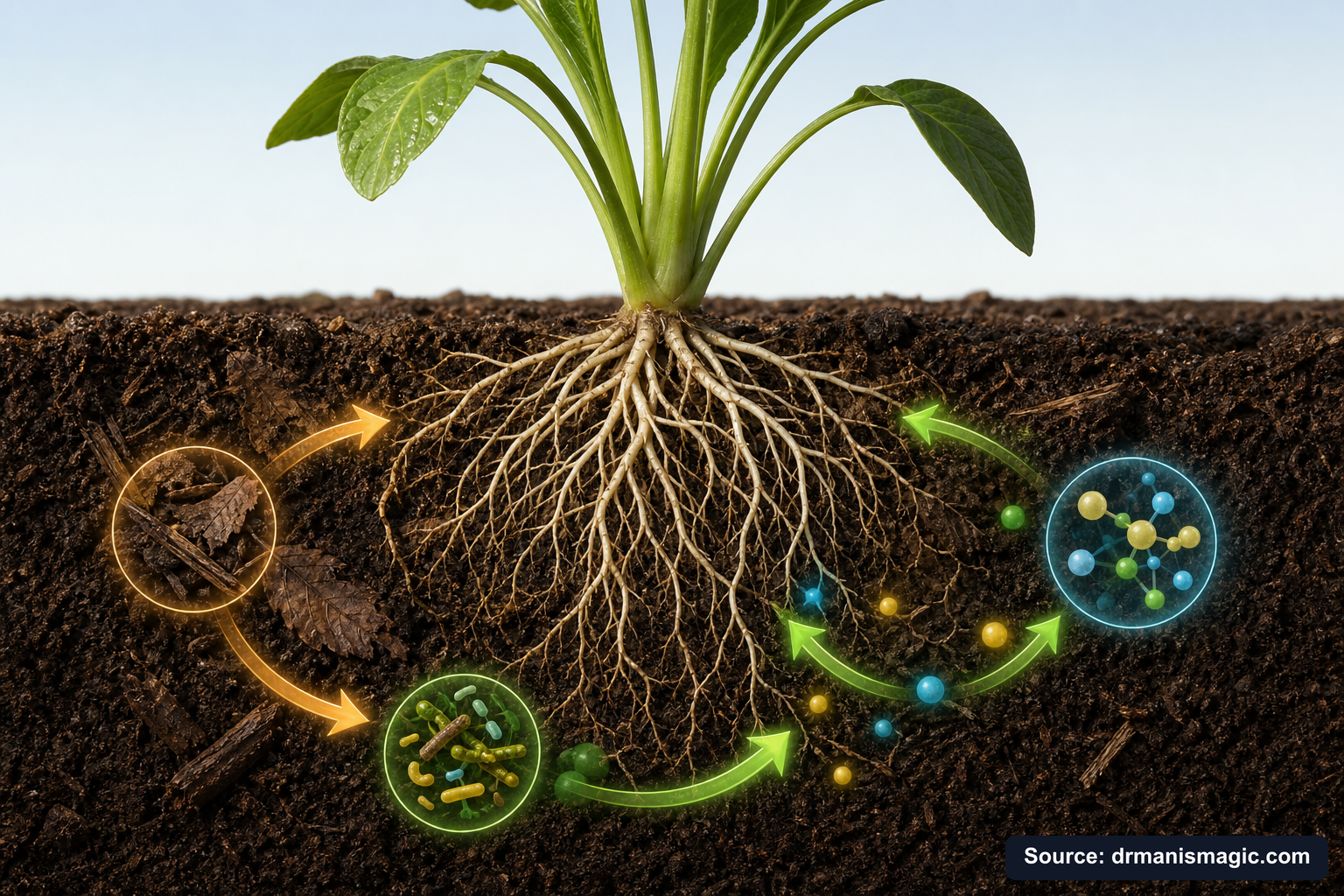
In other words, chitin from crab shells essentially puts your soil's immune system on high alert. Root rot pathogens like Phytophthora and Pythium hate a chitin-active soil environment. They struggle to establish. Your roots stay healthier not because you sprayed a fungicide, but because you fed the biology that keeps those pathogens in check naturally.
Crab shells also deliver calcium and magnesium directly to the root zone. Calcium is essential for cell wall strength. It is a large part of the woody mass of every tree you have ever grown. Magnesium sits at the center of every chlorophyll molecule in every green leaf. Without it, your plant cannot photosynthesize. With it, leaves stay deep green and photosynthesis runs at full capacity.
And because crab meal is a dry, stable input, it does not smell offensive. It has a mild, marine scent at most. Nothing that will drive your dog wild or make your neighbor question your life choices.
You Never Had a Brown Thumb.
You were handed the wrong tools. This free guide hands you the right ones.
You watered it. You fed it. It died anyway.
It was never you. It was the dirt, the salt food, and the bad advice.
This guide shows you what really went wrong, and how to fix it for good.
- Why your plants really died, and why it was never your fault
- The salt hiding in your plant food that quietly burns the roots
- The hidden killer in almost every bag of store soil
- The tiny helpers that grow a whole forest for free
- The rescue trick that brings a half dead plant back to life

What Does Kelp Do That Other Fertilizer Ingredients Cannot?
Quick Answer: Cold-processed kelp is packed with natural plant growth hormones called auxins and cytokinins, along with carbohydrates, trace minerals, and biostimulants. These compounds trigger root branching, improve stress tolerance, boost flower and fruit set, and feed the microbial community in your soil. No synthetic fertilizer contains anything like them.
Kelp is one of the fastest-growing organisms on the planet. Some species grow two feet a day. That growth rate is powered by a dense package of bioactive compounds that have no equivalent in a synthetic fertilizer.
Auxins are natural hormones that signal roots to branch out and grow longer. More root surface area means more nutrient and water absorption. Cold-processed kelp delivers these auxins without heat-destroying them. That last part matters. Many kelp products are heat-processed to extend shelf life, but the heat degrades the very compounds that make kelp valuable. Cold-processed kelp keeps those hormones intact and active.
Cytokinins in kelp help plants manage stress. Cold snaps. Heat waves. Drought. Transplant shock. Plants that receive regular kelp feeding recover faster and show less damage from environmental stress. We have seen this firsthand in our South Texas nursery, where summer temperatures regularly push past 100 degrees and plants that are not biologically supported simply struggle.
Kelp also feeds the microbial community. The carbohydrates in kelp act as a food source for soil bacteria. More bacteria means more nutrient cycling. More nutrient cycling means more plant-available nutrition. The whole system feeds itself in a positive loop.
And the smell? Cold-processed kelp has a very mild, ocean-adjacent scent. Not the sharp, ammonia-heavy fish smell that makes neighbors stop and stare. Just clean. Earthy. The way a healthy garden should smell.
What Role Do Volcanic Minerals Play in Clean Plant Nutrition?
Quick Answer: Volcanic minerals are one of the richest natural sources of silica and trace micronutrients like iron, manganese, zinc, copper, boron, and molybdenum. These micronutrients activate enzymes, strengthen cell walls, support immune function, and improve drought resistance. They are released slowly through weathering — a gentle, long-lasting supply that mirrors how nature feeds plants in mineral-rich soils.
Think about where the most fertile soils on earth are found. Near volcanoes. The slopes of Mount Etna in Sicily. The coffee-growing highlands of Costa Rica. The rice terraces of Bali. Farmers have known for centuries that volcanic soil grows the most vigorous, disease-resistant plants.
The reason is mineral density. Volcanic material weathers slowly over time, releasing a steady trickle of silica and micronutrients into the root zone. Silica strengthens cell walls, making plants more resistant to pest damage, drought, and fungal infection. The trace minerals activate the enzyme systems that power every internal process in a plant — from photosynthesis to fruit set to root development.
Most synthetic fertilizers focus only on nitrogen, phosphorus, and potassium. They ignore the twelve essential nutrients your plant needs. And when even one essential nutrient is missing, growth stalls — no matter how much of the other eleven you provide. This is called the Law of the Minimum, and it is one of the most important principles in plant science.
Volcanic ash in a clean organic fertilizer fills those gaps quietly and gently. No salt spike. No smell. Just a slow mineral release that mirrors what happens naturally in the richest soils on earth.
How Do You Know If Your Fertilizer Smell Signals a Real Problem vs. Normal Earthy Odor?
Quick Answer: A healthy, clean organic fertilizer should smell earthy — like a forest floor or fresh garden soil after rain. Sharp ammonia smells signal nitrogen volatilization and unstable inputs. Rotten-egg or sewage smells signal anaerobic decomposition, manure, or biosludge. A strong fish odor signals fish emulsion or fish meal inputs. Any smell that makes you want to leave the area quickly is a red flag.
Here is a quick reference to know what you are dealing with.
| Smell | What It Usually Means | Risk Level |
|---|---|---|
| Earthy, soil-like, mild | Stable organic inputs, aerobic processing, healthy microbes | Low — this is what you want |
| Sharp ammonia | High-nitrogen materials volatilizing; nitrogen escaping into air, not soil | Moderate — nitrogen loss, possible root stress |
| Rotten egg / sulfur | Anaerobic decomposition; oxygen-starved processing | High — root oxygen stress, pathogen risk |
| Strong fish or ocean | Raw fish emulsion or fish meal; often unstabilized | Moderate to high — pest attraction, pet reaction, neighbor complaints |
| Sewage or fecal | Biosludge / municipal waste inputs; PFAS risk | High — PFAS contamination possible; not recommended for edibles or lawns |
| Chemical or synthetic | Synthetic fertilizer base; salt-index likely high | Moderate to high — microbial damage, osmotic stress risk |
When Dr. Mani was developing the fertilizer we now use across our entire nursery, the smell test was part of the quality standard. If it smelled wrong, the inputs were wrong. Full stop. The goal was always a product you could open in your kitchen, near your houseplants, without wincing. That standard produced what we use today — a granular fertilizer that smells like earth, not like a fish market.
What Are the Three Plant Pillars and Why Do All Three Matter for Clean Nutrition to Work?
Quick Answer: The Three Plant Pillars are the framework Dr. Mani Skaria developed after decades of growing citrus in South Texas: Mineral-Based Soil for root oxygen and drainage, Live Microbials for nutrient cycling and root protection, and Organic Fertilizer for complete, slow-release nutrition. Each pillar depends on the others. Clean organic nutrition delivers its full benefit only when the soil drains properly and the microbes are alive and active.
This is the part that most fertilizer content misses entirely.
You can buy the cleanest, best-sourced organic fertilizer in the world. But if your soil is packed with decomposing bark that is slowly going anaerobic and starving your roots of oxygen, the fertilizer cannot do its job. The microbes needed to process it cannot survive in oxygen-depleted soil. The nutrients lock up. The plant struggles anyway.
And if your soil is fine but you have no live microbes — because a previous round of salt-based synthetic fertilizer wiped them out — same problem. The organic inputs sit there, unprocessed. The plant cannot access them.
The Three Plant Pillars work as a system because they address three different root causes of plant failure.
Pillar One: Mineral-Based Soil. Most potting mixes are made from pine bark and wood that breaks down within months. As it decomposes, it compacts. It steals oxygen from roots. It holds water in ways that invite root rot. Mineral-based soil — sandy loam that does not decompose — keeps the root zone open, oxygenated, and draining properly. Roots can breathe. Aerobic microbes can thrive.
Pillar Two: Live Microbials. Bacteria, fungi, and mycorrhizal networks are the unseen workforce that makes everything else function. They mineralize organic nutrients into plant-available forms. They suppress pathogens like Pythium and Phytophthora. They build soil structure. Without them, even the best fertilizer sits unused.
Pillar Three: Organic Fertilizer and Biostimulants. This is the clean nutrition that feeds both the microbes and, through them, the plant. Slow-release. Low-odor. No salt spike. No microbial massacre. Just a steady, biological feeding cycle that mirrors what happens in the healthiest natural soils on earth.
Pull any one pillar out, and the system wobbles. Keep all three in place, and your plants become — as Dr. Mani puts it — practically bulletproof.
You can explore the complete system at the Three Plant Pillars page to see how the pillars work together for any plant — lawns, gardens, fruit trees, houseplants, flowers, and more.
See also: Why Most Potting Mix Collapses Within 6-12 Months
Can Organic Fertilizer Still Burn Plants the Way Synthetic Fertilizer Does?
Quick Answer: Clean organic fertilizers with low salt indexes — especially amino acid-based or chitin-based formulas — have almost no risk of burning roots or leaves when used as directed. The plant's root system can regulate how much it absorbs. Unlike soluble synthetic fertilizers, you cannot easily over-apply a well-formulated organic product to the point of burning.
This is one of the most common questions we hear, especially from gardeners who have been burned — literally — by synthetic fertilizers in the past.
The burn from synthetic fertilizer is a salt effect. The concentrated salts in a synthetic fertilizer dissolve in water and create a high-osmotic-pressure zone around the roots. Water moves from low-salt areas to high-salt areas by osmosis. So instead of water flowing into the roots, it flows out. The root dehydrates. The tips turn brown and die. Leaves scorch at the margins. This is physiological drought caused by fertilizer salts — and it can happen even when you water your plants regularly.
Clean organic fertilizers do not work this way. The nutrients are bound up in protein structures — amino acids, chitin, plant matter. They do not dissolve instantly into a high-salt solution. They release slowly as microbes break them down. The plant's roots absorb what they need at the rate they need it. The system self-regulates.
This is especially important in containers, where salts accumulate fast. There is no deep soil for salts to dilute into. Every synthetic application adds to the salt load in that pot. Over time, the salt index rises, the microbes die off, and the root zone becomes increasingly hostile — even if you are fertilizing "correctly" by the bag's instructions.
With clean organic nutrition in a container, the risk of over-application is dramatically lower. The worst outcome from too much organic fertilizer is usually a temporary nitrogen surge that causes lush leaf growth. No root burn. No microbial die-off. No scorch.
See also: How Salt-Based Feeding Quietly Destroys Root Systems
What Is the Real Cost of Using the Wrong Fertilizer? (It Is Not What You Think)
Quick Answer: The real cost is not money. It is time. Salt-based feeding and smelly, unstable organic inputs can keep your plants looking acceptable for a season or two. But underneath, the microbes die, the roots weaken, and the soil degrades. After a few years, growth stalls and then reverses. You cannot buy back the seasons you lost. That is the cost no fertilizer label shows you.
Here is the conversation Dr. Mani has more than any other.
Someone calls or emails. They have a fruit tree — a lemon, an orange, a fig, a peach. They planted it four or five years ago. It is alive, but barely. It has never fruited. The leaves are pale. Growth stopped. And they want to know if there is still hope.
The answer is almost always yes. But here is the honest part: those four or five years are gone. The tree could have been fruiting by year two or three with the right foundation. The salt-based feeding, the bark-heavy potting mix, the lack of live microbes — these did not kill the tree immediately. They just quietly held it back, season after season, while the calendar kept moving.
The number one thing people tell us they want from their fruit trees is to see fruit on them while they are still around to enjoy it. That desire is ancient. It is wired into us. We were made to tend gardens, to plant, to nurture, to harvest. Every year that goes by without fruit is a year of that fundamental joy that you cannot get back.
Money you can earn again. Time, you cannot.
This is why the Three Plant Pillars are not optional extras. They are the foundation that determines how fast your garden responds and how long it keeps getting better. Get the foundation right from the start — mineral soil, live microbes, clean organic nutrition — and the calendar works in your favor instead of against you.
Want to see what others have grown? Read real grower stories from the Dr. Mani's Magic community — lawns, fruit trees, garden beds, houseplants, and more.
How Do You Switch From Smelly or Salt-Based Fertilizer to Clean Organic Nutrition? (A Simple Recovery Checklist)
Quick Answer: Transitioning from salt-based or smelly organic inputs to clean organic nutrition is straightforward. The key steps are flushing accumulated salts, reintroducing live microbes, and switching to a low-odor, amino acid-based organic fertilizer. Most plants show visible improvement within four to six weeks. The soil continues to improve over months and years.
If your plants have been on salt-based synthetics or poorly sourced organics, here is how to reset the foundation.
- Flush the root zone. Water deeply and thoroughly — enough to push accumulated salts down and out of the active root zone. Do this two or three times over a week before switching inputs.
- Check your soil structure. If you are in a container and the mix is older than one year, consider repotting into a mineral-based, non-decomposing soil. Oxygen-starved, compacted potting mix is the most common hidden reason plants fail to respond to better fertilizer.
- Stop all salt-based synthetic applications immediately. There is no gradual transition needed. Stop, flush, and move on.
- Introduce live microbes. Drench the root zone with a liquid microbial product containing bacteria, fungi, and mycorrhizae. This restarts the biological engine your soil needs to process organic nutrition. See Plant Super Boost for the live microbial blend we use at our nursery.
- Apply clean organic fertilizer at the recommended rate. Granular, slow-release, amino acid-based fertilizer goes on top of the soil or scratched lightly into the surface. Water it in gently.
- Be patient for the first four to six weeks. The microbes need time to establish. Organic nitrogen mineralizes more slowly than a soluble synthetic hit. You will not see an instant green-up. What you will see is steady, sustained improvement that does not crash two weeks later.
- Repeat the microbial drench monthly and reapply organic fertilizer on schedule. Consistency compounds. After three to four months, the soil biology is self-sustaining and the root system is noticeably stronger.
For a complete walkthrough of all three pillars and how to apply them to your specific plants, download the Free Plant Care Field Guide — the same guide we give to every grower who buys from our South Texas nursery.

The Bottom Line: Your Garden Should Smell Like Earth, Not a Problem
Here is the truth, simple and clean.
When you open a bag of fertilizer and it smells like a farm, a fish market, or a sewage plant, that is not a sign it is working. It is a sign that nitrogen is escaping into the air instead of going into your soil. It is a sign the inputs may be anaerobic, unstable, or sourced from materials you would not want near your kids or your vegetables. It is a sign the biology in that bag is fighting against your root zone instead of supporting it.
Clean organic nutrition smells like earth. Like the forest floor after rain. Like healthy soil that is alive and working. Because that is exactly what it is — a stable, aerobic, biologically intelligent input that feeds the microbes that feed your plants in a continuous, self-renewing cycle.
Dr. Mani spent forty years studying plant pathology, running a clean citrus program in Texas, and growing 250,000 trees before he built the product line that addresses all three pillars at once. The fertilizer we use at our own nursery — the one that smells like earth and not like anything offensive — is available to you right now, for any plant you grow.
If you are ready to feed your plants the way nature intended — without the smell, without the salt, without the PFAS risk, and with a 30-day money-back guarantee — the next step is simple. Explore what clean organic nutrition actually looks like, starting with the Crab, Kelp & Amino Acids fertilizer we developed and trust for every plant we grow.
Your garden should be a place you want to be in. Not a place you have to hold your breath to walk through. Give it the foundation it deserves — and let the smell of healthy earth be the only thing you notice.
Frequently Asked Questions
If you have ever opened a bag of organic fertilizer and immediately regretted it, you are not alone. These are the questions real plant owners ask after that experience. The answers might change the way you feed every plant you own.
Why does organic fertilizer smell so bad?
Most organic fertilizers smell bad because they have gone anaerobic. That just means the materials inside broke down without enough oxygen. When that happens, the same gases that make a swamp or sewer stink start forming. Ammonia, hydrogen sulfide, and other foul compounds escape into the air. That smell means nitrogen is evaporating before it ever reaches your roots. You paid for it. You just cannot use it. At Dr. Mani's Magic, we chose crab, kelp, and amino acid inputs specifically because they stay stable and do not go down that road.
Should clean organic plant food have a strong odor?
No. Clean organic nutrition should smell like fresh earth, not like a dumpster. After growing over 250,000 trees at our South Texas nursery, Dr. Mani learned that a strong, rotten smell is a warning sign, not a badge of honor. It means something went wrong before the bag ever reached you. Our Crab, Kelp, and Amino Acids fertilizer smells earthy because the inputs are stable and clean. That is the difference between food that feeds your soil and food that has already spoiled.
Can a smelly fertilizer actually hurt your plants?
Yes, it can. When anaerobic material hits your soil, it keeps breaking down the wrong way underground. That process steals oxygen from your root zone. Roots need oxygen to breathe and absorb nutrients. Suffocated roots mean a struggling plant. Worse, the ammonia spike that comes with rotten fertilizers can burn roots and wipe out the beneficial microbes living in your soil. Those microbes are Pillar Two of the Three Plant Pillars. Lose them and your whole growing system wobbles.
What organic fertilizer ingredients smell clean and actually work?
Look for crab shell meal, cold-processed kelp, and amino acid nitrogen. These are the three inputs Dr. Mani chose after decades of testing. Crab shell contains chitin, which feeds beneficial fungi and helps fight soil pathogens naturally. Cold-processed kelp delivers growth hormones and trace minerals without heating away the good stuff. Amino acid nitrogen feeds plants and microbes in a form they can actually absorb. None of these inputs go anaerobic the way fish emulsion or raw manure does. That is why our fertilizer smells like earth, not sewage.
Can strong fertilizer smells or chemical exposures harm your health over time?
Research shows that repeated exposure to harsh chemical odors, including ammonia and sulfur compounds, can irritate and even damage your sense of smell over time. Toxic chemical exposures account for a real percentage of olfactory disorders. That is one reason Dr. Mani built his entire product line around clean, stable inputs. You should be able to walk into your garden and smell flowers, not fumes. Your kids and pets deserve a yard that is not a chemistry experiment. That peace of mind is worth something money cannot buy back.
Why does fish emulsion fertilizer smell so much worse than other organics?
Fish emulsion is made from raw fish byproducts. When fish break down, they release trimethylamine and other sulfur compounds. Those are the same compounds that make spoiled seafood smell the way it does. Some pet owners report that fish emulsion fertilizer has made their dogs physically sick from the smell alone. If you use it indoors on houseplants, the smell can linger for days. Dr. Mani avoided fish entirely when formulating our fertilizer. Crab shell, kelp, and amino acids give you the same nitrogen and trace minerals without the nightmare odor.
If I switch to clean organic nutrition now, how fast will I see a difference?
Most plant owners start seeing visible improvement within 30 days when all Three Plant Pillars are in place together. That means mineral-based soil, live microbes, and clean organic fertilizer all working at the same time. You cannot get time back. Every month you spend feeding your plants the wrong way is a month of growth you lose forever. The best time to start was years ago. The second best time is right now. Dr. Mani has watched this system work on everything from citrus groves to apartment houseplants, and the results are real.
About the Author
Ron Skaria, MD
Ron Skaria, MD, is the co-founder of Dr. Mani's Magic and the son of Dr. Mani. He trained as a medical doctor and now works full time on the family farm in Hargill, Texas, building Dr. Mani's Magic alongside his dad. He wrote the Brown Thumb Field Guide to put his father's 48 years of plant science into plain words any gardener can use. His belief is simple. You never had a brown thumb. You just never had the right help.


