


What Fertilizer Odor Says About Its Chemistry | Dr. Mani's Magic
What Fertilizer Odor Says About Chemistry: Ammonia, Sulfur, Salts, and Soil Microbes
You open the bag. The smell hits you before you even get it to the garden. Sharp. Chemical. Maybe like a locker room, or rotten eggs, or something you'd expect to find behind a dumpster on a hot day. You hold your breath, scatter the granules around your plants, and hope for the best.
But here's the thing nobody ever tells you. That smell is not just a nuisance. It is a message. Your fertilizer is trying to tell you something about what it is actually made of, what it will do to your soil, and whether it is going to help your plants or quietly hurt them. The chemistry happening inside that bag, and inside your soil after you apply it, creates specific odors like a fingerprint. Once you know how to read those smells, you will never look at a bag of fertilizer the same way again.
At our South Texas nursery, we have grown over 250,000 trees. We have smelled every kind of fertilizer you can imagine. Some smelled clean and earthy. Some smelled like a gas station bathroom. And after decades of watching what those products did to our soil, our roots, and our plants, we learned to trust our nose almost as much as our soil tests. This guide will show you what each smell means, what the chemistry behind it really is, and what to do next. Let's open the loop.

Organic Fertilizer | Crab, Kelp & Amino Acids
Key Takeaways
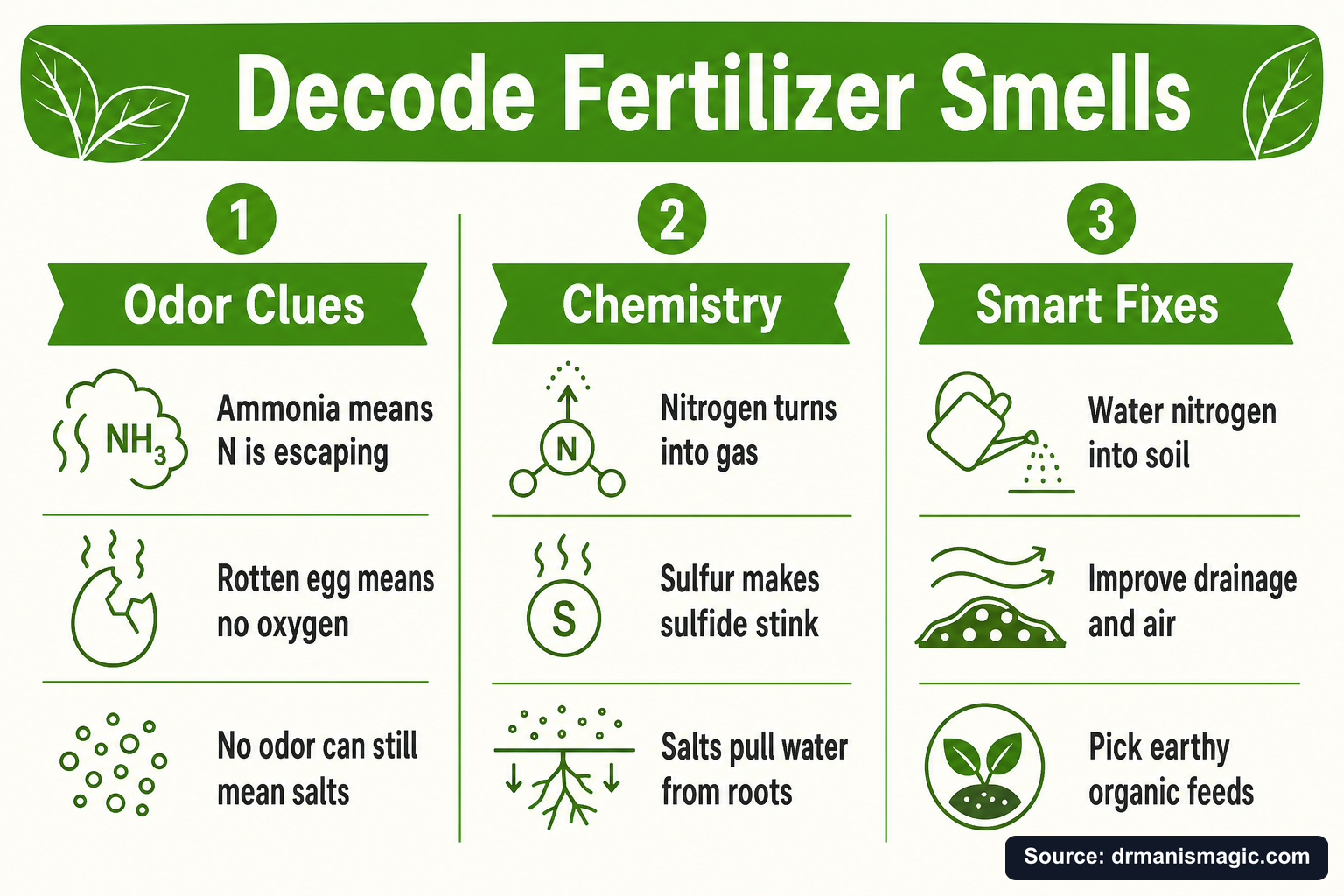
- Fertilizer odor is a direct chemistry signal, not just a nuisance. Each smell points to a specific compound, soil condition, or microbial process.
- Ammonia smell means nitrogen is escaping into the air instead of feeding your plants. That is wasted money and potential root burn.
- Rotten egg and sewage smells mean your soil is running out of oxygen, which is deadly for roots and beneficial microbes alike.
- Salt-based synthetic fertilizers can burn roots and kill soil microbes even when they have no strong odor at all. Odor-free does not mean safe.
- Some fertilizers contain biosludge and PFAS "forever chemicals." Odor is one clue, but label reading matters just as much.
- Organic fertilizers that smell earthy and mild are feeding your soil microbes first, which then slowly release nutrition to your plant roots in the safest, most natural way possible.
- The Three Plant Pillars framework, developed by Dr. Mani Skaria at US Citrus Nursery, gives you a clean, smell-smart foundation for any plant, lawn, garden, or tree.
Why Does Fertilizer Have a Smell at All?
Quick Answer: Fertilizer smells because chemistry is happening. Nitrogen compounds evaporate as ammonia gas. Sulfur compounds release rotten-egg odors. Anaerobic microbes produce sewage-like gases when soil loses oxygen. Every distinct smell has a specific chemical source, and each one tells you something useful about what is happening in your soil right now.
Smell is just chemistry you can detect with your nose. When certain molecules become volatile, meaning they float off into the air as a gas, your nose picks them up. Fertilizers are full of these kinds of molecules.
Nitrogen is the biggest culprit. When nitrogen-rich fertilizers sit on wet soil or are mixed with high-pH conditions, they release ammonia gas. That sharp, eye-watering smell you get near a fresh application of urea or a big pile of chicken manure? That is ammonia. And every molecule of ammonia floating past your nose is a molecule of nitrogen that never made it to your plant's roots.
Sulfur is another big one. Sulfur is a natural nutrient that plants need. But when soil loses oxygen, certain bacteria switch to a different chemical process. They start breaking down sulfur compounds in ways that produce hydrogen sulfide, the same gas that makes rotten eggs smell so terrible. That smell is a warning sign. It means your soil is oxygen-starved.
Then there are the smells from organic matter breaking down the wrong way. Sour or silage-like odors come from fermentation. Sewage smells can come from anaerobic decomposition, or from fertilizers that contain biosolids, which is a polite term for treated municipal waste, including human sewage sludge. More on that in a moment.
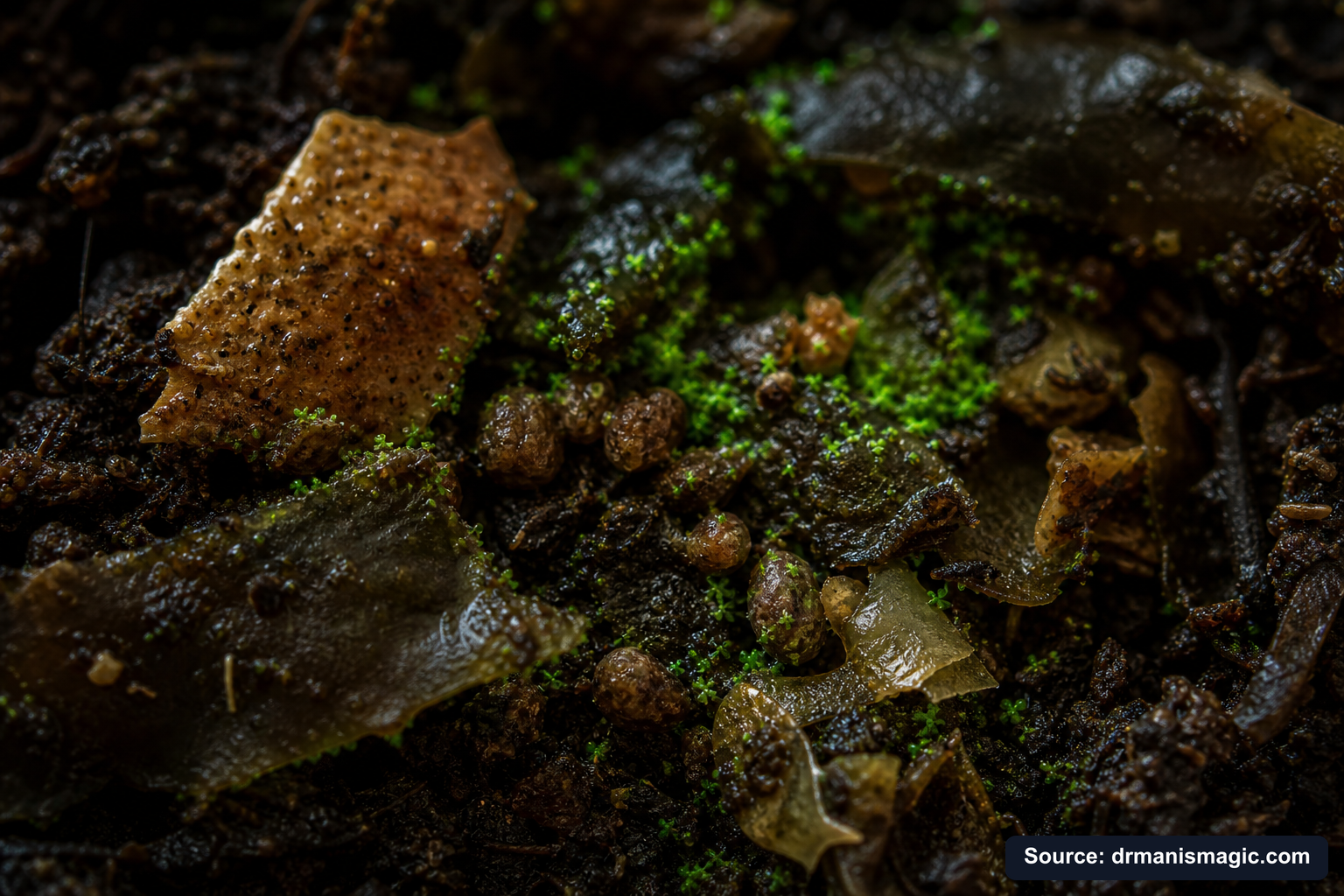
The earthy smell you get from healthy soil, that clean petrichor smell after rain, comes from a compound called geosmin, which is produced by thriving aerobic bacteria. When your soil smells like fresh earth, that is actually the scent of a healthy microbial ecosystem doing its job. According to research from the University of Maryland Extension, that earthy aroma is one of the best signs that organic matter is decomposing properly under aerobic, oxygen-rich conditions.
What Does an Ammonia Smell From Fertilizer Actually Mean?
Quick Answer: An ammonia smell means nitrogen is volatilizing, escaping as gas before your plant can use it. This happens most often with urea-based or ammonium-forming fertilizers applied to wet soil, high-pH soil, or bare soil surfaces. You are losing nutrition, and your roots may be at risk of chemical burn from concentrated nitrogen salts.
Ammonia is the smell of nitrogen running away. And that is a problem for two reasons.
First, you paid for that nitrogen. When it floats off as ammonia gas, it is gone. Your plant never sees it. Second, before it fully volatilizes, that concentrated nitrogen pool near the surface can act like a salt bomb against your roots and the beneficial microbes living near them.
Most synthetic nitrogen fertilizers, including urea, ammonium sulfate, and ammonium nitrate, are salt-based. When they dissolve in your soil water, they create high salt concentrations. Salt pulls water away from roots through a process called osmosis. Imagine your root cells trying to drink, but the water keeps getting pulled in the wrong direction. Plant scientists call this osmotic stress or physiological drought. Your plant can be sitting in moist soil and still be dying of thirst.
The ammonia smell gets worse in certain conditions. High soil pH above 7.0 drives more nitrogen toward the ammonia form. Hot weather speeds up volatilization. Applying fertilizer to the surface of dry or bare soil without watering it in means the nitrogen just sits there and evaporates. Heavy rain right after application can push it off in runoff before roots ever absorb it.
What should you do when your fertilizer smells like ammonia?
- Water it in immediately and deeply so nitrogen moves down into the root zone instead of evaporating.
- Check your soil pH. Values above 7.5 dramatically increase ammonia loss.
- Reduce application rates. More is not more. More is often just more smell and more root damage.
- Consider whether a slow-release organic nitrogen source might serve your plants better without the volatilization risk.
Why Does Soil Smell Like Rotten Eggs After Fertilizing?
Quick Answer: Rotten egg smell after fertilizing is hydrogen sulfide gas, produced by anaerobic bacteria in oxygen-starved soil. This usually means your soil is waterlogged, compacted, or has poor drainage. Roots cannot survive long in these conditions. The smell is a warning that root rot pathogens like Pythium and Phytophthora are likely already active.
Rotten egg smell is one of the most urgent warnings a gardener can get. It means your soil has gone anaerobic, which is a chemistry word for "out of oxygen."
Here is what is happening underground. Healthy soil is full of aerobic bacteria, the kind that need oxygen to live. These are the good guys. They break down organic matter, unlock nutrients, and protect roots. But when soil becomes waterlogged or compacted, the oxygen pockets between soil particles fill up with water. The aerobic bacteria start dying. Then a different group of bacteria, the anaerobic kind, take over. These microbes do not need oxygen. Instead, they use sulfur compounds as part of their energy process, releasing hydrogen sulfide gas as a byproduct. That is the rotten egg smell.
At the same time, anaerobic soil conditions are exactly where root rot fungi thrive. Pythium and Phytophthora, two of the most destructive root rot pathogens in gardening, love warm, wet, oxygen-poor soil. They can destroy a root system in days. By the time your plant shows yellowing leaves or wilting above ground, the roots below may already be gone.
Overwatering is the most common cause of anaerobic soil. But compaction is just as guilty. When soil particles are pressed together, there is no room for air. This is one reason Dr. Mani Skaria developed his mineral-based Super Soil, built from silica-rich sandy loam from the Rio Grande Valley. Unlike bark or sawdust-based potting mixes that compact over time, mineral soil holds its structure permanently, keeping oxygen available to roots year after year.
If your soil smells like rotten eggs, here is your recovery checklist:
- Stop watering immediately. Let the soil dry out until the top two inches feel dry to the touch.
- Improve drainage. For containers, check that drainage holes are clear. For garden beds, consider raised beds or adding coarse mineral material to break up compaction.
- Aerate compacted ground soil. A simple aerating fork or core aerator can reopen oxygen pathways quickly.
- Stop fertilizing until the soil is healthy again. Adding more fertilizer to anaerobic soil just adds more fuel to the wrong fire.
- Inspect roots when possible. Healthy roots are white or tan and firm. Rotted roots are brown, black, mushy, or slimy.
- Reintroduce beneficial microbes. Live aerobic bacteria and mycorrhizal fungi help outcompete anaerobic pathogens when oxygen returns.
- Do not mask the smell with fragrances or cover material. The odor is diagnostic. You need to solve the underlying chemistry, not hide the symptom.
What Does a Sewage or Sour Smell in Fertilizer Mean for Food Gardens?
Quick Answer: A sewage or sour fermentation smell can signal two very different problems. Sour or silage-like odors mean fermentation is happening, often from immature compost or anaerobic organic inputs. A true sewage smell may indicate the fertilizer contains biosolids, which is treated municipal sewage sludge. Biosolids can carry PFAS forever chemicals, heavy metals, and pathogens, making them especially risky in vegetable and fruit gardens.
This is where the conversation gets important. And a little uncomfortable.
Not all "organic" fertilizers are created equal. Some organic fertilizers are made from clean, food-grade inputs. Others use biosolids as a filler. Biosolids are the solid material left over after treating municipal wastewater, which includes human waste. They are technically legal to use in agriculture. But they come with a growing list of concerns.
The biggest one is PFAS. PFAS stands for per- and polyfluoroalkyl substances, sometimes called "forever chemicals" because they do not break down in the environment or in your body. They have been linked to serious health concerns in ongoing research. According to the Penn State Extension, PFAS from biosolid-amended soils can be taken up by crops, including vegetables and fruits, and can persist in soil for years.
Here is what makes this tricky. Some fertilizers that contain biosolids will tell you on the label. Some will not. The smell is one clue. A true sewage or very heavy ammonia smell in a bag of fertilizer is worth investigating. But you cannot always smell biosolids, especially in blended products.
A sour or silage smell, the kind that reminds you of fermented grain or pickles, usually means something different. It means organic matter is decomposing without enough oxygen, a fermentation process rather than a rotting one. This often happens in immature compost, wet manure piles, or liquid organic fertilizers that have gone anaerobic in the bottle. These products can still be useful once they mature or are properly aerated, but applying them directly to plant roots is risky.
The solution we landed on at our nursery, after testing inputs on 250,000-plus trees, was clean sourcing. Our Crab, Kelp & Amino Acids fertilizer contains zero biosludge, zero PFAS, and zero synthetic salts. It smells earthy and mild, almost pleasant, because it is made from crab shells, cold-processed kelp, volcanic ash, and amino acids derived from clean animal sources. No sewage. No mystery fillers. No forever chemicals in your food garden.
Can Odor-Free Fertilizer Still Burn Plants? The Hidden Salt Problem
Quick Answer: Yes. Many of the most damaging fertilizers have almost no smell at all. Synthetic salt-based granules can look and smell completely neutral but still cause osmotic drought, root scorch, microbial die-off, and long-term soil damage. Odor-free does not mean plant-safe. Salt index, application rate, and soil biology matter far more than whether a product smells bad.
This is the part that catches most gardeners completely off guard.
You open a bag of white granules. They barely smell like anything. You think, "This must be clean stuff." You follow the directions, maybe add a little extra for good measure, and water it in. Everything looks fine for a week or two. Then the tips of the leaves start turning brown. The grass develops streaks. A container plant starts wilting even though the soil feels moist. You scratch your head.
What you are seeing is salt damage. And it has nothing to do with odor.
Synthetic fertilizers are, chemically speaking, salts. Not table salt exactly, but the same class of ionic compounds that dissolve in water and raise the osmotic pressure of the soil solution. When that pressure gets high enough, it reverses the normal direction of water movement. Instead of water flowing from the soil into the root, water flows out of the root into the soil. The plant dehydrates from the inside out even while sitting in wet ground. That is osmotic stress.
Every fertilizer has what scientists call a salt index, a measure of how much it raises osmotic pressure in soil relative to sodium nitrate. High salt index fertilizers, which include most synthetic nitrogen and potassium sources, are the most dangerous near roots and seeds. The higher the salt index, the more potential for root scorch, seedling death, and microbial damage.
And that microbial damage is the hidden long-term cost. The beneficial bacteria and fungi in your soil, the same microbes that unlock nutrients, protect roots from pathogens, and build soil structure, are extremely sensitive to salt. A single heavy application of high-salt synthetic fertilizer can crash the microbial population in your root zone. Without those microbes, your soil becomes nutritionally locked. You have to add more fertilizer to get the same response. Then more. The cycle feeds itself, and the company selling you bags of white granules profits every season.
See also: How Salt-Based Feeding Quietly Destroys Root Systems
The Fertilizer Odor Diagnostic Table: What Each Smell Means
Use this table the next time a bag, bottle, soil, or compost pile gives you a strange smell. Match the odor, check the likely cause, and take the right action.
| Odor | Likely Compounds | What It Signals | Plant Risk | Corrective Action |
|---|---|---|---|---|
| Sharp ammonia, like a locker room | Ammonia gas (NH3) from urea or ammonium-forming nitrogen | Nitrogen volatilizing; high pH; surface application; urea decomposing | Nitrogen loss; root and microbial burn near application zone | Water in deeply; check pH; reduce rate; consider organic nitrogen |
| Rotten eggs, sulfur | Hydrogen sulfide (H2S) from anaerobic sulfur reduction | Soil is oxygen-starved; waterlogged or compacted conditions | Root rot (Pythium, Phytophthora); microbial die-off; root suffocation | Stop watering; improve drainage; aerate; inspect roots; reintroduce aerobic microbes |
| Sour or silage, like vinegar or fermented grain | Volatile fatty acids; ethanol; fermentation byproducts | Immature compost; anaerobic liquid fertilizer; low-carbon organic matter fermenting | Root burn from fermentation acids; phytotoxicity | Allow compost to mature fully; aerate liquid inputs; dilute before applying |
| Sewage or human waste | Amines; skatole; indole; volatile sulfur compounds from biosolids | Possible biosolid or municipal waste content; anaerobic organic decomposition | PFAS contamination risk; pathogen risk; especially serious in food gardens | Check label for biosolid content; avoid in edible gardens; choose clean-sourced inputs |
| Fishy | Trimethylamine; amines from fish meal or emulsion | Fish-based organic fertilizer; normal for the input but intense | Generally low plant risk; attracts pets and wildlife; unpleasant indoors | Water in well; avoid on indoor plants; choose a deodorized alternative if needed |
| Fresh earth, clean petrichor | Geosmin from Streptomyces and actinobacteria | Healthy aerobic microbial activity; compost is mature; soil biology is thriving | No risk; this is the good smell | Keep doing what you are doing |
| Musty or moldy | Fungal volatile organic compounds; mycotoxins possible | Product may be stored wet; fungal overgrowth in bag; compost not fully cured | Possible phytotoxicity; check for visible mold on granules | Spread product in sun to dry; inspect for mold; discard if heavily contaminated |
| Chemical or plastic | Polymer coating solvents; synthetic binders; urea coating breakdown | Slow-release synthetic fertilizer with polymer shell; plastic coating degrading | Plastic microparticles accumulating in soil; possible toxin leach | Avoid polymer-coated synthetics; choose natural slow-release alternatives |
| No odor at all | Inorganic mineral salts; water-soluble synthetics | Synthetic salt-based fertilizer; odorless does not mean harmless | High osmotic stress; root burn; microbial die-off; salt accumulation in containers | Check salt index; water deeply between applications; watch for leaf tip scorch and white soil crust |
You Never Had a Brown Thumb.
You were handed the wrong tools. This free guide hands you the right ones.
You watered it. You fed it. It died anyway.
It was never you. It was the dirt, the salt food, and the bad advice.
This guide shows you what really went wrong, and how to fix it for good.
- Why your plants really died, and why it was never your fault
- The salt hiding in your plant food that quietly burns the roots
- The hidden killer in almost every bag of store soil
- The tiny helpers that grow a whole forest for free
- The rescue trick that brings a half dead plant back to life

How Do Microbes Connect Fertilizer Odor to Root Health?
Quick Answer: Soil microbes are the engine behind fertilizer odor and nutrient availability. When aerobic microbes are healthy, they break down organic fertilizer quietly and efficiently, producing that clean earthy smell. When they are starved of oxygen or killed by salt, anaerobic microbes take over and produce the foul odors that signal danger. Healthy microbes equal healthy roots, good smells, and plants that thrive.
Here is the most important thing most fertilizer articles never tell you.
Your plant does not actually eat fertilizer. Not directly. The real story is more interesting than that, and it explains everything about why odor matters so much.
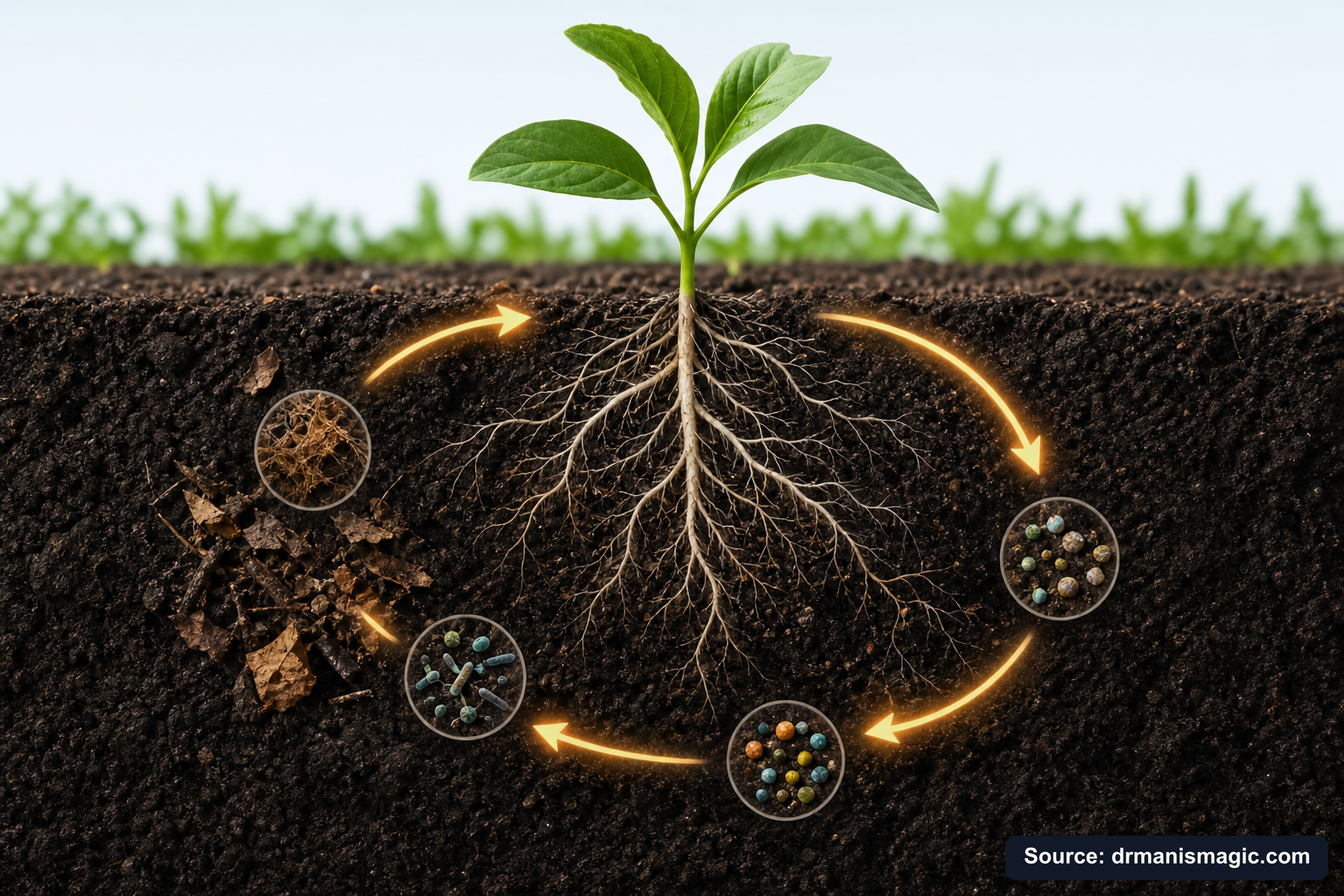
When you apply an organic fertilizer, the microbes in your soil eat it first. Bacteria and fungi break down the proteins, chitin, kelp compounds, and amino acids in the fertilizer. They use those nutrients for their own energy and growth. In the process, they convert the nutrients into simpler forms that plant roots can absorb, like ammonium and nitrate from nitrogen, phosphate from phosphorus, and potassium ions from potassium-rich compounds.
Then something even more powerful happens. When those microbes die, as all living things eventually do, their bodies release every nutrient they stored straight into the soil right next to your roots. It is like a slow, steady drip of perfectly pre-digested nutrition. This is why organic fertilizers keep feeding your plants long after you apply them. The microbes do the work. The plant gets the benefit. And the whole system keeps cycling as long as the microbes stay alive and active.
Now here is what salt-based synthetic fertilizers do to this system. They skip the microbes entirely. They dissolve directly into soil water as ions, ready for roots to absorb immediately. That sounds efficient. But the high salt concentration in the soil water stresses and kills the very microbes that make the whole natural cycle work. You get a quick green-up. Then the microbes die. Then the soil becomes nutritionally locked. Then you need more fertilizer. Then more microbes die. That is the cycle the big chemical companies never explain in their advertising.
Fish emulsion, a popular organic fertilizer, is a good example of what happens when organic inputs go wrong. It is technically natural. But it can go anaerobic during production or storage, creating intense ammonia and amine smells so strong that pets and dogs have been reported to vomit near it. That smell is chemistry gone sideways, a signal that the microbial process is not running clean. The inputs in our fertilizer are processed and stabilized so that they smell earthy, not rotten, because the biology is working the right way from the start.
You can learn more about how to set up this living system correctly with our Free Plant Care Field Guide, which walks through the Three Plant Pillars step by step for any plant, lawn, or garden.
Synthetic vs. Slow-Release vs. Organic Fertilizer: A Chemistry Comparison
Quick Answer: Synthetic fertilizers are fast-acting salt compounds that can burn roots and kill microbes. Polymer-coated slow-release synthetics reduce burn risk slightly but leave plastic residue in soil. Organic fertilizers like crab, kelp, and amino acids feed microbes first, release nutrients gradually, support root health, and leave no salt or plastic behind. For long-term plant health, organic wins on every measure that matters.
Let's put the three types side by side so the differences are impossible to miss.
| Feature | Synthetic Fast-Release | Polymer-Coated Slow-Release Synthetic | Organic (Crab, Kelp, Amino Acids) |
|---|---|---|---|
| Release speed | Immediate; dissolves on contact with water | Slow; regulated by coating thickness | Slow; regulated by microbial activity |
| Salt content | Very high; directly raises osmotic pressure | High inside coating; lower initial release | Negligible; plant regulates its own uptake |
| Effect on soil microbes | Kills beneficial bacteria and fungi; microbial crash | Less immediate damage but still harmful over time | Feeds microbes; increases microbial diversity |
| Root burn risk | High; especially in containers and at high rates | Moderate; reduced by coating but not eliminated | Very low; protein-based nitrogen is gentle |
| Typical odor | Little to no odor, or sharp ammonia | Slight chemical or plastic smell from coating | Earthy, mild; no sewage, no ammonia |
| PFAS or biosludge risk | Possible if biosolids used as filler | Plastic coating leaves microplastics in soil | Zero when sourced clean (no biosludge, no PFAS) |
| Long-term soil health | Degrades soil biology over time | Accumulates plastic; disrupts biology | Builds soil biology; improves structure |
| Best for | Fast visual response; short-term results | Convenience over single season | Long-term health, food gardens, any plant type |
See also: Why Most Fertilizers Are Actually Salt in Disguise
What Makes Crab Shells, Kelp, and Amino Acids Smell Different From Other Organic Fertilizers?
Quick Answer: Crab shells, cold-processed kelp, and amino acids smell earthy and mild because they are stable, aerobically processed inputs. They do not ferment or putrefy the way fish emulsion or poorly processed manure can. The chitin in crab shells, the natural hormones in kelp, and the protein nitrogen in amino acids all feed soil microbes cleanly, without the foul odors that signal anaerobic chemistry gone wrong.
Remember that theme about smell as a chemistry signal? Here is where it gets practical and personal.
Walk into a room where someone just opened a bag of crab meal and kelp. It smells like the ocean and the earth at the same time. It is not offensive. It does not make your eyes water. It does not send your dog into a frenzy or make your neighbors wonder if something died in your yard. That mild, clean smell is telling you something very specific. The chemistry is stable. The inputs are aerobically processed. The microbial activity they will trigger in your soil will be the clean, oxygen-rich kind that produces geosmin, that fresh earth smell, not hydrogen sulfide or ammonia.
The crab shells bring chitin to your soil. Chitin is a structural compound found in the shells of crustaceans and the cell walls of fungi. When chitin breaks down in soil, it stimulates a specific group of bacteria called chitinase-producing bacteria. These bacteria happen to be natural antagonists of many root rot pathogens. They compete with and suppress the fungi that cause diseases like Pythium and Phytophthora. Chitin is essentially a natural disease-defense trigger built right into the fertilizer.
The cold-processed kelp brings something different. Kelp is loaded with natural plant hormones called auxins and cytokinins, as well as carbohydrates, trace minerals, and biostimulants. Auxins regulate root growth and cell elongation. Cytokinins promote cell division and delay leaf aging. These are not synthetic chemicals. They are the same signaling compounds that plants evolved to respond to over millions of years. The kelp delivers them in their natural form, and your plant knows exactly what to do with them.
The amino acids provide nitrogen in its most plant-friendly form. Amino acids are the building blocks of proteins. When your plant receives amino acid nitrogen, it skips several energy-expensive conversion steps that are normally required when processing nitrate or ammonium. The plant can use that saved energy for growth, flowering, and fruiting instead. And because amino acid nitrogen moves through the soil attached to organic molecules rather than as free salt ions, it does not spike osmotic pressure. It does not burn roots. It does not kill your microbes.
Add volcanic ash to that mix, and you have a source of silica and trace minerals that strengthens cell walls, increases drought tolerance, and provides the micronutrients that most fertilizers completely ignore. The Law of the Minimum, which states that your plant grows only as fast as its most deficient nutrient allows, means that trace minerals matter more than most gardeners realize.
Salt Damage vs. Overwatering vs. Root Rot: How to Tell the Difference
Quick Answer: Salt damage, overwatering, and root rot can all look similar above ground but have different causes and different fixes. Salt damage shows as leaf tip scorch and white soil crust with no root decay. Overwatering causes wilting with wet soil and may progress to root rot. True root rot shows brown or black mushy roots, rotten egg smell, and collapse even after soil dries. Match the symptom to the cause before you treat.
One of the most common mistakes gardeners make is treating the wrong problem. You see a wilting plant and grab the hose. But if the problem is salt accumulation, more water only dilutes the issue temporarily without solving it. If the problem is root rot, more water makes it worse. And if the problem is both, which happens more than you think, you need to address them in the right order.
| Symptom | Salt Damage | Overwatering | True Root Rot (Pythium/Phytophthora) |
|---|---|---|---|
| Leaf appearance | Brown tips and margins; scorch pattern starting at edges | Yellowing; overall pale green; drooping | Sudden collapse; yellow to brown; may drop leaves fast |
| Soil surface | White or tan crust on container soil surface | Consistently wet; possibly waterlogged | May be wet or may appear dry if rot is advanced |
| Soil smell | Neutral or very slight chemical | Earthy to slightly musty | Rotten egg, sewage, or strong sour smell |
| Root appearance | White and firm but may show surface burn on fine roots | White to tan; may begin softening if prolonged | Brown or black; mushy; slimy; separates from outer sheath when pulled |
| Response to watering | Brief improvement; scorch returns with next application | Gets worse with more water | No improvement; plant continues to decline |
| Primary fix | Flush soil with clean water; reduce fertilizer rate; check drainage | Reduce watering frequency; improve drainage; check soil structure | Remove affected roots; repot in clean mineral soil; reintroduce aerobic microbes; stop fertilizing until recovery |
The connection between these three conditions is not a coincidence. Salt damage weakens roots, making them more vulnerable to waterlogging. Overwatering creates anaerobic conditions that kill the microbes that would normally protect roots from pathogens. And once Pythium or Phytophthora establish in oxygen-poor, salt-damaged soil, they spread fast. The three problems form a chain, and synthetic fertilizers often start that chain.
See also: The Hidden Reason Synthetic Fertilizers Cause Root Rot

The Three Plant Pillars and Why They Make Fertilizer Odor a Non-Issue
Quick Answer: The Three Plant Pillars, developed by Dr. Mani Skaria at US Citrus Nursery after growing 250,000-plus trees, are mineral-based soil, live microbials, and organic fertilizer. When all three are working together, your soil stays aerobic, your microbes stay alive, and your fertilizer smells earthy instead of foul because the chemistry is running the right way from the start.
After three decades and 250,000 trees at our nursery in Hargill, South Texas, Dr. Mani Skaria arrived at a framework so simple you can hold it in three fingers. Mineral-based soil. Live microbes. Organic fertilizer. That is it. That is the Three Plant Pillars.
The mineral-based soil prevents the compaction and oxygen loss that causes rotten egg smells. Unlike bark and sawdust mixes that decompose into root-choking sludge within months, mineral soil holds its structure permanently. Roots can breathe. Water drains. Aerobic bacteria stay active. The foul smells never get a chance to start.
The live microbials, bacteria, fungi, and mycorrhizae introduced through Plant Super Boost, populate your root zone with the organisms that make organic fertilizer work. They eat the crab, kelp, and amino acids. They convert the nutrients into plant-available forms. They suppress pathogens. They produce that clean earthy smell that tells your nose everything is working right.
The organic fertilizer, made from clean chitin-rich crab shells, cold-processed kelp, volcanic ash minerals, and amino acid nitrogen, feeds the microbes gently and steadily. It does not spike salt levels. It does not volatilize as ammonia. It does not produce sewage smells. It smells like the earth after rain, because that is the chemistry it creates.
Every plant owner, whether you have an acre of lawn, a raised bed vegetable garden, a row of flowering perennials, or a single lemon tree in a pot on your back porch, benefits from this same three-part foundation. It is not a citrus-only system. We tested it on citrus first because that is our specialty, but the chemistry works for anything with roots.
The system also respects time in a way that synthetic fertilizers never can. When you build living soil with the right microbes and clean organic nutrition, you are not starting over every season. You are compounding. The soil biology grows stronger. The root systems go deeper. The plants become more resilient. And you get to spend your time enjoying the garden instead of chasing problems.
The number one thing people tell Dr. Mani they want is to see their own tree bear fruit while they still can. Not someday. Now. The fastest path to that moment is not a bag of white granules that smells like nothing but secretly burns everything underground. The fastest path is a living soil system that works the way nature intended, every single day, without you having to think about it.
You can explore the complete Three Plant Pillars system and build your own foundation at the Three Plant Pillars bundle builder. And if you want to see what other gardeners, tree growers, and lawn owners have experienced after making the switch, take a few minutes and read through the customer reviews.
Your nose already knows something is wrong when the bag smells like a chemical plant or a septic tank. Now you know why. And now you know what to do about it. Start with clean inputs, build a living soil, and let the chemistry work the way it was designed to.
If you want the full A-to-Z planting system that covers soil, microbes, nutrition, watering, and more, grab the Free Plant Care Field Guide. No sales pitch. Just the information you need to grow something you are proud of, faster than you thought possible.
Frequently Asked Questions
You opened that bag and your nose told you something was wrong. Good. That smell is a clue. After growing over 250,000 trees at our South Texas nursery, we learned that fertilizer odor is one of the fastest ways to know if your soil is being helped or quietly destroyed. Here are the questions we hear most often.
What does fertilizer smell actually tell you about what is in the bag?
Smell is chemistry you can detect with your nose. A sharp, eye-watering ammonia smell means nitrogen is escaping into the air instead of feeding your plants. A rotten egg smell means your soil has lost oxygen. A sewage smell means microbes are dying. Each odor points to a specific chemical reaction happening right now in your soil. At Dr. Mani's Magic, we built the Three Plant Pillars around clean inputs that protect your soil from these warning signs.
Is it safe to smell fertilizer when you apply it?
A brief whiff outdoors is usually not dangerous. But breathing in ammonia fumes or fine fertilizer dust can irritate your throat, nose, and eyes. It can trigger asthma. It can cause dizziness. Synthetic salt-based fertilizers are the biggest offenders. Our Crab, Kelp, and Amino Acids organic fertilizer smells earthy and mild because it is not rotting or off-gassing harsh chemicals. You can apply it without holding your breath or reading warning labels.
Why does my yard smell like fertilizer after I apply it?
That lingering smell usually means nitrogen is escaping as ammonia gas instead of soaking into the soil. This happens most with synthetic urea-based fertilizers, especially on wet ground or in high heat. Every molecule that floats past your nose is a molecule your plants never received. It is wasted money and wasted time. Slow-release organic fertilizers like ours feed soil microbes first, which lock nutrients in place so they actually reach your roots.
What does a rotten egg or sewage smell from my garden mean?
That smell is hydrogen sulfide gas. It means your soil has gone anaerobic, which means it has run out of oxygen. Roots need oxygen to breathe. When soil compacts or stays waterlogged, beneficial bacteria die and harmful bacteria take over. This is exactly why Pillar One of the Three Plant Pillars is mineral-based soil. Our Super Soil is built from silica-rich sandy loam that drains properly and keeps oxygen flowing to your roots so this never happens.
Do organic fertilizers smell bad?
Some do. Fish emulsion is famous for making pets sick and clearing out a room. Many organic fertilizers go anaerobic in the bottle and smell like rotting sewage. That is a sign the microbes inside have already died. Our Crab, Kelp, and Amino Acids fertilizer smells earthy and clean. Our Plant Super Boost smells like fresh soil because the microbes inside are alive and stabilized, not rotting. You should be able to enjoy your garden every single day, not avoid it.
Can fertilizer smell harm my kids or pets?
Yes, it can. Synthetic fertilizers carry warning labels for a reason. Ammonia fumes irritate airways. Some slow-release synthetics are coated in plastics that leach toxins into your soil and water. Organic fertilizers like bone meal smell appealing to dogs and can cause serious harm if eaten. Our products contain no harsh chemicals, no plastic coatings, and no fish emulsion. They are designed so your kids can play barefoot and your pets can roam without you worrying.
What does it mean if fertilizer has no smell at all?
No smell does not mean safe. Many synthetic salt-based fertilizers are nearly odorless but they are still burning your soil microbes and creating dependency cycles that stall your plants after a few seasons. Odorless biosludge fertilizers can contain PFAS forever chemicals. Always read the label. At Dr. Mani's Magic, our products smell mild and earthy because they are clean, not because the chemistry is hidden. Trust the smell, but also trust what is actually printed on the bag.
About the Author
Dr. Mani Skaria, PhD
Dr. Mani Skaria, PhD, is a plant pathologist and the scientific founder of Dr. Mani's Magic. He spent 48 years studying how plants, soil, and living microbes work together, including his years as Professor Emeritus at Texas A&M and as a member of the USDA NAREEE Advisory Board. He invented micro-budding, a method for growing healthier, stronger trees, and has grown more than 250,000 trees on the family farm in Hargill, Texas - US Citrus Nursery. His life's work takes real lab science and turns it into simple, safe, organic plant care anyone can use at home.


