


How Odor Can Attract Pests and Signal Soil Problems | Dr. Mani's Magic
How Odor Can Attract Pests and Signal Soil, Fertilizer, and Root Problems
You step outside to check on your container lemon tree. Something stops you before you even get close. There is a smell. Not a bad smell exactly, just... off. A little fishy. A little sour. You shrug and walk away. Two weeks later, the leaves are yellowing. You notice tiny flies hovering at the soil surface. You dig in just a little and the roots look dark. Mushy. Wrong.
Here is what nobody told you: that smell was a warning. It was your garden trying to talk to you. Every distinct odor coming from your soil, your compost, or your fertilizer is a signal. It tells you something specific about what is happening underground, where the real battle for your plant's life is being fought right now.
After growing and testing more than 250,000 trees at our South Texas nursery, we learned to read those smells the way a doctor reads symptoms. A fishy odor means one thing. A rotten-egg smell means something completely different. An ammonia burn in your nose means your nitrogen is literally escaping into the air instead of feeding your plants. This guide is going to teach you how to read every one of those signals, what is actually causing them, and how to fix the root problem before it costs you something money cannot buy back: time.

Organic Fertilizer | Crab, Kelp & Amino Acids
Key Takeaways
- Every soil and fertilizer odor is a diagnostic signal, not just an annoyance.
- Fishy, ammonia, rotten-egg, and sour smells each point to a different problem with different solutions.
- Bad odors from organic amendments can attract flies, fungus gnats, rodents, raccoons, and dogs that dig up your plants.
- Anaerobic (no-oxygen) soil conditions cause rotten-egg smell and are the direct cause of root rot and Pythium or Phytophthora fungal disease.
- Salt-based synthetic fertilizers kill the beneficial microbes that prevent odor, pests, and disease.
- Clean, slow-release organic inputs like crab meal, kelp, and amino acids deliver nutrition without the odor, pest attraction, or salt damage.
- The Three Plant Pillars framework, developed at US Citrus Nursery, eliminates the root causes of these problems instead of chasing symptoms one by one.
Why Does Your Soil or Fertilizer Smell Bad After Applying Amendments?
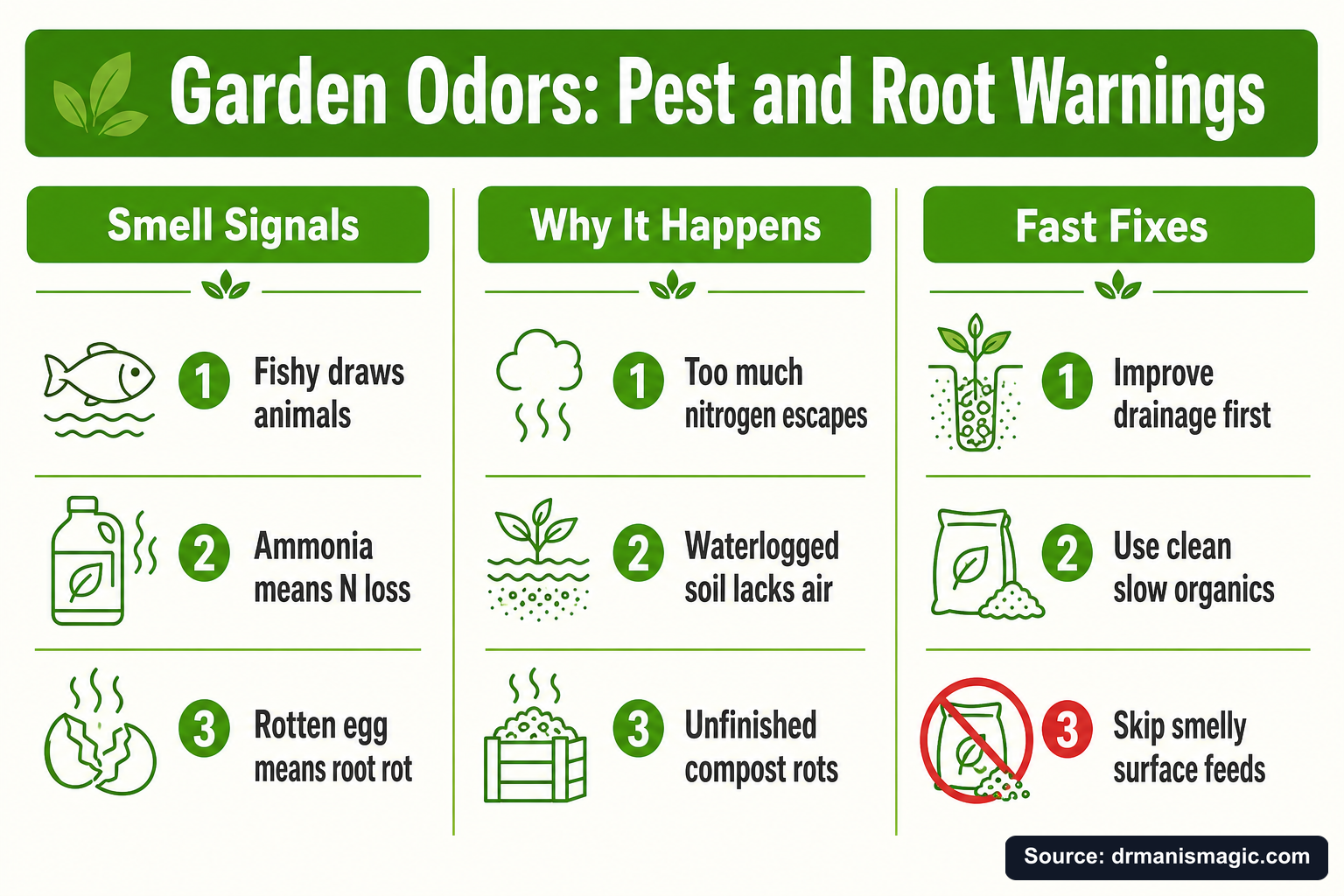
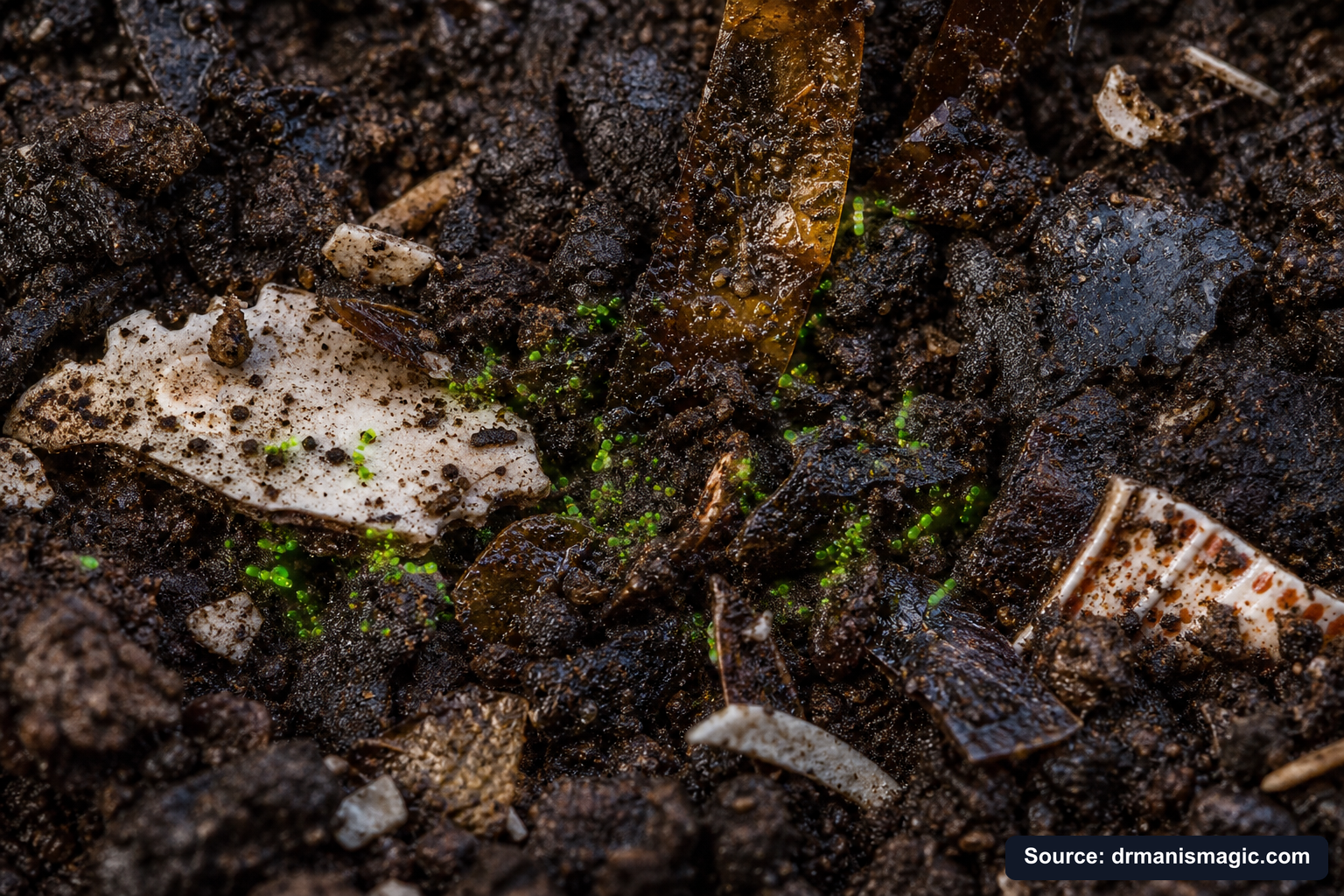
Quick Answer: Bad smell after fertilizing almost always means one of four things: too much nitrogen escaping as ammonia gas, anaerobic decomposition from waterlogged soil, animal proteins rotting on the surface, or incomplete compost still actively breaking down. Each smell points to a different fix. The odor is the clue, not the problem itself.
Smell is chemistry. Every odor you detect in your garden has a specific molecule behind it.
When you apply a high-nitrogen fertilizer and get that sharp, eye-watering ammonia sting, that is nitrogen literally leaving. It is volatilizing into the air instead of going into your plant's roots. That is wasted money. But more than that, it is a sign of pH imbalance or overapplication. Ammonia loss is especially bad when you mix high-nitrogen materials like blood meal or manure with high-pH wood ash. They react and push nitrogen straight into the atmosphere.
When you smell rotten eggs, that is hydrogen sulfide gas. It means your soil has gone anaerobic. No oxygen is reaching the root zone. The beneficial aerobic bacteria that protect your roots have died off. Now the anaerobic bacteria, the ones that produce toxic byproducts, have taken over. Pythium and Phytophthora, the two most destructive root-rot pathogens in container and garden plants, thrive in exactly these waterlogged, oxygen-starved conditions.
When you smell something sour or putrid, like old garbage, that usually means your compost is not finished. Immature compost is still decomposing. It is releasing compounds that are actually toxic to plant roots. Applying it too early is worse than not applying it at all.
When you smell fish, well, that one is obvious. You used a marine-based fertilizer or amendment. That smell alone is enough to bring every raccoon, opossum, and dog in a two-block radius right to your garden.
Here is a quick reference so you can diagnose your garden by smell alone:
| Odor You Smell | Likely Cause | What It Means for Your Plant | Pest Risk |
|---|---|---|---|
| Fishy / Marine | Fish emulsion, fish meal, crab meal, marine proteins | Usually safe for plants but nutrients may be releasing too fast | HIGH: raccoons, dogs, flies, rodents |
| Ammonia / Sharp chemical | Excess nitrogen, manure, blood meal, high-pH soil interactions | Nitrogen loss, possible root burn if concentrated | MODERATE: flies, gnats |
| Rotten egg / Sulfur | Anaerobic soil, waterlogged roots, dying root tissue | ROOT ROT WARNING: Pythium / Phytophthora likely active | HIGH: fungus gnats, shore flies |
| Sour / Putrid / Garbage-like | Immature or wet compost, meat or dairy in compost | Toxic compounds, nutrient lockout possible | HIGH: flies, rodents, raccoons |
| Manure / Barnyard | Raw or under-processed manure, biosolids | Possible salt damage, PFAS contamination risk | MODERATE: flies, rodents |
| Earthy / Petrichor | Healthy aerobic microbial activity (geosmin) | GOOD SIGN: your soil microbiome is alive and active | LOW |
| Musty / Basement | Mold or fungal growth in damp potting mix | Possible fungal pathogen, overwatering signal | HIGH: fungus gnats |
That earthy smell after rain? That is geosmin, a compound made by healthy Streptomyces bacteria in living soil. It is the smell of a thriving microbial ecosystem. When your soil smells like that, your plants are in good hands. When it smells like anything else in that table above, keep reading.
Does Fish Fertilizer Really Attract Raccoons and Other Pests?
Quick Answer: Yes. Fish emulsion and fish meal contain animal proteins and fatty acids that produce strong, persistent odors. These smells travel far and attract raccoons, opossums, dogs, foxes, and rodents. The animals dig at the root zone to find the source, physically damaging or uprooting your plants in the process.
This is one of the most underreported problems in the organic gardening world.
Fish emulsion has been a popular organic fertilizer for decades. It delivers nitrogen fast. It is liquid and easy to apply. But here is what the forums are full of: stories about pets vomiting from the smell, raccoons tearing up freshly fertilized containers at 2 AM, and dogs digging out newly planted trees.
The smell that marine-based fertilizers create when applied to warm soil is powerful. It lingers for days. Wildlife can detect it from distances that would shock you. And when they arrive to investigate, they dig. They dig right through your root zone. That physical disturbance, combined with any existing moisture stress, can topple a plant that had been growing beautifully.
The same problem applies to blood meal and feather meal. These are high-nitrogen organic amendments with strong protein odors. Blood meal in particular has been documented to attract rodents and neighborhood dogs. If you are growing in a container on a patio, or in a raised bed near your house, these odors become a direct problem for you, your pets, and your neighbors.
NC State Extension specifically warns that meat, fats, dairy, and similar materials in compost create odors that attract rodents and flies, and that foul compost odors are linked to wet, green material decomposing without enough oxygen. (NC State Extension Composting Guide)
Here is what most gardeners do not know: the odor problem and the pest problem are both symptoms of the same underlying issue. The inputs are releasing nutrients too fast, in the wrong conditions, producing smelly byproducts instead of quietly feeding your soil biology. The fix is not to avoid organic fertilizer. The fix is to choose inputs that are stabilized, slow-release, and processed in a way that does not create that pungent, pest-attracting off-gassing.
That is exactly why our Crab, Kelp & Amino Acids formula is processed the way it is. It does not have that sharp marine smell that sends raccoons sprinting across your yard at midnight. It smells earthy, mild, and clean, because it is stabilized and working with your soil biology rather than off-gassing protein breakdown products into the air.
What Do Fungus Gnats Have to Do With Soil Odor and Organic Matter?
Quick Answer: Fungus gnats are directly triggered by moist soil rich in decomposing organic matter, both of which produce odors that attract them. Their larvae feed on fungi and young roots, spreading disease and stunting seedlings. The combination of overwatering plus organic amendments is the number one setup for a fungus gnat infestation.
You have probably seen them. Those tiny flies hovering just above the soil surface of your houseplant or container tree. They look harmless. They are not.
The adults are annoying but mostly cosmetic. The larvae are the problem. They hatch in warm, moist, odorous soil and they feed on two things: fungi in the growing medium and the fine root hairs of your plant. Those fine root hairs are how your plant absorbs water and nutrients. When fungus gnat larvae chew through them, the plant gets stressed even when you are watering correctly. The symptoms look like overwatering or nutrient deficiency, because the roots simply cannot do their job anymore.
Utah State University Extension explains it clearly: fungus gnats breed in damp potting mix, mulch, and decaying organic matter, and their larvae can damage young roots, stunt seedlings, and spread pathogens. (Utah State University Extension: Fungus Gnats)
The setup for fungus gnats is almost always the same:
- A potting mix heavy in organic material like pine bark, peat, or decomposing wood fiber.
- Overwatering or poor drainage keeping that material perpetually damp.
- The damp organic matter produces odors that attract egg-laying females from outside.
- Larvae hatch and begin feeding on roots.
- The plant weakens and becomes more susceptible to root rot pathogens.
- Now you have fungus gnats AND root rot at the same time.
This is why the mineral foundation pillar matters so much. Most potting mixes sold at big box stores are loaded with organic material that decomposes within months. As it decomposes, it compacts, reduces oxygen flow to roots, holds moisture in all the wrong ways, and produces exactly the musty, decomposing odor that draws fungus gnats in. It is a trap built right into the bag.
Mineral-based soil, like the sandy loam foundation used in our Super Soil, does not decompose. It does not compact. It drains freely. It keeps oxygen moving through the root zone. And critically, it does not produce the wet, decomposing organic odor that sends fungus gnats flying toward your plants.
How Does Anaerobic Soil Cause the Rotten-Egg Smell and Root Rot?
Quick Answer: When soil stays waterlogged, oxygen runs out. Aerobic bacteria die off and anaerobic bacteria take over, producing hydrogen sulfide gas, which smells like rotten eggs. This oxygen-starved environment is exactly where Pythium and Phytophthora root rot pathogens thrive. The smell is your early warning that roots are already dying.
Roots breathe. Most people do not know that.
We think of roots as just anchors and nutrient pipes. But roots are living tissue. They need oxygen the same way you do. When soil becomes waterlogged, the air pockets between soil particles fill with water. Oxygen disappears. The roots start to suffocate.
In that oxygen-starved zone, the chemistry of your soil changes completely. The beneficial aerobic bacteria, the ones that protect your roots and unlock nutrients, cannot survive without oxygen. They die. In their place, anaerobic bacteria take over. These bacteria process organic compounds through fermentation-style reactions that produce hydrogen sulfide, a gas that smells exactly like rotten eggs.
At the same time, Pythium and Phytophthora, two water mold pathogens, explode in population. These are not true fungi. They are oomycetes, sometimes called water molds, and they produce swimming spores that move through saturated soil water and attack root tips directly. Once they establish, they spread fast. Root tissue turns brown and mushy. The plant begins to show what looks like drought stress, wilting, yellowing, dropping leaves, even though the soil is soaking wet. That is osmotic stress. The root system is so damaged it cannot move water upward, even when water is everywhere.
This is the rotten-egg situation. By the time you smell it, root damage has already begun. But it is not too late. See the recovery checklist below.
Recovery Checklist: What to Do When You Smell Rotten Egg From Your Soil
- Stop watering immediately. Let the soil dry out as much as the plant can tolerate.
- Check drainage. Make sure the container has working drainage holes. If not, repot immediately.
- Remove and inspect the root ball. Trim any black, mushy, foul-smelling roots with clean scissors. Healthy roots are white or tan and firm.
- Repot into mineral-based, well-draining soil. Organic-heavy potting mix will re-create the problem. You need soil that does not hold excess moisture.
- Drench the root zone with live beneficial microbes. Beneficial bacteria and mycorrhizal fungi compete directly against Pythium and Phytophthora and help rebuild the root system.
- Hold off on fertilizer for 2-3 weeks. Let the roots stabilize before adding any nutrition.
- Resume feeding with a low-salt, slow-release organic fertilizer once new growth appears. Avoid any salt-based synthetic fertilizers, which will add osmotic stress to an already damaged root system.
See also: The Hidden Reason Synthetic Fertilizers Cause Root Rot
Can Organic Fertilizer Burn Roots the Same Way Synthetic Fertilizer Can?
Quick Answer: True organic fertilizers rarely burn roots because they do not deliver a concentrated salt hit. Synthetic fertilizers are salt-based and create osmotic stress that pulls water out of roots. High-nitrogen organic inputs like blood meal can cause burn if overapplied, but the mechanism is different and the risk is far lower than with any salt-based synthetic product.
This question comes up constantly. And it is a fair one.
People hear "organic" and think "safe in any amount." That is not quite right. But the difference between organic and synthetic fertilizer damage is fundamental, not just a matter of degree.
Synthetic fertilizers are salt-based. Full stop. The nitrogen, phosphorus, and potassium in them are delivered as mineral salts. When you apply them to soil, they dissolve and create a high-salt zone around the roots. Salt pulls water out of root cells through osmosis. The roots literally dehydrate even when surrounded by moisture. This is called osmotic stress, and it is the exact same process that happens when you pour salt on a slug. The cell walls collapse. This is what gardeners call "fertilizer burn," and it can happen fast, especially in containers where salts accumulate with each watering cycle.
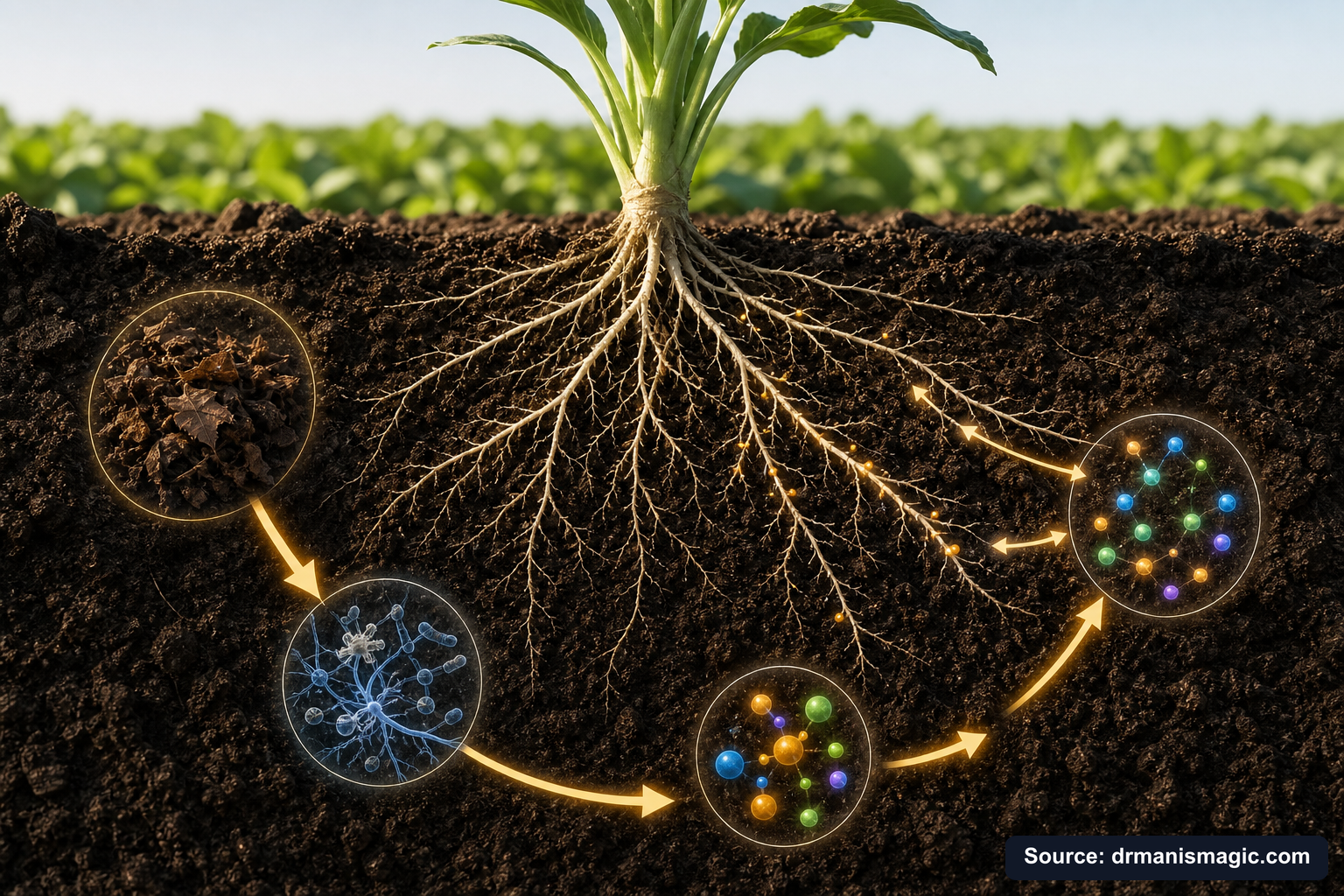
Now here is what makes organic fertilizer different at a biological level. True organic inputs like crab meal, kelp, feather meal, and amino acid-based fertilizers contain nitrogen bound up inside proteins and complex molecules. Plants cannot absorb nitrogen in that form directly. It has to be processed first. And who processes it? The microbes in your soil.
The microbes eat the organic matter. They break those protein chains apart. They convert bound nitrogen into ammonium and nitrate forms the plant can actually absorb. This takes time. Days, sometimes weeks. That slowness is not a weakness. That slowness is the whole point. It mirrors the pace at which nature has always delivered nutrients to plant roots. No spike. No crash. No salt hit. Just a steady, gentle release that keeps feeding the plant long after you last thought about fertilizing.
And here is the part that almost nobody talks about: when those microbes die after doing their work, they release all of the nutrients stored in their own bodies directly into the root zone. The microbes themselves become a second wave of slow-release nutrition. It is a natural, self-renewing feeding cycle built right into healthy soil.
Penn State Extension confirms that nutrients in organic fertilizers must be mineralized by soil microorganisms before plants can use them, and that this process slows when soil is cold, dry, waterlogged, or oxygen-limited. (Penn State Extension: Using Organic Nutrient Sources) This is exactly why the Three Plant Pillars work together. Oxygen-rich mineral soil keeps mineralization running. Live microbes keep breaking down and delivering. Clean organic fertilizer keeps feeding the whole system without salt damage.
You Never Had a Brown Thumb.
You were handed the wrong tools. This free guide hands you the right ones.
You watered it. You fed it. It died anyway.
It was never you. It was the dirt, the salt food, and the bad advice.
This guide shows you what really went wrong, and how to fix it for good.
- Why your plants really died, and why it was never your fault
- The salt hiding in your plant food that quietly burns the roots
- The hidden killer in almost every bag of store soil
- The tiny helpers that grow a whole forest for free
- The rescue trick that brings a half dead plant back to life

What Is the PFAS and Biosludge Problem in Some Organic Fertilizers?
Quick Answer: Some fertilizers labeled "organic" use biosolids, which is treated municipal sewage waste, as a filler. Biosolids can contain PFAS "forever chemicals" that accumulate in soil and plant tissue. There is no safe legal limit established for PFAS in garden soil, and these compounds do not break down. Clean sourcing matters more than the word "organic" on the label.
This one is important. And most people have no idea it is happening.
The word "organic" on a fertilizer bag does not tell you where the nitrogen came from. Some fertilizer manufacturers use biosolids, which is treated municipal waste, the processed output of sewage treatment plants, as a cheap nitrogen filler. It tests as organic. It gets labeled as organic. And it can be loaded with PFAS, polyfluoroalkyl substances, the class of synthetic chemicals sometimes called forever chemicals because they do not break down in soil or in the human body.
You are growing food. You are growing things in your yard where your children and pets play. You are growing things you will eat. The source of your fertilizer matters.
Blood meal, feather meal, and tankage are animal-protein-derived organic nitrogen sources that are generally free from PFAS concerns when properly sourced. Crab and shrimp shell meal from seafood processing, kelp harvested from clean ocean sources, and volcanic mineral products are also clean. These are the inputs that make sense for families who care about what goes into their soil.
Our Crab, Kelp & Amino Acids contains zero biosludge, zero PFAS, and zero synthetic salts. It is made in the USA from traceable, clean ingredients. That is not a marketing line. It is a sourcing decision we made because we feed our own families from the same trees we grow with it.
Synthetic vs. Organic vs. Chitin-Kelp Fertilizer: A Side-by-Side Comparison
Quick Answer: Synthetic fertilizers deliver nutrients fast but through salt, which damages roots and kills microbes. Organic fertilizers feed microbes first and plants second through a slow, safe, natural process. Chitin and kelp inputs add biological pest resistance and hormonal plant support that no synthetic fertilizer can replicate.
Let us lay this out clearly so you can see exactly what you are choosing between.
| Factor | Synthetic / Salt-Based | Organic (Blood Meal, Fish) | Crab / Kelp / Amino Acids |
|---|---|---|---|
| Odor risk | Low to moderate (chemical) | HIGH (fishy, ammonia, manure) | LOW (earthy, mild) |
| Pest attraction | Low | HIGH (raccoons, dogs, flies, gnats) | LOW to NONE |
| Salt index | VERY HIGH | Low to moderate | Very low |
| Microbial impact | KILLS beneficial microbes | Feeds microbes (if stabilized) | FEEDS and SUPPORTS microbes |
| Root burn risk | HIGH (osmotic stress) | Moderate if overapplied | Very low |
| Nitrogen release speed | Immediate (spike and crash) | Moderate (weeks) | Slow and steady (weeks to months) |
| PFAS / biosludge risk | Some products: YES | Some products: YES | ZERO (clean sourcing) |
| Chitin / pest defense | None | None | YES (crab shell chitin) |
| Plant growth hormones | None | None | YES (kelp auxins and cytokinins) |
| Trace minerals | Rarely included | Limited | YES (volcanic ash and kelp) |
| Container safe | Salt accumulation: RISKY | Generally yes | YES, highly container-safe |
Look at that table for a moment. The inputs that score worst on odor and pest attraction are the same inputs that score worst on salt damage and microbial harm. This is not a coincidence. The odor problem and the root problem come from the same place: inputs that are not in harmony with the biological systems that keep your soil alive.
What Does Chitin From Crab Shells Actually Do for Your Plants?
Quick Answer: Chitin is the structural material in crab and shrimp shells. When added to soil, it feeds a specific group of beneficial bacteria called chitinase-producing microbes. These bacteria also break down the chitin in fungal cell walls and in the exoskeletons of soil pest insects, giving your plant a natural, chemistry-free layer of protection against pathogens and root-feeding bugs.
This is one of the most exciting and least talked-about benefits in organic gardening.
Chitin is the same tough, fibrous material that makes up insect exoskeletons and fungal cell walls. When you add crab shell meal to your soil, you are adding chitin. The microbes in your soil that have evolved to eat chitin, a group called chitinase-producing bacteria and fungi, wake up and multiply. They start feeding on the crab shell chitin.
But here is the beautiful part. Those same microbes also attack the chitin in fungal pathogens like Pythium and Phytophthora. And they attack the chitin in the exoskeletons of soil-dwelling pest insects and nematodes. You are feeding your soil a population of microbes that naturally suppresses the exact organisms that cause root rot and root damage.
You are not spraying a pesticide. You are growing a living defense system in your soil. That is not a marketing claim. That is the biology of disease-suppressive soils, studied and documented in agricultural research for decades.
And unlike synthetic pesticides, this system does not leave residue. It does not harm earthworms. It does not require a re-entry interval before your kids can play in the yard. It smells like nothing alarming. It just works, quietly, underground, every single day.
What Does Kelp Actually Do Beyond Being a Fertilizer?
Quick Answer: Cold-processed kelp is not primarily a fertilizer. Its power comes from natural plant hormones called auxins and cytokinins, plus complex carbohydrates and biostimulants. These compounds trigger faster root development, help plants tolerate heat and drought stress, improve fruit set, and stimulate the microbial life around the root zone.
Kelp has been called the superfood of the ocean, and that is not an exaggeration when it comes to plant growth.
Ocean kelp grows incredibly fast, sometimes several feet per day in ideal conditions. It does this partly because it is packed with natural growth-regulating hormones. Auxins tell plant cells to elongate and roots to branch. Cytokinins trigger cell division. Together, they push root growth and shoot development faster than what nutrients alone can do.
When you apply cold-processed kelp to your soil, those hormones become available to your plants. The roots respond. New root tips form faster. The plant intercepts more nutrients and water. Stress tolerance improves. Fruit set improves. The whole plant gets a biological upgrade that no NPK ratio on a synthetic fertilizer bag can replicate.
The key word is cold-processed. Heat destroys these hormones. High-heat processing kills the auxins and cytokinins that make kelp worth using. Cold-processed kelp preserves them. This is a sourcing and processing detail that most gardeners never think to ask about, but it is the difference between kelp that works and kelp that is just green powder.
Combined with the slow-release nitrogen from amino acids and the defense-priming effect of crab shell chitin, kelp rounds out a three-part organic system that feeds, protects, and stimulates your plants all at once, without any of the smells, pests, or salt damage we have been talking about this entire article.
What Does Volcanic Ash Do for Trace Minerals in Soil?
Quick Answer: Volcanic ash provides a broad-spectrum source of silica and trace minerals including iron, zinc, manganese, copper, boron, and molybdenum. Silica strengthens plant cell walls, making them physically harder for insects and pathogens to penetrate. Trace minerals prevent the silent deficiencies that stall growth even when major nutrients are present.
There is a gardening principle called the Law of the Minimum. It says your plant's growth is limited by whatever nutrient is most deficient, even if everything else is abundant. You can have perfect nitrogen, phosphorus, and potassium, and still have a plant that struggles because it is missing a trace amount of boron for flower set, or manganese for chlorophyll production, or molybdenum for converting nitrate into usable nitrogen inside the leaf.
Volcanic minerals deliver dozens of these trace elements in a natural, slowly available form. They do not spike. They do not burn. They weather slowly over time, releasing a steady trickle of micronutrients that fills in the gaps that most fertilizers miss entirely.
Silica in particular deserves more attention than it gets. Silicon strengthens the physical structure of plant cells. Plants with adequate silica are measurably more resistant to fungal penetration and insect feeding. The cell walls are harder. They are less permeable to pathogen entry. This is not a chemical defense. It is a structural one, built from minerals, not pesticides.
Salt Damage vs. Overwatering vs. Root Rot: How Do You Tell Them Apart?
Quick Answer: Salt damage looks like tip burn and crispy brown leaf edges on otherwise green leaves. Overwatering looks like wilting and yellowing in moist soil. Root rot combines both: the plant wilts like it is thirsty but the soil is wet, and the roots are brown and soft. Smell the roots. Rotten egg or sewage odor confirms anaerobic rot is active.
These three conditions are constantly confused. And the fix for each is completely different. Using the wrong treatment makes it worse.
| Symptom | Salt Damage (Osmotic Stress) | Simple Overwatering | Active Root Rot (Pythium / Phytophthora) |
|---|---|---|---|
| Leaf appearance | Brown crispy tips and edges, green center | Yellow, limp, overall pale | Yellow, wilting, dropping leaves |
| Soil feel | Can be any moisture level | Wet, waterlogged | Wet or recently wet |
| Root color | White to tan, possibly dry and brittle | White to tan but possibly soft | Brown, black, mushy, foul smell |
| Odor from soil | None or chemical | Musty, slightly sour | Rotten egg, sewage, putrid |
| Wilting when soil is wet? | No | Sometimes | YES: classic sign |
| Best immediate fix | Flush soil with water to move salts out | Stop watering, improve drainage | Trim rotten roots, repot, add beneficial microbes |
| Prevention | Use organic, low-salt fertilizer | Improve soil drainage structure | Mineral soil, microbes, controlled watering |
The wilting-in-wet-soil sign is the one that catches most gardeners completely off guard. You see your plant wilting. You water it. It wilts more. You water it again. It gets worse. This is physiological drought caused by root rot. The roots are so damaged they physically cannot move water upward anymore. More water does not help. It accelerates the rot. This is the most heartbreaking version of the problem because the instinct to help is making things worse.
See also: How Salt-Based Feeding Quietly Destroys Root Systems

How Do the Three Plant Pillars Eliminate These Odor and Pest Problems at the Source?
Quick Answer: The Three Plant Pillars remove the root causes of odor and pest problems. Mineral-based soil prevents waterlogging and anaerobic conditions. Live beneficial microbes outcompete pathogens and process organic inputs cleanly. Slow-release organic fertilizer without animal-protein off-gassing eliminates the smells that attract pests in the first place.
Most gardening advice treats symptoms. You have fungus gnats? Buy sticky traps. You have root rot? Buy a fungicide. You have salt buildup? Flush and hope. The problems keep coming back because the conditions that created them were never addressed.
The Three Plant Pillars work differently. They address the three conditions that allow every problem in this article to exist in the first place.
When your soil is mineral-based and drains freely, oxygen stays in the root zone. Aerobic bacteria thrive. Anaerobic bacteria cannot get a foothold. No rotten-egg smell. No Pythium. No Phytophthora. No fungus gnats attracted by decomposing organic matter in waterlogged potting mix.
When your soil has a thriving population of beneficial bacteria, fungi, and mycorrhizae, those organisms compete directly against pathogens. They colonize root surfaces before the bad actors can. They eat the chitin in fungal pathogens and pest exoskeletons. They mineralize organic inputs cleanly and efficiently, without producing the off-gassing smells that attract raccoons and flies.
When your fertilizer is a clean, slow-release organic blend without marine protein off-gassing, without blood meal's ammonia spike, without synthetic salt, and without biosludge, there is simply nothing for pests to smell their way to. The nutrition is locked inside protein and chitin structures. It releases slowly as microbes do their work. It never creates the sharp, animal-protein odor plume that brings wildlife to your garden at 2 AM.
We developed this system over 30 years of growing at our South Texas nursery. We tested it on more than 250,000 trees. We watched it work in containers, in raised beds, in lawns, in orchards, in flower gardens, and in houseplants sitting on windowsills inside apartments. The principles do not change. The biology does not change. Roots need oxygen, microbes, and clean nutrition. Give them those three things and the odor problems, the pest problems, and the root problems mostly solve themselves.
You cannot get that time back if you wait. The plants you want to see bearing fruit, the garden you want to walk through barefoot, the lawn you want your kids to roll around on without worrying about chemical residue, all of it is waiting on a decision to start doing things in alignment with how nature actually works.
The best time to start was ten years ago. The second best time is today.
If you want the complete foundation, the soil, the microbes, and the clean organic fertilizer working together as a system, explore our Free Plant Care Field Guide and see how the Three Plant Pillars apply to whatever you are growing right now. No pushy sales pitch. Just the same system Dr. Mani built for his own trees, shared with you.
Frequently Asked Questions
Your nose knows more than you think. The smells coming from your soil and fertilizer are sending you real signals right now. After growing over 250,000 trees at our South Texas nursery, we learned exactly what those signals mean and how to fix them fast.
Why does my soil smell bad after I fertilize it?
Bad smell after fertilizing almost always means one of three things. First, nitrogen is escaping into the air as ammonia gas instead of feeding your roots. Second, your soil has gone waterlogged and oxygen-starved, which causes a rotten-egg smell. Third, your compost was not finished breaking down before you applied it. Each smell points to a different fix. The odor is the clue, not the problem itself. Clean, slow-release inputs like crab meal, kelp, and amino acids feed your soil without any of these smells.
What garden smells attract pests to your plants?
Fish-based fertilizers are one of the biggest pest magnets in the garden. The strong protein smell draws flies, fungus gnats, raccoons, and dogs that will dig up your containers and beds. Rotting compost and unfinished organic matter send out the same invitation. That smell is a dinner bell for pests. Our crab, kelp, and amino acids fertilizer was built specifically to deliver organic nutrition without the rotting smell that invites trouble.
What does a rotten-egg smell in my garden soil mean?
That rotten-egg smell is hydrogen sulfide gas. It means your soil has gone anaerobic, which means no oxygen is reaching your roots. When that happens, the good bacteria that protect your plant die off. The bad bacteria take over. Root rot pathogens like Pythium and Phytophthora love exactly these wet, oxygen-starved conditions. The fix starts with Pillar One: mineral-based soil that drains perfectly and keeps roots breathing. Without good drainage, no fertilizer on earth can save your plant.
Can a bad smell from my fertilizer signal that my roots are in trouble?
Yes, and this is one of the most important things we learned growing 250,000-plus trees. A fishy or sour smell coming up from your container or garden bed is often the first warning that something is going wrong underground. Roots are dark and mushy long before leaves turn yellow. If you catch the smell early and fix your soil oxygen and microbial balance, you can save the plant. If you wait until the leaves show it, you have often already lost too much time to recover fully.
Do beneficial microbes help stop bad odors in garden soil?
Absolutely. This is the heart of Pillar Two. Live beneficial bacteria and fungi keep your soil aerobic, meaning full of oxygen. They break down organic matter cleanly and completely, the way nature intended. When microbes are healthy and active, you do not get the rotten, sour, or sulfur smells that signal decay and disease. Synthetic salt-based fertilizers wipe these microbes out. That is why gardens using chemical fertilizers smell worse over time and become more prone to pest and disease problems every season.
What scents actually help repel pests from your garden naturally?
Healthy, living soil has a clean, earthy smell. That is the smell of active microbes doing their job. Pests are drawn to decay and rot, not to thriving, oxygen-rich soil. When your Three Plant Pillars are all working together, your soil smells like good earth, not a garbage pile. You can also use companion planting with herbs like basil and mint near your containers. But the single biggest thing you can do is eliminate the rotting smells that attract pests in the first place by using clean organic inputs.
Why does fish emulsion fertilizer smell so bad and is there a better option?
Fish emulsion goes anaerobic inside the bottle and in your soil. It literally rots. People report that even their pets get sick from the smell. You certainly do not want that on indoor houseplants or near a patio where you want to sit and enjoy your garden. That is exactly why Dr. Mani built our crab, kelp, and amino acids fertilizer the way he did. It delivers the same slow-release organic nitrogen without the smell that clears the room. Our Plant Super Boost smells like clean earth because the microbes inside it are stable and alive, not rotting.
About the Author
Dr. Mani Skaria, PhD
Dr. Mani Skaria, PhD, is a plant pathologist and the scientific founder of Dr. Mani's Magic. He earned his doctorate at Purdue University and spent 48 years studying how plants, soil, and living microbes work together, including his years as Professor Emeritus at Texas A&M and as a member of the USDA NAREEE Advisory Board. He invented micro-budding, a method for growing healthier, stronger trees, and has grown more than 250,000 trees on the family farm in Hargill, Texas - US Citrus Nursery. His life's work takes real lab science and practical experience and turns it into simple, safe, organic plant care anyone can use at home.


