


What Soil Smell Tells You About Soil Stress | Dr. Mani's Magic
What Your Soil Smell Is Telling You: The Link Between Smell and Soil Stress
You're kneeling in your backyard on a Saturday morning. The coffee is still warm in your hand. You reach down to check on your lemon tree or your raised vegetable bed, and something stops you cold.
The smell.
It hits you before you even see anything wrong. Sour. Swampy. Maybe like rotten eggs. Maybe like a wet basement that's been closed up for a month. Your plants look tired. Leaves are yellowing. Growth has stalled. Something is wrong underground, and your nose just told you exactly that — before any leaf chart, any soil test, any YouTube video could.

Organic Fertilizer | Crab, Kelp & Amino Acids
Here is what almost nobody tells you: that smell is not just unpleasant. It is a signal. A distress flare from the root zone. The soil beneath your plant is talking to you in the only language it has. And once you know how to read it, you will never look at a struggling plant the same way again. After growing over 250,000 trees at our South Texas nursery, we can tell you — your nose is one of the most powerful diagnostic tools you own. This article will teach you exactly what each smell means, why it happens, and what to do about it.
Key Takeaways
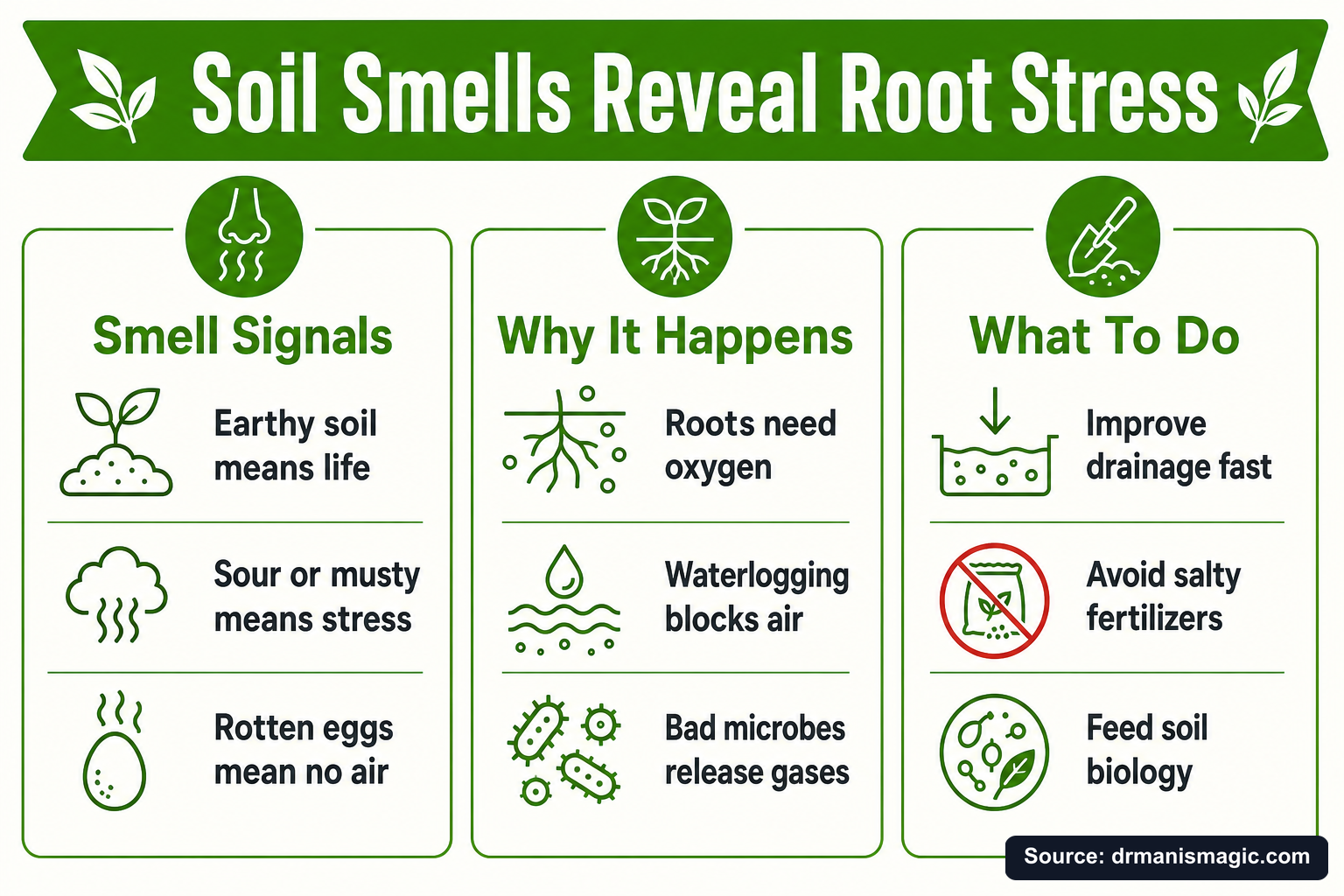
- A fresh, earthy soil smell means healthy aerobic microbes are doing their job. That is the smell you want.
- Sour, swampy, musty, ammonia, or rotten-egg odors are all warning signs of soil stress in different stages.
- Bad smells usually mean oxygen is missing from the root zone — and roots without oxygen die fast.
- Salt-based synthetic fertilizers damage the microbes that keep soil healthy and smelling right.
- Root rot is not just an overwatering problem. It is an oxygen-and-pathogen crisis that bad soil chemistry makes worse.
- The same soil-stress principles apply to lawns, fruit trees, houseplants, raised beds, containers, and ornamentals.
- Clean, biology-friendly nutrition keeps your soil smelling earthy and your roots growing strong.
Why Does Healthy Soil Smell Like Fresh Earth After Rain?
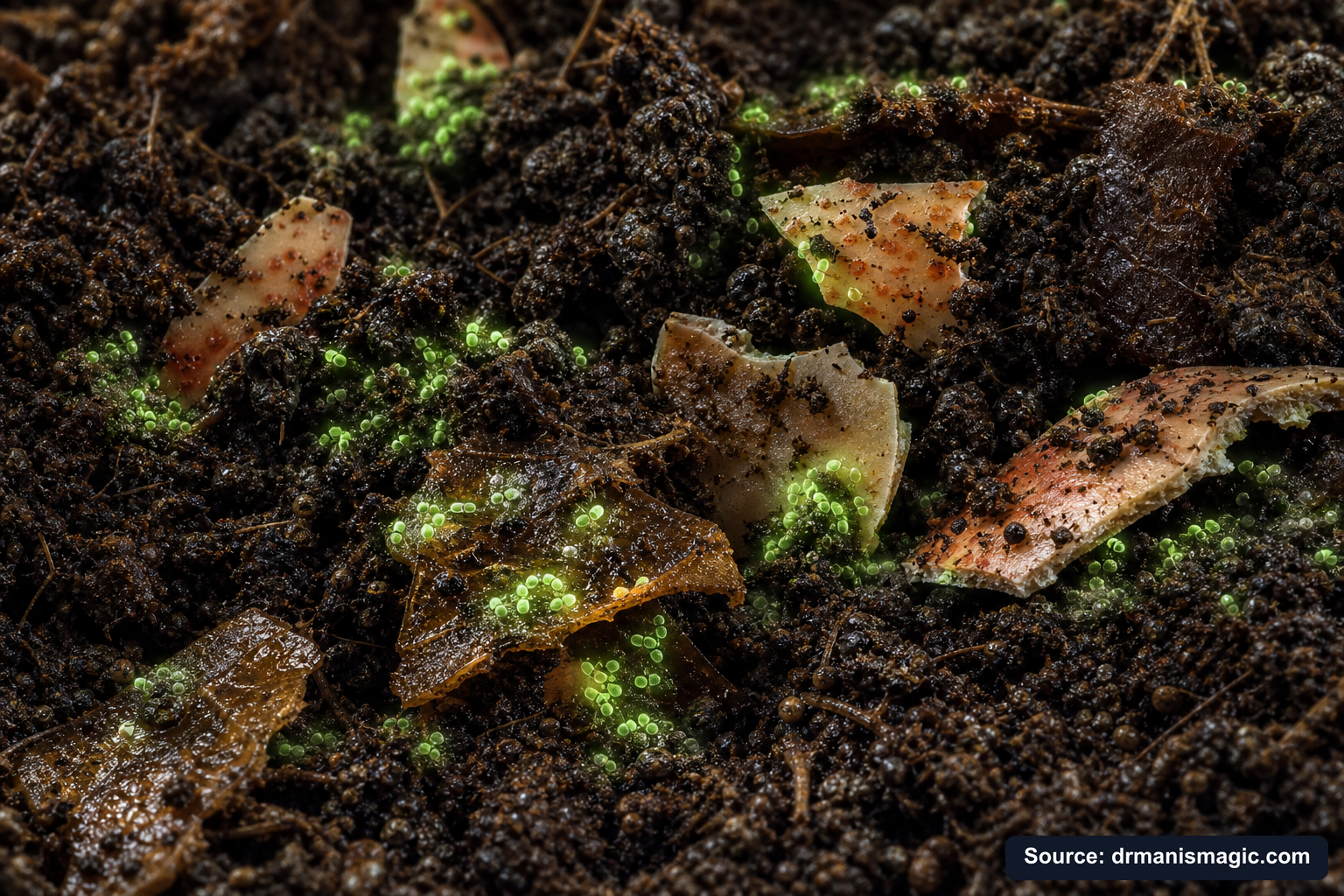
Quick Answer: That clean, earthy smell after rain comes from a compound called geosmin, produced by beneficial aerobic bacteria called actinomycetes. When you smell it, billions of microscopic workers are actively cycling nutrients, building soil structure, and feeding plant roots. It means your soil biology is alive and doing its job.
That smell has a name: geosmin. And it is one of the most reassuring things a gardener can experience. Aerobic bacteria — the kind that need oxygen to survive — produce this compound as a byproduct of their work. When the soil is well-drained, well-aerated, and full of life, these bacteria thrive. They break down organic matter. They unlock nutrients. They protect roots from pathogens. They build the invisible ecosystem that every plant on earth depends on.
According to the University of Minnesota Extension, soil biology drives nearly everything important in your root zone: nutrient cycling, disease suppression, water infiltration, and the conversion of organic matter into plant-available nutrition. When that biology is healthy, the soil smells like it. When that biology collapses, the smell changes — and so does everything else.
Think of your soil as a living city. Billions of residents — bacteria, fungi, nematodes, protozoa — all working together. When oxygen flows freely through the pores and spaces between soil particles, the city hums. Business gets done. Nutrients move. Roots breathe. When oxygen gets cut off, the city shuts down. The wrong residents take over. And the smell shifts from fresh earth to something much darker.
This is the link between smell and soil stress in its most basic form. Smell is just chemistry made sensible. And the chemistry of your soil tells you everything about whether your roots are thriving or suffocating.
What Does a Rotten-Egg Smell in Soil Actually Mean?
Quick Answer: Rotten-egg smell in soil means hydrogen sulfide gas is forming. This only happens when oxygen is almost completely gone and anaerobic bacteria take over. It signals severe waterlogging, extreme compaction, or drainage failure. Roots in this environment are already dying. This is the most serious odor warning sign a gardener will encounter.
Hydrogen sulfide. That is the culprit. The same gas that makes a bad egg smell like a bad egg. In soil, it forms when anaerobic bacteria — the ones that survive without oxygen — break down sulfur compounds in waterlogged conditions. You do not need a lab test to detect it. One whiff and you know something is seriously wrong.
This is not a cosmetic issue. When soil reaches this stage, roots are already under severe stress. Oxygen has been displaced by water. Root cells begin to die. And then the real problem starts: pathogens move in.
Phytophthora. Pythium. Fusarium. Rhizoctonia. These are the root rot pathogens that extension plant pathologists consistently associate with waterlogged, oxygen-depleted soils. According to UC ANR's Integrated Pest Management program, saturated soils displace oxygen, roots weaken or die, and pathogens exploit the stressed root zone. The water is not the disease. The lack of oxygen is what opens the door to disease. The rotten-egg smell is your nose telling you that door is wide open.
We have pulled trees out of pots that smelled like this. The roots were black and mushy. The soil was dense, compacted, holding water like a sponge that never dries. In almost every case, the gardener had been told to "just water more" or blamed themselves for overwatering. But the real problem started earlier — with soil that could not drain and biology that had already been compromised.
What Does Sour-Smelling Soil Mean for Your Plants?
Quick Answer: Sour-smelling soil points to anaerobic decomposition — organic matter breaking down without oxygen. This produces acids and alcohols that are toxic to roots. It often happens in pots with old, compacted potting mix, raised beds with poor drainage, or lawns with heavy thatch. It is less severe than rotten-egg smell but still a serious warning.
Sour soil is fermented soil. When organic matter breaks down without oxygen, bacteria produce acids and alcohols instead of the neutral byproducts that aerobic decomposition creates. Think of it like bread dough that went wrong. Instead of rising and smelling fresh, it turned into something sharp and acrid.
This happens most often in three situations. First, in containers with old potting mix that has compacted over months. Most commercial potting mixes are made from pine bark, peat, and wood fiber. These materials break down. When they do, they compress and squeeze out the air pockets roots need to breathe. The mix goes from fluffy to dense to sour-smelling — sometimes within a single growing season.
Second, it happens in raised beds where drainage layers have failed or where heavy clay soil underneath prevents water from escaping. Third, it happens in lawns with thick thatch — that layer of dead grass stems and roots that builds up between the green blades and the soil. Thatch holds moisture, blocks air, and creates exactly the kind of oxygen-poor environment where sour decomposition thrives.
The plants in these situations tell you what is happening below. Yellowing leaves. Stunted growth. Wilting even when the soil feels wet. This is physiological drought — roots that cannot absorb water even when water is present, because the root tissue is damaged and dying. The sour smell is the early warning. The yellowing leaves are the late warning.
See also: The Hidden Reason Synthetic Fertilizers Cause Root Rot
Why Does Musty-Smelling Soil Signal Compaction and Poor Aeration?
Quick Answer: Musty soil smell usually means fungal overgrowth in low-oxygen conditions, often paired with compaction or waterlogging. While some fungi are beneficial, musty odors in plant soil typically indicate the aerobic bacteria have declined and anaerobic or surface-level fungal activity has taken over. Compaction and poor drainage are usually the root causes.
Musty is the smell of a biology shift. When aerobic bacteria decline, certain fungi move into dominance. Some of these fungi are beneficial — mycorrhizal fungi, for example, form partnerships with roots and extend their reach dramatically. But the musty smell in struggling plant soil usually comes from a different kind of fungal activity — surface molds and decomposers that thrive in stagnant, low-oxygen conditions.
NDSU Extension specifically associates musty odors with poorly aerated lawn and garden soils, noting that compaction is one of the most common causes of this condition. Compacted soil loses its pore structure. Water pools instead of draining. Oxygen cannot move through. And the microbial community that keeps everything running shifts toward organisms that do not need air — and do not support plant health.
You see this most often in lawns that get heavy foot traffic. In container plants that have been in the same potting mix for years. In garden beds that have been tilled repeatedly until the soil structure broke down. The smell tells you the structure is gone. And without structure, nutrients cannot move, roots cannot breathe, and plants cannot grow the way they were designed to.
This is exactly why the first of our Three Plant Pillars is mineral-based soil. Not bark. Not peat. Not decomposing wood fiber. Mineral-based soil — silica-rich sandy loam from the Rio Grande Valley — does not compress. It does not break down. It holds its structure year after year, keeping the air pockets open that roots and microbes both need to survive.
What Does an Ammonia Smell From Soil or Compost Mean?
Quick Answer: Ammonia smell from soil or compost means nitrogen is being lost to the air as gas rather than being absorbed by plants or microbes. This happens with over-application of high-nitrogen fertilizers, fresh manure, or immature compost. It signals biological imbalance and wasted nutrition. The nitrogen that should be feeding your plants is literally evaporating.
Ammonia is escaped nitrogen. And nitrogen is the nutrient plants need most. When you smell ammonia rising from your soil, you are watching your fertilizer investment float away into the atmosphere — which is both wasteful and a sign that something in the soil biology is off balance.
This smell most commonly comes from three sources. Fresh or poorly composted manure applied in large amounts. Over-application of high-nitrogen synthetic fertilizers. Or immature compost that has not finished breaking down before being added to a bed or pot.
Here is what is happening underneath that smell: nitrogen is being volatilized. The ammonia form of nitrogen (NH3) is unstable. Without the right microbial activity and soil chemistry to capture it, it converts to gas and rises out of the soil. You lose the nutrition. The plant never sees it. And the imbalance in the soil biology that caused the problem continues.
This is one of the reasons we designed our fertilizer the way we did. Salt-based synthetic fertilizers dump nitrogen into the soil all at once, in forms that are immediately soluble and immediately volatile. Organic, amino-acid-based nitrogen works differently. Plants and microbes regulate how much they absorb. The release is slow and steady. The nitrogen stays in the root zone where it belongs. No ammonia cloud. No wasted investment. No smell that sends your neighbors wondering what happened to your garden.
The Smell Diagnostic Chart: What Each Odor Means
Here is a simple reference table. Smell your soil before you water, after a rain, when you repot — any time you interact with it. Let your nose tell you where things stand.
| Soil Smell | What It Means | Oxygen Status | Likely Plant Symptoms | First Action |
|---|---|---|---|---|
| Fresh, earthy, clean (petrichor) | Aerobic biology is thriving; geosmin from beneficial bacteria | Good | Healthy growth, green leaves, strong roots | Keep doing what you are doing |
| Musty, moldy, basement-like | Compaction, poor aeration, fungal overgrowth in low oxygen | Low | Slow growth, yellowing older leaves, soft stems | Improve drainage, aerate, check soil structure |
| Sour, vinegary, fermented | Anaerobic decomposition producing acids and alcohols | Very Low | Wilting despite wet soil, yellowing, root browning | Stop watering, improve drainage, remove compacted mix |
| Ammonia, sharp, stinging nose | Nitrogen volatilization from fresh manure, over-fertilization, or immature compost | Variable | Leaf tip burn, dark green then yellowing, wasted fertilizer | Reduce nitrogen inputs, let soil rest, add slow-release organic |
| Rotten eggs, sulfur, sewage | Hydrogen sulfide from anaerobic sulfate reduction — severe oxygen deficit | Near Zero | Black, mushy roots; wilting; plant collapse | Emergency drainage fix, root inspection, remove dead root tissue |
How Do Salt-Based Fertilizers Destroy Soil Smell and Soil Health?
Quick Answer: Salt-based synthetic fertilizers pull water out of root cells and kill the beneficial microbes that keep soil biology balanced and smelling healthy. When microbes die, nutrient cycling stops, soil structure breaks down, and conditions shift toward the anaerobic, bad-smelling states that signal plant stress. Salt is the hidden driver of most fertilizer-related soil problems.
This is the part of the story that the big chemical companies would rather you not think about too hard.
Most fertilizers on the market today are salt-based. That includes the granules in the bright blue bag. The liquid you mix with your watering can. Even many of the products labeled "plant food" at your local big box store. They are all, at their core, soluble salts.
Salt does something very specific to living tissue. It pulls water out through a process called osmosis. The scientific term for what happens to roots is osmotic stress. The roots try to absorb water from the soil, but the salt concentration in the soil is higher than the concentration inside the root cells. So instead of water flowing in, water flows out. The roots dehydrate. Even if you have watered plenty, the plant wilts — because physiological drought is not about how much water is in the soil. It is about whether the roots can actually access it.
But here is the part that connects directly to soil smell. The beneficial microbes — the bacteria and fungi that keep your soil earthy-smelling, nutrient-rich, and disease-resistant — are also killed by salt. They are just as vulnerable as root cells to osmotic damage. When you pour a high-salt fertilizer into your soil, you are not just feeding your plant. You are running a scorched-earth campaign through your own root zone.
No microbes means no nutrient cycling. No nutrient cycling means nutrients lock up. Locked-up nutrients mean deficiencies. Deficiencies mean stress. Stressed roots invite Pythium, Phytophthora, Fusarium, and Rhizoctonia — the same pathogens that cause root rot. And as those pathogens and anaerobic organisms take over, the smell shifts. From earthy to musty. From musty to sour. From sour to rotten eggs.
The smell tells the whole story. Salt starts it. Biology collapses next. The nose catches it before the eyes do.
See also: Why Most Fertilizers Are Actually Salt in Disguise
You Never Had a Brown Thumb.
You were handed the wrong tools. This free guide hands you the right ones.
You watered it. You fed it. It died anyway.
It was never you. It was the dirt, the salt food, and the bad advice.
This guide shows you what really went wrong, and how to fix it for good.
- Why your plants really died, and why it was never your fault
- The salt hiding in your plant food that quietly burns the roots
- The hidden killer in almost every bag of store soil
- The tiny helpers that grow a whole forest for free
- The rescue trick that brings a half dead plant back to life

Salt Damage vs. Overwatering vs. True Root Rot: What Is the Difference?
Quick Answer: Salt damage, overwatering, and root rot often look the same above ground but have different root causes and different fixes. Salt damage starts with white crust on soil and tip burn. Overwatering starts with oxygen loss. Root rot is the result of both — pathogens invading oxygen-starved, salt-stressed roots. Smell and root color help you tell them apart.
Most gardeners see wilting leaves and go straight to one of two conclusions: too much water or not enough. But the real picture is more layered than that. Here is a comparison to help you diagnose what is actually happening.
| Condition | Soil Smell | Root Appearance | Soil Surface Clue | Leaf Symptoms | Primary Cause |
|---|---|---|---|---|---|
| Salt Damage (Fertilizer Burn) | Often neutral or slightly acrid | Brown tips, fine roots shriveled | White crusty deposits on soil or pot rim | Tip burn, brown leaf edges, dark green then yellowing | Excess soluble salts causing osmotic stress |
| Overwatering (Oxygen Deprivation) | Musty, sour, or swampy | White to tan, soft and water-logged | Soil stays wet for many days; no drainage | Yellowing older leaves, wilting despite wet soil | Loss of soil oxygen from saturated conditions |
| True Root Rot (Pathogen Invasion) | Sour to rotten egg, sewage-like | Black, mushy, easily pulled apart | Waterlogged, may show mold on surface | Rapid collapse, leaves drop, stems go soft at base | Phytophthora, Pythium, Fusarium, or Rhizoctonia in oxygen-starved roots |
The most important thing to understand here is that these three conditions are not separate problems. They are a sequence. Salt damage weakens roots first. Overwatering or compaction removes oxygen next. Then the pathogens arrive — because a weakened root in an oxygen-poor environment is exactly the target they exploit. The smell tells you how far along the sequence has progressed.
Why Do Roots Need Oxygen — and What Happens When They Run Out?
Quick Answer: Roots need oxygen to produce the energy required for nutrient and water absorption. Without oxygen, root cells switch to anaerobic metabolism, produce toxic byproducts, and begin to die. This is the biological reason why waterlogged and compacted soils cause plant decline — and why bad smells always accompany that decline.
Here is something most gardeners do not learn until a plant is already dying: roots breathe oxygen. The same oxygen you breathe. Roots use oxygen to power a process called aerobic respiration — the same process your muscles use to generate energy. Without it, root cells cannot do their job. They cannot pump water up the stem. They cannot absorb nutrients from the soil. They cannot resist disease.
When soil becomes waterlogged or compacted, oxygen gets squeezed out of the pore spaces between soil particles. Water fills those spaces instead. The roots switch to anaerobic respiration — a much less efficient process that produces toxic byproducts like ethanol and lactic acid inside root tissue. These byproducts damage cells from the inside. The roots weaken. They die back. And the door opens for every pathogen waiting in the soil.
This is why soil structure is not a luxury. It is life support. When soil pores stay open, oxygen moves freely. When soil compacts or holds water, those pores close. The beneficial aerobic bacteria that keep your soil smelling earthy die off first — they need oxygen too. Then the anaerobic bacteria take over and start producing the gases that become the sour, swampy, rotten-egg smells you detect.
The smell is not the disease. The smell is the signal that the environment has shifted from one that supports life to one that destroys it. Catching that shift early — while you can still smell musty instead of rotten eggs — is the difference between a recoverable plant and a lost one.
Why Does Organic Fertilizer Feed the Soil Instead of Burning It?
Quick Answer: Organic fertilizer works by feeding the soil microbes first. The microbes break it down and convert it into plant-available nutrients. When those microbes eventually die, they release that stored nutrition directly into the root zone. This creates a slow, continuous feeding cycle that mirrors how plants eat in nature — without salt, without osmotic stress, and without destroying soil biology.
Here is the mechanism that changes everything once you understand it.
When you apply a salt-based synthetic fertilizer, nutrients go directly into the soil water in a concentrated, immediately soluble form. There is no conversion needed. The salt is already there, already dissolved, already exerting osmotic pressure. The plant absorbs what it can, the rest sits in the soil and accumulates — and the microbes that were supposed to be managing that root zone are already dead or dying from the salt exposure.
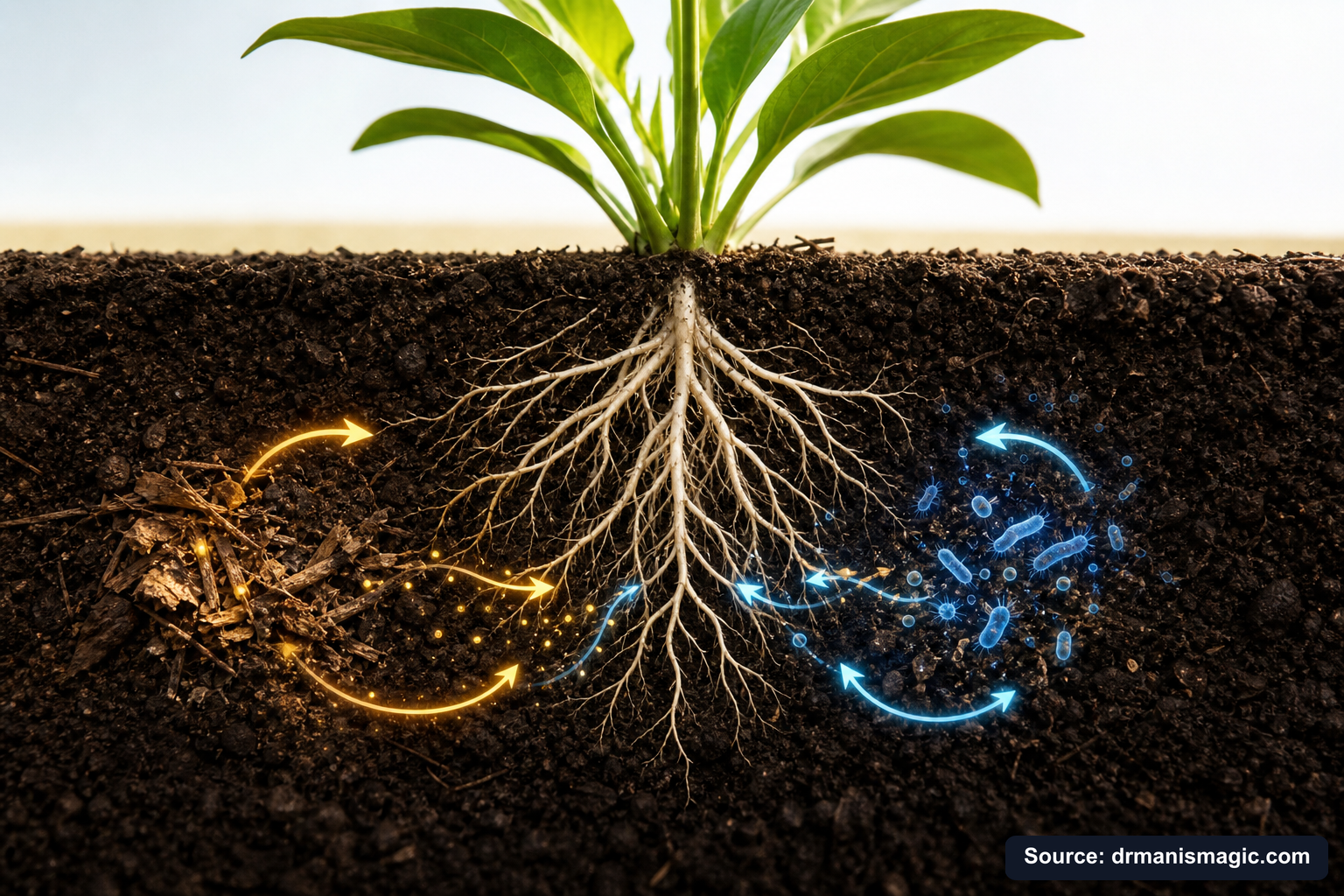
Organic fertilizer works completely differently. The nutrients in organic matter — from sources like crab shells, kelp, and amino acids — are locked inside proteins and biological structures. They cannot be absorbed by roots directly. They have to be processed first. And the organisms that process them are the very microbes that live in healthy, earthy-smelling soil.
Here is the sequence, step by step. You apply organic fertilizer to your soil. Bacteria and fungi in the root zone recognize it as food. They eat it. They grow. They multiply. As they digest the organic material, they convert it into simpler forms — amino acid nitrogen, mineral phosphorus, available potassium — in exactly the amounts and forms that plant roots can absorb. Then, when those microbes die naturally, their bodies release all of that stored nutrition directly into the soil. The plant's roots absorb it.
This is nature's slow-release system. It is not a marketing term. It is the actual mechanism. And because it runs at the pace of microbial metabolism rather than the pace of salt dissolving in water, it feeds the plant steadily over weeks and months instead of in one sharp spike followed by a crash.
No salt accumulation. No osmotic stress. No scorched root tips. No microbial die-off. No shift from earthy to sour to rotten egg. The soil stays alive. The smell stays clean. The plant keeps growing.
This is why our Crab, Kelp & Amino Acids fertilizer is built on exactly these ingredients — not as a trend, but because after 250,000 trees tested in South Texas, this is what we know works without destroying the biology that makes everything else possible.
What Makes Crab Shells, Kelp, and Amino Acids Different From Regular Fertilizer?
Quick Answer: Crab shells provide chitin, calcium, and magnesium that trigger natural disease resistance and strengthen cell walls. Cold-processed kelp delivers plant growth hormones, trace minerals, and biostimulants. Amino acids supply nitrogen in a form that both microbes and plant roots can use immediately, without salt or osmotic stress. Together they create a complete, biology-friendly nutrition system.
Let us go through each ingredient and what it actually does — in plain terms.
Crab Shells and Chitin
Crab shells are rich in a substance called chitin. Chitin is the same structural material that makes up the shells of insects and crustaceans. When chitin enters the soil, something interesting happens. The microbes that break it down — called chitinolytic bacteria — are the same organisms that attack the chitin shells of fungal pathogens and pest eggs in the soil. By feeding these bacteria with crab shell chitin, you are essentially building up an army of natural defenders right in the root zone. You are also delivering calcium and magnesium — two nutrients that strengthen plant cell walls and support woody growth. A plant with strong cell walls resists disease better. Simple as that.
Cold-Processed Kelp
Kelp is a marine plant that grows incredibly fast — sometimes several feet per day. It is packed with natural plant hormones called auxins and cytokinins that regulate root growth, cell division, and fruit development. It contains trace minerals from the ocean that are rare in most land-based soils. And because it is cold-processed — not heat-treated — those delicate hormones and biostimulants survive intact when they reach your soil. Heat destroys them. Cold processing preserves them. The difference shows up in how your roots respond.
Amino Acid Nitrogen
Amino acids are the building blocks of protein. They are the simplest form of organic nitrogen — already partially broken down, already in a form that both roots and microbes can use. When you feed nitrogen as amino acids instead of as a synthetic salt, the plant has control over how much it absorbs. It takes what it needs. The rest stays in the soil, held by microbial activity, waiting for the next demand. No spike. No crash. No osmotic pressure building up in the root zone. Just steady, calm, natural feeding at the pace the plant actually prefers.
What About PFAS and Biosludge?
This is a concern that more and more gardeners are raising — and rightfully so. Some organic fertilizers use biosludge: treated municipal waste that contains PFAS, often called "forever chemicals," because they do not break down in soil or in human bodies. The label might say "organic" and technically be correct. But the inputs are anything but clean.
Our Crab, Kelp & Amino Acids contains zero biosludge. Zero PFAS. Zero synthetic salts. Zero plastic-coated slow-release prills that leave microplastics in your soil. You can use it in a vegetable garden where your children eat the harvest. You can use it around pets. You can use it on houseplants without worrying about what you are breathing indoors. That matters. Especially when the alternative is a bag of salt with a green label and a claim about being "plant-friendly."
Does the Same Soil-Stress Principle Apply to Lawns, Containers, and Houseplants?
Quick Answer: Yes. The same aerobic-versus-anaerobic biology that drives soil smell and stress in a fruit tree also applies to lawns, raised beds, houseplants, containers, ornamentals, and vegetable gardens. The scale changes. The symptoms vary by plant type and root depth. But the root-zone oxygen and microbial principles are identical across all of them.
We get this question a lot. People assume that soil biology is something that only matters for large trees or commercial orchards. It does not. The invisible world under your grass, under your potted basil on the windowsill, under the roses in your front bed — it is the same world. The same organisms. The same oxygen requirements. The same sensitivity to salt and compaction.
A lawn with compacted soil smells musty where it is stressed. It thins out in patches. It holds puddles instead of absorbing rain. It develops thatch. The aerobic bacteria that should be breaking down dead grass and cycling nutrients are struggling or dead. Aerate the lawn, reduce salt-based fertilizer, add live microbials — and within weeks the smell shifts back toward earthy and the grass thickens.
A houseplant in old potting mix that has been in the same container for two years smells sour when you dig into it. The mix has compressed. The organic components have decomposed. The pore spaces are gone. The roots are circling the bottom, browning, struggling. The plant looks pale. Tip-burned. Sad. The same principles apply: restore oxygen, restore biology, switch to clean nutrition.
A raised vegetable bed that received heavy applications of synthetic fertilizer over several seasons develops that sharp, acrid smell after watering. Salt has accumulated. The soil biome has shifted. The vegetables struggle to set fruit even though they are getting fed. Because the nutrition is locked up by salt and the microbes that should be unlocking it are gone.
Every plant. Every setting. Same root-zone biology. Same smell signals. Same solutions. That is why we built the Three Plant Pillars as a universal framework — not a citrus-specific trick, but a first-principles approach to growing anything, anywhere.
How to Recover Stressed Soil: A Step-by-Step Checklist
If your soil smells off and your plants are struggling, here is a practical recovery sequence. Work through it in order. Do not skip to fertilizer before you fix drainage and biology.
- Smell it first. Use the diagnostic chart above. Identify what category you are in — musty, sour, ammonia, or rotten egg. The smell tells you how urgent the situation is and what to fix first.
- Fix drainage before anything else. If water is sitting in the pot or bed for more than 24 to 48 hours, oxygen is being displaced. For containers, check that drainage holes are not blocked. For beds, consider a French drain or raised planting mound. For lawns, aeration is step one.
- Remove and inspect roots. Gently unpot or dig around the root zone. Healthy roots are white to tan and firm. Brown, gray, or black roots that are soft and pull apart easily are dead or dying. Trim them cleanly with sterile scissors or pruners.
- Replace compacted or decomposed growing media. If the potting mix is dense, sour-smelling, and no longer draining freely, it needs to come out. Replace it with a mineral-based growing medium that will not compress and will maintain air pockets for years — not months.
- Stop all salt-based fertilizer immediately. Let the root zone rest. If there is visible white salt crust on the soil surface or pot edges, flush the soil with plain water multiple times to leach the accumulated salts before adding anything new.
- Reintroduce living biology. Once drainage is restored and salt levels are reduced, add live beneficial bacteria, fungi, and mycorrhizae to the root zone. These are the organisms that will rebuild soil structure, suppress pathogens, and restore the earthy smell that signals a healthy environment.
- Feed slowly and cleanly. Once biology is re-established, introduce a slow-release, salt-free organic fertilizer. Feed lightly and consistently rather than heavily and infrequently. Let the microbes set the pace.
For a complete growing framework that prevents these problems from the start, visit our Free Plant Care Field Guide — built from the same three-pillar system we use on every tree at our South Texas nursery.
The Real Cost of Ignoring What Your Soil Is Telling You
Here is something worth sitting with for a moment.
You can get money back. You cannot get time back.
The number one thing people tell Dr. Mani they want from their garden — more than anything else — is to see their tree bear fruit in their lifetime. Not in some abstract future. In their yard. With their own hands. Before years have passed and the window has closed. That is not a small desire. That is something deep and human and real. We were meant to tend gardens. That drive is wired into us.
And every month a plant spends in stressed, sour-smelling, salt-damaged soil is a month it is not growing toward that moment. Every season a lawn spends compacted and microbially depleted is a season it is not becoming the lush, safe, barefoot-friendly yard your family deserves. Every year you spend chasing quick fixes — bright blue bags of salt, liquid fertilizers that spike and crash, potting mixes that compress within months — is a year the clock keeps moving while your garden stays stuck.
The old way costs money. But mostly it costs time. And time is the one thing nobody gives back.
Your nose has been trying to tell you this. The sour pot. The musty lawn patch. The rotten-egg smell from the raised bed. These are not random. They are a root-zone biology that has been pushed out of balance — usually by inputs that were sold as solutions but were actually part of the problem.
The good news is that soil biology recovers. Faster than most people expect. When you restore oxygen, reintroduce live microbes, and switch to clean, slow-release organic nutrition, the smell shifts back toward earthy within weeks. Roots regrow. Leaves green up. Plants start moving again.
That is the whole point of everything we do at Dr. Mani's Magic. Not to sell you more products. To give you a foundation — mineral-based soil that breathes, live biology that protects and feeds, and organic nutrition that works with nature instead of against it — so that the time you invest in your garden actually produces results you can see, smell, and taste.
If you are ready to learn the complete three-pillar system that Dr. Mani developed and tested on over 250,000 trees, start with our Three Plant Pillars framework. It is the foundation. Everything else builds on it. And your nose — that honest, no-nonsense diagnostic tool you carry everywhere — will tell you when it is working.
Frequently Asked Questions
Your nose knows more than you think. These are the questions gardeners ask most after they catch a strange smell coming from their soil. Get the answers right here, straight from a team that has grown over 250,000 trees in South Texas and knows exactly what healthy soil smells like versus a root zone in trouble.
What does bad-smelling soil actually mean for my plants?
Bad-smelling soil is a warning sign. It means the oxygen is gone from your root zone. When roots cannot breathe, the wrong bacteria take over and start producing gases that smell like rotten eggs, sewage, or sour milk. Your plant is not just uncomfortable. It is in danger. The fix starts with getting oxygen back into the soil through proper drainage and living microbes that restore balance fast.
Why does healthy soil smell like fresh rain or clean earth?
That clean, earthy smell comes from beneficial bacteria doing their job. These tiny workers thrive when soil has good drainage, plenty of oxygen, and the right microbial life. At Dr. Mani's Magic, we call this the foundation of Pillar Two: Microbial Muscle. When your soil smells fresh, billions of microscopic helpers are unlocking nutrients, fighting pathogens, and feeding your roots. That smell means your plant is winning.
Can the type of fertilizer I use change how my soil smells?
Yes, and this is a big one. Salt-based synthetic fertilizers burn off the beneficial microbes in your soil. When those microbes die, the soil starts to go anaerobic, meaning it runs out of oxygen. That is when the bad smells start. Dr. Mani's organic Crab, Kelp, and Amino Acids fertilizer feeds your soil biology instead of destroying it. Your soil stays alive, balanced, and smelling the way it should.
Does potting mix cause soil smell problems?
Most potting mixes are made from pine bark and wood material that breaks down over time. As it decomposes, it steals oxygen from the root zone and creates the perfect conditions for rot and foul odors. Dr. Mani's Super Soil is built on mineral-based sandy loam from the Rio Grande Valley. It does not break down. It does not compact. It stays open and airy so roots can breathe and your soil stays fresh.
Will fixing my soil smell actually help my plant recover?
Absolutely. Smell is a symptom, and the root cause is almost always a broken soil environment. When you restore oxygen flow with the right mineral soil, reintroduce beneficial microbes with Plant Super Boost, and switch to clean organic fertilizer, the biology bounces back. Gardeners who follow Dr. Mani's Three Plant Pillars often see their plants perk up within weeks. We have watched it happen with over 250,000 trees. It works.
Does Dr. Mani's Plant Super Boost smell bad when I use it?
No, and that is one of the things that makes it different. Many microbial products go anaerobic in the bottle and smell like rotting sewage. Plant Super Boost uses a special stabilization process to keep the microbes alive without letting them rot. When you open the bottle, it smells earthy and clean. You can use it indoors on houseplants without clearing the room. That is the beauty of stabilized, living microbes done right.
Can the same soil smell problems affect lawns, houseplants, and fruit trees?
Yes. The same principles apply everywhere you grow something. A lawn that smells sour after watering, a houseplant pot that smells musty, a fruit tree container that smells swampy, they are all telling you the same thing. The soil biology is broken and oxygen is missing. Dr. Mani built the Three Plant Pillars to work for any plant in any setting. Grass, flowers, vegetables, tropical trees, citrus, all of it runs on the same root-level rules.
About the Author
Dr. Mani Skaria, PhD
Dr. Mani Skaria, PhD, is a plant pathologist and the scientific founder of Dr. Mani's Magic. He earned his doctorate at Purdue University and spent 48 years studying how plants, soil, and living microbes work together, including his years as Professor Emeritus at Texas A&M and as a member of the USDA NAREEE Advisory Board. He invented micro-budding, a method for growing healthier, stronger trees, and has grown more than 250,000 trees on the family farm in Hargill, Texas - US Citrus Nursery. His life's work takes real lab science and practical experience and turns it into simple, safe, organic plant care anyone can use at home.


