


Why Fresh Marine Inputs Smell Different: What Each Odor Means | Dr. Mani's Magic
Why Fresh Marine Inputs Smell Different (And What That Smell Is Actually Telling You)
You tear open the bag. Or uncap the bottle. And you stop.
The smell hits you before you even think about it. Maybe it's briny, like low tide on a warm morning. Maybe it's sour, almost like vinegar. Maybe it's a little yeasty, earthy, alive. You expected it to smell bad. You braced yourself. But it doesn't smell rotten. It smells like the ocean. Like something real. And now you're wondering: is that good? Is that normal? Is this stuff actually working, or did I just buy a bag of expensive beach garbage?
Here's the thing nobody tells you at the garden center. That smell? It's a report card. It tells you exactly what's happening inside the bag, inside the soil, and eventually inside your plant's roots. A briny, sour, or earthy smell means something very different from an ammonia stench or a rotten-egg reek. And knowing the difference could save your lawn, your fruit tree, your vegetable garden, and a whole lot of wasted time. After growing more than 250,000 trees at our South Texas nursery, we've learned to read these smells like a language. Let us teach you how.

Plant Super Boost
Key Takeaways
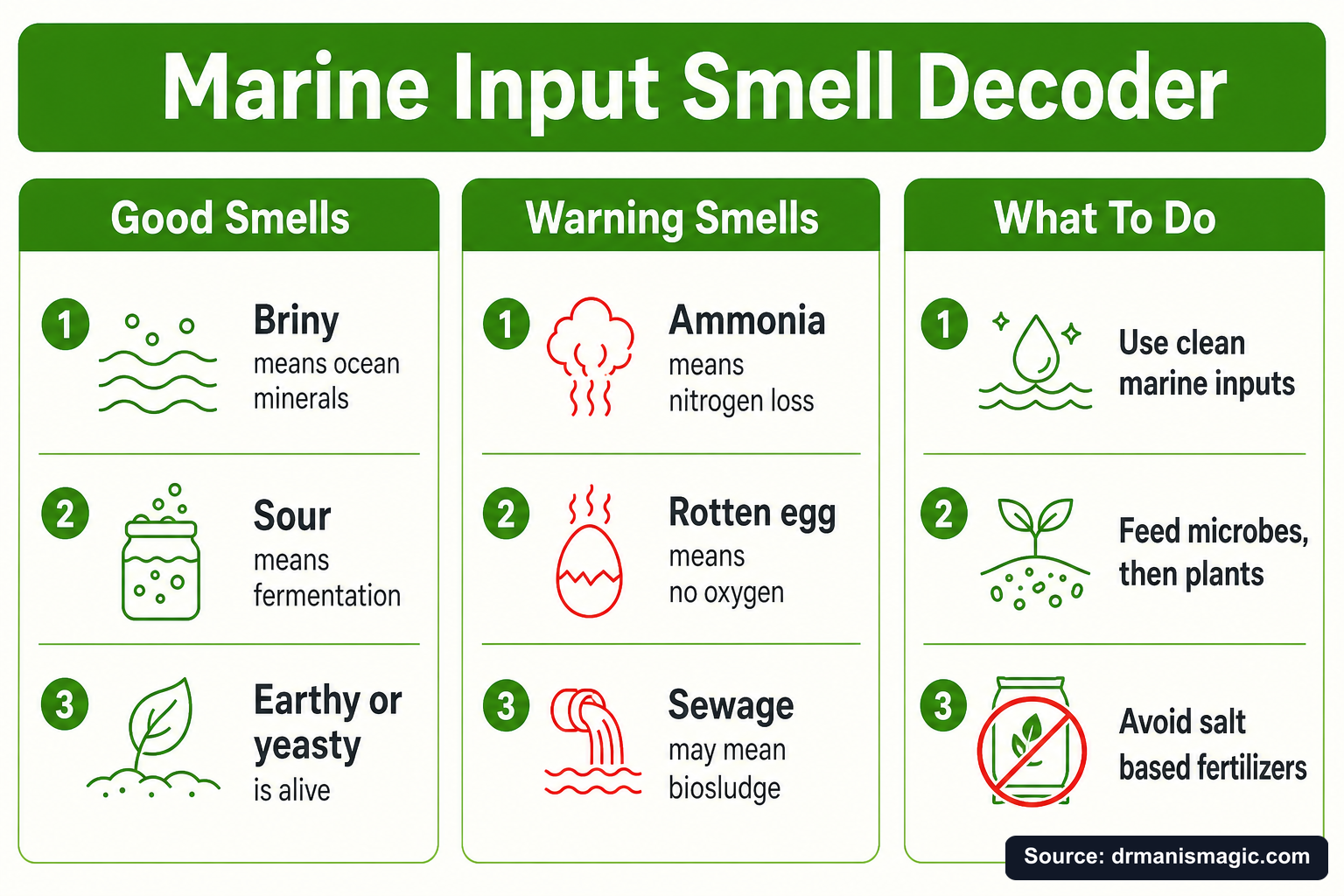
- Fresh marine inputs like crab meal, kelp, and fish hydrolysate can smell briny, sour, or yeasty — that is normal and healthy.
- Ammonia smell means nitrogen is escaping and something went wrong with storage, pH, or the carbon-to-nitrogen ratio.
- Rotten egg smell means anaerobic (no-oxygen) bacteria are producing hydrogen sulfide — a warning sign, not a feature.
- Sewage or putrid smell is a red flag that the product may contain biosludge or municipal waste — not clean marine ingredients.
- Synthetic salt-based fertilizers have no smell but do serious invisible damage: they kill soil microbes and cause osmotic stress in roots.
- The smell of a marine input is directly connected to its oxygen status, nitrogen chemistry, and microbial activity — all of which affect plant outcomes.
- Clean marine inputs like crab shells, cold-processed kelp, and amino acids from animal proteins feed your microbes first, and those microbes feed your plant. No harsh salts. No PFAS. No biosludge.
What Does "Fresh Marine Input" Actually Mean?
Quick Answer: Fresh marine inputs are plant amendments made from ocean-sourced materials like crab and shrimp shells, kelp seaweed, and fish proteins. They are very different from synthetic fertilizers or sewage-based products. They bring nitrogen, minerals, natural hormones, and soil-building compounds without synthetic salts or chemical residues.
Marine inputs are not a single thing. They are a family of ingredients, each with its own smell, chemistry, and job inside your soil.
Here is a quick breakdown of the main players:
- Crab and shrimp meal — Ground-up shells and bodies from seafood processing. Rich in chitin, calcium, and magnesium.
- Kelp meal or extract — Dried or cold-pressed seaweed. Loaded with trace minerals, natural plant hormones called auxins and cytokinins, and complex sugars called polysaccharides.
- Fish hydrolysate — Fish proteins broken down by enzymes. Rich in amino acid nitrogen and oily compounds.
- Fish emulsion — Similar to hydrolysate but often heat-processed, which destroys some of the amino acids and makes it more likely to go rancid or smell bad.
- Amino acid blends — Concentrated plant-available nitrogen from animal proteins like feather meal and tankage.
- Volcanic ash or rock dust — Trace minerals from geological sources. Adds silica and micronutrients that strengthen cell walls.
Each one smells different. And each smell tells a story about what the microbes inside that product are doing right now.
Why Do Fresh Marine Inputs Smell Different From Each Other?
Quick Answer: The smell of a marine input depends on how it was processed, how much oxygen was present, which microbes are active, and how the nitrogen is breaking down. Briny and sour smells are normal. Ammonia, sulfur, and putrid smells are warning signs of spoilage, anaerobic conditions, or contaminated source materials.
Think of it like bread versus bread that went moldy. Both start with flour and yeast. But one had the right conditions. One did not. The smell tells you which is which.
Marine inputs work the same way. When oxygen is present and the biology is healthy, you get controlled fermentation. You get a sour, vinegary, or briny smell. That is lactic acid bacteria doing their job. That is preservation happening. That is a sign the product is alive and stable.
When oxygen disappears and the wrong microbes take over, you get anaerobic decomposition. That is when you get the bad smells. Ammonia. Rotten eggs. Dead fish. Sewage. Each of those smells has a specific chemistry behind it, and understanding that chemistry helps you make better choices for every plant you own.
Researchers at Cornell University's compost program have documented that ammonia odor is directly linked to excess nitrogen and low carbon-to-nitrogen ratios in decomposing organic material — a classic sign of mismanaged organic inputs. The Food and Agriculture Organization of the United Nations has also mapped out the specific chemistry of fish spoilage, identifying compounds like trimethylamine, hydrogen sulfide, and lower fatty acids as the culprits behind the worst marine odors.
What Does the Marine Input Smell Decoder Tell You?
Quick Answer: Each smell maps to a specific microbial or chemical process. Briny means ocean minerals or kelp. Sour or vinegar-like means healthy fermentation or preserved hydrolysate. Ammonia means nitrogen loss and possible product mismanagement. Rotten egg means anaerobic sulfur chemistry. Sewage means a likely biosludge or municipal waste source. Use the smell as your first diagnostic tool.
| Smell | What It Means | Safe to Use? | What to Do |
|---|---|---|---|
| Briny, ocean-like | Normal kelp or sea minerals. Healthy product. | Yes | Apply as directed. This is ideal. |
| Sour, vinegar-like, or yeasty | Lactic acid fermentation or preserved fish hydrolysate. Controlled biology. | Yes | Normal for fermented or acid-preserved inputs. Safe and biologically active. |
| Earthy or mushroom-like | Fungal activity. Healthy decomposition happening. | Yes | This is a sign of living biology. Use it. |
| Ammonia or urine-like | Excess nitrogen escaping as gas. High pH. Low carbon content. Nitrogen loss. | Use with caution | Dilute before applying. May indicate poor formulation or improper storage. Risk of root burn. |
| Rotten egg or sulfur | Hydrogen sulfide from anaerobic bacteria breaking down sulfur-containing amino acids. | Limit use | Indicates anaerobic conditions. Product may have degraded. Aerate if possible before applying. |
| Dead fish or putrid | Spoilage amines from protein decay. Unmanaged storage or poor processing. | Avoid if severe | Badly degraded product. Beneficial amino acids may already be lost. |
| Sewage or chemical | Possible biosludge content. Municipal waste source. PFAS risk. | Do not use on edibles | Check the ingredient label. Look for biosludge or municipal biosolids disclosure. Avoid on food crops. |
| Rancid oil or fried food | Oxidized fish fats. Often from heat-processed fish emulsion. | Use sparingly | Rancid oils can disrupt soil biology. Cold-processed hydrolysate is a cleaner option. |
| Almost no smell | Likely synthetic or salt-based fertilizer. No biological activity. | Read the label | If it has no smell and is highly soluble, it is probably salt-based. See the comparison below. |
What Makes Ammonia Smell Dangerous for Your Plants?
Quick Answer: Ammonia smell means free nitrogen is escaping as gas instead of feeding your plants and microbes. It also signals high pH and possible salt buildup. Applied to roots in this state, high-ammonia inputs can cause osmotic stress, root tissue damage, and fertilizer burn — the same symptoms as salt injury from synthetic fertilizers.
Here is a picture most people never get to see.
Your plant's roots are trying to drink water through a process called osmosis. Water moves from a less salty area to a more salty area. When the soil around your roots has too much dissolved nitrogen, salt, or ammonia compounds, the water actually starts moving the wrong direction. Out of the root. Into the soil.
Scientists call this osmotic stress. Your plant feels it the same way you would feel severely dehydrated. The leaves curl. The tips turn brown. The growth stops. The plant looks like it needs water even when the soil is wet.
University of Maryland Extension describes salt injury from fertilizers this way: the damage looks exactly like drought stress — marginal leaf scorch, stunted growth, and root tissue that turns brown and dies. Their research confirms that the source of the salt does not matter. It could be synthetic fertilizer. It could be improperly composted manure. It could be a marine input that went wrong during storage. If the salt index is high and your roots are exposed to it, the damage is the same.
This is why a product that smells like ammonia is a warning. It is telling you the nitrogen chemistry is out of balance. And out-of-balance nitrogen, whether from a synthetic bag or a poorly managed marine input, hurts the very roots you are trying to feed.
See also: The Osmotic Shock Your Plants Feel From Synthetic Nutrients
Why Does Rotten Egg Smell Mean Trouble in Your Soil?
Quick Answer: Rotten egg smell comes from hydrogen sulfide gas, produced by anaerobic bacteria when there is no oxygen in the soil or product. These are the same conditions that breed Pythium and Phytophthora root rot pathogens. If your soil smells like rotten eggs, your roots are likely already under attack from oxygen deprivation and disease pressure.
Hydrogen sulfide is what you smell near a swamp. Or a clogged drain. Or a compost pile that has been sitting wet and sealed for too long.
It comes from bacteria that thrive without oxygen. When soil gets waterlogged, or when organic matter piles up without air, these anaerobic bacteria take over. They break down sulfur-containing amino acids like cysteine and methionine. The byproduct is hydrogen sulfide, that sharp, rotten egg gas.
Here is the part that matters for your plants. Those same oxygen-starved conditions are perfect breeding grounds for Pythium and Phytophthora. These are the two most common root rot pathogens in home gardens, containers, and nurseries. They love wet, low-oxygen soil. They spread fast. And by the time you see yellowing leaves or a collapsing plant, the roots are often already destroyed.
This is why Pillar One of the Three Plant Pillars is a mineral-based soil that drains freely and never compacts. No oxygen loss. No anaerobic zones. No rotten egg smell. No root rot pathogens getting a foothold. You can learn more about how we built this foundation at Dr. Mani's Magic Super Soil.
What Is Biosludge and Why Should You Care About It in Marine Fertilizers?
Quick Answer: Biosludge is treated municipal wastewater waste — essentially processed sewage solids — used as a cheap filler in some organic fertilizers. It can contain PFAS "forever chemicals," heavy metals, pharmaceutical residues, and pathogens. It is legally allowed in some organic fertilizers. The sewage-like smell in a marine product is often the first clue that biosludge is present.
This is the part of the organic fertilizer world that almost nobody talks about. And it is something Dr. Mani felt strongly enough about to make it a core promise of everything we make.
Some companies market their fertilizers as "organic" and "natural." And legally, they may be correct. But the source material is treated sewage. Municipal wastewater sludge. It gets processed, dried, and sometimes mixed with marine or plant ingredients to improve the smell and the numbers on the label.
The problem is PFAS. These are per- and polyfluoroalkyl substances, sometimes called "forever chemicals" because they do not break down in soil, water, or the human body. Penn State Extension has published guidance on PFAS contamination from biosolids in agricultural settings, noting that these chemicals can accumulate in soil and move into crops grown in contaminated fields.
If a marine fertilizer smells like sewage, that is your nose telling you something is wrong at the source level. Not just at the processing level.
Dr. Mani's Magic Crab, Kelp & Amino Acids contains zero biosludge, zero PFAS, and zero synthetic salts. The ingredients are exactly what the name says. Crab shells. Cold-processed kelp. Amino acids from clean animal protein sources. Volcanic ash for trace minerals. That is it. When you open the bag, it smells like the ocean and the earth. Because that is exactly what it is.
Fresh Marine Inputs vs. Synthetic Fertilizers: What Is the Real Difference?
Quick Answer: Synthetic fertilizers are salt-based, fast-release, and have almost no smell. They deliver a quick nutrient hit but kill soil microbes, cause osmotic stress, and create long-term soil damage. Marine inputs like crab, kelp, and amino acids are slow-release, biology-friendly, and feed the microbial ecosystem that actually delivers nutrition to your plant roots over time.
Here is the honest comparison most fertilizer companies do not want you to see.
| Feature | Synthetic Salt-Based Fertilizer | Fish Emulsion (Heat-Processed) | Clean Marine Input (Crab, Kelp, Amino Acids) |
|---|---|---|---|
| Smell | Almost none (dissolved salts) | Strong fishy to rancid | Briny, earthy, or mild ocean smell |
| Nitrogen form | Soluble nitrate or ammonium salt | Amino acids, some ammonia | Amino acid nitrogen, slow-release protein |
| Salt index | Very high | Moderate | Low |
| Effect on microbes | Kills beneficial bacteria and fungi | Mixed — can feed or overwhelm depending on dose | Feeds and supports microbe populations |
| Release speed | Instant — then gone | Fast to moderate | Slow and steady — mirrors nature |
| Root burn risk | High — especially in containers | Moderate if over-applied | Very low |
| PFAS or biosludge risk | Some products — check the label | Low but varies by source | None in clean marine inputs |
| Long-term soil health | Degrades — salt accumulates over time | Neutral to mildly positive | Builds biology and soil structure over time |
| Smell as a quality indicator? | No — no smell but still harmful | Smell indicates processing quality | Yes — briny/earthy = healthy; ammonia/sewage = problem |
The synthetic fertilizer has no smell because it is dissolved salt. Sodium. Chloride. Ammonium nitrate. These compounds are highly soluble. They do not have the complex proteins and biological compounds that produce odor. But that lack of smell does not mean they are gentle. Salt is salt. And salt at high concentrations in the root zone pulls water out of root cells. It causes physiological drought. It causes the brown leaf tips and stunted growth that millions of gardeners blame on the wrong thing every single season.
See also: How Salt-Based Feeding Quietly Destroys Root Systems
You Never Had a Brown Thumb.
You were handed the wrong tools. This free guide hands you the right ones.
You watered it. You fed it. It died anyway.
It was never you. It was the dirt, the salt food, and the bad advice.
This guide shows you what really went wrong, and how to fix it for good.
- Why your plants really died, and why it was never your fault
- The salt hiding in your plant food that quietly burns the roots
- The hidden killer in almost every bag of store soil
- The tiny helpers that grow a whole forest for free
- The rescue trick that brings a half dead plant back to life

What Does Chitin From Crab Shells Actually Do in Your Soil?
Quick Answer: Chitin is a natural compound in crab and shrimp shells that triggers your soil's beneficial microbial community to shift in a very specific way. Microbes that eat chitin also happen to suppress certain root pathogens and nematodes. Chitin also slowly releases calcium and magnesium as it breaks down, feeding your plants at the same time it protects their roots.
Chitin is one of those quiet heroes that most gardeners have never heard of.
When you add crab shells to your soil, the microbial community senses a new food source. The microbes that can digest chitin begin to multiply. And here is the fascinating part: many of those chitin-eating microbes are natural enemies of the pathogens that cause root rot. They compete for space. They produce compounds that suppress Pythium and harmful nematodes. It is biological pest management built right into your fertilizer.
At the same time, as those shells slowly break down, they release calcium. Calcium is the primary structural component of woody plant tissue. A large proportion of a tree trunk or a thick stem is calcium. Getting it from a slow, biological source means the plant can absorb it on its own schedule, not in a sudden salt spike.
This is what we mean when we say organic fertilizer works with the plant instead of forcing it.
What Does Cold-Processed Kelp Do That Other Fertilizers Cannot?
Quick Answer: Cold-processed kelp preserves natural plant hormones called auxins and cytokinins, along with complex polysaccharides and trace minerals. These compounds stimulate root branching, improve stress tolerance, and feed soil microbes without any salt load. Heat-processed kelp destroys most of these benefits, which is why the processing method matters as much as the ingredient itself.
Kelp is not just a mineral source. It is a biological signaling system.
Inside kelp cells are natural plant hormones. Auxins help roots grow longer and branch out wider. Cytokinins tell plants when to push new growth and divide cells. These are the same hormones your plant already produces, just in very small amounts. Adding cold-processed kelp is like giving your plant a gentle biological nudge at exactly the right moment.
But those hormones are fragile. Heat destroys them. That is why cold-processed kelp is worth the extra care. If a kelp product was boiled or heavily dried at high temperatures, the hormone compounds are gone. You are left with minerals and some polysaccharides, which are still useful, but the most powerful part of the kelp has been cooked away.
The polysaccharides in kelp also matter for a different reason. They are a food source for beneficial soil microbes. Complex sugars feed complex microbial communities. And complex microbial communities are what turn your dead soil into a living, self-sustaining ecosystem that keeps feeding your plants long after you walk back inside.
How Do Amino Acids Feed Your Plant Differently Than Regular Nitrogen?
Quick Answer: Amino acids are pre-digested nitrogen that plants can absorb directly through their roots and even their leaves, without waiting for soil microbes to break them down. They also feed the microbes themselves, creating a double benefit — fast delivery to the plant and long-term support for the soil biology that keeps the whole system running.
Imagine you sat down to eat a full steak dinner. Your body has to chew it, digest it, break it down into amino acids, and then absorb those amino acids. That takes time and energy.
Now imagine someone handed you a smoothie with all the amino acids already extracted. Your body absorbs it almost immediately. Less work. More speed.
That is what amino acid nitrogen does for your plant compared to raw protein or ammonium-based synthetic nitrogen. The heavy lifting is already done. The nitrogen is in a form the plant can use right away. Roots absorb it. Leaves can even absorb it in small amounts when applied as a foliar spray.
And while the plant is absorbing the amino acids directly, the microbes in the soil are feasting on the same compounds. They use the carbon backbone of the amino acids for energy. They multiply. They build more biology. When those microbes eventually die, they release even more nutrients back into the root zone. It is a cycle. A living, self-reinforcing cycle that synthetic fertilizer can never replicate because synthetic fertilizer kills the very microbes that power the cycle.
This is Pillar Two and Pillar Three of the Three Plant Pillars working together in real time.
Can Marine Fertilizers Burn Your Lawn, Trees, or Container Plants?
Quick Answer: Clean marine inputs at normal application rates almost never burn plants because they have a low salt index and release nutrients slowly. The risk goes up with high-ammonia products, improperly composted fish waste, or any concentrated marine input applied directly to roots in a container without dilution. The smell test helps here — ammonia smell before application is a warning that burn risk is elevated.
This is the safety question we hear most often. And the honest answer is: it depends on the product, not just the category.
Here is a plant-by-plant risk picture for clean, properly formulated marine inputs applied at label rates:
| Plant Type | Salt Sensitivity | Root Rot Risk | Foliar Burn Risk | Notes |
|---|---|---|---|---|
| Lawns and grass | Moderate | Low (if drainage is good) | Low | Apply granular and water in. Avoid over-application in summer heat. |
| Citrus and fruit trees | Moderate to high | Moderate (in poor soil) | Low | Use with mineral-based soil for best results. Monthly organic feeding is ideal. |
| Shade trees | Low | Low | Very low | Robust root systems handle most organic inputs well. |
| Vegetables and raised beds | Moderate | Low to moderate | Low | Great candidates for marine inputs. Avoid raw fish waste directly on roots. |
| Annual flowers | Moderate | Low | Low | Respond well to amino acid nitrogen. Monthly application works well. |
| Containers and houseplants | High | High (if overwatered) | Moderate | Use lower rates. Ensure drainage. Clean marine inputs are much safer than synthetics here. |
| Seedlings | Very high | High | Moderate | Dilute heavily. Seedling roots are extremely sensitive to concentrated inputs of any kind. |
| Evergreens and shrubs | Low to moderate | Low | Very low | Respond well to slow-release programs. Kelp hormones help with winter hardiness. |
The pattern you see in that table is that the burn risk from clean marine inputs is almost always low when the input is properly formulated, properly diluted, and applied to a soil with good drainage and living microbes. The risk climbs only when one of those conditions is missing.
See also: The Hidden Reason Synthetic Fertilizers Cause Root Rot
What Does a Healthy Marine Input Recovery Checklist Look Like?
Quick Answer: If you have applied a marine input that smells wrong, or if your plant is showing stress symptoms after a marine fertilizer application, follow these steps in order to diagnose and correct the problem before it does lasting root damage.
Did something go sideways after you applied a marine or organic fertilizer? Here is a clear, step-by-step path back to healthy roots.
- Stop all fertilizing immediately. Do not add more product trying to fix the problem. Give the soil a rest.
- Flush the soil with clean water. Water deeply and slowly several times over a few days. This moves excess salts, ammonia, or concentrated compounds away from the root zone. For containers, water until it drains freely from the bottom.
- Check the drainage. If water is pooling or draining slowly, the soil structure may be the real problem. Oxygen-starved soil creates anaerobic zones that breed Pythium and Phytophthora root rot. Consider repotting into a mineral-based soil with proper drainage.
- Smell the soil itself. Put your nose near the surface after watering. Rotten egg or sewage smell means anaerobic biology is active in the root zone. Earthy and neutral means you are okay.
- Add live microbes to help break down the excess. Beneficial bacteria and fungi can help detoxify and stabilize a stressed root zone. They also outcompete the harmful pathogens that move in after stress events.
- Wait and observe for 7 to 14 days. New leaf growth, improved color, and firming of stems are signs the roots are recovering. No new growth and continued wilting means the root damage may be more serious.
- Rebuild with the Three Plant Pillars from the ground up. The right mineral-based soil, living microbes, and a clean slow-release organic fertilizer are not just a fix. They are the foundation that prevents this from happening again.
Why Does Dr. Mani's Magic Smell Like Earth Instead of Fish?
Quick Answer: The Crab, Kelp & Amino Acids fertilizer from Dr. Mani's Magic smells mild and earthy because the ingredients are clean, properly processed, and stabilized without allowing anaerobic spoilage. There is no biosludge, no rancid fish oil, no excess ammonia, and no synthetic salt compounds. The smell is an honest reflection of what is inside the bag.
Dr. Mani spent years working with citrus trees at the Texas A&M Citrus Center. He tested fertilizers from all over the world. And one of the things he noticed was that the products that smelled the worst were often the ones that also caused the most problems: root burn, microbial crashes, inconsistent growth.
When he built the Dr. Mani's Magic line for our nursery in South Texas, he made a simple rule. If it smells like something you would not want near your family, it does not go in the bag.
Have you ever used liquid fish emulsion on a houseplant and then had to leave the room for a week? Read any gardening forum and you will find stories of dogs and cats getting sick from the smell. Neighbors complaining. Gardens that could not be enjoyed for days after feeding. That is not a feature. That is a flaw in the formulation.
Our Plant Super Boost microbial product is stabilized using a special method that keeps the live bacteria and fungi alive in the bottle without letting them rot or go anaerobic. It smells like earth. Like good soil after rain. Because that is exactly what healthy, oxygen-rich, biologically active material smells like.
And the Crab, Kelp & Amino Acids granular fertilizer smells briny and mild when you open the bag. You can use it on your indoor citrus tree in your kitchen and not have to apologize to your family for the next three days. That matters. A beautiful garden should smell like a garden, not a fish dock.
How Does the Slow-Release Mechanism of Marine Inputs Actually Work?
Quick Answer: Marine inputs like crab shells and amino acids feed soil microbes first. The microbes digest those proteins and compounds, converting them into plant-available nutrients at a slow, steady pace that mirrors what happens in nature. When those microbes die, they release even more nutrition directly into the root zone. The result is a self-reinforcing feeding cycle that lasts weeks or months after a single application.
Here is the most important thing to understand about organic marine fertilizer. It is not really a fertilizer in the traditional sense. It is a food supply for a living army.
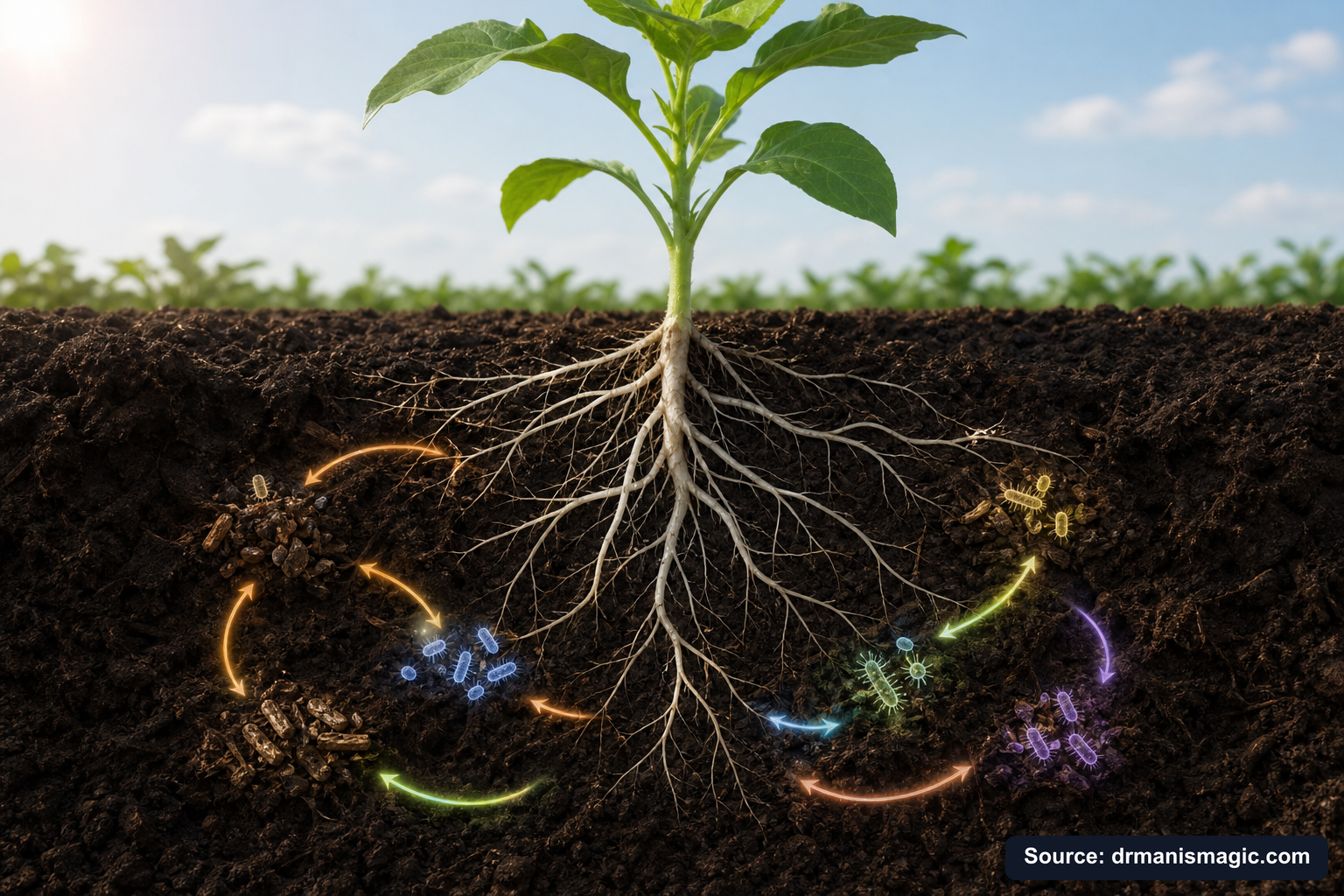
Picture your soil as a city. The crab shells, kelp polysaccharides, and amino acids are the food trucks that pull up. The microbes — bacteria, fungi, the whole biological community — are the workers who eat from those trucks. They get energy. They multiply. They do their jobs: breaking down complex proteins into simple nutrients, making minerals soluble, protecting roots from pathogens, exchanging carbon and nitrogen with the plant directly through the root zone.
The plant gets fed not in one big dump, but in a steady, manageable stream. A little nitrogen today. A little calcium tomorrow. Some potassium next week. The plant's roots regulate how much they pull in based on what they actually need. There is no spike. There is no crash. There is no salt accumulation from excess nutrients sitting unused in the soil.
And when those microbes die — because they do, and they always will — their bodies become nutrition. Every microbial cell is packed with nitrogen, phosphorus, and trace minerals that go straight back into the root zone. The microbes literally become fertilizer. It is a loop that never fully stops feeding your plant.
Synthetic salt fertilizer cannot do this. It dumps a huge dose of instantly soluble salts. The plant tries to absorb what it can. The rest sits in the soil, raises the salt index, kills microbes, and eventually washes away. Then you have to buy more. And more. And more.
We have grown over 250,000 trees testing exactly this difference. The ones grown with living biology and clean organic inputs consistently outperform the ones fed synthetic salts — not just in the short term, but in year two, year three, year five. The time investment in doing it right at the beginning pays back every single season after that.
Time is the one thing you cannot get back. You can earn more money. You cannot earn more seasons. If you have a fruit tree you planted hoping to harvest from it with your own hands someday, the slow and right way is actually the fastest way to that moment. See our complete Free Plant Care Field Guide if you want to see the full system laid out step by step.

The Clean Marine Standard: What to Look for on Any Label
Quick Answer: A trustworthy marine fertilizer should list specific ingredient sources like crab meal, kelp meal, or fish hydrolysate. It should disclose zero biosludge, zero PFAS, and have a low or no synthetic salt content. If the label does not specify the source of its nitrogen or lists "biosolids" as an ingredient, that is a red flag worth acting on.
You do not have to be a chemist to protect your family, your soil, and your plants. You just have to know what to look for.
Here is a fast checklist before you buy any marine or organic fertilizer:
- Named ingredients: Does the label say crab meal, kelp meal, or fish hydrolysate? Or does it say "organic nitrogen source" without specifying?
- Biosludge disclosure: Some products are legally required to disclose biosolids. Look for the words "biosolids," "municipal biosolids," or "sewage sludge" on the label or in the SDS sheet.
- PFAS statement: Increasingly, clean brands are explicitly stating zero PFAS. If a company will not answer this question, that is an answer in itself.
- Salt index: Organic inputs should have a low salt index. If the product lists sodium chloride, potassium chloride, or ammonium nitrate as primary ingredients, it is salt-based.
- Processing method for kelp: Cold-processed or cold-extracted kelp retains hormones and biostimulants. High-heat processed kelp loses most of these benefits.
- Country of origin: Products made in the USA from domestic materials avoid the supply chain risks and quality control issues that come with imported ingredients.
Every one of these standards is built into the Dr. Mani's Magic line. Not because it is a marketing claim. Because we use these products on our own trees, in our own nursery, tested on 250,000 plants over more than 30 years. We would not put anything in the bag that we would not put around our own roots.
Your plants are trying to tell you something every single day. The color of the leaves. The speed of the growth. And yes, the smell of what you feed them. A briny, earthy, mildly sour smell from a marine input is your nose picking up on living biology. On amino acids and polysaccharides and chitin and kelp hormones doing exactly what they were designed to do in healthy soil.
You do not need seventeen different products. You do not need a chemistry degree. You need a mineral-based soil that breathes, a living microbial community that eats and multiplies, and a clean organic fertilizer that feeds both the microbes and the plant without burning or poisoning either one.
That is the Three Plant Pillars. That is what we built. That is what works — on citrus trees, on lawns, on houseplants, on vegetable gardens, on fruit trees you planted hoping to harvest from someday very soon.
If you want to see exactly how the full system comes together, and get a straightforward guide you can actually follow without a single Google search, grab the Free Plant Care Field Guide. It is the same system Dr. Mani developed over four decades of growing in South Texas, written in plain language for anyone who just wants their plants to thrive.
Frequently Asked Questions
If you just opened a bag of crab meal or kelp and stopped dead in your tracks, you are not alone. That smell raises real questions. Here are the most common ones we hear from gardeners who want to know if what they are smelling is safe, normal, and actually working for their plants.
Why do fresh marine inputs like crab meal and kelp smell different from regular fertilizer?
Fresh marine inputs are made from real ocean materials. Crab shells, kelp, and fish proteins all carry natural compounds that smell briny, earthy, or slightly sour. That is the smell of real biology at work. Synthetic fertilizers have no smell because they are made from salt crystals and chemicals. The salt has no living activity. The ocean smell means your fertilizer is alive and full of the nutrients your soil microbes are hungry for.
Is a briny or sour smell from crab meal or kelp a sign that something went wrong?
No. A briny or sour smell is completely normal for clean marine inputs. It means the nitrogen is intact and the natural compounds are active. The smell you should worry about is sharp ammonia or rotten eggs. Ammonia means nitrogen is escaping into the air instead of feeding your soil. Rotten egg smell means the product has gone anaerobic, which means it ran out of oxygen and started rotting. Briny and sour? That is healthy. That is what real ocean material smells like.
Does the smell from marine fertilizer go away after you apply it to your garden?
Yes. Once you work marine inputs into the soil, the smell fades quickly. Soil microbes get to work right away breaking down the crab shells, kelp, and amino acids. Within a day or two, the smell is gone. This is one reason Dr. Mani chose crab, kelp, and amino acids for the Dr. Mani's Magic fertilizer blend. It does not linger on your plants, your hands, or your backyard. You can enjoy your garden the same day you feed it.
Why does fish emulsion smell so much worse than other marine fertilizers?
Fish emulsion is usually made with heat. That heat destroys the amino acids and makes the oils go rancid fast. Rancid fish oil is one of the worst smells in gardening. People report it making pets sick and making the garden unusable for days. Dr. Mani's Magic uses crab meal, kelp, and amino acids instead. No fish emulsion. No rotting smell. You can use it indoors on houseplants and still enjoy the room. That was a deliberate choice made after growing more than 250,000 trees.
What does a rotten egg smell from a soil amendment mean for my plants?
A rotten egg smell means hydrogen sulfide is being produced. That happens when bacteria run out of oxygen and start breaking down sulfur compounds the wrong way. It is called anaerobic activity. This is bad for your plant roots. Roots need oxygen to breathe and grow. If your soil smells like rotten eggs, something is blocking airflow, usually cheap potting mix packed with decomposing wood. Dr. Mani's Magic Super Soil uses mineral-based sandy loam that stays open and airy so roots never suffocate.
Why does synthetic fertilizer have no smell if it is supposed to feed my plants?
Synthetic fertilizers are made from salt-based chemicals. Salt has no living biology, so it has no smell. But that is actually the problem. Those salts go straight to the root zone and create what is called osmotic stress. The roots try to absorb water but the salt pulls moisture away instead. It also kills the soil microbes that your plant depends on for long-term health. No smell means no life. Dr. Mani spent 35 years watching this damage play out on citrus trees before building a better system around living inputs.
How do I know if a marine fertilizer is clean and safe or made from sewage waste?
Smell is your first clue. Clean marine inputs smell briny, earthy, or slightly sour. Sewage-based products, sometimes called biosludge, smell putrid and rotten in a way that does not fade. Always check the ingredient label. Look for crab meal, kelp meal, fish hydrolysate, or amino acids from animal proteins. If the label is vague or says "organic biosolids," that is a red flag. Dr. Mani's Magic uses only crab, kelp, and amino acids. Nothing from municipal waste. Nothing that will make your garden smell like a sewer.
About the Author
Ron Skaria, MD
Ron Skaria, MD, is the co-founder of Dr. Mani's Magic and the son of Dr. Mani. He trained as a medical doctor at Baylor College of Medicine, did his residency at UT Health Science Center - San Antonio and fellowship training at Texas Tech University. He now works full time on the family farm at US Citrus and US Citrus Nursery in Hargill, Texas, building Dr. Mani's Magic alongside his dad. He wrote the Brown Thumb Field Guide to put his father's 48 years of plant science into plain words any gardener can use. His belief is simple. You never had a brown thumb. You just never had the right help.


