


Vetiver Grass Roots and the Power of Silica Explained | Dr. Mani's Magic
Vetiver Grass Roots and the Power of Silica: What the World's Deepest Roots Teach Us About Oxygen, Structure, and Why Your Plant Is Probably Suffocating
Close your eyes for a second. Picture a hillside in India after a monsoon. Rain hammering the earth. Mud sliding. Everything loose and unstable. And right there in the middle of that chaos, one plant holds the entire slope together. Its roots don't spread sideways like most plants do. They drive straight down. Six feet. Sometimes ten. Like steel rods poured into the earth. The hill does not move. The soil does not wash away. That plant is vetiver grass. And the secret to its almost supernatural grip on the earth is the same secret that explains why your container plant might be quietly dying right now.
Here is what most people never hear: vetiver's roots are built around silica. Not in a mystical, supplement-bottle kind of way. In a structural, physics-of-the-earth kind of way. Silica is the mineral skeleton of our planet. It is the backbone of sand, quartz, pumice, and lava rock. It does not rot. It does not compress. It does not steal oxygen from roots while it decomposes. And that last part, right there, is the most important sentence in this whole article. Read it again if you need to.
Because here is the ugly truth about the bag of "potting mix" sitting on your patio right now. It is not soil. It is not mineral. It is mostly ground-up pine bark, which is basically compressed sawdust from the timber industry. It is organic. It is carbon-based. And like all carbon-based things, it is decomposing. Right now. While your plant sits in it. And that decomposition is eating the oxygen your roots desperately need to survive. Vetiver figured out the silica solution millions of years ago. We are just now catching up.
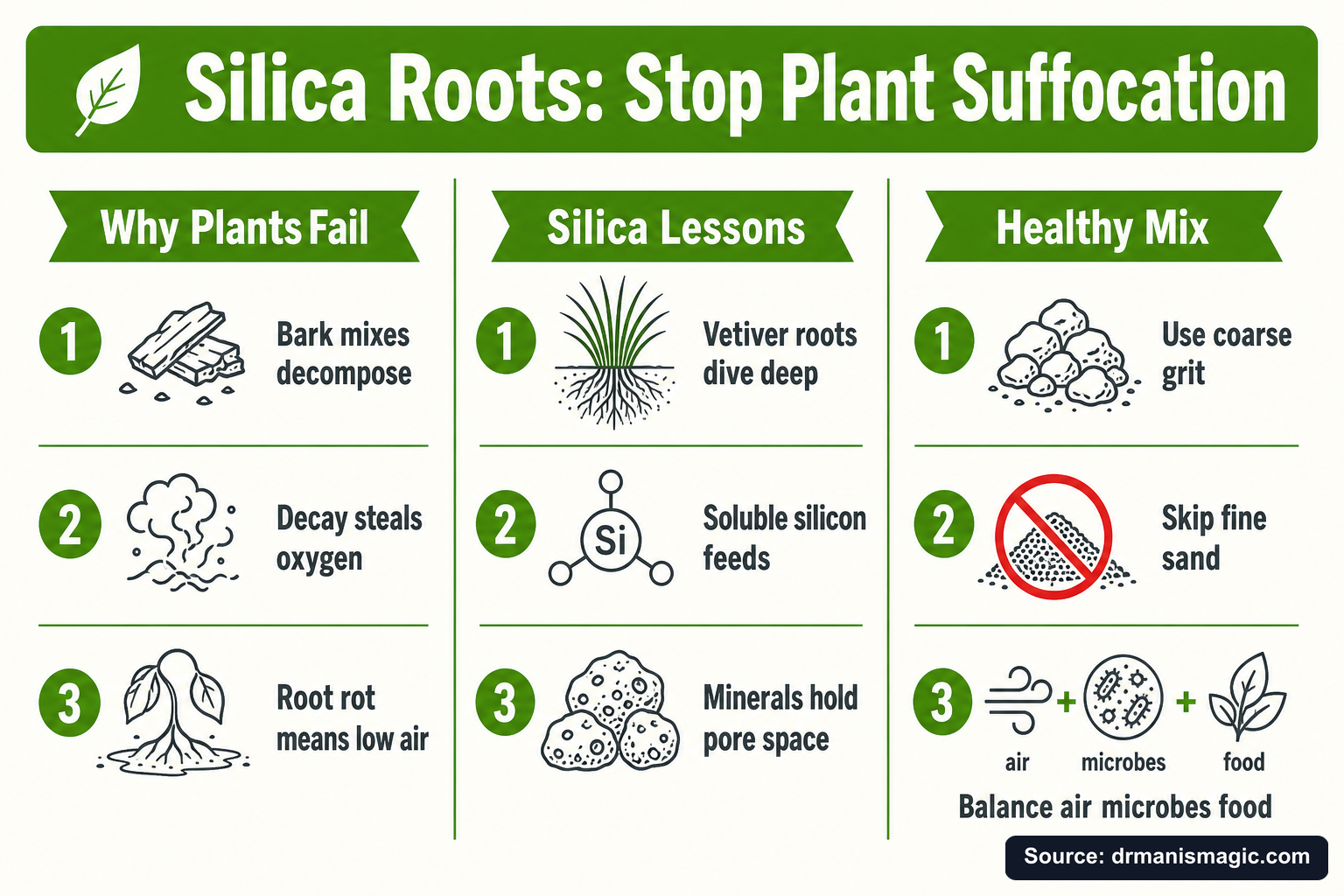
Key Takeaways
- Vetiver grass roots grow up to 10 feet deep using silica-reinforced tissue that resists rot and physical breakdown.
- Silica means three different things: inert mineral structure in sand and pumice, soluble silicon absorbed by plant roots, and phytoliths deposited inside grass tissues after uptake.
- Roots need oxygen, not just water. When organic potting mix decomposes, it consumes the oxygen your roots need to breathe.
- Fine sand can destroy drainage. Coarse silica sand or mineral grit opens pore space. Particle size is everything.
- Root rot is not caused by "too much water." It is caused by too little oxygen, too much salt, and not enough beneficial microbes.
- Mineral-based, silica-rich soil does not decompose, does not compact, and does not steal root oxygen over time.
- The Three Plant Pillars, developed and tested on over 250,000 trees at US Citrus Nursery in South Texas, solve the oxygen, microbe, and nutrient problem all at once.
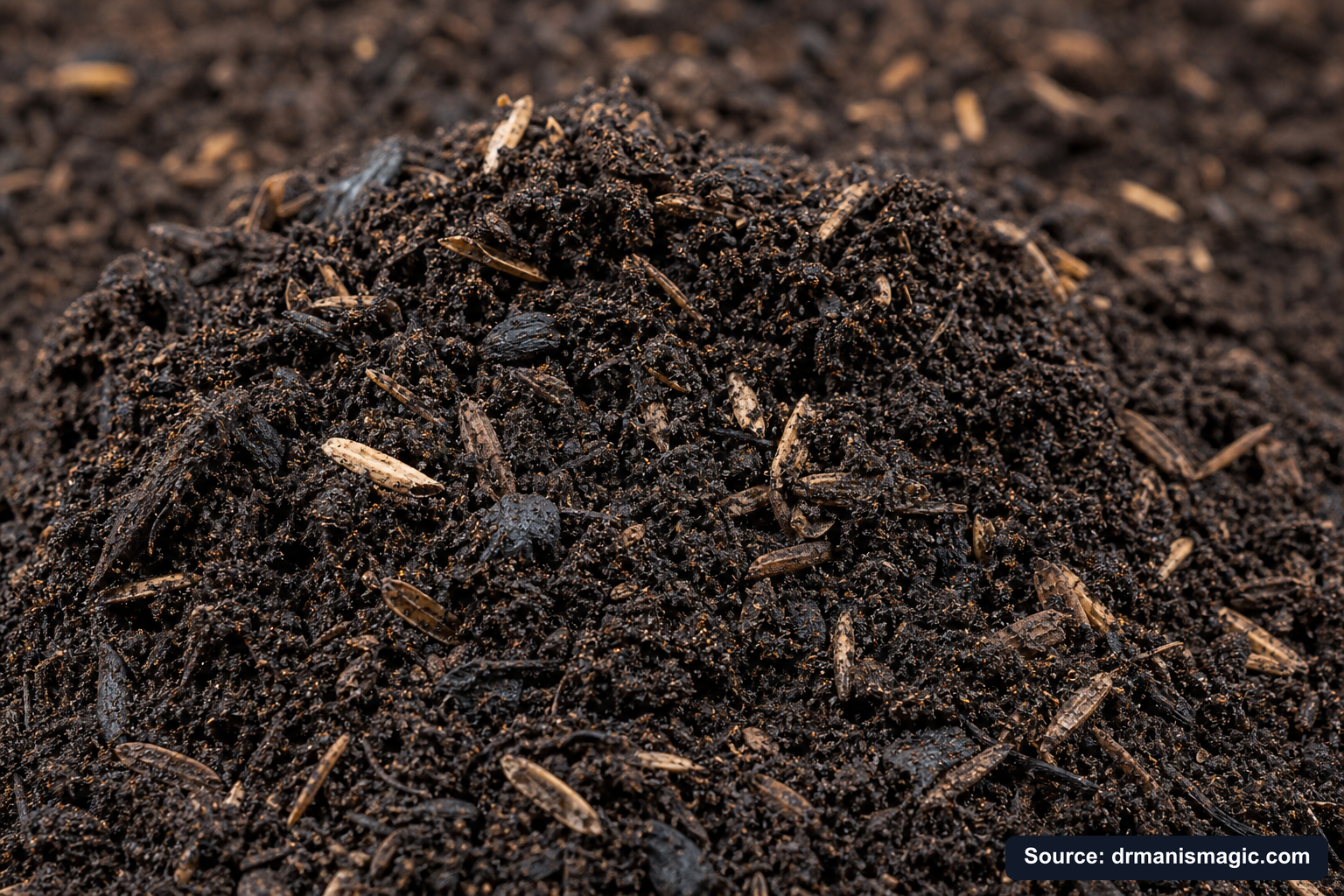
What Are Vetiver Grass Roots and Why Does Silica Matter?
Quick Answer: Vetiver grass has unusually deep, dense, vertically oriented roots that physically reinforce soil against erosion. Its tissues accumulate silica in microscopic structures called phytoliths. That same silica mineral, in a different form, is what makes sand, pumice, and grit the backbone of any healthy root zone.
Vetiver grass, known as Chrysopogon zizanioides, is not your average lawn grass. Most grasses spread their roots horizontally, threading sideways through the top few inches of soil. Vetiver goes vertical. Its root system plunges straight down into the earth, sometimes reaching depths that would make a bonsai master cry with envy. These roots are so dense and so strong that engineers in Southeast Asia, India, and Africa plant vetiver hedgerows along roadsides and riverbanks specifically to hold the earth in place during floods and heavy rains.
Now here is the science part, told simply. Vetiver is a grass. Grasses are some of the most efficient silica accumulators on the planet. They pull silicon from the soil in a dissolved form called orthosilicic acid, absorb it through their roots, and then deposit it inside their tissues as tiny glass-like structures called phytoliths. Think of phytoliths as nature's internal scaffolding. They make the grass stiff. They make the roots tough. They make the whole plant harder to chew, harder to rot, and harder to break.
Research published in peer-reviewed phytolith literature confirms that grasses are among the primary silicon-accumulating plant families on earth, depositing silica bodies throughout their tissues after uptake from the soil. This is not folk wisdom. This is observable plant biology. (PMC, National Library of Medicine)
But here is where most online content completely drops the ball. They lump all "silica" into one bucket and call it a magic ingredient. That is not accurate, and it is not useful to you as a grower. There are actually three very different things happening when we talk about silica and plants. Understanding all three will change how you think about your soil forever.
What Are the Three Types of Silica and Which One Actually Feeds Your Plant?
Quick Answer: Silica means three separate things: the inert mineral structure in sand, pumice, and lava rock that physically holds pore space open; soluble orthosilicic acid that plant roots actually absorb; and phytoliths, the silica bodies deposited inside plant tissue after uptake. Only the soluble form feeds the plant. The mineral form feeds the structure.
Let us break this down so clearly that even a 10-year-old could explain it at the dinner table.
Type 1: Structural Silica (The Physical Kind)
This is quartz. Sand. Pumice. Lava rock. Horticultural grit. Calcined clay. These materials are made of silicon dioxide, the most abundant mineral compound on earth. They do not decompose. They do not compact. They do not rot. When you mix them into a container medium, their job is entirely physical. They hold pore space open so air and water can move freely around roots. They are the architecture of your soil, not the nutrition.
Type 2: Soluble Silicon (The Biological Kind)
When water moves through silica-rich mineral soil, it picks up tiny dissolved amounts of silicon in the form of orthosilicic acid. This is the only form of silicon that plant roots can actually absorb. Once inside the plant, this dissolved silicon gets deposited as phytoliths in the plant's tissues, just like vetiver does. This is a slow, natural process. It is not a fertilizer. It is a biological building material.
Type 3: Phytoliths (The Deposited Kind)
After the plant absorbs soluble silicon, it deposits it as microscopic silica bodies in its leaves, stems, and roots. These phytoliths make the plant physically tougher, more resistant to physical stress, more resistant to fungal penetration, and harder for insects to chew. Vetiver's legendary root strength comes partly from this process happening at extraordinary scale deep underground.
| Type of Silica | Form | What It Does | Where You Find It |
|---|---|---|---|
| Structural Silica | Solid mineral (quartz, sand, pumice, lava) | Holds pore space open, prevents compaction, does not decompose | Coarse sand, pumice, lava rock, grit in container media |
| Soluble Silicon | Dissolved orthosilicic acid in water | Absorbed by roots, becomes biological building material inside plant | Natural soil water passing through mineral-rich media |
| Phytoliths | Silica bodies deposited in plant tissue | Strengthens stems, roots, and leaves; resists fungal attack and insects | Inside grass tissues, vetiver roots, rice hulls |
The takeaway is this: when you put coarse silica sand or pumice in your container mix, you are not directly feeding your plant silicon like a vitamin. You are building a physical structure that holds oxygen in, keeps water flowing, and never collapses over time. That structural benefit is arguably more important than the biological one. We will explain exactly why in the next section.
Why Do Roots Need Oxygen More Than Almost Anything Else?
Quick Answer: Roots breathe oxygen just like you do. When soil pore space fills with water and stays filled, roots suffocate within hours. University of Maryland Extension notes that container roots cannot explore beyond the pot and need media that supplies water, nutrients, AND air. When air disappears, roots die, and pathogens move in.
Here is something that trips up almost every new gardener. Plants breathe in carbon dioxide through their leaves. But their roots breathe in oxygen through the soil. These are two completely separate systems. And the roots' oxygen supply depends entirely on the physical structure of the material they are sitting in.
Imagine your soil as a sponge. A dry sponge is full of air pockets. Squeeze it under water, and all those air pockets fill with water. Now hold it there. The air is gone. If your roots were inside that sponge, they would be suffocating right now.
University of Maryland Extension states clearly that container roots cannot explore beyond the pot and depend entirely on the growing medium to supply water, nutrients, AND air. (University of Maryland Extension)
Rutgers NJAES confirms that saturated zones in containers leave roots without air until enough water evaporates or drains away. That window, where the root zone is saturated and airless, is when root damage begins.
UC IPM describes insufficient root-zone oxygen directly as root asphyxiation and flags it as potentially life-threatening to the plant.
This is why the physical structure of your soil is not a secondary concern. It is the primary concern. And this is exactly what silica-rich mineral media solve. Sand, pumice, and lava rock do not compress. They do not swell when wet. They maintain what scientists call air-filled porosity, the percentage of your soil's pore space that stays filled with air even after watering.
Now contrast that with pine bark potting mix. Bark is organic. Organic means carbon-based. Carbon-based means it decomposes. And decomposition is an oxygen-consuming process. As the bark breaks down, it does two terrible things at the same time. It consumes the oxygen your roots are trying to breathe. And it physically collapses, reducing pore space so there is less room for air even in the moments when water has drained away.
This is not a minor inconvenience. This is a slow execution of your plant's root system, delivered in a bag with a cheerful label and a picture of a tomato on the front.
After growing over 250,000 trees at our South Texas nursery, we learned this the hard way. Potting mix is not soil. It is a temporary, decomposing compromise that works fine for annual plants with short lifespans and catastrophically for perennials, fruit trees, and anything you expect to live for years. For a deeper look at what this does to your roots over time, see also: The Hidden Reason Synthetic Fertilizers Cause Root Rot.
Is Sand Good or Bad for Drainage?
Quick Answer: Coarse silica sand dramatically improves drainage and air-filled porosity. Fine play sand, masonry sand, or beach sand can actually destroy drainage by clogging the gaps between larger particles. Rutgers NJAES research confirms that adding the wrong sand to bark blends can reduce total porosity and air space, making drainage worse, not better.
This is one of the most misunderstood topics in all of container gardening. "Add sand for drainage" is advice you will find everywhere. And it is sometimes dangerously wrong.
Here is why particle size is everything. Imagine filling a bucket with golf balls. There are large gaps between every ball. Now pour in fine sand. That sand filters down and fills every single gap. Your drainage just got worse, not better. The same physics happen in your pot when you mix fine sand into bark-based potting mix.
Rutgers NJAES research on container nursery media explicitly notes that adding sand to pine bark blends can reduce total porosity and air space. The key variable is particle size distribution. Small particles fill the gaps between large particles. Large particles maintain the gaps that let air and water move.
So what kind of sand actually works? Coarse silica sand with angular particles. Horticultural grit. Pumice. Lava rock. Calcined clay. These materials have particles large enough and angular enough to rest against each other and create stable, permanent pore space that does not collapse under the weight of watering.
What to avoid: fine play sand from a hardware store, masonry sand, beach sand, and any sand that feels powdery between your fingers. These will compact, clog macropores, and create the very drainage problem you were trying to solve.
This is exactly why Dr. Mani chose silica-rich sandy loam from the Rio Grande Valley as the foundation of our soil system. The particle size is right. The mineral composition is right. It does not decompose. It does not compact. It stays open, year after year, so roots can always find the oxygen they need.
Potting Mix vs. Mineral-Based Soil: What Really Happens to Your Roots Over Time?
Quick Answer: Potting mix begins decomposing the moment you open the bag, collapsing pore space and stealing root oxygen within 6 months. Mineral-based soil made from silica-rich sandy loam stays structurally intact for years or permanently, maintaining the air-filled pore space roots need to breathe and grow.
Let us put the two side by side so you can see exactly what you are choosing between.
| Feature | Pine Bark Potting Mix | Mineral-Based Silica-Rich Soil |
|---|---|---|
| Primary ingredient | Pine bark sawdust (timber industry byproduct) | Silica-rich sandy loam, pumice, lava, grit |
| Decomposes? | Yes. Rapidly. Starts immediately. | No. Mineral structure is permanent. |
| Oxygen consumption | High. Decomposition eats oxygen from the root zone. | None. Inorganic minerals do not decompose. |
| Pore space over time | Collapses as bark breaks down. Compacts into sludge. | Stable. Particle structure holds pore space open permanently. |
| Drainage after 6 months | Severely reduced. Often hydrophobic when dry. | Unchanged. Water moves freely through mineral particles. |
| Root rot risk | High and increasing over time. | Low when properly mixed and watered. |
| Chemical compounds | Terpenes, terpenoids (pine chemistry). Not ideal for roots. | Inert. No harsh chemical compounds in root zone. |
| Surfactant dependency | Manufacturers add wetting agents that wash away over time. | None needed. Mineral particles wet naturally and consistently. |
| Repotting interval | Every 6-12 months for optimal performance. | Years to permanently. No forced repotting cycle. |
| Cost over 5 years | High. Repeated purchases required as mix degrades. | Low. One-time investment in permanent structure. |
Here is the part that really stings when you understand it. Big box stores and many commercial nurseries actually benefit from potting mix degrading. When your plant declines after six months and you cannot figure out why, you buy a new plant. You buy more bags of the same stuff that caused the problem. The cycle repeats. Their revenue is stable. Your garden is not. We are not saying this is malicious. We are saying the incentive structure does not reward long-term plant health. And you deserve to know that.
We are planting you in dead trees and calling it gardening. That is the short version of the potting mix story. And once you see it, you cannot un-see it.
There is also a chemistry angle that rarely gets discussed. Pine bark contains terpenes and terpenoids, the same family of chemical compounds that give us Pine-Sol and turpentine. These are powerful organic solvents. Manufacturers let the bark decompose in massive outdoor piles for years specifically to reduce the harshest of these chemicals before bagging it. But they are never fully gone. And you are literally planting your tree's roots in that.
Bonsai masters figured this out centuries ago. Traditional Japanese bonsai media has always been mineral-heavy: akadama, pumice, lava rock. Almost no organic content at all. These growers needed their trees to survive in tiny containers for decades. They could not afford to have their media collapse in six months. Mineral structure was the only answer. And it worked. Trees in mineral bonsai media outlive their owners routinely.
You Never Had a Brown Thumb.
You were handed the wrong tools. This free guide hands you the right ones.
You watered it. You fed it. It died anyway.
It was never you. It was the dirt, the salt food, and the bad advice.
This guide shows you what really went wrong, and how to fix it for good.
- Why your plants really died, and why it was never your fault
- The salt hiding in your plant food that quietly burns the roots
- The hidden killer in almost every bag of store soil
- The tiny helpers that grow a whole forest for free
- The rescue trick that brings a half dead plant back to life

Why Do Roots Rot in Wet Soil But Survive in Water Culture?
Quick Answer: In wet organic soil, decomposing bacteria and fungi consume oxygen faster than it can reach roots, and the collapsing pore structure keeps water trapped. In clean water culture (hydroponics), oxygen is dissolved directly in the water and no decomposing media is consuming it. The enemy is not water. It is the absence of oxygen and the presence of pathogens that move in when roots are already stressed.
This question confuses almost everyone. How can a plant survive with its roots submerged in water in a hydroponic system, but die from overwatering in a pot of soil? It seems contradictory. It is not, once you understand what is actually killing the roots.
In a hydroponic system, the water is clean. It is often oxygenated with air stones or circulation. There is no decomposing organic matter consuming oxygen. There are no pathogenic fungi waiting in rotting bark to attack stressed roots. The roots can absorb both water and dissolved oxygen at the same time. They thrive.
In a pot of waterlogged organic potting mix, the story is completely different. The saturated bark is consuming oxygen as it decomposes. The water sitting in the pore space has no dissolved oxygen because the decomposition process has used it all. The roots begin to die from oxygen starvation. And the moment roots are damaged and stressed, pathogenic fungi like Phytophthora and Pythium move in for the kill. These pathogens are often already present in bark-based media, waiting for exactly this moment.
This is why we at Dr. Mani's Magic say that root rot is not caused by overwatering. It is caused by insufficient oxygen, too much salt from synthetic fertilizers, and insufficient beneficial microbial activity to protect the root zone. Overwatering is just the trigger that reveals an already-compromised system.
Mineral-based media changes this equation completely. Coarse silica particles drain rapidly. Pore space stays open between particles even when wet. Oxygen can diffuse back into the root zone quickly. And because there is no decomposing organic matter, there is far less food source for pathogenic fungi in the first place.
What Is the Three Plant Pillars System and How Does Silica Fit In?
Quick Answer: The Three Plant Pillars are the framework developed by Dr. Mani Skaria and proven on 250,000+ trees at US Citrus Nursery in South Texas. Pillar 1 is mineral-based, silica-rich soil for permanent structure and oxygen. Pillar 2 is live microbes to protect and feed the root zone. Pillar 3 is organic fertilizer that works with microbes instead of killing them.
Dr. Mani Skaria is a Professor Emeritus of Plant Pathology, the inventor of micro-budding, and the founder of the Clean Citrus Program in Texas. He spent over 40 years at the Texas A&M Citrus Center studying why plants thrive or fail. And after decades of watching plants die in organic potting mix, get burned by salt-based fertilizers, and collapse without beneficial microbes, he built a system that solves all three problems at once.
He calls it the Three Plant Pillars. And silica is at the very foundation of Pillar One.
Pillar 1: Mineral Foundation
The soil must be silica-based and permanent. It must not decompose. It must hold pore space open for oxygen. It must drain freely without collapsing. The silica-rich sandy loam from South Texas that forms the base of Dr. Mani's system does not break down. It does not compact. It does not steal oxygen. It is the physical structure that makes everything else possible. Think of it as the concrete foundation under a house. You can build anything on a solid foundation. You cannot build anything on rotting sawdust.
Pillar 2: Microbial Muscle
Mineral soil alone is not enough. The root zone needs a living army of beneficial bacteria, fungi, and mycorrhizae to unlock nutrients, protect roots from pathogens, and create a self-sustaining ecosystem. These microbes are what transform mineral structure into a living, breathing soil environment. Without them, even the best mineral media leaves roots defenseless against disease. With them, roots push deeper, absorb more, and resist stress that would kill plants in depleted soil.
Pillar 3: Organic Fertilizer
The nutrients that feed the plant must be slow-release, organic, and completely free of synthetic salts. Salt-based fertilizers, even the expensive "premium" ones, kill the very microbes that Pillar 2 is trying to build. They also damage root tissue directly through osmotic shock. Organic fertilizers from sources like crab meal, kelp, and amino acids release nutrients slowly, work in harmony with soil microbes, and never burn roots or destroy the biological ecosystem you worked so hard to build. See also: Why Most Fertilizers Are Actually Salt in Disguise.
When all three pillars are in place, something remarkable happens. Roots breathe. Microbes multiply. Nutrients flow. The plant stops struggling and starts growing the way it was designed to grow in nature. We have watched this happen on over 250,000 trees. We have watched it happen with houseplants, tropical trees, lawns, flower gardens, and vegetable beds. The system works because it is not invented. It is observed. It is nature's actual operating system, just applied deliberately.
Can Vetiver Grow in Containers and What Does It Teach Us About Container Media?
Quick Answer: Vetiver can grow in containers but thrives best in mineral-heavy, well-drained media that mirrors the deep, oxygen-rich soil its roots prefer in nature. Its story teaches us that roots designed for mineral soil perform poorly in organic media. The best container media mimics what mineral earth naturally provides: open pore space, stable structure, and consistent oxygen availability.
Vetiver in a pot is an interesting thought experiment. In nature, its roots go down six to ten feet into mineral soil. In a container, those roots hit the bottom of the pot and have nowhere to go. But the lesson vetiver teaches us is not about its container performance. It is about what its roots were designed for.
Vetiver roots evolved in mineral-rich, well-drained soils. They evolved to push through stable, oxygen-rich earth that did not collapse around them. They evolved to accumulate silica because the silica was available in their native environment. The phytoliths that make vetiver roots so tough are a product of growing in mineral soil.
Now think about what happens when you put any plant with deep, oxygen-hungry roots into a small container filled with decomposing bark. The roots hit a wall immediately. The media begins collapsing around them. Oxygen disappears. The plant that was supposed to thrive instead struggles and slowly declines. And the grower blames themselves, buys more products, tries more tricks, and never identifies the actual problem.
The actual problem is always the same. The media was wrong from the start.
There is something else worth knowing here. Rice hulls, one of the amendments Dr. Mani uses in his soil system, are essentially phytoliths. They are the silica-rich outer shells of rice grains, the same kind of silica structures that vetiver deposits inside its roots. Rice hulls do not decompose quickly. They hold their structure for a long time, providing lightweight, durable pore space in a container mix. They are nature's own structural silica, packaged by the plant itself, and repurposed for your garden.
What Does a Root-Rot Recovery Look Like When You Switch to Mineral Media?
Quick Answer: Recovery from root rot in a container plant requires removing the dead root tissue, sterilizing or replacing the media with mineral-based soil, restoring beneficial microbes, and feeding with organic nutrients. Most plants in early to mid-stage root rot recover well when moved to properly structured mineral media with good oxygen availability.
If your plant is showing yellowing leaves, slow growth, soft or brown roots, or a stem that wobbles in its pot, you may already be dealing with root rot driven by oxygen deprivation in your current media. Here is a straightforward recovery checklist:
- Remove the plant from its current media carefully. Shake off as much of the old potting mix as you can. Old bark-based media is likely compacted and may smell sour or musty.
- Inspect the roots. Healthy roots are white or cream-colored and firm. Rotten roots are brown, black, soft, or slimy. Trim any dead or rotten root tissue back to healthy tissue using clean scissors or pruning shears.
- Let roots air-dry for 30-60 minutes in a shaded spot. This helps callous any cut surfaces and reduces the chance of further infection.
- Repot into mineral-based, silica-rich media that drains freely and holds pore space open. Avoid any media that feels light, fluffy, or smells like bark or wood. A good mineral mix feels heavy, gritty, and smells like clean earth.
- Drench the new media with live beneficial microbes immediately. Beneficial bacteria and mycorrhizal fungi will colonize the root zone and begin protecting the recovering roots from pathogenic fungi that may still be present.
- Hold off on heavy fertilization for two to four weeks. Let the roots stabilize before pushing growth. When you do fertilize, use slow-release organic fertilizer only. Zero synthetic salts at this stage.
- Water deeply but only when the top inch of media is dry. With mineral media, this is easier to judge because the media dries more evenly and consistently than bark-based mixes.
Most plants in early to mid-stage root rot recover remarkably well when given proper oxygen, live microbes, and time. The key is removing the source of the problem, which is the oxygen-depleted, decomposing media, and replacing it with a structure that lets roots breathe again.
The Aromatic Side of Vetiver: What the Roots Smell Like and Why That Matters
Quick Answer: Vetiver roots have a deep, smoky, earthy aroma used in perfumery and traditional Indian cooling screens for centuries. The silica-reinforced structure of the roots preserves their aromatic compounds long after harvest. This same structural durability that makes vetiver roots aromatic and long-lasting is what silica-rich mineral media does for your container plants: it preserves function without breaking down.
We cannot talk about vetiver roots without mentioning what they smell like. Because the smell is part of the story.
In India, vetiver roots have been woven into cooling screens called khus khus tatties for thousands of years. When water is poured over these screens and the breeze blows through, the room fills with a cool, smoky, earthy fragrance. This is one of the oldest forms of natural air conditioning on earth. Vetiver root mats, fans, and baskets were prized across the ancient world from India to Persia. The roots were also distilled into an essential oil that perfumers still use today as a base note in some of the world's most sophisticated fragrances.
What preserves that fragrance? Silica. The physical structure of the root, reinforced by phytoliths, protects the aromatic compounds inside from rapid breakdown. A root built around silica scaffolding lasts. A root built around soft, easily decomposing organic tissue does not.
Your container plant is the same. Give it a mineral foundation that holds its structure permanently, and it lasts. Give it a decomposing organic medium, and it slowly collapses from the inside out, no matter how much you water it, fertilize it, or pray over it.
The ancient world understood something we forgot. Structure matters more than nutrition. Get the structure right, and the nutrition follows naturally. Get it wrong, and nothing you add on top will save you.
How Do You Build a Long-Lived Container Mix Using Silica Principles?
Quick Answer: A long-lived container mix for perennial plants should be mineral-dominant, with coarse silica particles providing stable pore space, supplemented by small amounts of organic material for water retention and microbial habitat. The goal is air-filled porosity above 15-20% even after watering, with rapid drainage and no decomposing material consuming root oxygen.
Here is the practical framework for building container media that lasts. We have tested versions of this across every plant type you can imagine, from citrus trees in Texas heat to tropical houseplants in humid growing rooms.
The key principle is this: mineral components provide permanent structure. Organic components provide short-term water retention and microbial habitat. You want the mineral components to dominate so the structure never collapses, even as the small amount of organic material slowly breaks down.
For perennial container plants, fruit trees, and long-lived houseplants, a mix weighted heavily toward mineral components is the right approach. Think coarse silica sand, pumice, lava rock, calcined clay, and perlite as your structural backbone. A small amount of biochar provides long-term microbial habitat without decomposing. A small amount of coco coir provides water retention without the harsh pine chemistry of bark-based media.
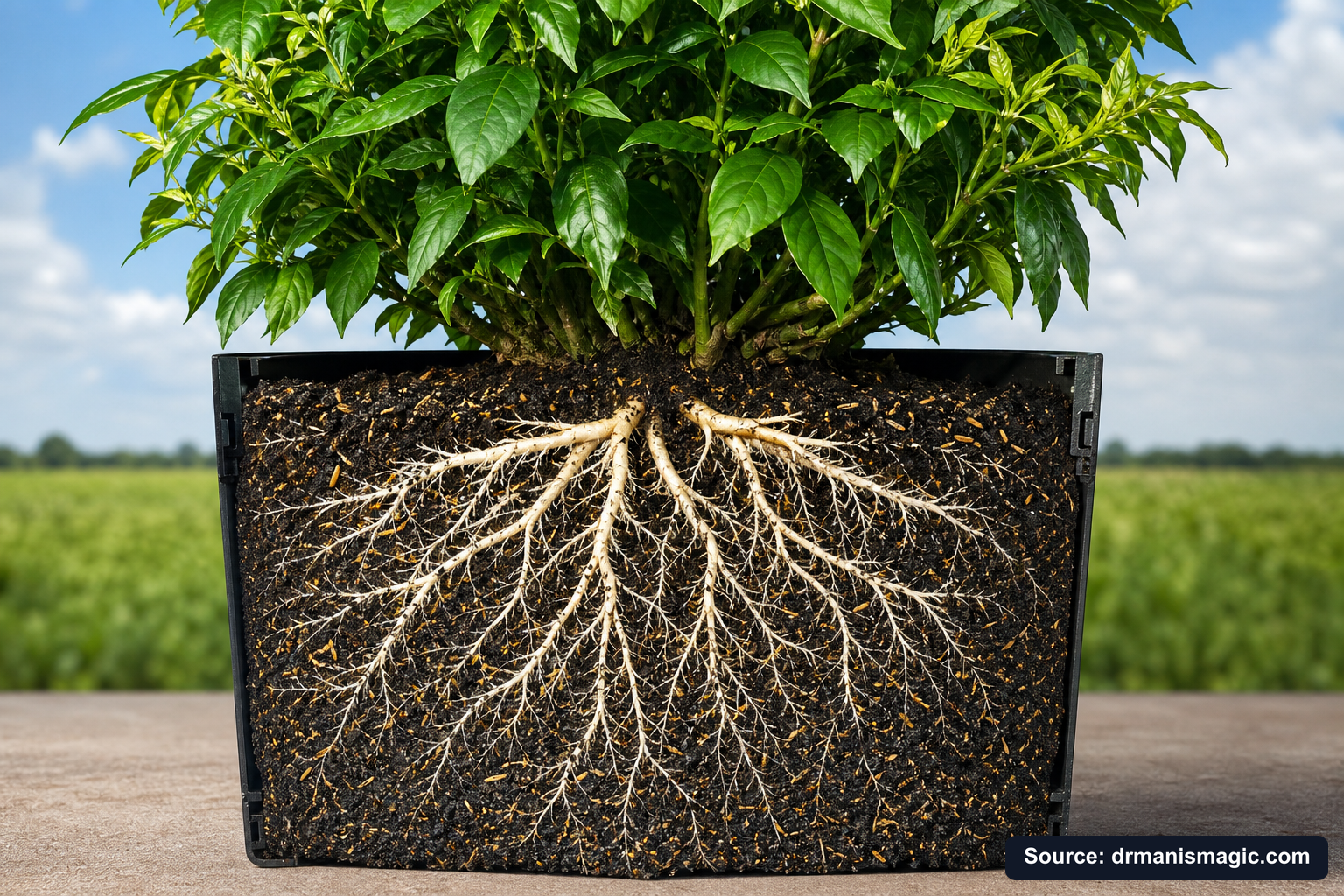
What you are building is essentially what vetiver evolved in: a stable, mineral-dominant environment with enough biological activity to support a living root system. The vetiver does not need fluffy, decomposing organic matter to grow its legendary roots. It needs structure, oxygen, and mineral-rich earth. So does your citrus tree. So does your fiddle leaf fig. So does your rose bush.
If you want to skip the building process entirely and start with a media that already has this figured out, Super Soil was designed from the ground up with exactly these principles: silica-rich sandy loam as the permanent mineral base, steam-sterilized to eliminate pathogens, with rice hulls and biochar added for structure and microbial support. Zero PFAS. Zero biosludge. Zero synthetic salts. Made in the USA. You do not have to build it yourself. We already built it.
What Does Vetiver Teach Us About the Future of Root-Zone Science?
Quick Answer: Vetiver demonstrates that the most durable root systems in nature are built on mineral structure, biological silicon uptake, and deep oxygen-rich soil. These are not new discoveries. They are ancient principles that modern container gardening repeatedly ignores in favor of cheap, lightweight, decomposing media optimized for short-term profit rather than long-term plant health.
There is a reason vetiver has been used for erosion control, fragrance, and traditional medicine across four continents for thousands of years. It works. Its roots are extraordinary not because of any magic ingredient added to the soil. They are extraordinary because the plant evolved in harmony with mineral earth, absorbing what the earth offered in the form of soluble silicon, depositing it as biological armor inside its own tissues, and pushing deeper into stable, oxygen-rich ground than any other grass on the planet.
That is not so different from what we are trying to do in every container garden, every raised bed, every backyard orchard. We are trying to create a root environment so stable, so oxygen-rich, so biologically alive that the plant can do what it was designed to do without fighting its own growing medium every day.
The Three Plant Pillars exist because Dr. Mani spent decades watching plants fail in the wrong media, burn from the wrong fertilizers, and collapse without the right microbial support. He did not invent this framework. He observed it in nature and rebuilt it deliberately for container growing. Mineral foundation. Microbial muscle. Organic nutrition. In that order. Always in that order.
You can learn more about putting all three pillars into practice immediately with the Free Plant Care Field Guide, which walks you through every step without jargon, without guesswork, and without the frustration of piecing together conflicting advice from a dozen different sources.
The best time to give your roots the mineral foundation they need was the day you first planted. The second best time is right now. You cannot get back the months or years a struggling plant has cost you. But you can stop the clock on that loss today, and start building toward the garden you actually pictured when you started this whole journey.
If you are ready to see what mineral-based, silica-grounded, biologically alive soil actually does for the plants you care about, we would love to show you. Everything we make is backed by a 30-day money-back guarantee. Real people answer the phone. No bots, no runaround. Just growers who have done this for 30 years and want your plants to thrive as much as you do.
Frequently Asked Questions
Vetiver grass has some of the deepest, strongest roots on the planet. And the secret behind those roots teaches us something huge about why most plants quietly fail. These questions get right to the heart of what silica does, why your soil might be suffocating your roots right now, and how the Three Plant Pillars fix the whole problem fast.
What makes vetiver grass roots so unusually strong and deep?
Vetiver roots drive straight down into the earth, sometimes reaching ten feet deep. They are reinforced with silica, the same mineral found in sand and quartz. Silica does not rot. It does not compress. It gives the roots a rigid, almost steel-like structure. That is why vetiver holds entire hillsides together during floods. Most plants never get this kind of structural support because their soil is full of decomposing organic material instead of stable mineral particles.
What is silica actually doing inside the soil and inside the plant?
Silica works in two ways. In the soil, it creates stable mineral particles like sand and grit that hold open pore spaces so roots can breathe. In the plant, roots absorb dissolved silicon and deposit it inside their tissues as tiny structures called phytoliths. Those deposits make cell walls stronger and harder to break down. The result is a root that resists rot, resists pressure, and keeps pulling in water and nutrients for a long time.
Why does regular potting mix suffocate plant roots over time?
Most potting mix is made from ground pine bark, which is basically sawdust from the timber industry. It is organic and carbon-based, which means it is always decomposing. That decomposition burns through the oxygen in the soil. Roots need oxygen to survive, just like you do. When the oxygen disappears, roots suffocate and rot sets in. The bag looks fine on the shelf, but inside your pot, it is quietly breaking down and stealing the air your roots need to thrive.
What is root rot really caused by, and how do you stop it?
Root rot is not simply caused by overwatering. It is caused by three things working together: too little oxygen in the soil, salt buildup from synthetic fertilizers that burns root tissue, and a total lack of beneficial microbes to fight off pathogens. Fix all three and root rot becomes rare. That is exactly what the Three Plant Pillars do. Mineral-based soil brings back the oxygen. Live microbes wage war on the pathogens. Organic fertilizer feeds the plant without the toxic salt burn.
How does Dr. Mani's Super Soil use the silica lesson from vetiver grass?
Dr. Mani spent decades growing citrus trees in South Texas and watched organic potting mixes fail over and over. So he built Super Soil around a sandy loam base from the Rio Grande Valley. That soil is silica-rich, mineral-based, and does not decompose. It holds open pore spaces permanently so roots can breathe and push deep, just like vetiver does in the wild. We have tested this on over 250,000 trees at US Citrus Nursery. The difference in root health is not subtle. It is dramatic.
What do beneficial microbes have to do with silica and strong roots?
Silica-rich mineral soil creates the right structure, but microbes make that structure come alive. Bacteria, fungi, and mycorrhizae colonize the root zone and do three things: they break down nutrients into forms roots can actually absorb, they fight off disease-causing pathogens, and they help roots extend further into the soil. Without microbes, even perfect mineral soil leaves your plant defenseless. That is why Plant Super Boost, our live microbial formula, is Pillar Two of the Three Plant Pillars. Structure plus life equals unstoppable growth.
What is the benefit of building your garden around the Three Plant Pillars instead of just buying better fertilizer?
Fertilizer alone is like putting premium gas in a car with a clogged engine. It does not fix the real problem. The Three Plant Pillars address the root cause, literally. Mineral-based soil keeps oxygen flowing. Live microbes protect and feed the root zone. Organic fertilizer delivers slow-release nutrients without burning the soil or poisoning your family. When all three work together, your plants stop struggling and start thriving. We proved this across 250,000 trees. The foundation is what changes everything.
About the Author
Dr. Mani Skaria, PhD
Dr. Mani Skaria, PhD, is a plant pathologist and the scientific founder of Dr. Mani's Magic. He earned his doctorate at Purdue University and spent 48 years studying how plants, soil, and living microbes work together, including his years as Professor Emeritus at Texas A&M and as a member of the USDA NAREEE Advisory Board. He invented micro-budding, a method for growing healthier, stronger trees, and has grown more than 250,000 trees on the family farm in Hargill, Texas - US Citrus Nursery. His life's work takes real lab science and practical experience and turns it into simple, safe, organic plant care anyone can use at home.


