


Biochar's Role in Soil Water and Air Balance for Healthy Roots | Dr. Mani's Magic
The Role of Biochar in Water and Air Balance: How to Build a Root Zone That Holds Moisture Without Suffocating Roots
Picture this. You just repotted your favorite citrus tree. You used a bag of something labeled "premium potting mix" from the big box store. You added a scoop of biochar because you read it was a miracle amendment. You watered it in. And for a few weeks, everything looked great.
Then, slowly, the leaves started to yellow. The soil stayed wet for days after watering. You stuck your finger in and it felt like wet cardboard. You pulled the tree out three months later and found brown, slimy roots that smelled like a swamp. Root rot. Again. And you did everything right. Or so you thought.
Here is what nobody told you. Biochar is not a magic sponge you sprinkle in and walk away from. It is a structural tool. Use it right, and your root zone breathes like a forest floor. Use it wrong, and you have just poured a bag of fine dust into your pots that clogs every air channel your roots depend on to survive. The role of biochar in water and air balance is real, it is powerful, and it is almost completely misunderstood by the people selling it to you.
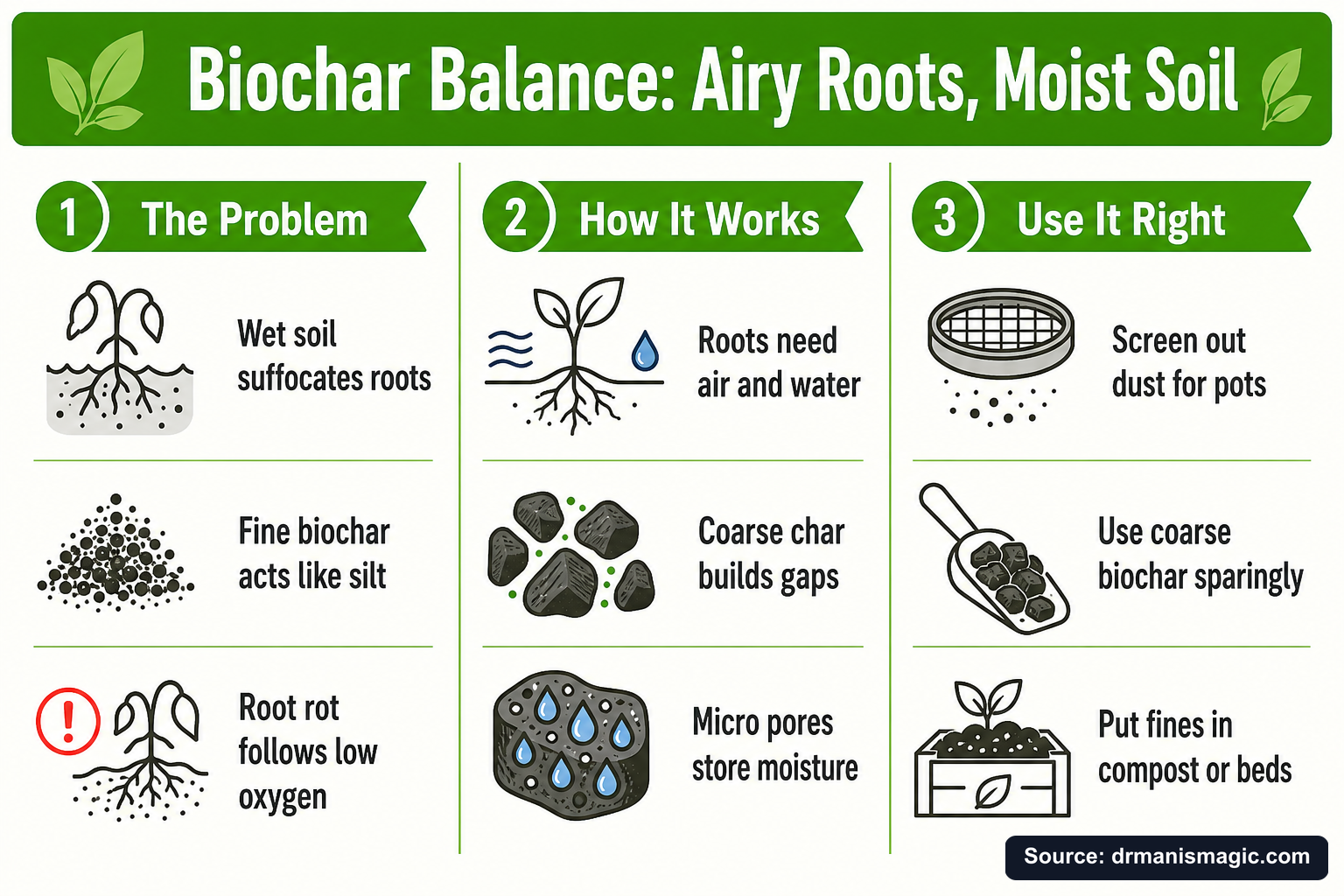
Key Takeaways
- Biochar can either improve or destroy the air balance in your container soil, depending entirely on particle size and how much you use.
- Roots need oxygen just as much as they need water. When oxygen cannot reach roots, they rot, even if you water perfectly.
- Coarse biochar particles build durable pore architecture. Fine biochar dust clogs air channels and behaves more like silt than like pumice or lava rock.
- Most potting mix is made from decomposing pine bark sawdust. That decomposition process actively steals oxygen from your root zone.
- The goal is not more water retention. The goal is the right balance of air-filled porosity and water-holding capacity at the same time.
- After growing over 250,000 trees at our South Texas nursery, we learned that mineral-based soil structure is the foundation everything else builds on, including biochar.
- Screen your biochar. Use coarse particles for container structure. Use fines for field soil or compost charging, not for pots.
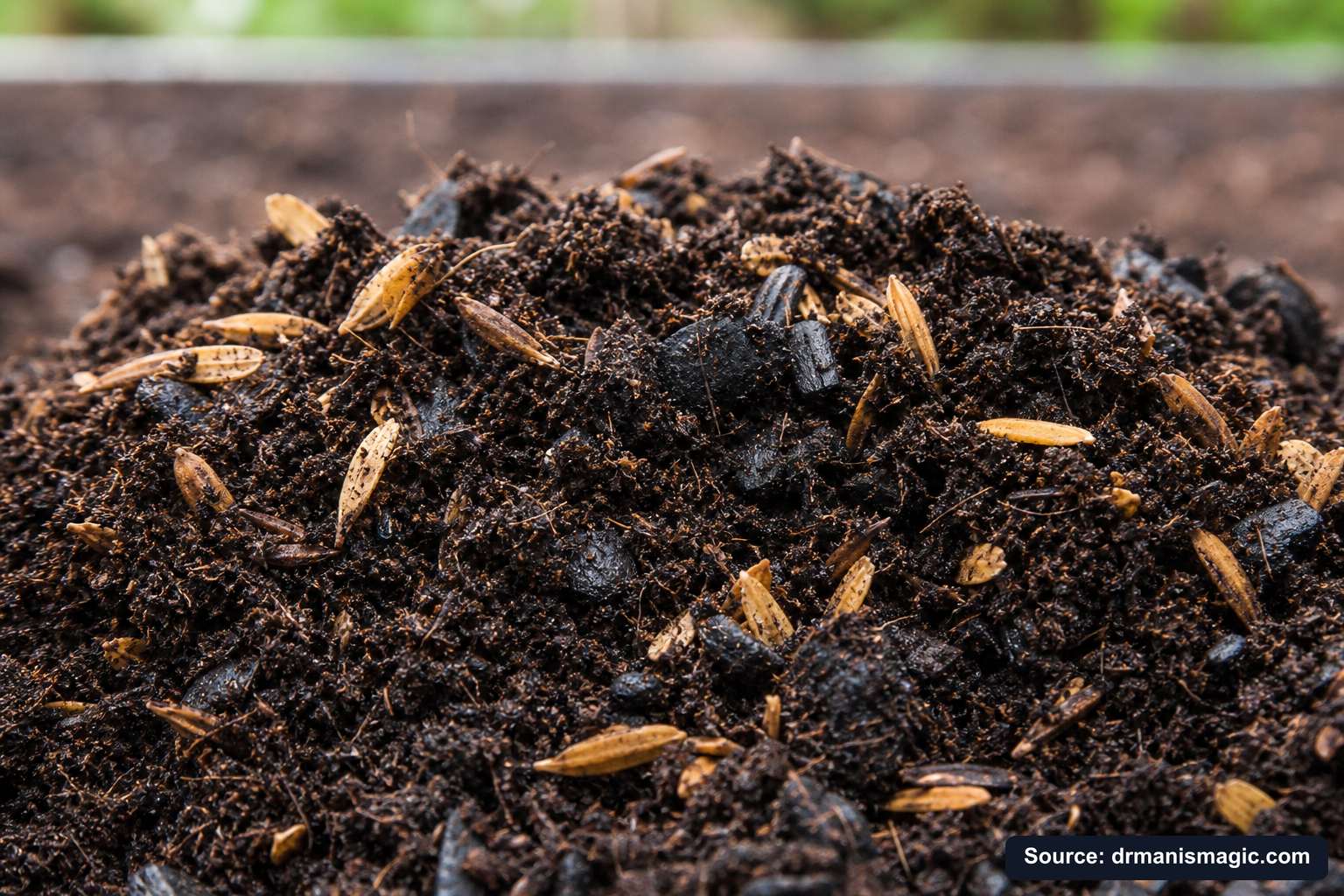
What Is Biochar Actually Doing Inside Your Soil?
Quick Answer: Biochar is a porous carbon material made by burning organic matter without oxygen. Inside your soil, it acts like a tiny sponge-and-apartment-building combination: the pores hold water and nutrients, and the channels between particles create pathways for air. But whether it helps or hurts depends entirely on particle size, dose, and what medium it goes into.
Biochar is charcoal. That is the simplest way to say it. But not the charcoal you light on a grill. It is made through a process called pyrolysis, which means burning wood, rice hulls, coconut shells, or other organic matter at high heat with very little or no oxygen. That process drives off the volatile compounds and leaves behind a rigid, highly porous carbon skeleton.
Think of a piece of biochar under a microscope. It looks like a tiny apartment building full of tunnels and rooms. Those internal pores can hold water and dissolved nutrients. The walls between those pores do not decompose the way wood does. That durability is the whole point. Unlike pine bark sawdust, which is breaking down the moment you put it in a pot, biochar persists for hundreds or even thousands of years. Scientists have found biochar in Amazonian soils called Terra Preta that are still fertile after more than 2,000 years of use.
But here is the thing that changes everything. How biochar behaves in your container depends almost entirely on the size of the particles you are working with. Coarse biochar chunks add structure and create the large air-filled channels that roots need. Fine biochar particles, especially dust-sized fines, fill those same channels and block airflow. The same material. Opposite results. That is the secret the industry is not telling you.
Why Do Roots Need Oxygen More Than Almost Anything Else?
Quick Answer: Roots breathe aerobically, meaning they consume oxygen and release carbon dioxide just like you do. When oxygen cannot diffuse into the root zone, roots stop functioning, weaken, and become easy targets for rot-causing pathogens like Phytophthora. Adequate air-filled porosity in container media is not optional. It is the difference between a thriving plant and a dying one.
Here is something that surprises almost every gardener the first time they hear it. Your plant loves carbon dioxide above ground. But underground, in the roots, the story is completely different. Roots respire aerobically. They consume oxygen and release carbon dioxide, the same way you do when you breathe. Cornell University's greenhouse teaching materials make this clear: oxygen must constantly diffuse into the growing medium, and carbon dioxide must diffuse out, or roots begin to suffer.
When the soil stays saturated, water fills all the pore spaces and oxygen cannot get in. Roots begin to die from oxygen starvation. And once roots are damaged, pathogens move in. Oregon State University nursery guidance notes that low air space dramatically increases the risk of Phytophthora root rot, and that air-filled porosity above roughly 30 percent has been associated with much lower disease incidence in container media.
This is why root rot is so often misdiagnosed as overwatering. Overwatering is just the trigger. The real cause is a medium that cannot drain fast enough or hold enough air after watering. A well-structured medium drains quickly, holds the right amount of moisture in its micropores, and keeps its macropores open for gas exchange. A poorly structured medium, like old, compacted potting mix or a pot loaded with fine biochar dust, traps water everywhere and leaves roots gasping.
After growing over 250,000 trees at our South Texas nursery, we learned this lesson the hard way. Roots that breathe grow. Roots that drown die. Everything else is secondary.
What Is the Difference Between Macropores and Micropores, and Why Does It Matter?
Quick Answer: Macropores are the large channels between particles that drain freely and hold air after watering. Micropores are the tiny internal pores inside particles that hold water by capillary action. Healthy container media needs both. Macropores keep roots oxygenated. Micropores keep roots hydrated. Biochar's value lies in contributing to both, but only when the particle size is right.
Soil scientists split pore space into two categories, and understanding both changes how you think about every amendment you add to a pot.
Macropores are the big spaces between particles. Water drains through them by gravity. After watering, they refill with air. That air is your oxygen supply for the root zone. These are the channels that keep roots from drowning.
Micropores are the tiny internal pores inside particles, like the tunnels inside a piece of biochar, pumice, or coir. Water clings to the walls of these pores by capillary action and does not drain out even when you water heavily. That retained moisture is what keeps roots hydrated between waterings.
The ideal container medium has plenty of both. It drains fast, which refills the macropores with air. And it holds enough moisture in its micropores so roots can drink between waterings without the medium staying wet long enough to cause oxygen problems.
UGA Extension's Biochar Basics confirms that biochar can change air space, container capacity, total porosity, and bulk density, but the direction of that change depends on feedstock, pyrolysis temperature, and critically, particle size. A coarse biochar particle contributes macropore structure between particles and micropore water retention inside the particle. A fine biochar particle, especially dust, fills the macropores between other particles and turns a well-draining mix into something closer to compacted silt.
This is the physics lesson that most biochar marketing completely ignores.
What Is the Potting Mix Problem and Why Does Decomposition Steal Your Oxygen?
Quick Answer: Most potting mix is made from pine bark sawdust, an organic carbon-based material that decomposes over time. That decomposition process consumes oxygen, the same oxygen your roots need to survive. As the mix breaks down, it compacts, blocks air channels, and creates the waterlogged, low-oxygen conditions that cause root rot even when you water correctly.
Here is a sentence worth reading twice. Most commercial potting mix is just shredded dead pine trees. That is it. The industry calls it "premium blend" and charges you twelve dollars a bag, but underneath the marketing language, you are planting your living tree into dead, decomposing wood.
Pine bark is a waste product from the timber industry in the southeastern United States. It is cheap. It is lightweight. It is easy to ship. It is terrible for your roots over any meaningful period of time. And here is the chemistry reason why. Pine trees contain a class of compounds called terpenes and terpenoids. You already know some of them by name. Pine-Sol and turpentine both come from pine chemistry. These compounds are harsh and can be toxic to roots and soil microbes. Manufacturers age the sawdust in giant piles for years to let decomposition break down the worst of these chemicals before they bag it and sell it to you.
But that decomposition never fully stops. It keeps going in your pot. And decomposition consumes oxygen. The same oxygen your roots need. As the organic matter breaks down, the mix also compacts and loses its pore structure. What started as a fluffy, well-draining medium turns into a dense, airless sludge within six months to a year. At that point, you have a pot full of material that stays wet, drains slowly, holds almost no air, and is actively competing with your roots for the oxygen that remains.
This is why you are not doing anything wrong when your plant declines after a year in the same pot. The medium itself is failing. The big box store benefits when you buy a new plant. They have zero incentive to tell you this.
This is also why we built Super Soil the way we did. Its base is steam-sterilized sandy loam from the Rio Grande Valley, silica-based and mineral, which means it does not decompose. It does not steal oxygen. It maintains its structure for years, not months.
How Does Biochar Compare to Other Structural Amendments for Containers?
Quick Answer: Coarse biochar performs similarly to pumice or lava rock in terms of structural contribution and durability, while also adding significant water retention and nutrient-holding capacity that purely mineral amendments lack. The key distinction is particle size. Fine biochar acts more like silt or peat. Coarse biochar acts more like pumice. Choose based on what your specific mix needs more of.
Bonsai growers have understood this for centuries. Traditional Japanese bonsai mixes use components like akadama, pumice, and lava rock, all of them mineral, all of them coarse, all of them chosen specifically because they do not decompose and they maintain pore structure indefinitely. The roots of a bonsai tree trained over decades need a medium that will not collapse. The same principle applies to any tree in a container.
Here is how the major container amendments compare across the criteria that actually matter for root health.
| Amendment | Water Retention | Air-Filled Porosity | Durability | Nutrient Holding (CEC) | Decomposition Risk | Best Container Use |
|---|---|---|---|---|---|---|
| Coarse Biochar | Medium-High | High | Very High | High | None | Bark or mineral mixes needing water retention and structure |
| Fine Biochar / Dust | High | Low (clogs macropores) | Very High | High | None | Field soil or compost charging only |
| Pumice | Low-Medium | Very High | Very High | Low | None | Mineral mixes, bonsai, succulents, orchids |
| Lava Rock | Low | Very High | Very High | Low | None | Bonsai, succulents, top dressing |
| Perlite | Low | High | Medium (crushes over time) | Very Low | None | Lightening heavy mixes |
| Pine Bark / Potting Mix | Medium (when fresh) | Medium (when fresh), Low (aged) | Very Low | Low | High | Short-cycle annuals only |
| Coco Coir | High | Medium | Medium | Medium | Slow | Blended into mineral mixes |
| Peat Moss | Very High | Low | Low | Medium | Medium-High | Seed starting, acid-loving plants in field |
| LECA | Low | Very High | Very High | Very Low | None | Hydroponics, semi-hydro, orchids |
| Compost | High | Low | Very Low | High | Very High | Field soil amendment, not containers |
| Sandy Loam (mineral) | Medium | High | Permanent | Medium | None | Permanent container foundation |
The pattern is clear. Mineral and inorganic amendments hold their structure. Organic amendments decompose and lose their function. Biochar sits in a unique middle position: it is technically organic by chemistry, but it is so stable that it behaves like a mineral. That is what makes it interesting. And that is why particle size matters so much. Coarse biochar gives you durability plus water holding. Fine biochar gives you durability plus pore-clogging.
You Never Had a Brown Thumb.
You were handed the wrong tools. This free guide hands you the right ones.
You watered it. You fed it. It died anyway.
It was never you. It was the dirt, the salt food, and the bad advice.
This guide shows you what really went wrong, and how to fix it for good.
- Why your plants really died, and why it was never your fault
- The salt hiding in your plant food that quietly burns the roots
- The hidden killer in almost every bag of store soil
- The tiny helpers that grow a whole forest for free
- The rescue trick that brings a half dead plant back to life

Coarse Biochar vs Fine Biochar: Which One Is Right for Your Container?
Quick Answer: Coarse biochar, roughly 3 to 10 millimeters in diameter, builds durable macro-pore architecture between particles and belongs in container mixes. Fine biochar, including dust and particles smaller than 1 millimeter, fills macropores and reduces air-filled porosity. Always screen your biochar before adding it to containers. Use fines for charging with compost or top-dressing field beds only.
This is the part that nobody puts on the bag. And it is the single most important piece of practical information in this entire article.
Particle size determines almost everything about how biochar behaves in a container. Think about it physically. When you drop a handful of large gravel into a pot, the spaces between those large particles remain open. Air can move through. Water drains fast. Now pour in a handful of sand. It starts to fill those spaces. Pour in dust. It fills every gap. The same volume of material, completely different behavior.
Coarse biochar, roughly the size of small pebbles, three to ten millimeters, contributes structural gaps between particles just like pumice or lava rock does. Water passes through those gaps. Air refills them after drainage. Inside each biochar chunk, the micropores hold water and nutrients for later. You get the best of both worlds: drainage and retention together.
Fine biochar, especially anything that looks like black powder or fine soil, acts like silt. It fills the spaces between your other particles. It reduces air-filled porosity. It can make drainage sluggish. In a peat or bark-based mix that is already low on air space, adding fine biochar can push conditions from marginal to dangerous for roots.
Here is your practical guide to screening and using biochar by particle size.
| Particle Size | How It Looks | Effect on Container Media | Best Use |
|---|---|---|---|
| Coarse (6-12mm) | Small pebbles, chunky | Adds macropore structure, excellent drainage, holds air and some water | Citrus, trees, perennials in bark or mineral mixes |
| Medium (3-6mm) | Coarse gravel, irregular | Good structural contribution, balances air and water retention well | Orchids, houseplants, bonsai |
| Fine (1-3mm) | Coarse sand size | Moderate drainage contribution, starts to fill larger voids | Use sparingly in mineral mixes only |
| Dust (<1mm) | Black powder | Clogs macropores, reduces air-filled porosity, acts like silt | Compost charging or field soil amendment only, never containers |
The practical step: buy or make your biochar, then screen it through a 3-millimeter mesh. Keep the coarse particles for your containers. Mix the fines into your compost pile or spread them on an in-ground garden bed where they can charge with microbes and nutrients before use. Do not skip the screening step. It changes the outcome completely.
How Much Biochar Should You Actually Add to a Container Mix?
Quick Answer: A starting rate of 5 to 15 percent by volume of coarse biochar works well in most bark-based or mineral container mixes. Going above 20 to 25 percent in organic-heavy mixes can raise pH too high and may reduce total moisture retention more than desired. Always blend, test, and observe rather than dumping in large amounts at once.
More is not better. This is one of the most common mistakes people make with any soil amendment, and biochar is no exception.
At low rates, five to fifteen percent by volume, coarse biochar adds structural pore space, contributes long-term water and nutrient retention, and supports microbial colonization without dramatically shifting pH or bulk density. This is the sweet spot for most container plants including citrus, tropicals, houseplants, and perennials.
At high rates, above twenty-five percent, several problems can emerge. Biochar is alkaline in many cases. High doses can push soil pH up significantly, which locks out nutrients like iron, manganese, and zinc. Very high biochar content can also reduce the overall water-holding capacity of the mix if the rest of the medium was providing most of the moisture retention. And if any of that biochar is fine or dusty, you are compounding the pore-clogging problem at scale.
UGA Extension confirms that biochar's effect on pH, electrical conductivity, and CEC varies based on feedstock and pyrolysis temperature. Biochar made from wood tends to be more alkaline. Biochar made from rice hulls or coconut shells tends to be closer to neutral. Always know your feedstock before you pick your dose.
Here is a simple recovery checklist if you suspect you have over-applied biochar or have a container mix with poor air balance right now.
- Check drainage. Water the pot thoroughly and time how long it takes for water to drain from the bottom. It should flow freely within a few seconds of watering, not sit and drain slowly over minutes.
- Check air-filled porosity visually. Push a wooden skewer into the medium after it drains. If it meets heavy resistance or comes out coated in wet, paste-like material, the macropore structure has collapsed.
- Inspect the roots. If you see brown, mushy roots with a sour smell, oxygen deprivation has already begun. Remove all visibly rotted roots before repotting.
- Remove and screen the old mix. If the mix is fine-heavy or collapsed, screen out the coarse particles and discard the fines. Do not reuse fine or dusty biochar in a container.
- Repot into a structured mineral-based medium. Replace the failed mix with a mineral-based, silica-rich medium that will not decompose or collapse. Add screened coarse biochar at five to fifteen percent by volume.
- Reintroduce live microbes. After repotting, drench the root zone with a live microbial inoculant to help the recovering root system rebuild its protective ecosystem.
- Hold fertilizer for two to four weeks. Let the roots stabilize before adding nutrients. Pushing growth on a stressed root system can cause more damage than waiting.
Why Does Biochar Work Better in Mineral-Based Soil Than in Potting Mix?
Quick Answer: Mineral-based soil already provides durable structure that does not decompose. Adding coarse biochar to it enhances water retention and microbial habitat without sacrificing the air-filled porosity the mineral foundation already provides. In potting mix, the decomposing organic base is already losing structural integrity, so biochar is fighting a losing battle against collapse from the start.
Think about what you are asking biochar to do in a potting mix. The pine bark around it is breaking down. The surfactants that kept it from repelling water are washing away. The pore structure is collapsing. The pH is shifting. And you dropped in some biochar hoping it would hold everything together.
It cannot. Not by itself. It is a structural amendment trying to shore up a medium that is structurally failing.
Now put that same coarse biochar into a mineral-based sandy loam mix. The sandy loam is silica-based. It does not decompose. It does not steal oxygen. It maintains its drainage channels year after year. The biochar adds water-holding micropores to a medium that drains fast, so now you have both drainage and moisture retention. The biochar's internal pores become colonized by the beneficial bacteria and fungi that protect roots. The mineral base provides the permanent architecture. The biochar enhances it.
This is why the Three Plant Pillars framework starts with mineral soil as the foundation. Not because nutrients are not important. Not because microbes are not important. But because without a stable, oxygen-permeable foundation, nothing else can function the way it is supposed to.
Dr. Mani Skaria, Professor Emeritus of Plant Pathology and founder of the Clean Citrus Program in Texas, spent decades watching trees fail in organic-based potting mixes before developing a mineral-based system that holds its structure permanently. The biochar in our Super Soil is there to enhance that permanent foundation. Not to compensate for a medium that is already failing.
See also: The Hidden Reason Synthetic Fertilizers Cause Root Rot
How Does Biochar Support Beneficial Microbes in the Root Zone?
Quick Answer: Biochar's internal pore structure provides protected habitat for bacteria, fungi, and mycorrhizae. Microbes colonize those pores and are shielded from soil disturbance, drying, and predators. This microbial colony then protects roots, unlocks nutrients, and builds soil health over time. Biochar alone is not alive. It needs microbes to activate its full potential.
Biochar by itself is an empty apartment building. It has all the rooms. It has all the structure. But nobody is home yet.
When you add live microbes to a biochar-containing medium, those organisms colonize the pores. They find protected habitat inside the biochar where they are shielded from soil disturbance, drying out, and microbial predators. Over time, a thriving microbial community builds up inside the biochar's internal structure. That community protects roots from pathogens, helps unlock bound nutrients, and builds the living soil ecosystem that plants evolved to depend on.
This is why biochar and live microbials are a natural pairing. The biochar provides the home. The microbes provide the protection and the nutrient cycling. Neither one alone does everything. Together, they start to replicate what a healthy forest floor does naturally.
After testing this on hundreds of thousands of citrus trees, tropical plants, and houseplants at our South Texas nursery, we have seen firsthand what happens when the root zone has both stable mineral structure and a thriving microbial community. The roots grow white and dense. The plant responds to feeding. Growth accelerates. Disease pressure drops. It is not magic. It is biology working the way it was designed to.
If you want to see what a fully activated microbial root zone looks like in a living plant, check out the results our customers have shared on our customer reviews page. Real plants, real people, real results from the Three Plant Pillars in action.
See also: Why Most Fertilizers Are Actually Salt in Disguise
Potting Mix vs Mineral Soil: The Side-by-Side That Explains Everything
Quick Answer: Potting mix is organic, carbon-based, and actively decomposing from day one. Mineral soil is silica-based, inert, and permanently stable. For any container plant you plan to keep alive longer than one season, mineral-based soil with biochar as an enhancement wins on every criteria that matters for long-term root health.
Let us put it side by side so there is no room for confusion.
| Criteria | Commercial Potting Mix (Pine Bark) | Mineral-Based Soil + Coarse Biochar |
|---|---|---|
| Base material | Pine bark sawdust (organic, carbon-based) | Sandy loam or silica-based mineral soil (inorganic) |
| Decomposition | Begins immediately, collapses in 6-12 months | Does not decompose. Permanent structure. |
| Oxygen to roots | Decreases over time as decomposition consumes O2 | Maintained long-term by stable pore architecture |
| Drainage over time | Slows as bark compacts and clogs | Consistent drainage year after year |
| Water retention | Good when fresh, becomes hydrophobic when dry | Stable, enhanced by biochar micropores |
| Microbial habitat | Poor long-term, depleted as mix degrades | Excellent long-term, biochar pores provide habitat |
| Root rot risk | High after 6-12 months | Low when drainage is maintained |
| Chemical compounds | Pine terpenes, added surfactants | Neutral mineral base, no added chemicals |
| Repotting frequency | Every 1-2 years minimum | Rarely needed due to permanent structure |
| Cost over 5 years | High (repeated purchases, failed plants) | Low (one investment, long-term performance) |
You cannot get your time back. Every year a plant sits in a collapsing potting mix is a year of growth lost. A citrus tree, a fruit tree, a flowering perennial, they all have a clock. The number one thing people tell us they want is to see their tree bear fruit while they still have the energy to enjoy it. That does not happen when the root zone is suffocating in decomposing sawdust. It happens when the foundation is right from the beginning.
For a deeper look at how to build that foundation from the ground up, the Free Plant Care Field Guide walks through every step of the Three Plant Pillars in plain language.
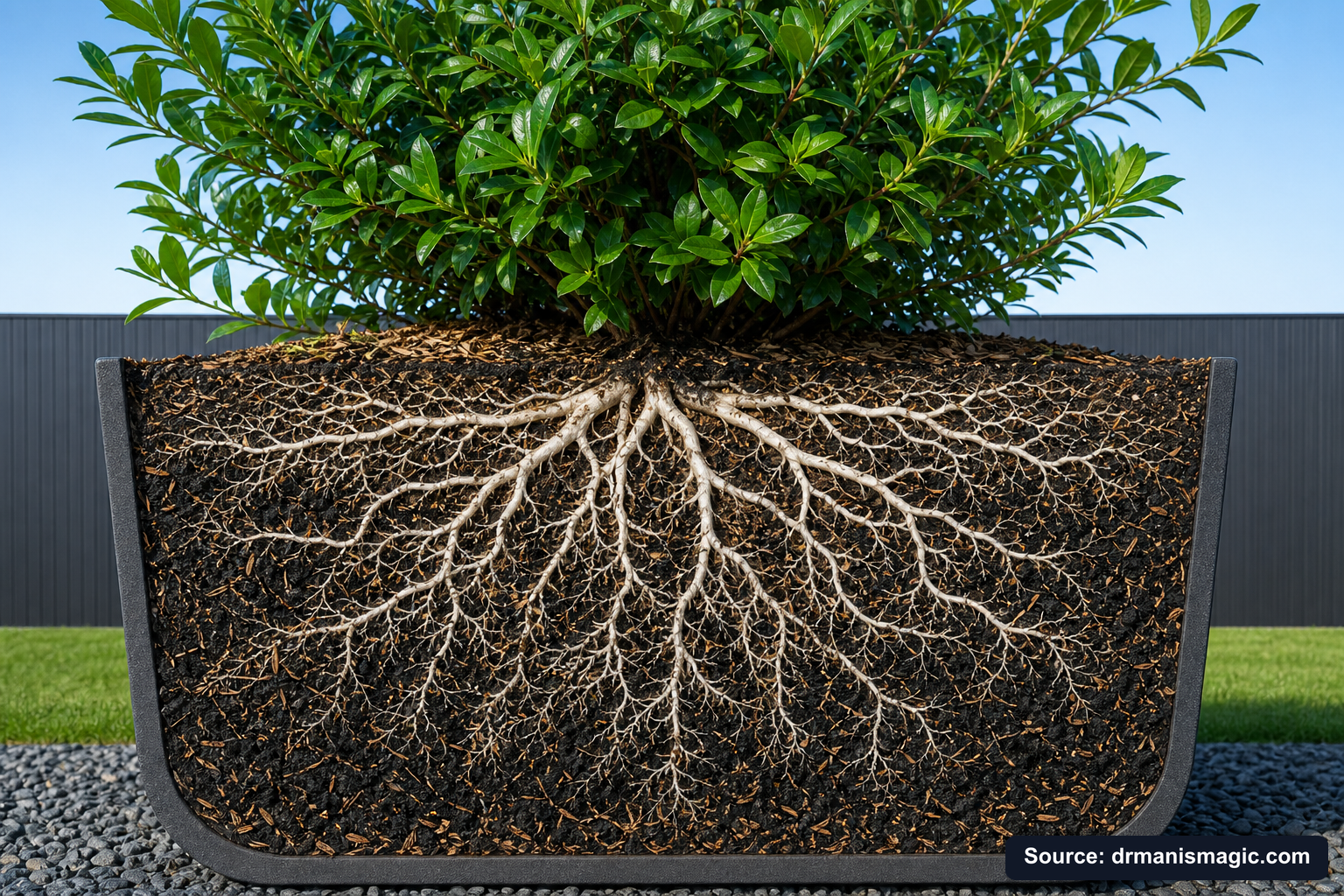
Building Your Root Zone the Right Way: Putting It All Together
Biochar is not hype. It is not a gimmick. And it is not the single solution your plants have been waiting for. It is one powerful tool in a system that works only when all the pieces are in place.
The role of biochar in water and air balance is this: when you use coarse particles in the right dose, inside a medium that already has durable mineral structure, biochar adds micropore water retention, long-term nutrient holding, and protected microbial habitat without sacrificing the air-filled porosity that roots depend on to stay alive and healthy.
Fine biochar dust in a decomposing potting mix does the opposite. It clogs air channels. It fills the pores that should be breathing. It turns a struggling medium into an oxygen-starved one.
The science is clear. Oregon State University and UGA Extension both confirm that air-filled porosity, not just moisture, is a governing factor in root health and disease resistance. Cornell's greenhouse materials confirm that roots respire aerobically and need constant oxygen diffusion. The physics of pore space confirms that particle size controls whether biochar opens or closes those pathways.
And thirty years of growing trees in South Texas, over 250,000 of them, confirms that mineral-based structure is the foundation that makes everything else work. Biochar enhances that foundation beautifully. It cannot replace it.
If you are ready to stop guessing about your root zone and start building something that actually holds together for years, not months, take a look at what we put inside our Super Soil. Mineral base. Coarse biochar. Coco coir. Rice hulls. Steam sterilized. Built to last. No sawdust, no synthetic surfactants, no chemicals that wash away and leave your medium hard as concrete.
Your roots deserve to breathe. And when they do, everything above the soil line changes too.
Frequently Asked Questions
Biochar sounds simple. Toss it in, grow better plants. But that is not how it works. These questions come up again and again from real gardeners who tried biochar and got confused results. After growing over 250,000 trees in South Texas, Dr. Mani has seen what biochar does right and what it does wrong inside a root zone.
Does biochar actually improve water retention in container soil?
Yes, but only when the particle size is right. Coarse biochar holds water inside its tiny pores while still leaving air channels open around it. That means roots get moisture without sitting in a swamp. Fine biochar dust clogs those same air channels and makes drainage worse. The wrong particle size turns a helpful tool into a root-rot factory. Always use screened, coarse biochar in containers.
What are the real disadvantages of using biochar in your garden?
Fresh biochar is like an empty sponge. It will pull nutrients away from your plant roots before it gives anything back. That causes temporary deficiencies that look like disease or neglect. Biochar also raises soil pH, which can lock out trace minerals. And here is the scary part: once it is in the ground, you cannot take it back. Use the wrong type or too much, and you are stuck with it for years.
How much water can biochar hold compared to other soil amendments?
High-quality coarse biochar can hold a surprising amount of water inside its pore structure. But the number changes a lot based on particle size and how the biochar was made. What matters more than the raw number is balance. Dr. Mani's approach through the Three Plant Pillars is not about maximum water retention. It is about holding just enough moisture while keeping plenty of oxygen flowing to roots at the same time.
Is biochar better than perlite for improving soil structure?
Biochar and perlite do similar jobs but behave differently over time. Perlite is inert and stable. Biochar is porous and can hold nutrients and microbes inside its walls. That makes biochar a better long-term home for the beneficial bacteria and fungi that are central to Dr. Mani's Microbial Muscle pillar. But biochar must be the right particle size. Coarse biochar outperforms perlite for microbial housing. Biochar dust is worse than nothing.
Does biochar improve drainage or make it worse?
Coarse biochar improves drainage by adding rigid structure that does not break down. Unlike pine bark sawdust, which compacts over time and chokes roots, biochar particles stay in place for hundreds of years. That keeps air channels open. But fine biochar particles behave like silt. They fill the spaces between soil particles and slow water movement down. Screen your biochar before use. If it feels dusty, it is going to hurt drainage, not help it.
Can you put too much biochar in your soil?
Absolutely. More is not better here. Going above 10 percent by volume can spike soil pH, lock out nutrients, and slow drainage. Fresh biochar is also an empty sponge that steals nitrogen from your plant before releasing anything useful. Always charge your biochar first. Mix it with compost or an organic fertilizer like Dr. Mani's Crab, Kelp, and Amino Acids blend and let it soak for one to two weeks before adding it to your containers or garden beds.
How does biochar fit into the Three Plant Pillars system?
Biochar belongs inside Pillar One: the Mineral Foundation. Dr. Mani's Super Soil is built on mineral-based sandy loam from the Rio Grande Valley that does not decompose or compact. Biochar adds long-lasting pore structure to that foundation. It also acts as a home for the live microbes in Plant Super Boost, which is Pillar Two. When biochar is charged with organic fertilizer from Pillar Three, all three pillars work together. That is when roots explode and plants become practically bulletproof.
About the Author
Dr. Mani Skaria, PhD
Dr. Mani Skaria, PhD, is a plant pathologist and the scientific founder of Dr. Mani's Magic. He earned his doctorate at Purdue University and spent 48 years studying how plants, soil, and living microbes work together, including his years as Professor Emeritus at Texas A&M and as a member of the USDA NAREEE Advisory Board. He invented micro-budding, a method for growing healthier, stronger trees, and has grown more than 250,000 trees on the family farm in Hargill, Texas - US Citrus Nursery. His life's work takes real lab science and practical experience and turns it into simple, safe, organic plant care anyone can use at home.


