


Why Most Potting Mix Is Just Processed Wood and Hurts Roots | Dr. Mani's Magic
Why Most Potting Mix Is Just Processed Wood (And What That's Doing to Your Roots)
You're at the garden center. You grab a bag of potting mix. It says "premium." It says "enriched." It's got a picture of a tomato the size of a softball on the front.
You get home, tear it open, and stop cold.
It smells like a sawmill. It looks like mulch. There are chunks of bark in there big enough to stub your toe on. You dig your hand in and pull out what feels like shredded wood from a lumber yard. You turn the bag over and squint at the ingredients. "Processed forest products." "Composted bark fines." "Wood fiber." You think: Did I just buy a bag of tree?

Plant Super Boost
You didn't get ripped off. Not exactly. But you weren't told the whole truth either. The truth is, most potting mix sold in America is not soil. It never was. It is engineered wood. And the reason it exists has almost nothing to do with what your plant needs, and almost everything to do with what was cheap and available when the nursery industry scaled up. After growing over 250,000 trees at our South Texas nursery, we learned exactly what that wood does to your roots over time. And once you see it, you cannot unsee it.
Key Takeaways
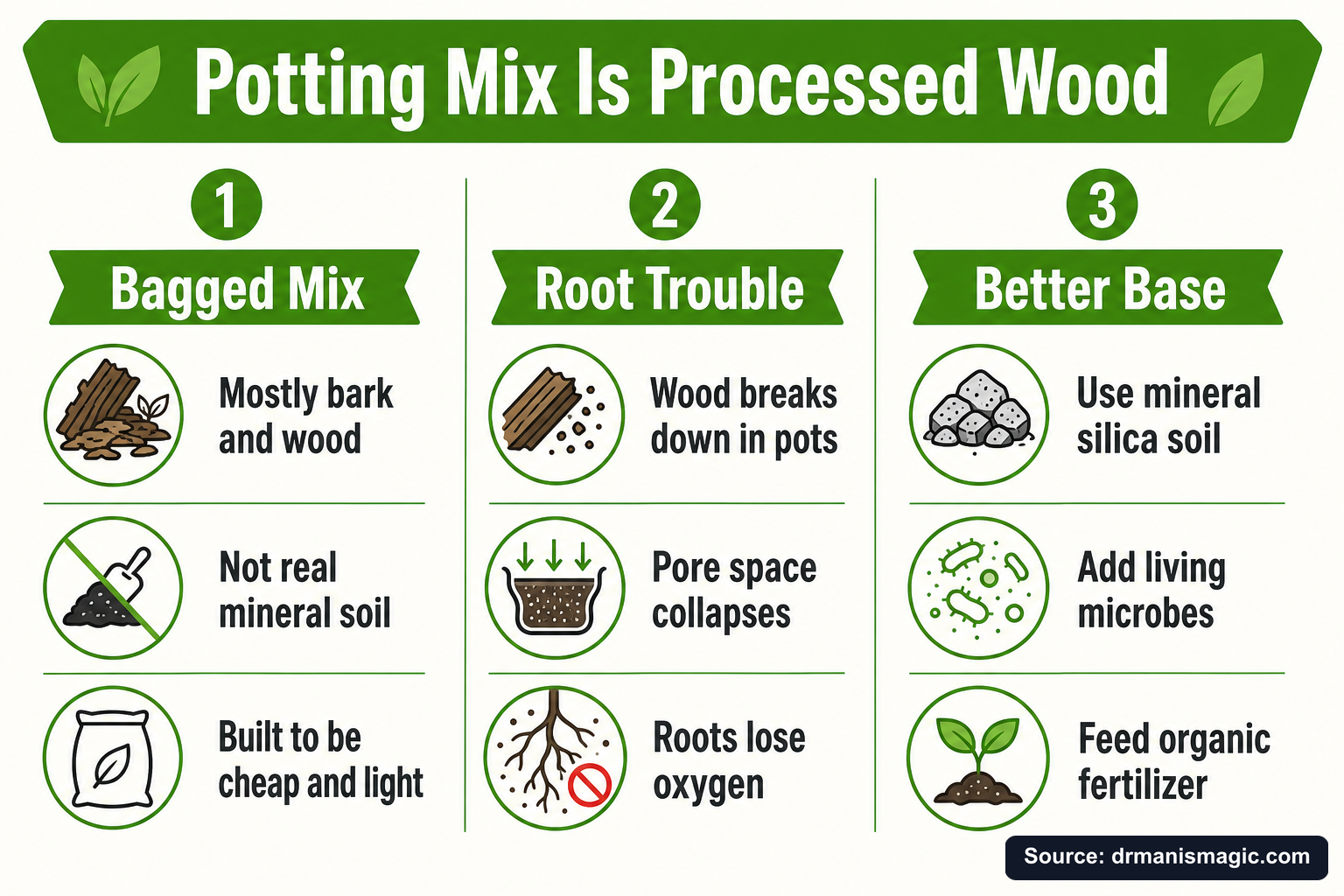
- Most potting mix is made from pine bark, wood fiber, and composted forest products, not mineral soil.
- Roots need oxygen to survive. Decomposing wood in a pot steals that oxygen as it breaks down.
- Garden soil fails in containers because it compacts, waterloggs, and suffocates roots.
- Potting mix starts degrading within months. For perennial plants and trees, that is a slow death sentence.
- Pine chemistry (terpenes and terpenoids) in bark can be harsh on root zones.
- Mineral-based soil made from silica does not decompose and does not rob your roots of oxygen.
- The Three Plant Pillars — mineral soil, live microbes, and organic fertilizer — form the foundation every plant needs to truly thrive.
Is Potting Mix Actually Soil?
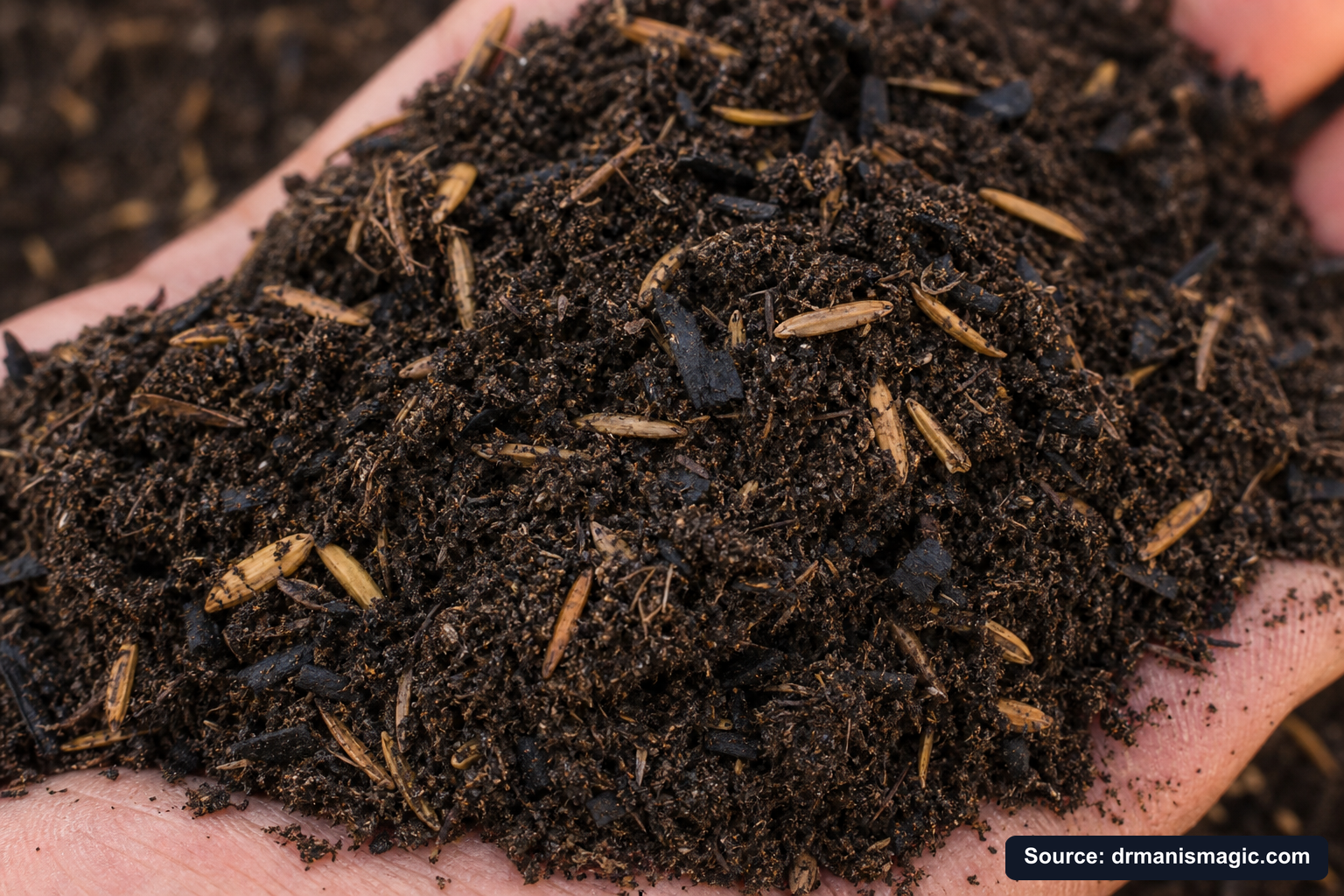
Quick Answer: No. Potting mix is not soil. It is an engineered soilless substrate made mostly from processed organic materials like pine bark, wood fiber, peat, and coir. It is designed to be lightweight and drain fast, not to replicate the mineral-rich structure of real earth. The word "soil" on the label is marketing, not botany.
Real soil is ground-up rock. It is mineral. It is silica-based. It took thousands of years of geological grinding to make. When you reach down and grab a handful of healthy native dirt, you are holding ancient stone broken into particles. That is what plants evolved in over millions of years.
Potting mix? That is pine bark and sawdust from a lumber mill that would otherwise go in a landfill.
We are not being dramatic. The University of Tennessee Extension and NC State's horticultural substrate research both confirm that pine bark became the dominant container media in the American nursery industry because it was a cheap byproduct of the southeastern timber trade, not because it was the best thing for plant roots. It was available. It was light. It was free from the mill. And it drained reasonably well in the short term.
So the industry built itself around it. Big box stores sell plants in it. Online nurseries ship in it. And millions of home gardeners fill their pots with it every single spring, wondering why their plants look great in May and struggle by August.
Now you know why.
Why Do Roots Need Oxygen More Than Almost Anything Else?
Quick Answer: Roots breathe oxygen just like you do. They pull oxygen from air pockets in the soil to power cellular growth and nutrient absorption. When those air pockets collapse or fill with water, roots suffocate within hours. This is called oxygen stress, and it is the real trigger behind most root rot cases in container plants.
Here is the thing people get wrong. They think plants breathe in carbon dioxide and that is the whole story. But that is only the leaves. The roots have a completely different job, and they run on oxygen.
Rutgers University's cooperative extension research identifies less than 10 percent air-filled pore space after watering as a likely oxygen-stress threshold for container plants. Oregon State nursery disease research goes further, noting that air-filled porosity above 30 percent can meaningfully reduce the risk of Phytophthora root rot, one of the most common and devastating container plant diseases in the country.
Think about that. Your roots are not just sitting in dirt. They are living in a system of tiny air tunnels. When those tunnels collapse, your roots choke.
And what collapses those tunnels?
Decomposition.
When organic matter breaks down, it shrinks. It compresses. It fills in the gaps. The pore space disappears. The oxygen disappears with it. And your roots, which cannot move, cannot escape. They just sit there in the dark, turning brown and slimy, waiting for the fungal cavalry to arrive and finish the job.
This is root rot. And in most cases, it did not start with too much water. It started with too little oxygen. The water just delivered the final blow.
What Is Actually Inside a Bag of Potting Mix?
Quick Answer: Most potting mix contains pine bark fines, wood fiber, peat moss or coir, perlite, and sometimes vermiculite or compost. The bulk of the volume is processed organic carbon material that will decompose over months. Fresh pine bark may also contain terpene compounds that are not friendly to root zones. The "soil" in the name is a marketing term with no legal definition.
Let us walk through the label like a detective.
"Processed forest products." That is pine bark. Possibly sawdust. Maybe compressed wood fiber.
"Composted bark fines." That is pine bark that sat in a massive outdoor pile for a year or two while it partially decomposed. They do this to reduce the harshest chemical compounds.
"Peat moss." That is ancient compressed plant matter from Canadian bogs, harvested at a rate far faster than it forms. Great at holding water. Terrible when it dries out completely, because then it repels water like a waxed car hood.
"Wood fiber." That is processed wood pulp, sometimes from sawmill waste, sometimes from dedicated fiber crops. Breaks down fast.
Now here is the part that should make you raise an eyebrow.
Pine bark contains an entire family of chemical compounds called terpenes and terpenoids. If those words sound familiar, they should. Pine-Sol is named after them. Turpentine is literally distilled pine tree resin. These are strong, volatile compounds. They are great for cleaning floors and stripping varnish. They are not what you want coating the root zone of your prized lemon tree or your favorite pothos.
The industry knows this. That is why they age and compost the bark in giant outdoor piles before bagging it. The idea is to let weathering and microbial activity break down the harshest terpenes. And it does help. But it also starts the decomposition clock ticking before the bag even hits the shelf.
You buy a bag of potting mix that is already partially broken down. You put your plant in it. And then the clock keeps ticking.
Why Does Garden Soil Fail So Badly in Containers?
Quick Answer: Garden soil compacts hard in pots, creates a perched water table at the bottom that drowns roots, and becomes a dense anaerobic brick within weeks. It is also heavy, prone to carrying pathogens, and has no consistent particle structure. Container geometry punishes garden soil in ways that open ground never does.
This is the other mistake people make. They figure, if wood-based potting mix is bad, just use real dirt from the backyard. Dig it up, fill the pot, done.
Do not do this.
In the ground, water drains freely downward through feet and feet of soil. The roots have room to breathe even when the top layer is wet. There is drainage happening dozens of feet below you that you never think about.
In a container, that vertical drainage column is just a few inches of soil sitting on a drainage hole. Water does not drain the way you think it does. It creates what soil scientists call a perched water table, a zone of saturated, oxygen-free soil that sits at the bottom of the pot regardless of whether you have drainage holes. The roots at the bottom of that pot are essentially sitting in a swamp.
Add garden soil's natural tendency to compact into a dense clay-like brick, and you have created the worst possible environment for container roots. Heavy. Airless. Wet. Full of field pathogens that thrived in the open ground but go out of control in the confined, warm, moist environment of a container.
Real soil from your backyard belongs in your backyard.
Potting Mix vs. Mineral-Based Soil: A Side-by-Side Look
Quick Answer: Potting mix is organic, carbon-based, and temporary. It decomposes within months, loses structure, and steals oxygen as it breaks down. Mineral-based soil is silica-based, permanent, and stable. It does not decompose, does not rob roots of oxygen, and maintains consistent pore space for years. For any plant you want to keep alive long-term, the difference is enormous.
| Feature | Standard Potting Mix | Mineral-Based Soil (Silica / Sandy Loam) |
|---|---|---|
| Primary ingredient | Pine bark, wood fiber, peat, coir | Silica sand, sandy loam, inorganic particles |
| Decomposes over time? | Yes, within 6-18 months | No. Silica is permanent. |
| Oxygen theft from decomposition? | Yes. Decomposition consumes oxygen. | No. |
| Air-filled pore space longevity | Collapses as bark compresses | Maintained long-term |
| Hydrophobic when dry? | Yes. Peat and bark repel water once fully dried. | No. Re-wets easily. |
| Surfactant needed? | Often added to help water penetrate | Not required |
| Pathogen risk | Moderate. Bark can harbor fungal spores. | Low when steam-sterilized |
| Useful life in a perennial container | 6-12 months before decline sets in | Permanent when properly prepared |
| Best for | Annual flowers, short-cycle plants | Trees, perennial plants, long-term containers |
Look at that table for a moment.
Notice something? Potting mix is actually fine for the plants you throw away every year. Annual flowers. Seasonal herbs. Plants you pull out in October and replace in April. The nursery industry built its media around those plants. Short cycle. High turnover. The bag works just long enough.
But you are not trying to grow petunias for ninety days. You are trying to grow a lemon tree. A fig. A rosemary that fills a whole pot on your patio. A houseplant you have had for three years and genuinely love. For those plants, the clock that potting mix starts ticking the moment you open the bag is not your friend. It is working against you from day one.
What Really Happens Inside Your Pot Over 12 Months?
Quick Answer: In the first few months, bark-based potting mix drains well and feels fluffy. By month four to six, the bark particles begin breaking down. Pore space shrinks. Drainage slows. Oxygen drops. By month twelve, many bark-based mixes have compressed into a dense, soggy, semi-anaerobic block that creates the exact conditions root rot needs to thrive.
Month one. You repot your tree. The mix is fluffy. It drains great. Your plant perks up and pushes new growth. You feel like a genius.
Month three. The mix is a little more dense. You notice watering takes a second longer to drain. You do not think much of it.
Month six. The top layer of the mix has sunk an inch below the rim of the pot. The bark has compressed. You start seeing slower growth. Some yellow leaves. You buy a fertilizer at the hardware store and give it a shot.
Month nine. The fertilizer helped for a few weeks. Now things look flat again. The mix does not drain as fast as it used to. You water less, trying not to overwater. The plant looks stressed anyway.
Month twelve. The mix looks almost solid. Dark. Dense. Wet for days after watering. The roots at the bottom of the pot, if you pulled the plant out and looked, would be brown. Slimy in spots. Wrapped around themselves because there is nowhere left to grow.
This is not bad luck. This is chemistry. Organic matter decomposes. When it decomposes in a closed container, the pore space disappears, the oxygen disappears, and the pathogens move in. Every time. Without exception.
Big box stores know this cycle. They count on it. When your plant declines at month nine, you drive back to the store, buy another plant in fresh potting mix, and the clock resets. That is the business model. Not cruelty. Just math.
You Never Had a Brown Thumb.
You were handed the wrong tools. This free guide hands you the right ones.
You watered it. You fed it. It died anyway.
It was never you. It was the dirt, the salt food, and the bad advice.
This guide shows you what really went wrong, and how to fix it for good.
- Why your plants really died, and why it was never your fault
- The salt hiding in your plant food that quietly burns the roots
- The hidden killer in almost every bag of store soil
- The tiny helpers that grow a whole forest for free
- The rescue trick that brings a half dead plant back to life

Does Wood in Potting Mix Cause Root Rot?
Quick Answer: Not immediately, but indirectly yes. Fresh or uncomposted wood fines can also trigger nitrogen immobilization, where soil microbes consume available nitrogen to break down the wood, starving your plant. More critically, as the wood decomposes over months, it collapses pore space and reduces oxygen availability, which is the primary root-rot trigger in container plants.
There is another problem with wood in your mix that almost nobody talks about. It is called nitrogen immobilization.
Here is how it works. When fresh wood or sawdust sits in soil, microbes get to work breaking it down. But those microbes need nitrogen to do their job. So they grab it. From your soil. From around your roots. The very nitrogen your plant was going to use to make new leaves and push new growth gets hijacked by microbes eating wood.
This is why plants in fresh, cheap, uncomposted wood-heavy mixes often look pale and yellow even when you are feeding them. The nitrogen is there. It just got stolen before your plant could use it.
Aged and composted bark reduces this effect. But it does not eliminate it. And it does not solve the structural decomposition problem that is always ticking away underneath.
See also: The Hidden Reason Synthetic Fertilizers Cause Root Rot
Root Health Diagnostic: What Your Container Is Telling You
Your pot gives you signals. Most people miss them. Here is how to read them.
| What You See or Feel | What It Probably Means | Root Zone Reality |
|---|---|---|
| Soil stays wet for 5+ days after watering | Pore space has collapsed. Drainage is gone. | Oxygen-starved roots. Root rot risk is high. |
| Dry potting mix repels water, beads on surface | Bark or peat has become hydrophobic | Roots are dry-stressed even when you water |
| Mix has sunken 1-2 inches below pot rim | Bark has compressed. Volume lost to decomposition. | Structure is failing. Roots are circling. |
| Yellow leaves despite regular feeding | Nitrogen immobilization or poor root uptake | Roots cannot absorb nutrients in poor oxygen conditions |
| Fungus gnats flying around the base | Wet, decomposing organic matter near the surface | Top inch is anaerobic. Larvae are feeding on root hairs. |
| Plant looks fine in spring, declines by late summer | Mix was fresh in spring, has decomposed through summer heat | Structural failure accelerated by warm temperatures |
| Roots growing out of drainage holes | Roots escaping poor conditions inside the pot | The root zone inside is compromised. Roots are seeking oxygen outside. |
Why Did the Bonsai Masters Figure This Out 1,000 Years Ago?
Quick Answer: Traditional Japanese bonsai masters used mineral-heavy, gritty substrates like akadama, pumice, and coarse sand because they understood that container roots need oxygen above all else. They rejected organic media for perennial container trees centuries before modern horticulture had the science to explain why. They were right.
Here is a fun fact. Bonsai is over a thousand years old. And bonsai masters, working entirely from observation and passed-down wisdom, figured out something that modern gardening still has not fully accepted.
They did not use bark. They did not use wood. They used mineral grit. Volcanic rock. Coarse sand. Dense, inorganic particles that drain fast, hold structure, and never decompose.
A bonsai tree can live for hundreds of years in a tiny pot. A juniper bonsai planted in 1625 in Japan is still alive today. Planted in mineral substrate. Still in its container.
Now ask yourself: how long does your potting mix last before you have to repot?
Six months? Maybe twelve?
The bonsai masters were not using gritty mineral mixes because they read a university study. They were using them because they watched what happened to trees over decades and centuries. The trees in mineral substrate lived. The trees in organic media struggled. The lesson was written in the results.
Dr. Mani Skaria, Professor Emeritus of Plant Pathology and founder of the Clean Citrus Program in Texas, arrived at the same conclusion through 40 years of scientific research and over 250,000 trees at the US Citrus Nursery in South Texas. The medium that keeps roots breathing is the medium that keeps plants alive. And the medium that keeps roots breathing is not made of wood.
What Is the Right Soil for a Container Plant You Want to Keep?
Quick Answer: For any perennial container plant, tree, or houseplant you want to keep for years, the right base is a mineral-based, silica-rich soil that does not decompose. It should drain fast, hold its structure indefinitely, and maintain air-filled pore space even after repeated watering. Organic amendments like coir or biochar can be added in small amounts, but the structural backbone must be inorganic.
This is Pillar One of the Three Plant Pillars that Dr. Mani developed after decades of watching what worked and what failed in real nursery conditions.
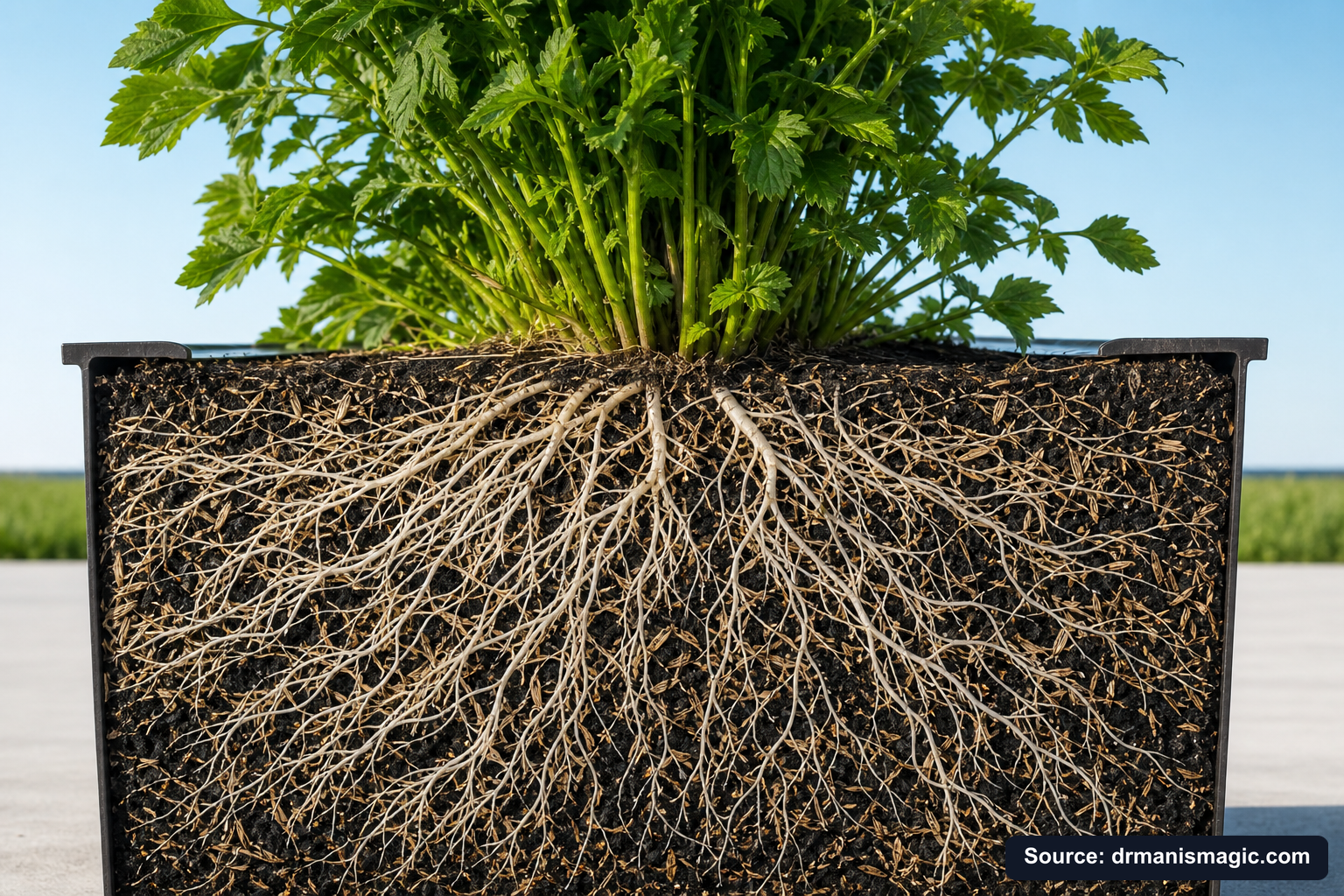
The principle is simple. Silica does not decompose. Rock does not rot. Mineral particles do not shrink when wet or expand when dry. They hold their shape. They hold their space. And that space is what your roots breathe in.
The soil we use at US Citrus Nursery, and the foundation of Super Soil, starts with steam-sterilized sandy loam from the Rio Grande Valley. Silica-rich. Inorganic. Permanent. We steam-sterilize every batch to eliminate pathogens before it ever touches a root. Then we blend in coco coir for moisture balance, rice hulls for additional aeration, and biochar as a long-term home for the beneficial microbes that make Pillar Two possible.
The result is a mix that drains fast, never goes hydrophobic, never collapses its pore space, and does not need to be replaced year after year. You make one good decision about your soil, and it works for you for the life of the plant.
That is the opposite of the potting-mix treadmill. And it is the foundation that makes everything else in the Three Plant Pillars system actually work.
Potting Mix vs. Mineral Soil: The Honest "vs." Comparison
Quick Answer: Potting mix wins on short-term cost and availability. Mineral-based soil wins on every measure that matters for long-term plant health: oxygen delivery, structural permanence, drainage consistency, pathogen resistance, and root longevity. For annuals, potting mix is acceptable. For trees, perennials, and houseplants you care about, mineral soil is not optional.
Let us be fair. Potting mix is not evil. For the right application, it is fine.
Annual flowers. Seasonal vegetables in grow bags. A tomato you are going to pull out in October. For those, a decent bag of bark-based mix does the job. It lasts long enough. The plant does not need it to last longer.
But the moment you put a long-lived plant into bark-based potting mix, you have started a countdown. You are asking a temporary material to do a permanent job. And it cannot do that. It was never designed to.
Mineral-based soil is permanent by nature. Silica does not break down in your lifetime. Or your children's lifetime. Or your grandchildren's. It just sits there, holding its shape, holding its pore space, letting oxygen flow to roots year after year.
The cost difference over time is not even close. A bag of potting mix that needs replacing every six to twelve months costs you more over five years than a one-time investment in permanent mineral-based soil. And it costs your plant far more than money. It costs time. Growing time. Fruiting time. Time you cannot get back.
The number one thing people tell Dr. Mani they want is simple. They want to see their tree bear fruit while they still can. Not someday. Not eventually. In their lifetime. In their backyard. With their own hands.
Every month a plant sits in collapsing potting mix is a month it is not growing toward that moment.
How to Recover a Plant That Has Been in Potting Mix Too Long
If you are reading this and thinking about the tree on your patio that has looked tired for the past year, here is a simple recovery checklist. You are not starting over. You are just correcting the foundation.
- Check the root ball. Gently remove the plant from its pot. Look at the roots. Healthy roots are white or light tan and firm. Rotting roots are brown, dark, or slimy. Trim off any dead or rotting root sections with clean scissors before repotting.
- Remove as much old potting mix as you can. Shake it off gently. You do not need to strip every particle, but get rid of the bulk of the old, compressed, decomposed material.
- Repot into mineral-based soil. Choose a mix with a silica-rich, inorganic base that drains fast and holds its structure. Make sure the new pot has a drainage hole.
- Add live microbes to the root zone. This is Pillar Two. Beneficial bacteria and fungi protect the recovering roots, out-compete pathogens, and unlock nutrients that the new soil holds. A liquid microbial drench applied right at repotting gives the recovery a major head start. See our Plant Super Boost for the live microbial blend we use on every tree at the nursery.
- Hold off on heavy fertilizing for the first two weeks. Let the roots settle. Once you see new leaf growth, that is your signal that roots are active and ready to receive nutrients.
- Switch to organic, slow-release fertilizer. This is Pillar Three. Salt-based synthetic fertilizers damage the beneficial microbes you just added. Organic sources like crab, kelp, and amino acids feed the plant and the soil ecosystem at the same time.
- Water correctly. Water deeply, then let the top inch or two of mineral soil dry out before watering again. Fast-draining mineral soil forgives overwatering in ways that dense, compressed potting mix never can.
See also: Why Most Fertilizers Are Actually Salt in Disguise
The Three Plant Pillars: What Potting Mix Was Never Designed to Give You
Quick Answer: The Three Plant Pillars — mineral-based soil for oxygen and structure, live microbes for root protection and nutrient unlocking, and organic fertilizer for slow-release nutrition — form a complete system that addresses the root causes of plant failure. Potting mix only attempts to address one pillar, structure, and it does that temporarily at best.
Here is the honest picture.
Potting mix was designed to give roots a temporary home. That is it. It was never designed to protect roots from pathogens. It was never designed to feed a living soil ecosystem. It was never designed to last. It was designed to be lightweight, affordable, and available at scale. It hit all three of those marks perfectly.
The Three Plant Pillars are built around what plants actually need, not what is cheap to manufacture.
Pillar One is mineral-based soil. Oxygen infrastructure. Permanent structure. Drainage that never fails.
Pillar Two is live microbials. Bacteria, fungi, and mycorrhizae that turn the root zone into a living, self-defending ecosystem. These microbes unlock nutrients locked in the soil, crowd out pathogens, and extend root reach far beyond what the roots can do alone.
Pillar Three is organic fertilizer. Not salt-based synthetic pellets that scorch the microbes you just added. Real, slow-release nutrients from sources like crab, kelp, and amino acids that feed the plant gently, completely, and in harmony with the living soil ecosystem underneath.
When all three work together, something shifts. The plant stops struggling. It starts growing with a confidence you can see. New leaves push out faster. The color deepens. The structure gets stronger. And it stays that way, month after month, year after year, because the foundation is not decomposing underneath it.
We tested this on over 250,000 citrus trees in South Texas. We tested it on houseplants, tropicals, and ornamentals. The results were not subtle. When the soil holds its structure, when the microbes are alive and working, when the fertilizer feeds without burning, plants do what they were always capable of doing. They thrive.
You can read more about what goes into this system in our Free Plant Care Field Guide, which walks through all three pillars in plain language, step by step.
You Were Not Born With a Brown Thumb
Here is the part that matters most.
If you have tried and failed with plants, it was not you. The medium your plants were growing in was working against you from the start. Processed wood, slow to decompose at first, then faster, then collapsing into an airless brick that no amount of watering skill or fertilizer could fix. The system was designed for short cycles and repeat purchases, not for the long-lived, fruit-bearing, porch-filling, kitchen-window-brightening plants you actually wanted.
Dr. Mani spent 40 years in plant pathology figuring out why plants fail. And the answer kept coming back to the same place. The foundation. The soil. The oxygen. The invisible architecture underneath the surface that either supports life or slowly suffocates it.
When you build on the right foundation, gardening stops being a guessing game. It becomes something closer to what it was always supposed to be. Simple. Rewarding. A little bit magical.
If you want to see what that foundation looks like in practice, and what it can do for every plant in your home or yard, the full Three Plant Pillars system is a great place to start. We put together everything you need to know, and all three products, at drmanismagic.com. Zero synthetic salts. Zero PFAS. Zero biosludge. Backed by a 30-day money-back guarantee, because we have seen what it does, and we know it works.
Your plants have been waiting for this. So have you.
Frequently Asked Questions
Most gardeners never stop to ask what is actually inside their bag of potting mix. Once you find out, everything changes. These questions cut right to the truth about what wood-based soils are doing to your roots and what a real mineral foundation looks like instead.
Why does potting mix have so much wood in it?
Simple answer: it was cheap and available. When the nursery industry scaled up, pine bark was a leftover from lumber mills. It drained okay in the short term. So the industry built itself around it. Not because it was best for your roots. Because it was free. At Dr. Mani's Magic, we tested over 250,000 trees and watched wood-based mixes break down, compact, and choke roots over time. That is why we use mineral-based Super Soil instead.
Is potting mix actually soil?
No. Real soil is ground-up rock. It is mineral and silica-based. Potting mix is mostly processed pine bark, wood fiber, and composted forest products. The word "soil" on the bag is marketing, not science. Plants evolved in mineral earth over millions of years. Dr. Mani's Magic Super Soil is built from sandy loam straight out of the Rio Grande Valley. It does not decompose. It does not rob your roots of oxygen. That is a real foundation.
What is better, potting mix or potting soil?
Neither one is the answer if you want long-term results. Potting mix breaks down fast and steals oxygen from roots as it decomposes. Potting soil compacts and drowns roots in containers. The real answer is mineral-based soil. Dr. Mani's Magic Super Soil does not compact, does not break down, and does not suffocate roots. It gives you permanent structure that works year after year without starting over.
Is 2-year-old potting mix still good?
Probably not for anything you care about. Wood-based mixes start breaking down within months. By year two, the structure is collapsing, the air pockets are gone, and roots are fighting for oxygen. You can refresh it, but you are patching a sinking ship. If you are growing something that matters to you, start with a mineral base that does not decompose in the first place. That is the whole idea behind Dr. Mani's Magic Super Soil.
Should I throw away old potting mix?
If your plant struggled, yes. Diseased soil carries problems into your next plant. If the soil smells rotten or looks compacted and dense, it has already broken down too far to help your roots breathe. The bigger lesson here is this: stop buying soil you have to replace every year. Dr. Mani's Magic Super Soil is steam-sterilized, mineral-based, and built to last permanently in your containers. Buy it once and stop the cycle.
What plants do not like wood chips or wood-based mulch?
Succulents, citrus trees, tropical trees, and most container plants do not do well with wood-based materials holding moisture against their roots and stems. Wood traps dampness, raises the risk of rot, and can release natural chemicals that stress root zones. Dr. Mani spent 35 years watching citrus trees suffer in wood-heavy mixes. The Three Plant Pillars start with mineral soil for a reason. Oxygen at the root zone is not optional. It is survival.
Should I add old charred wood or wood ash to my garden?
Be careful. Wood ash is highly alkaline and can push soil pH too high, locking out nutrients that plants need. Many fruit trees, tropical plants, and acid-loving plants will suffer if the pH swings too far. Before adding anything, know your soil. At Dr. Mani's Magic, we skip the guesswork entirely. Our Three Plant Pillars give you mineral-based soil, live microbes, and organic fertilizer working together. That system does not need quick fixes that can quietly wreck your growing environment.
About the Author
Dr. Mani Skaria, PhD
Dr. Mani Skaria, PhD, is a plant pathologist and the scientific founder of Dr. Mani's Magic. He earned his doctorate at Purdue University and spent 48 years studying how plants, soil, and living microbes work together, including his years as Professor Emeritus at Texas A&M and as a member of the USDA NAREEE Advisory Board. He invented micro-budding, a method for growing healthier, stronger trees, and has grown more than 250,000 trees on the family farm in Hargill, Texas - US Citrus Nursery. His life's work takes real lab science and practical experience and turns it into simple, safe, organic plant care anyone can use at home.


