


Why Synthetic Nutrition Breaks Soil Biology and Harms Your Plants | Dr. Mani's Magic
The Reason Synthetic Nutrition Breaks Soil Biology (And Why Your Plants Pay the Price)
Picture this. You're standing in your backyard on a Saturday morning, coffee in hand, looking at a plant that should be thriving. You fed it. You watered it. You did everything the bag told you to do. And yet the leaves look pale. The tips are brown. Something is wrong, and you can't figure out what.
So you go back to the garden center. You buy more fertilizer. You feed it again. And for a week or two, it perks up. A little green comes back. You feel hopeful. But then it slides backward again. Slower this time. A little worse. This has been going on for months. Maybe years. And nobody ever told you why.
Here is what nobody told you: that bag of fertilizer you keep buying? It is mostly salt. And salt, when it builds up in your soil, does something invisible and devastating. It quietly breaks the living system your plant depends on. Not all at once. Slowly. Like a leak in a pipe you cannot see. By the time you notice, the damage is already done. Today we are going to show you exactly how that happens, why it matters for every plant you own, and what you can do instead.

Plant Super Boost
Key Takeaways
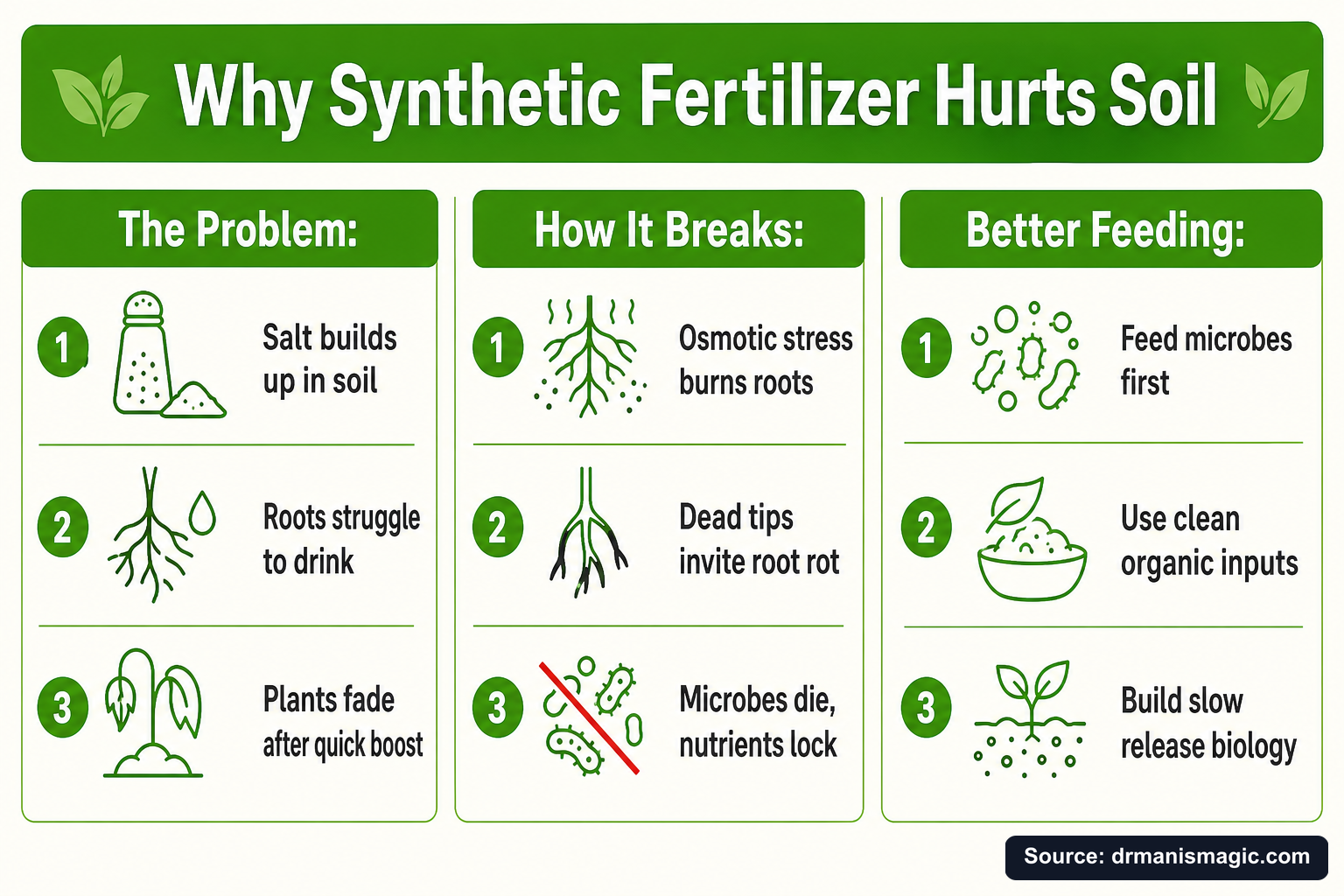
- Most synthetic fertilizers are salt-based, and salt builds up in soil over time, stressing roots and killing the microbes your plants need most.
- Salt in the root zone creates "physiological drought," where the plant cannot pull in water even when the soil feels wet.
- Salt-injured roots are the hidden first step toward root rot, because damaged roots invite disease-causing fungi like Pythium and Phytophthora.
- Beneficial soil microbes drive roughly 75% of plant-available nitrogen and 65% of available phosphorus in healthy soil. Lose those microbes, and your plant starves slowly.
- Organic fertilizers like crab, kelp, and amino acids feed the microbes first, and the microbes feed the plant, creating a natural slow-release system that mirrors how plants grew for millions of years.
- Biosludge fillers and PFAS "forever chemicals" show up in some fertilizers, both synthetic and organic. Clean inputs matter for your family, your pets, and your soil.
- The Three Plant Pillars framework, developed and proven across 250,000+ trees at US Citrus Nursery in South Texas, gives any plant owner a simple, biology-first foundation that works.
What Does "Salt-Based Fertilizer" Actually Mean?
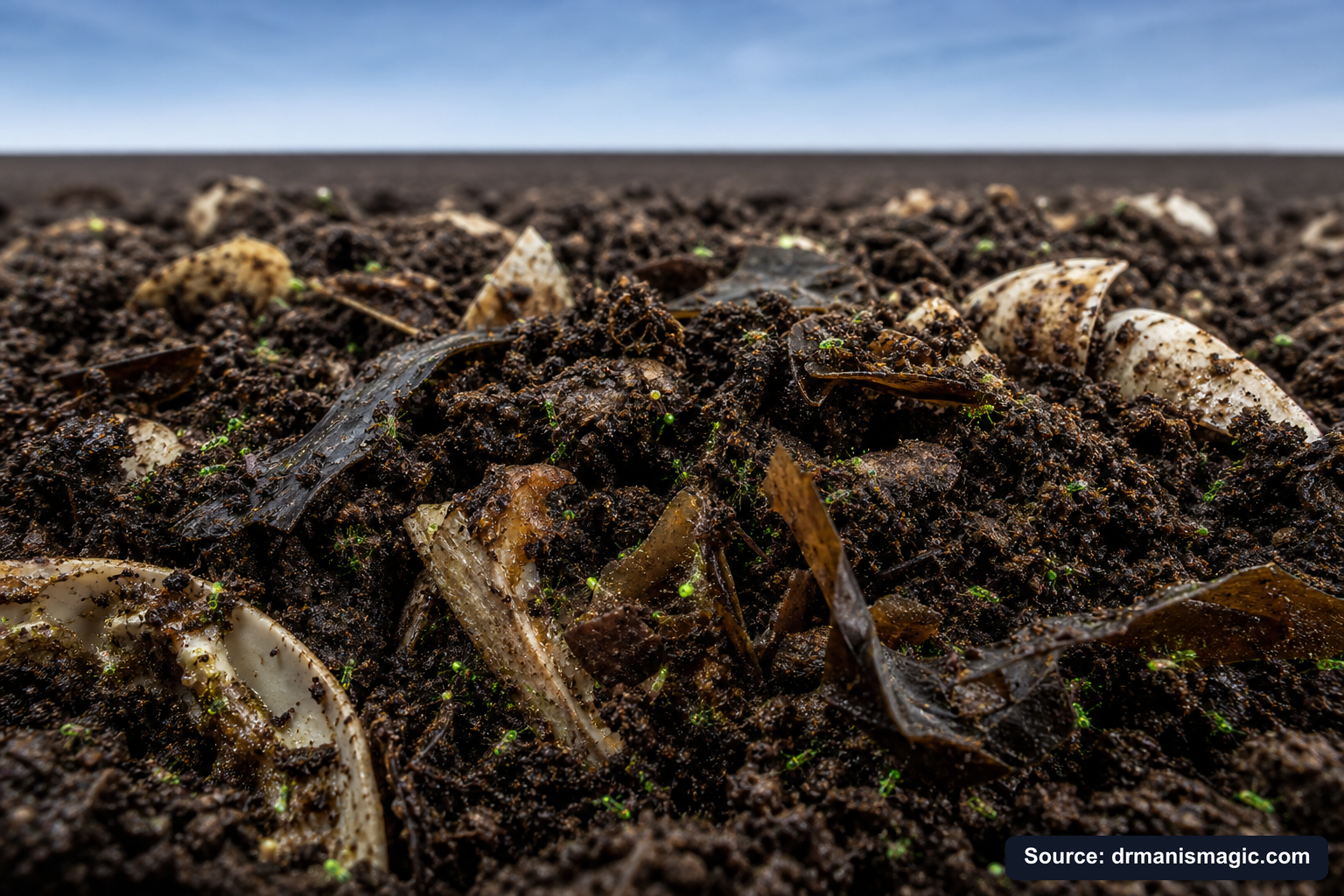
Quick Answer: Most synthetic fertilizers are made from salts, meaning they dissolve quickly in water and release nutrients in a sharp spike. That spike can be useful short-term, but the salt itself raises osmotic pressure around roots, pulls water away from the plant, burns root hairs, and depresses the soil microbes that build long-term fertility.
When most people hear the word "salt," they think of the stuff on their dinner table. But in soil science, "salt" means something broader. It means any compound that dissolves in water and releases ions. Most synthetic fertilizer granules and liquids are exactly that. They dissolve fast. They flood the root zone with ions. And those ions create a kind of pressure around the root that the plant has to fight against just to drink water.
Think of it this way. Imagine you are trying to drink through a straw. Now imagine someone is blowing air back through that same straw. That is what high salt concentration does to a root. The plant is trying to pull water in. The salt is pushing the pressure the other way. Scientists call this osmotic stress. University of Maryland Extension documents it clearly: excess soluble salts increase osmotic pressure in the soil solution, making it harder for plants to absorb water, causing wilting, leaf scorch, and root burn even when the soil is moist.
The plant looks thirsty. But it is not thirsty. It is being squeezed out of its own water supply. Gardeners call this physiological drought, and it is one of the most misread symptoms in all of gardening.
And here is the part most people never hear. When roots are being squeezed by salt stress, they do not just struggle to drink. They get physically damaged. The fine root hairs that do most of the absorbing? They are delicate. High salt burns them. It kills them. And burned, dead root tips are the exact entry point that disease-causing organisms like Pythium and Phytophthora are waiting for. Salt damage and root rot are not two separate problems. They are the same problem, playing out in two stages.
See also: How Salt-Based Feeding Quietly Destroys Root Systems
Why Do Soil Microbes Matter So Much to Your Plant?
Quick Answer: Healthy soil microbes supply roughly 75% of the nitrogen and 65% of the phosphorus that plants can actually use. They also build soil structure, suppress disease, and keep water moving through the root zone. Without them, your plant loses its most important support system and becomes dependent on you to hand-feed it every few weeks just to stay alive.
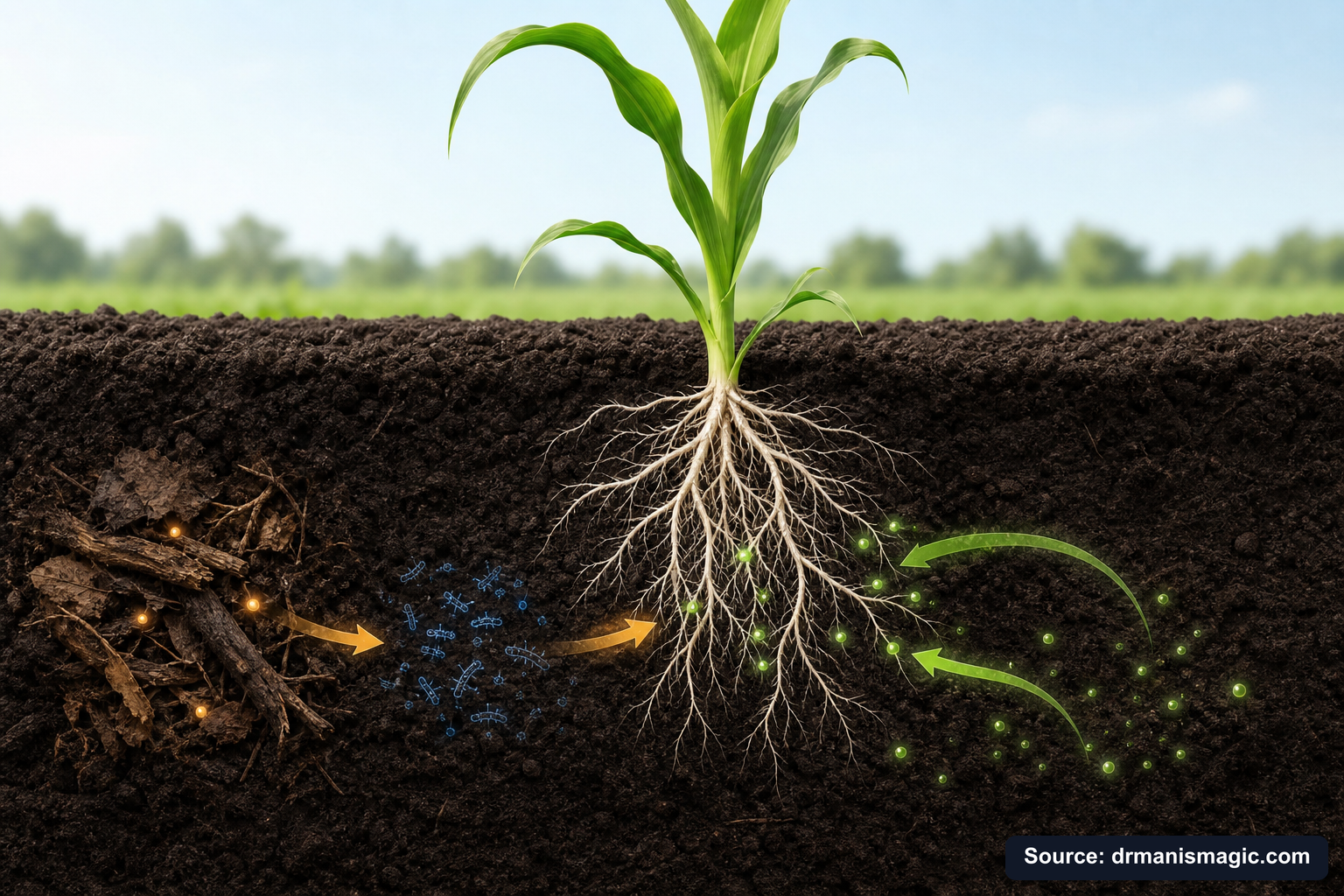
Here is the truth that big chemical companies never put on the bag. Your plant does not eat fertilizer directly. Not really. In nature, your plant gets most of its nutrition through a trade. The roots leak sugars into the soil. Microbes eat those sugars. In exchange, the microbes unlock nutrients that are bound up in organic matter and mineral particles, and they deliver those nutrients right to the root tips in a form the plant can actually absorb.
It is a partnership that has been running for hundreds of millions of years. Bacteria, fungi, mycorrhizae. A whole living web, working in the dark under your feet, doing jobs no fertilizer bag can replicate on its own. The University of Minnesota Extension notes that soil organisms drive nutrient cycling, water infiltration, disease suppression, and soil structure. Lose them, and you lose all of that at once.
So what happens when you dump salt-based fertilizer into this living system over and over? Two things. First, the salt can directly harm microbial cells through the same osmotic stress that hurts roots. High salt pulls water out of bacterial cells just like it pulls water away from roots. Many beneficial microbes die or go dormant. Second, and this is subtle, when you flood the soil with immediately available nutrients, the plant stops trading sugars for microbial services. It does not need to. It is getting fed directly. So the carbon pipeline that feeds the microbial food web dries up. The microbes starve. The living system quietly collapses.
After years of routine synthetic feeding, you are not growing in living soil anymore. You are growing in a chemical-dependent medium that needs constant inputs just to produce average results. The plant is not thriving. It is surviving on life support that you have to keep paying for.
At US Citrus Nursery in Hargill, South Texas, Dr. Mani Skaria and his team learned this the hard way across decades of trial with over 250,000 citrus trees. When you grow at that scale, you cannot afford to guess. You have to understand what is actually happening underground. And what they found, over and over, was that the biology of the soil was the whole game.
How Does Salt Build Up Over Time in Your Soil?
Quick Answer: Every application of synthetic fertilizer leaves behind salt ions that do not all wash away. They accumulate in the root zone, especially in containers and poorly draining soils. Over months and years, this salt buildup raises the electrical conductivity of the soil, makes nutrients harder to absorb, and creates a hostile environment for roots and microbes alike.
Salt buildup is a slow process. That is what makes it so dangerous. After one application of synthetic fertilizer, you might not see any problem. After five applications, the plant still looks okay. But under the surface, the salt index is creeping up. The electrical conductivity of the soil is rising. The microbial population is shrinking. The fine roots are getting shorter and stiffer.
In containers, this happens even faster. There is no deep soil for excess salts to leach into. They concentrate right where the roots live. You might notice a white crust forming on top of the potting mix. That is salt. It is visible proof that the invisible damage is already happening.
In garden beds and lawns, the process is slower but just as real. Especially if drainage is poor. Especially if the soil has been compacted. Compacted soil also reduces oxygen in the root zone, and most beneficial microbes need oxygen to survive. When you combine salt stress, reduced oxygen, and injured roots, you have created the perfect conditions for Pythium, Phytophthora, and other anaerobic pathogens to move in and finish the job.
This is the mechanism chain that most gardening advice never maps out. Salt damages roots. Damaged roots leak carbon and lose function. Reduced oxygen from compaction or overwatering shifts the biological balance toward disease. And the plant that looked "just a little stressed" a few weeks ago is now showing root rot.
See also: The Hidden Reason Synthetic Fertilizers Cause Root Rot
Salt Damage vs. Overwatering vs. True Root Rot: How to Tell the Difference
Quick Answer: Salt damage, overwatering, and root rot share overlapping symptoms, which is why so many gardeners misdiagnose and treat the wrong problem. Salt damage causes wilting and leaf scorch despite moist soil. Overwatering reduces oxygen and creates root rot conditions. True root rot shows dark, mushy roots with a sour smell. Often all three are happening at the same time.
This is one of the most confusing parts of plant care, and it is worth slowing down for. Because if you treat salt damage as a watering problem and water more, you make it worse. If you treat root rot as a nutrient deficiency and fertilize more, you accelerate the collapse.
| Symptom | Salt / Fertilizer Burn | Overwatering / Low Oxygen | True Root Rot (Pythium / Phytophthora) |
|---|---|---|---|
| Leaf wilting | Yes, despite moist soil | Yes, leaves may feel soft | Yes, progressive and worsening |
| Leaf tip / margin scorch | Yes, brown crispy edges | Less common early on | Can appear in advanced stages |
| Yellowing leaves | Yes, especially older leaves | Yes, often uniform | Yes, as nutrient uptake collapses |
| Root appearance | Brown tips, restricted fine roots | Pale, waterlogged, soft | Dark brown or black, mushy, foul odor |
| Soil surface | White crust may appear | Wet, possibly algae growth | Sour or anaerobic smell |
| Recent fertilizer history | Yes, usually recent application | Not required | Often follows salt damage or compaction |
| Fix | Flush salt, stop synthetic inputs, add biology | Improve drainage and aeration, reduce watering | Remove affected roots, improve oxygen, add beneficial microbes |
The honest answer is that these three problems feed each other. Salt injures the roots. Injured roots take up less water, creating wilting that looks like drought. You water more. More water reduces oxygen. Less oxygen favors Pythium and Phytophthora. Root rot sets in. And now you have all three happening at once, with symptoms that point in every direction except the real cause: the salt-based fertilizer you have been trusting for years.
What Is the Difference Between Synthetic and Organic Fertilizer, Really?
Quick Answer: Synthetic fertilizers deliver nutrients in immediately soluble salt form, creating fast spikes and salt accumulation. Organic fertilizers like crab meal and kelp deliver nutrients bound in proteins and organic compounds that microbes break down slowly. This feeds the soil biology first, creates a natural time-release system, and avoids the salt-driven damage cycle entirely.
Let us get concrete about this. Imagine two ways to feed a child. One way: you give them a huge bowl of pure sugar. They get a burst of energy. Then they crash. Do it every week and their health suffers. The other way: you give them a real meal. Proteins, fats, carbohydrates. It digests slowly. Energy is steady. Health builds over time.
Synthetic fertilizer is the sugar bowl. Organic fertilizer is the real meal. And the microbes in the soil are the digestive system that makes the real meal work.
Here is the mechanism, explained plainly. When you apply an organic fertilizer made from crab shells, kelp, and amino acids, the microbes in your soil go to work on it. They eat it. They break it down into simpler compounds. They convert those compounds into forms the plant root can absorb. Then, when those microbes die, the nutrients locked in their own bodies get released directly into the root zone. The whole system is a living, slow-release delivery machine that runs on its own, long after you walked away from the garden.
That is not a marketing claim. That is biology. And it is how every plant on this planet fed itself before synthetic fertilizer was invented in the middle of the last century.
| Feature | Synthetic Fast-Release | Synthetic Slow-Release (Coated) | Organic (Crab / Kelp / Amino Acids) |
|---|---|---|---|
| Nutrient delivery | Immediate, soluble spike | Gradual, but still salt-based | Microbe-mediated, truly slow |
| Salt index | High | Moderate to high | Very low |
| Microbial impact | Burns and suppresses microbes | Some suppression | Feeds and supports microbes |
| Root safety | Risk of root hair burn | Lower risk, but plastic residue | Safe, root-friendly |
| Soil carbon | Does not add carbon | Does not add carbon | Adds organic carbon, feeds food web |
| PFAS / biosludge risk | Yes, in some products | Yes, plastic shell residue | Zero when clean inputs used |
| Over-application risk | High | Moderate | Very low, plant regulates absorption |
| Works for all plants? | Yes, but at a cost | Yes, but with caveats | Yes, grass, trees, gardens, houseplants |
One more thing on synthetic slow-release fertilizers. Many of them are coated in plastic. That plastic breaks down in your soil over time and leaves microplastic residue. And some fertilizers, both synthetic and organic, use biosludge as a filler. Biosludge is treated municipal waste, which can contain PFAS, the "forever chemicals" that do not break down. They accumulate in your soil, in your plants, and potentially in your food. That is a real concern for anyone growing edibles, anyone with children playing barefoot in the yard, or anyone with pets digging in garden beds.
Clean inputs are not a luxury. They are the baseline. Zero PFAS. Zero biosludge. Zero synthetic salts. That is a standard worth holding every product to.
You Never Had a Brown Thumb.
You were handed the wrong tools. This free guide hands you the right ones.
You watered it. You fed it. It died anyway.
It was never you. It was the dirt, the salt food, and the bad advice.
This guide shows you what really went wrong, and how to fix it for good.
- Why your plants really died, and why it was never your fault
- The salt hiding in your plant food that quietly burns the roots
- The hidden killer in almost every bag of store soil
- The tiny helpers that grow a whole forest for free
- The rescue trick that brings a half dead plant back to life

What Makes Crab Shells, Kelp, and Amino Acids So Effective for Soil Biology?
Quick Answer: Crab shells contain chitin, which activates natural disease resistance in plants and feeds a class of beneficial microbes that suppress pathogens. Kelp provides plant hormones, trace minerals, and carbohydrates that stimulate root growth and stress resilience. Amino acids deliver nitrogen in a plant-ready form that requires no conversion, supports microbial growth, and bypasses the osmotic stress of salt-based nitrogen entirely.
Let us walk through each one. Because these are not random ingredients. They were chosen because each one does something specific and powerful for the living system in your soil.
Chitin From Crab Shells
Chitin is the structural material in crab shells, insect exoskeletons, and fungal cell walls. When you add it to soil, a specific group of beneficial bacteria called chitinase-producing bacteria bloom. They eat the chitin. And in doing so, they produce enzymes that also break down the cell walls of harmful fungi and parasitic nematodes. The plant, sensing the chitin breakdown products, activates its own immune pathways. It is like a natural fire drill that puts the plant's defenses on alert without any chemicals involved.
Crab meal is also rich in calcium and magnesium, two nutrients that build strong cell walls and power chlorophyll production. Calcium is actually the largest mineral component of woody plant tissue. Most fertilizers underdose it badly.
Cold-Processed Kelp
Kelp is a marine plant that grows in cold, mineral-rich ocean water. When it is cold-processed (not heat-treated), it retains its full suite of natural compounds: auxins, cytokinins, and other plant hormones that regulate root development and cell division. It also carries a broad spectrum of trace minerals that are rarely found in standard fertilizers, plus complex carbohydrates that feed soil microbes directly.
Auxins from kelp stimulate root branching. More root surface means more nutrient absorption. More absorption means faster growth, stronger flowering, and better fruit set. And because kelp does this through biology rather than salt-based chemistry, it builds the plant up instead of creating a dependency cycle.
Amino Acid Nitrogen
Standard synthetic nitrogen is usually nitrate or ammonium, salt forms that hit the root zone hard and fast. Amino acid nitrogen is different. Amino acids are the building blocks of proteins. Plants can absorb certain amino acids directly through their roots without converting them first. No conversion step means less energy spent, faster uptake, and zero osmotic stress. The root does not have to fight a salt gradient to get what it needs.
Amino acids also serve as a carbon source for soil microbes. They feed the biology while simultaneously delivering nitrogen to the plant. One input, two jobs, zero salt. That is why amino acid nitrogen is one of the cleanest, most efficient forms of plant nutrition available.
Volcanic Ash and Trace Minerals
Volcanic ash contains silica and a broad range of micronutrients. Silica strengthens cell walls, making plants more resistant to physical damage, drought, and pest pressure. It is rarely included in standard fertilizers, but it shows up consistently in the most resilient plants growing in mineral-rich soils. A complete fertilizer that includes volcanic ash fills in trace element gaps that most programs miss entirely.
When you combine all four of these ingredients, you get something that works the way nature intended. It feeds the microbes. The microbes feed the plant. The plant feeds back into the microbes. A loop that builds on itself instead of depleting itself. That is the complete opposite of the synthetic salt cycle.
Crab, Kelp & Amino Acids from Dr. Mani's Magic was built on exactly this framework, tested across the nursery's 250,000+ citrus trees, tropical houseplants, and ornamental gardens in South Texas before it ever reached a customer's doorstep.
How Do the Three Plant Pillars Fix What Synthetic Programs Break?
Quick Answer: The Three Plant Pillars address the three root causes of most plant failure: poor soil structure that suffocates roots, missing soil biology that leaves plants defenseless, and salt-based nutrition that breaks the system further. Fix all three together and you restore the conditions plants evolved in. Fix only one and you are still fighting the same battle.
Dr. Mani Skaria, Professor Emeritus of Plant Pathology, inventor of micro-budding, and founder of the Clean Citrus Program in Texas, spent over 40 years studying why plants fail. And what he found, over and over, was that most plant problems trace back to the same three broken foundations.
The first broken foundation is the soil itself. Most potting mixes are made from pine bark and wood fines. They feel light and fluffy when you buy them. But they are organic material, which means they decompose. Within six to twelve months, they compact into a dense, poorly draining sludge that suffocates roots and starves them of oxygen. No oxygen means no beneficial aerobic microbes. No aerobic microbes means the shift toward anaerobic, disease-prone conditions is already underway.
The fix is mineral-based soil. Sandy loam from South Texas. Silica-rich and permanent. It does not decompose. It does not compact. Roots can breathe, water can drain, and the oxygen the beneficial biology needs stays present. This is Pillar One.
The second broken foundation is the absence of living biology. Synthetic programs that run on salt-based nutrients over years gradually deplete the microbial community. Disease suppression weakens. Nutrient cycling slows. The plant becomes dependent on hand-feeding because it has lost the biological infrastructure that used to feed it automatically. Plant Super Boost, a liquid drench of live bacteria, fungi, and mycorrhizae, restores that biological infrastructure. This is Pillar Two.
The third broken foundation is the nutrition program itself. Replacing salt-based inputs with clean organic nutrition, slow-release, microbe-friendly, and free of PFAS and biosludge, closes the loop. The microbes eat the organic matter. They convert it into plant-available nutrients. The plant absorbs those nutrients without fighting osmotic pressure. And when those microbes complete their life cycle, they release their stored nutrition directly into the root zone. A natural time-release system that costs you nothing extra and keeps working long after application. This is Pillar Three.
Miss any one of the three and you are still working against nature. Get all three right and you are finally working with it. That is when gardening starts to feel less like a battle and more like what it was always supposed to be.
For a complete breakdown of how the Three Plant Pillars work together, including a step-by-step guide for any plant in any setting, visit the Free Plant Care Field Guide.
See also: Why Most Fertilizers Are Actually Salt in Disguise
How Do You Recover Soil Biology After Years of Synthetic Fertilizer?
Quick Answer: Recovery is possible for most soils and plants. The process takes weeks to a few months, not years. The key steps are: stop adding salt-based inputs, flush accumulated salts, restore oxygen and drainage, reintroduce living biology, and switch to slow-release organic nutrition. Most plants show visible improvement within 30 days when all steps are followed together.
If you have been running a synthetic fertilizer program for a long time, this is the part that matters most. Here is a simple recovery plan you can start this weekend.
- Stop the salt inputs. This is the obvious first step that most people skip because they are afraid the plant will starve. It will not. Soil has residual nutrients. And the biology you are about to restore will start making more available within days.
- Flush the root zone. For containers, water deeply three times in a row, letting each flush drain completely. This pushes accumulated salts down and out through the drainage holes. For garden beds, a deep watering followed by a rest period helps move salts through the soil profile.
- Check and improve drainage. If water is sitting in the container or pooling in the bed, the oxygen problem is not solved yet. For containers, consider repotting into mineral-based soil with good drainage. For garden beds, add organic matter and consider aeration if compaction is severe.
- Reintroduce living biology. Apply a liquid microbial drench of bacteria, fungi, and mycorrhizae directly to the root zone. This is the fastest way to restart the biological engine. Do this once a month going forward.
- Switch to slow-release organic nutrition. Apply a clean, salt-free granular organic fertilizer around the drip line. Let the microbes you just added start working on it. Do not expect an overnight miracle. The biology needs a few weeks to establish. But when it does, the feeding becomes self-sustaining in a way that no synthetic program ever can be.
- Be patient for 30 days. Watch for new root growth, fresh leaf flush, improved color, and better water retention. These are signs the biology is rebuilding. If you do not see improvement within 30 days, look harder at drainage and soil structure. That is almost always the remaining bottleneck.
- Stay the course. The biggest mistake in recovery is switching back to synthetic inputs the moment growth slows. Growth may slow briefly as the plant transitions from chemical dependency to biological feeding. That is normal. Push through it and the long-term result is a plant that is genuinely stronger, not just greener for two weeks.
The University of Minnesota Extension research on soil biology and health confirms what Dr. Mani's team has seen in practice: when you restore the conditions that beneficial microbes need, including organic carbon, oxygen, and moderate moisture, the biological system rebuilds faster than most people expect. The soil wants to be alive. You just have to stop fighting it.
Why Does Time Matter More Than Money in This Decision?
Quick Answer: You can recover from wasted money. You cannot recover wasted time. A plant growing on the wrong foundation for two or three years is two or three years behind where it could be. The real cost of synthetic dependency is not the fertilizer budget. It is the seasons, the harvests, and the growth that never happened while the biology was being quietly broken.
Dr. Mani hears one request more than any other. Not "I want bigger fruit" or "I want greener grass." The most common request, from gardeners of every kind across the country, is some version of: I want to see this tree produce fruit while I still can. I want to taste something I grew myself before too much time passes.
That desire is not trivial. It is primal. We were made to tend things, to nurture growth, to see the result of our care. And when a synthetic fertilizer program quietly breaks the biology that would deliver that result, it does not just cost you money. It costs you seasons. It costs you harvests. It costs you the specific, irreplaceable experience of standing in your own yard and picking something you grew.
The old way, the salt-and-pray approach, might give you a burst of green for a few weeks. But after a few seasons of that cycle, the soil is depleted, the roots are damaged, the microbes are gone, and the plant is surviving instead of thriving. You keep spending. The plant keeps declining. And the time keeps moving.
The biology-first approach takes a few weeks to establish. But once it does, it compounds. The microbes multiply. The root system expands into healthy, oxygenated soil. The organic nutrition feeds the system continuously. Growth accelerates. Resilience builds. And instead of chasing the next problem every few months, you are simply enjoying the result.
That is what the Three Plant Pillars were built to deliver. Not a quick fix. A foundation that works with time instead of against it.
Bringing It All Together
Here is the honest summary. Synthetic fertilizer does not automatically sterilize soil in one application. But repeated salt-based nutrition, applied without organic carbon, without attention to biology, and without concern for drainage and oxygen, can quietly dismantle the living system your plant depends on. It breaks the carbon exchange between roots and microbes. It stresses and burns root hairs. It invites osmotic drought. It opens the door for Pythium, Phytophthora, and other pathogens. And it creates a dependency cycle that keeps you buying while your plant slowly declines.
The alternative is not complicated. It is just different from what the big chemical companies have been selling since the 1950s. You need soil that drains and breathes. You need living biology in the root zone. And you need nutrition that feeds the biology first, so the biology can feed your plant in the slow, steady, natural way it was designed to be fed.
Crab shells. Kelp. Amino acids. Volcanic minerals. Clean inputs with zero synthetic salts, zero PFAS, zero biosludge. A 30-day money-back guarantee because the results speak for themselves. Tested on 250,000 trees in South Texas before it ever shipped to a single customer.
Your plants, your lawn, your garden, your containers, and your fruit trees are all running on the same biology. Get that biology right and everything else gets easier. If you want to see what that looks like in practice, the customer reviews are a good place to start. Real gardeners. Real results. Real plants that are finally doing what they were supposed to do all along.
When you are ready to stop fighting the soil and start working with it, the Three Plant Pillars are the place to begin.
Frequently Asked Questions
If your plants keep sliding backward no matter what you feed them, you are not alone. These are the questions gardeners ask most after learning the truth about synthetic fertilizers and soil biology. The answers below are grounded in 30 years of real-world testing across more than 250,000 trees at US Citrus Nursery in South Texas.
Do synthetic fertilizers harm soil?
Yes, and the damage happens underground where you cannot see it. Synthetic fertilizers are salt-based. That salt builds up over time and raises osmotic pressure around your roots. It makes it harder for your plant to drink water even when the soil feels wet. Worse, it kills the beneficial bacteria and fungi your plant depends on for long-term nutrition. At Dr. Mani's Magic, we call those microbes Pillar Two, and once they are gone, your soil stops working for you.
Can I use synthetic nutrients in soil that already has beneficial microbes?
You can, but you will be fighting yourself. Synthetic salts suppress and kill the very microbes that unlock nutrients for your plant. Without healthy microbes, your plant can only access a fraction of what you put down. The rest washes away or locks up in the soil. Dr. Mani tested this across citrus, tropical trees, and houseplants. Every time the microbes thrived, the plant thrived. Every time synthetic salts were added, microbial activity dropped and so did plant health.
Why do plants look better for a week after synthetic fertilizer, then crash again?
That short burst of green is real, but it is borrowed time. Synthetic fertilizers flood roots with a fast spike of nutrients. The plant responds quickly. But the salt left behind keeps building up. It stresses roots, kills microbes, and creates a cycle where you need more fertilizer to get the same effect. It is like a sugar rush followed by a crash. Organic fertilizers like our Crab, Kelp, and Amino Acids feed your soil microbes first, and those microbes feed your plant slowly and steadily, the way nature intended.
How do synthetic chemicals harm the living biology inside soil?
Healthy soil is alive. It holds billions of bacteria, fungi, and other microbes that break down nutrients and deliver them to plant roots. Synthetic fertilizer salts disrupt the osmotic balance those microbes need to survive. Nitrogen-fixing bacteria get suppressed. Mycorrhizal fungi, which extend your root system like a second root network, get wiped out. Once that living system collapses, your plant is on its own. No living support. No natural nutrient cycling. Just you, a bag, and a plant that keeps declining.
Do synthetic fertilizers cause long-term damage to my garden soil?
Yes. Over months and years, salt accumulation compacts your soil, throws off its pH, and strips away organic matter. This kills the earthworms and microbes that naturally hold soil together. Water stops soaking in the way it should. Runoff increases. Nutrients wash away instead of staying where roots can reach them. The soil goes from a living, breathing system to a dense, lifeless slab. That is why plants grown in synthetic programs often stall after a few seasons and then go backward. You cannot beat nature by going against it.
Are there harmful chemicals hiding inside common fertilizers?
Some fertilizers, both synthetic and certain organic ones, contain biosludge fillers and PFAS compounds called forever chemicals. These do not break down. They build up in your soil, your food, and your body. That is why clean inputs matter. Dr. Mani's Magic uses crab, kelp, and amino acids in our organic fertilizer because they are clean, slow-release, and free of the junk that poisons your backyard and your family. What goes into your soil eventually goes into everything that grows from it.
What is the right way to feed plants without breaking soil biology?
Feed the soil, not just the plant. That is the core of Pillar Three in the Three Plant Pillars system. Organic fertilizers like crab, kelp, and amino acids release nutrients slowly and feed your microbes first. Those microbes then deliver nutrition to your roots in a form plants have used for millions of years. Pair that with mineral-based Super Soil that never compacts and live microbes from Plant Super Boost, and you have a foundation that works with nature instead of against it. That is the system proven across 250,000 trees in South Texas.
About the Author
Dr. Mani Skaria, PhD
Dr. Mani Skaria, PhD, is a plant pathologist and the scientific founder of Dr. Mani's Magic. He spent 48 years studying how plants, soil, and living microbes work together, including his years as Professor Emeritus at Texas A&M and as a member of the USDA NAREEE Advisory Board. He invented micro-budding, a method for growing healthier, stronger trees, and has grown more than 250,000 trees on the family farm in Hargill, Texas - US Citrus Nursery. His life's work takes real lab science and turns it into simple, safe, organic plant care anyone can use at home.


