


How Roots and Microbes Share the Load to Feed Your Plants | Dr. Mani's Magic
How Roots and Microbes Share the Load: The Hidden Workforce Keeping Your Plants Alive
Picture this. You're standing in your backyard on a Saturday morning, coffee in hand, staring at a plant that just will not cooperate. The leaves are yellowing. The soil looks fine. You watered it. You fertilized it. You did everything the bag told you to do. And yet, something is wrong. Something you can't see.
Here's what nobody told you. Under your feet, right now, there is a living, breathing workforce. Billions of bacteria. Miles of fungal threads finer than a human hair. Tiny creatures breaking down minerals, trading nutrients, guarding roots against disease. This underground crew does more for your plants than any bottle or bag you've ever bought. And every time you pour on another round of salt-based fertilizer from the big box store, you are slowly killing them. Not helping. Killing.
After growing more than 250,000 trees at our South Texas nursery, we learned something that changed everything. The real secret to a thriving plant is not the fertilizer you pour on top. It's the relationship happening below the soil line. Roots and microbes work together like business partners. One feeds the other. The other protects the one. When that partnership breaks down, no amount of quick-green-up spray can fix it. But when you support that partnership? Plants do things that look like magic. That's exactly what this guide is about.

Organic Fertilizer | Crab, Kelp & Amino Acids
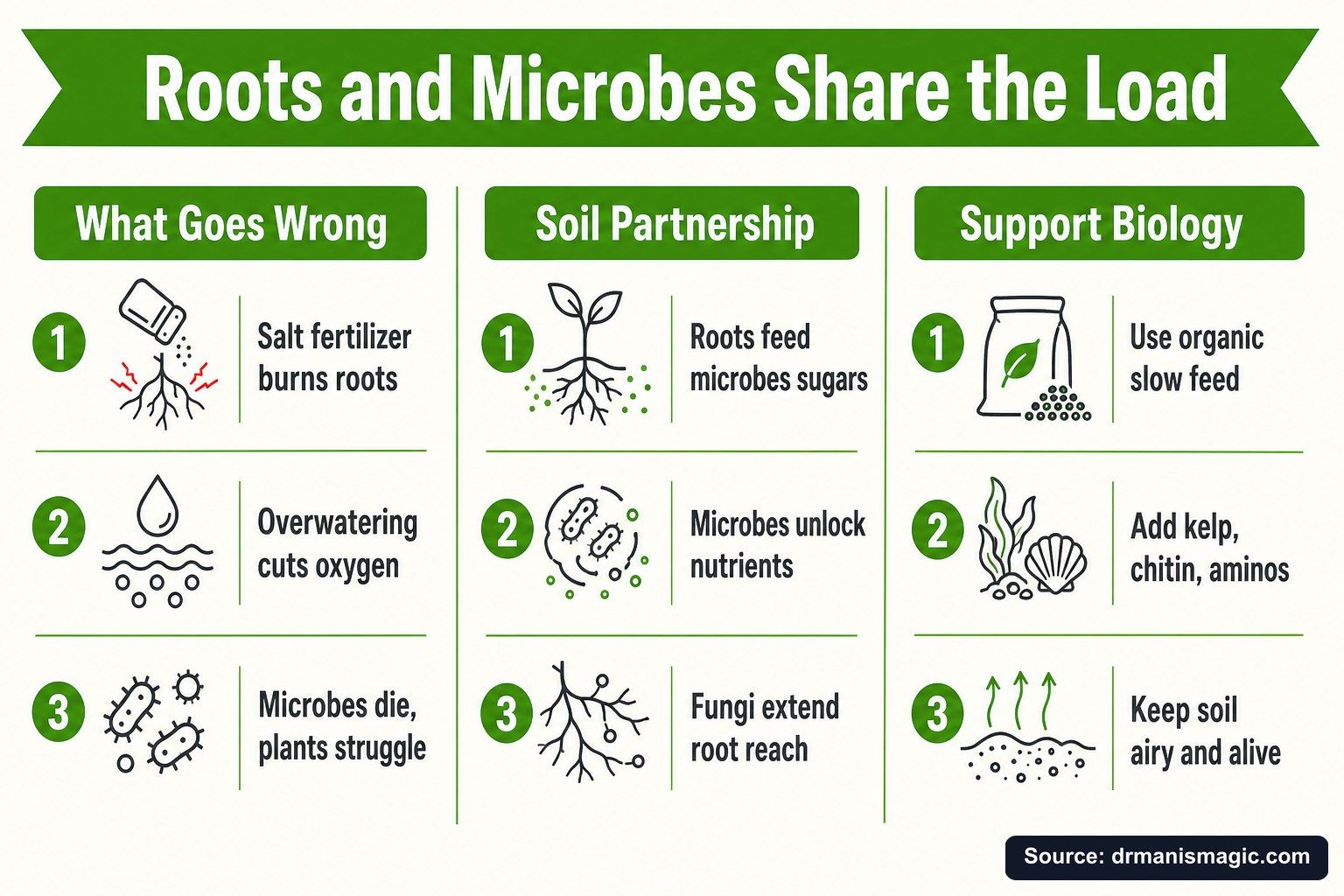
Key Takeaways
- Roots and microbes form a two-way partnership. Roots feed microbes sugar. Microbes feed roots nutrients. Break that deal and your plant suffers.
- Soil biology supplies roughly 75% of plant-available nitrogen and 65% of available phosphorus, making microbes the real fertilizer factory.
- Salt-based synthetic fertilizers pull water away from roots through osmotic stress, burn fine root tips, and wipe out the very microbes your plant depends on.
- Root rot is often an oxygen problem before it is a pathogen problem. Compaction, overwatering, and salt damage all cut off the air roots need to breathe.
- Organic fertilizer does not just avoid killing microbes. It feeds them first, then lets them slowly release nutrition into the root zone like a natural time-release system.
- Chitin from crab shells, natural hormones from cold-processed kelp, and amino acid nitrogen all work with soil biology instead of against it.
- The Three Plant Pillars, developed by Dr. Mani Skaria at US Citrus Nursery, give every plant the mineral foundation, live microbial muscle, and clean organic nutrition it needs to thrive long-term.
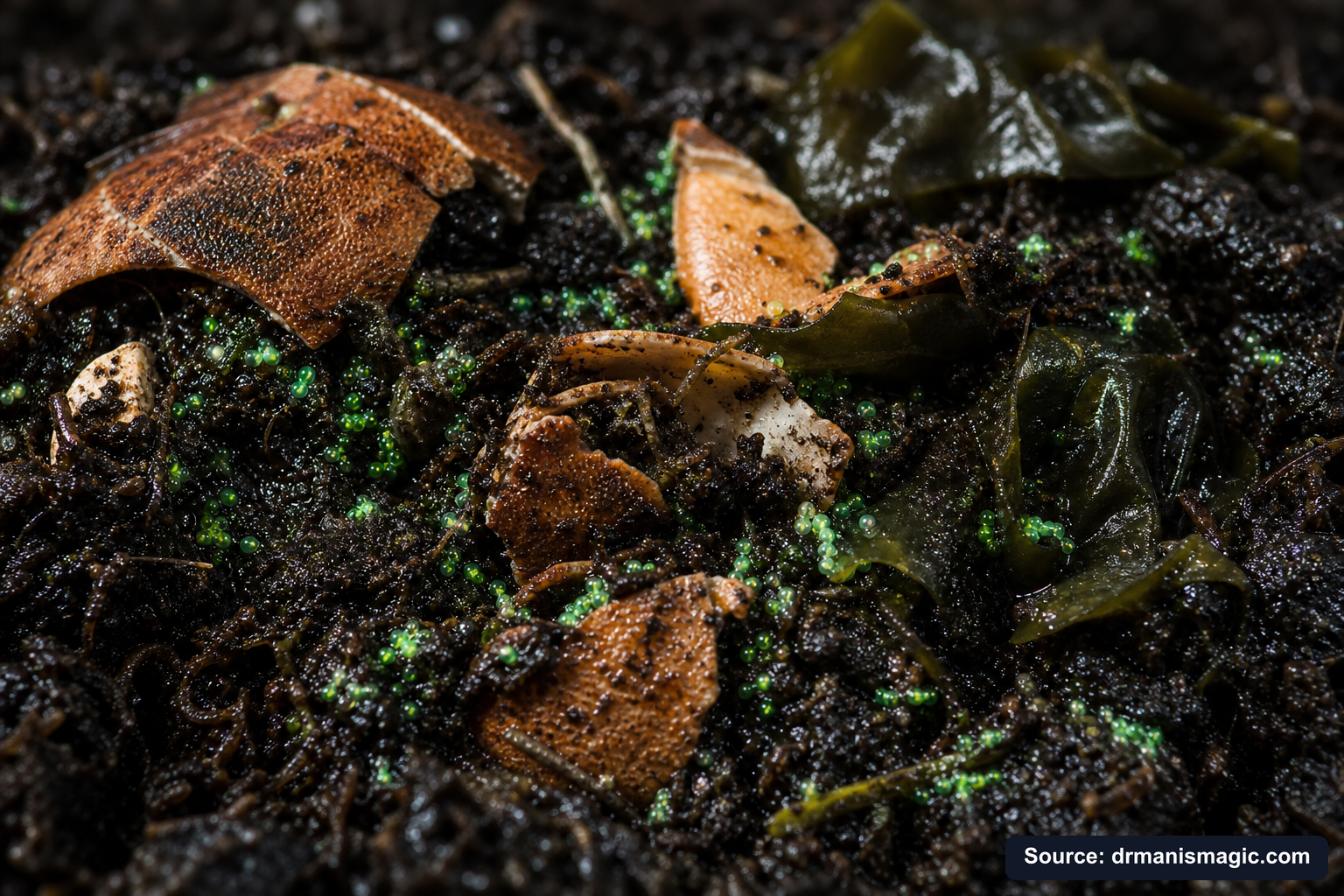
What Is the Rhizosphere and Why Does It Matter for Every Plant You Own?
Quick Answer: The rhizosphere is the thin zone of soil directly around your plant's roots. It is packed with billions of bacteria, fungi, and other microbes that trade nutrients with roots in real time. This zone is the most biologically active place on earth, and it controls how well your plant grows, fights disease, and handles stress.
The rhizosphere is not just dirt. It is a bustling marketplace.
Your plant's roots release a steady stream of sugars, proteins, and other compounds into the soil around them. Scientists call these root exudates. Think of them as a signal. A broadcast. "Hey microbes, come set up shop here. There is food for you."
And the microbes come. By the billions.
In exchange for that sugar, the microbes do extraordinary things. They break down organic matter. They pull nitrogen out of the air and convert it into a form the plant can drink up. They dissolve phosphorus locked in rock and mineral form. They glue soil particles together into loose, fluffy clumps that hold both air and water. They even produce chemicals that fight off fungal diseases like Pythium and Phytophthora before those pathogens ever reach the root.
According to research from the University of Minnesota Extension, soil biological processes supply roughly 75% of plant-available nitrogen and 65% of available phosphorus in healthy soil. That is not a small number. That is the majority of what your plant eats, coming from biology, not from a fertilizer bag.
This matters for your lawn. Your rose bed. Your potted lemon tree. Your raised vegetable garden. Every single plant you own lives or dies based on how healthy this underground partnership is.
When you understand that, the whole game changes.
How Do Roots and Microbes Actually Share the Work?
Quick Answer: Roots handle physical reach, water uptake, and sugar production. Microbes handle nutrient unlocking, nitrogen capture, disease suppression, and soil structure. Neither side can do the other's job. Together they form one complete nutrient-acquisition system that is far more powerful than either half alone.
Let's break down who does what, in plain English.
What Roots Do
Roots push through soil searching for water and minerals. They anchor the plant. They absorb oxygen. Yes, roots breathe oxygen, just like you do. They also produce and release those sugars and proteins we talked about, the exudates that attract and feed the microbial crew.
But roots have limits. They can only reach so far. They cannot dissolve mineral phosphorus locked in rock. They cannot pull nitrogen from the air. They cannot fight off fungal attacks on their own. That is where the microbes come in.
What Bacteria Do
Certain bacteria living near roots are nitrogen fixers. They grab nitrogen gas from the air, which is 78% nitrogen, and convert it into ammonia and then into nitrates. These are forms the plant can actually use. This is how plants in nature get their nitrogen without a single bag of fertilizer.
Other bacteria are mineralizers. They eat organic matter and break it down into simple nutrients the root can absorb. They are the recyclers of the soil world.
What Fungi Do
Fungi spread long, thread-like structures called hyphae through the soil. These threads reach far beyond where the physical root can grow. They find water pockets. They find phosphorus deposits. They bring it all back and trade it with the root for sugar.
One special group, called mycorrhizal fungi, actually weaves into the root itself. They literally become an extension of the root system, multiplying the plant's reach by ten times or more. Penn State Extension notes that mycorrhizal associations can extend the absorptive surface area of a root system by up to 700 percent. Seven hundred percent. That is not a small upgrade.
What the Partnership Produces Together
When roots and microbes are working in harmony, here is what you get:
- Nutrients unlocked and delivered in steady, gentle doses
- Nitrogen harvested from the atmosphere for free
- Phosphorus dissolved from rock and mineral form
- Soil structure improved so water drains well and air moves freely
- Disease-suppressing compounds that protect against Pythium, Phytophthora, Fusarium, and Rhizoctonia
- Water access extended far beyond the physical root zone
Disrupt this partnership and you lose all of that. Every bit of it. And most synthetic fertilizers do exactly that.
See also: How Salt-Based Feeding Quietly Destroys Root Systems
Why Do Salt-Based Synthetic Fertilizers Hurt Roots and Microbes?
Quick Answer: Synthetic fertilizers are made from salts. When salts concentrate near roots, they pull water out of plant tissue through osmotic stress, a process called physiological drought. The plant wilts even when the soil is wet. High salt also burns fine root tips and kills the beneficial microbes the plant depends on for 75% of its nitrogen supply.
Here is a science word you need to know. Osmosis.
It just means that water moves toward wherever salt is more concentrated. It is a basic law of nature. You cannot argue with it.
When you pour a high-salt synthetic fertilizer near your plant's roots, the salt concentration in the soil shoots up fast. Now the soil around the root is saltier than the water inside the root cells. So what happens? Water flows out of the root. Out of the plant. Into the salty soil.
Your plant is now losing water. Even if you just watered it. Even if the soil feels moist. The plant is thirsty because the salt is pulling its water away. Agronomists call this physiological drought. Your plant is experiencing drought while standing in wet soil.
This is why plants wilt after heavy fertilizing. This is why leaves scorch around the edges. This is why seedlings die when fertilizer touches them. It is not complicated. It is osmotic stress, and it is 100% caused by the salt.
What Salt Does to Your Microbial Workforce
Now remember that living workforce we talked about? Those billions of bacteria and miles of fungal threads?
Salt kills them.
The same osmotic pressure that pulls water out of plant roots pulls water out of microbial cells too. Bacteria dry out and die. Fungal threads shrivel. Mycorrhizal networks collapse.
Every time you apply a high-salt synthetic fertilizer, you are firing the very workers your plant depends on most. You might see a quick flush of green growth from the fast nitrogen hit. But underneath the soil, the workforce is being decimated. Next month you need more fertilizer because the natural nutrient cycling is broken. The month after that, you need even more. Sound familiar?
This is not a coincidence. This is the cycle the big chemical companies profit from. We are not saying it is an evil conspiracy. We are saying the incentives are not aligned with your plant's long-term health. Your plant is not their priority. Repeat purchases are.
See also: The Hidden Reason Synthetic Fertilizers Cause Root Rot
What Is Root Rot and Is It Really About the Pathogen?
Quick Answer: Root rot is usually an oxygen problem before it becomes a pathogen problem. Overwatering, compacted soil, poor drainage, and salt damage all cut off oxygen to roots. Oxygen-starved roots die and become easy targets for Phytophthora, Pythium, and Fusarium. Fix the oxygen problem first and most root rot stops before it starts.
Most people think root rot is caused by a fungus or a water mold. And yes, pathogens like Phytophthora and Pythium are often present when root rot is diagnosed. But here is the part most growers never hear.
Those pathogens do not usually win unless the root is already weakened.
Healthy, oxygen-rich roots have natural defenses. They produce compounds that fight off pathogens. The microbial community around them produces antibiotics and competing organisms that suppress disease. It is a well-armed fortress.
But when that root is starved of oxygen, when it is sitting in waterlogged soil or compacted dirt or a pot full of sawdust-based mix that has collapsed into sludge, the fortress walls come down. The root cells stop working. Defense compounds stop being produced. The microbial guards disappear. And now Phytophthora, Pythium, Fusarium, and Rhizoctonia walk right in.
According to UC Davis Plant Pathology, oxygen deprivation is a primary predisposing factor for Phytophthora root rot. The pathogen thrives in exactly the anaerobic, waterlogged conditions that first killed the root's natural defenses.
Salt damage plays a role here too. When salt burns fine root tips, those damaged tissues become entry points for pathogens. Salt-stressed roots are immunocompromised roots. They cannot fight back.
How to Tell What Is Actually Killing Your Plant
This is the diagnostic question everyone struggles with. Is it overwatering? Fertilizer burn? Salt damage? True root rot? The symptoms overlap badly. Here is a simple table to help you sort it out.
| Symptom | Fertilizer Salt Burn | Overwatering / Low Oxygen | True Root Rot (Pathogen) |
|---|---|---|---|
| Leaf wilting with wet soil | Yes, classic osmotic stress / physiological drought | Yes, roots cannot uptake water without oxygen | Yes, root tissue is dead and cannot transport water |
| Brown leaf edges or tip burn | Very common, salt scorch pattern | Less common early on | Less common until advanced |
| Root color when you pull the plant | Brown, brittle tips; rest may be white | Yellow to tan, mushy but not slimy | Dark brown to black, slimy, foul smell |
| When did it get worse? | After fertilizing | After a stretch of rain or heavy watering | Gradual decline over weeks; accelerates when stressed |
| Soil smell | No particular smell | Sour or stale smell | Rotten, sulfurous smell |
| Best first fix | Flush soil with clean water; switch to organic low-salt inputs | Improve drainage; let soil dry out; check soil structure | Remove affected roots; improve drainage; add live microbials to rebuild defense |
A 5-Step Recovery Checklist When Your Roots Are in Trouble
- Stop fertilizing immediately. Adding more salt to a stressed root system is like pouring water on a drowning person. Pause all synthetic inputs.
- Check your drainage. Lift the pot or dig at the base of the plant. Is water sitting there? Is the soil compacted and heavy? Oxygen cannot reach roots in waterlogged soil.
- Flush the root zone with clean water. If salt buildup is suspected, a slow, thorough flush with fresh water can leach accumulated salts down and away from roots.
- Improve soil structure. A mineral-based, well-draining soil mix is the long-term solution. Sawdust-heavy potting mix collapses over time and creates the low-oxygen environment that kills roots. See also: Why Most Potting Mix Collapses Within 6-12 Months
- Reintroduce live microbes. Once drainage improves and salt stress is reduced, adding a live microbial drench brings back the biological defense layer that suppresses Phytophthora, Pythium, and their friends. You are rebuilding the fortress.
How Does Organic Fertilizer Actually Feed Your Plant Through Microbes?
Quick Answer: Organic fertilizer does not go straight into the plant. It feeds the microbes first. The microbes eat the organic material and convert it into simple forms the plant can absorb. When those microbes die, they release all of that stored nutrition directly into the root zone. This creates a natural, slow time-release system that keeps feeding your plant long after the day you applied it.
Here is the part that most fertilizer bags never explain.
When you sprinkle on an organic fertilizer like crab meal, kelp, or amino acids, it does not dissolve and rush into the root like a synthetic salt does. Instead, the soil microbes find it. They recognize it as food. They eat it. They grow and multiply.
Inside those microbes, the nitrogen and phosphorus and other nutrients get converted into forms the plant can use. Then, as those microbes complete their life cycle and die, they release all of that nutrition directly into the root zone. It is like a slow-trickle IV drip. Steady. Gentle. Perfectly timed to what the plant can absorb.
The whole process mirrors exactly what happens in a healthy forest or meadow. Organic matter falls. Microbes break it down. Nutrients cycle back to roots. No bag required. No salt. No burn.
This is why organic fertilizers are almost impossible to over-apply in the damaging way synthetic salts can damage. The plant gets to regulate the pace. The microbes act as a buffer. If you add more than the plant needs right now, the microbes hold onto it and release it later. That is not a bug. That is the design.
And here is one more thing that is often missed. When you feed the microbes with organic material, you are also building the microbial population. More microbes means more nitrogen fixation. More phosphorus unlocking. More disease suppression. More soil aggregation. You are not just feeding your plant. You are growing your underground workforce at the same time.
You Never Had a Brown Thumb.
You were handed the wrong tools. This free guide hands you the right ones.
You watered it. You fed it. It died anyway.
It was never you. It was the dirt, the salt food, and the bad advice.
This guide shows you what really went wrong, and how to fix it for good.
- Why your plants really died, and why it was never your fault
- The salt hiding in your plant food that quietly burns the roots
- The hidden killer in almost every bag of store soil
- The tiny helpers that grow a whole forest for free
- The rescue trick that brings a half dead plant back to life

What Does Chitin From Crab Shells Actually Do in Soil?
Quick Answer: Chitin is a natural compound found in crab shells. When added to soil, it feeds a specific group of bacteria called chitinase-producing bacteria. These bacteria also eat the chitin in fungal cell walls and insect exoskeletons, which means they naturally suppress soil-dwelling pathogens and pests while releasing calcium and nitrogen for the plant.
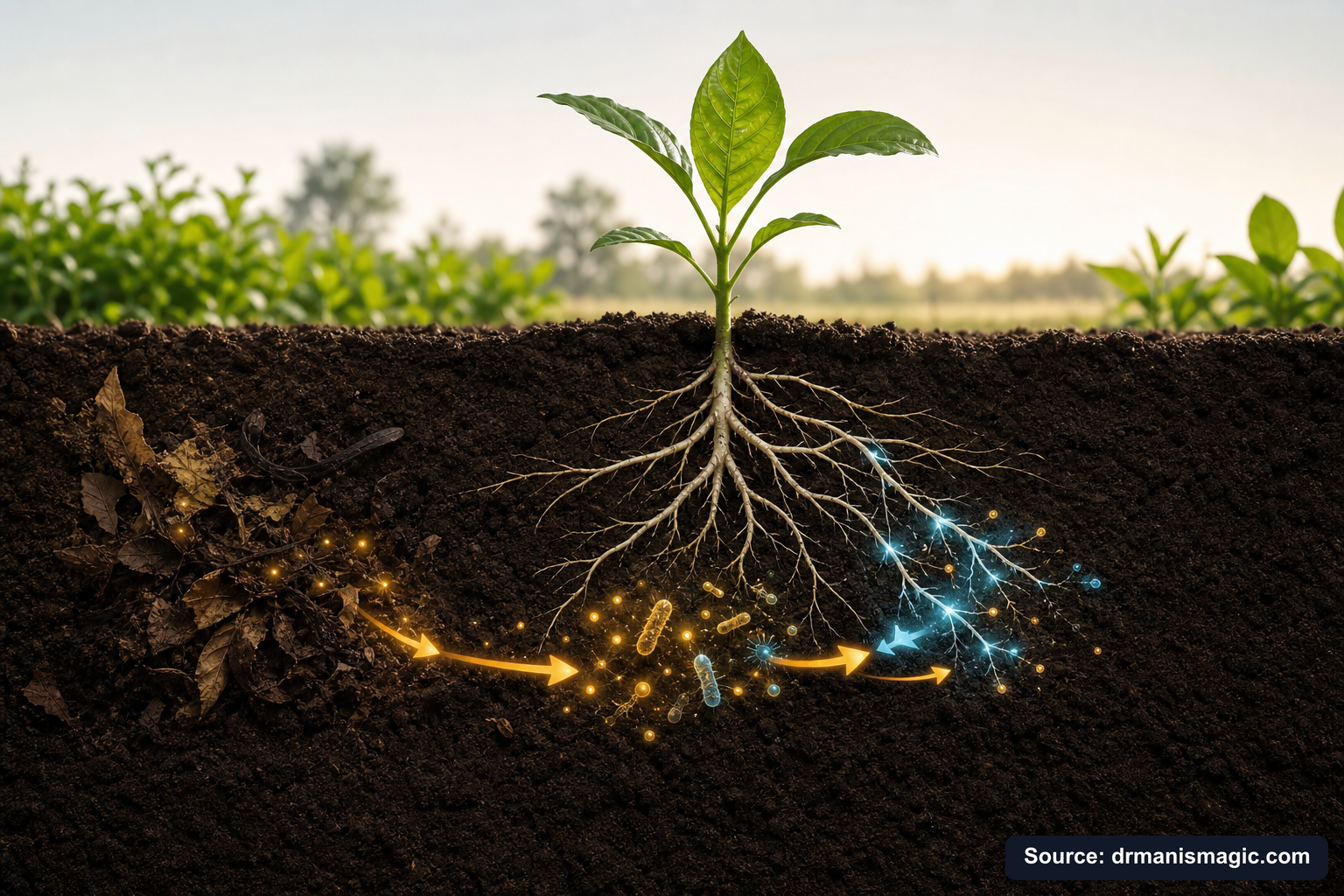
Chitin is one of the most underappreciated tools in soil biology.
When crab shell meal breaks down in the soil, bacteria that produce an enzyme called chitinase come running. These bacteria love chitin. They multiply rapidly. And here is the beautiful part. The same enzyme they use to digest crab shell also breaks down the cell walls of fungal pathogens and the exoskeletons of soil-dwelling pests like nematodes.
You are essentially training your soil's immune system by feeding it chitin. The chitinase-producing bacteria boom. Fungal disease pressure drops. Harmful nematode populations shrink. And as those bacteria process the crab shell, they release calcium and nitrogen back into the root zone.
Calcium is one of the most important structural nutrients a plant has. A large proportion of woody plant tissue is calcium. It strengthens cell walls. It supports root tip growth. It improves fruit firmness. Getting a steady slow-release source of calcium through organic crab meal is far superior to a one-time dose of calcium chloride that spikes and then drops.
This is why crab shell is not just a fertilizer ingredient. It is a biological activator that makes the whole soil ecosystem healthier and more disease-resistant.
What Does Cold-Processed Kelp Do That Regular Fertilizer Cannot?
Quick Answer: Cold-processed kelp delivers natural plant hormones called auxins and cytokinins, along with trace minerals, carbohydrates, and biostimulants. These compounds trigger root branching, improve stress tolerance, enhance flower and fruit set, and feed soil microbes with complex carbohydrates that synthetic fertilizers never contain.
Kelp has been used as a soil amendment for centuries. Coastal farmers in Ireland, Scotland, and Japan knew something was special about seaweed long before anyone could measure plant hormones.
Now we know why.
Cold-processed kelp contains natural auxins and cytokinins. These are plant growth hormones that signal roots to branch out, that tell cells to divide, that prepare the plant for flowering and fruit set. You cannot get these from a synthetic nitrogen-phosphorus-potassium bag. They simply do not exist in salt-based fertilizers.
Kelp also delivers a wide array of trace minerals pulled from the ocean. Iodine. Selenium. Vanadium. Dozens of trace elements that land-based soils often lack. Plants need these in tiny amounts, but they are like vitamins. Miss one and the whole system slows down. This is the Law of the Minimum. The weakest link determines the chain's strength.
The carbohydrates and complex sugars in kelp also feed soil microbes directly. Remember, microbes thrive on carbon. A rich carbon source from kelp means a thriving microbial community. Which means more nutrient cycling. More disease suppression. More of everything that makes plants grow strong.
Cold processing matters here. Heat destroys the hormones and many of the biologically active compounds in kelp. A heat-processed kelp meal is a fraction as effective as cold-processed. This is a detail that most fertilizer labels will never tell you.
Why Do Amino Acids Make Nitrogen Easier for Plants to Absorb?
Quick Answer: Amino acids are the building blocks of protein. When applied to soil, amino acid nitrogen bypasses several steps in the normal nutrient conversion cycle. Plants can absorb certain amino acids directly, and microbes convert the rest quickly into plant-ready nitrogen. This makes amino acid nitrogen far gentler and more efficient than the high-salt nitrate forms found in synthetic fertilizers.
Nitrogen is the nutrient your plants need most. It builds chlorophyll. It builds proteins. It drives new leaf growth. Without enough nitrogen, leaves go pale yellow and growth stalls.
But not all nitrogen is equal. Not even close.
Synthetic fertilizers deliver nitrogen as highly soluble nitrate or ammonium salts. The plant can absorb these quickly, which is why you see fast green-up. But those same salt forms are what cause osmotic stress and microbial damage. It is a trade-off you never asked to make.
Amino acid nitrogen is different. Amino acids are organic nitrogen compounds already partially processed by biology. Certain amino acids can be absorbed directly through root membranes without any conversion step at all. Others are quickly mineralized by soil microbes into plant-available forms.
The result is nitrogen delivery that is fast enough to be effective but gentle enough to never burn. No osmotic spike. No salt index problem. No microbial massacre. And because amino acids are also the raw material that microbes use to build their own proteins, feeding amino acids to the soil is like giving your microbial workforce a raise. They thrive. And when they thrive, they produce even more nitrogen from the atmosphere and organic matter around them.
It is a compounding effect. Every application makes the next one more powerful because you are building the system, not depleting it.
What Role Does Volcanic Ash Play in Plant Nutrition?
Quick Answer: Volcanic ash is a natural source of silica and dozens of trace minerals. Silica strengthens plant cell walls, making stems more rigid, leaves more resistant to insects and disease, and roots more resilient under drought stress. The slow weathering of volcanic minerals also releases micronutrients that feed both plants and soil microbes over a long period.
Silica is not listed as an essential plant nutrient by most textbooks. But walk into any field where volcanic soils are used and you will notice something. The plants are tougher. Thicker stemmed. More resistant to pest pressure.
That is silica at work.
When plants deposit silica into their cell walls, those walls become harder and more difficult for fungal spores to penetrate. Chewing insects have a harder time breaking through leaf tissue. Stems stand more upright and resist lodging in wind and rain. The plant is physically armored.
Volcanic ash also brings dozens of trace minerals to the soil. Iron. Manganese. Zinc. Copper. Boron. Molybdenum. These are the micronutrients that most fertilizers skip entirely. Yet each one plays a critical role. Zinc governs hormone production and shoot elongation. Boron controls pollen development and fruit set. Molybdenum helps convert nitrate nitrogen inside the plant into usable protein.
Miss any one of these and your plant hits a ceiling it cannot break through, no matter how much nitrogen you throw at it.
Slow weathering of volcanic minerals also feeds soil microbes over months and years. This is a long-game nutrient source that builds the soil's mineral bank rather than making one-time deposits and walking away.
Synthetic Fertilizer vs Slow-Release Organic Fertilizer: Which Is Right for Your Plant?
Quick Answer: Synthetic fertilizers deliver a fast salt-based nutrient hit that can cause osmotic stress, burn roots, kill microbes, and leave plastic residues in soil. Slow-release organic fertilizers feed the microbial ecosystem first, deliver nutrients gently over time, improve soil structure, and build long-term plant resilience. For any plant you want to keep alive and thriving, organic slow-release is the right choice.
Let's look at this side by side so it is crystal clear.
| Feature | Synthetic Fast-Release Fertilizer | Coated Slow-Release Synthetic | Organic Slow-Release (Crab, Kelp, Amino Acids) |
|---|---|---|---|
| Salt content / salt index | High. Major cause of root burn and osmotic stress | Medium. Still salt-based inside the coating | Very low. Protein-based nitrogen; plant regulates uptake |
| Effect on soil microbes | Kills beneficial bacteria and fungi on contact | Less acute damage but still harmful over time | Feeds and grows the microbial workforce |
| Root burn risk | High, especially if over-applied or soil is dry | Low to medium depending on coating integrity | Very low. Almost no risk of over-feeding damage |
| Nutrient delivery pace | Immediate spike, then drop | Spread over weeks to months depending on coating | Steady trickle driven by microbial activity; mirrors nature |
| Plastic or PFAS residue risk | Possible PFAS from biosludge fillers | Yes. Plastic polymer coatings remain in soil | Zero PFAS. Zero biosludge. Zero synthetic salts |
| Long-term soil health | Degrades biology, compacts soil over time | Neutral to slightly negative | Actively builds biology, improves structure, increases resilience |
| Works with or against biology? | Against. Kills the system it depends on | Neutral at best | With. Grows the system and becomes more effective over time |
There is no competition here once you understand the mechanism. One of these builds your underground workforce. The other fires them.
What Is Biosludge and Why Should You Care About PFAS in Fertilizer?
Quick Answer: Biosludge is treated municipal wastewater waste that is used as a filler in some fertilizers, both synthetic and organic. It often contains PFAS, also called forever chemicals, which accumulate in soil, plants, and human tissue and do not break down. Any fertilizer using biosludge is bringing hidden chemicals into your garden that no amount of watering will wash away.
This one is uncomfortable. But you deserve to know.
PFAS stands for per- and polyfluoroalkyl substances. They are called forever chemicals because they do not break down in the environment. Or in your body. They accumulate. They persist. And they have been linked to serious health concerns by the EPA and multiple university research teams.
Here is the problem. Some fertilizers, including products marketed as organic, use biosludge as a filler. Biosludge is treated human waste from municipal wastewater treatment plants. It sounds processed and safe. But PFAS from personal care products, industrial runoff, and household chemicals end up concentrated in that sludge. And then it ends up in your garden.
Walk barefoot on your lawn. Let your kids roll in the grass. Pick tomatoes and eat them off the vine. These are the moments that matter. These are the moments that should be free from hidden chemical risk.
This is why clean inputs matter. Not as a marketing claim. As a real-world decision about what you put into the soil your family lives around.
Dr. Mani's Magic Crab, Kelp & Amino Acids contains zero biosludge, zero PFAS, and zero synthetic salts. It is made in the USA from crab shell, cold-processed kelp, volcanic ash, and amino acids derived from clean animal sources. That is it. Nothing hiding in the ingredient list.
How Do the Three Plant Pillars Put This All Together?
Quick Answer: The Three Plant Pillars are mineral-based soil for drainage and oxygen, live microbes for biological nutrient cycling and disease defense, and organic fertilizer for clean slow-release nutrition that feeds the microbial system first. All three must work together. Fix only one and the other two cannot perform. This is the framework Dr. Mani Skaria developed after 40 years of research and 250,000 trees grown in South Texas.
Now it all connects.
Everything we have covered, the rhizosphere partnership, the osmotic damage from salts, the oxygen needs of roots, the way organic fertilizer feeds microbes first, the chitin that trains the soil's immune system, the kelp hormones that drive root branching, the amino acid nitrogen that nourishes without burning. All of it leads to one conclusion.
You cannot fix a plant problem with a single product. You have to fix the system.
That is exactly what the Three Plant Pillars are designed to do.
Pillar One: Mineral Foundation. Most potting mixes are full of pine bark and organic fillers that decompose over time. As they break down, they compact. They block oxygen. They hold water in all the wrong ways and drain in all the wrong ways. Root rot starts here, long before any pathogen shows up. A permanent mineral-based soil made from inorganic sandy loam gives roots the open, oxygen-rich structure they need to breathe, grow, and fight.
Pillar Two: Microbial Muscle. You cannot pour on a bag of fertilizer and expect the soil to come alive. Life has to be there first. Live bacteria, fungi, and mycorrhizal networks are the workforce that makes everything else possible. Without them, nutrients sit locked in unavailable forms. Pathogens go unchallenged. Soil structure deteriorates. With them, the root zone becomes a self-sustaining ecosystem that grows stronger every month.
Pillar Three: Organic Fertilizer. Once the soil structure is right and the microbial community is established, the fertilizer you choose either builds on that foundation or destroys it. Organic slow-release nutrition from crab, kelp, amino acids, and volcanic minerals feeds the microbes, provides a complete nutrient profile including all twelve essential elements, and does it all without a single gram of salt-based damage.
Miss any one pillar and the other two are fighting uphill. All three together and the system becomes, as Dr. Mani says, practically bulletproof.
Dr. Mani Skaria, Professor Emeritus of Plant Pathology, inventor of micro-budding, and founder of the Clean Citrus Program in Texas, developed this framework over 40 years of hands-on research. It was tested on over 250,000 citrus trees, a grove, houseplants, and tropical trees at US Citrus Nursery in South Texas. Then it was packaged and made available to any plant owner in America. Not just citrus growers. Anyone who has a lawn, a garden, a potted plant, a fruit tree, or a flower bed.
What Does This Mean for Your Lawn, Garden, Houseplants, and Trees?
Quick Answer: The root-microbe partnership works the same way in every plant system. Whether you are growing turf grass, raised bed vegetables, potted citrus, ornamental shrubs, or tropical houseplants, the same Three Plant Pillars apply. Oxygen in the root zone. Live microbial biology. Clean organic nutrition. The plant type changes. The biology does not.
This is not a citrus-only story.
The rhizosphere exists under your lawn. Under your rose bushes. Under the potted fig tree on your patio. Under the vegetable garden you planted in March. The same root exudates. The same nitrogen-fixing bacteria. The same mycorrhizal partnerships. The same vulnerability to salt damage and low oxygen.
A lawn drenched in high-salt synthetic fertilizer every spring is experiencing the same osmotic stress as an over-fertilized lemon tree. The same microbial die-off happens. The same compaction and thatch buildup follows as soil biology collapses. The grass looks green for a few weeks and then needs another hit. The cycle continues.
A vegetable garden where the soil has been worked with heavy synthetic inputs for years has depleted biology. Fewer nitrogen fixers. Fewer phosphorus solubilizers. More reliance on the bag. More cost. More time. Less result.
But a plant growing in mineral-based, well-draining soil, surrounded by a thriving microbial community, and fed with gentle organic nutrition? That plant has every advantage nature intended it to have. It fights pests on its own. It handles a missed watering without wilting into crisis. It produces more. It lives longer. It becomes the plant you pictured when you put it in the ground.
You can learn more about how to set this up for your specific situation in our Free Plant Care Field Guide. It walks you through the Three Plant Pillars step by step for every plant type, in plain language, with zero guesswork.
A Closing Thought on Time, Biology, and What Your Plants Deserve
Here is the honest truth. You can get money back. You cannot get time back.
Every season you spend pouring salt-based fertilizer onto dying biology is a season your plants spend struggling instead of thriving. Every year the cycle continues, root systems weaken a little more, microbial communities thin a little further, and the plant you dreamed of having, the one dripping with fruit, bursting with flowers, thick with green growth, stays just out of reach.
The number one thing people tell Dr. Mani they want is to see their tree produce fruit in their lifetime. That is not a small request. That is a primal human desire. We were made to tend gardens. We were made to watch things grow. The tragedy is not that it is hard. The tragedy is that most people were never given the right information to make it easy.
The root-microbe partnership has been working for three hundred million years. It does not need you to invent something new. It needs you to stop working against it.
Feed the microbes. Protect the oxygen. Give the roots clean nutrition that works with biology instead of burning it down.
The underground workforce is already there, waiting to go to work for you. You just have to give them what they need.
If you want to see what the Three Plant Pillars look like in action, and read from the 2,400-plus growers who have already made the switch, take a look at what they experienced. No pressure. Just real people, real plants, and real results from a nursery that has been doing this in South Texas for over 30 years.
Frequently Asked Questions
Roots and microbes are doing something incredible right under your feet, right now. Most gardeners never learn about this hidden partnership, and that is exactly why their plants struggle. These questions get straight to the truth so you can stop guessing and start growing.
What is the relationship between plant roots and microbes in the soil?
Roots and microbes are partners. Roots release sugars into the soil to feed bacteria and fungi. In return, those microbes unlock nutrients, fight off disease, and build the kind of soil structure that lets roots breathe and grow deep. Dr. Mani proved this partnership across 250,000 trees at US Citrus Nursery. When you support both sides of that deal, plants respond fast. Break it, and no fertilizer bag in the world will save you.
What kinds of microbes live around plant roots?
The zone right around your roots is packed with bacteria, fungi, and mycorrhizae. Bacteria like rhizobium pull nitrogen straight from the air and hand it to your plant in a form it can actually use. Fungi stretch out like tiny fingers, reaching nutrients far beyond where roots can go. Mycorrhizae connect to roots directly and act like a second root system. Dr. Mani's Plant Super Boost delivers all of these live and ready to work the moment they hit your soil.
How do plants and microbes actually trade with each other?
Your plant pumps sugars out through its roots. That sugar is food for microbes. Microbes eat it and then break down minerals, release nitrogen and phosphorus, and produce natural compounds that protect roots from harmful pathogens. It is a real trade happening every single day. Soil biology supplies roughly 75 percent of plant-available nitrogen this way. That is not a small thing. That is your plant's main food supply, and it only works when the microbes are alive and thriving.
What kills the microbes around my plant's roots?
Salt-based synthetic fertilizers are the number one killer. They pull water away from roots and microbes through osmotic stress. They burn the fine root tips your plant depends on. And they wipe out the very bacteria and fungi doing all the heavy lifting underground. Big box stores have been selling these salt bombs for decades. Dr. Mani watched it happen up close and built the Three Plant Pillars specifically to break that cycle and give your soil biology a fighting chance.
Why does my plant look healthy on top but still struggle to grow?
Because the real problem is underground. If your soil is compacted or loaded with synthetic salt residue, roots cannot breathe. Roots need oxygen just like you do. When oxygen is cut off, roots suffocate, microbes die off, and nutrients get locked up tight in the soil where your plant cannot reach them. The leaves might look okay for a while, but the foundation is crumbling. This is exactly why Pillar One of Dr. Mani's system is a mineral-based soil that drains perfectly and never compacts.
Can organic fertilizer actually feed my plants better than synthetic?
Yes, and here is why. Organic fertilizer feeds the microbes first. The microbes then break it down slowly and release nutrients into the root zone over time. It is a natural time-release system that works with your soil biology instead of against it. Dr. Mani's Crab, Kelp, and Amino Acids fertilizer uses chitin from crab shells, cold-processed kelp, and amino acid nitrogen. None of it burns roots. None of it kills microbes. And it does not smell bad either, which is a real bonus for indoor plants.
What are the Three Plant Pillars and why do they matter for root and microbe health?
Dr. Mani developed the Three Plant Pillars after decades of research and testing on over 250,000 trees. Pillar One is mineral-based soil that drains well and never rots or compacts. Pillar Two is live microbial muscle, the bacteria, fungi, and mycorrhizae that do the real work underground. Pillar Three is clean organic fertilizer that feeds the whole system without toxic salt damage. Together, these three pillars give roots and microbes everything they need to build a partnership that makes your plants practically bulletproof.
About the Author
Ron Skaria, MD
Ron Skaria, MD, is the co-founder of Dr. Mani's Magic and the son of Dr. Mani. He trained as a medical doctor at Baylor College of Medicine, did his residency at UT Health Science Center - San Antonio and fellowship training at Texas Tech University. He now works full time on the family farm at US Citrus and US Citrus Nursery in Hargill, Texas, building Dr. Mani's Magic alongside his dad. He wrote the Brown Thumb Field Guide to put his father's 48 years of plant science into plain words any gardener can use. His belief is simple. You never had a brown thumb. You just never had the right help.


