


How Rice Hulls Improve Aeration Without Collapse in Potting Mix | Dr. Mani's Magic
How Rice Hulls Improve Aeration Without Collapse (And Why Your Potting Mix Is Already Failing)
Picture this. You repot your favorite plant on a Saturday morning. The mix is fluffy. It smells earthy. You feel good about it. You water it, set it in the sun, and walk away feeling like a proper gardener.
Six months later, that same pot feels like a brick. The soil has shrunk two inches from the rim. Water pools on top instead of draining through. You poke it and your finger barely goes in. The roots at the bottom are brown and slimy. You're not sure what happened. You watered it. You fed it. You did everything right. But something went wrong underground, in the dark, where you couldn't see it. The mix collapsed. And when the mix collapsed, the air space disappeared. And when the air disappeared, the roots suffocated. And then the rot moved in.
This happens to almost every grower who uses standard potting mix. Not because they did anything wrong. Because the mix was designed to fail. It is made of carbon-based organic matter that decomposes over time. As it breaks down, it shrinks, clogs its own pore spaces, and steals the oxygen your roots were counting on. The fix is not a new fertilizer. The fix is structure. Permanent, physics-based structure that holds its shape for years. And one of the most underrated tools for building that structure costs almost nothing and comes from a rice mill. Let's talk about rice hulls.
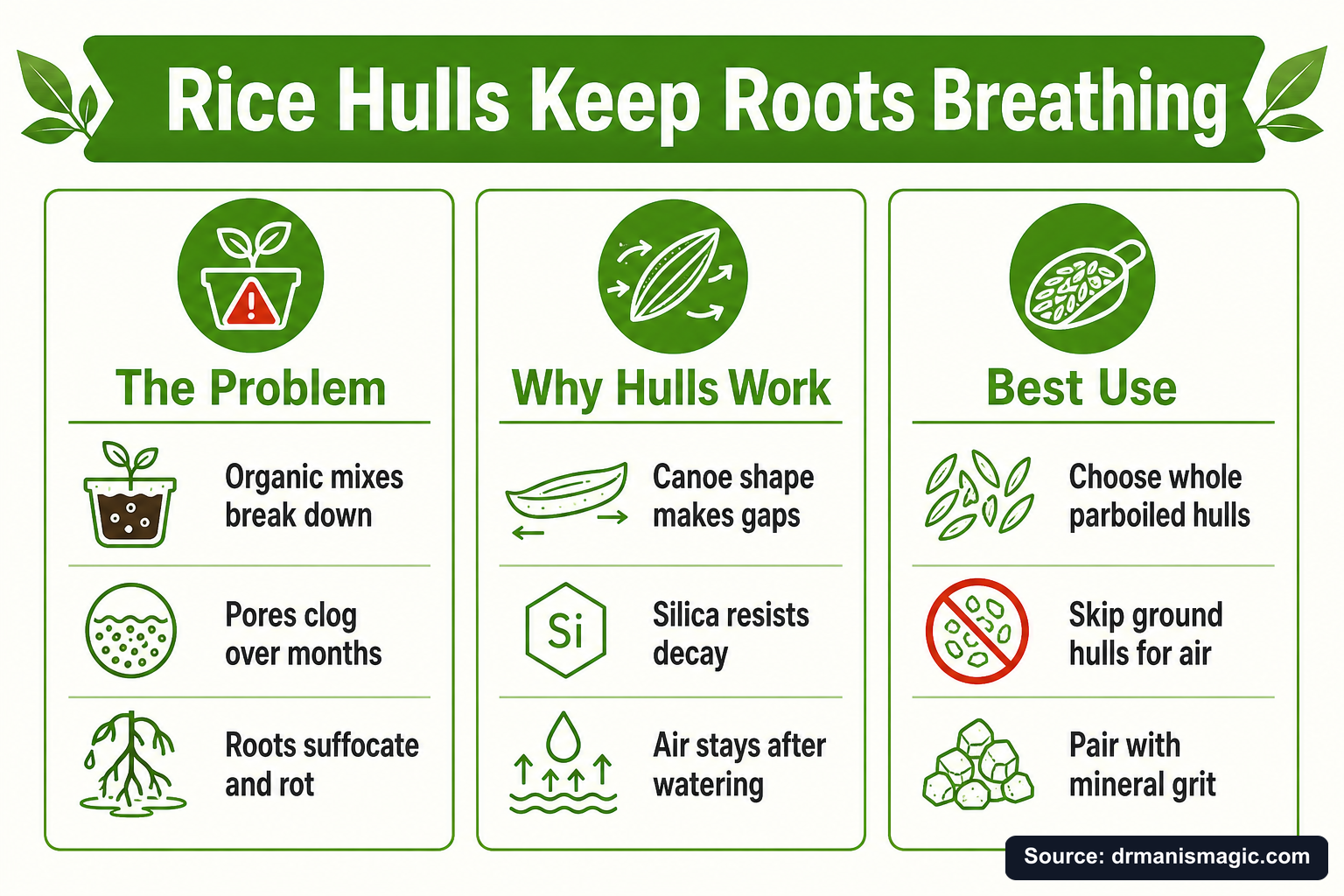
Key Takeaways
- Rice hulls improve aeration through particle geometry, not chemistry. Their canoe shape creates lasting air pockets between other mix ingredients.
- Most potting mix collapse happens because organic matter decomposes and clogs pore spaces over months, cutting off oxygen to roots.
- Parboiled whole rice hulls resist decomposition far longer than peat, bark fines, or compost because they are made of silica, the same base material as sand and glass.
- Roots need oxygen, not just water. A mix without enough air-filled pore space sets up root rot conditions even if you water perfectly.
- Rice hulls work best when paired with durable mineral aggregates for long-term containers. They are excellent for seed starting, vegetables, houseplants, and short- to mid-cycle crops on their own.
- Dr. Mani's Magic Super Soil uses rice hulls as part of a mineral-based, permanent soil system proven across more than 250,000 trees at US Citrus Nursery in South Texas.
- The Three Plant Pillars (mineral-based soil, live microbes, organic fertilizer) treat the root cause of plant failure, not the symptom.
Why Do Your Roots Need Air in the First Place?
Quick Answer: Roots breathe oxygen just like you do. When soil pore space fills with water and stays full, roots suffocate and rot. A healthy mix keeps some pores full of water and others full of air. Rice hulls help create and hold those air-filled pores so roots can breathe between waterings.
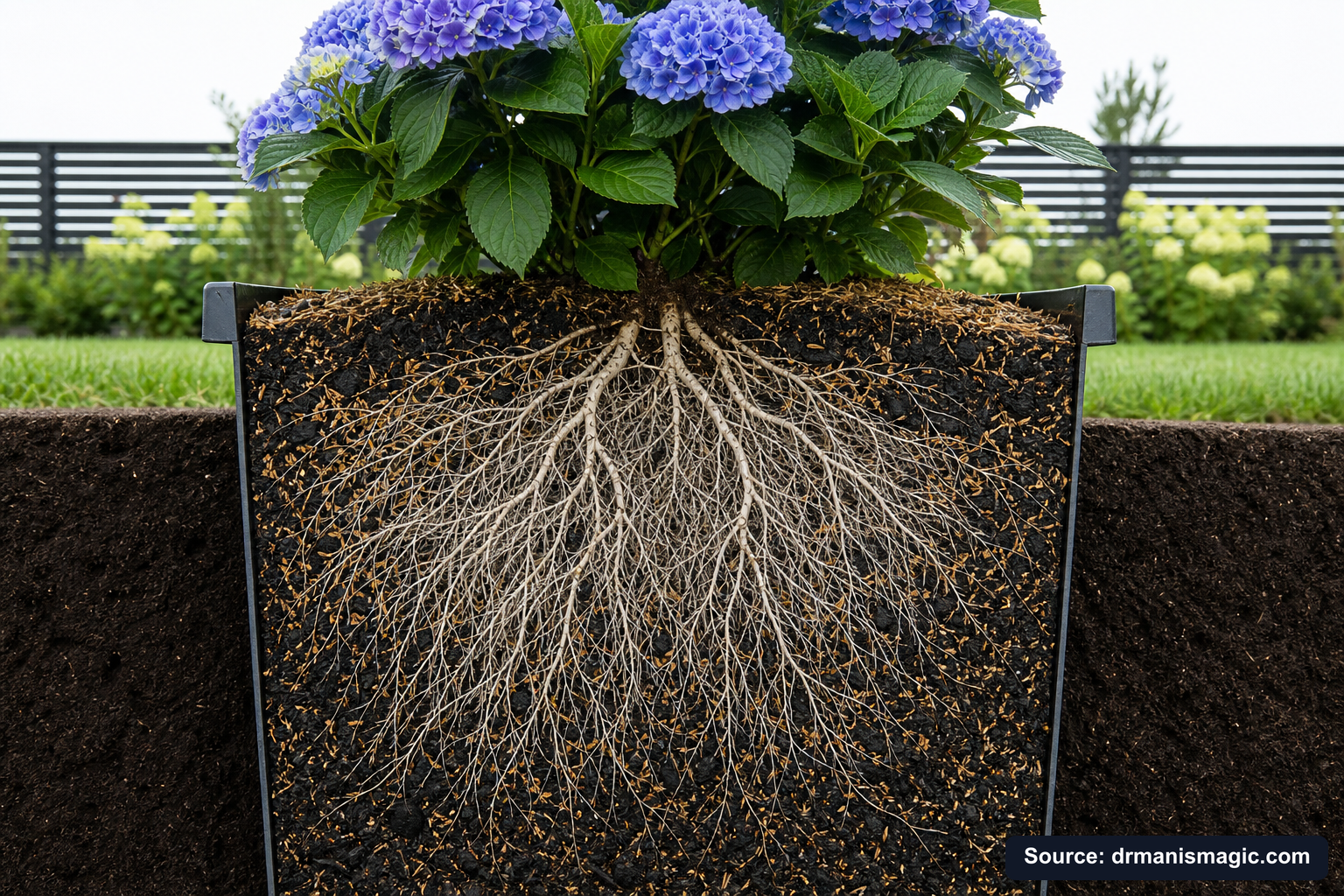
Here is a fact most gardeners never hear. Your plant breathes carbon dioxide through its leaves. But its roots breathe oxygen, just like you do. If you seal a plastic bag over your face, you run out of oxygen fast. If your soil has no air-filled pore space, your roots run out of oxygen just as fast. They just die a little more slowly, so you don't see it coming.
University of Florida extension researchers describe healthy container media as needing both container capacity (the water it holds) and air-filled porosity (the air it holds after drainage). The sweet spot they target is roughly 10 to 30 percent air-filled pore space after a pot drains fully. Below that range, roots begin to struggle. Below 5 percent, root rot conditions develop fast.
Standard potting mix out of the bag may start close to that range. Give it six months. Give it a year. The decomposing organic particles turn into fine material that settles into the pore spaces. The air space shrinks. The mix holds more water and less air. The roots start to suffer. This is not overwatering. This is structural collapse.
The solution is to build structure into your mix with particles that hold their shape over time. That is exactly what rice hulls do.
What Are Rice Hulls and Why Does Their Shape Matter So Much?
Quick Answer: Rice hulls are the hard outer shells removed from rice grains during milling. Parboiled whole hulls are canoe-shaped, about a quarter to half an inch long, and made primarily of silica. Their curved shape props open pore spaces between other mix ingredients, the same way arched bridges hold weight without collapsing flat.
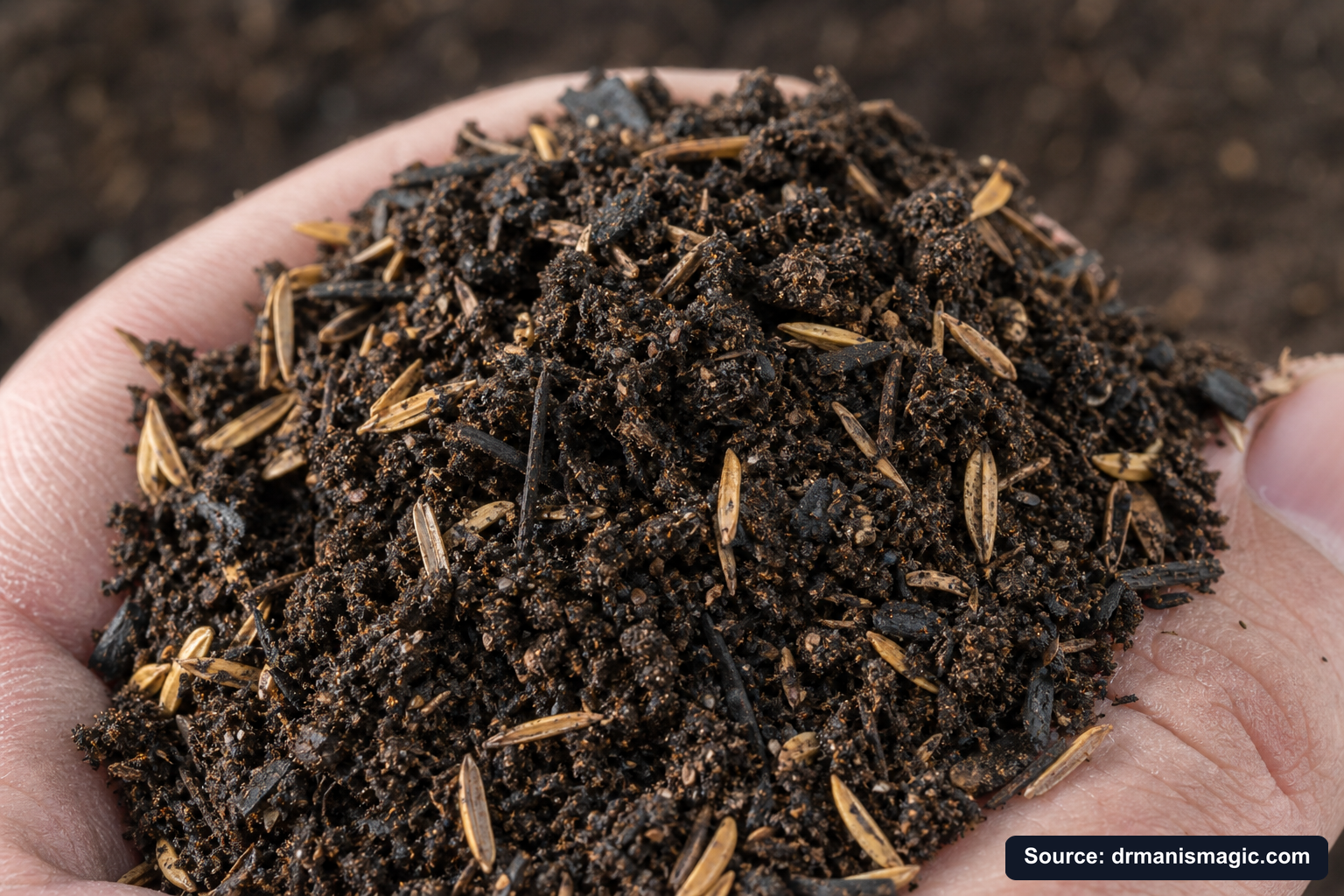
Think of a rice hull as a tiny canoe. Curved on top. Hollow in the middle. Roughly six to ten millimeters long. When you pour a pile of these canoes together, they cannot lie perfectly flat. They stack at odd angles, leaving gaps between them. Those gaps are macropores. That is where the air lives.
Now think about what happens when you pour a pile of fine sawdust together. It packs tight. Almost no gaps. Almost no air. That is what happens inside a decomposing potting mix.
The shape of a particle matters as much as what it is made of. Coarse, irregular particles create macropores. Fine, uniform particles fill them in. Rice hulls are coarse enough and irregular enough to keep pores open between water-holding ingredients like peat, coir, or compost.
The other reason rice hulls work so well is their chemistry. They are composed of roughly 15 to 20 percent silica by weight, according to research from Louisiana State University AgCenter. Silica is inorganic. It does not decompose the way carbon-based materials do. It is the same base chemistry as sand and glass. That is why a rice hull lasts in a pot far longer than a piece of pine bark the same size.
What Is the Difference Between Whole Parboiled Rice Hulls and Ground Rice Hulls?
Quick Answer: Whole parboiled rice hulls keep their canoe shape and create macropores. Ground rice hulls lose that shape and behave more like fine organic matter, similar to peat or coir. For aeration, you want whole hulls, not ground. The shape is the whole point.
This distinction almost never gets explained in gardening content, but it changes everything. Whole rice hulls are the curved, intact shells. They maintain their geometry in the mix. They prop pore spaces open.
Ground rice hulls are milled into a powder or fine flour. They have high silica content, which is useful for some applications. But ground hulls behave like any other fine particle. They pack together. They fill pores instead of creating them. For aeration purposes, ground hulls are the wrong tool.
Parboiling matters too. Raw rice hulls have a small amount of residual starch that can attract mold during storage. Parboiling removes that starch, stabilizes the hull, and makes it more resistant to decomposition in the root zone. Most rice hulls sold for horticultural use are parboiled. Check the label and look for the word "parboiled" or "PBH" before you buy.
What Is Air-Filled Porosity and Why Should You Care About It?
Quick Answer: Air-filled porosity is the percentage of your soil volume that holds air after water drains out. It is the single most important factor in preventing root rot in containers. Rice hulls increase air-filled porosity by creating macropores that drain fast and stay open between waterings.
Let's make this simple. Imagine your pot is a sponge. When you water it, the sponge gets wet all the way through. Then gravity pulls some of the water down and out the drainage hole. What is left? Some water in the tiny pores. And some air in the bigger pores. The bigger pores are called macropores. The smaller ones are called micropores.
Container capacity is how much water the sponge holds after it drains. Air-filled porosity is how much air space is left over. You need both. Too much water retention, not enough air. Roots drown. Too much air, not enough water retention. Roots dry out between waterings.
Rice hulls specifically improve air-filled porosity. They are large enough that water does not stick to them by capillary action the way it sticks to fine peat. Water drains right through the macropores rice hulls create, and air rushes in behind it. This is the physics of aeration. It is not magic. It is geometry.
Penn State Extension researchers note that the target air-filled porosity for container mixes is between 10 and 30 percent. Rice hulls at 10 to 20 percent of a mix volume can meaningfully push a collapsing peat-heavy blend back into that healthy range.
Why Do Potting Mixes Collapse Over Time?
Quick Answer: Standard potting mixes are made mostly of pine bark, sawdust, and other carbon-based organic matter. Organic matter decomposes. As it breaks down, the particles get smaller and denser, filling in pore spaces and reducing oxygen availability at the root zone. This is not overwatering. It is structural collapse caused by decomposition.
Here is something the bag of potting mix will never tell you. What you are buying is mostly dead trees. Pine bark. Sawdust. Maybe some composted wood fiber. These are all carbon-based organic materials. And here is the thing about organic matter: it decomposes. That is what organic matter does. It breaks down into smaller and smaller pieces until it returns to the earth.
In nature, that process is beautiful. In your container, it is a slow disaster.
As the particles decompose, they get finer. Finer particles settle into the pore spaces between larger particles. The air gaps close up. Oxygen cannot diffuse through anymore. The root zone goes anaerobic. That means no oxygen. And in an anaerobic root zone, the pathogens that cause root rot, including Phytophthora and Pythium, thrive.
There is a reason big box stores do not talk about this. They sell annual plants in cheap potting mix. Those plants live three to six months. The mix collapses, but the plant is already gone by then. Nobody connects the dots. The store sells another plant. Another bag of mix. The cycle continues. Nobody wins except the store.
For perennial plants, fruiting trees, and long-term container specimens, this collapse is catastrophic. You invest years of care into a plant. Then the mix fails underneath it and takes the plant down with it. The plant did not fail. The foundation failed.
After growing over 250,000 trees at our nursery in South Texas, we learned this the hard way. Pine bark-based mixes last months. Mineral-based mixes last years. The difference is whether your soil decomposes or not.
See also: The Hidden Reason Synthetic Fertilizers Cause Root Rot
How Long Do Rice Hulls Actually Last in a Potting Mix?
Quick Answer: Whole parboiled rice hulls typically maintain their structure for one to two years in a container environment. They outlast bark fines and compost significantly but will eventually break down. For multi-year perennial containers, pair rice hulls with durable mineral aggregates like pumice, coarse sand, or calcined clay for longest-lasting aeration.
This is the question that matters most, and almost nobody answers it directly. So here it is.
Whole parboiled rice hulls are not permanent. They are more durable than pine bark, peat, or compost. But they will eventually break down, usually in one to two years depending on watering frequency, temperature, and microbial activity in the mix.
For annual vegetables, seed starting, and houseplants you repot every year or two, rice hulls are excellent on their own. They last long enough to do the job, and they improve the mix significantly compared to peat or bark alone.
For citrus trees, bonsai, succulents, and woody perennials that stay in containers for five or ten years, you need more durable mineral aggregates alongside the rice hulls. Pumice, coarse perlite, lava rock, calcined clay, and expanded shale all outlast rice hulls significantly because they are inorganic. They do not decompose at all. Their pore structure stays intact indefinitely.
The ideal long-term container mix pairs rice hulls for initial aeration and light weight with durable mineral particles for permanent structural support. That is exactly the philosophy behind our Super Soil, which uses rice hulls alongside silica-rich sandy loam, coco coir, and biochar to create a mix that drains freely on day one and continues to drain freely years later.
Rice Hulls vs Perlite vs Pumice vs Other Aeration Amendments
Quick Answer: Rice hulls, perlite, pumice, lava rock, and calcined clay all improve aeration but differ in longevity, weight, cost, sustainability, and best use case. Rice hulls are the most sustainable and lowest cost. Pumice and calcined clay last the longest. Perlite floats and creates dust. The best mix uses more than one amendment matched to your crop's container lifespan.
Let's lay it all out. You deserve a clear comparison, not vague advice to "add drainage material."
| Amendment | Aeration | Longevity | Weight | Floats? | Sustainable? | Cost | Best For |
|---|---|---|---|---|---|---|---|
| Rice Hulls (whole parboiled) | High | 1–2 years | Very light | No | Yes (rice mill byproduct) | Low | Seed starting, annuals, houseplants, short-cycle containers |
| Perlite | High | Permanent | Very light | Yes | No (mined, silica dust hazard) | Low–Medium | General container mixes, seed starting |
| Pumice | Very high | Permanent | Medium | No | Moderate (mined volcanic rock) | Medium–High | Succulents, bonsai, long-term containers, citrus |
| Lava Rock | High | Permanent | Medium–Heavy | No | Moderate (mined) | Medium | Bonsai, succulents, cactus, heavy-use containers |
| Coarse Sand | Moderate | Permanent | Heavy | No | Yes (abundant) | Very Low | Sandy loam blends, citrus, mineral soil mixes |
| Calcined Clay | Very high | Permanent | Medium | No | Moderate | Medium–High | Long-term containers, bonsai, citrus |
| Expanded Shale | High | Permanent | Medium | No | Moderate | Medium | Raised beds, long-term containers |
| Vermiculite | Moderate | 1–2 years (compresses) | Very light | No | Moderate (mined) | Low–Medium | Seed starting, indoor plants, moisture retention mixes |
| Biochar | Moderate | Decades | Light | No | Yes (carbon sequestration) | Medium | Long-term soil health, microbial habitat, all containers |
| Bark Fines / Compost | Low (and falling) | 3–12 months | Medium | No | Moderate | Low | Short-cycle annuals only; degrades fast in perennial containers |
The honest takeaway from that table: no single amendment does everything. Rice hulls win on sustainability, cost, and lightness. Pumice and calcined clay win on longevity. The smartest mixes use two or three amendments together, each doing a different job.
One more note on perlite. It works. But it floats to the surface when you water. Over time, it migrates out of the root zone. It also creates fine silica dust when dry, which is a respiratory hazard. Many growers prefer rice hulls specifically because they stay put, do not float, and create no dust. For indoor plants especially, that matters.
Do Rice Hulls Make Soil Too Dry or Too Wet?
Quick Answer: Rice hulls do not hold much water themselves. They improve drainage and air space without significantly increasing moisture retention. This makes them ideal for plants that prefer drier conditions between waterings. For water-loving plants, balance rice hulls with coir or peat to maintain enough moisture-holding capacity in the mix.
This is a fair concern. If rice hulls create macropores that drain fast, does the mix dry out too quickly?
The short answer is: it depends on the rest of your mix. Rice hulls themselves hold very little water. They are not like vermiculite or coir, which hold several times their weight in moisture. Rice hulls drain freely. That is their job.
But in a balanced mix, they work alongside moisture-holding ingredients. Coir holds water. Peat holds water. Compost holds water. Rice hulls create the air corridors between those moisture-holding particles. Water stays in the micropores. Air stays in the macropores rice hulls create. Both coexist in the same mix.
For succulents, cacti, and citrus trees, a drier mix between waterings is actually ideal. These plants evolved in conditions where the root zone fully dries between rain events. Rice hulls support that naturally.
For moisture-loving tropicals and vegetables, you simply use a lower percentage of rice hulls in the mix. More coir, less rice hulls. The ratios are adjustable.
You Never Had a Brown Thumb.
You were handed the wrong tools. This free guide hands you the right ones.
You watered it. You fed it. It died anyway.
It was never you. It was the dirt, the salt food, and the bad advice.
This guide shows you what really went wrong, and how to fix it for good.
- Why your plants really died, and why it was never your fault
- The salt hiding in your plant food that quietly burns the roots
- The hidden killer in almost every bag of store soil
- The tiny helpers that grow a whole forest for free
- The rescue trick that brings a half dead plant back to life

What Are the Best Rice Hull Ratios for Different Plants?
Quick Answer: Rice hulls typically work best at 10 to 25 percent of total mix volume. Seed starting and annual vegetables use around 10 to 15 percent. Houseplants and citrus do well at 15 to 20 percent. Succulents and bonsai benefit from up to 25 percent, paired with mineral aggregates for long-term aeration.
Here are practical starting ratios based on plant type. These are starting points, not rigid rules. Adjust based on your climate, watering habits, and container size.
| Plant Type | Recommended Rice Hull % | Best Pairing Ingredients | Notes |
|---|---|---|---|
| Seed Starting | 10–15% | Fine coir, peat, vermiculite | Keeps mix light and draining for delicate roots |
| Annual Vegetables | 10–15% | Compost, coir, peat | Good for one growing season; no need for permanent structure |
| Houseplants (tropicals) | 15–20% | Coir, peat, perlite or pumice | Prevents the soggy-bottom problem in decorative pots |
| Citrus in Containers | 15–20% | Mineral sandy loam, coir, biochar, pumice or coarse sand | Long-term containers need mineral aggregates alongside rice hulls |
| Succulents and Cactus | 20–25% | Coarse sand, pumice, lava rock, minimal peat or coir | These plants want fast drainage and low moisture retention |
| Bonsai | 15–20% | Akadama, pumice, lava rock | Use whole hulls; replace as part of regular repotting schedule |
| Outdoor Perennials and Fruiting Trees | 10–15% rice hulls plus 20–30% mineral aggregate | Sandy loam, pumice, calcined clay, coir, biochar | Long-term containers need mineral aggregates for permanent structure |
Can Rice Hulls Replace Perlite in a Potting Mix?
Quick Answer: Yes, for most short- to mid-cycle containers, rice hulls can replace perlite at similar volume ratios. They improve aeration comparably, do not float, and create no dust. For containers that stay planted for more than two years, add a permanent mineral aggregate like pumice or coarse sand alongside the rice hulls.
This is the question a lot of growers are really asking. And the honest answer is yes, with one condition.
For annuals, vegetables, houseplants, and containers you repot within a year or two, rice hulls are a direct and superior substitute for perlite in many ways. They aerate comparably. They do not float. They do not create respiratory dust. They are a byproduct of the food industry rather than a mined mineral resource. If you are growing organically or just want a cleaner amendment, rice hulls are a very strong choice.
The one condition: for long-term containers, rice hulls alone are not enough. They will eventually break down. A citrus tree or fruit tree that stays in a container for five or ten years needs amendments that last as long as the plant does. Pumice, coarse silica sand, calcined clay, and expanded shale do not decompose. They are permanent structure. Rice hulls contribute to early-stage aeration in those mixes, but the mineral aggregates carry the long-term load.
This is exactly why the first of the Three Plant Pillars is mineral-based soil. Not organic matter. Not bark. Not peat. Mineral. Silica-rich. Permanent. Because your plant's root zone should outlast the mix it started in.
Does Silica in Rice Hulls Actually Help Plants?
Quick Answer: Yes. Silica strengthens plant cell walls, improves stress tolerance, and may reduce fungal disease pressure. As rice hulls slowly break down over one to two years, they release bioavailable silica into the root zone. This is a secondary benefit on top of their primary job as an aeration amendment.
This is a bonus most people do not know about. Rice hulls are not just structural. As they slowly decompose over a year or two, they release silica into the soil. And silica is genuinely useful to plants.
Research from the University of Georgia and multiple other institutions shows that silica strengthens plant cell walls, improves resistance to drought and heat stress, and may reduce the severity of certain fungal diseases. It is considered a beneficial element for many crops, particularly grasses, grains, and some fruiting plants.
This does not make rice hulls a fertilizer. They are not. They do not supply nitrogen, phosphorus, or potassium in meaningful amounts. But the slow silica release as they break down is a genuine, evidence-backed secondary benefit.
It also reinforces why whole parboiled rice hulls outlast other organic amendments. Their silica content is what makes them rigid enough to resist decomposition for one to two years. The same chemistry that eventually feeds the soil is what keeps the hull intact long enough to do its aeration job first.
What Happens to Roots When Aeration Fails? A Diagnostic Guide
Quick Answer: When air-filled pore space drops too low, roots stop receiving oxygen, turn brown and slimy, and become vulnerable to Phytophthora, Pythium, and other root rot pathogens. The visible symptoms appear in the leaves and stems long after the root damage begins, which is why most growers diagnose the problem too late.
Here is how root oxygen failure actually unfolds, and what to look for before it is too late.
| Stage | What Is Happening Underground | What You See Above Ground | Time Since Mix Started Collapsing |
|---|---|---|---|
| Stage 1: Early Compaction | Fine particles begin settling into macropores. Air space declining. Oxygen still adequate. | Nothing visible yet. Plant looks normal. | Months 3–6 |
| Stage 2: Oxygen Stress | Air-filled porosity below 10%. Roots slowing. Fine root tips beginning to die. Microbial balance shifting toward anaerobic species. | Slightly slower growth. Leaves look a little dull. Easy to miss. | Months 6–12 |
| Stage 3: Root Rot Begins | Pathogenic fungi (Phytophthora, Pythium) colonizing dead root tissue. Brown, slimy roots. Anaerobic smell if you unpot the plant. | Yellowing leaves. Wilting despite wet soil. Leaf drop. You water and it does not help. | Months 9–18 |
| Stage 4: Systemic Decline | Major root system compromised. Plant cannot uptake water or nutrients even when both are present. | Rapid decline. Brown leaf edges. Dropping fruit. Severe yellowing. Plant looks like it is dying despite your best efforts. | Months 12–24 |
| Stage 5: Point of No Return | Root system too damaged to sustain canopy. Plant collapses. | Dead plant. You blame yourself. It was the mix. | Varies |
The cruelest part of this process is that by the time you see the symptoms, the damage is already months old. You cannot see the root zone without unpotting the plant. And most growers do not unpot a plant until it is already visibly sick. That is why building the right mix from the start matters so much more than trying to rescue a collapsing one.
How Do You Recover a Plant from a Collapsed Potting Mix?
Quick Answer: Recovery requires removing the collapsed mix from the root zone, trimming dead roots, and repotting into a well-aerated, mineral-rich mix with rice hulls or other durable aggregates. Adding live beneficial microbes after repotting helps restore the biological balance that protects roots going forward.
If your plant is already showing signs of root oxygen stress, here is a recovery checklist. Work through it in order.
- Unpot the plant gently and inspect the roots. Healthy roots are light-colored and firm. Dead roots are brown, slimy, or smell sour. If you see mostly healthy roots, you caught this early. If most roots are brown, you have more work to do.
- Trim all dead and slimy root tissue with clean, sharp scissors. Cut back to where the root is firm and light-colored. Rinse the remaining roots gently with clean water.
- Let the roots air-dry for 15 to 30 minutes before repotting. This helps cut surfaces begin to callous slightly before going back into wet soil.
- Prepare a fresh mix with meaningful aeration amendment. Add rice hulls, pumice, or coarse silica sand at 15 to 25 percent of your mix volume. For long-term containers, use mineral-based soil as the base, not peat-heavy potting mix.
- Repot and water in with live beneficial microbes. Beneficial bacteria and mycorrhizal fungi colonize root tips and help protect them from the pathogens that caused the rot. This is Pillar Two of the Three Plant Pillars: microbial support. After a root-rot event, this step is not optional. Visit Plant Super Boost to see how we approach this at US Citrus Nursery.
- Hold off on fertilizer for two to four weeks. Give the recovering root system time to reestablish before adding nutrient load. When you do resume feeding, use organic slow-release fertilizer, not salt-based synthetics, which stress damaged roots further. See also: Why Most Fertilizers Are Actually Salt in Disguise.
- Monitor drainage and watering carefully. Water when the top inch of the new mix feels dry. Do not let the pot sit in standing water. Good drainage in the new mix is what makes the difference between recovery and relapse.
Why Does Potting Mix Smell Sour and What Does It Mean?
Quick Answer: A sour, rotten, or swampy smell from your potting mix means the root zone has gone anaerobic. Oxygen is gone. Anaerobic bacteria have taken over and are producing sulfur compounds and organic acids as byproducts. This is a medical emergency for your plant's root system.
You know the smell. You pull a plant out of a pot that has been sitting wet for months and it hits you like a punch. Sour. Swampy. Almost sulfurous. Like something rotting in a drain.
That smell is chemistry. Anaerobic bacteria produce hydrogen sulfide and organic acids as they break down organic matter without oxygen. The same process that makes a compost pile smell bad when it gets too wet and dense is happening inside your pot.
The potting mix did not go bad because you watered too much. The potting mix went bad because it collapsed, lost its air-filled pore space, and became anaerobic. Watering frequency may have accelerated it. But the root cause is structural. The mix could not maintain its air space over time.
Rice hulls, mineral aggregates, and biochar all work to prevent this by keeping macropores open and oxygen flowing through the root zone even after multiple wetting and drying cycles. When oxygen is present, beneficial aerobic microbes thrive. When oxygen is absent, the harmful anaerobic ones take over. It is that simple.
This is also why Dr. Mani's Magic Free Plant Care Field Guide emphasizes soil structure as the foundation of everything else. You can add the best fertilizer in the world. You can add live microbes. But if the soil structure has collapsed and the root zone is anaerobic, none of it will work. Oxygen first. Everything else second.
Are Rice Hulls Good for Citrus Trees in Containers?
Quick Answer: Yes. Citrus roots are highly oxygen-sensitive and among the first to suffer in collapsed, low-aeration mixes. Rice hulls improve air-filled porosity and help prevent the waterlogged root zone conditions that drive Phytophthora root rot, the most common killer of container citrus. For long-term citrus containers, pair rice hulls with permanent mineral aggregates.
Citrus roots are demanding. They need excellent drainage, strong aeration, and a root zone that does not stay wet for long after watering. This is why citrus trees planted in standard potting mix at big box stores so often decline within a year or two. The mix starts fluffy and drains well. Then it collapses. The root zone stays wet too long. Phytophthora moves in. The tree starts dropping leaves and looks like it needs more water, so the grower waters more, which makes it worse.
At our nursery in South Texas, after growing over 250,000 citrus trees, we watched this pattern repeat itself in customers who came to us with struggling trees. Almost every time, the mix was the problem. Not the watering. Not the fertilizer. The mix.
Rice hulls help by keeping macropores open between waterings.
Combined with silica-rich sandy loam and other mineral aggregates in a properly engineered mix, they create the aerated, fast-draining root environment citrus evolved to grow in.
Think of the sandy soils along the Rio Grande Valley.
Silica-rich.
Fast-draining.
Never waterlogged.
That is the native template for citrus root health.
Rice hulls help you replicate that in a pot.
The deep desire most gardeners carry is not complicated. They want to see fruit on a tree they planted with their own hands. They want to harvest something they grew. They want to know they did not waste the time they invested. That is a primal, beautiful thing. And it is achievable. But it requires the right foundation. Because you can get more money. You cannot get back the years you spent on a tree that was slowly suffocating in a collapsed mix.
The Bigger Picture: Rice Hulls and the Three Plant Pillars
Quick Answer: Rice hulls address Pillar One of the Three Plant Pillars: mineral-based soil structure. They improve the aeration and oxygen availability that roots depend on. Combined with live beneficial microbes (Pillar Two) and organic slow-release fertilizer (Pillar Three), they form part of a complete, science-based growing system proven across 250,000 trees at US Citrus Nursery in South Texas.
Here is the thing about rice hulls. They are one tool in a larger system. A really good tool. A misunderstood tool. But still one piece of a bigger picture.
At Dr. Mani's Magic, we built our entire product line around three non-negotiable pillars. Mineral-based soil that does not collapse. Live microbes that protect and feed the root zone. Organic fertilizer that builds long-term health without burning out the biology.
Rice hulls live inside Pillar One. They help create and maintain the air-filled pore space that roots need to breathe. They work alongside silica-rich sandy loam from South Texas, coco coir for moisture retention, and biochar as a long-term home for the microbial community. Together, these ingredients create a root environment that stays stable for years instead of months.
Dr. Mani Skaria, Professor Emeritus of Plant Pathology and founder of the Clean Citrus Program in Texas, spent forty years watching plants fail in carbon-heavy mixes and thrive in mineral-based ones. The lesson from those forty years is consistent. Structure first. Air first. Oxygen first. Everything else follows.
The chemical fertilizer companies want you buying bags of blue crystals every month. The big box stores want you buying new plants every season because the old ones died in collapsed potting mix. Neither of them benefits when your plants thrive for years without intervention. We do. Because that is what we built our reputation on.
Zero PFAS. Zero biosludge. Zero synthetic salts. Made in the USA. Tested on 250,000 trees and counting. That is the standard we hold every product to, including the rice hulls that go into our Super Soil blend.
If you have been chasing your tail with struggling plants, wondering why nothing seems to work for more than a season, the answer is almost certainly structural. The mix collapsed. The oxygen disappeared. The roots suffered. And no amount of fertilizer or extra watering can fix a root zone that has no air left in it.
The good news is that the fix is simpler than you think. Start with a mix that does not collapse. Add life to the root zone with beneficial microbes. Feed with organic, slow-release nutrition that works with the biology instead of killing it. That is the whole system. That is what rice hulls are part of.
If you want to see exactly how we put it together, explore our Super Soil and the full Three Plant Pillars framework. Everything we know about building a root zone that actually lasts is in there, built from thirty-plus years of growing in one of the most demanding climates in the country.
Your plants deserve a foundation that works as hard as you do. Start there, and the rest of gardening gets a whole lot simpler.
Frequently Asked Questions About Rice Hulls and Soil Aeration
Most gardeners never think about what happens underground until something goes wrong. These questions come up again and again from real growers who watched their soil collapse and their plants suffer. Get the straight answers here so you can stop guessing and start growing.
Are rice hulls good for your garden?
Yes, and they are one of the most underrated tools a gardener can use. Rice hulls are pH-neutral, lightweight, and safe for almost every plant. They create air pockets in your soil so roots can breathe between waterings. Dr. Mani tested them across more than 250,000 citrus trees at US Citrus Nursery in South Texas. The results were clear. Better aeration means healthier roots, and healthier roots mean stronger plants from the ground up.
How do rice hulls improve aeration without collapsing over time?
Rice hulls are made of silica, the same base material as sand and glass. That means they hold their shape for a very long time instead of breaking down like bark, peat, or wood chips. Their curved, canoe-like shape creates lasting air pockets between soil particles. Those pockets stay open. Your roots keep breathing. That is the opposite of what happens with standard potting mix, which collapses and suffocates roots within months.
What are the disadvantages of rice hulls?
Rice hulls do not add nutrients to your soil on their own. They are a structural tool, not a fertilizer. If you pile them on too thick as a top dressing, they can hold surface moisture and invite fungal growth. They also start as a dry, dusty material, so handle them gently. The good news is that Dr. Mani's Magic Super Soil pairs rice hulls with live microbes and organic fertilizer so all three plant pillars work together and cover each other's gaps.
How much rice hulls should you use in a potting mix?
A good starting point is about 10 to 20 percent of your total mix by volume. That is enough to open up pore space and keep air moving through the root zone without making the mix too loose to hold moisture. In Dr. Mani's Magic Super Soil, rice hulls are blended with mineral-based sandy loam, coco coir, and biochar so the ratios are already dialed in. You do not have to guess or do math. It is done for you.
What can you use instead of rice hulls?
Perlite is the most common swap, but it is light and tends to float to the top when you water. Coarse bark fines can work short-term but they decompose and collapse like the rest of your organic mix. Nothing matches rice hulls for long-term structure at a low cost. If you want a complete solution, Dr. Mani's Magic Super Soil is built on mineral-based sandy loam from the Rio Grande Valley, which does not decompose at all. That is Pillar One of the Three Plant Pillars working at full strength.
What is the difference between rice husks and rice hulls?
They are the same thing. Rice hull and rice husk both refer to the hard outer shell that protects a grain of rice while it grows. The terms are used interchangeably. What matters for gardening is whether the hulls are whole and parboiled, which makes them last longer in your soil. Processed or ground hull material breaks down much faster and loses its aeration benefit quickly. Dr. Mani's Magic uses whole rice hulls for maximum structure and staying power.
How long do rice hulls take to break down in soil?
Whole parboiled rice hulls are very slow to decompose because of their high silica content. In a container or garden bed, they can hold their structure for one to three years or longer depending on conditions. That is a huge advantage over organic potting mix ingredients like pine bark or peat, which can collapse in as little as six months. Slower breakdown means your air pockets stay open longer, and your roots keep getting the oxygen they need to thrive.
About the Author
Ron Skaria, MD
Ron Skaria, MD, is the co-founder of Dr. Mani's Magic and the son of Dr. Mani. He trained as a medical doctor at Baylor College of Medicine, did his residency at UT Health Science Center - San Antonio and fellowship training at Texas Tech University. He now works full time on the family farm at US Citrus and US Citrus Nursery in Hargill, Texas, building Dr. Mani's Magic alongside his dad. He wrote the Brown Thumb Field Guide to put his father's 48 years of plant science into plain words any gardener can use. His belief is simple. You never had a brown thumb. You just never had the right help.


