


Rice Hulls as a Renewable Silica Source for Healthier Root Zones | Dr. Mani's Magic
Rice Hulls as a Renewable Silica Source: The Aeration Secret Hidden Inside Every Grain of Rice
Picture this. You're standing in your kitchen, cracking open a bag of rice for dinner. Nothing remarkable about that. But look closely at what's left behind after the grain is milled. That thin, golden shell — the hull — gets tossed away by the billions of tons every single year. Farmers burn it. Mills landfill it. The whole world treats it like garbage.
Meanwhile, your potted lemon tree is slowly suffocating. Not from thirst. Not from pests. From the very thing it lives in. That bag of fluffy "potting mix" you bought at the hardware store? It's breaking down right now, collapsing into a dense, airless sludge. Every week that passes, your roots get a little less oxygen. A little less room to breathe. And nobody at the big box store is going to tell you that.
Here's the twist you didn't see coming. That rice hull — the thing the world throws away — is one of the most interesting soil amendments in horticulture. It is not just "organic perlite." It is a mineral-like, silica-bearing structural material that can open up a root zone the same way a skeleton holds up a body. And understanding why it works will completely change how you think about what goes into your pots, your raised beds, and your containers. Let's dig in.

Plant Super Boost
Key Takeaways
- Rice hulls contain roughly 20% silica by weight, making them one of the few plant-based materials that behave more like a mineral than an organic amendment.
- Their primary job in a potting mix is not to feed your plant — it is to hold open the pore spaces that deliver oxygen to roots.
- Parboiled rice hulls last significantly longer than raw hulls before decomposing, making them a better choice for container plants.
- Rice hulls can release small amounts of plant-available silicon over time, offering a slow silica benefit most other amendments do not provide.
- For short-cycle plants and annuals, rice hulls can partially replace perlite. For long-lived trees and perennials in containers, pair them with durable mineral aggregates.
- Decomposition of any organic amendment — including rice hulls — consumes oxygen, which is the same oxygen your roots need to survive.
- The real enemy of container plants is not overwatering. It is oxygen starvation caused by collapsing, decomposing growing media.
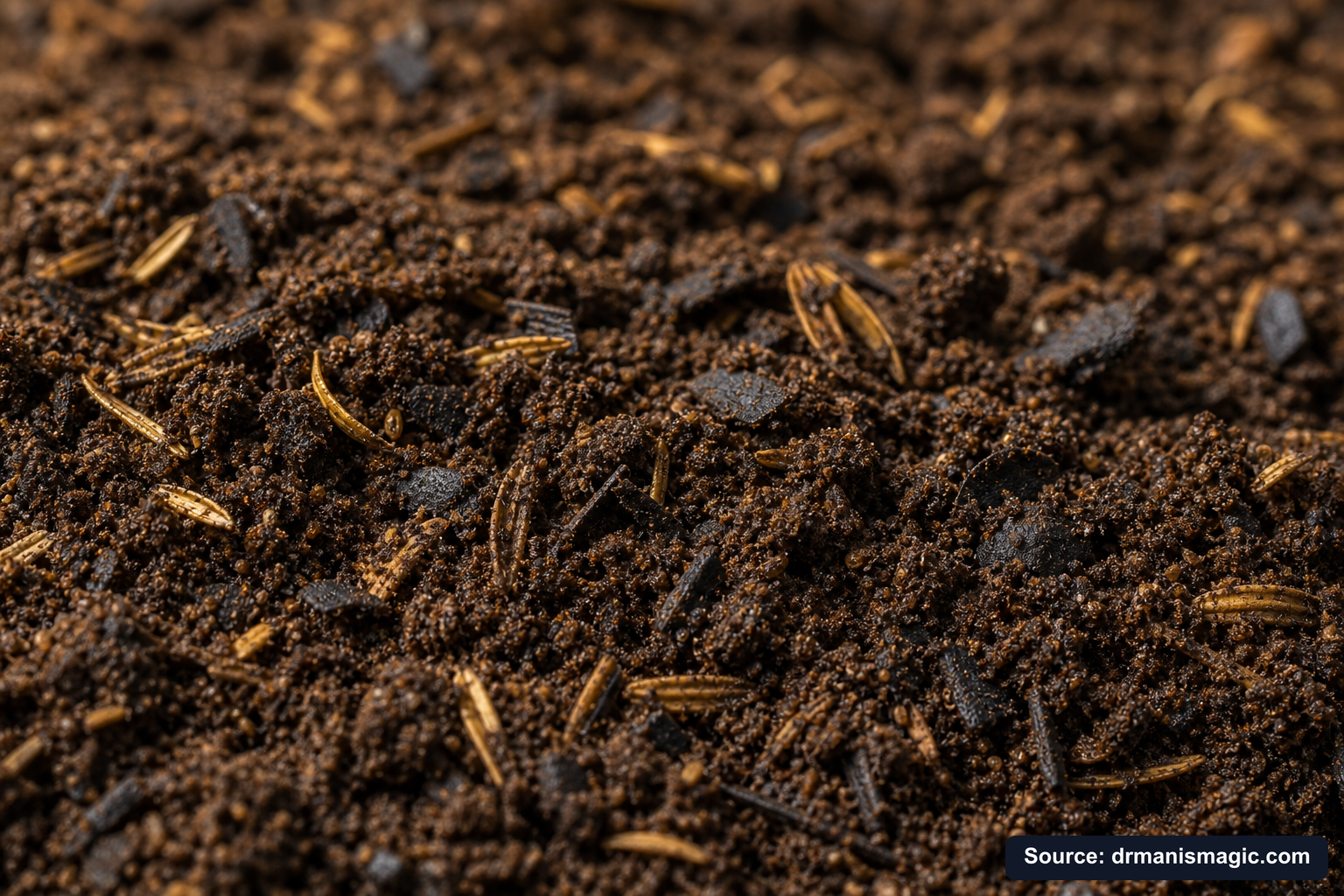
What Exactly Are Rice Hulls and Why Does Silica Matter?
Quick Answer: Rice hulls are the hard outer shells removed when rice is milled. They are naturally high in silica — about 20% by weight — which gives them unusual durability for a plant-based material. That silica content is why they resist decomposition longer than bark, coir, or peat, and why they behave more like a mineral in a potting mix than an organic one.
When a grain of rice grows on the plant, it builds a hard protective shell around itself. To do that, the plant pulls silicon from the soil water through its roots. It deposits that silicon as amorphous silica — a glassy, non-crystalline form — in the hull tissue. This is the plant's armor.
When the mill strips that hull away, what's left is a lightweight, hollow shell that is roughly 20% silica by weight, according to research published by the USDA Agricultural Research Service. That sounds like a small number. But compare it to peat moss, perlite, coir, or vermiculite. None of them come close to contributing measurable silicon to the growing environment. Rice hulls do.
Now here is where it gets interesting. Silica is inorganic. It does not decompose the way carbon-based organic matter does. Wood rots. Bark breaks down. Peat collapses. But silica? It just sits there. Stable. Structural. This is why rice hulls last longer in a pot than almost any other plant-derived amendment you can buy.
Think of it this way. Most amendments you add to a potting mix are like building a house out of cardboard. It works for a while. But one wet season and the whole thing sags. Rice hulls are closer to building with lightweight brick. Not as permanent as pure mineral aggregate like pumice or lava rock, but dramatically more durable than shredded bark or sawdust.
How Do Rice Hulls Actually Improve Root-Zone Oxygen?
Quick Answer: Rice hulls create macropores — large air spaces — in a potting mix that allow oxygen to flow to roots after irrigation. Oregon State University nursery research shows that air-filled porosity above about 30% significantly reduces root rot risk. Rice hulls, like perlite, push that number upward by preventing fine particles from packing together tightly.
Roots breathe. That is not a metaphor. Plant roots require oxygen from the soil atmosphere to survive, grow, and absorb nutrients. When soil pore space collapses — when the mix compacts — oxygen cannot reach the root zone. The roots suffocate. Then they rot.
Oregon State University extension research on nursery container media has linked air-filled porosity directly to root rot suppression. Specifically, air-filled porosity above roughly 30% reduces the conditions that allow pathogens like Phytophthora to thrive. Below that threshold, roots become vulnerable. And most pine-bark potting mixes, even fresh out of the bag, start declining within months as the organic material breaks down and pore spaces close up.
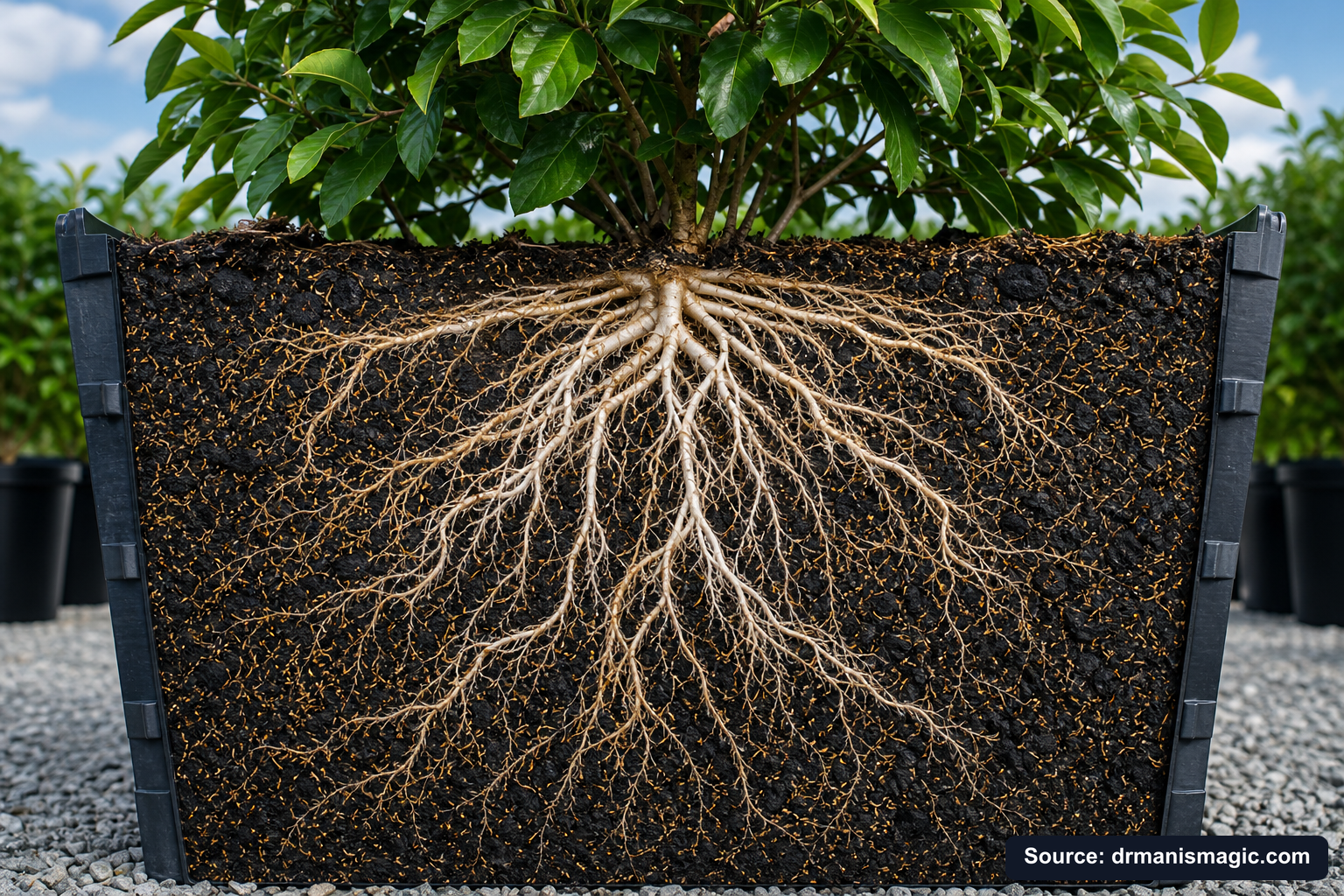
Rice hulls fix this by acting as physical spacers. Each hollow hull creates a small air pocket. Thousands of those pockets together form a network of macropores — big enough for oxygen to move through, big enough for excess water to drain out, but small enough that the mix still holds some moisture for the roots to drink.
The University of Arkansas greenhouse substrate research confirms what growers at our US Citrus Nursery in South Texas have seen firsthand after growing and testing over 250,000 trees. Particle size, pore structure, and container height all determine how much oxygen stays available after you water. It is not about the nutrients in the mix. It is about the architecture of the mix itself.
Here is the concept that most bag-of-potting-mix instructions will never explain to you. After you water a container, gravity pulls the free water down and out through the drainage holes. But some water stays trapped by surface tension in the small pores near the bottom of the pot. This is called the perched water table. The taller the container, the less of it is affected by the perched water. The coarser and more open the mix, the less water gets trapped. Rice hulls push your mix toward coarser, more open, better-draining territory — exactly where roots want to live.
Are Rice Hulls the Same as Perlite? What Is the Real Difference?
Quick Answer: Rice hulls and perlite both create air space in a potting mix, but they are fundamentally different materials. Perlite is a volcanic mineral that does not decompose. Rice hulls are plant-based, contain silica, and slowly break down over months to years. Rice hulls also release trace silicon into the root zone. Perlite does not.
People love to call rice hulls "organic perlite." It is catchy. But it is also a little misleading, and understanding the difference will make you a smarter grower.
| Property | Rice Hulls (Parboiled) | Perlite | Pumice | Pine Bark / Potting Mix |
|---|---|---|---|---|
| Origin | Agricultural byproduct (plant-based) | Volcanic mineral | Volcanic mineral | Timber industry waste (plant-based) |
| Silica Content | ~20% silica | ~70% silicon dioxide | ~60-75% silicon dioxide | Negligible |
| Decomposition | Slow (especially parboiled) | None | None | Fast (6-18 months in containers) |
| Aeration Benefit | High (macropore creation) | High (macropore creation) | Very High (micropores + macropores) | Initially moderate, then poor |
| Silicon Release to Plants | Yes — measurable slow release | No | Trace | No |
| Renewability | Excellent (agricultural byproduct) | Mined, finite | Mined, finite | Timber-dependent |
| Weight | Very light | Very light | Moderate | Light when dry, heavy when wet |
| Best Use Case | Short- to medium-cycle mixes, seed starting, annuals, young trees | All container types | Long-term perennial containers, bonsai | Short-cycle nursery production only |
| Long-Term Container Performance | Moderate (degrades over 1-3 years) | Good (does not degrade) | Excellent (does not degrade) | Poor (collapses within months) |
The biggest practical difference is this. Perlite will still be perlite in five years. Rice hulls will not. They slowly break down, especially in warm, moist conditions. That is not a flaw — it is just a fact you need to plan around. For an annual vegetable garden or a seed-starting flat, decomposition timeline barely matters. For a citrus tree or a fig or a Japanese maple you plan to keep in a container for a decade? You need to understand what happens when the hulls eventually break down.
The USDA ARS research on silicon release found that rice hulls released measurably more silicon into water than peat, perlite, vermiculite, or coir — though far less than wollastonite, a fast-releasing mineral silicon source. That slow silicon release is a genuine bonus. Silicon strengthens plant cell walls, can improve drought tolerance, and may improve resistance to some fungal diseases. It is not a dramatic fertilizer effect. But it is a real one. And it is something perlite simply cannot offer.
See also: The Hidden Reason Synthetic Fertilizers Cause Root Rot
What Happens When Rice Hulls Decompose in a Container?
Quick Answer: As rice hulls break down, the macropores they created begin to close. The mix compacts, oxygen availability drops, and root rot risk climbs. This process is slow with parboiled hulls — often 1 to 3 years — but it is inevitable. Long-term container plants need a mineral aggregate partner to maintain structure after hulls break down.
Here is the conversation nobody is having online. Everyone talks about how great rice hulls are for drainage. Very few people talk about what happens two years later.
Every carbon-based material in your container is on a countdown clock. The microbes in your soil — the good ones, the ones you want — eat organic matter. That is their job. They break it down, release nutrients, and cycle it back into the system. Beautiful process. Except when what they are eating is the structural skeleton of your potting mix.
When rice hulls decompose, they lose their hollow, rigid shape. They flatten. They compact. The air pockets they created disappear. Suddenly the mix that used to drain freely in seconds starts holding water for hours. The roots that used to breathe easily start gasping. This is the slow death that catches most container gardeners off guard — because the plant often looks fine right up until it does not.
Raw rice hulls decompose faster than parboiled rice hulls. Parboiling — the process of partially cooking the rice before milling — changes the starch chemistry inside the hull. It makes the hull more resistant to microbial breakdown. If you are buying rice hulls for horticulture, look for parboiled. They will outlast raw hulls by a significant margin in a container environment.
But even parboiled hulls are still organic. Still carbon-based. Still mortal, from a structural standpoint.
This is why, at Dr. Mani's Magic, we built our Super Soil around a mineral-based foundation — steam-sterilized sandy loam from the Rio Grande Valley — with rice hulls as one of the aeration contributors alongside coco coir and biochar. The mineral base does not decompose. It does not steal oxygen. It holds the structure permanently while the organic components do their shorter-term work.
We have tested this on over 250,000 citrus trees at our South Texas nursery. Trees that sit in all-organic potting mix start declining within a single season. Trees in mineral-anchored mixes keep growing year after year. The difference is not subtle. It is dramatic.
Does Silicon From Rice Hulls Actually Help Plants Grow?
Quick Answer: Yes, but modestly. Rice hulls release measurable plant-available silicon into the root zone over time — more than peat, perlite, vermiculite, or coir. Silicon strengthens cell walls, may improve drought and pest resistance, and supports grass and grain crops especially. The effect is real but slow. Rice hulls are not a silicon fertilizer — they are a structural amendment that provides silicon as a bonus.
Silicon is not classified as an essential plant nutrient the way nitrogen or phosphorus are. But it is classified as a beneficial element for many plants — and for some, like grasses, rice, sugarcane, and wheat, it is nearly essential. University of Florida IFAS extension research has documented silicon's role in strengthening plant cell walls, reducing lodging in grain crops, and improving tolerance to drought and some fungal pathogens.
Now, most gardeners are not growing wheat in their containers. But the principle matters for any plant under stress. Stronger cell walls mean better resistance to physical damage, insect feeding, and fungal penetration. A plant with adequate silicon is a tougher plant. And tougher plants are the goal.
The USDA ARS silicon research showed that rice hulls, when placed in water, released silicon at measurable rates — far exceeding what peat, perlite, vermiculite, and coir contributed. This means that in a living root zone, over time, rice hulls slowly donate silicon to the soil water where roots can absorb it. It is a slow drip, not a flood. But it is more than almost any other common potting amendment delivers.
Rice hull ash tells a different story. When rice hulls are burned — as they often are in industrial settings — the organic matter burns away and what remains is up to 90% amorphous silica. This ash is a faster-acting silicon source. But it is also alkaline, dusty, and not the same thing as whole or parboiled rice hulls. Do not confuse the two. Whole hulls in your potting mix provide structural aeration first and slow silicon release second. Rice hull ash is a different product with different handling requirements and a different use case.
You Never Had a Brown Thumb.
You were handed the wrong tools. This free guide hands you the right ones.
You watered it. You fed it. It died anyway.
It was never you. It was the dirt, the salt food, and the bad advice.
This guide shows you what really went wrong, and how to fix it for good.
- Why your plants really died, and why it was never your fault
- The salt hiding in your plant food that quietly burns the roots
- The hidden killer in almost every bag of store soil
- The tiny helpers that grow a whole forest for free
- The rescue trick that brings a half dead plant back to life

Rice Hulls vs. Other Aeration Amendments: Which One Is Right for Your Container?
Quick Answer: The right aeration amendment depends on how long your plant will stay in the container. Rice hulls are excellent for seed starting, annuals, houseplants, and young trees in short to medium cycles. For long-term perennial containers — citrus, bonsai, olives, figs, Japanese maples — pair rice hulls with pumice, lava rock, or mineral-based soil to maintain structure as hulls gradually break down.
Let's cut through the noise with a simple framework. Container life span is the single most important factor when choosing your aeration amendment.
| Plant Type / Use Case | Container Lifespan | Rice Hulls Alone? | Best Strategy |
|---|---|---|---|
| Seed starting trays | 4-8 weeks | Yes, excellent | Rice hulls + coir or peat |
| Annual vegetables | 1 season | Yes, works well | Rice hulls + compost-based mix |
| Houseplants | 1-3 years between repots | Partial — watch for compaction | Rice hulls + mineral aggregate (pumice or perlite) |
| Orchids | 1-2 years | Yes, as perlite substitute | Rice hulls + bark + perlite |
| Young citrus trees (nursery to patio) | 1-2 years before repot | Yes, with mineral base | Mineral soil + rice hulls + coir |
| Long-term patio citrus | 5-10+ years | No — not alone | Mineral-based soil foundation + rice hulls + pumice or lava rock |
| Bonsai / woody perennials | 5-15+ years | No — not alone | Akadama / pumice / lava rock dominant; rice hulls minor addition |
| Raised garden beds | Ongoing, topped up annually | Yes, excellent top dressing | Rice hulls as mulch/top dressing and mixed into upper layer |
Notice a pattern? The longer the plant lives in the container, the more you need a mineral foundation underneath the rice hulls. This is not a knock against rice hulls. It is an acknowledgment of what they are — a brilliant, renewable, dual-purpose amendment that excels in short to medium cycles and contributes meaningfully in long-term mixes when paired with something that does not decompose.
Bonsai masters figured this out centuries ago. Traditional Japanese bonsai substrate uses akadama clay, pumice, and lava rock — all mineral, all inorganic, all permanent. These growers need their structure to last decades. They cannot have their mix collapse in year two. The same principle applies to anyone growing a citrus tree, an olive, a fig, or a Japanese maple in a container for the long haul.
This is also why the ancient Romans grew fruit trees in sand-heavy, mineral-rich soils, not decomposing organic matter. History kept telling us the answer. We just stopped listening for a few decades when pine bark became cheap and convenient.
How Do You Use Rice Hulls in a Potting Mix? Practical Ratios and Methods
Quick Answer: For most containers, rice hulls work well at 10% to 25% of total mix volume. In seed starting, you can go as high as 40% for maximum drainage. For long-term perennial containers, keep rice hulls at 10-15% and anchor the mix with mineral aggregate. Always choose parboiled rice hulls over raw for longer structural life.
Using rice hulls is simple. But the ratios matter. Too little and you get no meaningful aeration benefit. Too much and the mix can become too light and drain too fast, leaving roots dry between waterings.
Here is a straightforward guide for the most common situations.
Seed Starting (maximum drainage, short cycle):
30-40% parboiled rice hulls + 40-50% coir + 10-20% worm castings or compost. Light, fluffy, fast-draining. Roots establish quickly. Transplant before significant decomposition occurs.
Annual Vegetables and Flowers:
15-25% parboiled rice hulls + 50-60% quality compost or coir + 15-25% perlite or mineral aggregate. This mix will hold one full season beautifully. Refresh each year.
Houseplants:
15-20% parboiled rice hulls + 30% coir + 30% perlite or pumice + 20% quality compost. Repot every 1-2 years as hulls begin to break down.
Citrus and Tropical Trees in Containers:
The foundation matters most here. Start with a mineral-based soil as your base. Add 10-15% parboiled rice hulls for extra macropore structure. Add coir for moisture retention. This is the philosophy behind the Super Soil blend we engineered at US Citrus Nursery after testing on over 250,000 trees. The mineral base does the permanent structural work. The rice hulls and coir supplement it.
Rice Hulls as a Top Dressing:
Spread a 1-2 inch layer of rice hulls on the surface of your containers or raised beds. They slow moisture evaporation, reduce weed germination, and slowly break down to add organic matter to the top layer. This is one of the easiest and most underused applications.
Why Do Long-Term Container Plants Fail — and How Do Rice Hulls Fit Into the Solution?
Quick Answer: Long-term container plants fail because their growing media collapses. Organic amendments decompose, pore spaces close, oxygen drops, roots suffocate, and rot sets in. Rice hulls slow this process compared to pine bark or peat, but they are not immune. The real solution is a mineral-anchored mix where the structure does not depend entirely on organic matter staying intact.
Let's follow the timeline of what happens to a plant in all-organic potting mix. Month one: the mix is fluffy, drains well, roots are happy. Month three: the pine bark starts to break down. The mix settles. Month six: the surfactants that helped the bark hold moisture have washed out. The mix starts to repel water when it dries. Month twelve: the whole structure has compacted. Water pools at the surface. Roots are in a near-anaerobic environment. The plant starts looking stressed. You water more. Things get worse. You buy more potting mix and start over.
Sound familiar? This is not bad luck. This is the predictable, inevitable result of building your root zone out of decomposing organic matter. Big box stores love this cycle. They profit every time you buy a new bag. They do not profit when your soil works permanently.
Rice hulls break this cycle — partially. Because they are silica-rich, they resist decomposition far longer than bark or peat. They maintain their structural contribution for 1 to 3 years in most container environments. That is much better than pine bark, which starts losing structural integrity in months.
But the complete solution — the one that works for the life of a long-lived tree — requires a mineral foundation that does not decompose at all. Sandy loam. Pumice. Lava rock. Materials that were never organic to begin with. These are the true permanent structure providers. Rice hulls are an excellent partner for them. They are not a replacement for them in multi-year containers.
This is Pillar One of the Three Plant Pillars framework that Dr. Mani Skaria developed after four decades of plant pathology research and nursery trials. Mineral foundation first. Not organic fluff. Mineral structure that lasts as long as the plant does.
What Is the Connection Between Rice Hulls, Silica, and the Three Plant Pillars?
Quick Answer: Rice hulls connect directly to Pillar One — the mineral foundation. Their silica content gives them mineral-like durability in an organic world. They create the oxygen-rich pore structure that roots need. Combined with live microbes (Pillar Two) and organic fertilizer (Pillar Three), they form part of a complete root-zone environment where plants thrive naturally and consistently.
Dr. Mani Skaria did not discover rice hulls by accident. He discovered them through decades of watching what worked and what did not across hundreds of thousands of container trees in South Texas. He noticed that the trees doing best were always the ones with the most oxygen in their root zones. And the mixes with the most oxygen were always the ones with the most structural stability — the least decomposition, the most open pore space.
Rice hulls earned their place in the Super Soil blend because they are uniquely positioned between the organic and mineral worlds. They come from a plant. But they behave like a mineral. They create macropores that deliver oxygen to roots. They resist decomposition far longer than bark or peat. And they slowly donate silicon back to the root zone — a trace mineral benefit that most amendments cannot match.
But here is the critical thing to understand. Rice hulls alone do not make a complete growing system. They are one piece of Pillar One — the mineral foundation piece. The root zone also needs living microbes (Pillar Two) to protect roots, unlock nutrients, and build soil health. And it needs organic fertilizer with biostimulants (Pillar Three) to feed the plant in a gentle, non-burning, salt-free form that works with the microbes instead of killing them.
When all three pillars are in place — structural soil, living biology, and clean nutrition — plants do not just survive. They thrive in a way that startles people who have only ever grown in conventional potting mix. The roots are white and healthy. The growth is consistent. The plant builds real resilience instead of just responding to chemical stimulation that burns out after a season.
See also: Why Most Fertilizers Are Actually Salt in Disguise
You can get money back. You cannot get time back. Every season you spend growing in collapsing potting mix is a season of growth you will never recover. And for people who dream of seeing real fruit hanging from a tree they planted with their own hands — in their lifetime — that time matters more than most people realize. We have heard this from thousands of growers. It is the most common thing people tell us. Do not let bad soil steal those seasons.
A Simple Recovery Checklist: How to Rescue a Container Plant Suffering From Soil Collapse
If you suspect your plant's potting mix has decomposed and is starving the roots of oxygen, here is a step-by-step recovery plan.
- Check the mix, not just the plant. Push a finger 2-3 inches into the mix. Does it feel dense, compacted, or slimy? Does water pool at the surface instead of draining quickly? These are signs of structural collapse.
- Gently unpot and inspect the roots. Healthy roots are white or light tan and firm. Brown, slimy, or mushy roots signal oxygen deprivation and possible root rot. Trim away any visibly rotten roots with clean scissors.
- Discard the old decomposed mix. Do not reuse it. Its structural life is over. Starting fresh is not wasteful — it is necessary.
- Repot into a mineral-anchored mix. Choose a mix with a non-decomposing mineral base. Add parboiled rice hulls at 15-20% for macropore aeration. Make sure the new mix drains freely — water should flow out the drainage holes within seconds of watering.
- Inoculate with live microbes. After repotting, drench the root zone with a live microbial inoculant. Beneficial bacteria and mycorrhizal fungi will help rebuild root health and protect against the pathogens that attacked the weakened roots. Learn more at Plant Super Boost.
- Feed gently with organic fertilizer. Do not hit a stressed plant with synthetic salt fertilizer. Start with a slow-release organic option that works with the microbes instead of burning them out. Salt kills microbes — and right now, your plant needs every microbe it can get.
- Give it four to six weeks. Recovery takes time. New white root growth is the sign you are looking for. Once you see it, the plant is on its way back. Be patient. The right foundation does its work quietly and steadily.
The Bigger Picture: Why Renewable Silica Sources Like Rice Hulls Matter
Quick Answer: Perlite and pumice are mined from finite geological deposits. Rice hulls are produced in enormous quantities every year as a byproduct of food production. Choosing rice hulls where appropriate reduces dependence on mined materials, supports agricultural waste utilization, and delivers genuine horticultural performance — not just a feel-good sustainability story.
Over 700 million tons of rice are produced globally each year. The hulls make up about 20% of that weight. That is roughly 140 million tons of rice hulls generated annually — most of it burned or landfilled. From a resource perspective, parboiled rice hulls for horticulture are one of the most elegant examples of turning an agricultural waste stream into something genuinely useful.
Perlite, by contrast, is a volcanic glass that must be mined, then expanded at extremely high temperatures — a process that consumes significant energy. Pumice is mined from volcanic deposits. Both are finite geological resources. They are excellent materials. But they are not renewable the way a grain of rice is renewable.
This matters to growers who care about where their inputs come from. It matters to growers in areas where perlite is expensive or hard to source. And it matters as an example of the kind of thinking that underlies genuinely sustainable horticulture — using what nature already produces in abundance rather than extracting from the earth indefinitely.
At Dr. Mani's Magic, made-in-USA sourcing is not a marketing line. It is a practical commitment. The rice hulls in our Super Soil blend are sourced domestically. The sandy loam base comes from the Rio Grande Valley. When supply chains get disrupted by tariffs, international politics, or shipping bottlenecks, our growers do not feel it the way importers do. That stability matters — especially when your fruit trees depend on consistent inputs year after year.
The Warm Truth About What Rice Hulls Can and Cannot Do
Rice hulls are remarkable. They are not magic by themselves. They are one excellent piece of a complete root-zone system.
They create oxygen-delivering pore space. They resist decomposition longer than almost any other plant-based amendment. They slowly release silicon into the root zone. They are renewable, lightweight, and domestically produced. They work beautifully in seed starting, annual vegetables, houseplants, and as a top dressing on raised beds and containers.
And they are one of the components that earned a place in the Super Soil blend we formulated after decades of nursery trials — alongside mineral-based sandy loam that does not decompose, coir for moisture retention, and biochar for microbial habitat.
But if you are growing a citrus tree, a fig, an olive, or any long-lived woody plant in a container, do not build your root zone on rice hulls alone. Pair them with a mineral foundation that will still be doing its job five years from now. Give those roots the oxygen they need not just this season, but every season for the life of the tree.
If you want to explore the complete soil-first system we developed and tested on over 250,000 trees — the system that combines mineral foundation, live microbes, and organic nutrition into one coherent framework — the Free Plant Care Field Guide is the best place to start. It is the same guide we give every grower who comes to us. No jargon. No guesswork. Just the foundation your plants have been waiting for.
Frequently Asked Questions
Rice hulls are one of the most misunderstood soil amendments out there. Most gardeners have never even heard of them. But once you understand what they do inside your pots and garden beds, you will never look at your potting mix the same way again. These questions come straight from real growers who wanted the truth.
What are the disadvantages of rice hulls in gardening?
The biggest drawback is simple: rice hulls do not feed your plants. They are a structural tool, not a fertilizer. If you pile them on too thick as a mulch, they can trap moisture and invite fungal mats on the surface. They also break down slowly, which is actually a good thing for aeration, but means they add very little nutrition over time. That is why Dr. Mani pairs them with live microbes and organic fertilizer from the Three Plant Pillars system. Each piece does its own job.
Are rice hulls better than perlite?
For most container plants, rice hulls hold up surprisingly well against perlite. Both open up pore space so roots can breathe. The big difference is that rice hulls are a natural byproduct of food production, while perlite is mined and processed using heat. Rice hulls are also lighter and break down over time, returning silica slowly to the soil. For long-lived trees and perennials in containers, Dr. Mani recommends pairing rice hulls with a durable mineral-based soil like Super Soil so your root zone stays open for years, not just one season.
How long do rice hulls last in soil?
Rice hulls are slow to break down. In most climates, they stay structurally useful for a full growing season and often well beyond a year. Their high silica content is the reason. Silica does not rot the way wood, bark, or peat does. That means your pore spaces stay open longer, giving roots more oxygen over time. This is a big deal because oxygen starvation from collapsing potting mix is one of the top silent killers of container plants. We have seen this play out across more than 250,000 trees at US Citrus Nursery.
What is the difference between rice husk and rice hull?
There is no difference. Rice hull and rice husk are two names for the exact same thing. It is the hard outer shell that protects the grain of rice while it grows. After milling, that shell is removed and usually thrown away. It is made of silica, lignin, and cellulose, which is why it is so tough and slow to decompose. Call it a hull or call it a husk, what matters is what it does inside your soil once you put it to work.
What is another name for rice hull?
Rice hull is also called rice husk. You will see both terms used in gardening articles, research papers, and product labels. They mean the same thing. Some manufacturers also use the term parboiled rice hulls, which refers to hulls that have been heat-treated before packaging. Parboiled hulls last even longer in a potting mix before breaking down, making them a smarter choice if you are growing trees or long-term container plants that need stable aeration for more than one season.
Do rice hulls make good compost?
Rice hulls can go into a compost pile, but they break down very slowly because of their silica content. They add carbon to the mix, which helps balance nitrogen-rich green materials. When they do eventually break down, they improve water retention, soil structure, and porosity in the finished compost. That said, Dr. Mani's approach is to use rice hulls directly in your potting mix for aeration rather than waiting for them to compost. You get the structural benefit right away without the long wait.
Are rice hulls safe for plants and people?
Yes. Rice hulls are one of the cleanest soil amendments you can use. They do not carry the chemical load of synthetic fertilizers or the salt damage that burns roots and wipes out beneficial microbes. For your garden, they improve drainage, hold just enough moisture, and slowly release silica that helps build stronger plant cell walls. Dr. Mani chose rice hulls as part of Super Soil because they fit the same standard as every other product in the Dr. Mani's Magic line: all-natural, safe for kids and pets, and made in the USA.
About the Author
Dr. Mani Skaria, PhD
Dr. Mani Skaria, PhD, is a plant pathologist and the scientific founder of Dr. Mani's Magic. He earned his doctorate at Purdue University and spent 48 years studying how plants, soil, and living microbes work together, including his years as Professor Emeritus at Texas A&M and as a member of the USDA NAREEE Advisory Board. He invented micro-budding, a method for growing healthier, stronger trees, and has grown more than 250,000 trees on the family farm in Hargill, Texas - US Citrus Nursery. His life's work takes real lab science and practical experience and turns it into simple, safe, organic plant care anyone can use at home.


