


Why Vetiver Is Used for Soil Stability Worldwide | Dr. Mani's Magic
Why Vetiver Is Used for Soil Stability Worldwide: Living Roots, Sand, and the Science of Holding Ground
Picture a hillside after a heavy rain. The soil is moving. Not sliding all at once, not dramatically — just quietly washing away, grain by grain, every time the sky opens up. A farmer watches it happen. A road crew watches it happen. A homeowner watches their yard edge creep toward the street. And they all ask the same question: what can we do about this?
Now picture that same hillside two years later. A dense hedge of tall, stiff grass stands in a line across the slope. The soil behind it has built up like a little terrace. The runoff slows, then stops. The roots beneath the surface reach down six, eight, ten feet into the ground — deeper than most trees. They grip the soil like ten thousand living cables. The hill is not moving anymore. And nobody poured a single yard of concrete to make it happen.
That grass is vetiver. And the story of why it works — really works, on sandy slopes, on loose degraded soils, on roadsides and riverbanks across six continents — is a story about something most gardeners never think about: what soil structure actually is, where it comes from, and why roots are the most underrated engineering material on the planet.

Plant Super Boost
Key Takeaways
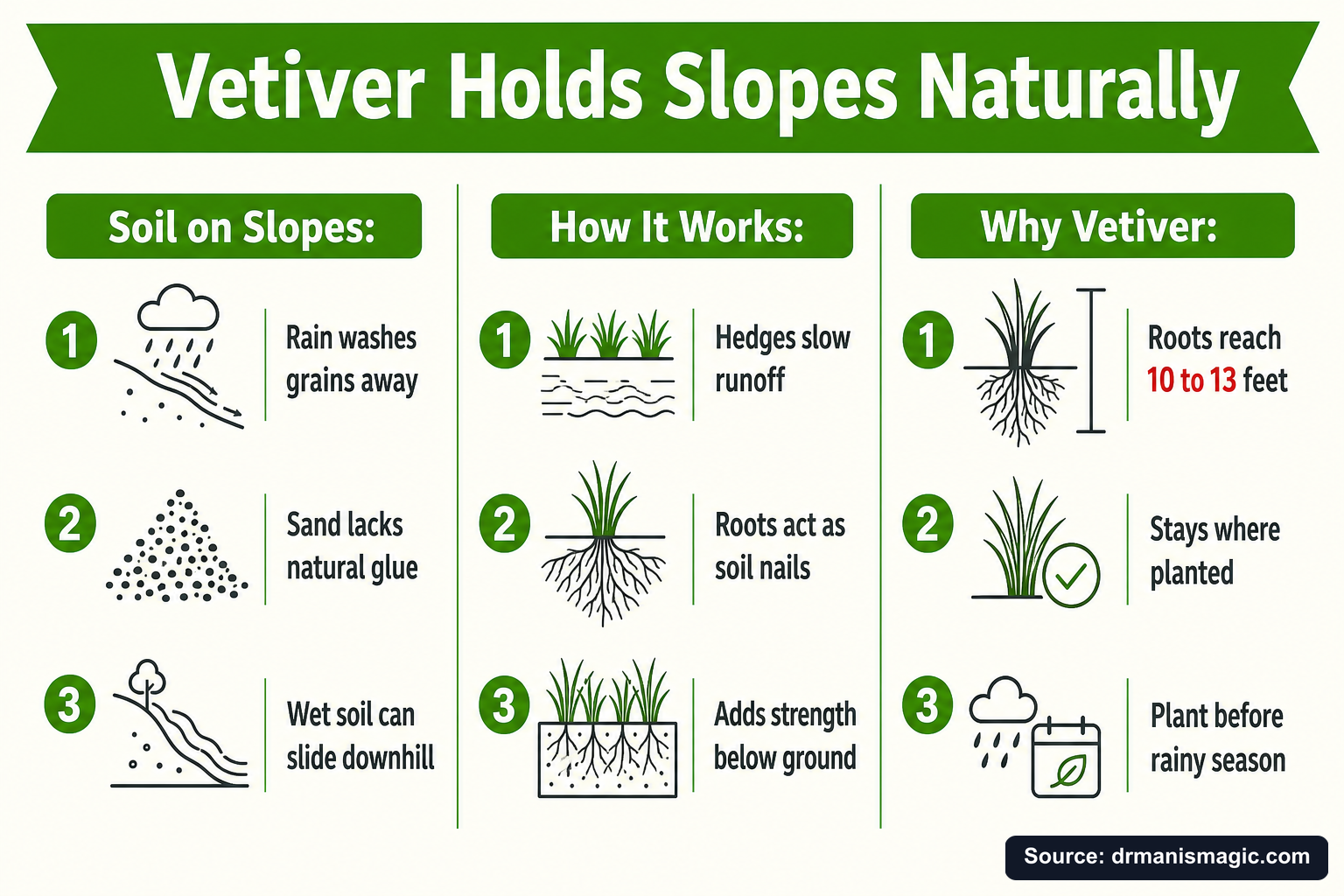
- Vetiver stabilizes soil in two ways at once: stiff above-ground hedgerows slow runoff and trap sediment, while deep fibrous roots physically reinforce the soil mass below the surface.
- Vetiver roots act like living soil nails, increasing the soil's resistance to shearing and sliding — this is called root-reinforced soil mechanics.
- Vetiver is especially powerful on sandy and loose soils because sand drains well but has almost no natural cohesion; vetiver roots add tensile strength where mineral particles alone cannot bind.
- The same physics that explain why vetiver stabilizes slopes also explain why mineral-based soil outperforms decomposing potting mix in containers: structure, oxygen, and drainage matter more than nutrient stuffing.
- Vetiver has a 3,000-year history as khus — used for fragrance, cooling, and water purification — and its extraordinary root system is the source of all of it.
- Establishment timing matters: vetiver hedges need one full growing season before a rainy season to build enough root depth to work.
- The Three Plant Pillars — mineral foundation, live microbes, organic fertilizer — explain the same principles vetiver relies on: structure first, oxygen always, biology as the engine.
What Is Vetiver Grass and Why Does It Behave So Differently From Other Plants?
Quick Answer: Vetiver (Chrysopogon zizanioides) is a perennial tropical grass native to India with an unusually deep, dense, downward-growing root system that can reach 10 to 13 feet in a single season. Unlike most grasses whose roots spread horizontally, vetiver roots drive straight down, making it a powerful natural anchor for unstable soils and slopes.
Most grasses spread sideways. Their roots fan out close to the surface, forming a mat. That mat catches rain and holds topsoil — which is useful. But it is shallow. One hard storm, one deep soil failure, one eroding riverbank, and that surface mat lifts away like a carpet.
Vetiver is built differently. Its roots go down. Straight down. In a single growing season, vetiver roots have been documented reaching depths of 10 to 13 feet in well-drained soils, according to research supported by the National Academies of Sciences in their landmark publication Vetiver Grass: A Thin Green Line Against Erosion. That is not a typo. Ten to thirteen feet of living root, dense and fibrous, woven through the soil like rebar through concrete.
And unlike many invasive grasses, vetiver does not spread by runners or underground rhizomes. It stays where you plant it. That one trait alone makes it a land manager's dream.
Above ground, the plant grows tall and stiff — three to six feet — and when planted in a row along the contour of a slope, it forms a dense hedge that water cannot easily push through. Sediment builds up behind it. Over time, that sediment forms a natural terrace. The slope becomes more stable season after season, not less.
Two mechanisms. One plant. That is the secret.
How Do Vetiver Roots Actually Hold Soil Together? The Science of Root-Reinforced Soil Mechanics
Quick Answer: Vetiver roots act like living nails driven into the soil, increasing what soil scientists call apparent cohesion and shear resistance. When soil tries to slide or erode, the roots resist that movement with tensile strength — measured in studies at 40 to 180 megapascals — dramatically raising the soil's factor of safety against slope failure.
Soil wants to slide. That is not a flaw. It is physics. Every mass of soil on a slope has a natural tendency to move downhill when the forces pulling it down exceed the forces holding it in place. Engineers call the ratio of holding force to sliding force the "factor of safety." A factor of safety below 1.0 means the slope fails. A factor of safety above 1.0 means it holds.
Bare soil on a steep slope often has a factor of safety uncomfortably close to 1.0. Add water — from rain, irrigation, or a rising water table — and pore-water pressure builds up inside the soil. That pressure pushes particles apart and reduces friction between them. The factor of safety drops. The slope moves.
Vetiver roots change the calculation. They cross the potential failure plane — the surface along which a slope would slide — and their tensile strength resists movement. Soil scientists call this root-reinforced cohesion. Studies published in the Brazilian Soil Science Journal and through repository research at Edith Cowan University show that vetiver-rooted soils consistently show higher cohesion values and improved factors of safety compared to bare or sparsely vegetated slopes.
Research from Sylhet Agricultural University and slope-stability analyses published in J-STAGE confirm that even partial vetiver establishment can shift a borderline slope from unstable to stable — without a single piece of hardware.
Think of it like this. Imagine a pile of dry sand. It holds its shape at a certain angle, then collapses. Now imagine driving thousands of thin steel cables down through that sand pile, all the way to the bottom. The sand cannot collapse anymore. The cables resist. That is what vetiver roots do — except the cables are alive, they grow back if cut, and they cost almost nothing to install.
Why Is Vetiver Especially Powerful on Sandy and Loose Soils?
Quick Answer: Sandy soils drain beautifully but have almost no natural cohesion — mineral particles simply do not stick to each other. Vetiver roots supply the tensile reinforcement that sand lacks, binding the soil mass without converting it into a waterlogged, oxygen-poor medium. This makes vetiver ideal for coastal dunes, roadside cuts, and degraded mineral soils where most plants struggle.
Sand is a paradox. It is some of the best-draining material on earth. Water moves through it freely. Oxygen stays in the pore spaces. Roots can breathe. But sand has almost no natural cohesion. Its particles are round, smooth, and slippery. They stack up, and then they fall apart. A slope made of pure sand will erode with the first hard rain because there is nothing binding the particles together except the weight of the particles above them.
Clay soils have the opposite problem. They have strong cohesion — particles stick together — but they drain poorly. Water fills the tiny pores. Oxygen disappears. Roots suffocate. And when clay gets saturated, it becomes plastic and slides in a slow, heavy mass called a mudslide.
Vetiver thrives on both. But its benefit is most dramatic on sandy and loose soils, because its roots supply exactly what sand lacks: tensile binding force. A Thailand study on loose sandy slopes and a Bangladesh sandy-clay slope model both showed that vetiver root reinforcement dramatically improved stability in soils where mineral particles alone could not hold the slope together.
Here is what makes this relevant far beyond slope engineering. The same principle — mineral particles that drain and oxygenate well, held in structure by living biology — is the exact principle behind well-designed container soil. Sand drains. Sand holds oxygen. Sand does not decompose. And when living roots and living microbes work through it, it stays stable and productive for years.
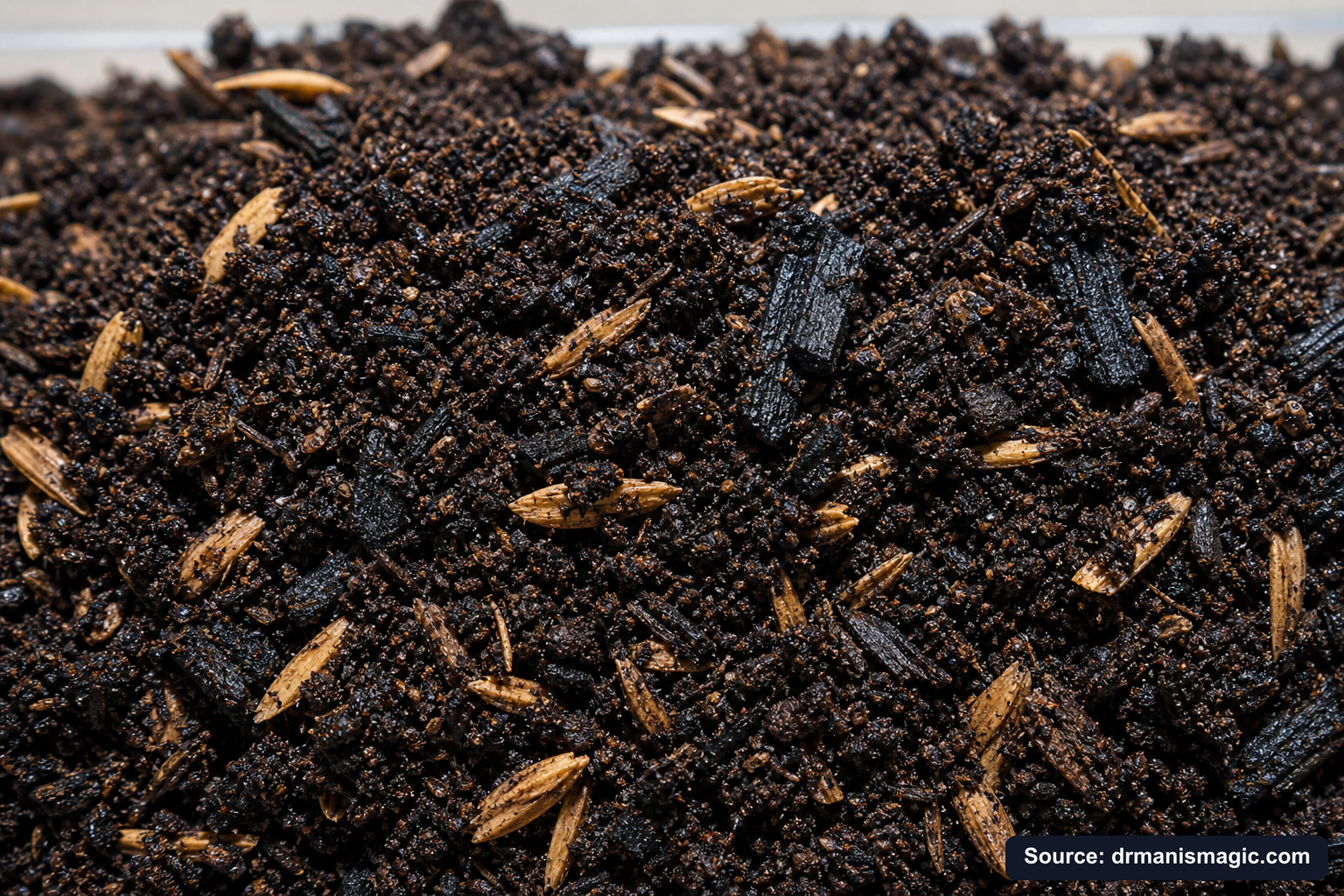
Most potting mix does the opposite. It is made from pine bark sawdust — organic, carbon-based material that decomposes. As it breaks down, it collapses in structure, fills pore spaces, and consumes the very oxygen that roots depend on. You are not planting your tree in soil. You are planting it in other dead trees. And those dead trees are quietly rotting around your roots.
See also: The Hidden Reason Synthetic Fertilizers Cause Root Rot
What Is the Two-Part Erosion Control Mechanism That Makes Vetiver Hedgerows Work?
Quick Answer: Vetiver controls erosion above and below ground simultaneously. Above ground, stiff dense hedgerows planted along slope contours slow water runoff and physically trap sediment. Below ground, roots up to 13 feet deep reinforce the soil mass and prevent deep failure. No other single plant does both jobs at this scale.
Most erosion-control plants work at the surface. They catch raindrops, slow sheet flow, and hold the top inch or two of soil. That is valuable. But surface control alone cannot stop deep erosion, slope failure, or bank collapse — the events that cause real damage to roads, farms, and homes.
Vetiver works at both levels at the same time.
Above ground: Planted in a single row along the contour of a slope — meaning horizontally, following the natural curve of the land — vetiver forms a hedge that water cannot easily push through. Runoff slows as it hits the dense stems. Sediment drops out of the water and settles behind the hedge. Over one or two seasons, a small terrace forms. The slope angle decreases. Erosion slows further. The system is self-improving.
Below ground: While the hedge is catching sediment on the surface, the roots are driving downward through the soil. They cross the zones where slope failure begins. They increase cohesion in the weakest layers. They reduce the buildup of pore-water pressure by pulling water out of the soil through transpiration. The University of California's pest management and plant science resources note that deep-rooted perennial grasses can meaningfully reduce soil moisture in unstable layers, lowering the risk of slope saturation and movement.
Together, these two mechanisms make vetiver something closer to a biological retaining wall than a simple ground cover.
| Method | Surface Control | Deep Root Reinforcement | Cost Over 10 Years | Self-Improving Over Time | Works on Sandy Soil |
|---|---|---|---|---|---|
| Vetiver Hedgerows | Yes — stiff stems trap sediment | Yes — roots to 13 feet | Very low after establishment | Yes — terraces build naturally | Yes — adds cohesion sand lacks |
| Concrete Retaining Wall | No | No — soil behind can still fail | Very high — maintenance and repair | No — degrades over time | Yes — but drains poorly |
| Erosion Control Fabric / Jute Mat | Partially — surface only | No | Moderate — must replace | No — degrades in 1-3 years | Partially |
| Annual Ground Cover Grasses | Partially — shallow mat | No — roots stay near surface | Moderate — replant annually | No | Partially |
| Gabion Baskets (Rock-Filled Wire) | No | No | High — wire corrodes, rocks shift | No | Yes |
Where Did Vetiver Come From? The 3,000-Year Story of Khus
Quick Answer: Vetiver is native to India, where it has been cultivated for over 3,000 years under the name khus. Its aromatic roots were woven into cooling mats, used to scent water, and burned as incense in temples. The same dense, oil-rich root system prized for fragrance is the structure that makes vetiver one of the most effective soil-stabilizing plants on earth.
Long before any soil scientist gave vetiver a technical name, people in India knew something was special about this grass.
They wove its roots into screens and mats called tatties and hung them in doorways. When wind blew through the mats, it carried the cool, earthy scent of vetiver oil — a natural air conditioner before electricity existed. They dropped the roots into clay water vessels to purify and perfume the water inside. They burned them in temples. They pressed the roots to extract an essential oil, called khus oil, that is still one of the most prized base notes in fine perfumery today.
The roots are dense, fibrous, and packed with volatile aromatic compounds. Those compounds — the same ones that make vetiver smell like damp earth and rain — are produced in a root system that happens to be one of the most structurally extraordinary in the plant kingdom.
The British colonial administration in India noticed in the 19th century that slopes near vetiver plantings stayed intact during monsoon floods while bare slopes washed away. The World Bank began promoting vetiver as a low-cost erosion-control technology in the 1980s. By the 1990s, it was being used in more than 100 countries, from Haiti to Australia to South Africa to the Philippines.
The same root that scented royal palaces also held hillsides together through the monsoon. That is not a coincidence. It is the same biology doing two different jobs.
You Never Had a Brown Thumb.
You were handed the wrong tools. This free guide hands you the right ones.
You watered it. You fed it. It died anyway.
It was never you. It was the dirt, the salt food, and the bad advice.
This guide shows you what really went wrong, and how to fix it for good.
- Why your plants really died, and why it was never your fault
- The salt hiding in your plant food that quietly burns the roots
- The hidden killer in almost every bag of store soil
- The tiny helpers that grow a whole forest for free
- The rescue trick that brings a half dead plant back to life

What Soil Types Work Best With Vetiver, and When Does It Struggle?
Quick Answer: Vetiver establishes well in most mineral soils — sandy, clay-loam, rocky, degraded, and low-fertility soils. It struggles in waterlogged or permanently saturated soils where root oxygen is chronically low. It is not suited for dense shade or very cold climates, as it is a tropical grass. Planting timing relative to the rainy season is critical for establishment.
Vetiver is famously tough. It tolerates drought, flood, fire, and poor fertility. North Carolina State University Extension notes that vetiver can survive soil pH from 3.0 to 10.5, making it one of the most pH-tolerant plants ever documented. It tolerates aluminum and manganese toxicity levels that would kill most crops. It grows in soils with almost no organic matter.
But it is not magic. It has limits.
Vetiver is a tropical grass. It grows well in USDA zones 8 through 11. In colder climates, the tops die back in winter. The roots survive mild winters but not sustained deep freezes. In zones below 8, vetiver functions as an annual erosion-control plant rather than a permanent perennial system.
Vetiver also needs oxygen at its roots. In permanently waterlogged soils — swamps, bogs, areas with a water table at the surface — vetiver cannot establish the deep root system that makes it effective. It may survive, but it will not thrive and will not provide the deep reinforcement its reputation is built on.
This is the same principle that governs every root zone, whether on a hillside or in a container on your patio. Roots need oxygen. Always. When the soil is saturated — whether by a high water table on a slope or by decomposing potting mix that has collapsed its own pore structure — roots suffocate. Biology shuts down. The plant weakens from below, invisibly, long before you see it in the leaves above.
Rutgers Cooperative Extension confirms that soil aeration — the movement of oxygen into and carbon dioxide out of the root zone — is one of the most critical and most overlooked factors in plant establishment and long-term health.
How Should You Actually Plant Vetiver for Slope Stabilization? A Practical Field Guide
Quick Answer: Plant vetiver in single rows along the contour of the slope — horizontally, following the land's natural curve — spaced 4 to 6 inches apart within the row. Rows should be placed every 3 to 10 feet vertically down the slope, depending on slope steepness. Plant at the start of the growing season, at least one full season before the expected rainy period, to allow root depth to develop before the first major storm.
The most common mistake with vetiver is treating it like a regular ground cover — scattered randomly across a slope or planted in loose clumps. That approach misses the entire mechanism.
Vetiver works because it forms a continuous, dense hedge across the slope. Water hits the hedge and slows down. If there are gaps, water finds them and channels through, cutting gullies that defeat the whole purpose. Dense planting within the row is not optional — it is the point.
Here is a practical setup guide:
- Identify the contour lines. Walk your slope and mark lines that follow the same elevation across the hill. These are your planting rows. Water flowing downhill will hit these rows at a right angle.
- Determine row spacing. On gentle slopes (less than 10 percent grade), rows can be 8 to 10 feet apart vertically. On steep slopes (over 20 percent), tighten rows to 3 to 5 feet apart.
- Plant slips or divisions, not seed. Vetiver is almost always planted vegetatively — small divisions of an established clump, called slips. Seed germination is unreliable. Source slips from a reputable nursery.
- Space slips 4 to 6 inches apart within each row. This tight spacing ensures the hedge closes up within one growing season.
- Plant at the start of the warm growing season. Vetiver needs warmth to establish. Planting in spring gives roots one full season to reach depth before winter or the next heavy rainy period.
- Water during the first 4 to 6 weeks. Once established, vetiver is extremely drought-tolerant. But the first weeks of root establishment are the vulnerable window. Do not let it dry out completely before roots have set.
- Cut the tops back to 12 inches after planting. This reduces water loss and forces energy into root development. It looks severe. Do it anyway.
What Does Vetiver Teach Us About Soil Structure, Oxygen, and Why Roots Rot in Dense Organic Media?
Quick Answer: Vetiver roots thrive by driving through mineral soil with open pore spaces full of oxygen. The same physics that explain vetiver's success explain why roots rot in dense organic potting mix: decomposing carbon-based media collapses pore structure, fills oxygen channels with decomposition byproducts, and creates the anaerobic conditions where root-killing pathogens thrive.
Here is the insight that most vetiver articles miss entirely — and it connects everything.
Vetiver roots are extraordinary partly because of where they grow. They drive through mineral soil: ground-up rock, silica particles, inorganic material that does not decompose. The pore spaces between those mineral particles stay open. Oxygen diffuses freely through them. Water drains through them. The roots can breathe at six feet down just as well as they can at six inches down.
Now imagine those same roots trying to grow through dense organic potting mix — the kind sold in every big-box store, the kind most container plants are sold in. That mix is pine bark sawdust. Carbon-based. Organic. And it decomposes.
As it decomposes, three things happen. First, the decomposition process consumes oxygen — the same oxygen your roots need. Second, the structure collapses as the particles break down, shrinking pore space and trapping water. Third, the saturated, oxygen-depleted environment becomes a perfect home for the fungal pathogens that cause root rot.
You did not overwater your plant. Your soil decomposed around the roots and suffocated them. That is an important distinction, and it is one that the pine bark sawdust industry has never had much interest in explaining clearly.
After growing and testing over 250,000 trees at the US Citrus Nursery in South Texas, Dr. Mani Skaria arrived at the same conclusion vetiver science confirms: mineral soil structure is not just one option among many. It is the foundation. Everything else — microbes, nutrients, water management — depends on the pore space and oxygen that only a stable, non-decomposing mineral base can reliably provide.
That is the first of the Three Plant Pillars: mineral foundation. Not organic fill. Not sawdust. Mineral structure — the same structure vetiver roots have been exploiting for thousands of years on hillsides across the world.
| Factor | Mineral-Based Soil (Silica/Sandy Loam) | Organic Potting Mix (Pine Bark Sawdust) |
|---|---|---|
| Structure over time | Stable — silica particles do not decompose | Collapses within 6 to 12 months as bark breaks down |
| Oxygen in root zone | Consistently high — pores stay open | Drops as decomposition consumes O2 and pores close |
| Drainage over time | Consistent — mineral particles hold structure | Worsens — compaction increases, waterlogging follows |
| Root rot risk | Low — oxygen-rich environment resists pathogens | High — anaerobic conditions favor fungal disease |
| Microbial environment | Supports beneficial aerobic bacteria and fungi | Favors decomposition-linked anaerobic microbes |
| Need to replace | Permanent — no replacement needed | Every 6 to 12 months for healthy container plants |
| Pine chemistry / terpene exposure | None | High at first — terpenes and resins in fresh bark |
| Hydrophobicity risk | Low — mineral particles rewet easily | High — surfactants wash out, bark repels water when dry |
How Do the Three Plant Pillars Connect to Vetiver's Root Science?
Quick Answer: Vetiver succeeds because it has mineral structure to grow through, open pore space for oxygen, and a living rhizosphere biology around its roots. The Three Plant Pillars — mineral soil, live microbes, organic fertilizer — replicate those exact conditions for any plant in any container or garden bed. The same physics that hold hillsides together will hold your plant's root zone together.
Vetiver did not invent these principles. It just executes them perfectly, which is why it works on six continents and in soils that defeat every other solution.
The Three Plant Pillars — the framework developed and proven through 30-plus years of growing at US Citrus Nursery — are built on the same foundation:
Pillar One: Mineral Foundation. Vetiver roots thrive in mineral soil because it does not decompose, does not steal oxygen, and does not collapse. Super Soil is built from steam-sterilized sandy loam from the Rio Grande Valley — silica-rich, permanently structured, and engineered to keep pore space open for decades. No pine bark. No sawdust. No decomposing organic fill that robs your roots of the oxygen they depend on.
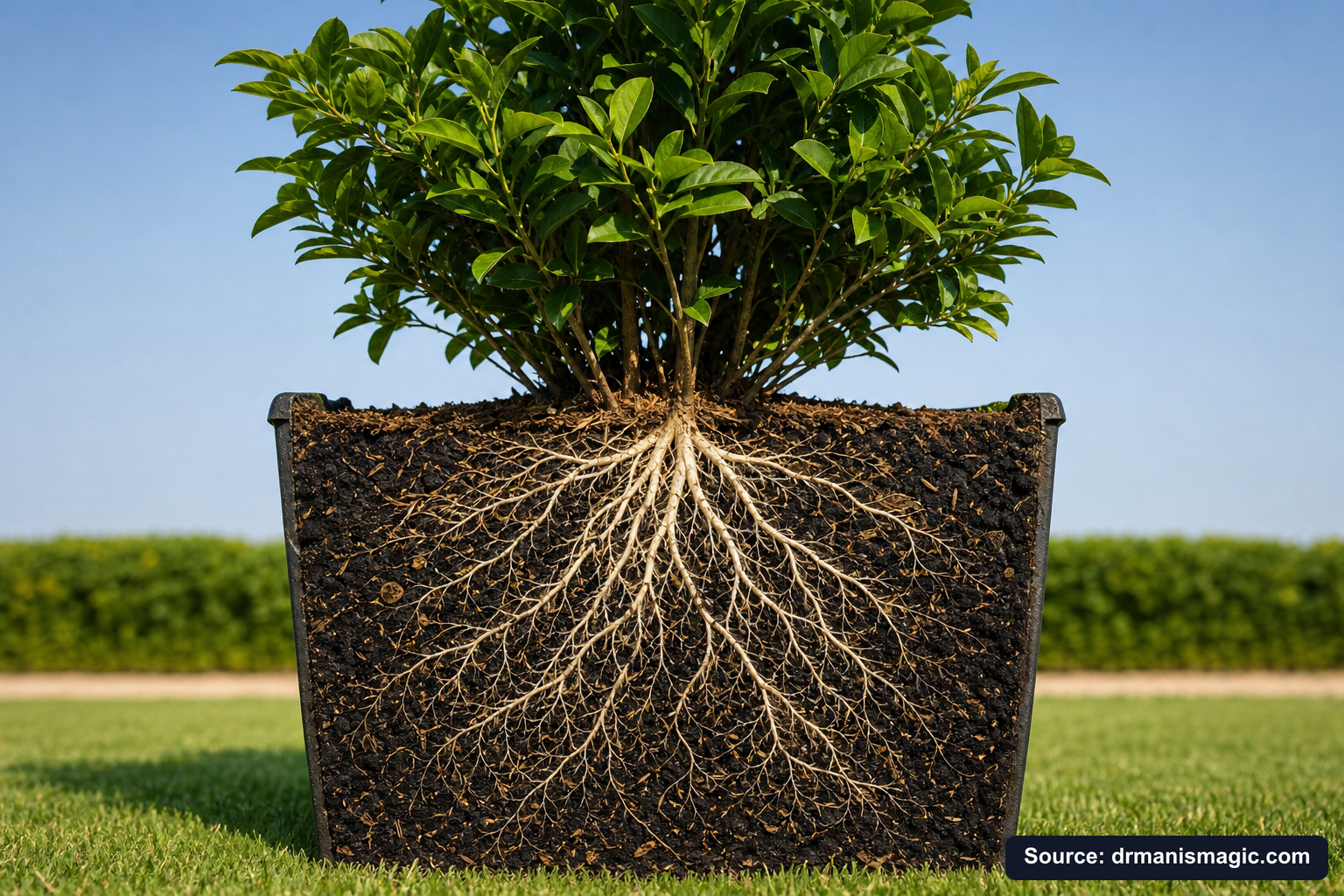
Pillar Two: Microbial Muscle. Around every healthy vetiver root, there is a thriving zone of microbial life — bacteria, fungi, and mycorrhizae that unlock nutrients, protect against pathogens, and build soil structure. This is called the rhizosphere, and it is the most biologically active zone in any healthy plant's world. Plant Super Boost delivers those living organisms — stabilized and alive — directly to your root zone. No dead powder. No rotten smell. Living microbes, ready to work.
Pillar Three: Organic Fertilizer. Vetiver thrives in low-fertility soils because its biology is intact. It does not need salt-based fertilizer bombs to push growth. It needs slow, steady, biologically available nutrition. Salt-based synthetic fertilizers kill the very microbes that make root systems resilient — a cycle that benefits nobody except the companies selling more product when your plant declines. See also: Why Most Fertilizers Are Actually Salt in Disguise
All three pillars together create the conditions vetiver has been exploiting naturally for thousands of years: stable mineral structure, open oxygen channels, and living biology in the root zone. That combination is not a gardening trend. It is how plants evolved to grow.
What Can Any Gardener Take Away From the Vetiver Story?
Quick Answer: The lesson vetiver teaches is that soil structure and root oxygen matter more than surface-level fixes. Whether you are stabilizing a slope or growing a fruit tree in a container, the principle is identical: give roots mineral structure that does not decompose, keep oxygen in the pore spaces, and let living biology do the heavy lifting.
You do not need a hillside to apply what vetiver teaches.
The physics of a slope and the physics of a container pot are the same story at different scales. In both cases, the question is: can roots breathe? Can water drain? Is the soil structure holding, or is it slowly collapsing around the roots?
On a slope, the answer is written in mudslides and eroding banks. In a container, the answer is written in yellowing leaves, stunted growth, and the slow, quiet death that most people blame on bad luck or a "brown thumb."
It is not bad luck. It is physics. And physics does not care about your intentions or the brand name on the bag of potting mix you bought.
Dr. Mani Skaria spent 40 years as a plant pathologist and citrus scientist figuring out what vetiver figured out on its own millions of years ago: the foundation matters most. Get the mineral structure right. Get oxygen to the roots. Get living biology working in the root zone. Everything else — watering, pruning, fertilizing — becomes easier, more forgiving, and more rewarding when the foundation is solid.
We tested this on over 250,000 trees. We watched the ones in decomposing potting mix struggle, stall, and die. We watched the ones in mineral-based soil with live microbes and organic nutrition thrive in ways that still surprise us. We did not guess at this. We earned it, tree by tree, season by season, in the heat of South Texas.
The number one thing people tell us they want — more than anything else — is to see fruit on a tree they planted while they still have the years to enjoy it. Not someday. Soon. And the fastest path to that is the same path vetiver has always taken: deep structure, open oxygen, living roots in living soil.
You can get money back. You cannot get time back. The best time to build the right foundation was ten years ago. The second-best time is right now.
If you want to start building that foundation today, take a look at our Free Plant Care Field Guide — it walks you through the Three Plant Pillars in plain language, step by step, so you can stop guessing and start growing.
Frequently Asked Questions About Vetiver Grass and Soil Stability
Vetiver grass raises a lot of good questions. People want to know if it works, what it costs, and whether it causes any problems. These answers cut through the noise fast. And if you stick around, you will also see how the same soil science that makes vetiver so powerful connects directly to how Dr. Mani's Magic helps every plant you own grow stronger from the ground up.
What are the disadvantages of vetiver grass?
Vetiver hates shade. If you plant it where bigger plants block the sun, it will struggle to get established. In heavy shade, it can die out over time because it cannot compete with shade-loving species. This matters most in the first growing season. Give it full sun during establishment and it will reward you with roots that grip the soil like living rebar for decades to come.
Does vetiver grass attract mosquitoes?
No. Vetiver actually repels mosquitoes. Research shows that vetiver oil and two of its natural compounds, valencene and vetiverol, work as safe, effective mosquito repellents. So instead of attracting pests, this plant pushes them away. That is the opposite of what most people expect. It is another reason vetiver fits perfectly into a natural, chemical-free garden philosophy.
How long does vetiver grass live?
Vetiver is a perennial grass that can live up to 100 years in tropical conditions. Once it is established, it keeps growing season after season without replanting. That kind of long-term staying power is exactly what Dr. Mani's Magic is built around too. Stop replacing. Stop starting over. Build a foundation that lasts, whether that is vetiver on a slope or mineral-based Super Soil in your containers.
Can you eat or drink vetiver?
You cannot eat the leaves because they are too tough and fibrous. But the roots have been used for thousands of years to flavor water, teas, and syrups. Soaking clean vetiver roots in water overnight creates a natural cooling drink used in Ayurvedic tradition. Pregnant women should skip it and check with a doctor first. Everyone else can enjoy a glass or two a day with no worries.
Is vetiver the same as lemongrass?
No. They are cousins in the grass family but very different plants. Vetiver is all about its deep roots, which produce a heavy, earthy, woody scent. Lemongrass is about its leaves and stalks, which smell bright and citrusy. One goes down deep into the soil. The other grows up and out. Different jobs, different smells, different uses. Do not swap them in your garden or your recipes.
Is vetiver grass expensive to buy?
Individual slips can run high depending on the source. But here is the good news. Vetiver divides and propagates easily. Start with a small number of plants, split them over time, and you can fill an entire slope without buying more. Many growers set up a small nursery area just for this purpose. The upfront cost is real, but the long-term value of a plant that lives 100 years and holds your soil together makes it worth every penny.
Why does soil structure matter so much for vetiver and for container plants?
Vetiver works because its roots drive straight down through soil that drains well and stays open. The same principle applies to every plant you own. Roots need oxygen. They need drainage. They need room to move. That is exactly why Dr. Mani's Magic Super Soil uses mineral-based sandy loam instead of decomposing pine bark. Decomposing mixes compact, choke roots, and block oxygen. Mineral soil stays open. Roots breathe. Plants thrive. We proved it across 250,000 citrus trees at US Citrus Nursery, and it works the same way for your houseplants, fruit trees, and garden beds.
About the Author
Ron Skaria, MD
Ron Skaria, MD, is the co-founder of Dr. Mani's Magic and the son of Dr. Mani. He trained as a medical doctor at Baylor College of Medicine, did his residency at UT Health Science Center - San Antonio and fellowship training at Texas Tech University. He now works full time on the family farm at US Citrus and US Citrus Nursery in Hargill, Texas, building Dr. Mani's Magic alongside his dad. He wrote the Brown Thumb Field Guide to put his father's 48 years of plant science into plain words any gardener can use. His belief is simple. You never had a brown thumb. You just never had the right help.


