


Why Silica-Rich Materials Belong in Soil for Healthy Roots | Dr. Mani's Magic
Why Silica-Rich Materials Belong in Soil: The Mineral Skeleton Your Roots Are Desperate For
Picture this. You're standing on your patio on a Saturday morning, coffee in hand, looking at your potted lemon tree. The leaves are yellowing. The soil looks dark and wet even though you haven't watered in five days. You poke your finger into the mix and it feels like a damp sponge that never quite dries out. Something is wrong, but you can't figure out what. You've fed it. You've watered it. You've talked to it. (Don't pretend you haven't.)
Here's what nobody told you. The problem isn't your watering schedule. It isn't the fertilizer. It's the stuff your tree is planted in. That dark, spongy, sweet-smelling mix you bought at the hardware store? It's slowly strangling your roots. It's collapsing. It's decomposing. And every time it does, it's stealing the one thing your roots need more than water, more than nutrients, more than anything else. Oxygen.
What your plant is begging for is something solid. Something permanent. Something that holds its shape month after month, year after year, and never robs the root zone of air. That something is a mineral skeleton built from silica-rich materials. And once you understand why, you'll never look at a bag of potting mix the same way again. This is the article the big-box stores hope you never read.
Key Takeaways
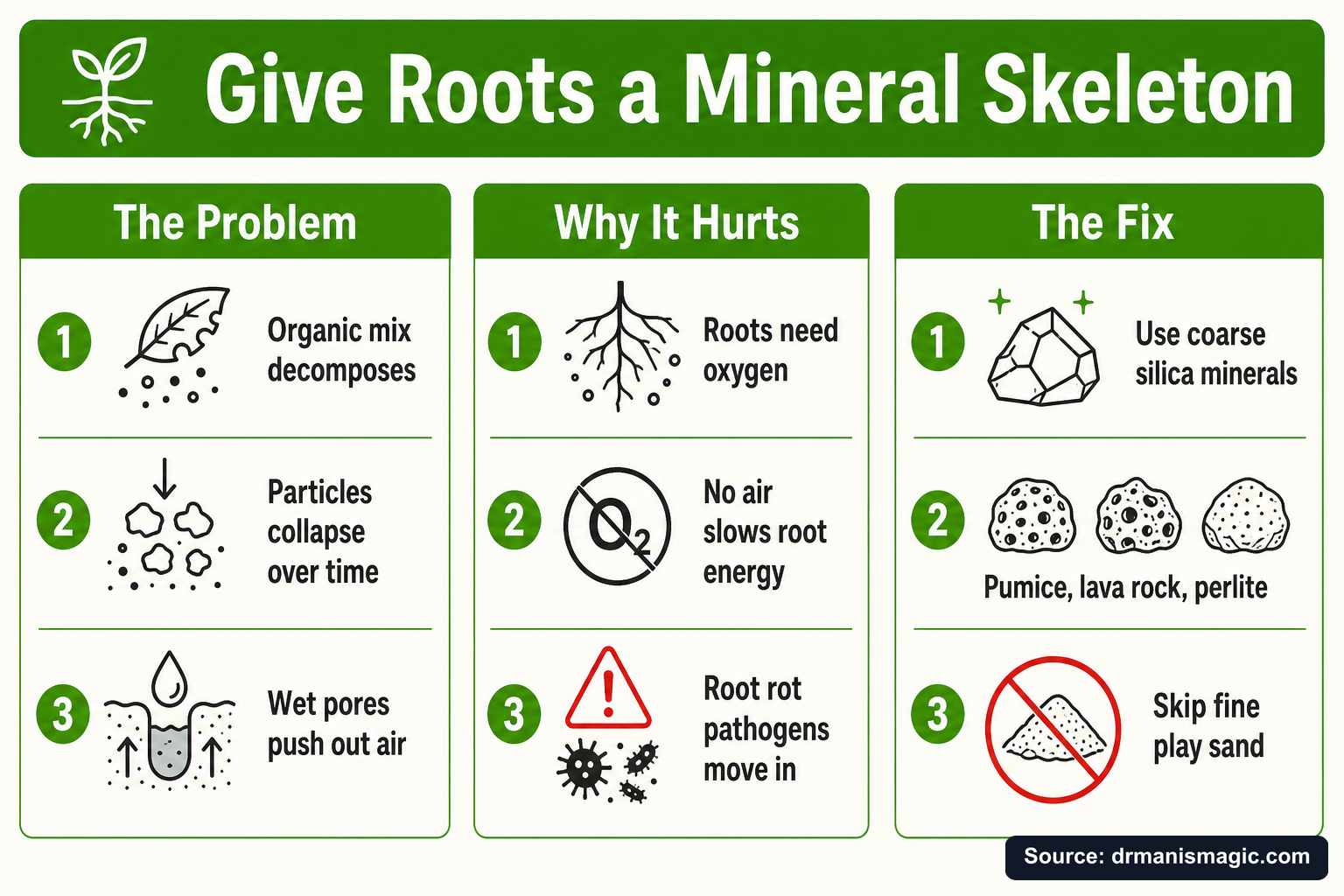
- Silica-rich materials like coarse sand, pumice, lava rock, and perlite belong in soil because they create permanent pore space that holds oxygen around roots.
- Organic potting mix is mostly pine bark sawdust. It decomposes, collapses, and steals oxygen from roots as it breaks down.
- Roots need oxygen to survive. Water-filled pores push air out, slow root respiration, and open the door for root rot pathogens like Phytophthora.
- Not all silica materials are equal. Coarse, chunky particles protect pore space. Fine sand and play sand can actually make drainage worse.
- Mineral-based soil does not decompose, does not collapse, and does not go hydrophobic the way old potting mix does.
- The Three Plant Pillars — mineral soil, live microbes, and organic fertilizer — work together as a system. Mineral soil is the irreplaceable foundation.
- After growing over 250,000 trees at the US Citrus Nursery in South Texas, Dr. Mani Skaria proved that mineral-based, silica-rich soil is the long-term answer for container plants of every kind.
Why Do Roots Need Oxygen If Plants Love Carbon Dioxide?
Quick Answer: Plants absorb carbon dioxide through their leaves for photosynthesis, but their roots are a completely different story. Roots breathe oxygen just like you do. They use it to produce energy for growth, nutrient uptake, and defense against disease. No oxygen in the soil means no healthy roots, period.
This is the single biggest misunderstanding in home gardening. And honestly, it's not your fault. Nobody teaches it.
Above ground, your plant is running a solar panel. Leaves absorb sunlight and carbon dioxide, convert them into sugar, and power the whole plant. Beautiful system. But below the soil line, the roots are running an engine. And engines need oxygen to fire.
Roots burn oxygen to produce ATP, which is the energy molecule that powers everything the root does: absorbing water, pulling in nutrients, building new root tips, and defending against microbial attack. When oxygen is cut off, the engine sputters. Root cells start dying. The plant sends distress signals to the leaves. You see yellow. You see wilt. You see slow growth.
University of Florida IFAS Extension explains it plainly: "Root growth and function require adequate oxygen in the root zone. When soils become waterlogged or compacted, oxygen is depleted and root function declines rapidly." University of Florida IFAS
So the question becomes: what keeps oxygen in the soil? The answer is pore space. Big, open, stable pores that air can flow through and live in. And what creates those pores? Coarse, hard, chunky particles that don't collapse, don't compact, and don't decompose.
That is exactly what silica-rich materials do. They are the architects of oxygen infrastructure in your soil.
What Is a Silica-Rich Material and Why Does It Matter for Soil Structure?
Quick Answer: Silica-rich materials are mineral particles made primarily of silicon dioxide, the same compound that forms quartz, sand, pumice, and volcanic rock. They matter because they are physically hard, chemically stable, and do not decompose. In soil, they act as a permanent skeleton that holds pore space open so roots can breathe.
Silicon dioxide is the most common mineral compound on Earth. It makes up the majority of sand, quartz, granite, lava rock, pumice, and dozens of other naturally occurring materials. It is essentially rock. And rock, as you know, does not rot.
That permanence is the whole point.
When you mix coarse silica-rich particles into soil or a potting blend, they do something remarkable. They hold their shape. They don't compress when you water them. They don't break down when microbes eat through the organic matter around them. They don't turn into mush after six months in a pot. They sit there, solid and stable, like tiny pebbles of infrastructure, holding the walls of the pore channels open so air and water can move freely.
Think of it like the frame of a house. You can stuff insulation and drywall and furniture inside, but the frame is what keeps the walls from collapsing. Silica-rich particles are the frame of your soil. Everything else — organic matter, microbes, nutrients, water — needs that frame to function.
Now here's what almost nobody talks about. Silicon dioxide is not the same thing as plant-available silicon. When people say "add silica to help plants grow," they are usually referring to dissolved silicic acid, a soluble plant nutrient that strengthens cell walls and improves stress resistance. That is a real and separate benefit. But the structural benefit of silica-rich particles in the root zone is a completely different mechanism. It is physical, not chemical. It is about pores, not nutrients.
This article is about the physical benefit. The mineral skeleton. The oxygen infrastructure. That is the reason silica-rich materials belong in soil.
What Is Wrong With Regular Potting Mix and Why Does It Kill Container Plants?
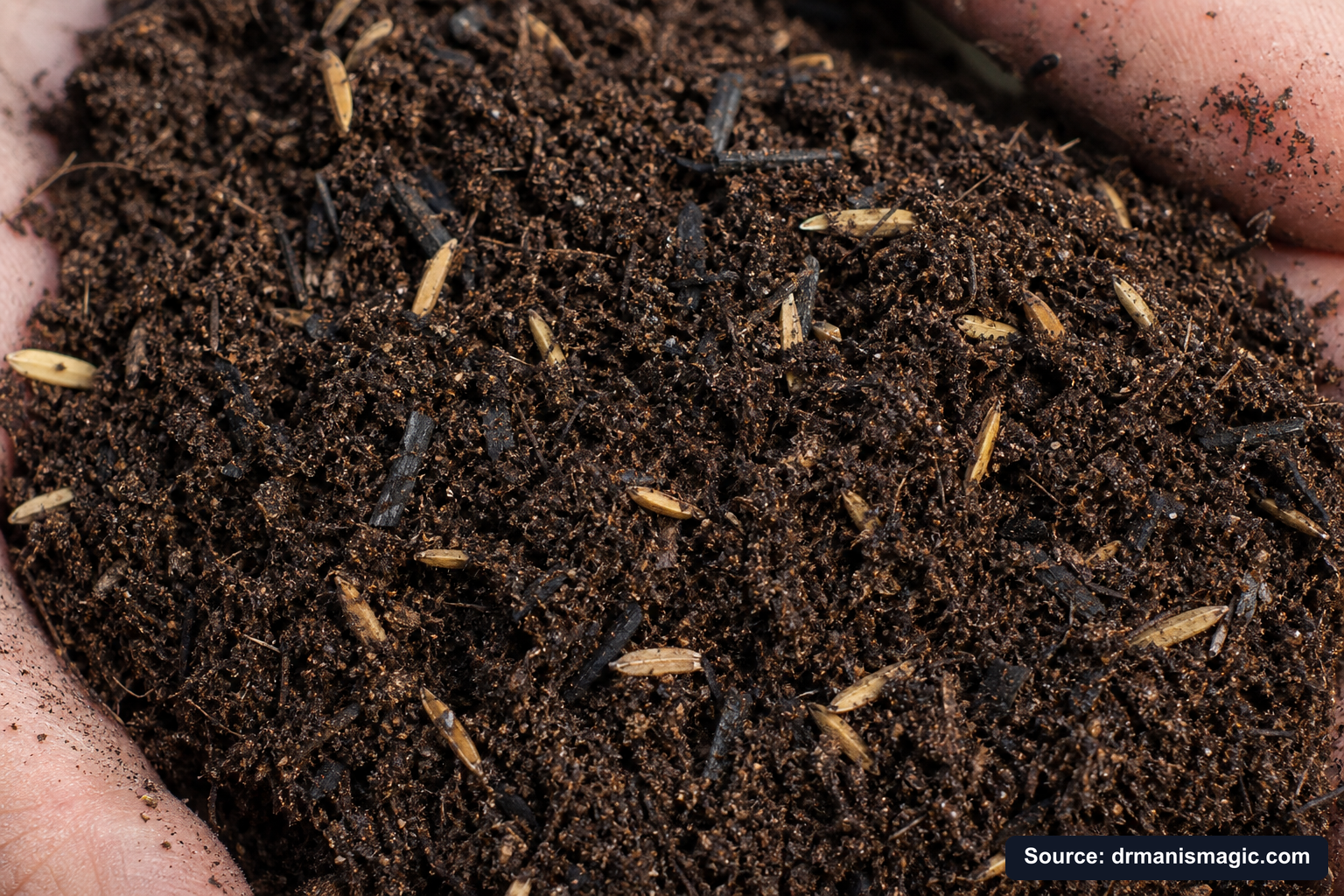
Quick Answer: Regular potting mix is mostly pine bark sawdust, a carbon-based organic material that decomposes over time. As it breaks down, it collapses into smaller and smaller particles, crushing pore space, blocking oxygen, and creating the waterlogged, sour, root-choking conditions that cause root rot. It is not soil. It is a temporary growing medium that begins failing within months.
Here is something that should be on the label of every bag of potting mix sold in America: "Warning. You are planting your tree in other dead trees."
Potting mix is not soil. It never was. It is a marketing name for pine bark sawdust, a waste byproduct from the timber industry. The Southeast United States has enormous pine forests. Sawmills produce mountains of bark and wood waste. Someone figured out that if you grind it up and put it in a bag with a pretty label, gardeners will buy it. And they did. By the billions.
It is lightweight. It is cheap. It is easy to ship. It is great for nurseries and big-box stores. It is terrible for your plant.
Here is why. Pine bark is loaded with chemical compounds called terpenes and terpenoids. You already know some of them. Pine-Sol is named after them. Turpentine is literally distilled from them. These are the compounds that give pine its sharp, medicinal smell. They are powerful enough to strip paint and clean industrial equipment. And they are sitting in the stuff wrapped around your plant's roots right now.
To reduce the harshness of these chemicals, manufacturers pile the sawdust into enormous heaps and let it decompose for months or years. That decomposition process does mellow the chemistry. But it also kicks off something far worse. Decomposing organic matter consumes oxygen. The same oxygen your roots need to survive. And decomposing material gets smaller and finer and more compact with every passing week.
Then there is the water problem. Raw pine bark naturally repels water. It is wood. Wood is hydrophobic. To make potting mix hold moisture, manufacturers add surfactants, which are essentially industrial wetting agents, soap-like chemicals that force the wood particles to absorb water. At first it works. The mix holds moisture and feels great. But surfactants wash out over time. Within six months to a year, the mix starts repelling water again. You water your plant and watch the water run straight down the sides of the pot, never reaching the roots in the center. The mix has gone hydrophobic. You think you are watering. The roots are thirsty.
And it keeps getting worse. As the organic particles decompose further, they get smaller and smaller. Smaller particles fill smaller and smaller pores. Pore space disappears. The mix compacts. Air cannot get in. Water cannot drain out. The root zone becomes a dark, wet, airless environment. That is when root rot pathogens like Phytophthora move in, because they thrive exactly where oxygen is absent.
This is not a story about overwatering. This is a story about a growing medium that was never designed to last.
The big-box stores do not mind. They sell annual plants in one-season potting mix. The plant lives long enough to look good on the shelf and for a few weeks in your home. Then it declines. You buy another one. The cycle repeats. They profit every single time your plant dies.
But if you are growing a citrus tree, a fig, a rose bush, a bonsai, or any perennial plant you expect to keep for years, that model is a disaster. You need a medium that lasts as long as your plant does.
You need mineral-based soil.
See also: The Hidden Reason Synthetic Fertilizers Cause Root Rot
How Does Potting Mix Compare to Mineral-Based Soil Over Time?
Quick Answer: Potting mix begins declining within months as it decomposes and compacts. Mineral-based soil stays structurally stable for years because silica particles do not break down. The longer your plant lives in a container, the bigger the gap in performance becomes between these two approaches.
This comparison is the heart of the whole conversation. Let's lay it out plainly.
| Feature | Standard Potting Mix (Pine Bark) | Mineral-Based Soil (Silica-Rich) |
|---|---|---|
| Primary ingredient | Pine bark sawdust (organic carbon) | Sandy loam, pumice, lava rock, coarse sand (inorganic silica) |
| Decomposition over time | Yes — collapses within 6–12 months | No — stable for years |
| Pore space over time | Decreasing — particles get finer as they break down | Stable — mineral particles hold their shape |
| Oxygen availability to roots | Declining — decomposition and compaction reduce air space | Consistent — pores remain open |
| Water behavior | Becomes hydrophobic as surfactants wash out | Consistent drainage without hydrophobic collapse |
| Root rot risk | High — waterlogged, low-oxygen conditions favor pathogens | Low — well-drained, oxygenated root zone resists pathogens |
| Ideal for perennial container plants | No — designed for short-cycle annual use | Yes — built to last as long as the plant does |
| Sterilization | Often contains pathogens and weed seeds | Steam-sterilized when properly prepared |
| Chemistry in root zone | Terpenes and turpentine compounds from pine | Inert mineral particles with no harsh chemistry |
After growing over 250,000 trees at US Citrus Nursery in Hargill, South Texas, Dr. Mani Skaria watched this comparison play out in real time, season after season. Trees in pine-bark-based potting mix needed constant repotting, constant coaxing, and still declined. Trees in mineral-based silica-rich soil rooted deeply, drained perfectly, and kept going year after year without the need to start over. The difference was not subtle. It was dramatic.
That is why Pillar One of the Three Plant Pillars is mineral-based soil. Not fertilizer. Not microbes. Soil first. Always.
What Does Perched Water Table Mean and Why Should Container Gardeners Care?
Quick Answer: A perched water table is a layer of saturated, waterlogged soil that forms at the bottom of any container, even when there are drainage holes. It forms because water clings to fine particles through surface tension and will not drain until the saturated zone reaches a certain depth. Fine organic particles make this zone larger. Coarse mineral particles make it smaller.
This is one of the most important concepts in container gardening. And almost nobody explains it at the consumer level.
Here is what happens when you water a container plant. Water moves down through the soil under gravity. When it reaches the bottom of the pot, it wants to drain out through the holes. But it cannot all escape. Some water clings to the particles through a force called capillary tension. This clinging water forms a zone of saturation at the base of the pot. That zone is called the perched water table.
Now here is the key. The size of that saturated zone depends entirely on the size of the particles in your soil. Fine particles have tiny pores. Tiny pores hold water more tightly through capillary tension. So a pot filled with fine, decomposed organic matter can have a perched water table that fills a large portion of the container. Roots sitting in that zone are in a waterlogged, oxygen-depleted environment even if you think you are watering correctly.
Coarse mineral particles have large pores. Large pores cannot hold water as tightly. Water drains freely. The perched water table shrinks dramatically. More of the container stays oxygenated. Roots breathe. Growth happens.
Rutgers Cooperative Extension research on container media confirms this: "Coarser particle sizes increase the proportion of macropores, which drain freely by gravity and hold air after drainage. Fine particles increase micropores, which retain water by capillary forces and reduce air-filled porosity." Rutgers New Jersey Agricultural Experiment Station
This is why shallow pots are trickier than tall ones. A shallow pot has a shorter column of soil. The perched water table takes up a proportionally larger fraction of it. Roots have less room to breathe. This is also why fine sand, play sand, or builder's sand can actually make drainage worse rather than better when mixed with fine organic media. Adding fine particles to fine particles just creates more surface area for capillary tension to hold water. You end up with a denser, wetter, more suffocating mix.
The rule is simple. Coarse mineral particles improve drainage and oxygen. Fine mineral particles can do the opposite. This distinction matters enormously when you are choosing amendments for your soil.
You Never Had a Brown Thumb.
You were handed the wrong tools. This free guide hands you the right ones.
You watered it. You fed it. It died anyway.
It was never you. It was the dirt, the salt food, and the bad advice.
This guide shows you what really went wrong, and how to fix it for good.
- Why your plants really died, and why it was never your fault
- The salt hiding in your plant food that quietly burns the roots
- The hidden killer in almost every bag of store soil
- The tiny helpers that grow a whole forest for free
- The rescue trick that brings a half dead plant back to life

Is All Sand the Same? Coarse Silica vs Fine Sand vs Play Sand for Plants
Quick Answer: No. Coarse, angular silica particles like horticultural grit, coarse sand, pumice, lava rock, and perlite improve drainage and pore space. Fine sand, play sand, and builder's sand have small particles that can fill existing pores, increase water retention, and make drainage worse. Always use coarse, gritty mineral amendments for container plants.
This is the trap that catches most gardeners who try to do the right thing.
They read that sand improves drainage. They go buy a bag of play sand from the hardware store. They mix it into their potting mix. And their drainage gets worse. Their soil feels heavier. Their plant does not improve. They conclude that sand is a myth and give up.
The problem is not sand. The problem is the wrong sand.
Here is the comparison you need to understand before you add anything mineral to your soil.
| Material | Particle Size | Drainage Effect | Durability in Container | Best Use |
|---|---|---|---|---|
| Play sand / builder's sand | Very fine (0.1–0.5mm) | Can worsen drainage by filling pores | Permanent (mineral) | Not recommended for containers |
| Coarse horticultural sand / sharp sand | Coarse (1–3mm) | Improves drainage when mixed with coarse organics | Permanent (mineral) | Succulents, cacti, bonsai, citrus gritty mix |
| Pumice | Coarse, porous (3–6mm) | Excellent — porous particles hold some air internally too | Permanent (volcanic mineral) | Containers, orchids, bonsai, succulents |
| Lava rock / scoria | Coarse, irregular (5–15mm) | Excellent — large irregular pores resist compaction | Permanent (volcanic mineral) | Bonsai, citrus, tropical containers |
| Perlite | Coarse expanded glass (2–6mm) | Good — lightweight and porous | Fragile — crushes over time | Short-term containers, seedlings |
| Silica-rich sandy loam (Rio Grande Valley) | Mixed coarse and medium mineral | Excellent with proper clay content ratio | Permanent — does not decompose | Long-term containers, citrus, tropical trees |
| Rice hulls (silica-based) | Small but rigid and angular | Good — creates aeration channels | Long-lasting — silica resists decomposition | Aeration amendment, top dressing |
Notice something about perlite. It is a popular amendment and it does work, short term. But perlite is expanded volcanic glass. It is fragile. Over time, under the weight of watering and handling, perlite particles crush and compact. The pore space they created disappears. A container that drained well in year one drains poorly in year two. It is a better short-term solution than organic potting mix, but it is not permanent.
Pumice and lava rock are different. They are dense volcanic minerals. They do not crush. They do not decompose. They hold their shape indefinitely. Bonsai artists have known this for centuries. Their trees live in pots for decades. They cannot afford to have their growing medium collapse. So they use mineral soil. Almost entirely. Sometimes 100% mineral grit with just a trace of organic matter. Those trees live for a hundred years.
That ancient wisdom is not a coincidence. It is applied plant physics.
How Does Oxygen Loss in Soil Cause Root Rot Step by Step?
Quick Answer: Root rot is not caused by water alone. It is caused by oxygen deprivation, which weakens root cells, followed by pathogen invasion. Silica-rich materials prevent this by keeping pore space open so roots stay oxygenated, strong, and resistant to fungal attack.
Most people think root rot is a watering problem. Water too much, roots rot. Simple. But that is not actually how it works. Understanding the real mechanism changes everything about how you build your soil.
Here is the step-by-step sequence that happens inside a waterlogged container.
- Water fills pore space. When you water your plant, or when your potting mix stays perpetually damp, the pores between soil particles fill with water instead of air. Oxygen is pushed out.
- Root cells stop respiring normally. Roots need oxygen to produce energy through aerobic respiration. Without oxygen, they switch to a less efficient anaerobic process. Energy output drops. Root activity slows.
- Root cell walls weaken. Without proper energy, root cells cannot maintain their structure or their immune response. Cell membranes become more permeable. The root tip becomes vulnerable.
- Anaerobic bacteria and pathogens multiply. Oxygen-depleted soil is paradise for anaerobic organisms, including the Phytophthora and Pythium fungi that cause root rot. They are present in almost every garden. They just need the right conditions to explode in population.
- Pathogens attack weakened roots. The already-struggling root cells cannot mount a defense. Pathogens penetrate. Roots turn brown and slimy. The outer skin of the root slips off when you touch it. This is root rot.
- The plant signals distress above ground. You see yellowing leaves, wilting despite wet soil, dropping fruit, and stunted growth. You add more water thinking the plant is thirsty. The problem gets worse.
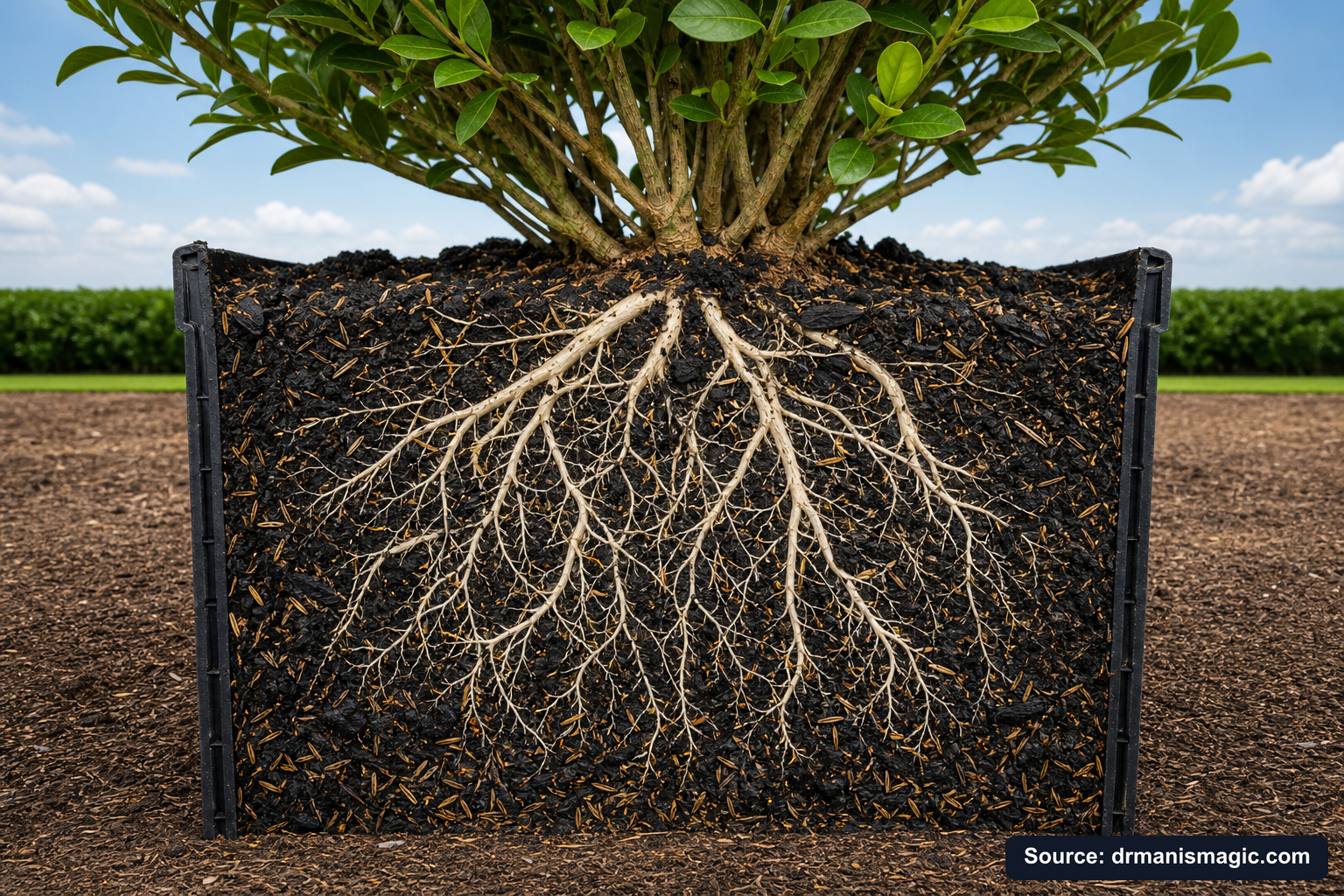
The fix is not to water less. The fix is to give the root zone pore space that allows drainage and oxygen even after you water. Coarse, stable, silica-rich particles do that. They keep the structural channels open. Water drains through. Air flows back in. Roots stay oxygenated. Pathogens never get their opening.
See also: How Salt-Based Feeding Quietly Destroys Root Systems
Potting Mix vs Mineral Soil: What Does Your Container Plant's Future Look Like?
Quick Answer: A container plant in decomposing potting mix will likely struggle within one to two years as the medium collapses and oxygen availability drops. The same plant in stable, mineral-based silica-rich soil has a foundation that lasts for years without collapse, repotting, or rebuilding.
Let's talk about time. Because time is the one thing you cannot get back.
You can get money back. You can find a new plant. But the months and years you spent watching a tree slowly fail in bad soil? Those are gone. The harvests you missed. The shade that was not there yet. The satisfaction of picking fruit from your own branches. All of it delayed or lost because the growing medium was a slow-motion collapse in progress.
This is the number one thing Dr. Mani hears from gardeners. They want to see their tree produce fruit in their lifetime. They want to see the payoff of the investment they made in a living thing. That desire is real. It is ancient. We were put on this earth to tend a garden, and that drive has never left us.
The cruel irony is that the potting mix sold at every big-box store in America is designed for one season. Annual bedding plants. Six weeks in a pot. Looks good on the shelf. Gets you through spring. Then the store restocks for summer and you are left with a decomposing medium in a pot you planned to keep for ten years.
The solution starts with the right foundation. A silica-rich, mineral-based soil that does not decompose, does not collapse, and does not turn into a root-choking sludge. From that foundation, your plant can build the root system it was designed to build. And from that root system, everything else follows.
That is exactly what Super Soil was built to be. Its base is silica-rich sandy loam from the Rio Grande Valley of South Texas, a mineral soil that does not decompose. Dr. Mani steam-sterilizes every batch to eliminate pathogens. Rice hulls add silica-based aeration channels. Biochar adds long-term nutrient-holding capacity. Coco coir provides just enough water retention to balance the mineral drainage. It is the mineral skeleton your roots have been waiting for, engineered for containers that need to last for years, not seasons.
How Do the Three Plant Pillars Connect to Silica-Rich Soil?
Quick Answer: Silica-rich mineral soil is Pillar One of the Three Plant Pillars. Without it, Pillar Two (live microbes) and Pillar Three (organic fertilizer) cannot function at their best. Microbes need oxygen-rich soil to thrive. Organic nutrients need a stable, living root zone to be absorbed. Mineral soil is the foundation the other two pillars stand on.
The Three Plant Pillars are the framework that Dr. Mani Skaria developed after decades of research and over 250,000 trees grown at US Citrus Nursery. They are not a marketing concept. They are the sequence of priorities that determine whether your plant thrives or struggles.
Pillar One is mineral-based soil. Silica-rich. Permanent. Oxygenated. It is first for a reason. Without proper soil structure, nothing else works the way it should.
Pillar Two is live microbials. Bacteria, fungi, and mycorrhizae that colonize the root zone, unlock nutrients, protect roots from pathogens, and create a living ecosystem that amplifies every other input you give the plant. But here is the thing about microbes. They need oxygen too. Beneficial aerobic microbes die in waterlogged, anaerobic soil. You can pour the best microbial inoculant in the world into a collapsing potting mix and watch most of it die within weeks. The mineral soil creates the oxygen-rich environment where beneficial microbes survive and multiply.
Pillar Three is organic fertilizer. Slow-release, salt-free nutrients from sources like crab, kelp, and amino acids that feed the plant gently and work in harmony with the microbial community. But roots cannot absorb nutrients efficiently if they are stressed, damaged, or drowning. Healthy root cells in an oxygenated mineral soil absorb nutrients at peak efficiency. Damaged roots in waterlogged potting mix cannot absorb anything well, no matter how much fertilizer you add.
This is why the order matters. Soil first. Microbes second. Organic fertilizer third. Get the mineral foundation right and the other two pillars amplify each other. Skip the mineral foundation and you are pouring microbes and nutrients into a system that cannot use them.
You can explore the full Three Plant Pillars system and see how each product fits together into a complete growing foundation.
See also: Why Most Fertilizers Are Actually Salt in Disguise
What Is a Silica-Rich Mineral Soil Recovery Plan If Your Plant Is Already Struggling?
Quick Answer: If your plant is in failing potting mix with waterlogged roots, there are clear steps to recover it. The earlier you act, the more you can save. Rebuilding around a mineral-based soil foundation is the key to long-term recovery.
If you are reading this and looking at a plant that is already showing the signs, here is your recovery sequence.
- Stop watering immediately. Let the existing soil dry out as much as possible. This slows the pathogen activity and gives remaining healthy roots a chance to breathe.
- Remove the plant from its container. Gently knock away the old potting mix from the root ball. Look at the roots. Healthy roots are white or light tan and firm. Rotten roots are brown, black, slimy, and smell sour.
- Prune away all rotten roots. Use clean, sharp scissors. Cut back to where the root tissue is clean and firm. Do not be afraid to remove a significant portion. Dead roots do nothing for the plant and actively harbor pathogens.
- Let the roots air dry for 30 to 60 minutes. This helps seal the cut ends and reduces the chance of immediate reinfection.
- Repot into a mineral-based, silica-rich growing medium. Use a coarse, well-draining mix with a strong mineral skeleton. Make sure the pot has adequate drainage holes and is not too large for the root ball you have left.
- Inoculate with live beneficial microbes. Introduce beneficial bacteria and mycorrhizal fungi to the new root zone. These organisms will colonize the new roots, produce natural antifungal compounds, and help the root system rebuild faster than it could alone. You can learn more about how to do this with the Free Plant Care Field Guide.
- Hold off on heavy fertilization for two to four weeks. Let the roots stabilize first. When you do feed, use a gentle organic slow-release fertilizer with no synthetic salts that could stress already-damaged root tissue.
Recovery is possible. But it is always faster and less heartbreaking to prevent the collapse than to recover from it. The mineral skeleton prevents the collapse.
Why Do Bonsai Trees and Ancient Horticulture Point to Mineral Soil as the Answer?
Quick Answer: Bonsai practitioners have used almost purely mineral soil for centuries because their trees must survive in small containers for decades. The ancient practice confirms what modern plant science explains: mineral particles preserve pore space and oxygen, allowing roots to thrive long-term in confined spaces.
Here is a fact that should make you pause. Bonsai trees live for hundreds of years. Some famous specimens are over a thousand years old. They spend their entire lives in pots smaller than most people's flower planters. And their growers figured out centuries ago that the secret was not richer soil, more fertilizer, or more water. The secret was a nearly 100% mineral growing medium.
Traditional Japanese bonsai soil recipes use materials like akadama (a calcined clay mineral), pumice (volcanic silica), and lava rock (volcanic mineral). All mineral. All coarse. All permanent. Some recipes include less than ten percent organic matter. Some include none at all.
Why? Because a tree that must live in a pot for a hundred years cannot afford to have its growing medium collapse in year one. It cannot afford waterlogged roots or anaerobic soil conditions. It needs a stable mineral skeleton that holds pore space open decade after decade, allowing roots to breathe, water to drain, and microbes to thrive.
These growers did not have university extension research or soil physics textbooks. They had centuries of observation. They watched what worked and what did not. And what worked, every single time, was mineral soil.
Modern extension science from Virginia Tech, NC State, Oklahoma State, and Oregon State all arrive at the same conclusion through controlled research: air-filled porosity in container media is the critical variable for root health, and coarse mineral particles are the most reliable way to maintain it over time.
The bonsai master and the plant scientist are pointing at the same thing. Mineral. Coarse. Permanent. That is the answer.
A Closing Thought: The Foundation Your Plants Have Always Deserved
Somewhere right now there is a plant in a pot on a patio or a windowsill or a back porch. It is sitting in a bag of decomposing pine bark that the store called "premium potting mix." The pores are collapsing. The oxygen is disappearing. The roots are struggling. And the person who planted it with genuine love and hope is wondering what they are doing wrong.
They are not doing anything wrong. They were never given the right information. The deck was stacked against them from the moment they reached for that bag on the shelf.
You know better now. You know that roots breathe. You know that organic matter decomposes and steals oxygen. You know that silica-rich mineral particles are the permanent framework that keeps pore space open, drainage flowing, and oxygen available for the long haul. You know the difference between coarse grit that helps and fine sand that hurts. You know why the bonsai masters and the university researchers and Dr. Mani Skaria after 40 years of growing citrus all arrived at the same place.
Mineral soil first. Always.
The time you spend watching a plant struggle in failing potting mix is time you cannot get back. The harvests you miss, the growth that stalls, the joy that gets delayed — none of it has to happen. Not when you build on the right foundation from the start.
If you are ready to give your plants the mineral skeleton they have always needed, take a look at what Dr. Mani built from the ground up for exactly this purpose. Your plants will feel the difference in weeks. Your soil will hold that difference for years.
Explore Super Soil and start building the foundation your plants deserve.
Frequently Asked Questions
Most gardeners never think about silica in their soil. That is a big mistake. These questions come up again and again from plant owners who are tired of soggy roots, yellowing leaves, and soil that turns into a brick after a few months. Read these answers carefully. They could save your plants and your wallet.
Why is silica important in soil?
Silica builds the mineral skeleton that holds pore space open in your soil. Those open pores let oxygen reach your roots. Roots need oxygen to breathe, absorb nutrients, and fight off disease. Without silica, your soil collapses over time and suffocates your roots. Dr. Mani proved this across more than 250,000 trees at the US Citrus Nursery in South Texas. Silica-rich soil is one of the reasons those trees thrived when others failed.
Does all dirt contain silica?
Yes, silica shows up in most natural soils and rocks. But the amount matters a lot. The silica-rich sandy loam from South Texas that Dr. Mani uses in Super Soil is packed with it. That is very different from the pine bark sawdust in most store-bought potting mixes. That stuff has almost no silica and breaks down fast. You want soil with enough silica to stay open, drain well, and never collapse around your roots.
How much silica is actually in soil?
Silica content in soil can range from less than one percent all the way up to forty-five percent of dry weight depending on where the soil comes from. Most organic potting mixes are low in silica because they are mostly decomposing wood and bark. Dr. Mani's Super Soil uses inorganic, mineral-based sandy loam that stays high in silica content and holds its structure permanently, year after year, without breaking down.
How do you add silica to soil?
You can mix silica-rich materials directly into your soil. Rice hulls are a great example. They are made of silica, they last a long time before breaking down, and they create tiny air pockets that help water move through the root zone just right. Dr. Mani's Magic offers rice hulls as a standalone product for exactly this reason. You can also use them as a top dressing to slow down weeds. The simplest move is to start with a mineral-based soil like Super Soil that already has silica built in from the ground up.
Are there different types of silica and does it matter for gardening?
For gardening, what matters most is the physical form of silica in your soil. You want coarse, chunky, stable particles that hold pore space open. Fine silica like play sand can actually make drainage worse by packing too tightly. The silica in Dr. Mani's Super Soil comes from coarse sandy loam, which stays open and airy around roots. That is the kind of silica that protects your plants. Industrial silica forms like fumed or colloidal silica are not what you want in a garden bed.
Can silica in soil help my plants absorb nutrients better?
Yes, and here is the connection most people miss. Silica keeps soil open and oxygenated. Oxygen-rich soil is where beneficial microbes thrive. Those microbes, the bacteria and fungi in Dr. Mani's Plant Super Boost, convert silica and other minerals into forms your plant roots can actually absorb. That is Pillar One and Pillar Two of the Three Plant Pillars working together. Mineral soil sets the stage. Live microbes do the heavy lifting. Your plant gets fed the way nature intended.
What foods are high in silica and what does that tell us about plants?
Oats, barley, brown rice, green beans, bananas, and cucumbers are all high in silica. Notice something? These are plants that grow in mineral-rich soil. They pull silica up through their roots and use it to build strong cell walls, improve color, and resist disease. That is exactly what happens when you give your garden plants a silica-rich mineral foundation. Strong soil grows strong plants. Strong plants grow food worth eating. That is the whole point of the Three Plant Pillars system.
About the Author
Dr. Mani Skaria, PhD
Dr. Mani Skaria, PhD, is a plant pathologist and the scientific founder of Dr. Mani's Magic. He earned his doctorate at Purdue University and spent 48 years studying how plants, soil, and living microbes work together, including his years as Professor Emeritus at Texas A&M and as a member of the USDA NAREEE Advisory Board. He invented micro-budding, a method for growing healthier, stronger trees, and has grown more than 250,000 trees on the family farm in Hargill, Texas - US Citrus Nursery. His life's work takes real lab science and practical experience and turns it into simple, safe, organic plant care anyone can use at home.


