


What Happens When Your Soil Decomposes and Kills Your Roots | Dr. Mani's Magic
What Happens When Your Soil Decomposes (And Why Your Plant Pays the Price)
You repot your tree into fresh potting mix. It smells earthy. It feels light and fluffy between your fingers. Water runs right through it. For a few weeks, maybe a few months, everything looks great.
Then something shifts. The water starts pooling on top. The soil shrinks away from the sides of the pot. You notice a faint sour smell, like wet newspaper left in a garage. The leaves go yellow. You water more. It gets worse. You Google "why is my plant dying" at 11pm and land on seventeen different answers. You try three of them. Nothing works. Sound familiar?
Here is what nobody told you. The potting mix did not fail because you watered wrong. It failed because it was always going to fail. It was made of organic matter, mostly pine bark sawdust, and organic matter does one thing above everything else. It decomposes. And when it decomposes inside your container, something silent and devastating happens to your roots. We are going to show you exactly what that is, why it matters, and what to do about it. After growing over 250,000 trees at our South Texas nursery, we learned this lesson the hard way so you do not have to.
Key Takeaways
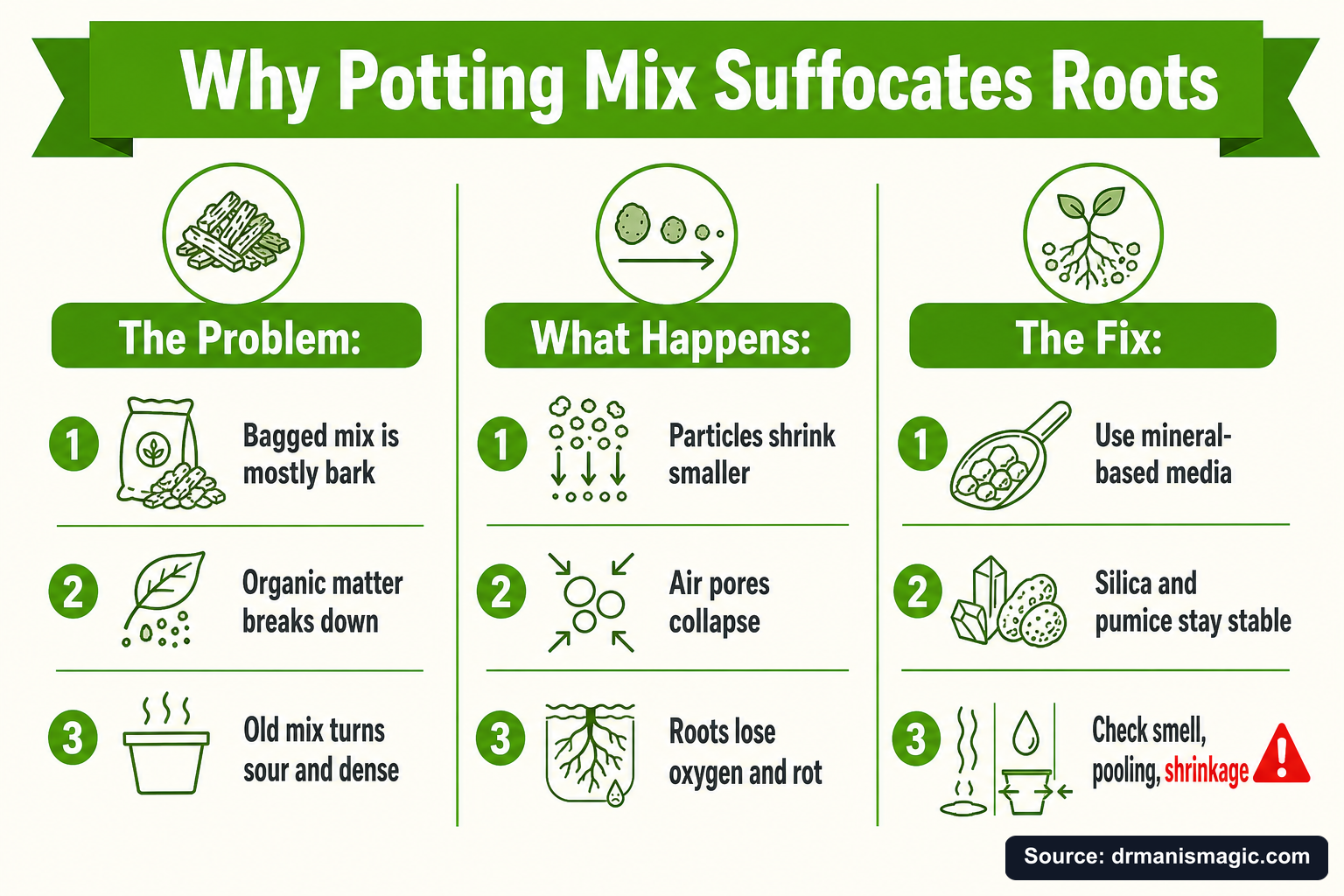
- Potting mix is mostly pine bark sawdust. It is not soil. It decomposes within months.
- When organic particles break down, they get smaller. Smaller particles collapse the air pores your roots breathe through.
- No air pores means no oxygen. No oxygen means root rot. Root rot kills plants.
- Mineral particles like silica, sand, pumice, and lava rock do not decompose. They hold their structure for years.
- The fix is not more watering or better fertilizer. The fix is a stable, mineral-based growing medium that does not collapse over time.
- Dr. Mani's Three Plant Pillars framework starts with mineral soil because everything else depends on roots that can breathe.
- You can diagnose decomposed media at home in about two minutes using your eyes and nose.
Does Potting Soil Actually Go Bad?
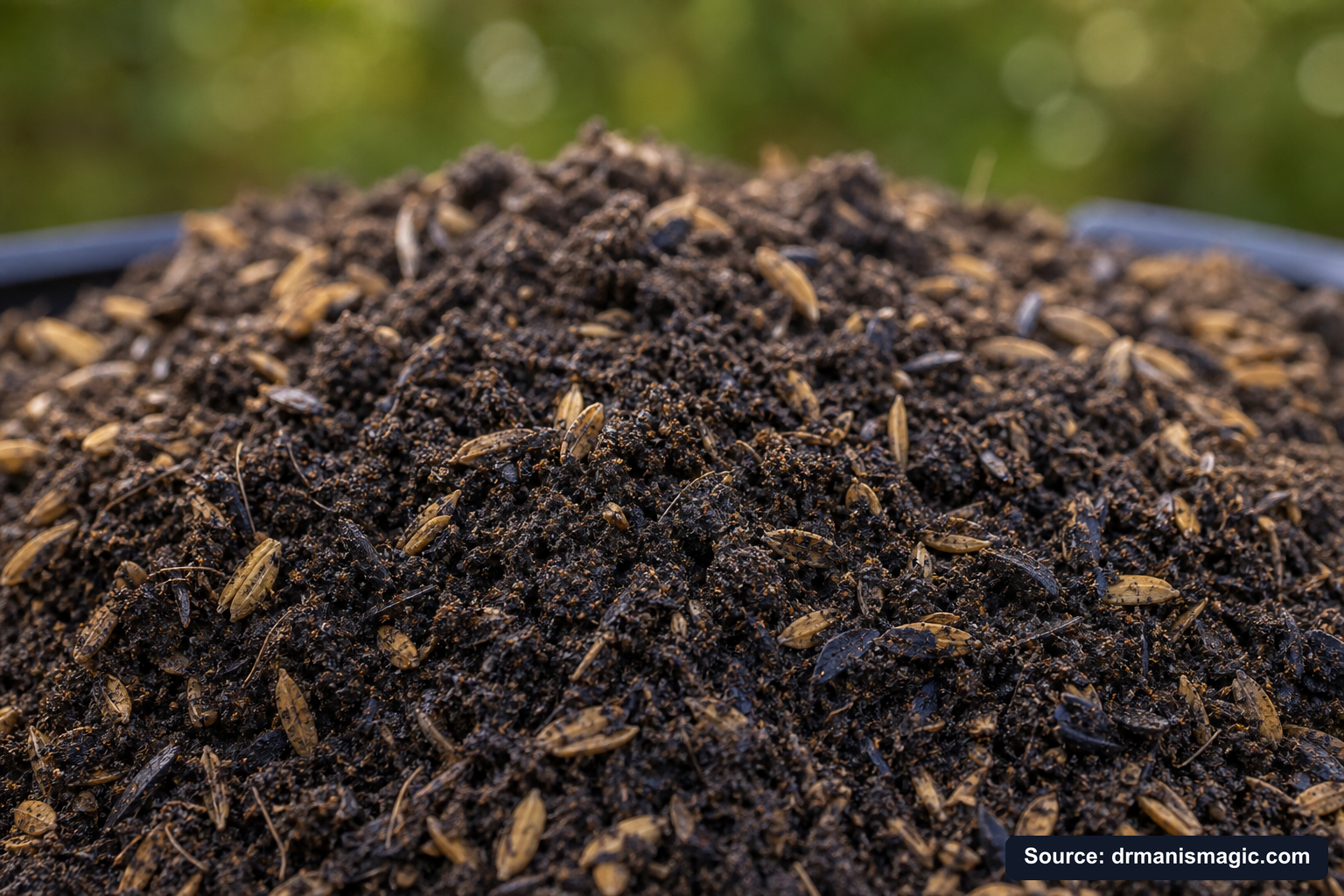
Quick Answer: Yes, but not in the way most people think. The nutrients do not "expire" like milk. What goes bad is the physical structure. Organic particles break down into smaller and smaller pieces, pores collapse, air disappears, water sits stagnant, and roots suffocate. That is the real failure mode of old potting mix.
Let us get something straight first. Most of what is sold as "potting soil" in a big orange or blue store is not soil at all. It is potting mix. And potting mix is mostly ground-up pine bark. Sometimes it contains peat, coir, compost, or sawdust. But the foundation is almost always wood-based, carbon-based, organic matter.
Why? Because pine bark is a waste product from the timber industry. The Southeast United States has enormous pine forests. Sawmills produce mountains of bark that used to cost money to dispose of. Then someone figured out they could bag it up, call it potting soil, and sell it. Cheap to make. Lightweight to ship. Easy to market.
Perfect for the company selling it. Not so great for your roots.
Here is the thing about organic matter. It is carbon-based. And all carbon-based matter does the same thing eventually. It decomposes. That is not a flaw. That is how nature works. In a forest, decomposition feeds the ecosystem. Old leaves and bark break down, microbes digest them, nutrients return to the soil. Beautiful system.
But in your container? Decomposition is a wrecking ball.
Because in a container, the roots cannot escape. They cannot grow sideways ten feet to find better ground. They are stuck in whatever you put them in. And when that medium starts breaking down, the roots go down with it.
What Actually Decomposes in Your Potting Mix?
Quick Answer: The organic fraction decomposes. Pine bark, peat, coir, compost, and sawdust all break down over time. Mineral particles like sand, pumice, lava rock, perlite, and silica aggregates do not biologically decompose. They are structurally stable for years. This distinction is the most important thing most gardeners never learn.
Think of your potting mix like a sandwich. The bread is organic matter. The fillings might include a little perlite or some coir. The bread is going to get soggy and fall apart. The fillings might hold their shape longer. But if the bread is 70 or 80 percent of the sandwich, the whole thing eventually turns to mush.
Organic materials that decompose in containers include:
- Pine bark and fir bark (the main ingredient in most bagged potting mix)
- Peat moss
- Coir fiber
- Compost
- Sawdust
- Wood chips
Mineral materials that do NOT biologically decompose include:
- Silica sand
- Pumice
- Lava rock
- Perlite (though it can fracture mechanically over time)
- Granite grit
- Quartz
- Calcined clay
The mineral stuff is made of silica. Silica is ground-up rock. Rock does not rot. It weathers very slowly over geological time, but in your lifetime, in your pot, it holds its shape.
This is the core of what Dr. Mani Skaria figured out after decades of growing citrus at the Texas A&M Citrus Center and then at his own nursery in South Texas. Your roots do not need organic matter in the medium. They need structure. They need space. They need oxygen. And only a mineral-based medium gives them all three permanently.
Think about that for a second. You have been planting your trees in other dead trees. Pine bark is a dead tree. Sawdust is a dead tree. And dead trees decompose. You would not plant your roots in a pile of rotting lumber in your backyard. But that is essentially what bagged potting mix is.
Why Do Decomposing Particles Destroy Your Soil's Pore Structure?
Quick Answer: When organic particles break down, they shrink into finer and finer pieces. Those fine pieces fill in the air gaps between larger particles. The gaps disappear. Those gaps were your root's oxygen supply. No gaps, no oxygen. No oxygen, dead roots. This process is called pore collapse, and it is the hidden killer inside every bag of organic potting mix.
Picture a jar full of marbles. The marbles cannot pack perfectly together. There are spaces between them. Those spaces are filled with air. Now imagine replacing the marbles with sand. The sand particles are smaller, so they pack more tightly. Less air space. Now imagine replacing the sand with flour. Almost no air space at all.
That is exactly what happens inside your pot as organic particles decompose.
Fresh pine bark particles are relatively large. There are gaps between them. Water drains through. Air moves in after watering. Roots can breathe. This is why new potting mix works pretty well at first.
But over six to twelve months, those bark particles break down. They get smaller. The fines migrate downward. The mix compacts. The gaps shrink and disappear. Water can no longer drain properly. Instead, it sits in a zone just above the drainage holes. Researchers call this a perched water table. It is exactly what it sounds like. A layer of standing water trapped inside your pot, no matter how many holes are in the bottom.
NC State University Extension and Oregon State University nursery research both converge on the same critical number. Container media needs air-filled porosity above roughly 20 to 30 percent after a full watering to support healthy root function. Oregon State research specifically notes that air-filled porosity above 30 percent reduces risk from Phytophthora, a water mold pathogen that causes root rot in hundreds of plant species. When decomposed media drops below that threshold, Phytophthora and similar pathogens thrive.
And once roots lose oxygen, they cannot defend themselves. They go brown. They go slimy. They die. And then the pathogens move in to finish the job. Most people see yellow leaves and assume they need more fertilizer. But the leaves are yellow because the roots are dead. Fertilizer cannot help a dead root. More water cannot help a dead root. Only fixing the medium can help.
What Does Decomposed Potting Mix Look and Smell Like? A Diagnostic Guide
Quick Answer: Decomposed potting mix has a sour or sewage-like smell, looks dark and sludgy, shrinks away from the pot walls, repels water when dry, and drains slowly or not at all. Your plant will show yellow leaves, leaf drop, and slow or no growth. Brown mushy roots confirm the damage is already done.
You do not need a lab. You need your senses. Here is what decomposed media looks, smells, and feels like.
| Warning Sign | What It Means | Urgency Level |
|---|---|---|
| Sour or sewage smell | Anaerobic decomposition is happening. No oxygen in the root zone. | High |
| Soil shrinks from pot walls | Organic particles have broken down and the volume has dropped. | Medium |
| Water pools on top and drains slowly | Pore structure has collapsed. Perched water table forming. | High |
| Dry mix repels water (hydrophobic) | Surfactants have washed out. Bark is now naturally water-repellent. | Medium |
| Black sludge at pot bottom | Decomposed fines have migrated down and packed solid. | High |
| Fungus gnats around the plant | Wet, decaying organic matter is a breeding ground for fungus gnats. | Medium |
| Yellow leaves, leaf drop | Roots are suffocating or already rotting. Nutrient uptake has shut down. | High |
| Brown, mushy roots | Root rot is active. Oxygen has been absent for weeks or months. | Critical |
| Fine dark particles at drainage holes | Bark fines have broken down completely and are washing out. | Medium |
If you are checking off three or more of those signs, your plant is living in a root-rot factory. And the longer it stays there, the more time it loses. You can get money back. You cannot get time back. Every month a plant spends in collapsed media is a month it is not growing, not fruiting, not thriving.
We hear this from people every single week. The number one thing they tell us is that they want to see fruit on their tree in their lifetime. And yet the medium they are using is designed to fail within months. That is not a recipe for harvest. That is a recipe for heartbreak.
Why Does Old Potting Soil Stay Wet When You Water It?
Quick Answer: Decomposed potting mix creates a perched water table, a zone of standing water that sits trapped above the drainage holes regardless of how much you water or how many holes the pot has. Collapsed pores cannot move water fast enough. The result is waterlogged roots even when you think you are watering correctly.
This one trips up almost every container gardener. You have drainage holes. You water carefully. And yet the soil stays wet for days. You blame yourself. You wonder if you are overwatering.
But here is the real story. Drainage holes only let water escape from the very bottom of the pot. Above those holes, water has to travel through the medium by gravity. When the medium has good pore structure, water moves freely. When the medium has collapsed, water cannot move. It gets trapped.
Picture a wet sponge. Now squeeze it flat. That flat sponge holds way more water than the fluffy one, and it drains way more slowly. That is your decomposed potting mix. It is a flattened sponge sitting around your roots.
And remember the surfactant problem. Fresh potting mix has chemical surfactants added by the manufacturer to help the wood-based particles absorb water instead of repelling it. Wood is naturally hydrophobic. It sheds water. That is why boats are made of wood. The surfactants chemically force the bark to hold moisture.
But surfactants wash out over time. After a few months of watering, they are gone. Now the bark particles repel water again. So you get a strange combination. The collapsed fines at the bottom trap water. The drier bark particles at the top repel water. You end up with wet pockets and dry pockets in the same pot, at the same time.
That is why gardening forums explode with arguments about overwatering versus underwatering. Both camps are right. Both are wrong. The actual problem is the medium itself.
Can Old Potting Soil Cause Root Rot?
Quick Answer: Yes. Decomposed potting mix is one of the primary drivers of root rot in container plants. When oxygen levels in the root zone drop due to collapsed pores and standing water, roots die. Dead roots attract pathogens like Phytophthora that finish the job. The medium, not overwatering, is usually the root cause.
Root rot has a reputation as a watering problem. Water too much, get root rot. Simple.
Except it is not that simple. Because we have all seen plants sitting in standing puddles that stayed perfectly healthy. And we have seen plants die from root rot in pots that drained beautifully when they were young.
Here is what actually causes root rot, according to the plant pathology research Dr. Mani Skaria built his career on.
Root rot is triggered by root damage first. The pathogens come second. Healthy, oxygenated roots can fight off pathogens. They produce defensive compounds. They have active immune-like responses. But oxygen-starved roots are defenseless. They go brown and die. And then the fungi and water molds move in.
The three main causes of root damage in containers are:
- Too little oxygen (caused by pore collapse in decomposed media)
- Too much salt (from synthetic fertilizers that burn root cells)
- Not enough beneficial microbial activity to protect the root zone
You will notice overwatering is not on that list. That is not an accident. Overwatering only causes problems when the medium cannot handle the water. In a well-structured, mineral-based medium, you can water frequently without root rot. In a collapsed, decomposed medium, even careful watering causes problems.
UF/IFAS citrus guidance backs this up directly, linking extended waterlogging and oxygen deprivation to root decline and death in container citrus. It is not about how much water you give. It is about whether the medium can move that water through fast enough to keep air in the pore spaces.
See also: The Hidden Reason Synthetic Fertilizers Cause Root Rot
You Never Had a Brown Thumb.
You were handed the wrong tools. This free guide hands you the right ones.
You watered it. You fed it. It died anyway.
It was never you. It was the dirt, the salt food, and the bad advice.
This guide shows you what really went wrong, and how to fix it for good.
- Why your plants really died, and why it was never your fault
- The salt hiding in your plant food that quietly burns the roots
- The hidden killer in almost every bag of store soil
- The tiny helpers that grow a whole forest for free
- The rescue trick that brings a half dead plant back to life

Potting Mix vs. Mineral-Based Soil: What Is the Real Difference?
Quick Answer: Potting mix is organic, carbon-based, and designed to decompose. It works for a few months and then fails. Mineral-based soil is silica-based, structurally permanent, and does not decompose in any meaningful timeframe. It maintains pore structure, oxygen availability, and drainage for years. The difference in plant outcomes is dramatic.
Let us put this side by side so the difference is impossible to miss.
| Property | Organic Potting Mix (Pine Bark Based) | Mineral-Based Soil (Silica Sandy Loam) |
|---|---|---|
| Base material | Pine bark, peat, sawdust, coir | Silica sand, sandy loam, pumice, lava rock |
| Decomposes? | Yes. Starts immediately, significant decline in 6-12 months | No. Structurally stable for years or decades |
| Pore structure over time | Collapses as particles break into fines | Maintained. Particles hold shape and size |
| Oxygen availability | Drops steadily as pores close | Consistent. Air spaces remain open |
| Drainage over time | Slows. Perched water table forms | Consistent drainage maintained |
| Root rot risk | Increases with age | Minimal when properly structured |
| Surfactant dependency | Yes. Needs chemical surfactants to hold water initially | No. Natural water dynamics, no additives needed |
| Smell over time | Sour, anaerobic, sometimes sewage-like | Clean, earthy, neutral |
| Lifespan in containers | 6-18 months before significant decline | Years to decades with no replacement needed |
| Cost over 5 years | High. Requires repeated replacement and repotting | Low. One-time investment in a permanent medium |
| Pine chemistry concerns | Yes. Terpenes and terpenoids present in bark | None. Inorganic material, no chemical compounds |
That last row deserves a moment. Pine bark contains a whole family of natural chemical compounds called terpenes and terpenoids. You already know some of them by name. Pine-Sol is made from them. Turpentine is one of them. These are the compounds that make pine wood resistant to insects and decay. They are chemically potent.
That is great for cleaning floors and stripping varnish. It is not great for the root zone of your precious plant. Manufacturers let pine bark sit in massive piles for years, decomposing, specifically to reduce these harsh chemicals. The decomposition process is considered a feature. But while the terpenes are breaking down, the structural integrity of the bark is also breaking down. You are starting with a compromised medium on day one.
Why Do Container Plants Decline After One to Three Years in Potting Mix?
Quick Answer: Perennial container plants outgrow the useful life of their potting mix. By year one or two, the organic particles have broken down enough that pore structure is severely compromised. The plant entered a declining medium and cannot escape. Annual plants are swapped out before the mix fails. Perennials like citrus, fruit trees, and tropical houseplants are not so lucky.
Here is something almost nobody talks about. The whole potting mix industry is built around annual plants.
Petunias. Tomatoes. Marigolds. You buy them in spring, they grow for one season, and they are gone by fall. The potting mix lasts about as long as the plant. Nobody notices the medium failing because the plant is replaced before it fails.
But what about your lemon tree? Your Meyer lemon in a pot on the patio? Your fiddle leaf fig in the living room? Your olive tree in the courtyard? Your bonsai that has been in the same container for three years?
These are perennial plants. They are meant to live for decades. But they are sitting in media designed for a single season. By month six, the mix has started its decline. By month twelve, drainage is compromised. By month eighteen, the roots are suffocating. By year two or three, the plant looks like it is in slow decline and you cannot figure out why.
You might think it needs more fertilizer. You add fertilizer. Salt-based fertilizers add more stress to already damaged roots. Things get worse. You look for answers online and find seventeen conflicting opinions. You try three of them. Nothing works.
The medium failed. That is the whole story. And the answer is not a new fertilizer or a new watering schedule. The answer is a medium that does not fail.
Ancient bonsai masters understood this intuitively. Traditional Japanese bonsai media is heavy in mineral aggregates like akadama, pumice, and lava rock. Very little organic matter. These trees live in containers for decades and sometimes centuries. The medium holds because it is mineral-based. The pore structure does not collapse. The roots breathe for generations.
We are not reinventing anything. We are just applying what the oldest plant cultivators on earth already knew.
For more on how the roots of any plant thrive when you get the foundation right, check out our Free Plant Care Field Guide.
How Do You Fix Decomposed Potting Mix? A Recovery Checklist
Quick Answer: The only real fix for decomposed potting mix is removal and replacement with a stable, mineral-based medium. There is no amendment that restores collapsed pore structure once the organic particles have broken down into fines. Act as soon as you notice the warning signs and your plant has the best chance of recovery.
Good news. Plants are resilient. If you catch the decline early enough, recovery is very possible. Here is a step-by-step recovery process.
- Diagnose first. Check the warning signs from the table above. Sour smell, slow drainage, yellow leaves, and shrinking medium are your main signals. If three or more are present, plan to repot.
- Choose the right time. Early spring is ideal for most plants. Avoid repotting in peak summer heat or during active flowering if you can help it.
- Prepare your new medium before you start. Have your mineral-based medium ready to go. Do not leave roots exposed to air for more than a few minutes.
- Remove the plant and inspect the roots. Gently shake off as much old medium as possible. Look at the roots. Healthy roots are white or light tan and firm. Rotten roots are brown or black, mushy, and smell bad.
- Prune damaged roots cleanly. Use clean, sharp scissors. Cut back to healthy tissue. This feels scary but it is necessary. Dead roots cannot recover. Healthy roots will grow new branches.
- Repot into mineral-based medium. Set the plant at the same depth it was before. Do not bury the crown or the root flare. Pack the new medium gently around the roots. Water in slowly.
- Give it time and support. Avoid heavy fertilizing for the first two to four weeks. Let the roots settle. Add live beneficial microbes to help the root zone recover faster and defend against pathogens.
That last step matters more than most people realize. Live beneficial microbes colonize the root zone and actively protect roots from the same pathogens that caused the rot in the first place. They also unlock nutrients that stressed roots cannot access on their own. Think of them as the recovery team for your root zone.
See also: Why Most Fertilizers Are Actually Salt in Disguise
What Are the Three Plant Pillars and Why Does Soil Come First?
Quick Answer: The Three Plant Pillars are the framework Dr. Mani Skaria developed after decades of growing over 250,000 trees in South Texas. Pillar One is mineral-based soil. Pillar Two is live microbials. Pillar Three is organic fertilizer. Soil comes first because without oxygen reaching the roots, no fertilizer, no microbe, and no watering schedule can save the plant.
Dr. Mani Skaria spent 35 years as a plant pathologist and Professor Emeritus at the Texas A&M Citrus Center. He invented micro-budding. He founded the Clean Citrus Program in Texas. He has seen every way a plant can fail.
And after all of that, he boiled it down to three things. Not twenty. Three.
Pillar One: Mineral-Based Soil. A permanent, silica-based growing medium that does not decompose, does not collapse, and does not steal oxygen from the roots. This is the foundation. Without it, the other two pillars cannot work. You cannot fertilize your way out of a medium that is suffocating your roots. You cannot microbe your way out of a collapsed pore structure. The medium has to be right first.
Pillar Two: Live Microbials. Your soil is a living ecosystem. Billions of bacteria, fungi, and mycorrhizae should be working in the root zone at all times. They unlock nutrients, break down organic matter into plant-available forms, protect roots from pathogens, and build soil structure. When you use synthetic fertilizers, the salt kills these microbes. When your medium decomposes and goes anaerobic, the beneficial microbes die and the harmful pathogens take over. Living microbes are not optional. They are the muscle that makes everything else work.
Pillar Three: Organic Fertilizer. Once the first two pillars are in place, your plant needs fuel. Slow-release, salt-free organic nutrients feed the plant and the microbes at the same time, without burning roots, without killing beneficial biology, and without creating chemical dependency. Crab, kelp, and amino acids. The nutrients plants evolved to use.
The Three Plant Pillars are not theory. They are the system we use every day at our nursery in Hargill, Texas, on 250,000 citrus trees, on tropical houseplants, on flowering trees, on garden vegetables. When all three are working together, plants do not just survive. They thrive in a way that looks almost unfair compared to what everyone else is getting.
What Makes Dr. Mani's Magic Super Soil Different From Regular Potting Mix?
Quick Answer: Dr. Mani's Magic Super Soil is built on a mineral base of silica-rich sandy loam from the Rio Grande Valley, steam-sterilized for safety and purity. It does not biologically decompose. It maintains pore structure, oxygen availability, and drainage for years. It is a permanent investment in your plant's foundation, not a seasonal product you replace every spring.
When Dr. Mani looked at what was available for container growing, he saw the same problem everywhere. Every bag on the shelf was pine bark based. Every bag was going to fail within a year. Every bag was designed for short-cycle plants, not for the perennial trees and houseplants his customers were trying to grow for decades.
So he made his own.
Super Soil starts with silica-rich sandy loam from South Texas. That sandy loam is mineral-based. It does not decompose. It maintains its particle size and pore structure year after year. Roots can breathe in it on day one and still breathe in it three years later.
Every batch is steam-sterilized. That matters because backyard soil and random sand from construction sites can carry pathogenic fungi, nematodes, and other threats that would destroy a container plant. The steam sterilization eliminates those threats without chemicals, without residues, without anything you would not want near your family or your food.
Dr. Mani then blends in coco coir, rice hulls, and biochar. The coco coir provides gentle moisture retention. The rice hulls are silica-based and add long-lasting aeration without decomposing quickly. The biochar acts as a habitat for beneficial microbes and a slow-release water and nutrient reservoir. Zero PFAS. Zero biosludge. Zero synthetic salts.
The result is a medium that works for citrus trees, tropical houseplants, flowering trees, garden containers, and any plant that needs to breathe. One investment. No annual replacement. No sour smell after six months. No collapsed pores. No mystery decline.
And if you are not happy within 30 days, we will refund every penny. No hoops to jump through. That is how confident we are in it.
A Final Word on Time, Roots, and Getting It Right
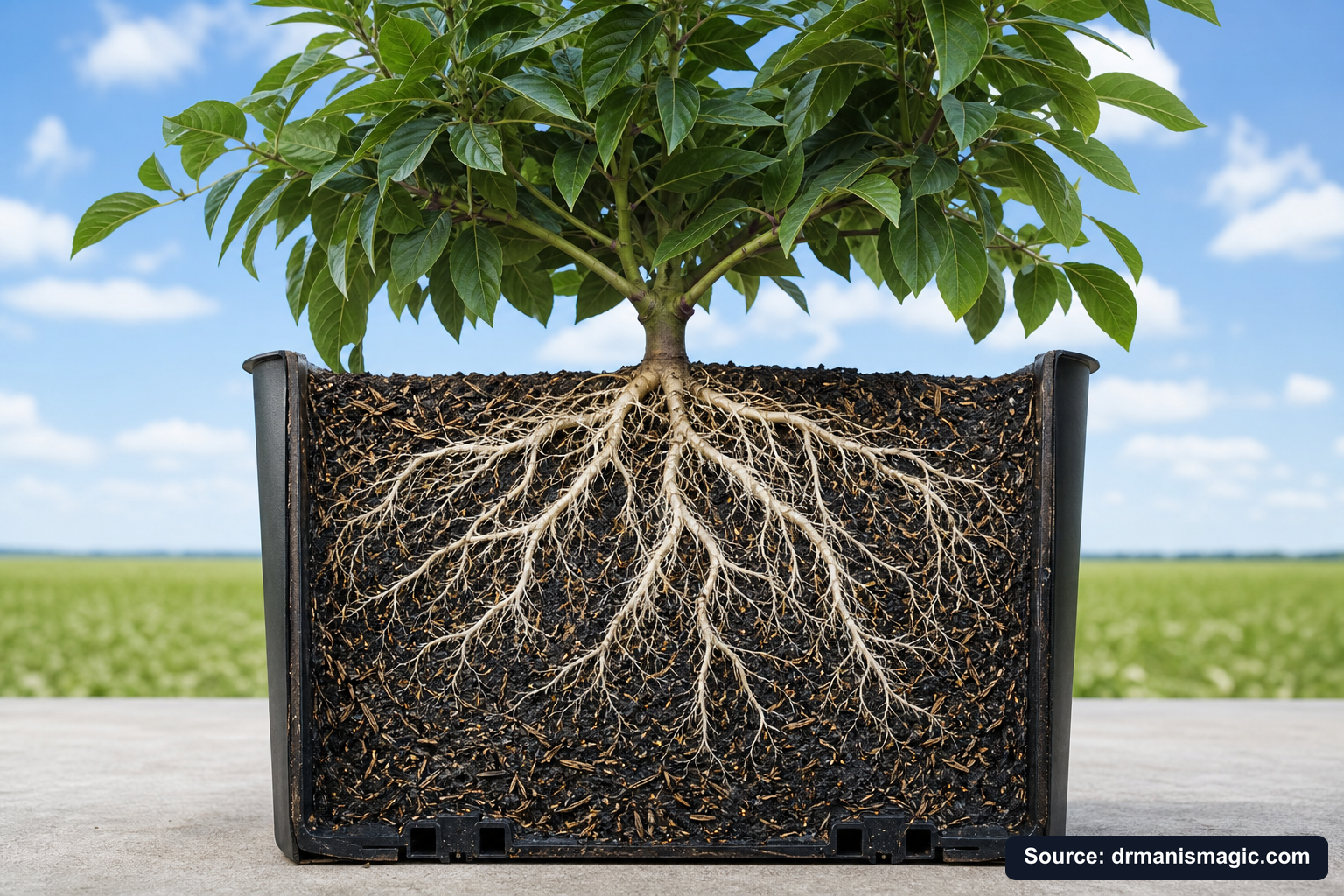
Here is the truth that nobody in the big box gardening world wants you to know. The medium your plant is sitting in right now is either building toward something beautiful or slowly taking it apart. There is no neutral.
If it is organic, it is decomposing. Right now, as you read this. The particles are getting smaller. The pores are getting tighter. The oxygen is getting thinner. Your roots are working harder just to stay alive.
And the biggest cost is not the price of the bag. The biggest cost is time. Time your plant spent struggling instead of growing. Time you spent troubleshooting instead of harvesting. Time you spent Googling instead of enjoying your garden.
You can always buy another bag of potting mix. You cannot buy back the years a plant spent suffocating in collapsed media.
The fix is not complicated. Get the foundation right. Start with a mineral-based medium that does not decompose. Add live microbes that protect and nourish the root zone. Feed with organic nutrients that work with the soil, not against it. That is the Three Plant Pillars. That is what Dr. Mani spent a lifetime proving across 250,000 trees in South Texas.
If you want to see what that foundation looks like and whether it is right for your plants, take a look at our Free Plant Care Field Guide. It walks you through the whole system, step by step, in plain language. No guesswork. No jargon. Just the foundation your plants have been waiting for.
Frequently Asked Questions
Your potting mix is quietly falling apart right now. Most gardeners never find out why their plants struggle until it is too late. These questions get straight to the truth about decomposing soil and what you can actually do about it.
Does potting soil really go bad over time?
Yes, and it happens faster than you think. Most potting mix is made from pine bark and sawdust. Those materials decompose. As they break down, the tiny air pockets your roots breathe through collapse. Water stops draining. Oxygen disappears. Roots suffocate. This is not a watering problem. It is a structural problem baked into the product from day one. We watched this destroy trees at our South Texas nursery until we built a better solution.
What actually happens to roots when soil decomposes?
When organic particles break down, they shrink. Smaller particles pack tighter together. That kills the air pockets roots need to breathe. Roots sitting in oxygen-starved, soggy soil start to rot. Rotting roots cannot pull water or nutrients up into your plant. So your plant yellows, stalls, and slowly dies while you keep watering and wondering what went wrong. The soil looked fine in the beginning. That is the trap.
Can dead or collapsed soil be brought back to life?
You can improve it, but collapsed organic matter cannot rebuild its structure. Once pine bark breaks down into sludge, it stays sludge. The real fix is reintroducing live microbes and rebuilding from a stable base. Dr. Mani's Plant Super Boost adds live bacteria, fungi, and mycorrhizae back into sick soil. But for containers, the long-term answer is switching to a mineral-based growing medium that does not collapse in the first place.
Is it okay to add new potting mix on top of old potting mix?
For containers, just layering new mix on top does not fix the problem. The old decomposed material at the bottom is still choking your roots. The better move is to remove the old mix, refresh with a stable growing medium, and inoculate with live microbes. For garden beds, adding compost on top can help feed soil life. But in pots, your roots live in whatever is at the bottom, and that is where the damage hides.
What kind of soil does not decompose in a container?
Mineral-based soil. Sand, silica, pumice, lava rock, and similar inorganic particles do not break down. They hold their structure for years. Dr. Mani's Super Soil is built on sandy loam from the Rio Grande Valley. It is steam-sterilized, mineral-based, and stays open and airy long after organic mixes have turned to mush. We tested this across more than 250,000 trees. Roots that can breathe grow strong. Roots that cannot breathe die slowly.
Why does my potting soil smell sour or like wet newspaper?
That smell is anaerobic decay. When air pockets collapse and water sits stagnant, the beneficial aerobic microbes die off. Anaerobic bacteria take over and produce that sour, rotten odor. It means your soil has gone septic around your roots. More watering makes it worse. This is one of the clearest signs your growing medium has decomposed past the point of helping your plant. Your nose is telling you what your eyes cannot see yet.
What is the right fertilizer to use when soil is breaking down?
Salt-based synthetic fertilizers make a bad situation worse. They burn off the remaining beneficial microbes and create a chemical dependency cycle. The right move is an organic, slow-release fertilizer like Dr. Mani's Crab, Kelp, and Amino Acids blend. It feeds plants without scorching roots or wiping out soil life. Pair it with Plant Super Boost to reintroduce live microbes, and Super Soil as your base. That is the Three Plant Pillars working together the way nature intended.
About the Author
Ron Skaria, MD
Ron Skaria, MD, is the co-founder of Dr. Mani's Magic and the son of Dr. Mani. He trained as a medical doctor at Baylor College of Medicine, did his residency at UT Health Science Center - San Antonio and fellowship training at Texas Tech University. He now works full time on the family farm at US Citrus and US Citrus Nursery in Hargill, Texas, building Dr. Mani's Magic alongside his dad. He wrote the Brown Thumb Field Guide to put his father's 48 years of plant science into plain words any gardener can use. His belief is simple. You never had a brown thumb. You just never had the right help.


