


How Salt-Based Fertilizers Destroy Root Systems Before Leaves Show Damage
How Salt-Based Feeding Quietly Destroys Root Systems (Before Your Leaves Even Know It)
You just fed your plant. You followed the directions on the bag. You watered it in. You felt good about it.
Then, two weeks later, the leaves start to curl. The tips go brown. The plant looks thirsty, even though the soil is wet. You water it more. It gets worse. You scratch your head and wonder what you did wrong.
Here is what nobody told you. The damage did not start in the leaves. It started underground, in the dark, days before you saw a single symptom. The roots were being quietly poisoned by the very thing you thought was helping them. And the villain of this story is not some rare garden pest. It is salt. Ordinary, invisible, fertilizer salt. It is in almost every bag and bottle at every big box store in America. And after growing more than 250,000 trees at our South Texas nursery, we have seen exactly what it does to a root system. What we found changed the way we feed every single plant we grow.

Organic Fertilizer | Crab, Kelp & Amino Acids
Author Section
By Dr. Mani Skaria, PhD · Plant Pathologist · Professor Emeritus, Texas A&M University–Kingsville · USDA NAREEE Advisory Board Member · Founder, Texas Clean Citrus Program · Inventor of Micro-Budding
Key Takeaways
- Salt-based fertilizers create a "chemical drought" around roots, making it impossible for plants to drink even when the soil is wet.
- Root damage from fertilizer salt begins underground and silently, long before leaves show any burn or yellowing.
- High salt levels kill the beneficial microbes your soil depends on to unlock nutrients and fight disease.
- Damaged roots become easy targets for root rot pathogens like Pythium and Fusarium.
- You can test for salt buildup using a simple EC (electrical conductivity) reading before symptoms get serious.
- Organic, slow-release nutrition feeds microbes first, which then gently feed your plant in a way that mirrors nature.
- Recovery is possible. Stop the salt, leach the soil, rebuild the biology, and your roots can come back.
What Does Salt Actually Do to Your Roots?
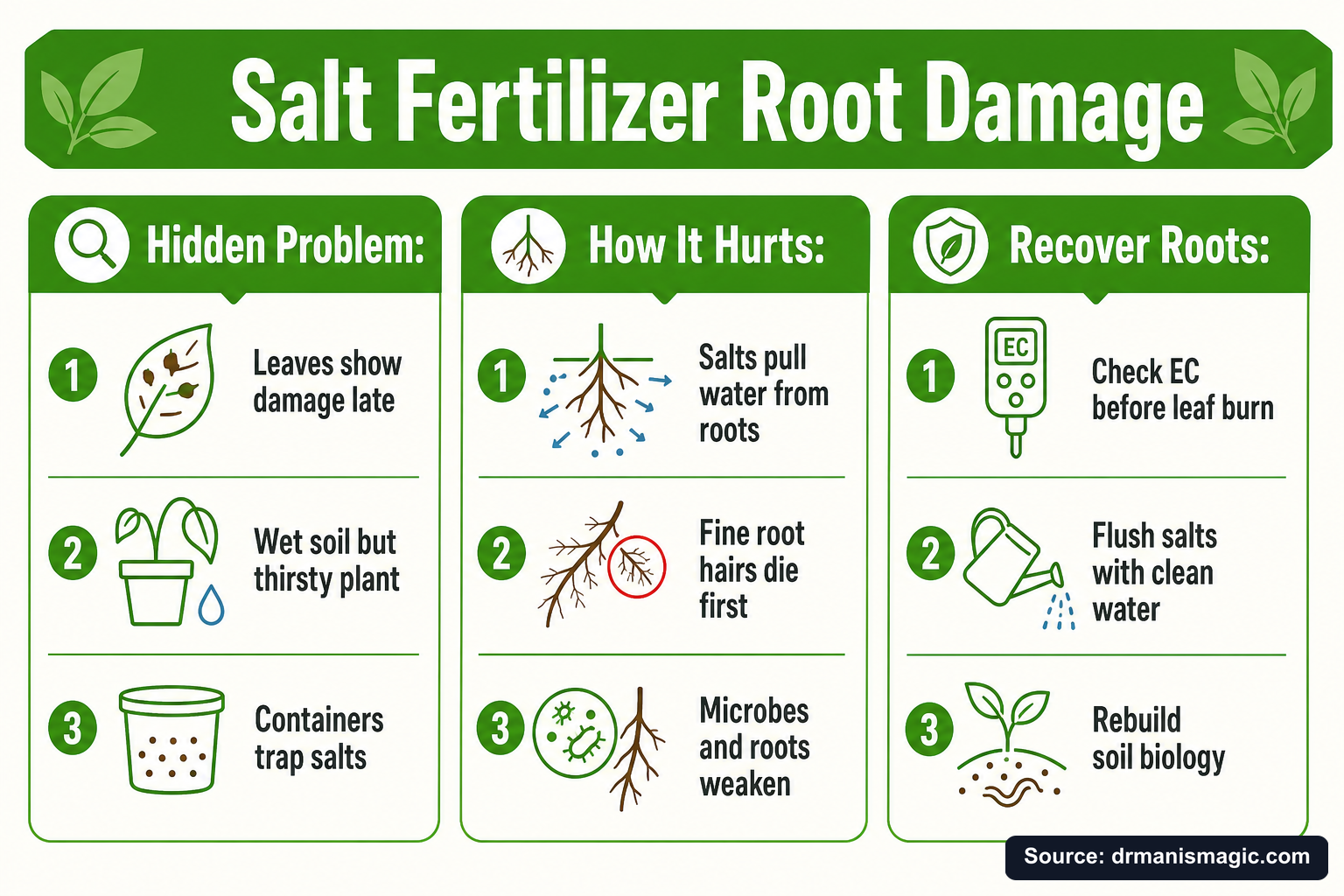
Salt-based fertilizers pull water away from your roots instead of letting roots pull water in. This is basic chemistry called osmosis. Water always moves toward the area with more dissolved particles. When you pour a high-salt fertilizer into your soil, the concentration of dissolved particles outside the root becomes greater than the concentration inside the root. So water flows out of the root cells and into the surrounding soil. The plant is literally losing water even while sitting in wet ground.
Scientists and university extension researchers call this osmotic stress. Gardeners call it mystery wilting. We call it a chemical drought. Your plant looks thirsty. You water it more. More water dissolves more salt. The problem gets worse. This cycle repeats until the roots are injured too badly to recover, and by then the leaves are burning at the edges and people think the problem just started. It did not. It started weeks ago, in the dark, underground, where nobody was looking.
Why Do Salt Levels Rise So Fast in Containers and Raised Beds?
In the ground, rain can flush salt through the soil profile and away from roots. In a pot or a raised bed, there is nowhere for that salt to go. Every time you fertilize with a salt-based product, some of it gets used and some of it stays behind. Feed again in a few weeks and more salt stays behind. Over months and years, the electrical conductivity of your soil climbs higher and higher. The roots are sitting in an increasingly salty environment with no escape.
You may have noticed a white crust forming on the surface of your potting soil or along the rim of a container. That white crust is not minerals from your water. It is salt migrating upward as water evaporates. It is a visible warning sign that the salt concentration below the surface is already high enough to do real damage. Most people wipe it off and keep feeding. The root damage continues.
What Is EC Testing and Why Should Every Plant Owner Know About It?
EC stands for electrical conductivity. It measures how many dissolved salts are in your soil or water. The higher the EC number, the more dissolved salts are present, and the harder it is for roots to absorb water. A simple EC meter costs about fifteen to thirty dollars and can be found online. It is one of the most useful diagnostic tools a home gardener can own, yet almost nobody outside of greenhouse production knows it exists.
To test your soil, take a small soil sample, mix it with distilled water, let it settle, and dip the meter into the liquid. Most houseplants, citrus, vegetables, and flowers prefer an EC below 2.0 millisiemens per centimeter. Above 3.5, you are in the danger zone for most sensitive plants. Above 5.0, root damage is almost certain. If your plant has been struggling and you cannot figure out why, an EC reading can tell you in sixty seconds whether salt is the problem. It takes the guesswork out of the diagnosis entirely.
You can also test your irrigation water. Many municipal water sources and well systems carry dissolved minerals that add to your soil salt load over time, even before you add a single drop of fertilizer. Knowing your water EC helps you understand your baseline before you even begin feeding.
How Does Salt Damage Lead to Root Rot?
This is the part that most fertilizer articles completely skip over. They talk about leaf burn. They talk about brown tips. But they never explain the sequence of events that turns a salt problem into a root rot problem. Here is exactly how it happens.
First, high salt causes osmotic stress and the root cells lose water. The outer layer of fine root hairs, the tiny hair-like structures responsible for most water and nutrient absorption, are extremely sensitive. They are the first to be injured by high salt concentrations. Once those root hairs are damaged, the root loses its ability to absorb water and oxygen efficiently.
Roots need oxygen to survive. When root tissue becomes oxygen-starved and physically injured, it becomes the perfect breeding ground for opportunistic pathogens. Organisms like Pythium, Fusarium, and Phytophthora, which are always present in soil at low levels, suddenly have an easy target. Healthy roots resist these pathogens naturally. Injured, salt-stressed roots do not. The infection spreads. The root system collapses. And by the time you pull the plant out and look at the roots, they are dark, mushy, and smell like rot.
The cruel irony is that the symptoms of salt stress and the symptoms of root rot look almost identical above ground. Wilting. Yellowing. Slow growth. Leaf drop. Most people treat the wrong problem. They stop watering because they think the soil is too wet. Or they add more fertilizer because they think the plant is hungry. Both responses make a salt problem worse.
What Does Fertilizer Salt Do to the Microbes in Your Soil?
This is where it gets personal for us. Because at our nursery, this is the discovery that changed everything.
Your soil is not just dirt. Healthy soil is a living city. A single teaspoon of healthy garden soil contains more living organisms than there are people on Earth. Bacteria, fungi, mycorrhizae, protozoa, nematodes. These organisms are not passengers. They are the engine. They break down organic matter and release nutrients. They form partnerships with roots and extend the plant's reach for water and minerals by hundreds of times. They produce natural antibiotics that suppress disease. They build soil structure that allows air and water to move freely.
Salt kills them. Not gradually. Salt pulls water out of microbial cells the same way it pulls water out of root cells. High salt concentrations in soil are lethal to beneficial bacteria and fungi. When you apply a heavy dose of synthetic, salt-based fertilizer, you are not just feeding your plant. You are executing the microscopic workforce that your plant depends on to stay healthy. The soil goes quiet. The biology collapses. And now your plant is entirely dependent on your next fertilizer application, because the natural system that would have fed it for free is dead.
Big chemical companies know this. A plant that cannot feed itself is a plant that needs you to keep buying their product. That is not a conspiracy theory. It is just a business model. And it is why, after thirty-plus years of growing citrus and tropical trees in South Texas, Dr. Mani Skaria built an entirely different approach.
How Does Organic Fertilizer Actually Feed a Plant?
Here is the mechanism that most gardening content never explains properly. And once you understand it, you will never look at a fertilizer bag the same way again.
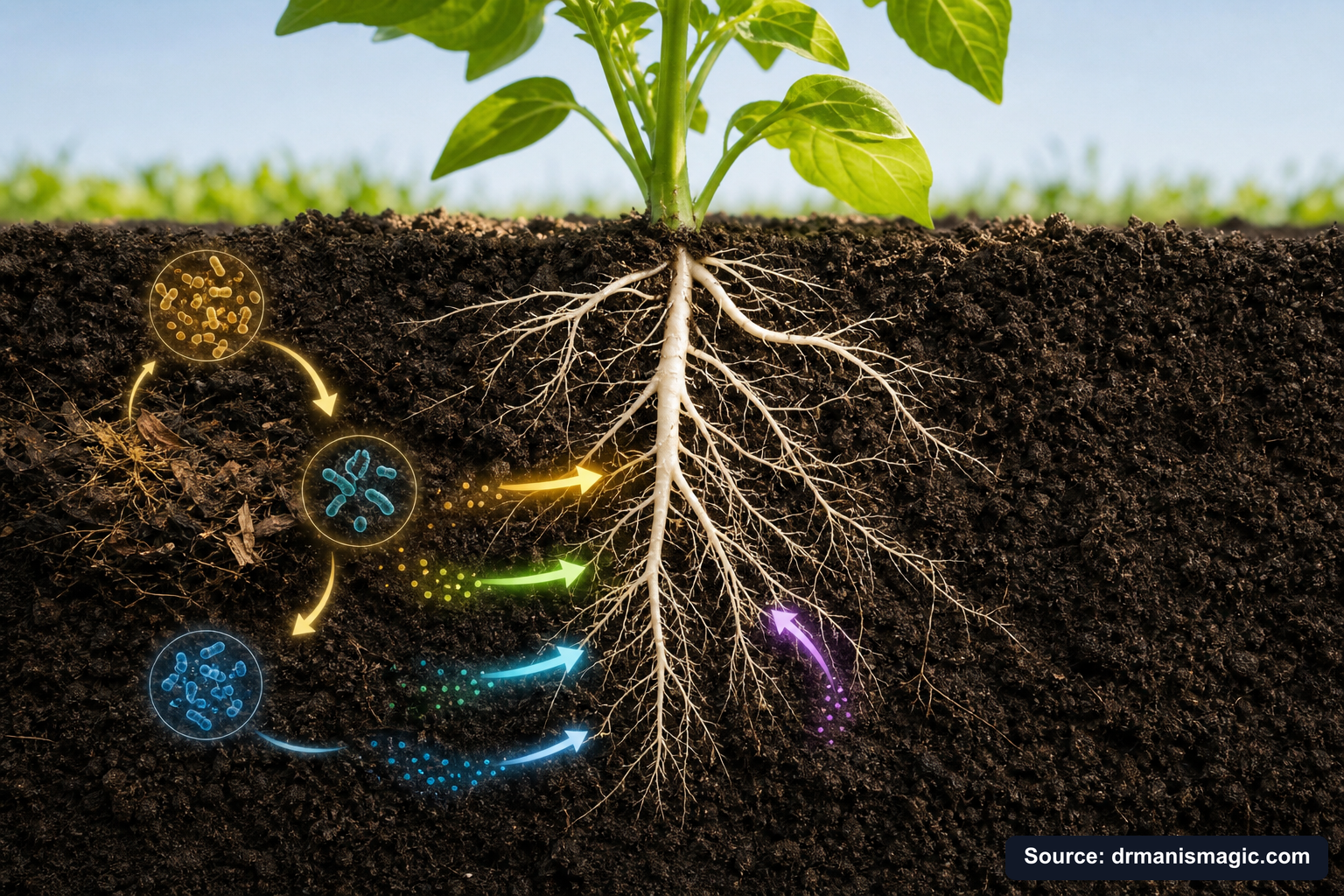
When you apply an organic, protein-based fertilizer to your soil, the plant does not absorb it directly. The microbes eat it first. Bacteria and fungi consume the organic material. They break it down, process it, and convert it into mineral forms of nitrogen, phosphorus, and potassium that plant roots can absorb easily. This process takes days to weeks. It is slow. It is steady. It mirrors exactly the pace at which nutrients become available in a healthy forest or meadow, where no human ever applied a single granule of fertilizer.
Then, when those microbes die and decompose, they release everything they stored directly into the root zone. It is like a second feeding that you never had to pay for or schedule. The organic material feeds the microbes. The microbes feed the plant. The plant feeds the microbes sugar through its roots in return. The whole system is circular and self-reinforcing. It gets better every month instead of declining every month. That is the exact opposite of what happens with salt-based synthetic feeding.
This is Pillar Three of the Three Plant Pillars, the framework Dr. Mani developed and tested across more than 250,000 trees at US Citrus Nursery. Organic fertilizer does not just avoid harming the microbes. It partners with them. And the difference in results is not subtle.
You Never Had a Brown Thumb.
You were handed the wrong tools. This free guide hands you the right ones.
You watered it. You fed it. It died anyway.
It was never you. It was the dirt, the salt food, and the bad advice.
This guide shows you what really went wrong, and how to fix it for good.
- Why your plants really died, and why it was never your fault
- The salt hiding in your plant food that quietly burns the roots
- The hidden killer in almost every bag of store soil
- The tiny helpers that grow a whole forest for free
- The rescue trick that brings a half dead plant back to life

What Makes Crab, Kelp, and Amino Acids Different From Other Organic Fertilizers?
Not all organic fertilizers are created equal. Some organic products use biosludge, which is treated municipal waste, as a filler. Biosludge can carry PFAS, the so-called forever chemicals that accumulate in soil, plants, and human tissue and do not break down. You can find PFAS in both synthetic and some organic fertilizer products. This is not a fringe concern. It is an active area of research at major universities and an increasing regulatory focus across the country. If you grow food in your garden or you have children and pets playing in your yard, this matters.
The ingredients in a clean organic fertilizer tell you everything. Crab shells are rich in chitin, a natural compound that activates a plant's immune system and stimulates beneficial microbial activity, particularly the organisms that suppress fungal root pathogens. Cold-processed kelp delivers natural plant hormones called auxins and cytokinins that regulate root growth, cell division, and stress response. Amino acids provide nitrogen in a form that plants can absorb with almost no metabolic cost. And volcanic ash adds a spectrum of trace minerals including silica, which strengthens cell walls, increases drought resistance, and builds the kind of structural resilience that shows up as thicker stems, glossier leaves, and fruit that holds on the tree instead of dropping.
These are not ingredients designed to produce a quick green flush that fades in two weeks. They are designed to build. And because none of them are salt-based, they do not create osmotic stress. They do not burn root hairs. They do not kill microbes. They work the way nature works: slow, steady, and cumulative.
That is exactly what we formulated into Crab, Kelp & Amino Acids, the organic granular fertilizer we developed for our own nursery and now make available to any plant owner who wants to feed without the damage.
How Do You Know If Salt Is Already Damaging Your Plant Right Now?
Use this diagnostic checklist. Go through it before you water, fertilize, or do anything else.
- Have you fertilized with a synthetic product recently? Within the last two to four weeks is the highest-risk window.
- Is your plant wilting even though the soil feels moist or wet? Classic chemical drought. The roots cannot pull water in despite the moisture being present.
- Are the leaf tips or margins turning brown? This is a late-stage symptom. Root damage has likely been occurring for weeks already.
- Is there a white crust on the soil surface or on the container rim? Visible salt migration. The concentration below the surface is higher than what you can see.
- Are the roots dark, mushy, or slimy when you inspect them? Salt injury has progressed to root rot. The pathogens have moved in.
- Does your EC meter read above 3.0? Reduce inputs immediately and begin a leaching protocol.
- Is the plant in a container with poor drainage? Poor drainage concentrates salt and amplifies every other risk factor on this list.
If you answered yes to two or more of these, salt is a likely contributor to your plant's decline. The good news is that this is diagnosable, treatable, and preventable going forward.
What Does Salt Damage Look Like Compared to Other Common Problems?
| Symptom | Salt / Fertilizer Burn | Underwatering | Root Rot (Fungal) | Nutrient Deficiency |
|---|---|---|---|---|
| Leaf tip / margin burn | Yes, very common | Sometimes, tips first | Rare initially | Rare, usually yellowing |
| Wilting despite wet soil | Yes, key sign | No, soil is dry | Yes, can occur | No |
| White crust on soil | Yes | No | No | No |
| Recent fertilizer application | Yes, typical trigger | No link | No direct link | No, usually absence of feeding |
| Root color when inspected | Brown tips, root hair loss | Dry, shriveled, tan | Dark, mushy, foul smell | Usually white or tan, structurally intact |
| EC reading | High, above 3.0 | Normal or low | Variable | Normal or low |
| Responds to more watering | No, often gets worse | Yes, improves quickly | No, worsens with overwatering | No change from water |
How Do You Rescue a Plant That Has Already Been Damaged by Salt?
First, stop all fertilizer applications immediately. You cannot solve a salt problem by adding more inputs. Give the soil a chance to stabilize.
Second, if the plant is in a container with good drainage, perform a deep leaching. Water slowly and thoroughly, allowing water to flow freely out of the drainage holes for several minutes. Do this three times over the course of a week. Each pass dissolves and carries soluble salts out of the root zone. Check your EC reading before and after to confirm the levels are dropping.
Third, if the roots are already showing signs of rot and the damage is severe in a container, consider repotting into fresh, well-draining mineral-based soil. Remove as much of the old medium as possible. Trim away any dark, mushy root tissue with clean scissors. Let the roots air for fifteen minutes before repotting.
Fourth, once the plant is stabilized, begin rebuilding the microbial population in the root zone. Living bacteria and fungi are your recovery team. They will colonize the root zone, suppress remaining pathogens, and begin the process of making nutrients available again in a gentle, plant-friendly form.
Fifth, when you return to feeding, use only low-salt, organic inputs. Let the biology do the work. Be patient. A root system recovering from salt stress needs weeks to rebuild. The visible response above ground will lag behind the root recovery by several weeks. Do not panic if the leaves look the same for a while. The work is happening where you cannot see it.
Does This Only Apply to Citrus Trees or to All Plants?
Every plant with roots is vulnerable to salt damage. Lawns. Houseplants. Roses. Vegetable gardens. Raised beds. Fruit trees in containers. Ornamental hedges. Perennial flower borders. The mechanism is the same across all of them because osmosis does not care what species of plant it is affecting. The chemistry works the same way whether the roots belong to a Meyer lemon, a tomato plant, a St. Augustine lawn, or a fiddle-leaf fig on your kitchen windowsill.
We know this because we tested it. Our nursery in South Texas grew over 250,000 citrus trees. We also worked with houseplants, tropical trees, ornamentals, and garden beds. The same principles held across all of them. Salt-based inputs hurt roots and kill microbes. Mineral-based soil provides the drainage and aeration that keeps roots breathing. Live microbials rebuild the soil ecosystem. Organic, slow-release nutrition feeds the biology that feeds the plant.
We call this the Three Plant Pillars. It is not a marketing phrase. It is the operating system we built our entire nursery around because it was the only approach that produced consistent, long-term results across every type of plant we grew.
Why Does Time Matter More Than Money When It Comes to Soil Health?
Money is replaceable. Time is not.
Here is the thing about salt-based feeding that nobody puts on the label. It works in the short term. You apply it, you see green growth, you feel good. Then, over months and years, the salt accumulates. The microbes thin out. The roots weaken slowly. The plant becomes less resilient. It starts declining. You buy more products. You try more things. A year passes. Two years pass. The plant never quite thrives. And you never quite figure out why.
The most common thing people tell Dr. Mani when they first reach out to us is that they want to see fruit on their own tree, harvested with their own hands, while they are still healthy enough to enjoy it. That is a deeply human desire. It is not about money. It is about time. And every month spent feeding with inputs that quietly damage the root system is a month lost. A season lost. A year lost.
When the Three Plant Pillars are working together, the biology accelerates. Roots thrive. Nutrients flow freely. Growth happens faster than most people expect. Not because we found some magic shortcut, but because we stopped fighting nature and started working with it. That is the difference between a foundation that builds and a foundation that quietly crumbles.
What Is the Safest Way to Feed Going Forward?
The safest feeding program is one that works with your soil biology instead of against it. Here is what that looks like in practice.
Start with a soil that drains freely and does not compact over time. Organic potting mixes made from bark and wood decompose. As they decompose, they compact, steal oxygen from roots, and create the anaerobic conditions that root pathogens love. A mineral-based soil holds its structure permanently. Roots breathe. Water drains. The environment stays aerobic and healthy.
Add living microbials to the root zone. Bacteria, fungi, and mycorrhizae are not optional extras. They are the infrastructure of a healthy plant. Without them, your plant is on life support. With them, it has a self-sustaining support system that gets stronger every month.
Feed with a complete, low-salt, organic granular fertilizer that contains a full spectrum of macro and micronutrients plus biostimulants. Apply it regularly at modest rates rather than in large, infrequent doses. Let the biology process it slowly. Do not chase quick green flushes. Chase long-term root health. That is what produces the fruit, the blooms, the lush lawn, the thriving garden that you can enjoy season after season without drama.
And test your EC. Know what your soil's salt level is before you feed. It takes sixty seconds and it removes all the guesswork.
After thirty-plus years and more than 250,000 trees, the lesson we keep coming back to is simple. Healthy plants start below the soil surface. Everything you see above ground is just a report card on what is happening in the root zone. Feed the roots. Protect the microbes. Keep the salt out. The rest takes care of itself.
If you want to explore the organic, biology-friendly approach we use at our nursery, start by looking at how we designed our fertilizer from the ground up. Every ingredient was chosen to work with your soil's living system, not against it. You can learn more at drmanismagic.com. Your roots will thank you long before your leaves ever will.
Frequent Asked Questions (FAQ)
Q1. What does fertilizer salt actually do to plant roots underground?
Salt-based fertilizers trigger a chemical process called osmosis that pulls water out of root cells rather than allowing roots to absorb it. When a high-salt fertilizer is applied to soil, the concentration of dissolved particles outside the root becomes greater than inside, forcing water to flow outward from root cells into the surrounding soil. The result is a condition researchers and university extension services call chemical drought — the plant experiences dehydration and water stress even when the soil is completely saturated with moisture. This damage begins underground in the fine root hairs responsible for most water and nutrient absorption, days or weeks before any leaf symptoms appear. By the time brown leaf tips and curling become visible above ground, root damage has typically been occurring silently for weeks already.
Q2. Why do salt levels build up faster in containers and raised beds than in ground soil?
Salt levels accumulate faster in containers and raised beds because there is no natural drainage pathway for excess salt to escape the root zone the way rainfall flushes salt through open ground soil. Every synthetic fertilizer application leaves behind a residual salt load — some is absorbed by the plant and some remains in the growing medium. Each subsequent application adds more. Over months and years, the electrical conductivity of the soil in a container climbs progressively higher with no mechanism for relief. A visible white crust forming on the soil surface or along the container rim is a late-stage warning sign of this accumulation — it is fertilizer salt migrating upward as water evaporates, and it indicates that the salt concentration in the root zone below the surface is already high enough to cause active root damage. Most gardeners wipe the crust away and continue fertilizing, unknowingly worsening the root zone conditions with each additional application.
Q3. What is EC testing and how does it help diagnose salt damage in garden soil?
EC stands for electrical conductivity, a measurement of how many dissolved salts are present in soil or water — the higher the EC reading, the greater the salt concentration and the harder it is for roots to absorb moisture. A simple EC meter costs between fifteen and thirty dollars, is widely available online, and provides a sixty-second diagnosis that removes the guesswork from identifying salt buildup before visible symptoms appear. To test soil, a small sample is mixed with distilled water, allowed to settle, and the meter is dipped into the liquid. Most citrus trees, houseplants, vegetables, and flowering plants perform best at an EC below 2.0 millisiemens per centimeter. Readings above 3.5 place sensitive plants in a danger zone for osmotic stress, and readings above 5.0 make root damage almost certain. Irrigation water can also be tested, since many municipal water systems and private wells carry dissolved mineral loads that add to the soil salt baseline before any fertilizer is applied.
Q4. How does fertilizer salt damage lead to root rot in citrus trees and other plants?
Fertilizer salt leads to root rot through a sequential chain of root zone failures rather than a direct pathogen attack. The process begins when elevated salt concentration causes osmotic stress that injures the fine root hairs responsible for water and oxygen absorption — once those root hairs are damaged, the root tissue becomes oxygen-starved and physically weakened. Opportunistic soil pathogens including Pythium, Fusarium, and Phytophthora are present at low levels in virtually every garden soil, where healthy roots and active microbial communities keep them in check under normal conditions. Salt-stressed, oxygen-deprived root tissue provides no biological resistance, giving these pathogens an easy entry point. The infection spreads through the root system, turning roots dark, mushy, and foul-smelling. The critical diagnostic error most gardeners make is that salt stress and root rot produce nearly identical above-ground symptoms — wilting, yellowing, slow growth, and leaf drop — causing most people to either stop watering or add more fertilizer, both of which worsen a salt-driven root rot situation rather than addressing it.
Q5. How does fertilizer salt kill beneficial soil microbes and why does that matter for plant health?
Salt kills beneficial soil microbes through the same osmotic stress mechanism that injures plant roots — elevated salt concentration in the root zone pulls water out of bacterial and fungal cells, dehydrating and killing them regardless of whether the cell belongs to a root tip or a soil microorganism. A single teaspoon of healthy garden soil contains more living organisms than there are people on Earth, including bacteria, fungi, mycorrhizae, protozoa, and nematodes that collectively form the nutrient cycling, disease suppression, and root extension system plants evolved to depend on. When repeated synthetic fertilizer applications collapse this microbial community, the natural system that supplies the majority of plant nutrition breaks down entirely. The plant becomes completely dependent on external fertilizer applications for every nutrient it receives, because the living biology that previously converted organic matter into plant-available nutrition is no longer functioning. This dependency is self-reinforcing — each fertilizer application adds more salt, kills more microbes, and deepens the plant's inability to feed itself through the natural soil food web it was designed to work with.
Q6. How does organic fertilizer feed plants differently from synthetic fertilizer?
Organic fertilizer feeds plants through a microbe-first biological mechanism rather than delivering immediately soluble nutrients directly to roots in a high-salt solution. When organic fertilizer containing proteins, amino acids, and chitin is applied to soil, the nutrients are not immediately plant-available — soil bacteria and fungi consume the organic material, break it down through a process called mineralization, and convert it into simple mineral forms including nitrate and phosphate that plant roots can absorb. As those microbes complete their life cycle and die, they release all nutrition stored in their cellular bodies directly into the root zone as a second, self-generated nutrient supply. This creates a slow-release system that automatically adjusts to plant growth pace — warm, moist conditions accelerate microbial activity and nutrient release to match faster growth, while cooler, drier conditions slow both processes in synchrony with reduced plant demand. The result is continuous, steady nutrition delivery without salt accumulation, without osmotic stress on roots or microbial cells, and without the dependency cycle that repeated synthetic applications create.
Q7. What are the seven warning signs that fertilizer salt is already damaging a plant right now?
Seven diagnostic indicators suggest fertilizer salt is actively damaging a plant's root system. First, recent synthetic fertilizer application within the last two to four weeks represents the highest-risk window for salt damage onset. Second, wilting despite moist or wet soil is the signature symptom of chemical drought — roots cannot absorb water due to osmotic pressure regardless of soil moisture. Third, brown leaf tips or margins appearing after fertilization are a late-stage sign indicating root damage has been occurring for weeks. Fourth, a white crust on the soil surface or container rim is visible salt migration confirming that below-surface concentration is already at damaging levels. Fifth, dark, mushy, or slimy roots when inspected indicate salt injury has progressed to active root rot with pathogen involvement. Sixth, an EC meter reading above 3.0 millisiemens per centimeter signals immediate need to reduce inputs and begin a salt flushing protocol. Seventh, a container with poor drainage amplifies every other risk factor by concentrating salt with no pathway for excess to escape.
Q8. What is the step-by-step process for rescuing a plant already damaged by fertilizer salt?
Rescuing a plant from fertilizer salt damage requires a five-step recovery sequence that addresses salt concentration, drainage, root damage, soil biology, and future feeding approach in the correct order. The first and most critical step is stopping all fertilizer applications immediately — adding more inputs before salt levels stabilize will deepen root damage regardless of what product is used. Second, for container plants with adequate drainage, deep leaching is performed by watering slowly and thoroughly three times over one week, allowing water to flow freely through drainage holes for several minutes each pass to dissolve and carry soluble salts out of the root zone, with EC readings taken before and after to confirm levels are dropping. Third, if roots already show dark, mushy rot in a container, repotting into fresh mineral-based soil is necessary — removing as much old growing medium as possible, trimming damaged root tissue with clean scissors, and allowing roots to air for fifteen minutes before repotting. Fourth, once the plant is stabilized, living microbial inoculants are introduced to rebuild the beneficial bacteria and fungi population that will suppress remaining pathogens and restore natural nutrient cycling. Fifth, when feeding resumes, only low-salt organic inputs are used, with the expectation that above-ground visual recovery will lag several weeks behind root recovery as the biological system rebuilds.
Q9. Does fertilizer salt damage apply only to citrus trees or to all types of plants?
Fertilizer salt damage applies equally to every plant with roots regardless of species, growing environment, or geographic location, because osmosis operates as a universal chemical law that does not differentiate between plant types. The same salt-driven osmotic stress mechanism that injures citrus feeder roots in a South Texas container affects Meyer lemon trees, tomato plants, St. Augustine lawn grass, houseplants including fiddle-leaf figs, roses, vegetable garden beds, raised beds, ornamental hedges, and perennial flower borders in exactly the same way. The electrical conductivity thresholds that trigger root damage are consistent across sensitive plant species, and the sequence from salt stress to microbial collapse to root rot follows the same chain of events underground whether the plant is a mature fruit tree or a newly germinated seedling. The Three Plant Pillars framework — mineral-based soil for drainage and aeration, live microbials for nutrient cycling and disease suppression, and organic slow-release fertilizer that feeds biology rather than burning it — produces consistent results across all plant types for exactly this reason.
Q10. What is the safest long-term fertilizer program for protecting root health in citrus trees, containers, and garden beds?
The safest long-term fertility program for root health in citrus trees, containers, and garden beds is built on three non-substitutable foundations applied together rather than in isolation. Mineral-based soil made from silica-rich sandy loam that does not decompose, compact, or steal oxygen from roots over time provides the permanent drainage structure and aeration that keeps the root zone aerobic and resistant to the conditions that allow root rot to develop — unlike bark and wood-based potting mixes that collapse into oxygen-depleting sludge within months. Living microbials including bacteria, fungi, and mycorrhizae applied to the root zone provide the biological infrastructure for natural nutrient cycling, disease suppression, and root system extension that University of Minnesota Extension research confirms can supply the majority of plant nutritional needs without synthetic fertilizer input. Complete organic granular fertilizer containing crab shell chitin for immune activation and slow-release calcium, cold-processed kelp for natural growth hormones and trace minerals, and amino acid nitrogen for direct low-cost plant uptake provides full-spectrum nutrition without any salt index impact on roots or soil biology. EC testing before each feeding application removes the guesswork from salt monitoring, ensuring inputs are adjusted before damage begins rather than after visible symptoms appear.


