


Soil as Infrastructure for Roots and Biology: Why Pore Space Matters | Dr. Mani's Magic
Your Plant Is Suffocating. Here's the Invisible Reason Why.
You did everything right. You bought a beautiful plant from the nursery. You picked a nice pot. You watered it. You set it in a sunny spot. And for a few weeks, maybe even a few months, it looked incredible.
Then something changed. The leaves went yellow. Growth stalled. You watered more. Then less. You Googled "why is my plant dying" at 11pm and got seventeen different answers. Root rot. Overwatering. Underwatering. Too much sun. Not enough sun. You tried them all. And still, slowly, quietly, your plant kept declining. Meanwhile, the weeds in your yard — the ones you never water, never fertilize, never think about — are thriving like they own the place.
Here's the truth no one at the garden center told you. The problem almost certainly started underground. Inside the pot. Inside the soil itself. Not because you watered wrong. Because you planted your tree in the wrong infrastructure. And by the time you finish this article, you will understand something that most gardeners never figure out — something that changes everything about how you grow plants for the rest of your life.

Plant Super Boost
Key Takeaways
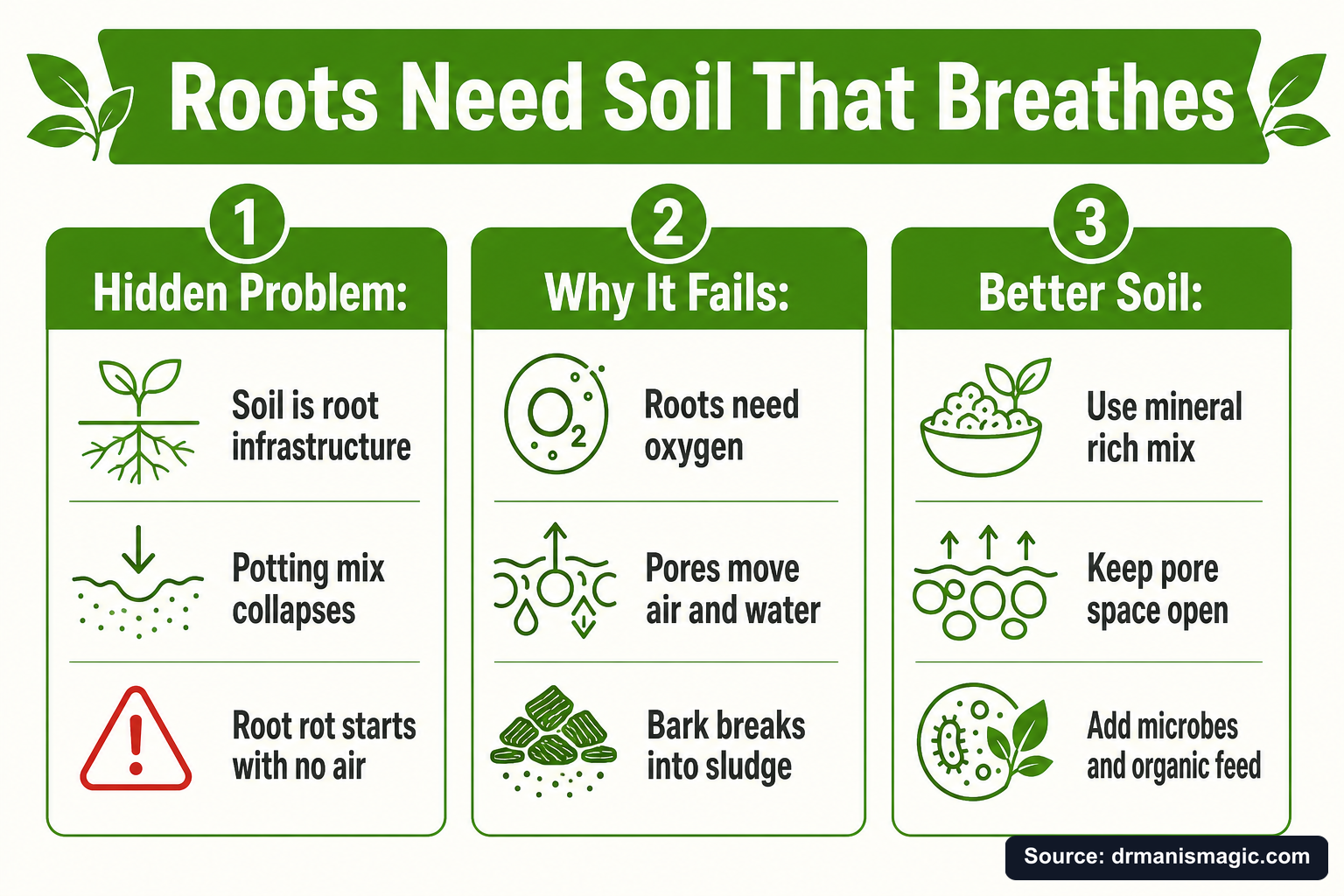
- Soil is not just filler. It is the oxygen, water, and biological infrastructure that keeps roots alive.
- Roots need oxygen to breathe, and when pores fill with water or decomposing material, roots suffocate.
- Standard potting mix is mostly pine bark sawdust. It decomposes, collapses, and steals oxygen from roots.
- Mineral-based, silica-rich soil does not decompose. It holds its structure for years, keeping pores open and roots breathing.
- Root rot is not just an overwatering problem. It is an infrastructure failure — oxygen lost, pores collapsed, pathogens in.
- The Three Plant Pillars — mineral soil, live microbes, organic fertilizer — give roots everything they need to thrive long-term.
- After growing over 250,000 trees at our South Texas nursery, we built a soil system that solves this problem permanently.
Why Do Roots Need Air Underground?
Quick Answer: Roots breathe oxygen just like you do. They use it to power nutrient uptake, water absorption, and cell growth. Without a steady supply of oxygen flowing through connected air-filled pores in the soil, roots slow down, turn brown, and rot — even if the plant above ground looks fine for a while.
This surprises a lot of people. Plants make oxygen, right? They breathe in carbon dioxide and breathe out oxygen. So why would roots need air?
Here is the key: the leaves and the roots are doing completely different jobs. The leaves handle photosynthesis. The roots handle respiration. And root respiration needs oxygen from the soil — not carbon dioxide from the air.
Think of it like a house. The roof collects solar energy. But the furnace in the basement needs fuel to run. Cut off the fuel and the furnace dies, no matter how much sunlight hits the roof.
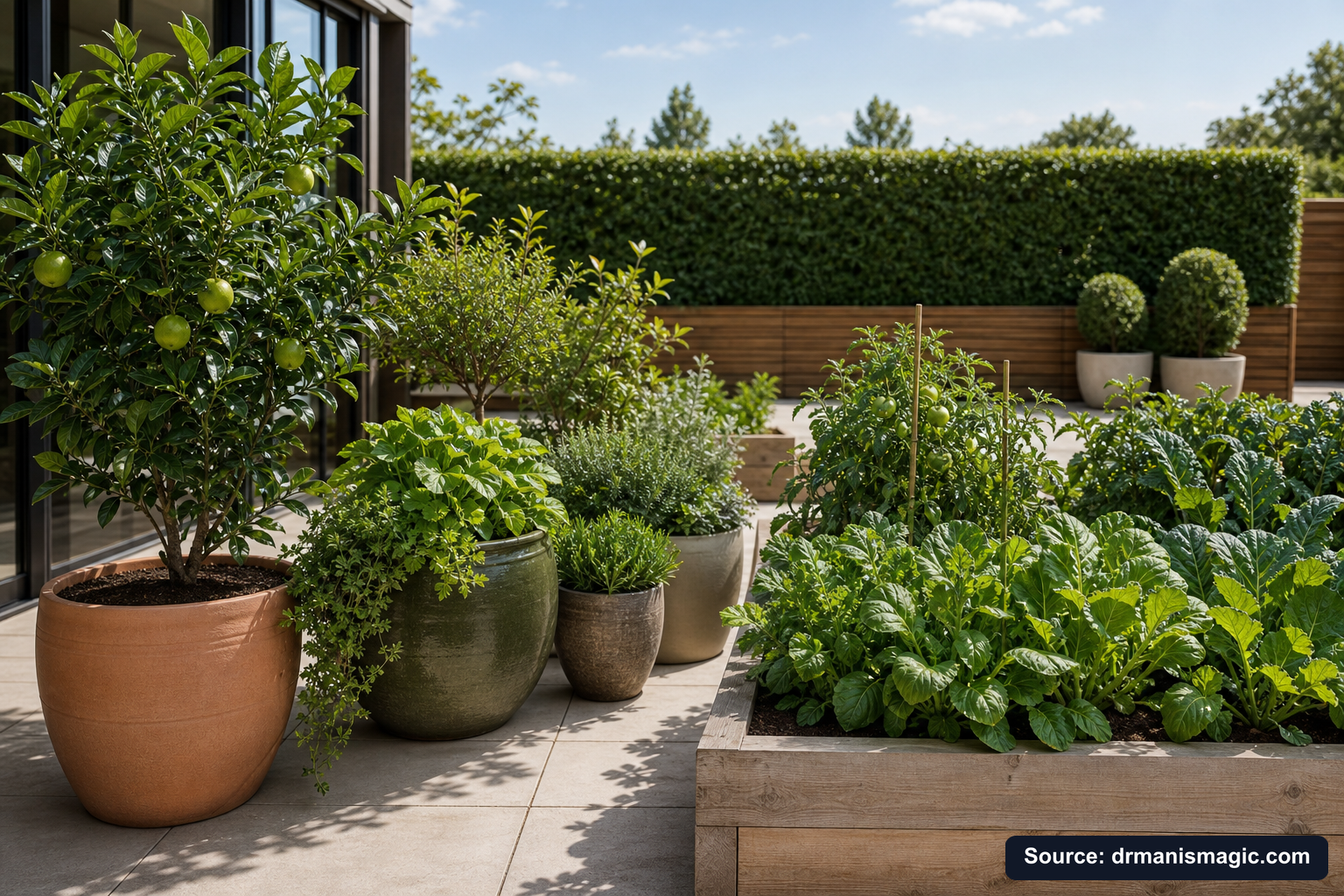
According to Penn State Extension, oxygen is essential for root respiration, and when soil pores become saturated with water or collapse from compaction, roots begin to fail within hours. The same principle holds whether you are growing a lemon tree on a patio, a fiddle-leaf fig in a living room, or tomatoes in a raised bed.
Oxygen moves through soil the same way it moves through a sponge. Air travels through connected, open pores. When those pores are full of water, there is no room for air. When those pores collapse — because the material around them has broken down — the air pathways close permanently. And that is when the real trouble begins.
What Is Soil Pore Space and Why Does It Matter More Than Nutrients?
Quick Answer: Soil pore space is the empty space between soil particles where air and water travel. Good container media has up to 85% pore space. When pores collapse from decomposition or compaction, oxygen cannot reach roots. No amount of fertilizer fixes a suffocating root system.
Iowa State University Extension notes that quality container media can be roughly 85% pore space, compared to about 50% in ideal field soil. That number sounds wild until you understand what it means.
In a container, roots cannot spread out sideways into fresh ground like they can in a garden bed. Everything the plant needs — air, water, nutrients, microbial partners — must exist inside that pot. So the architecture of the soil itself becomes the whole world for your roots.
Picture a freshly opened bag of popcorn. Lots of fluffy space. Lots of air. Now picture that same popcorn after someone sat on it. Flat. Dense. No air pockets left. That is what happens to pine-bark potting mix inside a container over six to twelve months.
Here is what a healthy pore system does for your roots:
- Holds water in small pores so roots can drink over time
- Drains excess water out of large pores so oxygen can flow back in
- Creates pathways for carbon dioxide to escape the root zone
- Gives beneficial soil microbes room to live and move
- Anchors the root system so the plant stays upright
When the pore structure collapses, all five of those functions fail at once. That is not a watering problem. That is an infrastructure collapse.
Why Does Potting Mix Collapse Over Time?
Quick Answer: Standard potting mix is mostly decomposed pine bark — an organic, carbon-based material. All organic matter eventually breaks down further. As it does, the particles get smaller, pores disappear, and the mix compacts into a dense, oxygen-blocking sludge. This usually starts within six months.
Here is the uncomfortable truth the garden center will never put on the bag: you are planting your tree in other dead trees.
That is not a metaphor. Potting mix is primarily pine bark sawdust — a waste byproduct from the timber industry. It is cheap, it is abundant in the southeastern United States, and it is lightweight. Those qualities are great for nursery profit margins. They are not great for your roots.
Pine bark is organic. All organic matter is carbon-based. And all carbon-based materials decompose. That is a law of nature, not a suggestion.
But here is the part that makes this particularly bad for container plants: the decomposition process consumes oxygen. The same oxygen your roots desperately need. So as your potting mix breaks down, it is actively stealing oxygen from your root zone while simultaneously collapsing the physical structure that carried oxygen in the first place.
You lose twice. Every single time.
And it gets worse. Pine trees are not gentle plants. They produce a family of chemical compounds called terpenes and terpenoids — nature's chemical defense system. You already know some of them by name. Pine-Sol. Turpentine. These are real compounds derived from pine chemistry. Great for cleaning floors. Not great for a root zone.
To reduce those harsh chemicals before selling the bark as potting mix, manufacturers let it sit in enormous piles — decomposing — for months or years. They are literally pre-composting it to make it less toxic. But now you have a material that is already deep into the decomposition process before it ever touches your plant's roots.
Then, because decomposing wood naturally repels water, manufacturers add surfactants — synthetic wetting agents — to help the mix hold moisture. For a while, this works. Then the surfactants wash away. And suddenly your potting mix becomes hydrophobic. It repels water. It dries into a hard, shrunken block that pulls away from the sides of the pot. Water runs straight down the gap and out the bottom without ever touching the root ball.
You water. Nothing happens. You water more. Still nothing. The plant wilts. You panic. Sound familiar?
This is not your fault. This is infrastructure failure by design.
Potting Mix vs. Mineral-Based Soil: What Is the Real Difference?
Quick Answer: Potting mix is organic and decomposes within months, collapsing pore space and stealing root oxygen. Mineral-based soil is silica-based, like ground-up rock, and does not decompose. It holds its structure permanently, keeping pores open and roots breathing for years — even decades.
| Feature | Standard Potting Mix | Mineral-Based Soil |
|---|---|---|
| Primary material | Pine bark / sawdust (organic, carbon-based) | Silica-rich sandy loam (inorganic, mineral-based) |
| Decomposes? | Yes — within 6 to 12 months in a container | No — silica does not decompose |
| Oxygen delivery over time | Declines rapidly as pores collapse | Stays consistent — pores remain open |
| Water behavior over time | Becomes hydrophobic; repels water when dry | Consistent drainage and moisture retention |
| Structural stability | Shrinks, compacts, pulls from pot walls | Holds weight, anchors roots, stays stable |
| Root rot risk | High — pore collapse invites pathogens | Low — open structure keeps roots oxygenated |
| Lifespan in a container | 6 months before significant decline | Years — potentially permanent |
| Pine chemistry in root zone | Yes — terpenes, terpenoids present | None |
| Needs replacement? | Yes — regularly | No — a one-time investment |
Here is the short version: organic materials come and go. Minerals stay forever. Rocks do not decompose. That is why the greatest gardeners in history — from the ancient Romans to the Japanese bonsai masters — built their soil systems around mineral components, not wood waste.
Bonsai practitioners have known this for centuries. Their trees live for hundreds of years in tiny containers. The secret is a mineral-heavy substrate — pumice, akadama, decomposed granite — that never collapses. Roots breathe. Water drains. The tree thrives across generations.
What did the big box store put in your pot? Pine sawdust. Collected last Tuesday.
What Is the Perched Water Table and Why Does Your Pot Height Matter?
Quick Answer: Even after a pot drains from the bottom, a zone of water-saturated soil always sits at the base of the container. This is called the perched water table. In short, shallow pots with dense media, this saturated zone can fill most of the root zone and suffocate roots — even when drainage holes are open.
This is one of the most important concepts in container gardening. And almost nobody talks about it.
When water enters a pot, gravity pulls it down. Eventually, it drains out the bottom. But not all of it. A layer of saturated soil always stays at the bottom of the container, held there by capillary forces — the same forces that make a paper towel soak up water even when you hold it sideways.
This layer of permanently wet soil is called the perched water table. And it exists in every pot, no matter what you do.
In a tall pot with coarse, mineral-based media, the perched water table might only occupy the bottom two inches. The rest of the root zone stays aerated. Roots breathe. Life is good.
In a short pot with fine, organic potting mix, that same saturated zone might fill half the container. Roots sit in oxygen-depleted, waterlogged conditions permanently. And you wonder why your plant looks stressed after watering.
This is also why the same potting mix behaves differently in different containers. A mix that works okay in a tall nursery pot can suffocate roots in a shallow decorative bowl. The physics change. The biology suffers.
UC IPM research describes this phenomenon as an aeration deficit — a combination of insufficient oxygen, excess moisture, and increased susceptibility to root-decay pathogens. It is not overwatering. It is infrastructure failure in the root zone.
Root Rot vs. Overwatering: What Is Actually Happening?
Quick Answer: Root rot is not caused by water alone. It is caused by oxygen loss in the root zone. Water fills the pores that should carry oxygen. Decomposing organic media makes this worse by collapsing pore space. Once roots are weakened from oxygen starvation, fungal pathogens move in and finish the job.
Everyone says "you overwatered it." That phrase has sent millions of gardeners down the wrong path.
Water alone does not kill roots. Oxygen deprivation does. Water is simply the delivery mechanism for the real problem — pore space that is full of liquid instead of air.
Think about this: rice grows in standing water. Lotus plants thrive in ponds. Mangroves live in saltwater swamps. Water by itself is not the enemy. The enemy is a root zone with no oxygen pathways left.
Here is the real sequence of events in a root rot situation:
- Potting mix begins to decompose and collapse.
- Pore space shrinks. Oxygen pathways narrow.
- Water stays in the remaining pores longer because there is nowhere else to go.
- Root cells, starved of oxygen, begin to die.
- Dead and dying root tissue becomes food for fungal pathogens like Phytophthora and Pythium.
- The pathogens spread. More roots die. The plant above ground starts showing stress.
- You add more water trying to help. The cycle accelerates.
The pathogens did not cause the problem. They arrived after the infrastructure failed. They are opportunists, not assassins. Fix the infrastructure and you take away their home.
After growing over 250,000 trees at our South Texas nursery, we saw this pattern so many times that Dr. Mani Skaria — Professor Emeritus of Plant Pathology, inventor of micro-budding, and founder of the Clean Citrus Program in Texas — made it his mission to engineer a soil system that removes oxygen loss from the equation entirely.
You Never Had a Brown Thumb.
You were handed the wrong tools. This free guide hands you the right ones.
You watered it. You fed it. It died anyway.
It was never you. It was the dirt, the salt food, and the bad advice.
This guide shows you what really went wrong, and how to fix it for good.
- Why your plants really died, and why it was never your fault
- The salt hiding in your plant food that quietly burns the roots
- The hidden killer in almost every bag of store soil
- The tiny helpers that grow a whole forest for free
- The rescue trick that brings a half dead plant back to life

How Do You Diagnose Root Health in a Container Plant?
Quick Answer: Healthy roots are white or cream-colored, firm, and branched. Unhealthy roots are brown, gray, slimy, or mushy. But you can also diagnose root zone problems from above-ground symptoms — yellow leaves, wilting after watering, and no new growth are all signs that oxygen is not reaching the roots.
| Symptom You See | What It Usually Means Underground | Root Infrastructure Issue |
|---|---|---|
| Yellow leaves, no new growth | Roots cannot uptake nutrients | Pore collapse, oxygen deficit |
| Wilting after watering | Roots too damaged to absorb water | Advanced root rot from aeration failure |
| Soil dries unevenly | Hydrophobic zones in decomposed media | Surfactant washout in organic mix |
| Water runs straight through pot | Soil pulled from pot walls; root ball bypassed | Media shrinkage from decomposition |
| Musty or sour smell from soil | Anaerobic bacterial activity | Zero oxygen in root zone — emergency |
| Brown, slimy roots on inspection | Active root rot pathogen infection | Infrastructure has already failed |
| Plant declines after year one | Potting mix has passed its structural lifespan | Organic media decomposed and compacted |
If you see two or more of these symptoms together, your soil infrastructure has likely failed. The good news is that once you understand the root cause — literally — you can fix it. Here is a practical recovery checklist:
- Gently remove the plant from its pot and inspect the roots. Healthy roots are white and firm. Rotten roots are brown and mushy.
- Trim away all dead, brown, or slimy roots with clean scissors.
- Let the roots air-dry for thirty to sixty minutes in a shaded spot.
- Choose a container with excellent drainage — tall enough to keep the perched water table away from the primary root zone.
- Repot into a mineral-based, silica-rich growing medium that will not decompose and collapse.
- Water gently and do not fertilize for two to three weeks — give the roots time to recover and re-establish.
- Once new growth appears, introduce live microbials to rebuild the biological ecosystem around the roots. See also: Why Dead Microbe Products Fail in Real Gardens
What Are the Three Plant Pillars and Why Do They Work Together?
Quick Answer: The Three Plant Pillars are mineral-based soil, live microbials, and organic fertilizer. Each pillar solves a different root-zone problem. Together, they create the physical structure, biological activity, and nutritional environment that plants evolved in. Miss one pillar and the other two cannot fully work.
After decades of testing at US Citrus Nursery — through 250,000 trees, through failures and breakthroughs, through South Texas heat that would wilt your courage along with your plants — Dr. Mani Skaria landed on a framework so clear and so rooted in plant science that it works for any plant, anywhere.
He called it the Three Plant Pillars.
Here is why each one matters — and why they only work as a team:
Pillar One: Mineral-Based Soil. This is the physical infrastructure. Silica-based, inorganic, and permanent. It does not decompose. It does not steal oxygen. It holds its pore structure for years, giving roots room to breathe, water to drain, and biology to flourish. This is the foundation everything else rests on.
Pillar Two: Live Microbials. Healthy soil is alive. Bacteria, fungi, and mycorrhizae form a microscopic ecosystem around every root tip. They unlock nutrients the plant cannot reach alone. They produce hormones that stimulate root growth. They physically protect roots from pathogens. Without them, your plant is defenseless — a soldier with no armor. With them, your root zone becomes a self-regulating, disease-resistant ecosystem.
Pillar Three: Organic Fertilizer. Plants need nutrients. But the way you deliver those nutrients matters enormously. Salt-based synthetic fertilizers burn roots, destroy beneficial microbes, and create a cycle of dependency that keeps you buying more product while your plant gets weaker. Organic, slow-release nutrition — derived from crab, kelp, and amino acids — feeds both the plant and the microbial community at the same time. It works with nature instead of against it.
Pull out any one pillar and the whole system wobbles. Great soil with dead microbes is just a sterile medium. Great microbes in decomposing potting mix get suffocated along with the roots. Great fertilizer in a collapsed, oxygen-starved root zone just feeds the pathogens.
All three together? That is when the magic happens.
See also: The Hidden Reason Synthetic Fertilizers Cause Root Rot
Why Does Mineral-Based Soil Beat Organic Potting Mix for Long-Lived Plants?
Quick Answer: Annual plants live fast and die within one season, so temporary potting mix is not a disaster. But perennial trees, shrubs, and houseplants live for years or decades. Their roots need stable, permanent infrastructure. Organic potting mix collapses in months. Mineral soil holds its structure for the life of the plant.
There is a reason big box stores love potting mix. Their business model is built on annual plants — petunias, tomatoes, impatiens. Buy them in spring. They die in fall. Come back next spring and buy more.
For that business model, it does not matter that the potting mix collapses in six months. The plant will be dead or replaced before the problem becomes obvious.
But you are not trying to grow a petunia. You want a lemon tree that fruits for twenty years. A fiddle-leaf fig that fills your living room corner. An olive tree on your patio that your kids will one day show their kids. You want something that lasts.
And here is the painful truth about time: you can get money back, but you cannot get time back. Every year a plant spends struggling in collapsed, oxygen-starved potting mix is a year it does not grow, does not fruit, does not thrive. People ask us all the time — with real emotion in their voices — whether they will ever get to see fruit on their own tree. Whether they planted it in time. Whether the right system could have gotten them there sooner.
The answer is yes. With the right infrastructure, yes.
The ancient Romans grew olive trees in containers for centuries using mineral-heavy, sandy growing media. Japanese bonsai masters grow trees in tiny pots for generations — not with potting mix, but with volcanic mineral substrates that hold their structure across lifetimes. These are not accidents. These are people who understood that the growing medium is infrastructure, not decoration.
The only things that last in a pot are minerals. Everything else breaks down.
What Makes Dr. Mani's Magic Super Soil Different From Everything Else?
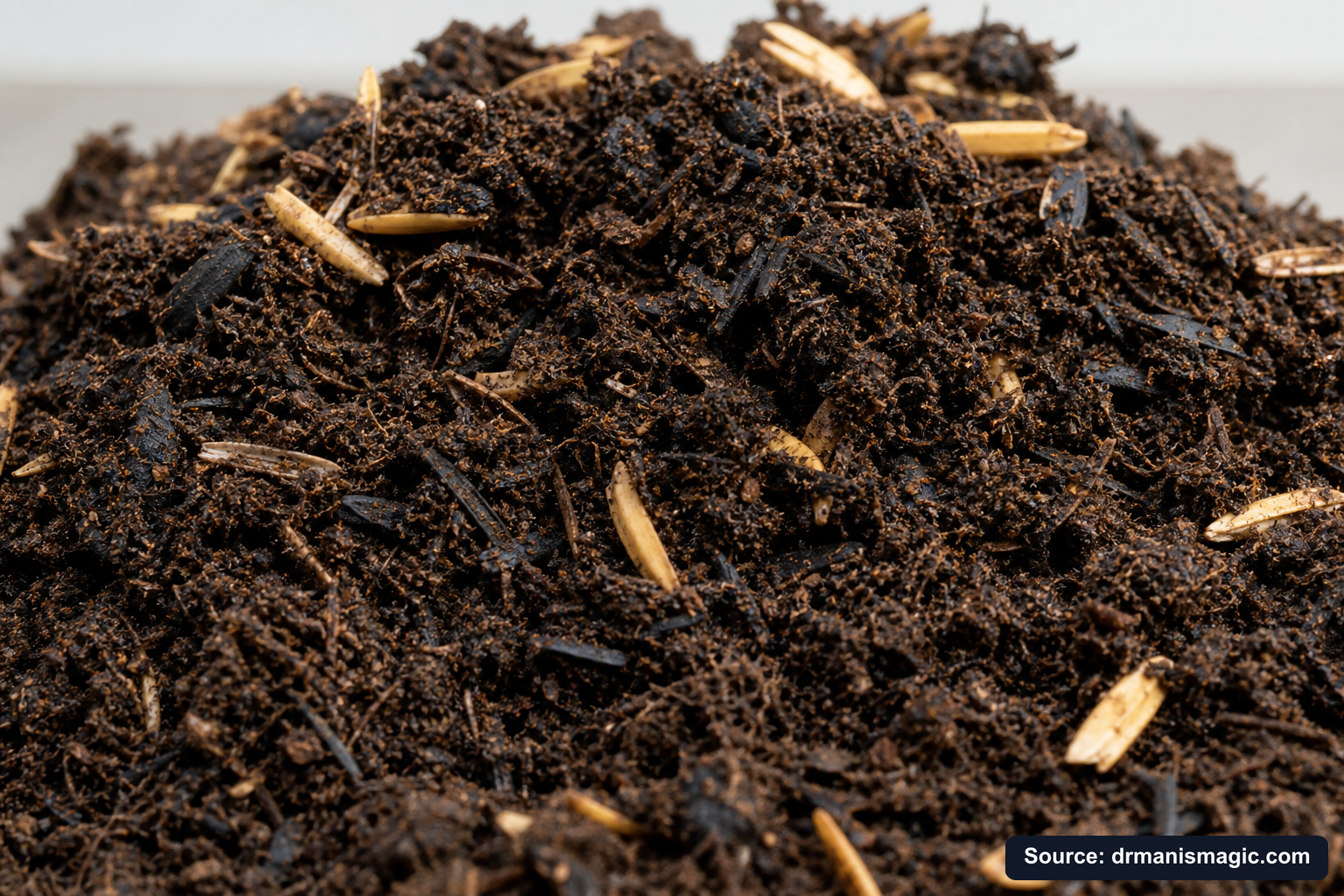
Quick Answer: Super Soil is built on steam-sterilized, silica-rich sandy loam from South Texas — a mineral base that does not decompose. It is blended with coco coir, rice hulls, and biochar for optimal pore structure. It contains zero synthetic salts, zero biosludge, and zero PFAS. It is designed to be a permanent growing medium, not a temporary patch.
Dr. Mani did not set out to create a product. He set out to solve his own problem.
At US Citrus Nursery in Hargill, Texas, he was growing thousands of grafted citrus trees. And he kept watching the same thing happen: trees started strong, then declined. Not because of watering mistakes. Not because of pests. Because the soil they were in stopped working. It decomposed. It compacted. It stole their oxygen and handed the root zone to pathogens.
So he built his own soil. From scratch. Starting with what nature uses — silica-rich sandy loam from the Rio Grande Valley. Inorganic. Permanent. Steam-sterilized to eliminate any pathogens before a single root touches it. Then blended with coco coir for moisture balance, rice hulls for long-lasting aeration, and biochar to create a permanent home for beneficial microbes.
The result is Super Soil — a growing medium that does not break down, does not become hydrophobic, does not require replacement every season. You plant in it once and it keeps working. Zero synthetic salts. Zero biosludge. Zero PFAS. Backed by a 30-day money-back guarantee because Dr. Mani knows it works.
This is not a product that was designed to sell. It was designed to grow. There is a difference.
How Do Live Microbes Make Soil Infrastructure Even More Powerful?
Quick Answer: Mineral-based soil creates the physical infrastructure — the open pores, drainage, and aeration. Live microbes — bacteria, fungi, and mycorrhizae — make that infrastructure biologically active. They colonize the pore spaces, protect roots from pathogens, unlock nutrients from the soil, and create a self-sustaining root ecosystem that keeps improving over time.
Imagine building the most beautiful highway in the world. Wide lanes. Perfect asphalt. Every on-ramp exactly right. Now imagine leaving it empty. No cars. No trucks. No commerce. Just a beautiful, useless road.
That is mineral soil without microbes.
The pore structure is your highway system. The microbes are the traffic that makes it mean something. Together, they create a living root zone that does things no fertilizer or pesticide can replicate.
Mycorrhizal fungi extend root reach by up to ten times. Beneficial bacteria produce hormones that stimulate root branching. Microbes physically outcompete pathogens for space and resources, making root rot far less likely. They convert organic matter in the soil into forms plants can actually use.
The Plant Super Boost that Dr. Mani developed uses a special stabilization process to keep live bacteria, fungi, and mycorrhizae genuinely alive in the bottle — not dead cultures that look good on a label but deliver nothing to your roots. Mix it with water and drench your soil monthly. You are re-seeding the biological ecosystem every time.
And unlike fish emulsion or other organic liquid products that go anaerobic and smell like a swamp, Plant Super Boost smells like fresh earth. Because it is not rotting. It is alive.
What Is the Long-Term Vision for Your Soil?
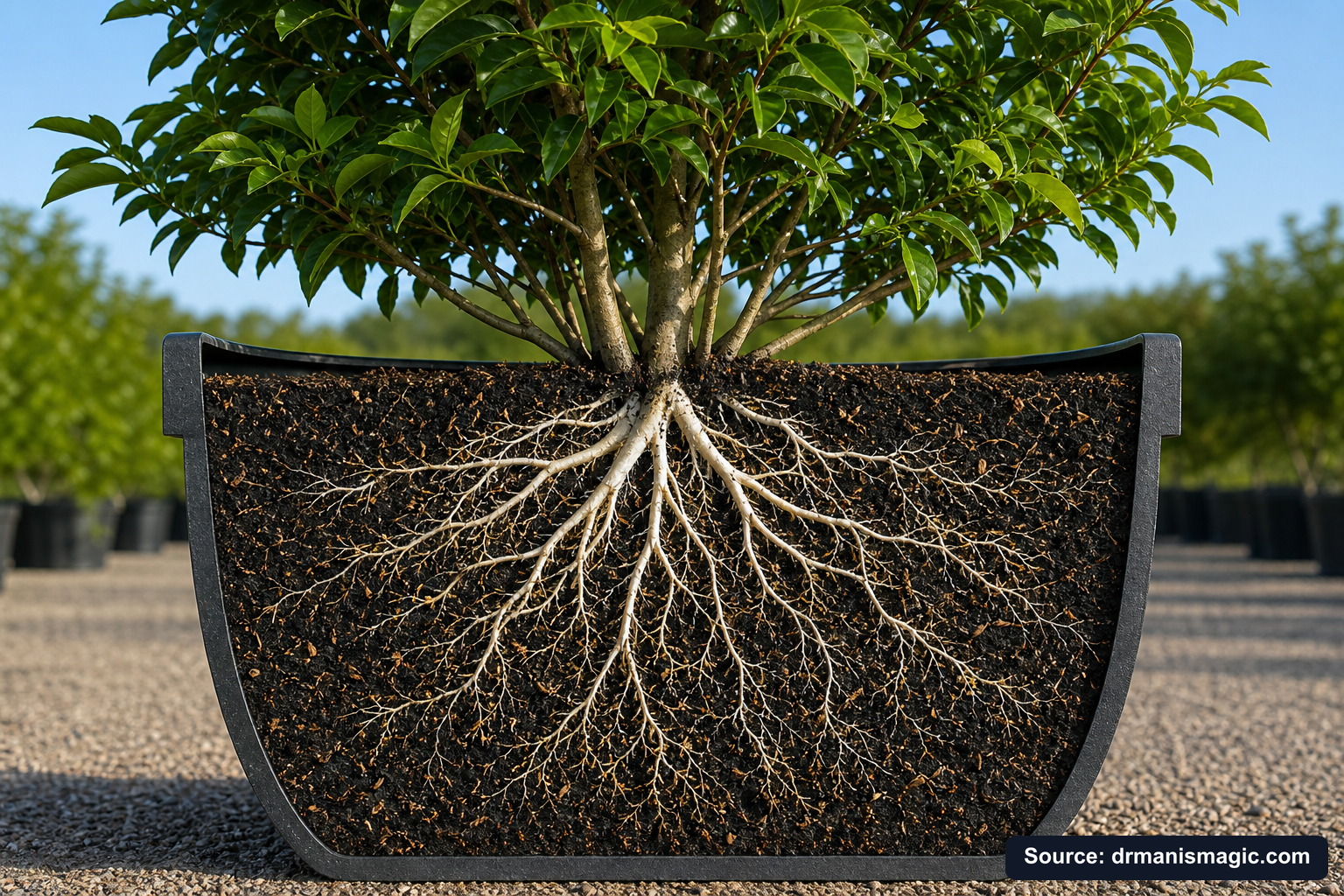
Quick Answer: The goal is a self-sustaining, biologically active root zone that improves over time rather than declining. Mineral-based infrastructure plus live microbes plus organic nutrition creates a system that mimics the natural soil ecosystem — getting richer and more resilient with every season instead of compacting and collapsing.
Most potting advice focuses on the short term. What to add this month. What to spray next week. Which product to buy for this problem.
We think about years. Decades. The tree you plant today that your grandchildren will pick fruit from.
When the infrastructure is right — when mineral pores stay open, when microbes colonize the root zone, when slow-release organic nutrition feeds both the plant and the biology — something remarkable happens. The system gets better over time. Microbial populations grow. Organic matter in the biochar holds more nutrients. Roots deepen and branch. The plant becomes, in the truest sense, bulletproof.
That is the opposite of what happens with potting mix. Potting mix starts declining the day you open the bag. Mineral-based soil with live biology starts improving the day you plant.
One trajectory goes down. The other goes up. You choose which one your plants live on.
For a complete, step-by-step walkthrough of how to set up all Three Plant Pillars for any plant — trees, houseplants, gardens, or lawn — download the Free Plant Care Field Guide. It is the same system Dr. Mani built for 250,000 trees at US Citrus Nursery, translated into plain language anyone can follow. No guesswork. No late-night Googling. Just roots that breathe, biology that thrives, and plants that flourish the way nature always intended.
Frequently Asked Questions
Most gardeners never think about what is happening underground. But soil structure is the hidden reason plants thrive or slowly die. These questions come up again and again from real growers, and the answers will change how you think about every plant you own.
How does soil structure affect root growth?
Soil structure controls whether roots can breathe, drink, and push outward. When soil has open pores, roots get the oxygen they need to absorb water and nutrients. When pores collapse from compaction or decomposing organic material, roots suffocate and stop growing. Dr. Mani's Magic Super Soil uses mineral-based sandy loam that holds its structure permanently, keeping those pores open so roots can spread freely and grow strong.
What soil properties matter most for root development?
Drainage, aeration, and structure are the big three. A soil that drains well but still holds some moisture gives roots room to breathe and drink. Most bagged potting mixes are made from pine bark and sawdust. Those materials break down fast, collapse into a soggy mess, and choke roots. Mineral-based soil does not decompose. It stays open and airy for years, which is exactly why we built Super Soil around silica-rich sandy loam from South Texas.
What happens to roots when soil breaks down over time?
As organic potting mix decomposes, it compacts. Air pockets disappear. Water sits instead of draining. Roots run out of oxygen and start to rot from the outside in. The plant above ground looks okay for a while, then suddenly crashes. This is not overwatering. This is an infrastructure failure. We proved this across 250,000 trees at our South Texas nursery. The fix is soil that does not break down in the first place.
Why is soil structure so important for plants in containers?
Container plants cannot send roots sideways into fresh ground the way in-ground trees can. They are completely dependent on what is inside that pot. If the soil collapses, there is nowhere to go. Oxygen disappears. Nutrients lock up. That is why soil structure is even more critical in a pot than in the ground. Super Soil was designed specifically for container growing, using mineral ingredients that stay loose and airy no matter how long your plant sits in the pot.
Are roots responsible for building soil structure over time?
Yes, roots actually help build and hold soil together. They create channels for air and water, and they feed the microbes that glue soil particles into healthy clumps called aggregates. But here is the catch: roots can only do this work when the soil gives them room to start. That is why Pillar One of Dr. Mani's Three Plant Pillars is mineral-based soil. You give roots a strong foundation first, and then the roots and microbes improve that foundation together over time.
What happens when soil structure is poor?
Poor soil structure means waterlogging, oxygen loss, and root death. Earthworms and beneficial microbes die off. Nutrients cannot move. Disease spreads fast. Research shows that even a small drop in soil porosity can cut crop yields by 20 percent or more. For your backyard tree or houseplant, poor structure means slow decline that looks like a watering problem or a fertilizer problem, when the real issue started in the soil long before you noticed anything wrong.
How do microbes connect to soil structure and root health?
Microbes are the living glue of healthy soil. Bacteria and fungi bind soil particles together, create stable pore spaces, and unlock nutrients that roots cannot reach on their own. Without them, even good soil starts to fall apart over time. That is why Pillar Two of the Three Plant Pillars is live microbials. Dr. Mani's Magic Plant Super Boost delivers live bacteria, fungi, and mycorrhizae straight to your roots. It does not smell bad. It just works, the same way it worked on over 250,000 trees in our South Texas nursery.
About the Author
Ron Skaria, MD
Ron Skaria, MD, is the co-founder of Dr. Mani's Magic and the son of Dr. Mani. He trained as a medical doctor at Baylor College of Medicine, did his residency at UT Health Science Center - San Antonio and fellowship training at Texas Tech University. He now works full time on the family farm at US Citrus and US Citrus Nursery in Hargill, Texas, building Dr. Mani's Magic alongside his dad. He wrote the Brown Thumb Field Guide to put his father's 48 years of plant science into plain words any gardener can use. His belief is simple. You never had a brown thumb. You just never had the right help.


