


Why Potting Mix Breaks Down So Fast (And What to Do About It) | Dr. Mani's Magic
Why Potting Mix Breaks Down So Fast (And What No One Is Telling You)
You buy a fresh bag of potting mix. It smells earthy and clean. You fill the pot, push the roots in, and water it. The plant looks great for a few weeks. Maybe even a couple of months.
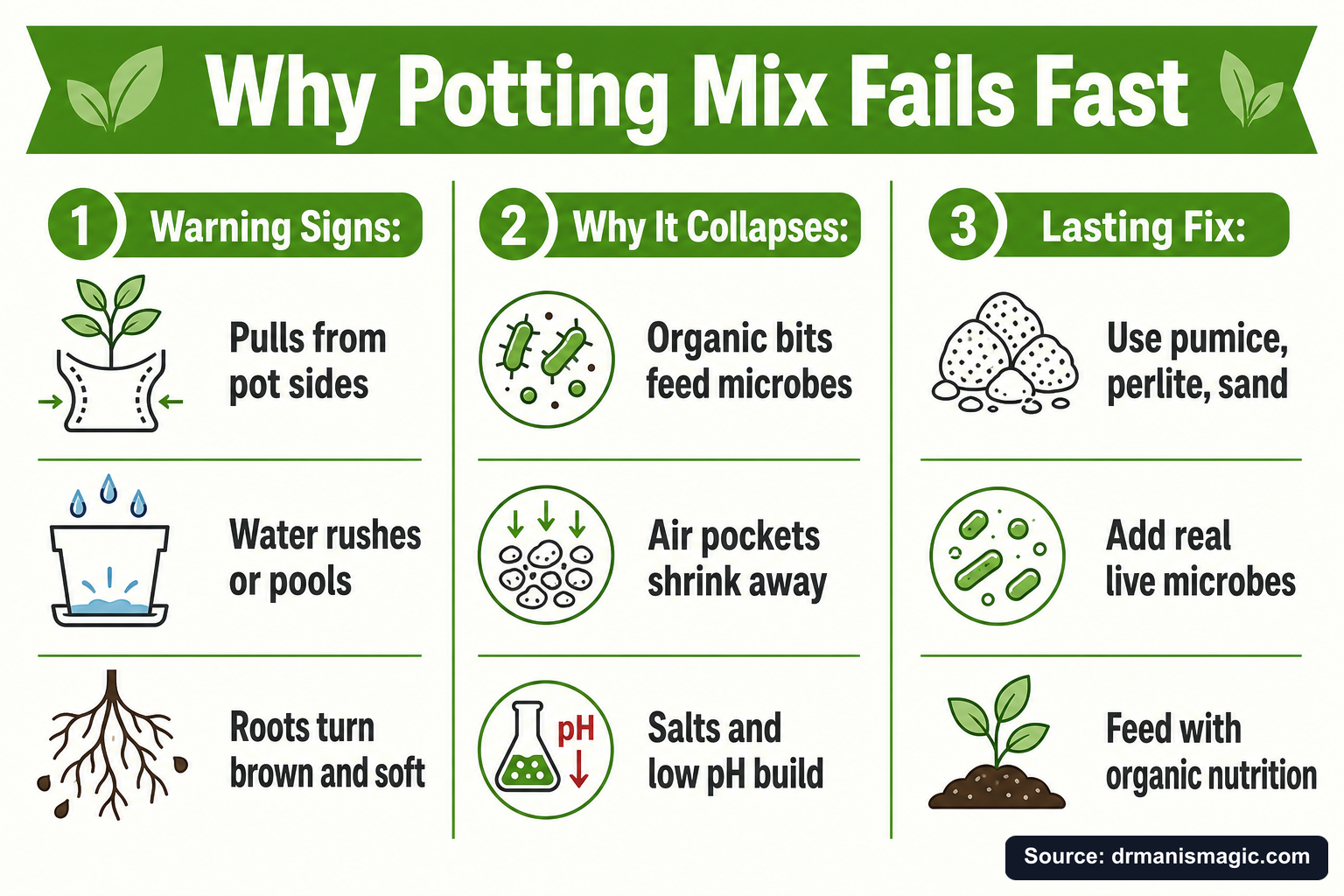
Then something shifts. The soil starts pulling away from the sides of the pot. Water runs straight through without soaking in. Or worse, it sits on top and never drains at all. You press your finger into the mix and it feels dense, almost like wet clay. The leaves start to yellow at the edges. The roots, when you finally dig down and look, are brown and soft instead of white and firm. You did everything right. You watered consistently. You fed it. And yet here you are, watching another plant circle the drain.
Here is the thing nobody on the bag tells you. That potting mix was never meant to last. It was never designed to behave like real soil. It was engineered to feel good in your hands at the store. Most of it is made from organic particles, bark, peat, coir, wood fiber, and compost, that bacteria and fungi start eating the moment they get wet. The mix is literally consuming itself from the inside out. Understanding why that happens, and what you can actually do about it, is the difference between plants that thrive for years and plants that quietly die season after season.

Plant Super Boost
Key Takeaways
- Most potting mix is made from decomposable organic particles that microbes eat over time, shrinking the structure and collapsing air space around roots.
- When air space disappears, roots suffocate. Waterlogged, compacted mix is the number one setup for root rot.
- Salt buildup from synthetic fertilizers accelerates breakdown and kills the beneficial microbes that keep soil alive.
- Natural garden soil has a self-repairing ecosystem. Containers do not. That gap is why pots fail so much faster than the ground.
- Mineral-based soil ingredients like pumice, perlite, and silica sand resist breakdown far longer than bark or peat.
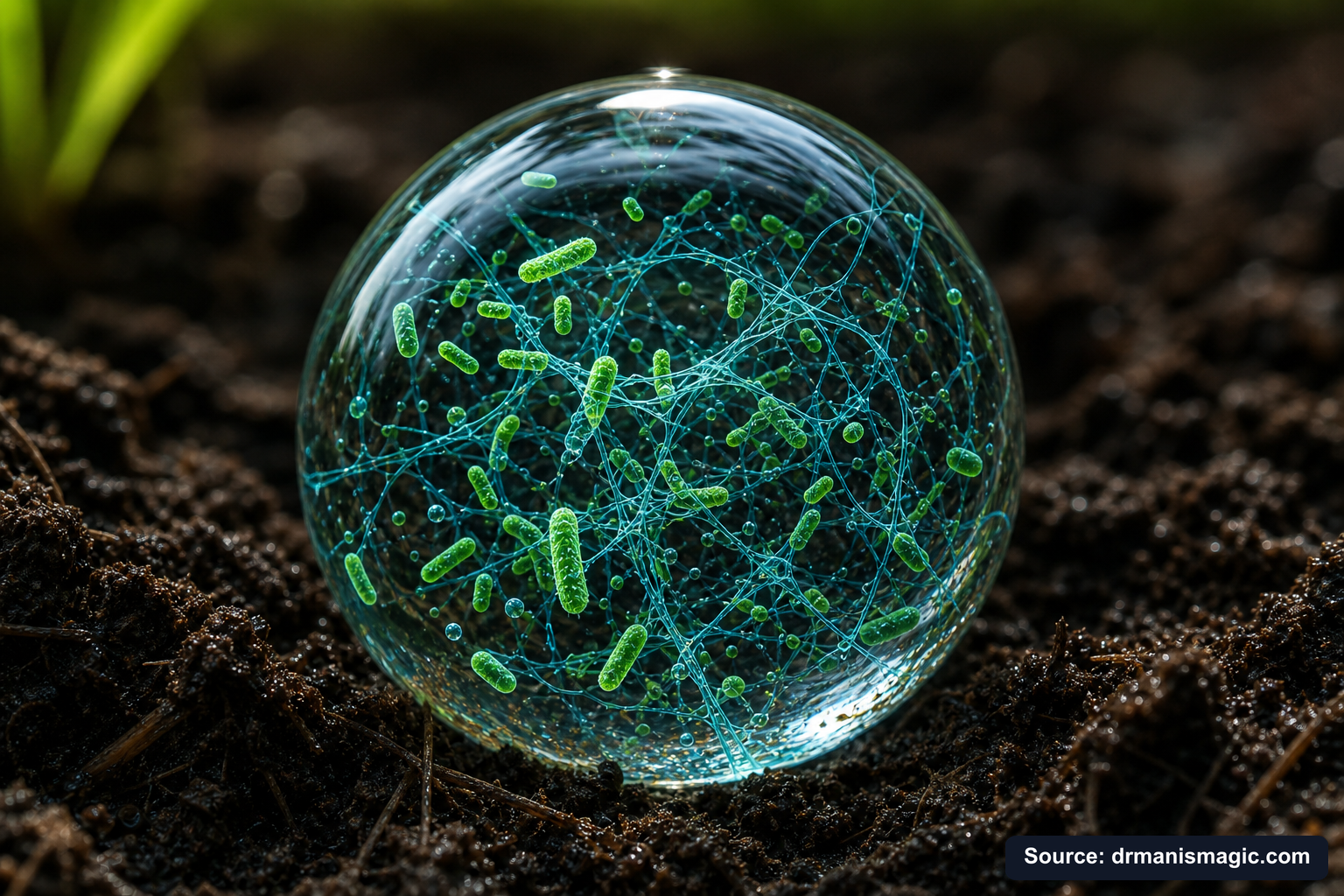
- Beneficial bacteria, fungi, mycorrhizae, protozoa, and nematodes form the invisible workforce that keeps any growing medium healthy. Most bagged mixes have very little living biology.
- Restoring your soil biology with genuinely live microbes, paired with mineral structure and organic nutrition, is the only real fix that lasts.
What Does "Potting Mix Breakdown" Actually Mean?
Quick Answer: Potting mix breakdown is not one thing. It is a chain reaction: organic particles decompose into fine dust, air pockets collapse, water gets trapped, roots run out of oxygen, pH shifts, salts accumulate, and the tiny living community that holds it all together disappears. The result is a dense, soggy, hostile environment that looks like soil but acts like concrete.
Think of your potting mix like a sponge made of wood chips, coconut fiber, and bark. That sponge has millions of tiny gaps. Those gaps hold air. Roots breathe through those air pockets. When you water, the water fills the gaps temporarily and then drains out, leaving fresh air behind.
Now imagine bacteria and fungi slowly eating the walls of that sponge. Particle by particle, the structure shrinks. The gaps get smaller. Fine dust fills the spaces. Water stops draining. Air stops moving. The sponge stops being a sponge and starts being a brick.
That is breakdown. And it is not a sign you did something wrong. It is the predictable, unavoidable result of using organic particles as the skeleton of a growing medium. According to University of Maryland Extension, container media lose structure primarily because the organic fraction decomposes, reducing the large pore spaces that allow drainage and oxygen exchange. The process is physical, chemical, and biological all at once.
Here is what happens step by step:
- Organic particles decompose. Bark, peat, and wood fiber are carbon sources. Bacteria and fungi treat them as food. As microbes metabolize the particles, the pieces get smaller and smaller.
- Fine particles accumulate. Tiny fragments pack together. They fill the spaces that used to hold air.
- Air-filled porosity drops. Roots need oxygen to function. When the air spaces vanish, roots begin to suffocate even if they are not sitting in standing water.
- Water retention rises. Fine particles hold water like a sponge that never dries. Overwatering becomes almost impossible to avoid even with perfect technique.
- pH drifts. Decomposing organics often push pH lower. Nutrient availability shifts. Some minerals lock up and become unavailable no matter how much fertilizer you add.
- Salts accumulate. Every synthetic fertilizer application deposits salt. In a container, there is nowhere for it to go. Salt stress injures roots and kills the beneficial microbes that would otherwise help the plant fight back.
- The living community collapses. Without a functioning soil food web, the mix becomes biologically dead. No microbes to cycle nutrients. No fungi to build structure. No protozoa to release nitrogen. Just degraded particles and chemical residue.
Why Do Containers Break Down Faster Than Garden Soil?
Quick Answer: Garden soil has a full, self-repairing ecosystem with deep mineral layers, billions of organisms, plant roots cycling carbon, earthworms rebuilding structure, and constant recolonization. A container has none of that. It is a small, closed, biologically thin system with no backup. When it degrades, there is nothing to rebuild it.
Walk into any forest. Pull up a handful of dirt. It is alive in a way that is almost impossible to describe. You can smell it. That rich, earthy scent is actually a chemical called geosmin, released by actinobacteria, a family of soil bacteria. That smell is life. It is the smell of a functioning soil food web.
Real soil has layers. Mineral particles form a permanent skeleton that does not decompose. Organic matter sits on top and cycles through. Roots push through cracks and leave behind sugars that feed microbes. Earthworms pull organic matter down and excrete rich castings. Protozoa eat bacteria and release nitrogen. Fungal hyphae, those white threads you sometimes see when you pull a weed, weave through everything and glue particles together with a sticky protein called glomalin. When one part of the system gets disrupted, another part compensates.
A container has almost none of this. It has a small volume of mostly organic material. No deep mineral matrix. No earthworms. No recolonization pathway when the biology gets depleted. Extreme swings from soaking wet to bone dry. Extreme temperature swings because the walls of the pot have no insulation. Fertilizer salts with nowhere to flush. And because it starts with pasteurized or sterilized ingredients, the biological community was thin from day one.
That is why a plant in the ground might thrive for decades while the same plant in a container needs repotting every year or two. The container is not a miniature ecosystem. It is a temporary engineered substrate that ages quickly and forgives very little.
According to University of Wisconsin-Madison Extension, container media must be managed much more carefully than in-ground soil because the buffering capacity is far lower, meaning small errors compound quickly.
What Is the Soil Food Web and Why Does It Matter in a Container?
Quick Answer: The soil food web is the community of living organisms that cycle nutrients, build structure, and protect plant roots. Bacteria decompose organic matter. Fungi extend roots and bind particles. Protozoa eat bacteria and release nitrogen. Nematodes graze on microbes and keep populations balanced. Without this web, a container is just expensive dirt that degrades and nothing more.
Here is the part most potting mix articles never tell you. Breakdown is not just about the physics of decomposing particles. It is about what happens to the living community inside the mix when those particles disappear.
In a healthy system, decomposition and structure work together. Fungi produce a sticky protein called glomalin that glues soil particles into stable clumps. Those clumps create pore spaces that hold air and water in the right balance. Bacteria cycle carbon and nitrogen. Protozoa graze on bacteria and release plant-available nitrogen as waste. Beneficial nematodes regulate populations and keep pathogenic organisms in check.
When the organic particles in a container decompose, two things happen at once. First, the physical structure collapses, as we described above. Second, the food source for the beneficial community disappears. Bacteria run out of carbon. Fungi have no substrate to colonize. The food web thins out. Pathogenic organisms, which are often more stress-tolerant than beneficial ones, fill the vacuum. Root rot becomes almost inevitable.
Here is a clear picture of who does what in the soil food web:
| Organism | What It Does for the Plant | What It Needs to Survive | What Destroys It |
|---|---|---|---|
| Beneficial bacteria | Decompose organic matter, fix nitrogen, suppress pathogens, improve root function | Carbon sources, moisture, oxygen, no synthetic salts | Salt-based fertilizers, herbicides, broad-spectrum pesticides |
| Mycorrhizal fungi | Extend root reach up to 100x, deliver water and phosphorus, produce glomalin to build structure | Living root hosts, organic matter, low phosphorus stress | Synthetic fungicides, high phosphorus fertilizers, sterilized media |
| Protozoa | Eat bacteria, release plant-available nitrogen as waste, regulate bacterial populations | Active bacteria, moisture, pore space | Compaction, waterlogging, pesticides |
| Beneficial nematodes | Graze on bacteria and fungi, keep populations balanced, suppress pathogenic nematodes | Active microbial populations, moisture, air pores | Synthetic pesticides, soil compaction, extreme salt levels |
| Actinobacteria | Break down tough organic matter like bark and lignin, produce antibiotics that suppress disease | Carbon, moisture, neutral pH | Low pH, synthetic herbicides, waterlogging |
After growing over 250,000 trees at our South Texas nursery, we learned that the plants that thrived longest were never the ones with the most expensive fertilizer. They were the ones with the most active biology in the root zone. Every single time.
This is the heart of what we call the Three Plant Pillars: mineral-based soil that holds structure, live microbials that do the invisible work, and organic fertilizer that feeds the system without burning it. Miss any one of those and the whole thing eventually falls apart.
Which Potting Mix Ingredients Break Down Fastest?
Quick Answer: Peat, fine compost, and wood fiber decompose the fastest, often collapsing within six to twelve months. Pine bark and coir last a bit longer. Mineral ingredients like perlite, pumice, silica sand, and calcined clay do not decompose at all. The more mineral your mix, the longer it holds its structure.
Not all ingredients age the same way. Some are temporary. Some are nearly permanent. Knowing the difference changes how you pot your plants and how often you have to repot them.
This is a hard truth about most premium bagged mixes: the ingredients that feel the nicest and look the best in photos are often the ones that disappear the fastest. Fluffy, fine peat. Rich dark compost. Soft wood fiber. They photograph beautifully. They feel wonderful. And they are gone within a year.
| Ingredient | Breakdown Speed | Compaction Risk | Salt Risk | Microbial Habitat Value | Best For |
|---|---|---|---|---|---|
| Fine peat | Fast (6-18 months) | Very High | Medium (acidifies over time) | Low once hydrophobic | Short-term annuals only |
| Fine compost | Very Fast (3-9 months) | High | Medium-High (variable) | High initially, drops fast | Amendment only, not base |
| Wood fiber | Fast (6-12 months) | High | Low-Medium | Medium | Short-term filler |
| Pine bark (coarse) | Moderate (1-3 years) | Medium | Low | Medium-High | Woody perennials, orchids |
| Coir (coconut fiber) | Moderate (1-2 years) | Medium | Medium (can carry salts) | Medium | General use with drainage amendment |
| Rice hulls | Slow (2-4 years, silica-based) | Low | Low | Medium | Aeration, top dressing, weed suppression |
| Perlite | None (mineral) | Very Low | Very Low | Low (smooth surface) | Drainage, long-term aeration |
| Pumice | None (mineral) | Very Low | Very Low | High (porous surface) | Long-term drainage and microbial habitat |
| Silica sand | None (mineral) | Very Low | Very Low | Medium | Permanent structure base |
| Biochar | None (centuries) | Very Low | Very Low | Very High (porous home for microbes) | Long-term biology and water buffering |
Dr. Mani Skaria spent decades watching what happened when the organic fraction of a mix disappeared. Roots compacted. Growth stalled. Plants that looked fine in spring would be struggling by fall. He stopped looking for the best organic mix and started asking a different question entirely. What if the skeleton of the mix was mineral, permanent, and structural from the start?
That question led to Super Soil, a mineral-based blend built on silica-rich sandy loam from the Rio Grande Valley. It does not decompose. It does not compact. It does not steal oxygen from roots as it breaks down. It is the same foundation we use for every tree in our nursery.
You Never Had a Brown Thumb.
You were handed the wrong tools. This free guide hands you the right ones.
You watered it. You fed it. It died anyway.
It was never you. It was the dirt, the salt food, and the bad advice.
This guide shows you what really went wrong, and how to fix it for good.
- Why your plants really died, and why it was never your fault
- The salt hiding in your plant food that quietly burns the roots
- The hidden killer in almost every bag of store soil
- The tiny helpers that grow a whole forest for free
- The rescue trick that brings a half dead plant back to life

How Do Salt-Based Fertilizers Speed Up Potting Mix Collapse?
Quick Answer: Synthetic fertilizers are salt compounds. In a container, those salts have nowhere to go. They build up, pull water away from roots through osmotic stress, and kill the beneficial bacteria and fungi that hold the growing medium together. The mix degrades faster, biology collapses, and the plant becomes dependent on more and more inputs just to stay alive.
This is the part of the story that the big fertilizer companies do not want you to think about too hard.
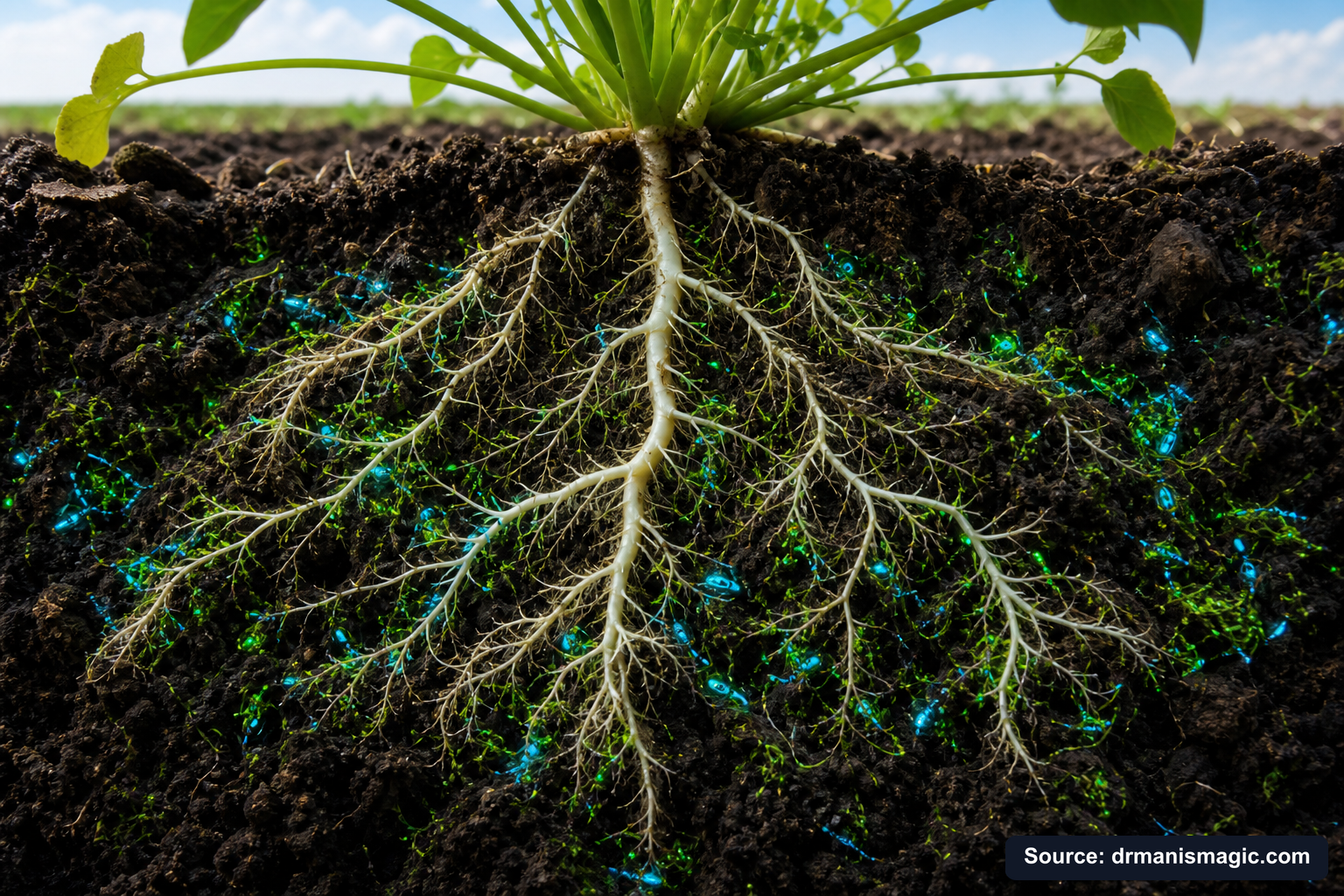
When you pour synthetic fertilizer into a pot, you are adding dissolved salts. Your plant uses some of them. The rest stays in the mix. Every watering concentrates them a little more. The electrical conductivity of the growing medium rises. Beneficial bacteria and fungi, which evolved in low-salt environments, begin to die. The soil food web collapses. The only things left are stress-tolerant organisms, many of which are pathogenic.
At the same time, high salt levels pull water out of root cells through a process called osmotic stress. Even if the mix is moist, the plant can experience drought stress because the water is chemically bound to salt ions. Leaves curl. Tips burn. Growth slows. The gardener sees the symptoms and adds more fertilizer. The cycle gets worse.
This is not an accident. A plant that is dependent on synthetic inputs to survive needs to be fed constantly. That is a profitable business model. It is just not good for your plants.
See also: The Hidden Reason Synthetic Fertilizers Cause Root Rot
Organic fertilizers like our Crab, Kelp and Amino Acids formula work differently. They release nutrients slowly through microbial activity. They feed the food web instead of poisoning it. They do not spike salt levels. The microbes stay alive. The structure holds longer. And your plants respond in a way that feels almost shocking the first time you see it.
Why Does Potting Soil Become Hydrophobic and Repel Water?
Quick Answer: When peat or fine organic matter dries out completely, the particles develop a waxy coating that repels water instead of absorbing it. Water runs down the sides of the pot and out the bottom without ever wetting the root zone. The plant is thirsty even though you are watering it every day.
You have probably seen this. You water your pot. The water beads up on the surface. It runs along the edge between the soil and the pot wall and drains out the bottom in seconds. The soil in the middle stays completely dry.
That is hydrophobia. And it is a direct result of fine organic particles drying out past a certain threshold. Peat is especially prone to it. Once dried, peat develops a wax-like coating that water cannot penetrate without surfactant help. The same happens with fine compost and wood fiber.
The fix is not to water more. The fix is to change what the mix is made of. Mineral particles do not become hydrophobic. They absorb and release water consistently whether they are wet or dry. Pumice, silica sand, rice hulls, and similar materials hold their water-absorption properties through thousands of wet-dry cycles without ever developing that waxy, repellent surface.
How Can You Tell If Your Potting Mix Has Already Collapsed?
Quick Answer: Signs of collapse include water pooling on the surface and draining very slowly, mix pulling away from the pot walls, a sour or rotten smell, yellowing leaves despite regular feeding, roots circling the bottom or growing out of drainage holes, and visible white mineral crust on the soil surface. Any one of these is a warning. Multiple signs mean it is time to act.
Here is a quick checklist you can run through right now. Walk to your most important container plant and check these things:
- Water the pot and watch. Does water drain within 30 seconds or sit on top for a minute or more?
- Push your finger two inches into the mix. Is it dense and compacted or loose and crumbly?
- Smell it. Does it smell earthy and clean or sour and swampy?
- Look at the surface. Do you see a white or yellowish crust? That is salt accumulation.
- Check the sides of the pot. Is the mix shrinking away from the walls?
- Tip the plant out if you can. Are the roots white and firm or brown and mushy?
- Look at the leaves. Are the tips brown? Are older leaves yellowing from the bottom up?
If you checked more than two of those boxes, the mix has already degraded past the point where fertilizer alone can rescue it. You need to address the structure and the biology, not just the nutrition.
What Is the Recovery Plan When Potting Mix Has Already Failed?
Quick Answer: First stop adding fertilizer and let accumulated salts flush out. Then assess whether the roots are still viable. Repot into a mineral-dominant mix with genuine drainage. Reintroduce live biology with a full-spectrum microbial inoculant. Feed with organic fertilizer that supports the food web instead of burning it. Then be patient. Recovery is real, but it takes a few weeks.
Here is a step-by-step recovery plan you can follow today:
- Stop all synthetic fertilizer immediately. Adding more salt to a salt-damaged mix makes everything worse. Give the plant a break from inputs.
- Flush the pot thoroughly. Water heavily three times in a row, letting it drain completely between flushes. This leaches accumulated salts out through the drainage holes. You can smell the difference afterward.
- Inspect the roots. Gently remove the plant. Cut away any brown, mushy root tissue with clean scissors. Healthy roots are white, firm, and have a clean smell.
- Repot into a mix with a mineral base. Choose a mix with perlite, pumice, or silica sand as the structural backbone. The goal is air-filled porosity above 20 percent even after watering. If you can squeeze a handful of wet mix and it holds water like a wrung sponge, it needs more mineral material.
- Reintroduce live biology. This is the step most gardeners skip, and it is the most important one. Your roots need living allies. Pour a microbial inoculant into the new mix before planting and then drench again after. We will talk more about what makes a microbial product actually work in a moment.
- Feed with organic fertilizer only for the first 60 days. Let the microbial community stabilize before introducing any synthetic inputs. Organic fertilizer feeds the food web and cycles slowly. That is exactly what a recovering root zone needs.
- Monitor drainage at every watering. If water stops draining freely within the first few weeks, something is still wrong with the structure. Address it before the roots suffer again.
Why Do Most Bottled Microbe Products Fail to Help Your Potting Mix Recover?
Quick Answer: Most bottled microbe products are either dried lab-grown spores that never reactivate properly in soil, or liquid compost teas that have already gone anaerobic and smell foul. Dead microbes cannot colonize roots, build structure, or suppress pathogens. You need genuinely live, full-spectrum biology that was never allowed to die in the first place.
Walk into any garden center and you will see shelves full of microbial products. Some are powders. Some are liquids. Some have impressive-sounding lists of bacterial species and concentration numbers on the label. Most of them do almost nothing.
Here is why, and this is something Dr. Mani spent years figuring out through direct testing at our nursery.
Most commercial microbes are produced in giant industrial vats. Specific bacterial or fungal strains are brewed in bulk, then dried into a powder. The hope is that the dormant spores will reactivate when they hit moist soil. In practice, we tested dozens of these products on thousands of trees. The results were consistently disappointing. The plants responded no differently than untreated controls.
The second type of product is liquid compost tea. This sounds promising because fresh compost is genuinely alive and powerful. But here is the problem. Once compost tea is bottled and shipped, it begins to go anaerobic, meaning the oxygen runs out and the beneficial microbes start dying. By the time it reaches you, the bottle may smell like sewage. Some even fizz when opened, which is the gas from fermentation and microbial death. Some value remains from humic acid and fulvic acid in the liquid, but the living community is largely gone.
Here is a direct comparison of what you typically find on the market versus what genuinely works:
| Product Type | Microbe Viability at Use | Spectrum of Organisms | Odor | Real-World Effectiveness |
|---|---|---|---|---|
| Dry/powdered lab-grown microbes | Very Low (dormant spores rarely reactivate) | Narrow (1-5 selected strains) | None or dusty | Minimal to none in our testing |
| Liquid lab-grown microbes | Low (same strains, just rehydrated) | Narrow | Low | Minimal in our testing |
| Bottled compost tea (shipped) | Low to None (anaerobic by arrival) | Partial (was broad, now dying) | Strong, foul, sulfurous | Some benefit from organic acids, not live biology |
| Fresh compost (on-site, under 24 hours) | High | Broad and natural | Warm, earthy | Excellent, but requires time and effort |
| Plant Super Boost (stabilized, full-spectrum) | High (naturally stabilized, never anaerobic) | 2,000+ bacteria, 400-500 fungi including mycorrhizae, plus protozoa and nematodes | Earthy, not foul | Visible root response within weeks, confirmed by lab analysis and microscopy |
The story behind Plant Super Boost is worth telling. Dr. Mani, through what can only be described as a fortunate meeting, connected with a world-famous compost expert who had spent decades advising royal families and governments on agricultural biology. This expert had discovered an all-natural technique to stabilize the full spectrum of microbes from freshly harvested compost without allowing them to die or go anaerobic. When you smell Plant Super Boost, it smells like earth. Not sewage. Not chemicals. Just clean, alive soil. And if you put a drop under a microscope, you can watch the microbes moving. That is not marketing language. That is biology you can see with your own eyes.
This expert was eventually blacklisted by large chemical companies after citrus groves using his methods started outperforming their synthetic programs. He eventually joined forces with Dr. Mani and the team at US Citrus Nursery, and together they built what became the Dr. Mani's Magic product line.
Zero PFAS. Zero biosludge. Zero synthetic salts. And a 30-day money-back guarantee because we have never once needed to worry about whether it works.
How Do You Make Potting Mix Last Longer From the Start?
Quick Answer: Choose mixes with coarse, stable, mineral ingredients as the base. Avoid mixes that are mostly fine peat or compost. Add perlite, pumice, or rice hulls if drainage feels slow. Feed with organic fertilizer to support the food web. Apply live microbials monthly. Flush accumulated salts regularly. These steps can extend the productive life of a container from one season to many years.
Prevention is always faster than recovery. Here is how to set up a container that holds its structure and biology for the long term:
Choose structure over texture. The mix that feels softest and richest in your hands is usually the one that collapses fastest. Look for ingredients like pine bark (coarse grade), pumice, perlite, and coir rather than fine peat, compost, and wood fiber as the majority of the mix.
Amend aggressively with mineral material. If you are using a commercial bagged mix, add at least 25 to 30 percent perlite or pumice by volume. This alone can double or triple how long the structure holds.
Do not overfertilize. More fertilizer does not mean faster growth. It means more salt, faster microbial die-off, and faster structural collapse. Feed with organic, slow-release sources and let the biology do the work.
Water based on the plant, not a schedule. Overwatering compacts organic particles faster and drives anaerobic conditions that kill beneficial microbes. Let the top inch or two dry before watering again for most plants.
Flush your containers every few months. Run water through the pot slowly and heavily. Let it drain completely. Repeat three times. This leaches accumulated salts and resets the chemistry of the mix.
Apply live microbials monthly. Even in a mineral-dominant mix, the biological community needs regular reinforcement. Monthly applications of a full-spectrum microbial inoculant rebuild what natural soils repair automatically. This is the step that makes everything else work harder. You can learn more about building a complete foundation in our Free Plant Care Field Guide.
See also: Why Most Fertilizers Are Actually Salt in Disguise
What the Three Plant Pillars Have to Do With All of This
Quick Answer: The Three Plant Pillars, mineral-based soil, live microbials, and organic fertilizer, directly address every cause of potting mix failure. Mineral soil resists breakdown. Live microbes rebuild biology. Organic fertilizer feeds the food web without salt damage. Together they create a container environment that gets better over time instead of worse.
Here is the thing about all of this. Potting mix breakdown is not random bad luck. It is the predictable result of building a growing system on the wrong foundation.
Organic particles as a structural base. Synthetic salt fertilizers that destroy the biology. No living microbes to rebuild what gets lost. It is a system designed to fail. Not necessarily on purpose. But the incentive structure rewards selling new bags of mix and new bottles of fertilizer every season. Nobody profits when your pot stays healthy for five years.
Dr. Mani built the Three Plant Pillars after watching this cycle play out across 250,000 trees and decades of research. He stopped trying to optimize within the broken system and started from first principles. What do roots actually need? Oxygen. Stable structure. Living allies in the rhizosphere. Nutrition delivered in a form that works with biology, not against it.
Mineral-based soil gives you the permanent skeleton. It does not decompose. It does not compact. Roots breathe through it for years without repotting.
Live microbes give you the invisible workforce. They cycle nutrients, suppress pathogens, build aggregate structure, and extend the effective reach of every root in your container.
Organic fertilizer gives you the slow, steady fuel that the food web can actually use. No salt spikes. No microbial die-off. Just consistent, building nutrition that compounds over time.
When all three pillars are in place, something interesting happens. Your container does not degrade over one season. It improves. The biology builds. The structure holds. The roots go deeper. The plant gets stronger every month instead of weaker. That is not a marketing promise. That is what happens when you stop fighting nature and start working with it.
We have seen it in our nursery. We have seen it in thousands of customer gardens across the country. And we have the reviews from growers who thought they had a brown thumb and discovered they just had the wrong foundation.
One of the most common things we hear from people who come to us is that they want to see fruit on a tree they planted with their own hands. Not next decade. Not someday. In their lifetime, in their backyard, this season if possible. That desire is real. It is ancient. We were put on this earth to tend growing things. The tragedy is when people spend years doing everything they were told and watch plant after plant struggle and die because the foundation was wrong from the start. Time spent in that cycle is time you never get back.
You do not have to lose another season to a collapsing potting mix. The fix is not complicated. It just requires building on the right three things from the beginning.
If you are ready to stop guessing and start growing on a foundation that actually works, the best first step is to explore the complete Three Plant Pillars system at Dr. Mani's Magic and see which products fit your garden. Your plants will show you the difference within weeks. And this time, the results will last.
Frequently Asked Questions
Potting mix questions come up every single day in our nursery. After growing over 250,000 trees at US Citrus Nursery, we have seen every mistake in the book. These answers cut through the noise and give you the real story on what is happening inside your pots.
Is 2-year-old potting soil still good to use?
Probably not in the way you are hoping. After two years, most bagged potting mix has already started eating itself. The bark and wood particles break down into fine dust. Air pockets collapse. Drainage slows way down. Even if your plants looked healthy, the structure is gone. That is why Dr. Mani built Super Soil on a mineral base that does not decompose. You plant once and the structure stays strong for years, not months.
How do you bring dried-out potting soil back to life?
You can try soaking the pot from the bottom up or slowly working water into the mix by hand. That can help short term. But here is the real problem. Dried-out potting mix means the organic particles have already shrunk and pulled away from the pot walls. Water runs straight down the gap and never reaches the roots. Adding live microbes from Plant Super Boost along with a mineral-based soil gives your roots something solid and alive to grow into again.
What is the best thing to do with old potting soil?
If the plants in it were healthy, you can mix it into a garden bed or compost pile. Do not just refill the same pot with it. The structure is already broken down. If you want to stretch it further, mix in some biochar and rice hulls to open up air space again, then drench it with Plant Super Boost to wake up the biology. Think of it as a rescue mission, not a fresh start.
Should you replace potting soil every year?
With standard bagged potting mix, yes. That stuff is built to decompose. It is only a matter of time. But that cycle of buying and replacing every year costs you real money and real time. Dr. Mani's Super Soil is mineral based, which means it does not rot down. You refresh the biology with Plant Super Boost and feed with the Crab, Kelp, and Amino Acids fertilizer. That is it. No annual replacement needed.
How can you tell if potting soil has gone bad?
Trust your nose first. Fresh, healthy soil smells earthy and clean. If it smells sour, like sulfur, or like something rotting, that is a red flag. Then look at the texture. If it feels dense and wet like clay or pulls away from the pot sides when dry, the structure is gone. Healthy soil should feel light and slightly gritty. If yours fails both tests, it is time to start fresh with a mineral base that will not rot on you.
When should you never reuse old potting soil?
If you had root rot, fungus gnats, mold, or any plant disease in that pot, do not reuse that mix without sterilizing it first. Those pathogens stay alive in the old organic material and will attack your next plant fast. This is exactly why the Three Plant Pillars matter so much. Mineral-based soil does not harbor the same rot and disease that sawdust-heavy mixes do. Pair that with live beneficial microbes and you build a defense system, not a disease trap.
Does potting soil attract bugs?
Yes, and here is why. Most bagged potting mix is full of decomposing organic matter. Fungus gnats and other pests love that environment. They lay eggs in the wet, rotting material near the surface. The fix is not just a spray. It is changing what is in the pot. Mineral-based soil does not give fungus gnats the soft, rotting feast they are looking for. Add Plant Super Boost to fill your soil with beneficial microbes that compete with the bad stuff, and you take away the welcome mat entirely.
About the Author
Ron Skaria, MD
Ron Skaria, MD, is the co-founder of Dr. Mani's Magic and the son of Dr. Mani. He trained as a medical doctor at Baylor College of Medicine, did his residency at UT Health Science Center - San Antonio and fellowship training at Texas Tech University. He now works full time on the family farm at US Citrus and US Citrus Nursery in Hargill, Texas, building Dr. Mani's Magic alongside his dad. He wrote the Brown Thumb Field Guide to put his father's 48 years of plant science into plain words any gardener can use. His belief is simple. You never had a brown thumb. You just never had the right help.


