


The Truth About Root Rot Nobody Explains | Dr. Mani's Magic
The Truth About Root Rot Nobody Explains: It Starts When Roots Stop Breathing
You pull your favorite plant out of its pot. You expected maybe a little root trimming. Instead, you find a brown, mushy mess. It smells like a swamp. Half the roots are already gone. You watered it the same way you always do. You used the fertilizer from the hardware store. You did everything the YouTube video said. And yet here you are, holding a dying plant and wondering what you did wrong.
Here's the thing. You probably didn't do anything wrong. Not exactly. The real story of root rot isn't about too much water. It isn't even really about fungus. It's about what happens deep in the soil, in a world so small you can't see it, long before that first brown root ever appears. It's about oxygen. It's about invisible armies of microbes that either protect your roots or abandon them. And it's about a broken ecosystem that most gardening advice never bothers to explain.
After growing more than 250,000 trees at our South Texas nursery, we've watched root rot take down plants that were watered perfectly, fertilized on schedule, and repotted into fresh soil. We've also watched plants shrug off root rot conditions that should have killed them. The difference wasn't the watering can. It was the living world inside the soil. That's what this article is about. And once you understand it, you'll never look at a dying plant the same way again.
Key Takeaways
- Root rot is not just a watering problem. It is a soil ecosystem collapse that starts when roots lose oxygen.
- Pathogens like Phytophthora and Pythium are opportunists. They move through water and attack roots that are already stressed and oxygen-starved.
- Beneficial microbes are your plant's first line of defense. When they die, pathogens win by default.
- Salt-based synthetic fertilizers, fungicides, pesticides, and sterile potting mixes all destroy the beneficial microbes your roots depend on.
- Many root rot symptoms look exactly like drought stress, salt burn, or fertilizer burn. Misdiagnosing the problem leads to treatments that make things worse.
- Repotting into "fresh" sterile soil can actually make root rot return faster if you don't rebuild the biology.
- The Three Plant Pillars — mineral-based soil, live microbes, and organic fertilizer — address the root cause instead of just the symptoms.
Why Does Root Rot Actually Start? (It's Not What You Think)
Quick Answer: Root rot starts when waterlogged soil runs out of oxygen. Without oxygen, roots weaken, beneficial microbes die off, and water-loving pathogens like Phytophthora and Pythium swim freely through the saturated soil and invade stressed roots. Too much water is the trigger, but the real damage is the ecosystem collapse that follows.
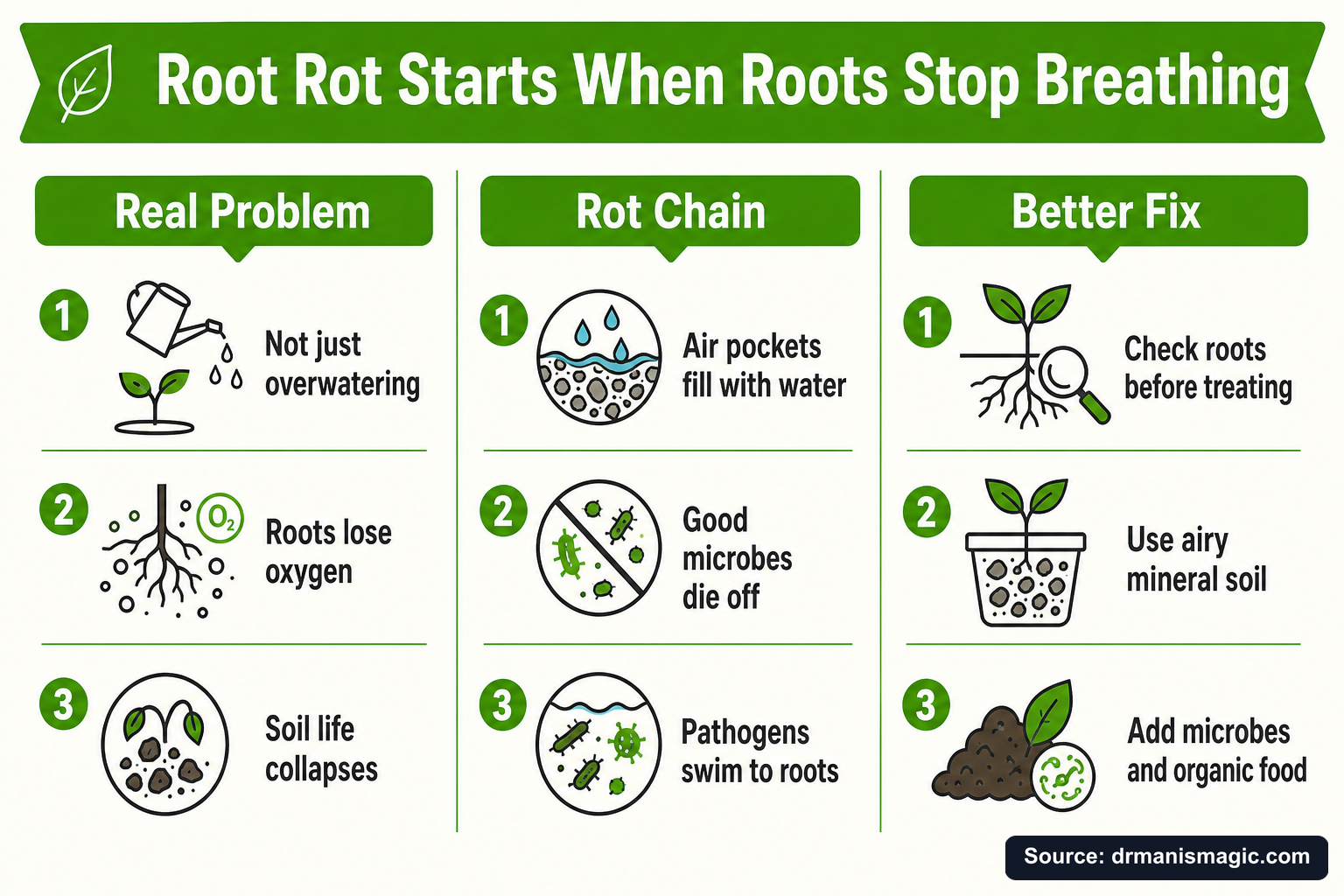
Roots need oxygen to survive. This surprises a lot of people. We think of plants loving water. But roots breathe. They pull oxygen out of tiny air pockets in the soil. When soil stays waterlogged for too long, those air pockets disappear. The roots start suffocating. This is called anaerobic soil, which just means soil without air.
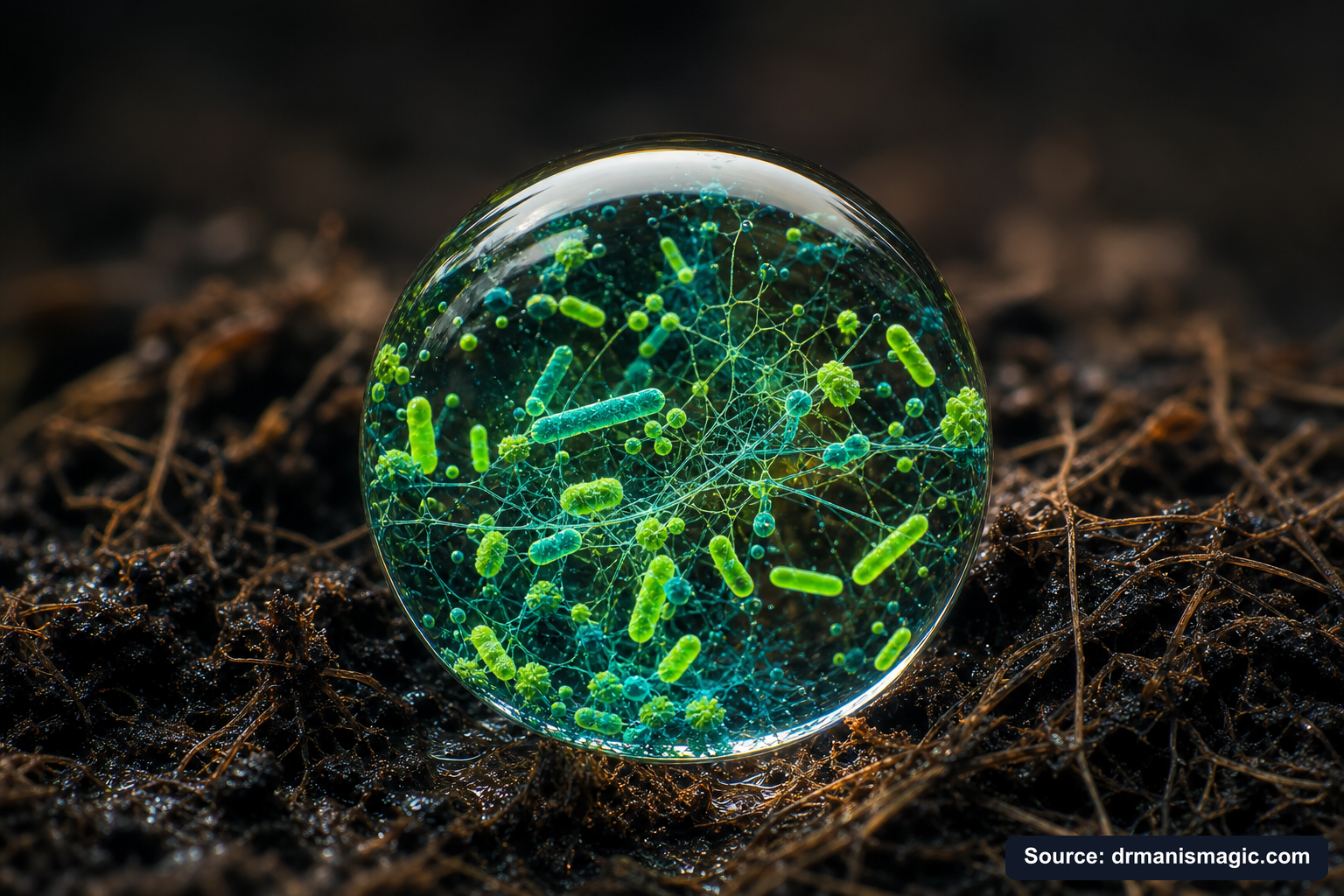
Now here's where it gets interesting. Your soil is not just dirt. It is a living city. Trillions of beneficial bacteria, fungi, and other microbes live in the space around your roots. Scientists call this the rhizosphere. These tiny creatures do an enormous amount of work. They unlock nutrients your plant can't reach on its own. They produce natural compounds that keep pathogens away. They compete with harmful organisms just by being there and taking up space.
Most of those beneficial microbes are aerobic. That means they also need oxygen to live. When the soil floods and the oxygen disappears, the good microbes die. And the pathogens that love wet, airless conditions? They thrive. Specifically, water molds called oomycetes — including Phytophthora and Pythium — produce swimming spores called zoospores. These spores literally swim through water films in saturated soil. They follow drainage patterns through your pot or your garden bed. They find the weakest, most stressed roots and move in. Researchers at Penn State Extension have documented this sequence in detail, noting that these pathogens are fundamentally water-dependent opportunists that exploit anaerobic conditions rather than healthy soil environments.
The roots collapse from the outside in. The soft outer layer, called the cortex, turns brown and mushy. The plant above ground starts showing symptoms that look like drought. Wilting. Yellow leaves. Leaf drop. You water it more. The problem gets worse. The cycle continues until the plant dies.
That's the real sequence. Not "too much water caused fungus." It's "saturated soil lost oxygen, roots weakened, beneficial microbes died, pathogens moved in, root tissue collapsed, and the plant above ground slowly starved." Understanding this chain changes everything about how you respond.
Is It Root Rot, Salt Burn, Drought, or Suffocation? How to Tell the Difference
Quick Answer: Pull the plant out and look at the roots. Root rot roots are brown or black, soft, and mushy, and they often smell like rotten eggs or swamp water. Drought roots are dry and shriveled but still firm. Salt-burned roots are dry and brown at the tips but the rest stays firm. Oxygen-starved roots may look pale or slightly discolored but without mushiness or odor.
This is the diagnosis step that most online articles completely skip. And skipping it is how people end up treating the wrong problem, making things worse, and losing plants they could have saved.
Here is a simple framework. Get your hands dirty. Pick up the pot. If it feels very heavy for its size, the soil is still holding a lot of water. Stick your finger two inches into the soil. If it's wet, put the watering can down. Now look at the roots themselves.
| Symptom | Root Rot | Drought Stress | Salt / Fertilizer Burn | Oxygen Starvation |
|---|---|---|---|---|
| Root color | Brown to black | Tan or off-white | Brown tips, pale body | Pale, slightly tan |
| Root texture | Soft, mushy, slimy | Dry, shriveled, firm | Dry, brittle at tips | Soft but not slimy |
| Soil smell | Rotten, swampy, sulfur | Dry, dusty | No smell or salty scent | Musty, stale, flat |
| Soil surface | Wet, stays wet long | Bone dry, pulls from edges | White crust on top | Compacted, drains slowly |
| Drainage speed | Very slow or none | Fast or normal | Normal | Very slow |
| Above-ground wilting | Wilts even when watered | Wilts, perks up when watered | Leaf tips brown and crispy | Slow general decline |
| History | Overwatered or poor drainage | Forgot to water | Heavy synthetic fertilizer use | Dense or old potting mix |
The smell test is powerful. Genuine root rot has a distinctive, unpleasant smell. Sulfur. Swamp. Something dead. If your soil smells like that, you are dealing with a real anaerobic pathogen situation. If it just smells dry or dusty, the problem is probably not rot.
The white crust on top of the soil is a strong sign of salt damage. This usually comes from synthetic fertilizers or mineral-heavy tap water. Salt accumulation burns root tips and blocks water uptake. It can look almost identical to root rot from above the soil. But when you pull the roots out, they're dry and firm, not mushy. The treatment is completely different. You flush salts out. You don't dry the soil out further.
See also: How Salt-Based Feeding Quietly Destroys Root Systems
Why Do Roots Need Live Microbes to Stay Healthy?
Quick Answer: Beneficial bacteria, fungi, protozoa, and nematodes form a living shield around your roots. They compete with pathogens for space and food, produce natural disease-suppressing compounds, unlock nutrients the plant can't access alone, and extend the root system's reach. Without them, roots are defenseless the moment conditions go wrong.
Think about how forests work. Nobody fertilizes a forest. Nobody treats it with fungicide. Nobody repots the trees into fresh potting mix every spring. Yet forests are some of the most disease-resistant, nutrient-efficient, resilient plant communities on Earth. The reason is the soil food web. A living, layered ecosystem of billions of microorganisms working together in ways we are only beginning to fully understand.
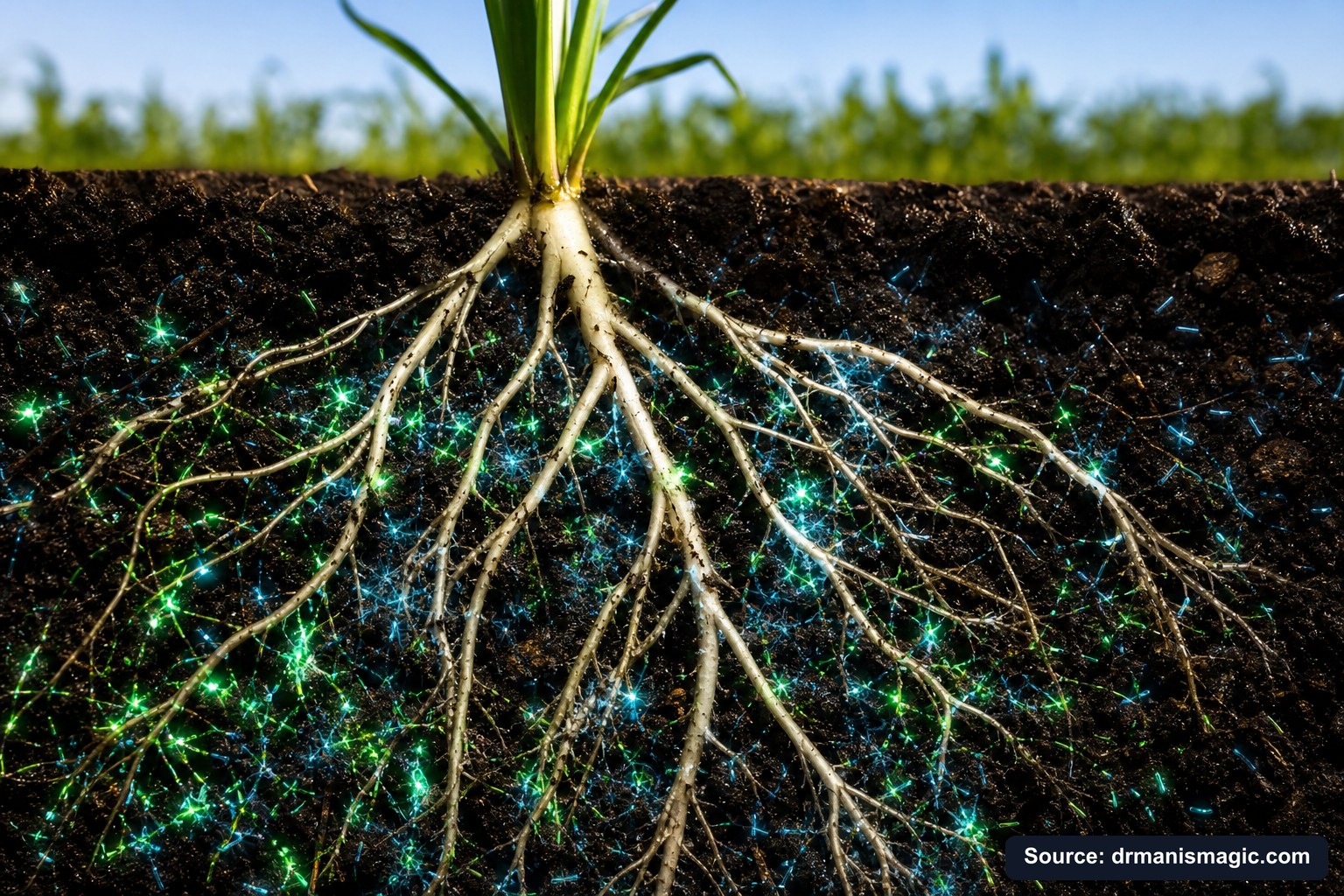
Your plant evolved inside that system. Its roots are wired to partner with microbes. Mycorrhizal fungi extend the root system like a second root network, reaching nutrients and water that roots alone could never access. Beneficial bacteria fix nitrogen from the air and make phosphorus available. Protozoa and beneficial nematodes graze on bacteria, releasing nutrients in plant-available forms and keeping the microbial population balanced. The whole system cycles nutrients, suppresses disease, and builds soil structure all at once.
When you grow a plant in a pot or a managed garden bed, you strip most of that system away. Potting mixes are often sterile by design. The soil food web is gone. Your plant is like a person dropped into a city with no immune system, no food supply chain, and no neighbors to call for help. It can survive for a while on what you feed it directly. But the moment conditions get stressful — too much water, a pathogen spore, a temperature swing — there's nothing there to catch it.
University of California Agriculture and Natural Resources research confirms that disease-suppressive soils are consistently associated with high microbial diversity and activity, while pathogen outbreaks are far more common in biologically depleted soils. This isn't a niche finding. It's consistent across decades of plant pathology research.
| Microbe Type | What It Does for Your Roots | What Happens Without It |
|---|---|---|
| Beneficial bacteria | Fix nitrogen, solubilize phosphorus, produce disease-suppressing compounds, improve soil structure | Nutrient lockup, less disease resistance, compacted soil |
| Mycorrhizal fungi | Extend root reach up to 100x, improve water uptake, produce glomalin to hold soil particles together | Roots can't access nutrients or water efficiently, poor structure |
| Protozoa | Graze on bacteria, release nutrients in plant-available forms, cycle the soil food web | Nutrient cycling slows, bacterial balance goes off |
| Beneficial nematodes | Graze on bacteria and fungi, suppress harmful nematodes, support nutrient release | Harmful nematodes can dominate, root damage increases |
| Full-spectrum community | Competes with Phytophthora, Pythium, Rhizoctonia, and other pathogens by taking up space and resources | Pathogens colonize roots unopposed when conditions turn wet |
The white fuzzy threads you sometimes see on the roots of weeds? That's mycorrhizal fungi. It's one reason weeds are so hard to kill. They have a living support system wrapped around every root. Your garden plants deserve the same advantage.
Why Does Root Rot Come Back After You Repot?
Quick Answer: Root rot returns after repotting because the pathogens travel with you. They hide in dirty pots, old tools, contaminated potting mix, irrigation water, and even on the plant itself. Worse, if you repot into sterile new soil, there are no beneficial microbes to compete with the pathogens that inevitably arrive. Biology beats sterility every time.
This is the question that frustrates people the most. You did the right thing. You trimmed the mushy roots. You let them dry. You got brand new potting mix. You repotted into a clean container. And three months later, the brown roots are back. How?
Several things are happening at once.
First, the pathogens often survive on the plant itself. Phytophthora and Pythium can colonize root tissue that still looks firm and healthy. You trimmed the obviously dead roots. But the spores are already there, waiting for the next time conditions favor them.
Second, your tools carry them. Your watering can. Your pruning shears. The tray the pot sits in. Spores are microscopic. You cannot see them. One contaminated tool is enough to reintroduce the problem.
Third, and this is the part Penn State Extension specifically calls out, sterile potting media can become more vulnerable after recontamination, not less. When you heat-treat or pasteurize soil, or buy a commercial sterile mix, you kill everything. The good and the bad. The pathogens that find their way in afterward — from dirty tools, irrigation water, or the nursery environment — face no competition. They colonize the sterile media rapidly. Your new, clean soil becomes a perfect launching pad for the next infection.
The fix is not to make your soil more sterile. The fix is to make it more alive. You need to recolonize that soil with beneficial organisms fast enough that pathogens can't get a foothold. That means inoculating with a genuine full-spectrum microbial product before and after repotting. It means using a soil with good structure and drainage so oxygen stays in the root zone. And it means feeding the biology with organic nutrients that microbes can actually use.
This is exactly what the Three Plant Pillars system is designed to do. Mineral-based soil that holds structure and drains well. Live microbes to populate the root zone immediately. Organic fertilizer that feeds both plant and biology without burning either one.
How Do Synthetic Fertilizers Make Root Rot Worse?
Quick Answer: Synthetic fertilizers are salt-based. High salt levels in the soil draw water out of roots through osmotic pressure, just like saltwater dehydrates your body. This damages root cells directly, weakens the plant's defenses, kills beneficial microbes, and creates the exact conditions that root rot pathogens love: stressed roots and depleted biology.
Most people don't know this. It's not on the bag. The fertilizer companies certainly don't lead with it in their advertising.
Salt-based fertilizers work by dissolving into the soil water and making nutrients immediately available. They give you fast green-up. They look like they're working. But here's what's happening at the root level. High salt concentrations in the soil water pull moisture out of root cells by osmosis. The very nutrient solution you're feeding your plant is also dehydrating it at the root. This is called osmotic stress. It causes microscopic damage to root cells. It weakens the root's ability to defend itself. And it kills the beneficial bacteria and fungi living in the rhizosphere, because those organisms are sensitive to high salt concentrations too.
You've now done three things at once. You've damaged the roots. You've killed the root's microbial defenders. And you've created a weaker plant that is more susceptible to any pathogen that comes along. This is why we call synthetic fertilizer a band-aid that makes the underlying problem worse. The plant looks better for a few weeks. Then it crashes harder than before.
Slow-release organic fertilizers work differently. They don't spike salt levels. They feed the soil biology, which then makes nutrients available to the plant gradually. The microbes stay alive. The roots stay protected. The nutrients come in a form and pace the plant actually evolved to receive.
See also: The Hidden Reason Synthetic Fertilizers Cause Root Rot
You Never Had a Brown Thumb.
You were handed the wrong tools. This free guide hands you the right ones.
You watered it. You fed it. It died anyway.
It was never you. It was the dirt, the salt food, and the bad advice.
This guide shows you what really went wrong, and how to fix it for good.
- Why your plants really died, and why it was never your fault
- The salt hiding in your plant food that quietly burns the roots
- The hidden killer in almost every bag of store soil
- The tiny helpers that grow a whole forest for free
- The rescue trick that brings a half dead plant back to life

What Is the Ecological Sequence of Root Rot? (The Full Map)
Quick Answer: Root rot follows a predictable chain: poor drainage or overwatering fills soil air pockets with water, oxygen disappears, roots begin to suffocate, beneficial aerobic microbes die off, water-loving pathogens like Phytophthora and Pythium swim freely and attack weakened roots, root tissue collapses, nutrient uptake fails, and above-ground symptoms appear that look like drought or nutrient deficiency.
Most articles show you a picture of brown roots and say "that's root rot." That's like showing you a car crash and saying "that's what happens when something goes wrong." It doesn't help you prevent the next one.
Here is the full sequence, step by step.
- Drainage fails or watering is too frequent. Soil air pockets fill with water. The soil stays wet for too long.
- Oxygen disappears from the root zone. The soil becomes anaerobic. Roots begin to suffocate. Energy production at the root level drops.
- Beneficial aerobic microbes start dying. Bacteria and fungi that need oxygen cannot survive. The microbial population crashes. Disease-suppressive capacity disappears.
- Pathogen spores activate and move. Phytophthora and Pythium produce zoospores that swim through water films in the saturated soil. They follow the wettest paths — drainage channels, the bottom of pots, low spots in garden beds.
- Pathogens reach weakened roots. Stressed, oxygen-deprived roots have reduced cell wall strength and fewer microbial defenders. The pathogens penetrate the root cortex.
- Root tissue collapses. The outer cortex turns brown and soft. The infection can spread upward into the crown and stem. Secondary decay organisms move in on top of the primary pathogens.
- Nutrient and water uptake fail. Even if you solve the drainage problem now, the damaged roots can no longer feed the plant properly. The plant above ground begins to decline.
- Above-ground symptoms appear. Wilting. Yellow leaves. Leaf drop. Stunted growth. These look identical to drought stress. Many people water more. The cycle repeats.
Understanding this map tells you where to intervene. You can stop it at step one by improving drainage and soil structure. You can stop it at step three by maintaining a healthy microbial population that survives temporary saturation. You can reduce step four's damage by having beneficial fungi and bacteria already competing for root surface space. The earlier you intervene in the chain, the better the outcome.
Why Are Most Microbial Products on Store Shelves Not Working?
Quick Answer: Most commercial microbial products are made from lab-grown organisms that are dried into powder, then rehydrated. The spores often fail to reactivate in real soil conditions. Others are liquid compost teas that go anaerobic during shipping and arrive smelling like sewage. Both types have dramatically reduced viability. Genuine live biology from stabilized, full-spectrum compost is a completely different category.
The microbial product market has exploded. Walk into any garden center and you'll see dozens of products promising billions of bacteria, mycorrhizae, and soil biology in a bag or a bottle. Most of them do very little. Here's why.
The first type is dried powder microbes. These come from large manufacturing facilities that grow specific strains of bacteria or fungi in giant vats, then dry them into a powder. The idea is that the dormant spores will wake up when you add water and pour them into soil. We have tested dozens of batches of these products at our nursery. The results were consistently disappointing. The organisms either fail to reactivate, die quickly in real soil conditions, or simply don't have the diversity needed to rebuild a functioning soil food web.
The second type is liquid compost tea products. These start from an organic base, which gives them some humic acid and fulvic acid content. That organic matter does provide some benefit. But the microbes themselves go anaerobic during production, shipping, and storage. You can tell immediately. The bottle smells terrible. Sometimes it fizzes when you open it. That's fermentation gas. Those microbes are not thriving. They are dying.
The third type is lactobacillus-based products. Lactobacillus is extremely vigorous and easy to cultivate. But it doesn't belong in your soil. It outcompetes the beneficial organisms you actually need. It belongs in your yogurt, not your root zone.
There is a fourth way. It is much harder to produce. You start with genuinely active, hot compost — the kind that steams because biological activity is generating real heat. You capture the full spectrum of organisms present in that compost: thousands of bacterial species, hundreds of fungal species including mycorrhizae, protozoa, and nematodes. Then you stabilize them using a natural, proprietary method that keeps them alive without going anaerobic. No stench. No fermentation. Just live biology in a bottle.
This is what Dr. Mani's Magic Plant Super Boost is. If you put a drop under a microscope, you can see the organisms moving. We have lab analyses to back it up. Zero PFAS. Zero biosludge. Zero synthetic salts. The technique was developed by a world-renowned compostologist who was eventually blacklisted by large chemical companies after his methods started producing remarkable results in commercial citrus groves. Through what we can only describe as a providential meeting, he joined our team at US Citrus Nursery. What he created now comes in a bottle you can pour on your houseplants.
| Microbial Product Type | Viability When You Use It | Spectrum of Organisms | Odor | What We Found |
|---|---|---|---|---|
| Dried powder (lab-grown) | Very low | Narrow, 1-5 strains | None | No measurable plant response in our nursery trials |
| Dried powder rehydrated in liquid | Very low | Narrow | None to mild | Same result; organisms don't establish well |
| Compost tea (fresh, under 24 hours) | Moderate | Broader but incomplete | Earthy, turning sour | Works if you use it immediately; impractical for most |
| Compost tea (old, over 24 hours) | Very low | Partial, anaerobic | Strong, sewage-like | Anaerobic organisms dominate; not beneficial |
| Lactobacillus-based liquids | High viability — wrong organisms | Narrow, fermentative | Sour | Outcompetes beneficial microbes; avoid in soil |
| Plant Super Boost (stabilized full-spectrum) | High — visibly alive under microscope | 2,000+ bacterial species, 400-500 fungi including mycorrhizae, protozoa, nematodes | Earthy, mild | Consistent root zone improvement across 250,000+ trees and diverse plant types |
Can You Save a Plant That Already Has Root Rot? A Recovery Protocol
Quick Answer: Yes, many plants can recover if you act quickly, remove the damaged root tissue, restore drainage and oxygen to the root zone, and immediately inoculate with live beneficial microbes to outcompete remaining pathogens. The key is rebuilding the ecosystem, not just removing the visible damage.
You've diagnosed it. The roots are mushy. The smell is there. Now what? Here is a straightforward recovery checklist that addresses the root cause, not just the symptoms.
- Remove the plant from the wet soil immediately. Gently shake off as much old potting mix as you can. Get the roots into fresh air. The oxygen exposure alone starts helping right away.
- Trim all mushy, brown, or slimy roots with clean, sharp scissors. Sterilize your cutting tool with isopropyl alcohol before and after. Cut back to firm, white, or light-colored root tissue. If the entire root system is compromised, trim what you can and proceed.
- Let the roots air dry briefly. Thirty minutes to a couple of hours in a shaded, airy spot. This helps close the cut surfaces slightly before repotting.
- Repot into a mineral-based, fast-draining soil. This is the most important structural fix. Dense, bark-heavy potting mix is what got you here. You need a soil that holds structure, drains fast, and doesn't compact. Super Soil's mineral base from South Texas sandy loam does exactly this. It doesn't break down. It doesn't steal oxygen. It gives roots the air space they need.
- Inoculate the new soil with live microbes before or immediately after repotting. This is the step most people skip. And it is the reason root rot comes back. You need beneficial organisms colonizing that root zone right now, before pathogens do. Mix a full-spectrum live microbial solution into the soil drench at repotting time.
- Hold back on watering. Water just enough to settle the soil. Then wait until the top two inches are dry before watering again. The plant will feel stress. Resist the urge to overwater it through that stress. You're rebuilding aerobic conditions. Wet soil undoes everything.
- Feed with organic fertilizer, not synthetic. Once the plant shows any sign of new growth — a new leaf, a new root tip — begin feeding with slow-release organic nutrients. This feeds the soil biology as much as the plant and avoids the salt damage that weakens roots all over again.
Recovery takes weeks to months depending on how far the root damage progressed. Be patient. A plant that lost half its root system needs time to rebuild. But if you follow this protocol and maintain it, most plants pull through with more vigor than before. The root zone biology is now stronger than it was before the rot started.
Why Does Sterile Soil Make Root Rot More Likely to Return?
Quick Answer: Sterile soil has no biological competition. When pathogens inevitably arrive — through the air, dirty tools, irrigation water, or the plant itself — they colonize the empty biological space with nothing to stop them. Penn State Extension specifically warns that excessive heat treatment removes the beneficial organisms that would otherwise suppress Pythium and other root pathogens.
This feels counterintuitive. Sterile sounds clean. Clean sounds safe. But in biology, a vacuum doesn't stay empty. Something always fills it.
When you pasteurize soil, solarize it, drench it with hydrogen peroxide, or buy a commercial sterile mix, you start with a clean slate. No pathogens. No beneficials. Just mineral particles and organic matter. The first organisms to arrive will colonize freely. And pathogens are excellent colonizers. They travel on water, on hands, on tools, on the plant roots themselves. They arrive constantly.
In a living soil, those pathogen spores land in a crowd. Millions of beneficial bacteria are already there, competing for every carbon source and every attachment point on the root surface. The pathogens have a hard time getting established. In sterile soil, those same spores land in an empty stadium. Nothing is competing. They grow unchecked.
This is why the solution to root rot is not more sterility. It's more biology. You want to populate your soil with beneficial organisms so aggressively and so quickly that pathogens can never find enough room to become a problem. This is the definition of a disease-suppressive soil.
The Free Plant Care Field Guide walks through how to maintain this kind of living root environment across different plant types, from houseplants to fruit trees to garden beds.
Root Rot vs. Salt Burn: The Comparison That Changes Everything
Quick Answer: Root rot is caused by pathogens in oxygen-depleted, wet soil. Salt burn is caused by excess fertilizer salts or mineral buildup that dehydrates root cells and blocks water uptake. Both cause wilting and brown roots. But the treatments are opposite: root rot needs less water and more biology; salt burn needs thorough flushing and a switch to organic feeding.
This comparison matters enormously because the wrong treatment makes things worse fast.
If you have salt burn and you cut back watering (thinking it's root rot), you concentrate the salts further and cause more damage. If you have root rot and you flush the soil thoroughly (thinking it's salt burn), you saturate the root zone and feed the pathogens more wet conditions to thrive in.
Here is how to tell them apart with confidence.
Salt burn almost always has a history of synthetic fertilizer use. Look for a white or chalky crust on the top of the soil or the inside of a clay pot. The leaves show brown tips and edges, not yellowing across the whole leaf. The roots, when you pull them, are dry and crispy at the very tips but still firm elsewhere. The soil drains normally. The pot feels light, not heavy with water.
Root rot has a watering or drainage history. The soil smells bad. The roots are soft and brown across their length, not just at the tips. The pot feels heavy. Water sits on the soil surface before soaking in, or drains out very slowly. The plant wilts even right after watering, which is the key giveaway.
One more thing. Salt damage from synthetic fertilizers weakens roots and reduces their ability to fight off pathogens. So salt burn often leads to root rot if left untreated. The two problems feed each other. This is exactly why the Three Plant Pillars system uses organic, non-salt-based fertilizer as one of its core elements. You're not just feeding the plant. You're protecting the root zone biology from the damage that opens the door to rot in the first place.
What Can You Do Right Now to Protect Your Roots Long-Term?
Quick Answer: Start by fixing the soil structure so roots can breathe, add live full-spectrum microbes to rebuild disease-suppressive biology, and switch to organic fertilizer that feeds the soil without burning it. These three steps address the root cause of root rot rather than just treating the symptoms after they appear.
You don't have to wait until you see brown roots. The best time to build a healthy root zone is before a problem starts. And the best thing about the Three Plant Pillars approach is that it is just as effective as a prevention strategy as it is a rescue protocol.
Let's be honest about something. Most gardening products are designed for repeat purchase. Your plant struggles. You buy a treatment. It works a little. The plant struggles again. You buy more. The cycle keeps the industry profitable. It does not keep your plants alive.
The approach Dr. Mani Skaria developed over 40 years of plant pathology research and 30 years of running a nursery in South Texas is the opposite. Build a root zone so healthy, so biologically active, and so well-structured that problems don't get a foothold in the first place. Mineral soil that drains and breathes permanently. Live microbes that populate every surface of the root zone with beneficial biology. Organic fertilizer that feeds both the plant and the biology without salt damage.
Time is the one thing nobody can give back. Every month a plant spends struggling in poor soil, depleted biology, and salt-damaged roots is a month it isn't growing, fruiting, or thriving. We hear it constantly from gardeners who contact us after years of frustration. They want to see fruit on their trees. They want to harvest from their garden. They want to walk through their yard and feel proud of what they've built. That doesn't happen with band-aid treatments. It happens when the root zone is right.
We tested all of this on more than 250,000 trees at US Citrus Nursery. On houseplants. On tropical trees. On garden beds. On lawns. The Three Plant Pillars work because they work with nature's design instead of against it. When the mineral structure is right, the biology is thriving, and the nutrients are gentle and complete, plants do what they were designed to do. They grow strong. They fight off disease. They produce abundantly.
If your plant is struggling right now, or if you just want to build a root zone that doesn't require emergency rescues, we'd love to help. Start with the Free Plant Care Field Guide for a clear, step-by-step foundation. If you're ready to put all three pillars in place at once, the Three Plant Pillars bundle has everything you need in one place. No guesswork. No incompatible products. No more brown roots and no more wondering why your plants keep struggling. Just the foundation your plants were designed to grow in.
Frequently Asked Questions
Root rot kills more plants than almost any other problem. And most gardeners never find out the real reason why. These questions come straight from plant owners who did everything right and still lost their trees, flowers, and houseplants. The answers below are grounded in what we learned growing over 250,000 trees in South Texas.
What is the main cause of root rot?
The main cause of root rot is soil that traps water and cuts off oxygen to the roots. Roots need to breathe. When they can't, they weaken fast. Then water-loving pathogens like Phytophthora and Pythium move in and eat the dead tissue. Most potting mixes made from pine bark and sawdust compact over time and make this worse. That is why Pillar One of the Three Plant Pillars is mineral-based soil that drains freely and never compacts.
Can you stop root rot once it starts?
Yes, if you catch it early enough. Remove the plant from its pot. Trim every mushy, dark root with clean scissors. Let the roots dry for a few hours. Then repot in fresh, well-draining soil. The biggest mistake people make is putting the plant back into the same soil. That soil still holds the pathogens. You have to change the environment completely or the rot comes right back.
What is the best remedy for root rot?
The best remedy is a three-step reset. First, remove all rotten roots and let the healthy ones dry. Second, repot into mineral-based, well-draining soil that holds air pockets so roots can breathe again. Third, add live beneficial microbes to the root zone. Beneficial bacteria and fungi compete with rot-causing pathogens and crowd them out. This is exactly what Dr. Mani's Magic Plant Super Boost does. It puts the living army back in the soil where it belongs.
Can roots grow back after root rot?
The rotten roots are gone for good. But healthy roots can absolutely grow back if the plant still has live tissue. The key is rebuilding the soil environment so new roots have what they need. That means oxygen-rich, mineral-based soil and live microbes to protect the new growth. We have watched citrus trees come back from severe root damage when the soil ecosystem was corrected. The plant wants to grow. Give it the right foundation and it will.
Does cinnamon stop root rot?
Cinnamon has mild antifungal properties and can help seal freshly trimmed root cuts. Dust it lightly on the cut ends after pruning. It slows the spread of fungal spores on exposed tissue. But cinnamon does not fix the soil. It does not bring back the beneficial microbes your plant lost. Think of it as a bandage. The real cure is fixing the living ecosystem in your soil so pathogens have nothing to work with in the first place.
Why do my plants keep getting root rot even after I repot them?
Because most people repot into sterile potting mix that has no living microbes. Sterile soil gives pathogens a clean field with no competition. The rot comes back fast. The fix is not just fresh soil. It is living soil. When you add beneficial bacteria, fungi, and mycorrhizae back into the root zone, they compete with harmful organisms and protect new roots. That is Pillar Two of the Three Plant Pillars, and it is the step most gardeners skip entirely.
What is the best way to prevent root rot long term?
Prevention comes down to the Three Plant Pillars working together. Start with mineral-based soil that drains well and never compacts into sludge. Add live microbials so your soil stays biologically active and protective. Feed with organic, slow-release fertilizer that does not burn roots or kill beneficial microbes the way salt-based synthetics do. When all three pillars are in place, your roots stay oxygenated, protected, and strong. Root rot becomes very hard to start in that environment.
About the Author
Dr. Mani Skaria, PhD
Dr. Mani Skaria, PhD, is a plant pathologist and the scientific founder of Dr. Mani's Magic. He earned his doctorate at Purdue University and spent 48 years studying how plants, soil, and living microbes work together, including his years as Professor Emeritus at Texas A&M and as a member of the USDA NAREEE Advisory Board. He invented micro-budding, a method for growing healthier, stronger trees, and has grown more than 250,000 trees on the family farm in Hargill, Texas - US Citrus Nursery. His life's work takes real lab science and practical experience and turns it into simple, safe, organic plant care anyone can use at home.


