


What Happens When Roots Can't Breathe: The Suffocation Cascade | Dr. Mani's Magic
What Happens When Roots Can't Breathe: The Root Suffocation Cascade Explained
Picture this. You're standing on your back patio on a Sunday morning, coffee in hand. Your lemon tree looked great three weeks ago. Now the leaves are yellow. Some are dropping. You watered it faithfully. You fed it. You did everything right.
Or did you?
Here is what nobody tells you. Roots breathe. Just like you do. Right now, your lungs are pulling in oxygen and pushing out carbon dioxide. Your roots are doing the exact same thing — underground, in silence, every single hour of every single day. When they can't get that oxygen, something terrible starts. It doesn't announce itself. No alarm goes off. The leaves look fine at first. Then, slowly, the whole plant begins to suffocate from the bottom up. By the time you see yellow leaves, the damage has already been happening underground for weeks.

Plant Super Boost
After growing and testing more than 250,000 trees at our South Texas nursery, we have seen this exact story play out hundreds of times. The good news? Once you understand the root suffocation cascade — the chain reaction that starts the moment soil runs out of oxygen — you can stop it, reverse it, and build a root zone that practically runs itself. That is exactly what this guide will show you.
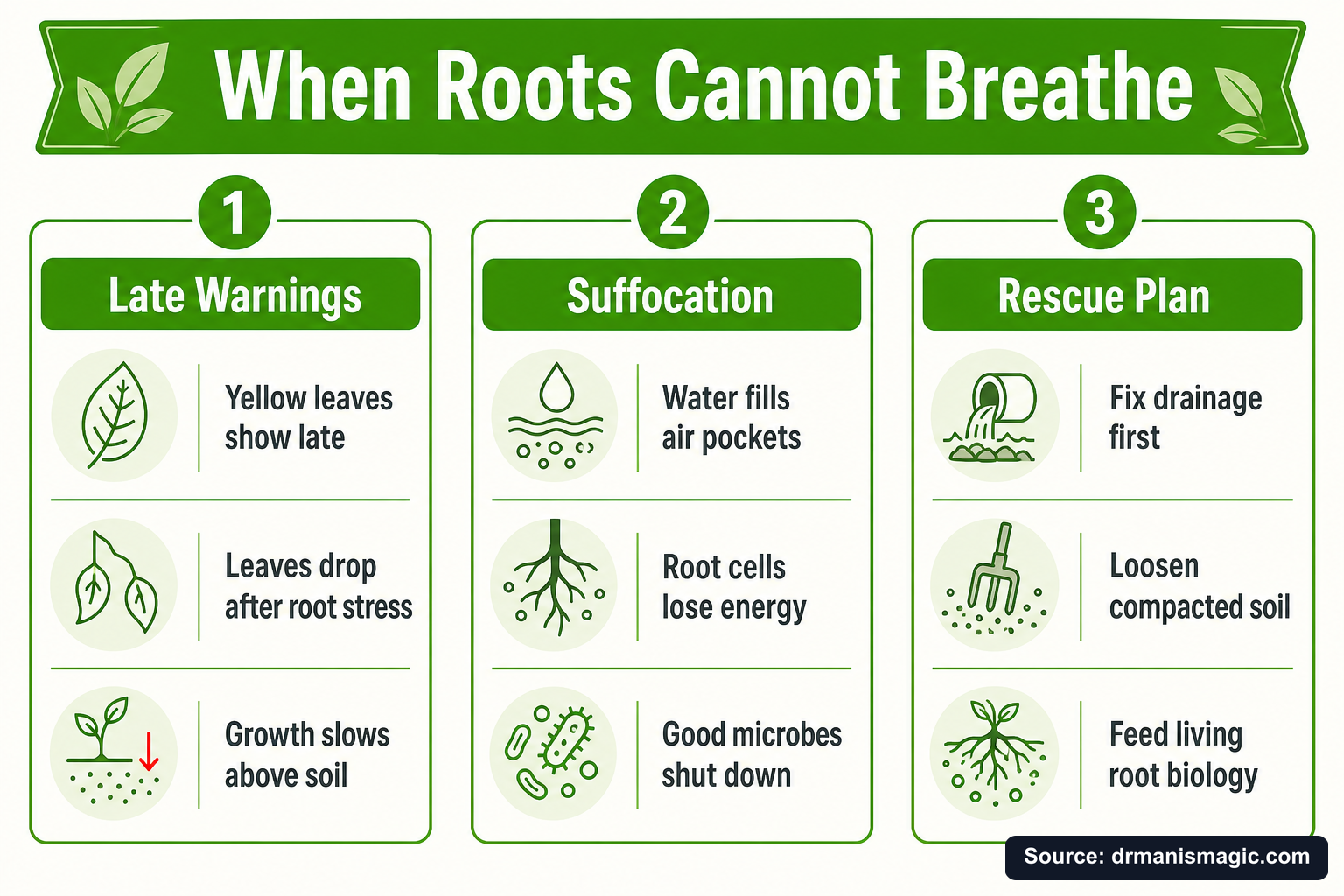
Key Takeaways
- Roots need oxygen to survive. When water or compacted soil fills the air pockets underground, roots begin to suffocate within hours.
- The damage follows a predictable chain: oxygen disappears, roots weaken, good microbes die off, bad chemistry takes over, and pathogens move in.
- Yellow leaves, leaf drop, and poor growth are late-stage symptoms. The real disaster is happening underground long before you see anything above ground.
- Overwatering, compaction, poor drainage, and the wrong soil type all trigger the same cascade — but the fix for each is different.
- Beneficial microbes — bacteria, fungi, protozoa, and nematodes — are your root zone's invisible immune system. When oxygen disappears, so do they.
- The Three Plant Pillars — mineral-based soil, live microbials, and organic fertilizer — work together to keep roots breathing, thriving, and nearly bulletproof.
- Recovery is possible, but it requires fixing the root cause first. Drainage and oxygen come before any product you pour on the soil.
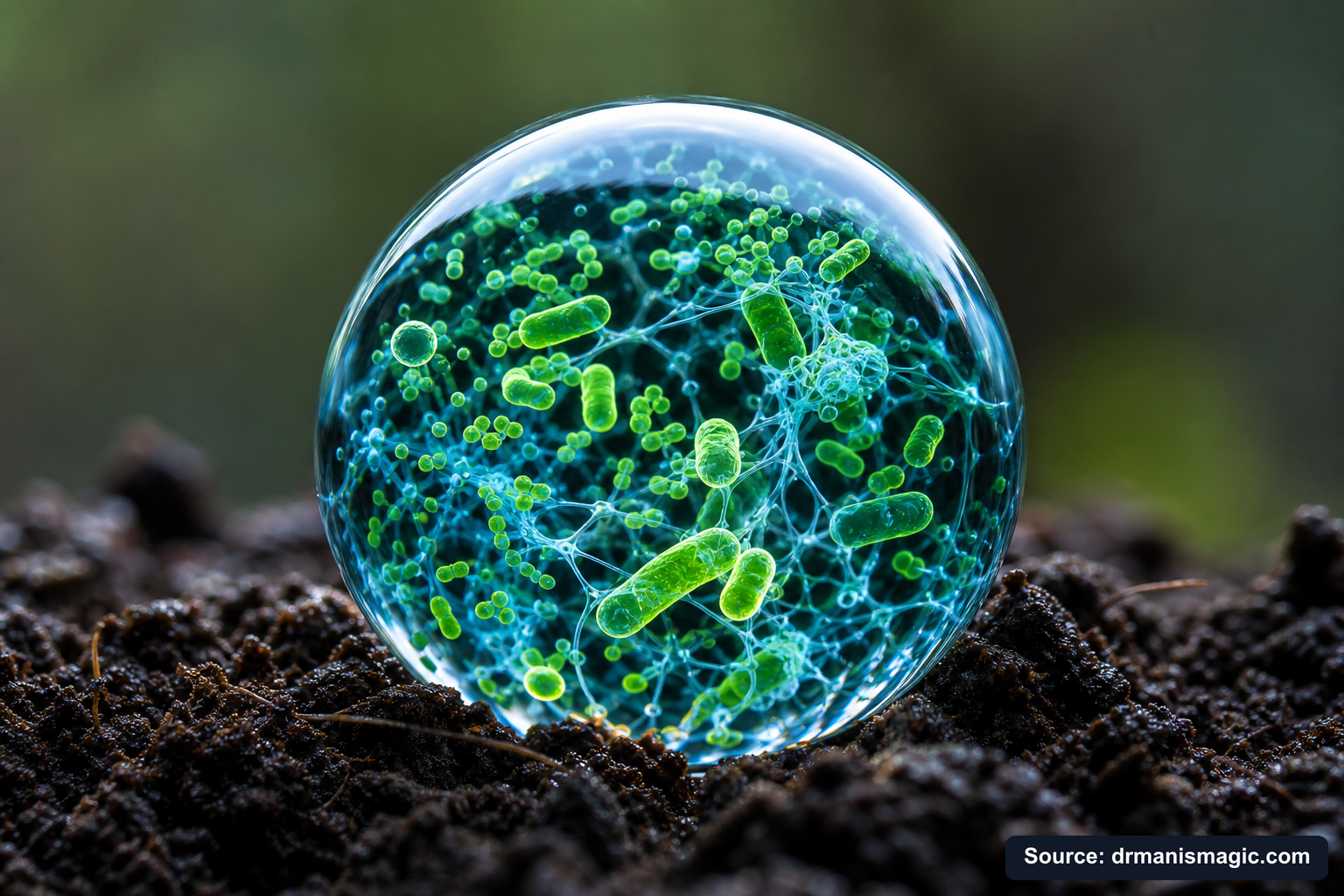
Can Roots Actually Breathe? What Does That Even Mean?
Quick Answer: Yes, roots breathe oxygen just like you do. They pull oxygen from tiny air pockets in the soil and use it to power cellular respiration — the process that keeps roots alive and drives nutrient and water uptake. Without oxygen, roots cannot produce energy, cannot absorb food, and begin to die within hours.
Roots breathe through a process called cellular respiration. Think of it like a tiny engine running inside every root cell. That engine burns oxygen to make energy. That energy is what lets the root push water and nutrients up into your plant. No oxygen means no energy. No energy means the engine stalls.
Healthy soil is not just dirt. It is a sponge with millions of tiny air pockets between the particles. Those pockets hold oxygen. Roots stick their microscopic tips into those pockets and breathe. Soil scientists at Penn State Extension have documented that oxygen availability is one of the most critical factors limiting both root growth and soil microbial activity. When those pockets fill with water and the oxygen runs out, the countdown begins.
This is also why roots can grow beautifully in a glass of water — the water is oxygenated and fresh — but die in soggy potting mix. Stagnant water sitting around roots in a pot or in dense clay soil has no fresh oxygen flowing through it. The roots drown in plain sight.
What Happens When Soil Has No Oxygen? The Root Suffocation Cascade
Quick Answer: When soil oxygen drops, roots lose the ability to produce energy, absorb nutrients, and grow. Beneficial aerobic microbes die off. Anaerobic bacteria take over, releasing toxic compounds including hydrogen sulfide — the rotten-egg smell in waterlogged soil. Opportunistic pathogens like Phytophthora then exploit the weakened roots, causing rapid decay.
This is the cascade nobody explains. It is not just "roots rot." It is a step-by-step collapse with a very predictable sequence.
Step 1: Oxygen Disappears
Water fills the air pockets in your soil. Oxygen diffusion slows to almost zero. Roots and the billions of aerobic microbes living around them are all competing for the last scraps of oxygen. Within hours in warm temperatures, it is gone.
Step 2: Root Cells Start Losing Power
Without oxygen, root cells switch to a backup energy process called anaerobic respiration. It is far less efficient. It also produces toxic byproducts — including ethanol and lactic acid — right inside the root tissue. The root is essentially poisoning itself trying to survive.
Step 3: The Beneficial Microbes Go Silent
The good guys in your soil — beneficial bacteria, mycorrhizal fungi, protozoa, and nutrient-cycling nematodes — are all aerobic organisms. They need oxygen too. When it disappears, they die off or go dormant. The invisible workforce that was feeding your plant, protecting it from disease, and building soil structure simply vanishes.
Step 4: The Bad Chemistry Begins
With aerobic biology gone, anaerobic bacteria take over. They produce very different chemistry. Sulfur compounds get reduced to hydrogen sulfide — that rotten egg smell you notice when you dig into a waterlogged pot. Iron and manganese get reduced into forms that are toxic to roots. The entire chemistry of your root zone shifts from life-giving to life-threatening.
Step 5: Pathogens Move In
Pathogens like Phytophthora species thrive in exactly these conditions. They are not the cause of the problem. They are the opportunists who arrive after the oxygen is already gone. They infect weakened, dying root tissue and accelerate the collapse. UC IPM citrus guidance specifically notes that Phytophthora root rot symptoms are nearly impossible to distinguish from flooding damage, nematode injury, or salt damage without laboratory testing — because they often happen together.
Step 6: Nutrient and Water Uptake Collapses
The feeder roots — the tiny hair-like roots that do almost all of the actual absorbing — start to die. They slough off. The root system shrinks. Even if you add fertilizer now, there is nothing left to absorb it. Water uptake fails too. The plant begins to dehydrate even if the soil is soaking wet.
Step 7: The Canopy Finally Shows the Damage
Now the leaves turn yellow. Now they drop. Now the branches start to die back. This is the moment most gardeners panic and start Googling. But this is actually the last step in a process that started weeks or even months ago underground.
By the time you see it on the leaves, the root zone has already been through a war.
What Are the Symptoms of Root Suffocation — and How Do You Know the Real Cause?
Quick Answer: Yellowing leaves, leaf drop, stunted growth, and wilting in wet soil all point to root oxygen problems. But the same symptoms show up with Phytophthora, salt damage, nematodes, fertilizer burn, and pH imbalance. The diagnostic clues are in the soil — smell it, inspect the roots, and check drainage before assuming any single cause.
This is where most gardeners get stuck. They see yellow leaves and assume the plant needs more fertilizer. They add more. It gets worse. Because the real problem is not a nutrient deficiency. It is a root zone that cannot absorb anything at all.
Here is a diagnostic table to help you sort through what you are actually dealing with.
| Symptom You See | Likely Cause | Soil Condition | Root Appearance | Soil Odor | Immediate Action |
|---|---|---|---|---|---|
| Yellow leaves, soggy soil | Overwatering / poor drainage | Waterlogged, no air pockets | Brown, soft, slippery | Sour or rotten egg | Stop watering. Improve drainage. Let soil dry out. |
| Yellow leaves, firm dry soil | Salt buildup / fertilizer burn | Crusty white residue possible | Brown tips, shriveled | No odor or chemical smell | Flush soil deeply with clean water. Switch to organic fertilizer. |
| Wilting despite regular watering | Phytophthora root rot | Often wet or recently flooded | Dark brown to black, mushy | Rotten, sulfur-like | Reduce water. Improve drainage. Consider lab test. |
| Slow growth, few new roots | Nematode damage | Normal appearance | Galls, knots, or stunted tips | Usually none | Soil test for nematodes. Add beneficial biology. |
| Leaf drop after transplant | Transplant shock / compaction | Often dense or poorly aerated | Minimal feeder roots | None | Improve soil aeration. Add live microbials. Water gently. |
| Brown leaf edges, yellow between veins | pH imbalance locking nutrients | Normal moisture | May look healthy | None | Test soil pH. Correct with appropriate amendment. |
| Sudden decline after chemical application | Herbicide or pesticide injury | Normal | May show burning or die-back | Chemical smell possible | Stop applications. Flush soil. Rebuild microbial life. |
The most important tool in your diagnostic kit costs nothing. Get down on your knees, dig a small handful of soil from around the roots, and smell it. Earthy and clean? Good sign. Sour, sulfur, or sewage-like? You have anaerobic conditions. That smell is hydrogen sulfide — the chemical signature of oxygen-starved soil. Trust your nose before you trust any product label.
Why Do Roots Rot in Wet Soil But Grow in Water?
Quick Answer: Roots in a glass of water survive because the water is oxygenated and constantly refreshed. Soggy soil traps stagnant water with no oxygen flow, creating the exact anaerobic conditions that kill roots. It is not the water itself that causes rot — it is the absence of oxygen that comes with stagnant, trapped water.
This question trips up a lot of gardeners. They propagate cuttings in water and it works great. Then they water their pot and the roots rot. How can water be both good and bad?
The answer is oxygen flow. When you propagate a cutting in a jar of water on your windowsill, that water is in contact with air. It is refreshed every time you change it. Oxygen dissolves in. The roots can breathe.
But soggy potting mix is a different world. That water sits locked between soil particles with no airflow. Whatever oxygen was in there gets consumed by roots and microbes in the first few hours. Nothing replaces it. And if the potting mix is made from decomposing bark and wood — the kind sold at every big box store — it breaks down over time into a dense, waterlogging sludge that makes the problem even worse.
This is exactly why Pillar One of the Three Plant Pillars is mineral-based soil. Our Super Soil is built on silica-rich sandy loam from the Rio Grande Valley — mineral particles that do not decompose, do not compact, and keep those air pockets open permanently. The roots can breathe. The water drains. The cascade never starts.
See also: Why Most Potting Mix Collapses Within 6-12 Months
You Never Had a Brown Thumb.
You were handed the wrong tools. This free guide hands you the right ones.
You watered it. You fed it. It died anyway.
It was never you. It was the dirt, the salt food, and the bad advice.
This guide shows you what really went wrong, and how to fix it for good.
- Why your plants really died, and why it was never your fault
- The salt hiding in your plant food that quietly burns the roots
- The hidden killer in almost every bag of store soil
- The tiny helpers that grow a whole forest for free
- The rescue trick that brings a half dead plant back to life

What Role Do Soil Microbes Play When Roots Can't Breathe?
Quick Answer: Beneficial soil microbes — bacteria, fungi, protozoa, and nematodes — form a living immune system around your roots. They need oxygen just like roots do. When the root zone goes anaerobic, this entire workforce collapses, leaving roots defenseless against pathogens, nutrient-locked, and unable to recover without active help.
Here is the part of this story that almost nobody tells you. And it is the most important part.
Your soil is not just dirt. In a healthy, oxygen-rich root zone, there are literally billions of living organisms in every tablespoon of soil. Bacteria. Fungi. Protozoa. Nematodes. These are not germs. They are your plant's invisible workforce — the same invisible workforce that lets wild forests grow for centuries with no fertilizer bags, no pesticides, and no help from any of us.
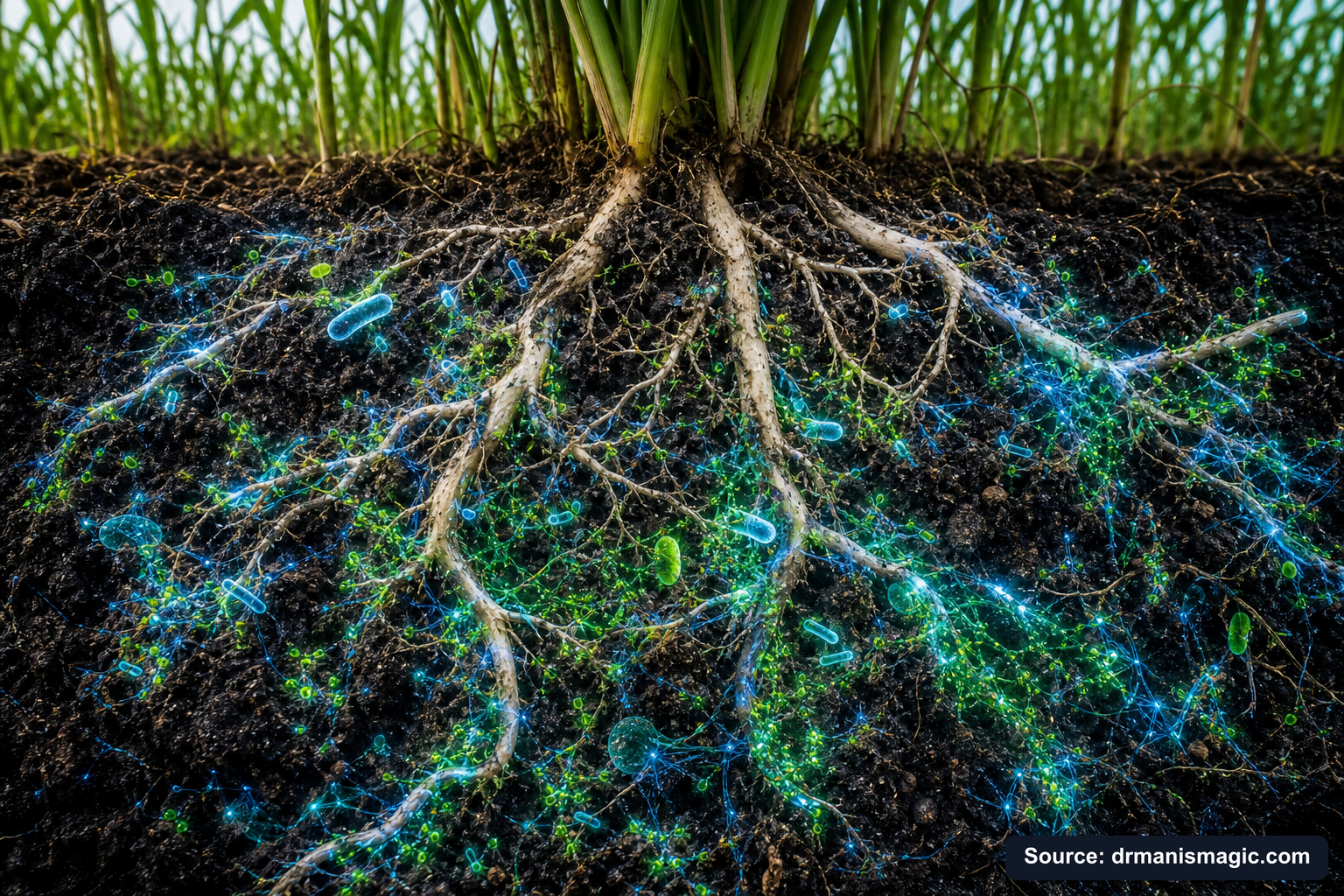
They do a staggering amount of work.
| Microbe Type | What They Do for Your Plant | What Happens When They Die |
|---|---|---|
| Beneficial Bacteria | Fix nitrogen from air, dissolve locked minerals, crowd out pathogens, produce growth hormones | Nutrients get locked up. Pathogens multiply without competition. |
| Mycorrhizal Fungi | Extend root reach up to 100x, deliver water and phosphorus, produce glomalin that holds soil structure together | Root system shrinks. Soil structure collapses. Drought stress spikes. |
| Protozoa | Eat bacteria and release nitrogen in plant-available form — like a slow-release fertilizer that runs itself | Nitrogen cycling stops. Nutrients accumulate but stay inaccessible. |
| Beneficial Nematodes | Eat bacteria, fungi, and harmful nematodes — regulate the food web, cycle nutrients at deeper soil levels | Harmful nematodes face no predators. Root damage accelerates. |
Every single one of these organisms is aerobic. They need oxygen. When your soil floods, compacts, or gets treated with salt-based fertilizers that draw water away from microbial cells — they die. Or they go dormant. And the pathogens that thrive in anaerobic conditions? They have no competition left. They multiply freely.
The University of Florida IFAS extension research on flooded citrus confirms this directly: anaerobic bacteria thrive without oxygen and can destroy citrus root systems rapidly, with hydrogen sulfide odor and root sloughing as the key field indicators. This is not a slow process. It happens fast.
Rebuilding this biology after it collapses is possible. But it takes time, and it takes the right inputs. Most of the so-called microbial products on the market will not help at all — and we will explain exactly why in the next section.
Why Do Most Microbial Products Fail to Restore Oxygen-Starved Root Zones?
Quick Answer: Most commercial microbial products are either dried powders with dead or dormant spores that never reactivate, or compost-tea liquids that have already gone anaerobic in the bottle. Neither delivers genuinely live, full-spectrum biology to your roots. Dead microbes cannot do the work that living ones do.
This is where the gardening industry has been selling you a story that does not hold up.
Walk into any garden center and you will find shelves full of products with impressive-sounding microbe lists on the label. Bacillus this. Trichoderma that. Mycorrhizae blend. Sounds great. But here is what is actually in most of those bottles and bags.
Type 1: Dried powders. These are microbes grown in giant factory vats, then dried into spores and packaged. The idea is that they will reactivate when you add water. After growing over 250,000 trees at our nursery and testing dozens of these products, we have seen virtually no consistent benefit from them. The reactivation rate is poor. The spectrum is narrow. They are not the same as the teeming, diverse, living community that roots evolved alongside.
Type 2: Smelly liquids. These are compost tea-style products that started with real organic material but then sat in a bottle for weeks or months. Without aeration, they go anaerobic. The microbes die and begin to ferment. Some bottles even hiss when you open them — that is gas from decomposition. You can smell it immediately. The rotten, sewage-like odor is the telltale sign. Some gardeners see results from these anyway because the liquid still contains humic acids and other organic compounds. But the live biology is gone.
Type 3: Lactobacillus-based products. Yes, like yogurt bacteria. Very easy to culture, very vigorous, very alive. But lactobacillus is so aggressive it actually outcompetes and displaces the beneficial bacteria you want in your soil. It belongs in your gut, not your garden.
None of these get to the heart of what root-zone recovery actually requires: a genuinely live, full-spectrum community of bacteria, fungi, protozoa, and nematodes — delivered alive to your root zone and ready to work.
This is the problem Dr. Mani Skaria set out to solve when he developed Plant Super Boost. The product uses a proprietary, all-natural stabilization technique developed by a world-renowned compost expert — a technique that keeps the full spectrum of microbes from fresh compost alive in the bottle, without them going anaerobic and dying. No synthetic preservatives. No dried powders. If you put a drop under a microscope, you can see them moving. Lab analysis confirms over 2,000 bacterial species and 400 to 500 fungal species including mycorrhizae, plus protozoa and nematodes. And it smells like fresh earth — not sewage — because it is genuinely alive and stable.
Zero PFAS. Zero biosludge. Zero synthetic salts. That matters when you are trying to rebuild the very biology that salts and chemicals destroyed.
Live Microbes vs. Dead Microbe Products: What Is the Real Difference?
Quick Answer: Live, full-spectrum microbes harvested from active compost and properly stabilized deliver immediate biological activity in the root zone. Dried powders and anaerobic liquids deliver little to no working biology. The difference in plant response is the difference between hiring a workforce and sending a resume for one.
| Product Type | Microbes Alive at Use? | Spectrum | Odor | Real-World Results |
|---|---|---|---|---|
| Dried powder (factory-grown) | Low — spores rarely reactivate fully | Narrow (1-10 species) | Neutral | Minimal benefit observed in testing |
| Dried powder added to liquid | Low | Narrow | Neutral to mild | Same issue — avoid |
| Compost tea (fresh, under 24 hours) | Moderate (if actively aerated) | Partial | Earthy to slightly sour | Good if used immediately — impractical for most |
| Compost tea (old, over 24 hours) | Low — anaerobic die-off | Partial | Strong rotten odor | Some organic compounds remain; live biology gone |
| Lactobacillus products | High — but wrong species | Narrow and aggressive | Sour | Displaces beneficial microbes — not recommended |
| Plant Super Boost (stabilized, full-spectrum) | High — visible under microscope | 2,000+ bacteria, 400-500 fungi, protozoa, nematodes | Fresh earth — no stench | Consistent results across 250,000+ trees tested |
The difference is not a small one. Think about your gut health. A probiotic with five strains of freeze-dried bacteria is very different from a diet rich in live-culture fermented foods. Your gut knows the difference. Your roots know the difference too.
See also: Why Dead Microbe Products Fail in Real Gardens
Can a Plant Actually Recover From Root Suffocation?
Quick Answer: Yes, many plants can recover from root suffocation if the oxygen problem is corrected early enough and the feeder roots are not completely gone. Recovery requires fixing drainage first, then rebuilding the microbial community, then reintroducing gentle organic nutrition. Skipping to products before fixing the root cause will not work.
Here is the honest truth. Recovery depends on how far the cascade has gone.
If you catch it at Step 1 or 2 — waterlogged soil, no visible root damage yet — recovery is very achievable. If you are at Step 5 or 6 — Phytophthora colonizing dead root tissue, feeder roots sloughing off — it is much harder, and some plants will not make it back.
But for most home gardeners catching the problem when the leaves first start turning yellow, there is a real path forward. Here is the recovery sequence that works, in order.
- Stop watering immediately. Give the root zone a chance to drain and begin to dry. Do not water again until the top two inches of soil are genuinely dry.
- Check and fix drainage. If the pot has no drainage hole, add one or repot. If the plant is in the ground in heavy clay, consider raised beds or drainage channels. No product in the world works until oxygen can get back to the roots.
- Smell the soil. If it smells like rotten eggs or sewage, you have anaerobic conditions. Gently remove as much of the old wet soil as possible and repot in well-draining mineral-based soil.
- Inspect the roots. Trim off any roots that are black, soft, or mushy. Healthy roots are white or tan and firm. Leave those alone.
- Rebuild the microbial community. Apply a live, full-spectrum microbial product to the root zone once drainage is restored. This is when biology can actually start working again.
- Reintroduce nutrition gently. Do not rush to fertilize. Wait until you see new growth — a sign the roots are absorbing again. Then use organic, slow-release fertilizer with no synthetic salts. Salts kill the microbes you just worked to restore.
- Monitor and maintain. Recovery takes weeks, not days. Apply microbials monthly. Keep the soil aerated. Watch for new growth as your signal that the root zone is coming back to life.
You cannot buy your way out of an oxygen problem. But you absolutely can fix it — if you fix it in the right order.
How Does the Wrong Soil Make Root Suffocation Almost Inevitable?
Quick Answer: Standard potting mix made from pine bark and wood chips decomposes over 6 to 12 months, compacting into a dense, poorly draining sludge that blocks both oxygen and water flow. Mineral-based soil made from silica-rich sandy loam does not decompose, keeping air pockets permanently open so roots can breathe for years without repotting.
Most potting mix is not designed to last. It is designed to look good on a shelf and sell fast. The base ingredient is usually pine bark, wood chips, or peat — all organic materials that break down over time. As they decompose, they compact. The air pockets disappear. The drainage slows. The very material meant to support your plant begins to suffocate it.
We have watched this happen over and over at our South Texas nursery. A tree goes into a pot in beautiful, fluffy potting mix. Eighteen months later, the mix has compacted to half its original volume. The drainage is poor. The roots are stressed. And the gardener has no idea why the tree that was thriving is now declining.
There is also a darker side. Decomposing organic matter in a pot can steal the oxygen that was left in the soil as microbes work to break it down. So the very act of the soil decomposing makes the oxygen problem worse.
Our Super Soil is built on silica-rich mineral particles from the Rio Grande Valley that do not decompose. They hold their structure for years. The air pockets stay open. The drainage stays consistent. And the roots can breathe the way they were designed to breathe — permanently.
See also: The Hidden Reason Synthetic Fertilizers Cause Root Rot
What Does This Mean for You Right Now? A Practical Path Forward
Here is the beautiful part of this story. The root suffocation cascade sounds scary. And it can be. But it is entirely preventable. And it is reversible in most cases — if you understand what is actually happening underground.
The plants that never struggle with root suffocation all share the same three foundations. Soil that keeps air pockets open permanently. A living microbial community that protects, feeds, and strengthens roots from the inside out. And organic nutrition that works with those microbes instead of burning them to the ground.
That is not a new idea. That is how nature has grown forests, prairies, and orchards for millions of years without a single bag of synthetic fertilizer. Dr. Mani Skaria spent 40 years as a plant pathologist at the Texas A&M Citrus Center watching exactly this truth play out. The plants that thrived were the ones with living soil. The ones that died were the ones cut off from it.
We built the Free Plant Care Field Guide to make this practical and simple for any plant owner — whether you have a single houseplant on a windowsill or a backyard full of fruit trees. No jargon. No complicated chemical regimens. Just the three foundations, applied in the right order, doing exactly what nature designed them to do.
You cannot get your time back. Every month spent in the wrong soil, with dead microbiology, and salt-based fertilizers burning the very roots you are trying to feed, is a month you do not get a second chance at. The best time to set your plants up on the right foundation was the day you planted them. The second best time is right now.
If you want to start with the living microbial layer — the invisible workforce that turns a struggling root zone into a thriving one — explore Plant Super Boost and see what genuinely live, full-spectrum biology does for your plants. Backed by a 30-day money-back guarantee. Made in the USA. And it smells like fresh earth — because it actually is.
Frequently Asked Questions
Roots are doing life-or-death work underground right now, and most gardeners never think about it until it is too late. These are the questions we hear most often from plant owners who are tired of watching their trees and gardens slowly fade. Get the answers right, and everything changes.
What helps roots breathe underground?
Roots breathe through tiny air pockets between soil particles. The best thing you can do is give them a soil that holds those pockets open. That is exactly why Dr. Mani built Super Soil from mineral-based sandy loam instead of wood chips or pine bark. Wood breaks down and collapses. Mineral soil stays open. Roots keep breathing. It is that simple, and we proved it across more than 250,000 trees in South Texas.
How do I get more oxygen to my plant roots?
Stop using heavy, organic-based potting mixes that compact over time. Switch to a mineral-based soil that drains fast and holds its structure. Then add live microbes. The beneficial bacteria and fungi in Plant Super Boost break up the soil at a microscopic level, keeping channels open so oxygen can reach every root tip. More oxygen means more energy. More energy means faster growth and stronger plants.
What actually happens when roots cannot breathe?
It is a chain reaction. First, oxygen disappears from the soil. Then roots lose the ability to make energy. They stop absorbing water and nutrients. Good microbes die off. Bad bacteria and fungi move in. Root rot begins. By the time you see yellow leaves or drooping branches above ground, the damage has been building underground for weeks. We call this the root suffocation cascade, and we have watched it destroy trees that looked perfectly healthy just a month before.
How does a root actually breathe?
Every root cell runs a tiny engine called cellular respiration. That engine pulls in oxygen from the soil air pockets and burns it to make energy. That energy is what pumps water and nutrients up into your plant. Roots release carbon dioxide back into the soil as a byproduct, just like your lungs do. No oxygen in the soil means the engine stops. The root starves. The plant above it starts to suffer.
What happens when roots are exposed to open air?
Exposed roots dry out fast. Once the outer tissue dries, the root loses its ability to pull in water and nutrients. The plant goes into stress mode. Growth slows. Leaves may curl, yellow, or drop. If the exposure lasts too long, those roots die and the plant has to spend precious energy growing replacements instead of producing fruit, flowers, or new leaves. Always cover exposed roots quickly with good mineral-based soil to protect them.
Why do roots stay so close to the surface?
Because that is where the oxygen is. Deep soil is usually dense and compacted, with almost no air pockets. Roots go where they can breathe. About 80 to 90 percent of a tree's root system lives in the top 18 to 24 inches of soil. That is exactly the zone you are managing when you choose the right soil and add live microbials. Get that zone right and your roots will spread wide, anchor deep, and feed your plant like champions.
What kills roots permanently and how do I avoid it by accident?
Salt kills roots. That is the ugly truth about synthetic fertilizers that nobody in the big box store will tell you. They are salt-based, and salt pulls water out of root cells and wipes out the beneficial microbes your roots depend on. Over time, your soil becomes a dead zone. Organic fertilizer made from crab, kelp, and amino acids feeds your roots without the salt burn. No toxic buildup. No dead soil. Just steady, strong growth that keeps going season after season.
About the Author
Dr. Mani Skaria, PhD
Dr. Mani Skaria, PhD, is a plant pathologist and the scientific founder of Dr. Mani's Magic. He earned his doctorate at Purdue University and spent 48 years studying how plants, soil, and living microbes work together, including his years as Professor Emeritus at Texas A&M and as a member of the USDA NAREEE Advisory Board. He invented micro-budding, a method for growing healthier, stronger trees, and has grown more than 250,000 trees on the family farm in Hargill, Texas - US Citrus Nursery. His life's work takes real lab science and practical experience and turns it into simple, safe, organic plant care anyone can use at home.


