


How Weathered Rock Becomes Permanent Soil for Healthy Roots | Dr. Mani's Magic
How Weathered Rock Becomes Permanent Soil: The Secret Physics Behind Roots That Never Quit
Picture this. You're kneeling in your backyard, fingers pressed into a bag of fresh potting mix. It smells earthy. It feels soft. It looks rich and dark and alive. You think, "This is perfect." You pot your new tree. You water it. You feel like a real gardener.
Six months later, that same mix has turned into something that looks like wet cardboard. It smells faintly sour. Water pools on top and just sits there. The roots you pull out are brown. Slimy. Dead. And you're standing there wondering what you did wrong. Here's the thing. You didn't do anything wrong. You were handed the wrong foundation from the very beginning. And nobody told you why.
The answer goes all the way back to something that's been happening under your feet for millions of years. It's the story of how rock becomes soil. Real soil. Permanent soil. The kind that keeps roots breathing, keeps plants alive, and never collapses under them. Once you understand this story, you'll never look at a bag of potting mix the same way again. And you'll know exactly what to do instead.
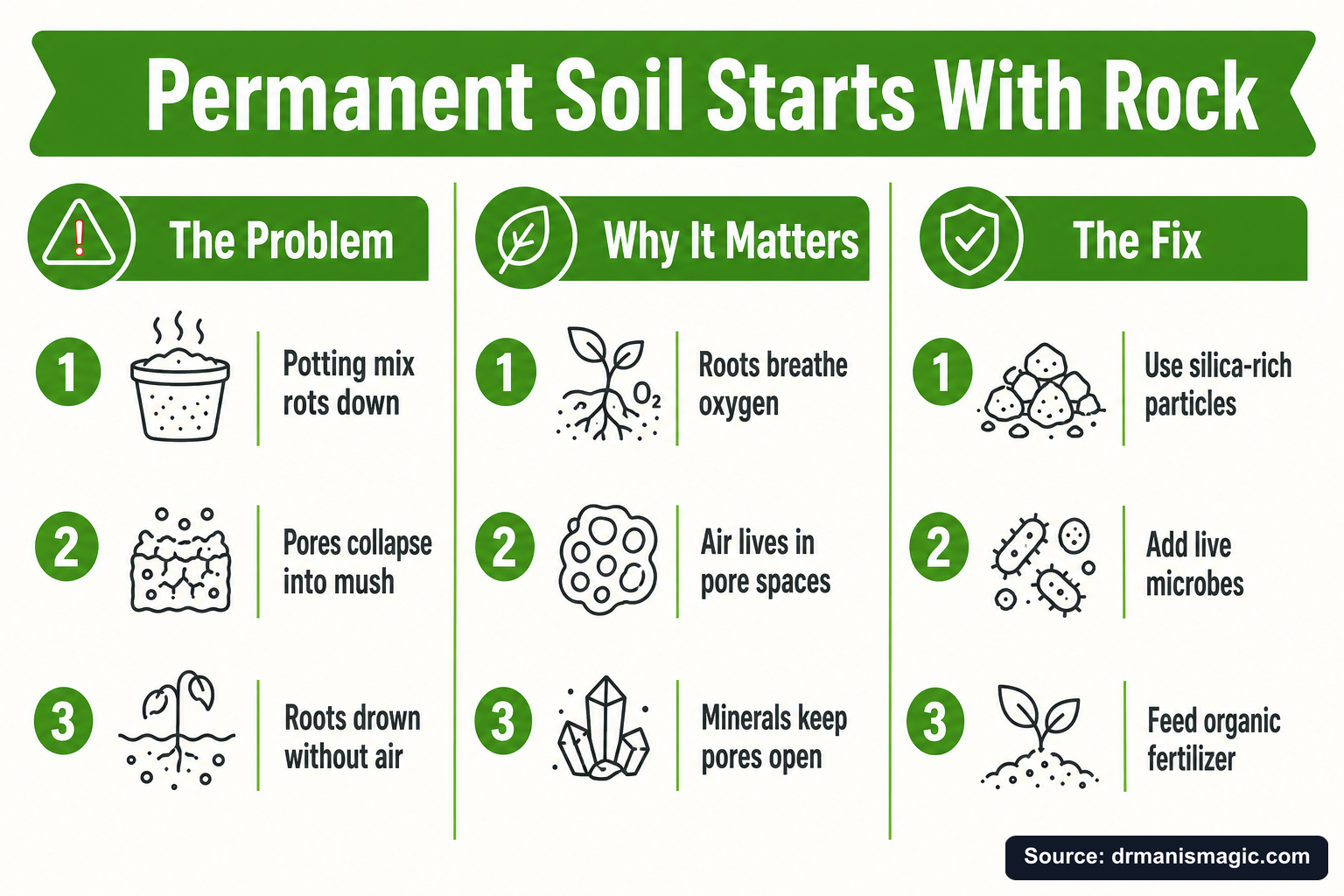
Key Takeaways
- Real soil is not just crushed rock. It takes physical weathering, chemical change, biological activity, and organic matter to create true, plant-supporting ground.
- The most important thing soil does for roots is deliver oxygen. When that stops, roots rot. Full stop.
- Standard potting mix is mostly pine bark sawdust. It is organic matter. It decomposes. When it decomposes, it steals the oxygen your roots need to survive.
- Mineral-based soil, built on silica-rich particles that do not decompose, preserves pore space and keeps oxygen flowing to roots permanently.
- The Three Plant Pillars — mineral-based soil, live microbes, and organic fertilizer — are the framework Dr. Mani Skaria developed after growing over 250,000 trees at US Citrus Nursery in South Texas.
- Container gardening creates a closed system. The rules of the ground do not apply. Oxygen, drainage, and pore structure must be engineered, not assumed.
- Durable mineral particles are the skeleton. Everything else hangs on them. When the skeleton collapses, the whole plant collapses with it.
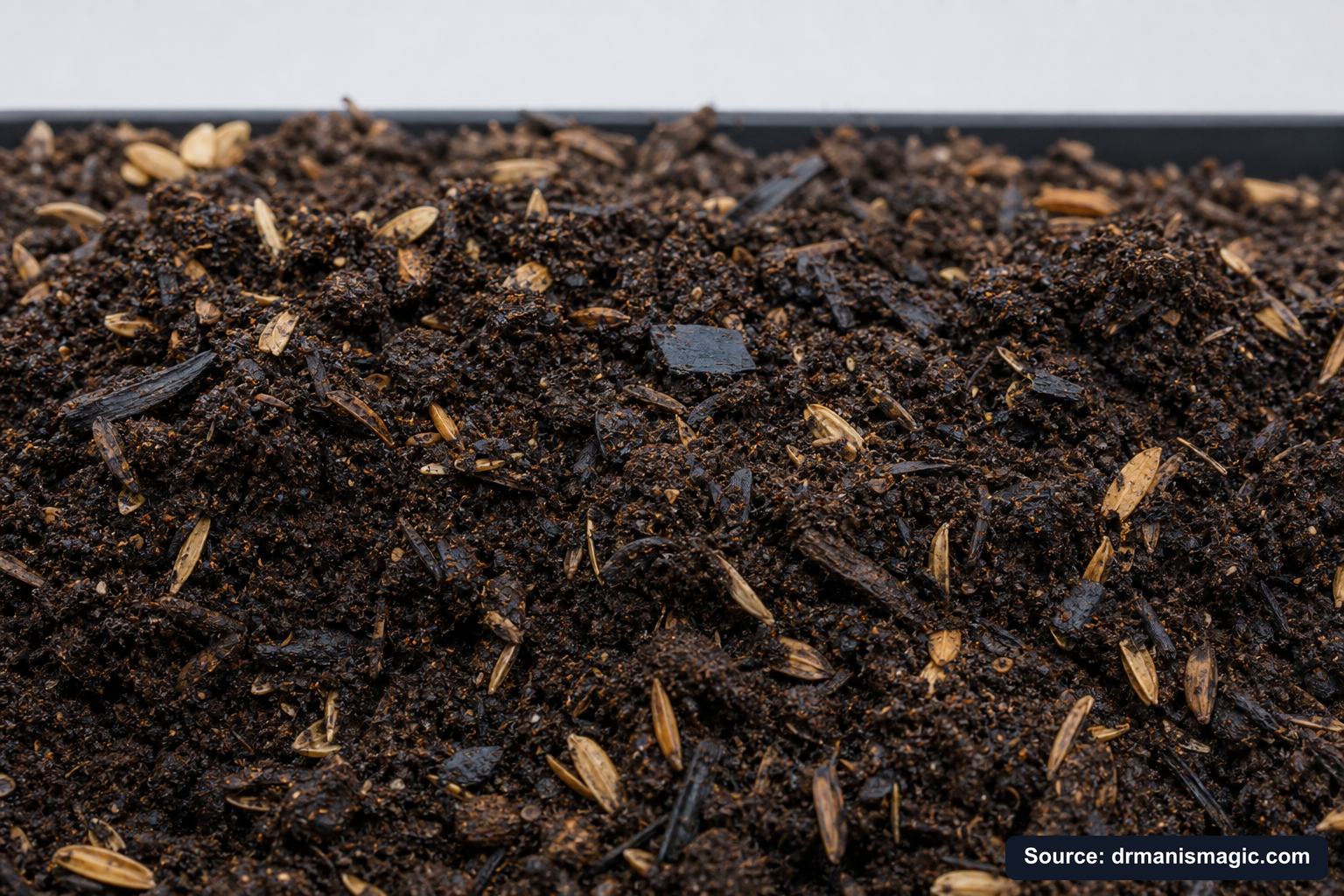
What Does Weathered Rock Actually Have to Do With Your Plant's Roots?
Quick Answer: Weathered rock provides the mineral particles that form the skeleton of true soil. Those particles create the pore spaces roots need for oxygen and water. Without durable mineral particles, soil compacts, pores close, oxygen disappears, and roots suffocate. The same physics that builds natural soil over centuries also determines whether your container plant lives or dies.
Let's start at the beginning. A mountain of solid granite sits in the sun. Rain hits it. Ice cracks it. Wind scrapes it. Over thousands of years, that granite breaks into smaller and smaller pieces. Gravel. Sand. Silt. This is physical weathering. It's just rock getting smaller.
But here's what most people don't know. Smaller rock is still just rock. It is not yet soil.
According to soil science educators at the University of Nebraska-Lincoln, true soil forms only when mineral parent material is transformed by four additional forces: chemical weathering, biological activity, organic matter accumulation, and the development of distinct layers called horizons. Rock fragments alone are a starting point. They are the skeleton. But the skeleton needs biology, organic residue, air, and water before it becomes something a plant can live in.
Think of it this way. A house frame is not a house. You need walls, plumbing, wiring, and air circulation before anyone can live there comfortably. Mineral particles are the frame. The rest of soil is the infrastructure that makes it livable for roots.
Now here is the part that changes everything for gardeners. That mineral skeleton, those durable silica-based particles, does not rot. Does not collapse. Does not compress into mush. It has been sitting in the earth for millions of years and will be there millions of years from now. That permanence is exactly what roots need.
Why Do Roots Need Oxygen More Than Almost Anything Else?
Quick Answer: Roots breathe. They pull oxygen from the air spaces in soil to power nutrient uptake and stay healthy. When pore spaces fill with water or collapse from decomposing media, roots are cut off from oxygen. Without it, roots turn brown, go slimy, become vulnerable to disease, and eventually die. No oxygen means no roots. No roots means no plant.
Here's something that surprises almost every gardener the first time they hear it. Your plant uses carbon dioxide up top. But the roots below need oxygen. The same oxygen you and I breathe.
Roots are not passive tubes. They are active, working tissue. They respire. They consume oxygen to produce the energy needed to absorb water and nutrients. When oxygen is available, roots are white, firm, healthy, and aggressive. When oxygen disappears, everything changes fast.
Oklahoma State University Extension explains it clearly: air-filled porosity is the single most critical physical property of any container growing medium. Not water. Not nutrients. Air. The percentage of the total soil volume that holds air after drainage is the number that determines root health more than anything else.
So where does that air live? In the pores. The tiny gaps between soil particles. Big pores drain fast and fill with air. Small pores hold water. A good growing medium has both. When the balance tips too far toward small pores, or when pores collapse entirely, water sits where air should be. Roots suffocate. Root-rot pathogens, which thrive in low-oxygen conditions, move in and finish the job.
This is not overwatering. This is oxygen starvation. The distinction matters enormously because the solution is completely different.
What Is the Real Problem With Standard Potting Mix?
Quick Answer: Standard potting mix is mostly pine bark sawdust, an organic material that decomposes within months. As it breaks down, it steals oxygen from the root zone, collapses pore spaces, repels water, and creates conditions that favor root rot. It was designed for cheap shipping and short-term retail turnover, not for long-term plant health.
Let's talk about what's actually in that bag you bought at the hardware store.
It is not soil. It is not even close to soil. It is called potting mix because calling it what it actually is would not sell very well. What it actually is, mostly, is pine bark sawdust. Ground-up wood waste from the timber industry in the southeastern United States. A cheap byproduct that got repurposed into a product.
Here's the uncomfortable truth. You have been planting your trees and flowers and houseplants inside other dead plants.
Now, pine is not just wood. Pine has its own chemistry. There is an entire scientific field called pine chemistry, focused on compounds called terpenes and terpenoids. You already know some of these by name. Turpentine. Pine-Sol. These are pine compounds. They are excellent for stripping paint and cleaning floors. They are not what you want surrounding the roots of your favorite tree.
To reduce the harshness of these chemicals, manufacturers pile the sawdust into enormous heaps and let it decompose for years before packaging it. That decomposition process does break down the terpenes. But it also begins the process that will eventually destroy your plant's root environment. Because decomposition is not a one-time event. It continues inside your container, month after month, long after you've potted your plant.
And here is where it gets worse. As that organic material breaks down, it does two things your roots hate. First, the decomposition process consumes oxygen. The microbes breaking down the wood are competing with your roots for the same air. Second, as the structure collapses, the pore spaces that once allowed air and water to move freely simply disappear. The mix compresses into a dense, wet, oxygen-poor mat.
To make freshly packaged potting mix hold water in the first place, manufacturers add surfactants. These are chemicals that force hydrophilic properties onto material that naturally repels water. Wood repels water. That's why wooden boats float. Surfactants temporarily fix that. But they wash out over time. Which is why old potting mix often becomes bone-dry and impossible to re-wet. Water just beads off the surface and runs straight down the inside edge of the pot. The roots in the center stay bone dry while the outer edge gets a quick rinse.
So you get the worst of every world. First, chemical compounds from pine that are harsh on roots. Then, decomposition that steals oxygen. Then, collapsed structure that eliminates air space. Then, loss of surfactants that makes water distribution impossible. And the whole process happens in about six months.
The big box stores know this cycle. Their business model depends on it. When your plant struggles, you buy more plants. You buy more products. The annual plant turnover keeps the shelves stocked and the cash registers ringing. Nobody at a big box store is incentivized to explain to you why your container soil has an expiration date.
How Is Soil in the Ground Different From Soil in a Container?
Quick Answer: In the ground, water drains downward through continuous layers of soil and rock. In a container, water hits a bottom boundary and creates a saturated zone called a perched water table. This zone stays wet and oxygen-poor regardless of how well your mix drains on paper. Container soil must be engineered specifically for this closed system. Garden soil fails in pots every time.
This is the piece that confuses almost everyone. People see plants thriving in garden beds and think the same soil will work in a pot. It does not. The physics are completely different.
When rain falls on a garden bed, water moves downward through soil layers, through subsoil, through fractured rock, and eventually into groundwater. The drainage is continuous and essentially unlimited. The soil never becomes fully saturated for long because there is always somewhere for water to go.
Put that same garden soil in a container and something very different happens. Water moves downward until it hits the bottom of the pot. At that point, it stops. The fine particles in the soil hold water through surface tension, and a saturated zone develops at the bottom of the container. This is called a perched water table. It is always there, regardless of how many drainage holes you have in the pot.
NC State University Extension confirms that field soil in containers becomes too dense, waterlogged, and low in oxygen, creating conditions that favor root rot and disease. This is not a theory. It is container physics.
The only way to fight the perched water table is with particle size. Larger, coarser particles create larger pores. Larger pores drain faster. The more large pores you have, the smaller the saturated zone at the bottom. The taller your container, the better this works. Short, wide containers have proportionally larger saturated zones. Tall containers have smaller ones.
This is why mineral-based soil with durable, coarse particles outperforms any organic mix in a container. The particles do not decompose. The pores stay open. The air stays in. The roots stay healthy. Not just for six months. For years. Permanently.
Potting Mix vs. Mineral-Based Soil: Which One Actually Lasts?
Quick Answer: Potting mix is an organic, carbon-based medium that decomposes within months, collapsing pore spaces and stealing oxygen from roots. Mineral-based soil is built on inorganic, silica-rich particles that do not decompose, preserving structure and oxygen availability for years. For any container plant you plan to keep longer than a season, mineral-based soil is the only rational choice.
Let's put this side by side so it's clear.
| Feature | Standard Potting Mix | Mineral-Based Soil (like Super Soil) |
|---|---|---|
| Primary ingredient | Pine bark sawdust (organic carbon) | Silica-rich sandy loam (inorganic mineral) |
| Does it decompose? | Yes. Within 6–12 months | No. Mineral particles are permanent |
| Effect on oxygen | Decomposition consumes oxygen from root zone | Pores stay open; oxygen flows continuously |
| Water behavior over time | Becomes hydrophobic; repels water when dry | Consistent drainage and moisture retention |
| Pore structure durability | Collapses as organic matter breaks down | Maintained indefinitely by particle size |
| Root rot risk | High; low oxygen favors pathogens | Low; oxygen-rich environment resists disease |
| Chemical concerns | Pine terpenes, added surfactants | Steam-sterilized; no synthetic additives |
| Useful lifespan in container | 6–12 months before performance drops | Years; repotting driven by plant size, not soil failure |
| Cost over 3 years | High; requires annual replacement | Low; one investment lasts |
| Who benefits from the short lifespan? | Big box stores and potting mix manufacturers | You and your plant |
The difference is not subtle. It is structural. One medium is built to last. The other is built to sell again next spring.
You Never Had a Brown Thumb.
You were handed the wrong tools. This free guide hands you the right ones.
You watered it. You fed it. It died anyway.
It was never you. It was the dirt, the salt food, and the bad advice.
This guide shows you what really went wrong, and how to fix it for good.
- Why your plants really died, and why it was never your fault
- The salt hiding in your plant food that quietly burns the roots
- The hidden killer in almost every bag of store soil
- The tiny helpers that grow a whole forest for free
- The rescue trick that brings a half dead plant back to life

What Happens to Roots When Pore Space Disappears?
Quick Answer: When pore space collapses in a container, roots are cut off from oxygen and become vulnerable to root-rot pathogens. The roots turn brown and slimy, nutrient uptake stops, leaves yellow, growth stalls, and the plant begins a slow decline that most gardeners mistake for a watering problem. By the time symptoms appear above ground, the damage below is already serious.
Roots communicate in a language most gardeners never learn to read. By the time a plant looks bad above the soil line, something has gone very wrong below it for weeks or months already.
Here is what actually happens when pore space disappears from a container mix.
Stage one. The organic matter starts breaking down. Pores shrink. Air-filled porosity drops. Roots start to slow their uptake because oxygen levels are falling. The plant looks fine. You would never know.
Stage two. Water begins sitting in the lower third of the container longer than it should. The roots in that zone are now in a consistently low-oxygen environment. Root-rot fungi, which are always present in small numbers, sense the opportunity. They begin to attack weakened root cells. Roots start turning brown at the tips.
Stage three. Nutrient uptake crashes. Leaves start showing yellowing, sometimes called chlorosis. Growth slows to almost nothing. The gardener notices and tries more fertilizer. More fertilizer on a root system that cannot absorb it does nothing helpful and sometimes makes things worse.
Stage four. Root decay spreads. The plant begins dropping leaves. Branches die back. What started as a decomposing growing medium has now become a plant funeral.
The most heartbreaking part of this story is the time it takes. You can spend months, sometimes years, slowly losing a tree that you love. Trying different fertilizers. Different watering schedules. Different locations. And the whole time, the real problem was the medium underneath.
That is time you cannot get back. If you have been dreaming of the day you pick fruit from your own tree, watching that tree slowly decline in collapsing potting mix is one of the most frustrating experiences in gardening. The solution was always the foundation.
What Did Ancient and Expert Growers Know About Permanent Soil Structure?
Quick Answer: Bonsai masters, ancient Mediterranean gardeners, and experienced nursery growers have always favored mineral-heavy, gritty, fast-draining media for long-lived container plants. They understood intuitively what soil science confirms: durable mineral particles preserve structure and oxygen over decades. Organic-heavy mixes were always considered temporary.
This is not a new idea. It just got buried.
Bonsai growers have known for centuries that trees kept alive for generations need mineral media. The classic Japanese bonsai soil is akadama, a fired clay particle, mixed with pumice and lava rock. Almost no organic content. The pores stay open for decades. The trees live for hundreds of years. That is not an accident. That is permanent soil structure by design.
Ancient Mediterranean farmers grew olive trees and figs in rocky, mineral-rich, fast-draining soils. The trees that survived and produced for centuries were the ones whose roots could breathe. The ones planted in heavy, organic, waterlogged ground struggled and died young.
And here in South Texas, after growing over 250,000 trees at US Citrus Nursery, Dr. Mani Skaria arrived at the same conclusion through decades of hard experience. The trees that thrived long-term were the ones with roots that could breathe. The medium that allowed that breathing was mineral-based, silica-rich, and permanent. Not sawdust. Not pine bark. Not decomposing organic matter.
Dr. Mani did not discover this truth by reading about it. He found it by watching trees live and die in different media over many years. That kind of knowledge cannot be faked or rushed. It is earned through time and attention.
The Super Soil that came out of that experience is built on steam-sterilized, silica-rich sandy loam from the Rio Grande Valley, blended with coco coir, rice hulls, and biochar. Every ingredient chosen for a specific job. Every ingredient chosen to last.
How Do the Three Plant Pillars Apply to Permanent Soil?
Quick Answer: The Three Plant Pillars — mineral-based soil, live microbes, and organic fertilizer — work as a system. Mineral soil provides the permanent structure and oxygen that roots need. Live microbes colonize that structure and protect the root zone. Organic fertilizer feeds both the plant and the microbes without the salt damage that synthetic fertilizers cause. All three are needed. None works well without the others.
Dr. Mani did not just land on the right soil. He understood that soil alone is not the whole answer. Because natural soil is not just mineral particles. Natural soil formation, the kind that happens over thousands of years, adds three things to those mineral particles: biological life, organic residues, and chemistry.
That is exactly what the Three Plant Pillars replicate in a container.
Pillar One is the mineral foundation. The silica-rich particles that do not decompose. That preserve pore space. That keep oxygen flowing to roots. That provide structural support so the plant stands strong and roots can push deep and wide. This is the skeleton that makes everything else possible.
Pillar Two is live microbial activity. In natural soil formation, biological colonization is what transforms dead mineral particles into a living system. Bacteria and fungi colonize the particle surfaces. They break down organic residues. They unlock nutrients. They protect roots from pathogens. Without microbes, even perfect mineral soil is just an inert substrate. With microbes, it becomes a living ecosystem that works for your plant around the clock.
Pillar Three is organic fertilizer. Not synthetic salt-based fertilizer. Not slow-release pellets coated in plastic. Organic, slow-release nutrition from sources like crab, kelp, and amino acids that feed the plant gently and feed the microbes too. Salt-based synthetic fertilizers kill the microbial life you are trying to build. They are directly at odds with Pillar Two. Organic fertilizer and live microbes are allies. They make each other more effective.
When all three pillars are in place, something remarkable happens. The plant stops struggling. It starts thriving. Not temporarily. Not until the potting mix collapses. Permanently. Because the foundation does not decompose.
See also: The Hidden Reason Synthetic Fertilizers Cause Root Rot
How Do You Know If Your Container Soil Is Failing? A Diagnostic Guide
Quick Answer: Soil failure in containers shows up as poor drainage, water sitting on the surface, yellowing leaves, stunted growth, sour smell from the pot, brown or slimy roots, and a medium that is hard to re-wet when dry. If your plant has been in the same potting mix for more than six months and is showing any of these signs, the medium has likely collapsed and needs to be replaced with a mineral-based alternative.
Most gardeners blame themselves when a plant declines. They think they watered wrong. They think they chose the wrong spot. They think they have a brown thumb. In almost every case, the real problem is the medium the plant is sitting in.
| Symptom You Can See | What It Usually Means Below Ground | Urgency |
|---|---|---|
| Water pools on top of soil and drains slowly | Pore structure has collapsed; mix is compacted | High |
| Water runs instantly down inside edge of pot | Mix is hydrophobic; surfactants have washed out | High |
| Yellowing leaves on lower branches | Nutrient uptake failing; root damage likely | High |
| Growth stalled for more than 4–6 weeks in growing season | Root zone compromised; oxygen or nutrition blocked | Medium-High |
| Sour or musty smell from the pot | Anaerobic decomposition; root rot likely present | High |
| Roots visible at drainage holes and circling the pot | Root-bound; medium has compressed; repotting overdue | Medium |
| Leaf drop without obvious pest or disease | Root system declining; plant in survival mode | Very High |
If you are seeing two or more of these signs together, act now. The plant is telling you something. Listen to it.
What Is the Step-by-Step Recovery Plan for a Plant in Failing Potting Mix?
Quick Answer: Recovery starts with removing the plant from its failing medium, inspecting and pruning damaged roots, transitioning to a mineral-based growing medium, and reintroducing live microbial activity. Moving fast matters. Every week in collapsed, oxygen-poor media is another week of root damage. The plant can recover if you catch it before the root system is completely gone.
Here is a practical recovery sequence you can follow right now.
- Remove the plant from the container. Do it gently. Lay the root ball on a clean surface. Look at the roots honestly. Healthy roots are white or light tan and firm. Damaged roots are brown, black, or slimy.
- Prune away all damaged roots. Use clean, sharp scissors or pruning shears. Cut back to healthy white tissue. This is not optional. Leaving rotted roots in place allows the disease to spread.
- Let the root ball dry slightly. Not bone dry. Just give it 30 to 60 minutes of air. This helps slow any active rot and makes it easier to see what you are working with.
- Prepare a clean container with mineral-based growing medium. Choose a pot with excellent drainage. Fill it with a silica-rich, mineral-based medium that preserves pore structure. Avoid any potting mix that is primarily bark or sawdust.
- Repot carefully and water in with live microbial solution. Set the plant at the same depth it was growing before. Water gently with a live microbial drench to begin rebuilding the biological ecosystem in the root zone. Live bacteria and fungi help protect healing roots and accelerate recovery.
- Hold off on heavy fertilization for 2–4 weeks. A plant in recovery needs oxygen and microbial support more than it needs nutrients. When you do fertilize, choose an organic, slow-release option that will not burn stressed roots with salt.
- Monitor closely for the next 4–6 weeks. New growth is the sign that roots are recovering. Be patient. The plant was under stress for months. It will not recover overnight. But with the right foundation, it will recover.
See also: Why Most Fertilizers Are Actually Salt in Disguise
What Makes a Mineral Particle the Right Choice for Long-Term Container Plants?
Quick Answer: The right mineral particle for container growing is large enough to create macro-pores that drain and hold air, durable enough to resist decomposition, and clean enough to avoid introducing pathogens. Silica-based particles like sharp sand, pumice, lava rock, and expanded shale meet these criteria. Fine sand, play sand, and most builder's sand do not. Particle shape and size matter as much as mineral type.
Not all sand is the same. Not all grit is the same. This distinction matters more than most gardening content ever explains.
Coarse, angular mineral particles with irregular surfaces create the kind of pore structure that lasts. The angles and edges prevent tight packing. Air spaces stay open. Water moves through. Roots push in between the particles and find oxygen.
Fine, smooth, round particles do the opposite. They pack together tightly, like marbles in a jar. The pores between them are tiny. Water moves slowly. Air can barely get in. Fine sand, play sand, and beach sand all behave this way. Mixing fine sand into potting mix does not improve drainage. It often makes things worse by filling the existing pores with tiny particles that block air movement.
Silica-rich material is the key. Silica is inorganic. It does not decompose. It does not steal oxygen. It does not collapse. The silica-based sandy loam that Dr. Mani sources from the Rio Grande Valley in South Texas has been sitting in the earth for a very long time. It will keep sitting in your container for just as long, holding structure, holding pores, and holding oxygen right where your roots need it.
Every batch of that material is steam-sterilized before it goes into a bag. That step matters. Soil from the ground can carry pathogenic fungi, bacteria, nematodes, and viruses. Steam sterilization eliminates those threats without chemicals. You get the mineral permanence of natural soil without the biological risk of backyard dirt.
For more on building the complete foundation your plants deserve, the Free Plant Care Field Guide walks you through every step in plain language.
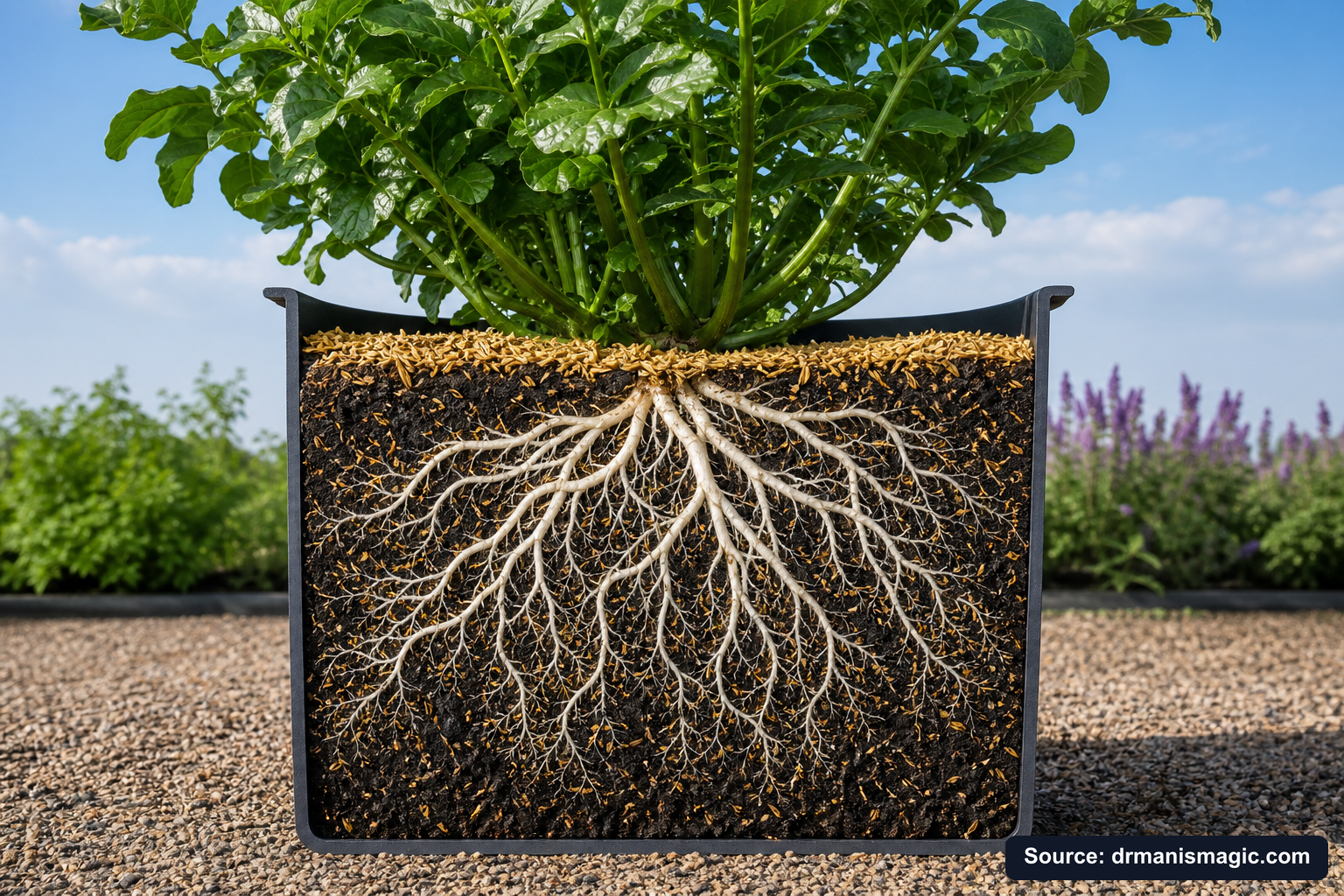
The Bottom Line on Permanent Soil and Why It Changes Everything
Here is what it all comes down to. Soil is not dirt. Real soil has a skeleton made of mineral particles. It has biology from living microbes. It has chemistry from organic matter. And it has structure, specifically the pore space that carries oxygen to roots.
Most potting mix has none of that. It has decomposing wood waste that temporarily holds a shape and then collapses. It was designed to get a plant from a greenhouse shelf into your car and survive long enough for you to feel good about the purchase. After that, the clock is ticking.
Your plants deserve better. Your time deserves better.
Because here is the truth that nobody in the big box store will ever tell you. You can replace lost money. You can buy more plants. But the months and years you spend watching a tree slowly decline in failing potting mix, waiting for fruit that never comes, hoping next season will be different? That time is gone. You cannot buy it back.
The best time to build your plants on the right foundation was the day you bought them. The second best time is right now.
Dr. Mani spent 40 years studying plant pathology, running the Clean Citrus Program for Texas, and growing over 250,000 trees at US Citrus Nursery to arrive at a system that works. The Three Plant Pillars are not marketing language. They are the distilled result of that lifetime of work. Mineral foundation. Live microbes. Organic nutrition. In that order. Always.
Zero synthetic salts. Zero PFAS. Zero biosludge. A 30-day money-back guarantee because confidence in the product is not the problem. The only problem is getting started.
If you are ready to stop guessing and start growing on a foundation that actually lasts, take a look at what Super Soil is built to do. Your roots will know the difference the moment they touch it.
Frequently Asked Questions
If you have ever watched a plant slowly die in what looked like perfectly good soil, these questions are for you. Understanding how rock becomes real soil is the key to understanding why most potting mixes fail your plants. Dr. Mani spent 35 years and over 250,000 trees figuring this out so you do not have to.
How does weathering turn rock into soil?
Rain, wind, and freezing temperatures crack rock into smaller and smaller pieces over thousands of years. That is physical weathering. Then water and oxygen react with those pieces and change their chemistry. Over time, tiny mineral fragments form. When biology and organic matter join those fragments, you get true soil. The mineral skeleton comes first. Everything else builds on top of it.
What makes mineral particles so important for plant roots?
Mineral particles do not break down. They hold their shape permanently. That shape creates tiny spaces between the particles called pores. Roots need those pores to breathe. Oxygen travels through pores to reach the root zone. When pores stay open, roots stay alive. When pores collapse, roots suffocate. That is the whole game right there.
Why does regular potting mix fail over time?
Most potting mixes are built on pine bark and sawdust. Those are organic materials. Organic materials decompose. As they break down, they shrink, compact, and squeeze the pores shut. Water stops draining. Oxygen stops moving. Roots start rotting. It is not a slow decline either. Within six months, many mixes have already started collapsing. You did not kill your plant. The soil did.
What is mineral-based soil and why does Dr. Mani use it?
Dr. Mani's Magic Super Soil is built on silica-rich sandy loam from the Rio Grande Valley in South Texas. Silica does not decompose. It holds its structure permanently. That means pores stay open, water drains correctly, and roots keep breathing for years. Dr. Mani tested this on over 250,000 trees at US Citrus Nursery before bringing it to home gardeners. It is not a theory. It is a proven foundation.
Can you grow healthy plants without microbes in the soil?
You can try. But you are fighting nature every step of the way. Microbes are the living engine of healthy soil. They break down nutrients into forms roots can actually absorb. They fight off disease. They build the kind of soil biology that makes plants resilient. Without them, your plants are on their own in a hostile environment. Dr. Mani's Plant Super Boost delivers live bacteria, fungi, and mycorrhizae straight to your roots.
What are the Three Plant Pillars and how do they connect to soil science?
The Three Plant Pillars are the framework Dr. Mani built after decades of real-world testing. Pillar one is mineral-based soil, which is the permanent skeleton that keeps pores open. Pillar two is live microbes, which are the biological engine that makes nutrients available and fights disease. Pillar three is organic fertilizer, which feeds plants slowly without burning roots or killing the microbes. All three work together. Remove one and the system weakens.
Does the type of soil matter more for containers than for garden beds?
Yes. A lot more. In the ground, soil has natural drainage, depth, and a living ecosystem built over centuries. A container is a closed system. You control everything inside it. If the soil collapses, there is nowhere for roots to go. Oxygen disappears fast. That is why mineral-based soil matters even more in pots than in the ground. The rules of natural soil formation do not apply in a container. You have to engineer the right conditions yourself.
About the Author
Ron Skaria, MD
Ron Skaria, MD, is the co-founder of Dr. Mani's Magic and the son of Dr. Mani. He trained as a medical doctor at Baylor College of Medicine, did his residency at UT Health Science Center - San Antonio and fellowship training at Texas Tech University. He now works full time on the family farm at US Citrus and US Citrus Nursery in Hargill, Texas, building Dr. Mani's Magic alongside his dad. He wrote the Brown Thumb Field Guide to put his father's 48 years of plant science into plain words any gardener can use. His belief is simple. You never had a brown thumb. You just never had the right help.


