


The Teamwork Between Arthropods and Microbes in the Soil Food Web | Dr. Mani's Magic
The Teamwork Between Arthropods and Microbes: How the Soil Food Web Feeds Your Plants
Picture this. You pull a weed out of an old garden bed. A healthy one, with thick roots. And clinging to those roots, you see something strange. Tiny white threads. Little creatures scurrying away from the light. Maybe a springtail tumbling off into the dirt. You almost toss it aside. But wait. What you are holding is not just a weed. You are holding a tiny city. A living, breathing, feeding, building city that has been working underground, completely invisible to you, every single day.
Now imagine your own plants. Your lemon tree on the patio. Your rose bush by the fence. Your lawn after a long summer. They are either plugged into that underground city, getting fed and protected around the clock, or they are cut off from it. Alone. Struggling. Hungry. And here is the part nobody tells you at the garden center: most plants in pots, in treated soil, in chemically managed yards, are almost completely cut off. The city is empty. The workers are gone. And the plant is on its own.
That is exactly what we fixed after growing more than 250,000 citrus trees at our South Texas nursery. We watched what happened when the underground city was thriving. We watched what happened when it was not. The difference was not subtle. It was the difference between a plant that fights back and a plant that quietly gives up. This article is about who lives in that city, what they do all day, and how you can put them back to work for every plant you own, from houseplants on your windowsill to fruit trees in your backyard.

Organic Fertilizer | Crab, Kelp & Amino Acids
Key Takeaways
- Soil is a living food web. Bacteria, fungi, protozoa, nematodes, mites, springtails, and other arthropods all work together to feed your plants.
- Arthropods are not just decomposers. They shred plant residue, move fungal spores, aerate soil, and control which microbes dominate.
- Protozoa and beneficial nematodes are the soil's nutrient miners. They eat bacteria, then release nitrogen right where roots can grab it.
- Mycorrhizal fungi act like a second root system, extending plant reach by up to 1,000 times and protecting against drought and disease.
- Most potting mixes, treated soils, and chemically managed lawns have lost most or all of this biology. Recovery is possible but requires more than one dose.
- Dead or dried microbial products sold in powder form almost never work. Genuinely live, stabilized microbes are rare and make a real difference.
- The Three Plant Pillars (mineral soil, live microbes, organic fertilizer) are the foundation for rebuilding the underground city in any plant environment.
What Is the Soil Food Web and Why Does It Feed Your Plants?
Quick Answer: The soil food web is a layered system where bacteria and fungi break down organic matter, protozoa and nematodes eat those microbes and release nutrients, and arthropods shred debris, aerate soil, and move microbes around. Each layer feeds the next, and together they deliver a steady supply of nutrients directly to plant roots.
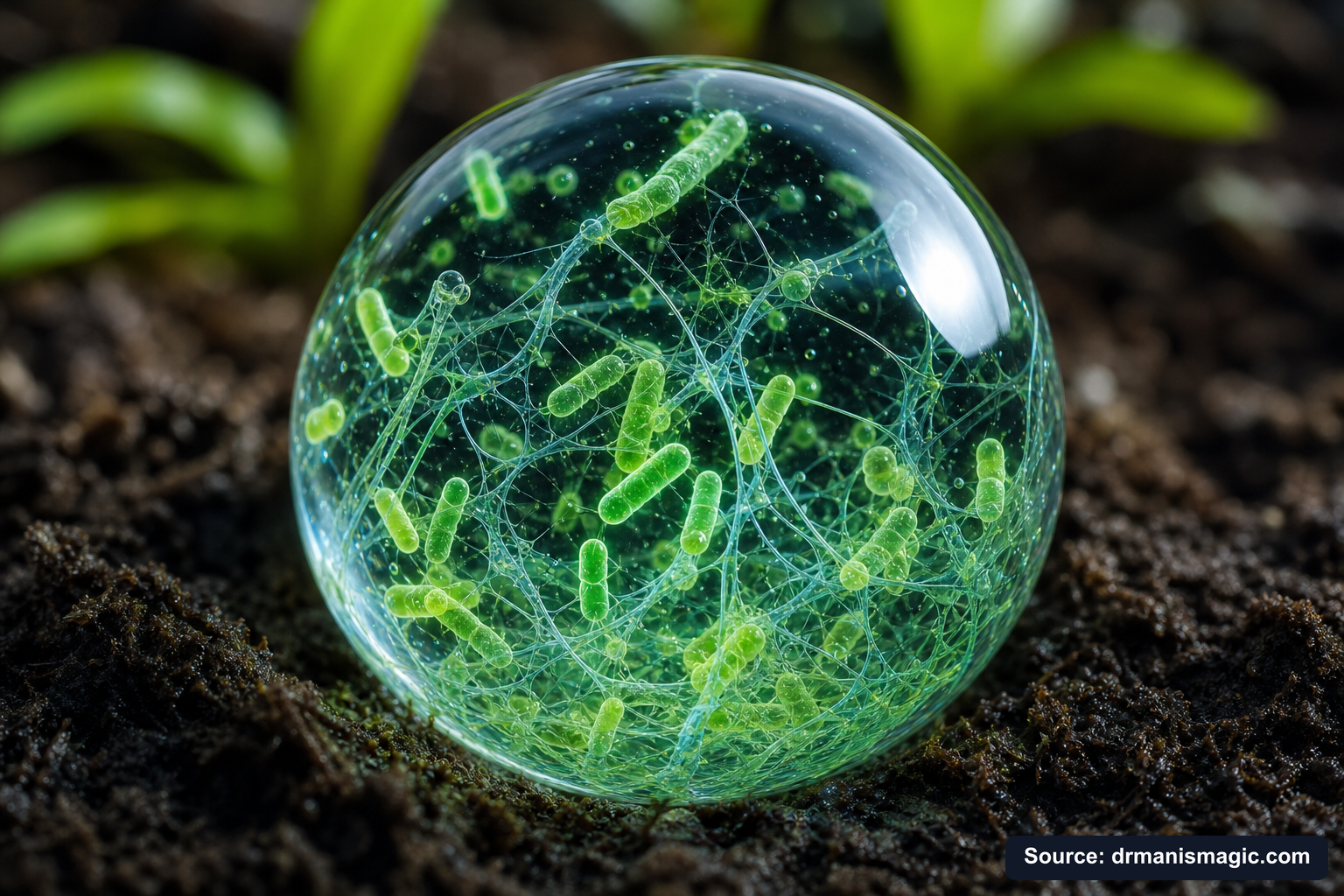
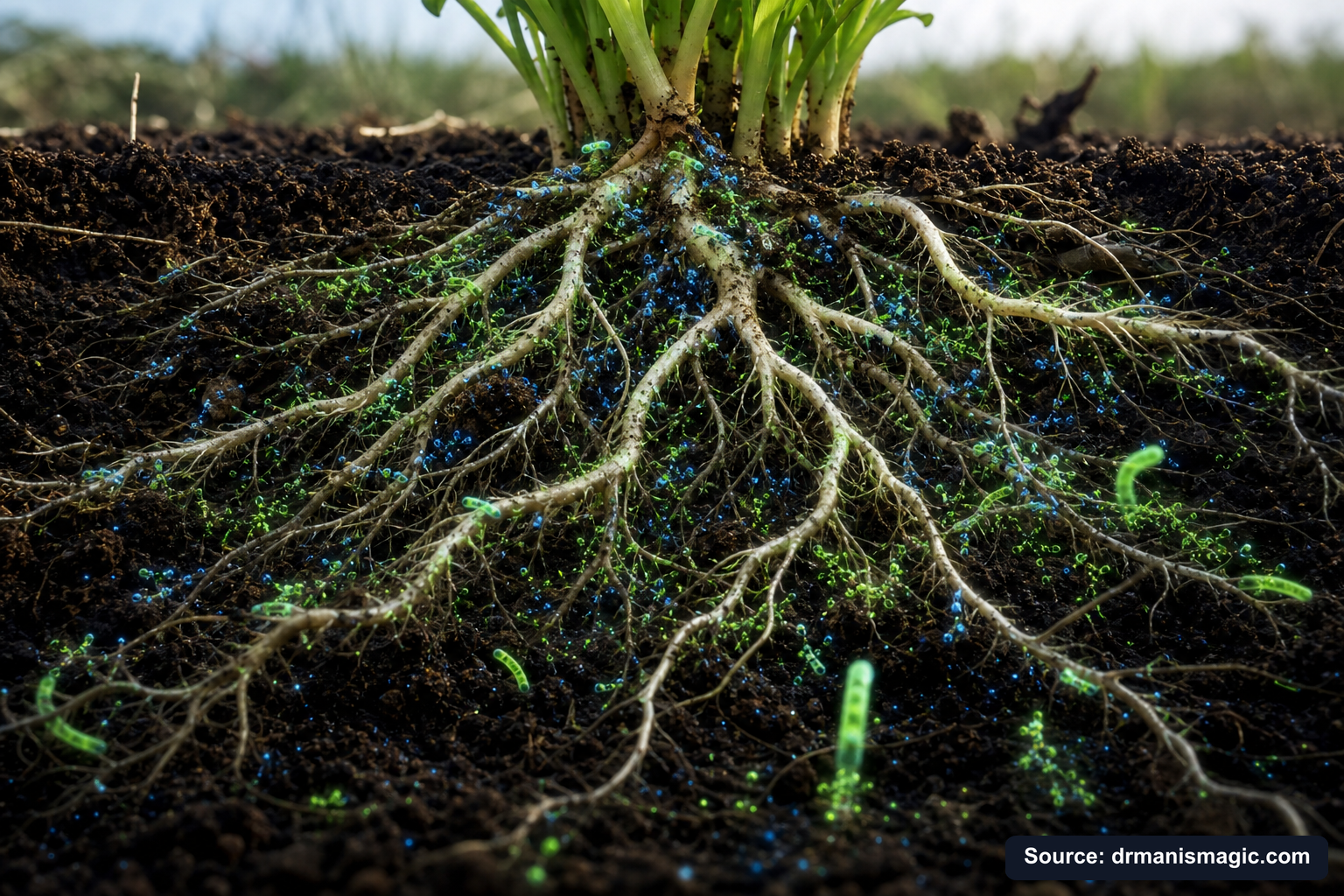
The soil food web is the real engine behind plant growth. It starts with your plant. Right now, your plant's roots are leaking sugar. On purpose. Plant roots pump sugars, proteins, and other compounds into the soil around them. Scientists call this zone the rhizosphere. The plant is literally buying groceries for the microbes nearby. In return, those microbes unlock nutrients the plant cannot reach on its own.
Then the grazers arrive. Tiny animals eat the microbes. They digest them. And when they release waste, that waste is loaded with nitrogen, phosphorus, and other plant foods, delivered right at the root surface. It is the most efficient nutrient delivery system ever designed. No factory made it. No chemical company patented it. It has been running for 400 million years, according to fossil evidence cited by researchers at Penn State Extension.
The diagram below shows how this works as a continuous loop, not a one-way street.
| Level | Who Lives Here | What They Do | What the Plant Gets |
|---|---|---|---|
| 1 — Producers | Plant roots, algae | Release sugars and exudates into the rhizosphere | Attract and feed the whole food web |
| 2 — Decomposers | Bacteria, fungi | Break down organic matter into simpler compounds | Nutrients unlocked from dead plant material |
| 3 — Grazers | Protozoa, bacterial-feeding nematodes, mites | Eat bacteria and fungi, release nitrogen-rich waste | Plant-available nitrogen released at root zone |
| 4 — Shredders | Springtails, millipedes, sowbugs, beetles | Fragment plant residue, create fecal pellets, disperse spores | More surface area for decomposers, aerated soil |
| 5 — Predators | Predatory nematodes, predatory mites, centipedes | Eat grazers and shredders, regulate populations | Balanced microbial community, disease suppression |
| 6 — Top predators | Earthworms, beetles, some insects | Ingest soil, mix layers, create channels | Deep aeration, nutrient distribution, structure |
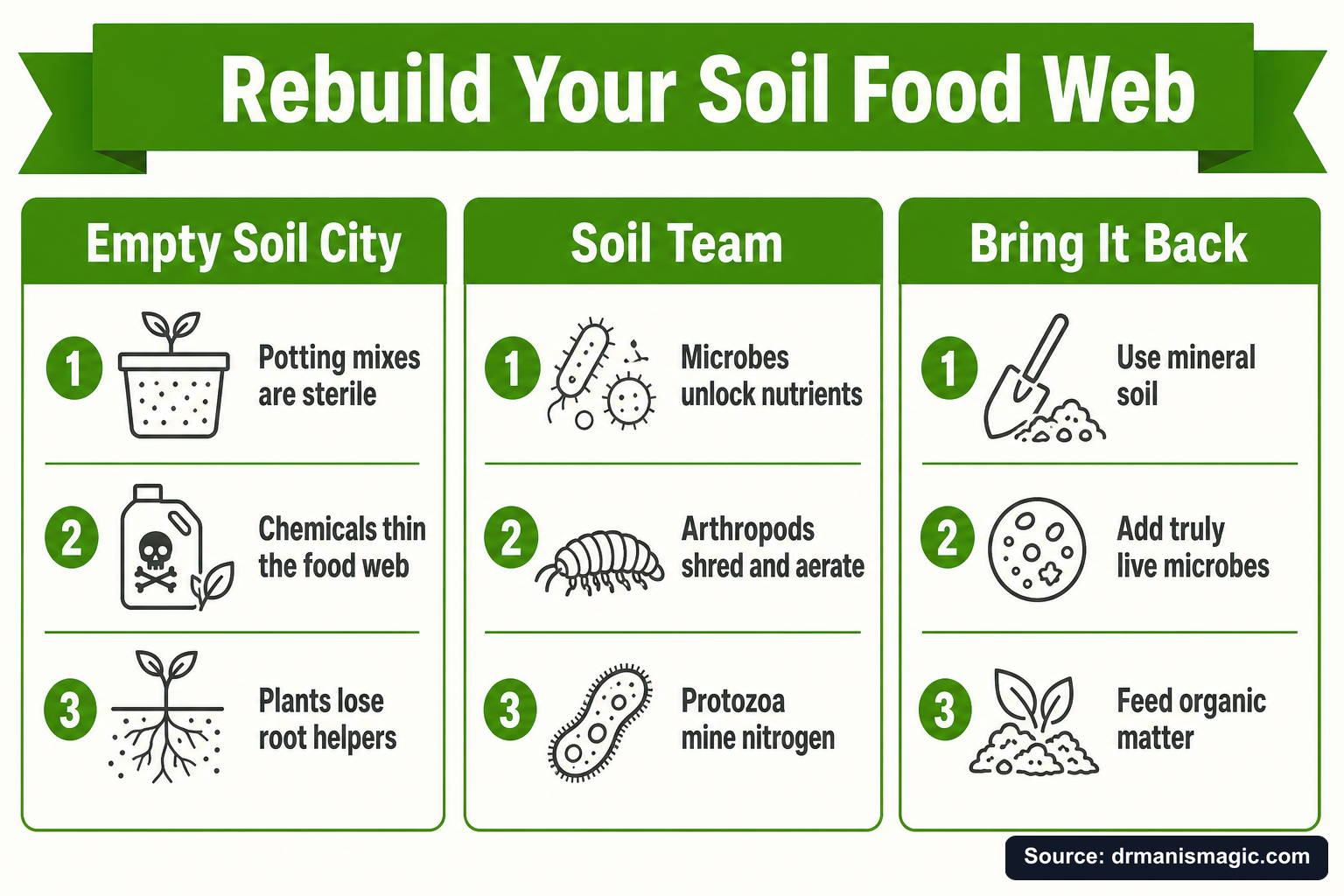
Remove any level, and the system slows down. Remove multiple levels, which is what synthetic chemicals, solarized soil, and sterile potting mix do, and the whole city goes dark.
What Do Arthropods Actually Do in the Soil Food Web?
Quick Answer: Arthropods, including springtails, mites, millipedes, beetles, and other soil insects, shred plant debris into smaller pieces, create channels for air and water, carry fungal spores to new locations, and control microbial populations by grazing on bacteria and fungi. Without them, decomposition slows and nutrients stay locked up.
Arthropods are the heavy equipment operators of the underground city. Most people think of them as just decomposers. That is a serious underestimate. They are habitat engineers.
Here is what they actually do, broken down by group.
Springtails are tiny, white, jumping creatures you might see in moist soil or on the surface of a wet pot. They eat fungi and algae. By grazing on specific fungi, they actually control which fungal species dominate. They also carry fungal spores on their bodies as they move. One springtail moving through six inches of soil can inoculate dozens of new locations. According to researchers at the University of Florida IFAS Extension, springtails are among the most abundant soil arthropods on earth, with populations sometimes reaching 100,000 per square meter in healthy soil.
Mites are even smaller. There are thousands of mite species in soil. Some eat bacteria. Some eat fungi. Some eat other mites. As a group, they regulate microbial population size. When bacteria or fungi overgrow, mites graze them back down. This keeps any one species from taking over and keeps the web diverse and balanced.
Millipedes and sowbugs are the shredders. They eat dead leaves, wood chips, and other plant debris. Their digestive systems do not fully break this material down. They pass it out as fecal pellets, which are small, moist, nutrient-rich particles packed with bacteria. These pellets are the starting point for decomposition. They create enormous surface area for bacteria and fungi to colonize. One millipede can turn a whole leaf into dozens of ready-to-decompose pellets overnight.
Beetles and other soil insects dig tunnels. These tunnels allow air and water to move deep into the soil. Roots follow them. So do bacteria. So does water. Without these channels, even the best soil can become compacted and oxygen-poor within months.
The teamwork between arthropods and microbes is not optional. It is the mechanism. Microbes cannot reach new food sources on their own. Arthropods carry them there. Microbes cannot break down a whole leaf efficiently. Arthropods shred it first. This is a partnership that has been running longer than any human civilization.
Why Are Protozoa and Beneficial Nematodes the Missing Piece Most Gardeners Never Hear About?
Quick Answer: Protozoa eat bacteria and excrete ammonium, which is a form of nitrogen plants can absorb directly. Beneficial nematodes eat bacteria, fungi, and other nematodes, and release nitrogen the same way. Both act as nutrient pumps, converting locked-up biology into plant-available food right at the root zone. Most gardening content ignores them completely.
If bacteria and fungi are the factory workers, protozoa and nematodes are the managers who keep the factory running at the right speed. And almost nobody talks about them.
Here is why they matter so much. Bacteria store nitrogen inside their cells. A lot of it. But plants cannot absorb bacterial cells directly. So protozoa eat the bacteria. They digest the nitrogen they need, and they release the rest as ammonium. Ammonium is one of the most direct forms of nitrogen a plant root can absorb. No synthetic fertilizer needed. The system makes it fresh, on demand, right where the root is waiting.
This process is called the microbial loop, or more specifically, the grazer-mediated nitrogen mineralization cycle. Penn State soil biology researchers describe it as one of the most important nutrient cycling mechanisms in managed and natural soils alike.
Nematodes work the same way. Most people hear the word nematode and think pest. Root-knot nematodes, for instance, are genuinely destructive. But the majority of nematode species in healthy soil are beneficial. They come in several types.
- Bacterial-feeding nematodes eat bacteria and release nitrogen, just like protozoa.
- Fungal-feeding nematodes graze on fungal threads and release nutrients stored in fungal tissue.
- Omnivorous nematodes eat bacteria, fungi, and algae depending on what is available.
- Predatory nematodes eat other nematodes, including plant-parasitic ones. They are a natural control system.
A soil with diverse nematode populations is a sign of a mature, functioning food web. A soil with only plant-parasitic nematodes and nothing else is a warning sign. It means the predators and competitors are gone, usually because of chemical use or physical disturbance.
Our Plant Super Boost is one of the few microbial products that includes protozoa and nematodes alongside bacteria and fungi, because we pulled it from real, active compost rather than ordering species off a factory checklist. If you look at a drop under a microscope, you can see them moving. That matters. Dead cells cannot do what living ones do.
What Do Mycorrhizal Fungi Do That Regular Fertilizer Cannot?
Quick Answer: Mycorrhizal fungi attach to plant roots and grow a second root network that can be up to 1,000 times larger than the root itself. This network pulls in water, phosphorus, zinc, and other nutrients from far beyond where roots can reach. No fertilizer application can replicate this because fertilizer sits in one place and roots have to find it.
Here is a fact that will change how you think about fertilizer forever. Your plant's roots can only reach so far. Beyond that zone, nutrients sit locked in the soil, unreachable. A phosphorus molecule three inches from the root tip might as well be on the moon.
Mycorrhizal fungi change that equation completely. They grow into the root, form a tight partnership, and then extend threads called hyphae out into the surrounding soil. These threads are thinner than a human hair. They can reach places roots never could. They absorb phosphorus, zinc, copper, and water, then carry it back to the root. In return, the plant feeds the fungus sugar.
The white fuzz you sometimes see on healthy roots when you pull a plant from a pot? That is mycorrhizae. And the weeds in your garden are covered in it, which is part of why they are so hard to kill. They have the full system working for them. Your potted citrus tree in sterile potting mix often does not.
Mycorrhizal fungi also produce a protein called glomalin. Glomalin is like a biological glue. It sticks soil particles together into aggregates. Those aggregates create air pockets. Air pockets mean roots can breathe. And roots that can breathe grow deep. This is one reason our Super Soil is built on a mineral base. Organic potting mixes collapse over time. When they collapse, those air pockets disappear and the fungal networks cannot be maintained. The city gets buried.
See also: The Hidden Reason Synthetic Fertilizers Cause Root Rot
How Do Arthropods and Microbes Work Together as One System?
Quick Answer: Arthropods shred debris and move microbes to new food sources. Microbes break down the shredded material and release nutrients. Protozoa and nematodes eat the microbes and release plant-available nitrogen. Roots absorb that nitrogen and release more sugar to attract more microbes. The whole loop feeds itself as long as each player is present.
The teamwork between arthropods and microbes is a closed loop. Each step feeds the next. Let us walk through it from start to finish.
A leaf falls. A millipede shreds it into pellets. Bacteria and fungi colonize those pellets. Springtails arrive and graze on the fungi, carrying spores to new locations. Mites graze on the bacteria, keeping populations from overgrowing. Protozoa eat the bacteria and release ammonium right next to a root. The root absorbs the ammonium and grows stronger. The stronger root releases more sugar into the soil. More bacteria arrive. The loop continues.
Now remove the arthropods. The leaf sits whole. Bacteria can colonize the outside surface, but the interior is locked away. Decomposition slows to a fraction of its normal speed. Nutrients stay bound in organic matter. The plant waits. And waits. Leaves yellow. Growth stalls. The gardener goes to the store and buys a bag of synthetic fertilizer because it seems like the plant needs more food. But the problem was never a lack of food. The problem was a missing workforce.
This is the cycle that Dr. Mani Skaria studied across more than 30 years of citrus science at Texas A&M and at our South Texas nursery. The answer was never more chemical input. The answer was rebuilding the biology that makes nutrient cycling happen naturally.
You Never Had a Brown Thumb.
You were handed the wrong tools. This free guide hands you the right ones.
You watered it. You fed it. It died anyway.
It was never you. It was the dirt, the salt food, and the bad advice.
This guide shows you what really went wrong, and how to fix it for good.
- Why your plants really died, and why it was never your fault
- The salt hiding in your plant food that quietly burns the roots
- The hidden killer in almost every bag of store soil
- The tiny helpers that grow a whole forest for free
- The rescue trick that brings a half dead plant back to life

What Kills the Soil Food Web and How Does Damage Happen?
Quick Answer: Synthetic herbicides, salt-based fertilizers, fungicides, pesticides, soil solarization, fumigation, and sterile potting mixes all kill or remove soil biology. Even one application of a broad-spectrum pesticide can wipe out beneficial arthropod and microbial populations that took years to build. Recovery is possible but requires deliberate steps.
The underground city does not die all at once. It gets hollowed out slowly. And most gardeners never notice until the plant is already struggling.
Here is how the damage happens, and what it costs you.
Salt-based synthetic fertilizers are the most common culprit. Salt draws water out of cells through osmosis. It works on plant cells. It also works on bacterial cells, fungal cells, and protozoa. A heavy application of synthetic fertilizer is a drought event for soil biology. Populations crash. The plant gets a short burst of chemical nutrition, then the biology that would have fed it continuously is gone. See also: How Salt-Based Feeding Quietly Destroys Root Systems.
Synthetic herbicides, including glyphosate, disrupt microbial enzyme pathways. Research has shown that glyphosate can reduce mycorrhizal colonization even when applied to nearby plants, not just the target weed. The fungal network does not know which plant is the intended target.
Broad-spectrum fungicides wipe out beneficial fungi alongside pathogenic ones. If you spray to control powdery mildew and you also kill the mycorrhizal network, you have traded a temporary cosmetic problem for a long-term structural one.
Sterile potting mix starts with zero biology. Pine bark, peat, and composted wood fiber have no living food web. They are dead from the start. When they also collapse and compact within six to twelve months, they take away the air space that any biology you did add would have needed to survive. This is one of the core problems we built the Three Plant Pillars to solve.
Construction soil and solarized soil have been physically or thermally stripped of biology. Rebuilding them takes longer than most people expect, and a single application of microbes is rarely enough.
Live Microbes vs. Dead Microbe Products: What Is the Real Difference?
Quick Answer: Dried powder microbials from factory labs often fail to reactivate in soil. Compost-tea liquids go anaerobic within 24 hours and arrive smelling like sewage, meaning most microbes are already dead. Genuinely live, stabilized microbes from active compost are rare. They should smell earthy, not foul, and show visible movement under a microscope.
This is the part the industry does not want you to look at too closely. Walk into any garden store and you will see shelves full of microbial products. Bags of white powder with impressive species lists. Dark liquid bottles with earthy labels. Granular inoculants mixed into fertilizer. Most of them do almost nothing.
Here is why, and how to tell the difference.
| Product Type | How It Is Made | Viability When You Use It | Smell | Does It Work? |
|---|---|---|---|---|
| Dry powder (lab-grown) | Brewed in vats, dried into powder, packaged | Very low. Spores rarely reactivate in soil. | Neutral to slight | We tested dozens. Results were consistently poor. |
| Liquid with dried powder added | Same lab process, powder suspended in water | Very low. Looks alive. Is not. | Neutral | No meaningful improvement in our trials. |
| Compost tea (fresh, under 24 hours) | Brewed from active compost, aerated | Moderate. Must be used immediately. | Earthy, pleasant | Yes, if applied fresh. Most people cannot do this consistently. |
| Compost tea (old, over 24 hours) | Same, but left too long | Low to none. Anaerobic and dying. | Strong, sewage-like | No. Some residual value from humic and fulvic acids only. |
| Lactobacillus-based products | Rice water fermentation, easy to make | High, but wrong species for soil | Sour | No. Lactobacillus dominates and crowds out beneficial species. |
| Plant Super Boost (stabilized, compost-sourced) | Harvested from active compost, stabilized by all-natural method | High. Visible movement under microscope. Lab-verified. | Earthy, not foul | Yes. Includes 2,000+ bacterial species, 400-500 fungal species, protozoa, and nematodes. |
The smell test is the easiest diagnostic you have. If a microbial product smells like sewage, the microbes inside it are dying or already dead. Anaerobic decomposition produces that smell. Living, stabilized microbes smell like fresh earth after rain. That petrichor smell. Clean. Biological. Alive.
Plant Super Boost passes that test because it is not going anaerobic. The microbes are stable. And they are not lab-grown from a checklist. They come from real, active compost, the same way that the best compost tea in the world works, except without the 24-hour deadline or the smell.
How Do You Diagnose a Biologically Depleted Soil?
Quick Answer: Signs of depleted soil biology include compaction, poor drainage, yellowing leaves despite fertilizing, recurring fungal disease, root rot, slow growth, and lack of visible soil creatures like earthworms or springtails. These symptoms often get treated with more chemicals, which makes the underlying biology problem worse.
Most gardeners treat symptoms. They see yellow leaves and add fertilizer. They see slow growth and add more fertilizer. They see disease and add fungicide. Each of these responses can make the biology problem worse.
Here is what to look for instead.
Pick up a handful of soil. Healthy, biologically active soil has a structure. It holds together in loose aggregates. It smells clean and earthy. Biologically dead soil is either powdery and dry or compacted and waterlogged. It smells like nothing, or like chemicals, or like something sour.
Look for creatures. In a healthy garden bed, you should see earthworms when you dig. You should see springtails in moist areas. You should see beetles, mites, and other tiny arthropods. If you dig six inches deep and find nothing alive, the city is empty.
Watch your plant's response to fertilizer. If you apply organic fertilizer and nothing happens, the biology to process it is missing. Organic nutrients need microbes to convert them into plant-available forms. No microbes, no conversion. The food sits unused.
Notice compaction. Stick a pencil into your soil. If it stops within an inch or two, the soil is compacted. Compacted soil has no air. No air means no aerobic microbes. No aerobic microbes means the whole system is running on fumes.
How Do You Rebuild the Soil Food Web After Damage?
Quick Answer: Rebuilding takes multiple steps over time: first stop the inputs that are causing damage, then add organic matter and living roots, then inoculate with genuinely live microbes, then maintain moisture and aeration. One application is rarely enough. The food web needs habitat, food, and time to re-establish itself.
Rebuilding the underground city is not a one-dose project. Think of it like reintroducing a species to a habitat. You cannot just release a few animals into a barren landscape and expect a thriving ecosystem. You need food, shelter, water, and time. Soil biology is the same.
Here is a practical recovery protocol, whether you are dealing with a sterile potting mix, a fumigated garden bed, construction fill, a solarized lawn, or a pot full of salt-burned soil.
- Stop adding what is killing the biology. Stop synthetic herbicides, fungicides, and salt-based fertilizers. Every application resets the clock. You cannot build a city while someone keeps demolishing it.
- Improve the physical habitat first. If the soil is compacted, aerate it. If it is waterlogged, improve drainage. If it is a potting mix that has collapsed, consider transitioning to a mineral-based soil that will not decompose and compact over time. Biology needs air and structure to survive. Our Super Soil is built for exactly this, using a mineral sandy loam base that does not break down.
- Add organic matter as food. Compost, aged wood chips, or organic mulch on the surface gives bacteria and fungi something to work with. Without food, even inoculated microbes starve.
- Introduce genuinely live microbes. This is where most people waste money on powder products that do not work. Use a stabilized, full-spectrum microbial product from a verified live source. Apply monthly. The first application starts colonization. Subsequent applications build diversity and numbers over time.
- Keep living roots in the soil. Roots feed microbes through exudates. No roots, no food for the food web. Cover crops, companion plants, or even healthy weeds (before they seed) keep the system running between main crops.
- Maintain moisture without waterlogging. Microbes need water. Arthropods need moisture. But saturated, airless soil kills aerobic biology. Consistent, moderate moisture is the goal.
- Give it time and repeat. A badly damaged soil can take a full growing season or more to show meaningful recovery. Do not judge by one application. Judge by the trend over three to six months.
The Three Plant Pillars system addresses all three of the biological, structural, and nutritional needs at once. Mineral soil for habitat. Live microbes for the workforce. Organic fertilizer that feeds the plant without burning the biology. When all three are in place, the recovery curve gets much steeper and much faster.
Why Does the Smell of Your Microbial Product Tell You Everything?
Quick Answer: A foul, sewage-like smell in a microbial product means the microbes have gone anaerobic and are dying or dead. A clean, earthy smell means the microbes are alive and stable. This single sensory check is more reliable than most product labels.
Close your eyes for a second and imagine two bottles. One smells like a forest floor after rain. Rich, earthy, alive. The other smells like a drain. Like something rotting in a warm place. Now imagine pouring both of those onto your plants. Which one do you think is going to help?
This is not a trick question. It is a chemistry lesson. When microbes die in a liquid environment, they go anaerobic. Anaerobic means without oxygen. The bacteria that thrive without oxygen produce sulfur compounds and organic acids as waste products. Those compounds smell exactly like sewage. They are the same compounds produced in a backed-up drain.
Many microbial products sold to gardeners arrive in that state. The label says "billions of CFUs." The picture shows lush plants. The smell says something very different. And the plant results, when you track them honestly over time, confirm what the smell already told you.
Plant Super Boost smells earthy because the microbes inside it are not dying. The all-natural stabilization process our compostologist partner developed keeps them stable, alive, and ready to work. No anaerobic decomposition. No foul smell. Just the clean biological signature of a product that is actually alive.
This is one of the reasons we built the Dr. Mani's Magic line around honesty about what works and what does not. Our customer reviews reflect what happens when people move from products that smell wrong to products that actually contain living biology. The plants respond. And the gardener stops blaming themselves for having a brown thumb.
What Can You Do Right Now to Support the Teamwork Between Arthropods and Microbes?
Quick Answer: Stop inputs that kill soil biology, add organic mulch to the surface, inoculate with live full-spectrum microbes monthly, improve soil structure so air and water can move freely, and keep living roots in the ground as often as possible. These steps rebuild the food web over one to three growing seasons.
Here is the thing about time. You can earn more money. You cannot earn more time. Every season you spend pouring salt-based fertilizer onto biologically empty soil is a season your plants spend struggling instead of thriving. Every year you wait to fix the foundation is a year you do not get back.
The number one thing people tell us they want from their garden and their fruit trees is to see results in their own lifetime. Not their grandchildren's lifetime. Theirs. That urgency is completely reasonable. And the path to getting there faster is not more chemical input. It is getting the biology right so the plant can do what it was designed to do.
Here is what you can do starting today.
- Stop using synthetic herbicides and salt-based fertilizers in areas where you want biology to thrive.
- Add a layer of organic mulch or compost to your soil surface. This feeds the shredders and gives bacteria something to work with.
- Switch to an organic, slow-release fertilizer that works with microbes instead of against them. Our Crab, Kelp and Amino Acids fertilizer does exactly this, with zero synthetic salts, zero biosludge, and zero PFAS compounds.
- Inoculate monthly with genuinely live microbes. Not powder. Not smelly liquid. Live, stabilized, full-spectrum biology from real compost.
- Make sure your soil structure allows air and water to move. If you are using potting mix that has compacted, that is a structural problem no amount of biology can fully compensate for.
- Keep something growing in your soil as often as possible. Living roots feed the food web even between seasons.
The underground city has been waiting. It does not take much to wake it back up. It takes the right ingredients, applied consistently, in the right order. That is exactly what the Three Plant Pillars were designed to deliver, tested across 250,000 trees in South Texas, and now available for every plant you own, from your backyard orchard to the pothos on your kitchen shelf.
If you want to see the full system and how it works together, you can explore our Free Plant Care Field Guide for a practical, step-by-step walkthrough. No jargon. No guesswork. Just the same foundation we use every day for our own trees.
The teamwork between arthropods and microbes has been feeding plants for hundreds of millions of years. It does not need your help to run. It just needs you to stop getting in the way, and then invite it back home.
Frequently Asked Questions
The teamwork between arthropods and microbes is the real secret behind healthy plants. Once you understand what is happening underground, everything changes. These questions come up again and again from gardeners who want to stop guessing and start growing.
What is the relationship between soil microbes and soil animals like mites and springtails?
Soil animals like mites and springtails eat microbes, move them around, and shred dead plant material into smaller pieces. That shredded material becomes food for bacteria and fungi. The bacteria and fungi then release nutrients right at your plant roots. It is a loop. Each creature feeds the next. When that loop is broken, your plant goes hungry no matter how much fertilizer you pour on.
What animals eat microbes in the soil?
Protozoa eat bacteria. Nematodes eat protozoa and bacteria. Mites eat fungi and nematodes. Springtails eat fungi and decaying matter. Every time one of these tiny animals eats a microbe and releases waste, that waste is loaded with nitrogen and other plant food. This is how your plant gets fed naturally. Dr. Mani watched this system work across more than 250,000 citrus trees in South Texas. The results were not subtle.
Why are microbes important to plants and the animals living in soil?
Microbes are the engine of the whole system. They break down organic matter, unlock nutrients that are stuck in the soil, and protect roots from disease. Soil animals depend on microbes for food. Plants depend on soil animals to move microbes and aerate the soil. Take the microbes away and the whole underground city shuts down. Your plant ends up alone, struggling, and wide open to pests and rot.
How do plants and microbes interact underground?
Your plant roots leak sugar into the soil on purpose. That sugar attracts bacteria and fungi. The bacteria and fungi unlock phosphorus, nitrogen, and trace minerals that the roots cannot reach alone. Mycorrhizal fungi go even further, stretching out like a second root system and extending your plant's reach up to 1,000 times. This is not a theory. It is a 400-million-year-old system that still works today when you give it the right conditions.
What kills the teamwork between arthropods and microbes in my garden?
Salt-based synthetic fertilizers are the number one killer. They wipe out beneficial microbes fast. Harsh pesticides and fungicides do the same. Most potting mixes made from pine bark and sawdust break down and compact over time, choking out the oxygen that microbes and soil animals need to survive. Big box store products were not designed to protect this system. They were designed to sell you something again next season.
Can I rebuild the soil food web in pots and raised beds?
Yes, and it starts with the Three Plant Pillars. First, you need mineral-based soil that drains well and does not compact. Second, you need genuinely live microbes, not dried powder from a shelf that has been dead for months. Third, you need organic fertilizer that feeds the microbes without burning them. Dr. Mani built this system after decades of trial in his South Texas nursery. It works in pots, raised beds, lawns, and orchards.
What makes Dr. Mani's Plant Super Boost different from other microbial products?
Most microbial products on the market are dead by the time you open the bottle. They dried out, sat on a shelf, and lost their power. Plant Super Boost uses a special stabilization process that keeps the bacteria, fungi, and mycorrhizae genuinely alive. You can smell the difference. It smells like earth, not rot. That is what live, stabilized microbes smell like. Dead ones smell like nothing or worse. Your plants feel the difference within weeks.
About the Author
Ron Skaria, MD
Ron Skaria, MD, is the co-founder of Dr. Mani's Magic and the son of Dr. Mani. He trained as a medical doctor at Baylor College of Medicine, did his residency at UT Health Science Center - San Antonio and fellowship training at Texas Tech University. He now works full time on the family farm at US Citrus and US Citrus Nursery in Hargill, Texas, building Dr. Mani's Magic alongside his dad. He wrote the Brown Thumb Field Guide to put his father's 48 years of plant science into plain words any gardener can use. His belief is simple. You never had a brown thumb. You just never had the right help.


