


Why Are Most Fertilizers Actually Salt? | Dr. Mani's Magic
Why Most Fertilizers Are Actually Salt in Disguise (And What It's Quietly Doing to Your Roots)
Picture this. You just fed your tree. You followed the directions on the bag. You even measured it out carefully. And a few days later, the leaf tips are brown. The plant looks worse, not better. You scratch your head and wonder what you did wrong.
You didn't do anything wrong. The fertilizer did.
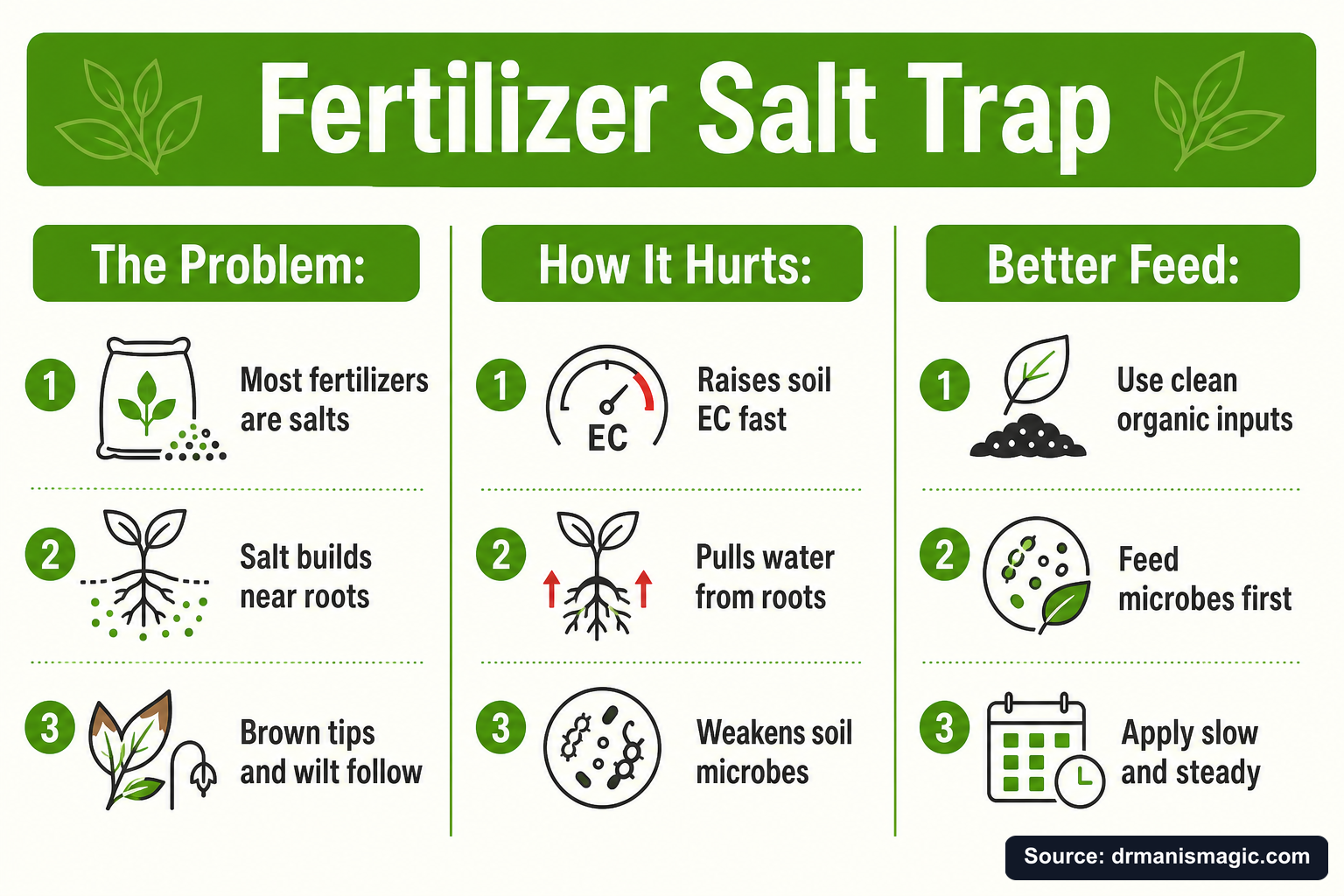
Here's what nobody told you. Most of the fertilizers sitting on the shelf at your local garden center are built around one core ingredient. Not plant food. Not vitamins. Salt. Soluble chemical salts that dissolve fast, spike into the root zone, and start pulling water in the wrong direction. Instead of water flowing into the roots, it flows out. The plant gets thirsty in wet soil. It wilts. It scorches. It struggles. And then you buy more fertilizer, thinking you need to feed it again. That's the cycle. And it's not an accident.
At US Citrus Nursery, we grew over 250,000 trees in South Texas before we figured out what was actually happening underground. Dr. Mani Skaria, a Professor Emeritus of Plant Pathology and the founder of Texas's Clean Citrus Program, spent decades watching healthy-looking fertilizers quietly wreck root systems. What he found changed everything we do. And we want to share it with you today, whether you're growing a lemon tree in a pot, a rose bush in your backyard, a vegetable garden, or an entire lawn. The science is the same. The damage is the same. And the fix is the same.
Key Takeaways
- Most conventional fertilizers are made from soluble chemical salts that raise the salt concentration around your roots.
- High salt around roots causes osmotic stress, a condition where water is pulled out of roots instead of into them, causing wilting, brown tips, and root burn even in moist soil.
- Salt kills the beneficial microbes in your soil that plants depend on to unlock nutrients naturally.
- Salt damage, overwatering, and root rot often look the same but have different causes and different fixes.
- Organic fertilizers like crab, kelp, and amino acids feed the microbes first, and those microbes feed the plant slowly and steadily, the way nature intended.
- Some fertilizers, both synthetic and organic, are made with biosludge and contain PFAS "forever chemicals." Clean inputs matter more than most gardeners realize.
- The Three Plant Pillars, developed and tested by Dr. Mani Skaria at US Citrus Nursery, give any plant the foundation to thrive without the salt-and-cycle trap.
What Does "Salt-Based Fertilizer" Actually Mean?
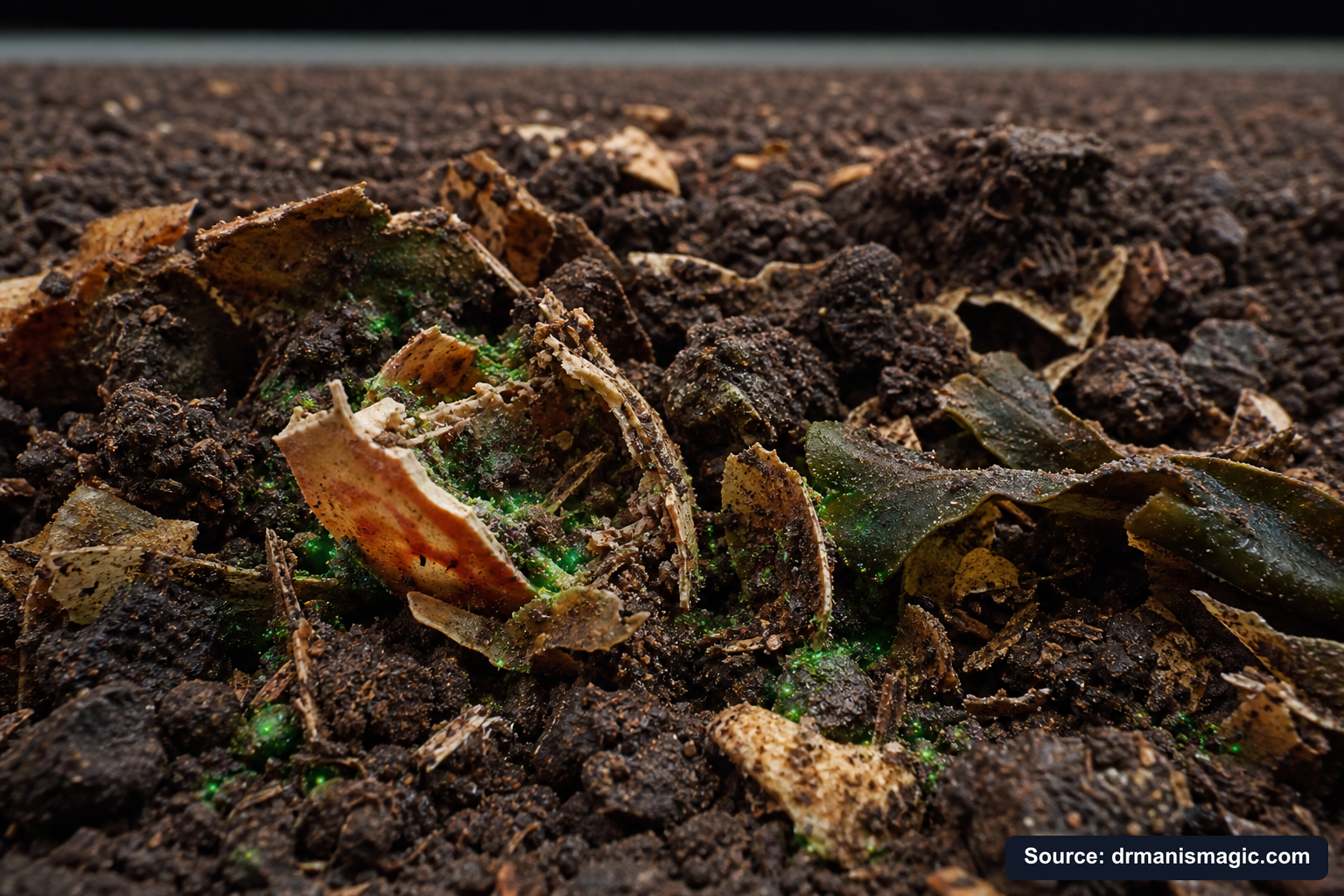
Most synthetic fertilizers are made of soluble mineral salts, not table salt, but chemical compounds that behave like salt in soil. They dissolve in water, increase electrical conductivity around roots, and change how water moves. The result is roots that struggle to drink, even when the soil feels wet.
When we say "salt," we don't mean the stuff in your shaker. We mean the chemistry of it.
A salt, in chemistry, is any compound that dissolves in water and breaks apart into charged particles called ions. Table salt breaks into sodium and chloride. Ammonium nitrate, one of the most common fertilizer ingredients, breaks into ammonium and nitrate. Muriate of potash breaks into potassium and chloride. These are all salts. They all dissolve fast. They all raise what scientists call electrical conductivity, or EC, in the soil solution around your roots.
Think of EC like the thickness of the liquid your roots are sitting in. When EC gets too high, it's like asking your roots to drink through a straw stuffed with marbles. Water doesn't flow in. It gets blocked. Or worse, it actually flows out.
The University of Wisconsin Extension and the University of Minnesota Extension both describe many common fertilizer materials as highly soluble salts that dissociate in the soil solution. This isn't fringe science. It's how fertilizer chemistry has always worked. The problem is that most gardeners were never taught this part.
The fertilizer companies certainly weren't rushing to explain it.
Why Do High Fertilizer Salts Pull Water Away From Roots?
High salt concentrations outside the root create osmotic pressure, a physical force that pulls water outward through the root membrane. This is called osmotic stress or physiological drought. Your plant wilts and scorches even in moist soil because the salt gradient is working against it like a reverse pump.
Osmosis is simple. Water always moves from where there is less dissolved stuff to where there is more. Your roots work because the concentration inside them is higher than the water in the soil. Water flows in naturally.
Now add a big dose of soluble fertilizer salts. Suddenly the concentration outside the root is higher than inside. The physics flip. Water now flows out of the root. The root shrinks. The cells collapse. You see brown tips, wilting leaves, and scorched edges, even though you just watered.
Penn State Extension, Oregon State Extension, and North Carolina State Extension all use something called the salt index to measure how aggressively different fertilizers raise this osmotic pressure. High salt index fertilizers, like ammonium nitrate and potassium chloride, are the most dangerous. They spike EC fast. The damage happens before you even see it.
Utah State Extension notes that this is especially dangerous in containers, in hot weather, in drought conditions, and with seedlings. These are exactly the situations where most gardeners fertilize the hardest, because they think the plant is hungry. Often it isn't hungry at all. It's thirsty. And the fertilizer is the reason.
See also: The Osmotic Shock Your Plants Feel From Synthetic Nutrients
How Does Salt in Fertilizer Cause Root Rot and Disease?
Salt stress weakens root cells and kills the beneficial microbes that protect roots from pathogens. Stressed, salt-damaged roots become easy targets for Pythium, Phytophthora, and Fusarium, the root rot fungi that destroy plants from the bottom up. Salt and root rot almost always travel together.
Here is the connection that almost no one talks about.
When roots are stressed by osmotic pressure, they become weak. Their cell walls are compromised. Their ability to fight off invaders drops to almost nothing. At the same time, the beneficial bacteria and fungi that normally live in your soil and protect your roots are being wiped out by the same salt that burned the roots in the first place.
Salt kills microbes. This is not a metaphor. High soluble salt concentrations in soil solution are directly toxic to most beneficial soil bacteria and mycorrhizal fungi. These are the tiny living organisms that form a protective layer around roots, produce natural antibiotics against pathogens, and help roots access nutrients. When they die, the door swings open.
Pythium and Phytophthora, the oomycete pathogens that cause damping-off and root rot, thrive in these conditions. Fusarium and Verticillium love stressed, oxygen-deprived roots. Once they get in, they spread fast. And by the time you see yellowing leaves or a collapsing stem, the root system may already be gone.
This is why fertilizer burn, overwatering, and root rot so often appear together. It is not a coincidence. Salt stress slows water uptake. Slow water uptake means soggy, low-oxygen soil. Low-oxygen soil means anaerobic conditions. Anaerobic conditions are where the worst root pathogens party.
See also: The Hidden Reason Synthetic Fertilizers Cause Root Rot
How Do You Tell Salt Damage Apart From Overwatering or True Root Rot?
Salt damage shows up as brown leaf tips and margins with yellow halos, stunted new growth, and white crust on soil or pot rims. Overwatering shows yellowing and limp stems. True root rot shows dark, mushy roots with a sour smell. They often overlap, but knowing which came first points you to the fix.
This is one of the most common traps gardeners fall into. The symptoms look alike. You treat the wrong thing. The plant keeps suffering.
| Symptom | Salt / Fertilizer Damage | Overwatering | True Root Rot (Pythium / Phytophthora) |
|---|---|---|---|
| Leaf tips and edges | Brown, crispy, with yellow halo | Yellow, soft, or limp | Yellow to brown, progressive |
| Soil surface | White or gray crust of salt deposits | Soggy, stays wet too long | Soggy, may smell sour or rotten |
| Root appearance | Brown, dry-looking root tips | Brown, soft, beginning to rot | Dark brown, black, mushy, foul smell |
| When it appears | Shortly after fertilizing, especially in heat | Days after heavy watering | After repeated overwatering or salt stress |
| New growth | Stunted, small, pale | Slow, limp | Stops entirely |
| Soil feels | Moist or normal, but plant wilts | Saturated, heavy | Saturated, heavy, possibly compacted |
| Primary cause | High EC from soluble fertilizer salts | Poor drainage, overwatering | Pathogens enter through stressed roots |
If you see a white crust on your pot or soil surface, that is dried salt residue. That is your soil telling you something. Flush it with clean water, stop the synthetic feed, and start rebuilding the biology.
Recovery Checklist: What To Do When You Suspect Salt Damage
- Stop all synthetic fertilizer immediately. Give the roots a break.
- Flush the soil deeply with clean, unchlorinated water to push salts below the root zone. Do this two or three times over a week.
- Check drainage. Salt damage gets worse fast in soil that holds water. If you are in a container, make sure water flows freely out the bottom.
- Trim visibly burned leaf tips back to healthy green tissue. The plant wastes energy trying to recover dead cells.
- Reintroduce beneficial microbes as soon as possible. Living bacteria and fungi help rebuild root defenses and restart natural nutrient cycling.
- Once the plant stabilizes, switch to a slow-release organic fertilizer. The microbes will do the rest.
- Be patient. Roots recover from the inside out. You will not see improvement above the soil for a week or two, but the biology is already working.
What Does Salt Actually Do to the Beneficial Microbes in Your Soil?
Beneficial soil bacteria and mycorrhizal fungi are extremely sensitive to osmotic stress. High fertilizer salt concentrations dehydrate and kill them the same way they damage root cells. When microbes die, nutrient cycling stops, root protection disappears, and the plant loses its most powerful natural ally.
Your soil is supposed to be alive. Every healthy teaspoon of garden soil contains millions of bacteria, fungi, and other microorganisms. These are not passengers. They are the workers.
Beneficial bacteria fix nitrogen from the air and convert it into a form roots can drink. Mycorrhizal fungi stretch far beyond the reach of roots and bring back minerals the plant could never reach alone. Other microbes produce natural compounds that suppress Pythium, Phytophthora, and other pathogens. They are your plant's immune system, its nutrient delivery network, and its water management team all in one.
Salt wipes them out.
When you pour a high-salt synthetic fertilizer into your soil, the EC spikes. The microbes, which are just tiny cells with membranes, get hit by the same osmotic force that hits your roots. Water is pulled out of their cells. They shrink. They die. The soil goes quiet. And your plant is left completely exposed.
This is what Dr. Mani Skaria calls a microbial massacre. And it is followed, almost inevitably, by a fertilizer addiction cycle. Because without microbes cycling nutrients naturally, the plant becomes entirely dependent on the next synthetic feeding to survive. The company profits. The plant suffers. And you are stuck buying bag after bag, season after season, watching your soil get grayer and harder and more lifeless every year.
We watched this happen across thousands of trees at US Citrus Nursery before Dr. Mani cracked the code. The answer was not a better synthetic fertilizer. It was stopping the salt cycle entirely.
You can learn more about building a living soil system through the Three Plant Pillars framework we developed and tested on our nursery trees.
How Does Organic Fertilizer Actually Feed Your Plant Differently?
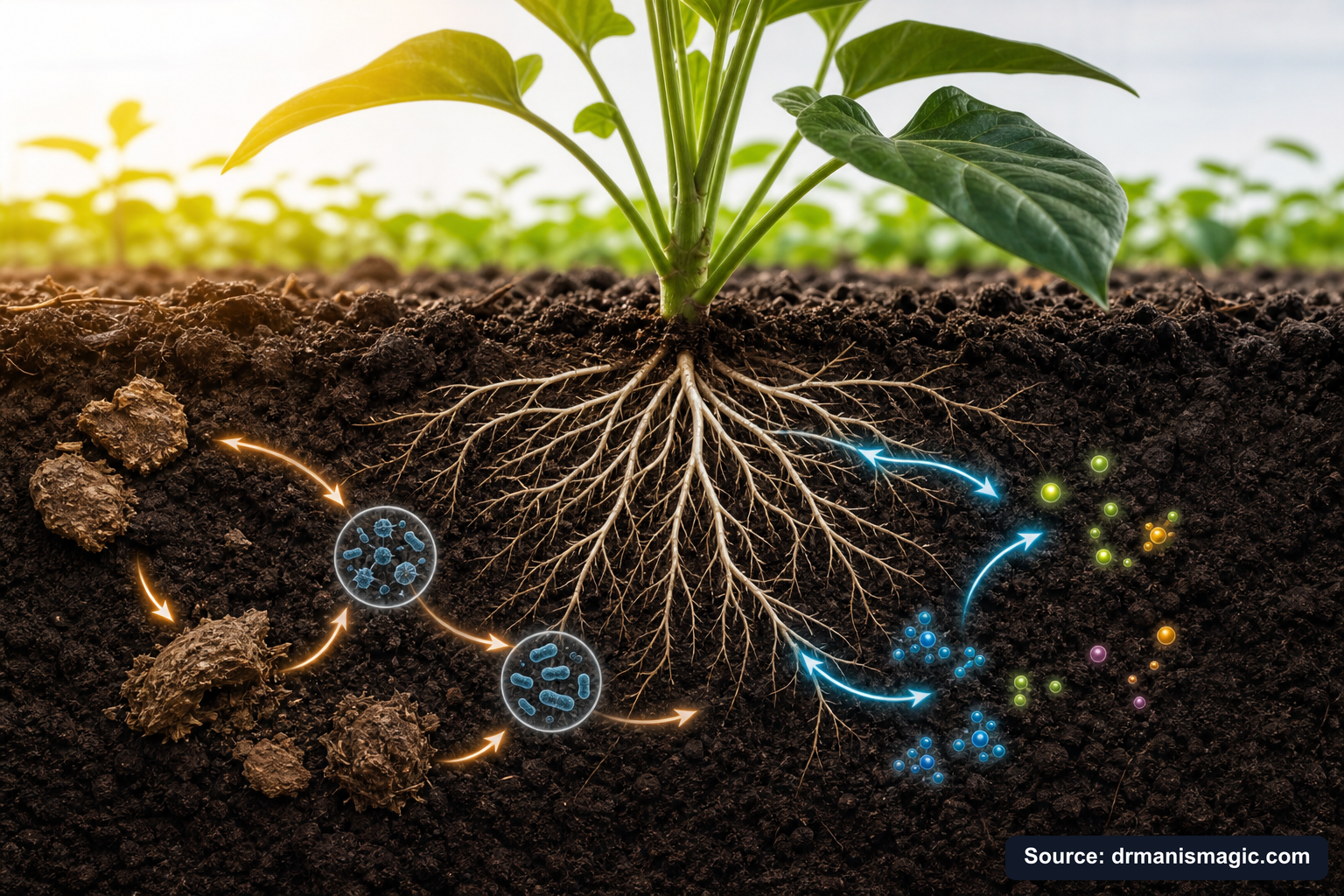
Organic fertilizer feeds the microbes first. The microbes break it down, absorb it, and convert it into plant-available nutrition. Then when those microbes die, they release that nutrition directly into the root zone in a slow, steady trickle the plant can actually use. It is a natural time-release system that keeps working long after you apply it.
This is the part most people never hear. And once you understand it, the whole game changes.
When you apply an organic fertilizer made from crab shells, kelp, and amino acids, here is what actually happens underground.
The bacteria and fungi in your soil smell it. They move toward it. They eat it. Inside their tiny bodies, they break down the proteins and minerals into forms the plant can absorb. Nitrogen locked inside crab shell chitin and amino acid chains gets converted into ammonium and nitrate, the same forms plants love, but slowly, steadily, at a pace the root system can handle.
Then those microbes live their short lives and die. And when they die, everything they ate and stored gets released right there in the root zone. A second wave of nutrition, delivered like a slow drip, right where the roots can grab it.
This is not a marketing story. This is how nutrient cycling has worked in every forest, prairie, and living soil on Earth since before humans existed. We did not invent it. We just stopped fighting it.
The salt-based synthetic approach skips this whole process. It dumps nutrients straight into the soil solution in a form so concentrated it overwhelms the system. The plant might grab some of it. But the rest? It damages roots, kills microbes, and leaches into groundwater. Then you have to do it again in six weeks.
Organic feeding mirrors nature's pace. And nature does not burn plants.
What Makes Crab Shell Chitin, Kelp, and Amino Acids Different From Regular Fertilizer?
Crab shell chitin triggers natural pest and disease resistance in plants. Kelp delivers growth hormones, trace minerals, and biostimulants that no synthetic fertilizer contains. Amino acids provide plant-ready nitrogen that both plants and microbes absorb efficiently. Together, they deliver full-spectrum nutrition with near-zero salt and zero synthetic residue.
Let's break down why each ingredient matters.
Crab Shell and Chitin
Crab shells are rich in chitin, a complex carbohydrate that is one of nature's most remarkable plant signals. When chitin enters the soil, it triggers something fascinating. The plant's immune system wakes up. It starts producing natural compounds that repel fungal pathogens and root-feeding insects. Think of chitin as a training signal that puts the plant on alert without any chemicals needed.
Crab shells also carry calcium and magnesium. Calcium is the primary structural material in woody plant tissue. Without enough of it, stems are weak, fruit cracks, and roots grow poorly. The calcium in crab shells is released slowly and gently, not in a salt spike that overwhelms the system.
Cold-Processed Kelp
Kelp is one of the most nutrient-dense organisms on the planet. It grows fast in the ocean because it is packed with everything it needs: dozens of trace minerals, natural plant growth hormones called auxins and cytokinins, complex carbohydrates that feed soil microbes, and biostimulant compounds that help plants manage stress.
The key word is cold-processed. Heat destroys the delicate hormones and biostimulants in kelp. Cold processing preserves them. That is why the source and method of kelp processing matters so much. Most cheap fertilizers use heat-processed kelp powder that has lost most of its biological value.
Auxins help regulate root growth. Cytokinins stimulate cell division and fruit set. These are the signals that tell a plant when to push roots deeper, when to flower, and when to fill fruit with sugar. No synthetic fertilizer on earth contains these signals. They exist only in living or cold-preserved biological sources.
Amino Acids
Amino acids are the building blocks of protein. When they are in your soil, the plant can absorb them directly through the roots and immediately use them to build enzymes, chlorophyll, and cell tissue. This is the most efficient form of nitrogen available. The plant does not have to wait for a microbe to break down a protein first. It can use amino acid nitrogen right away.
At the same time, amino acids feed the microbes too. They are a preferred food source for beneficial bacteria. So applying amino acid-based fertilizer has a double effect: the plant gets faster access to nitrogen, and the microbial community gets stronger at the same time.
Volcanic Ash and Trace Minerals
Volcanic ash carries silica and a broad spectrum of trace minerals in a slow-release, plant-available form. Silica strengthens cell walls, making stems tougher and leaves more resistant to pest damage and drought. Trace minerals like iron, zinc, manganese, copper, boron, and molybdenum are all needed in tiny amounts, but they are absolutely essential. A deficiency in any single one of them, no matter how small, can stall the whole growth process.
Synthetic fertilizers rarely include these trace elements. Organic sources do, naturally, because they come from living things that accumulated them over time.
You Never Had a Brown Thumb.
You were handed the wrong tools. This free guide hands you the right ones.
You watered it. You fed it. It died anyway.
It was never you. It was the dirt, the salt food, and the bad advice.
This guide shows you what really went wrong, and how to fix it for good.
- Why your plants really died, and why it was never your fault
- The salt hiding in your plant food that quietly burns the roots
- The hidden killer in almost every bag of store soil
- The tiny helpers that grow a whole forest for free
- The rescue trick that brings a half dead plant back to life

How Do Fertilizer Salts Compare Across Different Types? (The Full Breakdown)
Fast-release synthetic fertilizers carry the highest salt index and the most risk of burn and microbial damage. Slow-release coated synthetics are better but still carry plastic shell residue and some salt risk. Organic sources like crab, kelp, and amino acids carry near-zero salt index and actively support the biology that feeds plants naturally.
| Fertilizer Type | Salt Index Risk | Microbial Impact | Release Speed | Other Concerns | Biological Value |
|---|---|---|---|---|---|
| Urea (synthetic N) | High | Kills beneficial microbes | Very fast | Volatilizes quickly, leaches | None |
| Ammonium nitrate | Very high | Kills beneficial microbes | Immediate | High burn risk, leaching | None |
| Ammonium sulfate | High | Kills beneficial microbes | Fast | Acidifies soil over time | None |
| Potassium chloride (muriate of potash) | Very high | Kills beneficial microbes | Fast | Chloride toxic to sensitive plants | None |
| Liquid synthetic NPK | High (spikes fast) | Disrupts microbial balance | Immediate | Easy to overapply, accumulates in containers | None |
| Slow-release coated synthetic | Moderate | Reduced harm, but still present | Controlled (weeks) | Plastic coating fragments remain in soil | Low |
| Compost / manure | Low | Feeds microbes | Slow | Variable nutrient content, some biosludge risk | Moderate to high |
| Biosludge-based "organic" | Low to moderate | Mixed | Slow | May contain PFAS forever chemicals | Variable, contamination risk |
| Fish hydrolysate | Very low | Feeds microbes well | Slow | Strong odor, can go anaerobic | High |
| Crab, Kelp & Amino Acids (organic granular) | Near zero | Actively feeds and protects microbes | Slow, steady | Zero PFAS, zero biosludge, zero synthetic salts | Very high |
| Humic acids / biochar | None | Enhances microbial habitat | N/A (soil conditioner) | Works best alongside organic fertilizers | High (synergistic) |
What Is the Biosludge and PFAS Problem With Some Fertilizers?
Biosludge is treated municipal waste, including human sewage, that is used as a filler in some fertilizers labeled "organic." It often contains PFAS, the class of synthetic "forever chemicals" linked to health concerns. These chemicals do not break down in soil. Knowing what is in your fertilizer matters for your family, your pets, and your garden long-term.
This is the part that makes people uncomfortable. But it needs to be said.
Some fertilizers, both synthetic and labeled organic, use biosolids as a filler. Biosolids is the industry word for treated municipal waste. Human sewage, processed and dried. It is a byproduct of wastewater treatment plants, and it contains whatever the population flushed down the drain, including pharmaceuticals, industrial chemicals, and PFAS.
PFAS stands for per- and polyfluoroalkyl substances. They are called "forever chemicals" because they do not break down in the environment or in the human body. Research from multiple universities is ongoing, and regulatory limits are still being established. What we know is that once PFAS are in your soil, they stay there. They can move into plants. They can move into groundwater. They are not something you want in your vegetable garden or on your lawn where your kids and pets play.
The label "organic" on a fertilizer does not mean free of PFAS. It means it came from a living source. Biosludge qualifies as an organic source under current labeling rules. So you can buy an "organic" fertilizer that is full of treated sewage and forever chemicals, and the label will not tell you.
Dr. Mani's Magic Crab, Kelp & Amino Acids contains zero biosludge, zero PFAS, and zero synthetic salts. The ingredients are crab shells, cold-processed kelp, amino acids derived from clean animal protein sources, and volcanic ash. That is it. Nothing added to cut costs. Nothing that ends up in your soil for generations.
When you think about what you are growing food in, and what your children are kneeling in, and what your dog is rolling in, clean inputs stop being a luxury. They become the obvious choice.
Synthetic vs. Organic Fertilizer: Which One Actually Works Better Long-Term?
Synthetic fertilizers produce fast visible results but degrade soil biology over time, making plants dependent on the next application. Organic fertilizers work more slowly at first but build a self-sustaining soil ecosystem that feeds plants more consistently, resists disease better, and produces healthier roots and fruit without the accumulating damage of salt stress.
Here is the honest comparison most gardening content skips.
In the short term, synthetic fertilizers look like winners. You pour on a high-nitrogen liquid feed and the grass goes green in five days. The tree pushes out a flush of new leaves. It is satisfying. It feels like it worked.
But under the soil, the story is different. The EC spiked. Some microbes died. The roots pushed that nitrogen into fast growth, which means soft, lush tissue that is actually more attractive to insects and more vulnerable to disease. The salt accumulated a little more. The soil got a little less alive.
Do it enough times, and you end up with a plant that cannot survive without the next feeding. The soil is grey and crusty. Water runs off instead of soaking in. Roots are shallow and brittle. The plant looks okay from a distance, but it is running on fumes.
Organic fertilizers start slower. The microbes need a few weeks to fully activate and start cycling nutrients. But once they do, the soil wakes up. Water retention improves. Root systems go deeper. The plant builds real structural tissue instead of soft, lush growth. Disease resistance climbs. And you find yourself feeding less often because the soil is doing the work for you.
After 30 years and 250,000 trees, we stopped chasing the quick green-up. The plants that won in the long run were always the ones rooted in living soil, fed with clean organic inputs, and never touched by the salt cycle.
See also: Why "Instant Green-Up" Comes With a Cost
Why Is the Salt Cycle Especially Dangerous in Containers, Raised Beds, and Hot Weather?
In containers and raised beds, water does not have unlimited space to carry salts away. Salts accumulate with every feeding until concentrations become toxic. Hot weather accelerates water evaporation, concentrating salts even further. These are the highest-risk situations for fertilizer salt damage, and the most common places people apply the most fertilizer.
Open ground at least gives salts somewhere to go. Rain flushes them down. Lateral root growth can escape the worst zones. The biology has room to buffer.
A container has none of that. Every time you water and the pot does not drain fully, salts stay. Every time you feed with a soluble synthetic, the concentration goes up. By midsummer in a pot that has been fed monthly with a liquid synthetic fertilizer, the EC around those roots can be dangerously high. And you often cannot see it happening until the edges of every leaf start browning and the plant stops growing.
Hot weather makes it worse. When water evaporates from the soil surface, it leaves the salts behind. The same way a puddle dries up and leaves a white ring of mineral deposits. That white crust you see on the rim of your clay pots? That is salt. That is what is also happening around your roots.
Seedlings are especially vulnerable because their roots are tiny and the cells are not yet toughened. A salt concentration that a mature tree can tolerate for a few weeks will kill a seedling in days. This is why starter fertilizers placed too close to seeds cause damping-off that looks exactly like a fungal disease.
The safest approach in containers and raised beds is always a slow-release organic granular fertilizer applied to the soil surface, where it breaks down gradually and the microbes do the work of moderating how much nutrition reaches the roots at any time.
What Are the Three Plant Pillars and How Do They Break the Salt Cycle for Good?
The Three Plant Pillars are the framework Dr. Mani Skaria developed and tested on 250,000-plus trees at US Citrus Nursery. Pillar One is mineral-based soil that drains freely and never compacts. Pillar Two is live microbials that protect roots and cycle nutrients naturally. Pillar Three is organic fertilizer that feeds the biology without salt. All three together make plants nearly bulletproof.
After years of watching plants struggle on synthetic programs, Dr. Mani Skaria identified the three things every plant needs to truly thrive. Not tricks. Not workarounds. First principles.
Pillar One is the soil. Most potting mixes are made from pine bark, wood chips, and other organic matter that breaks down within months. As it decomposes, it compacts. It steals oxygen from the root zone. It holds water too long. Roots suffocate. Pathogens move in. The solution is mineral-based soil, sandy loam that does not decompose, does not compact, drains freely, and gives roots the oxygen they need to breathe. Without this foundation, nothing else works properly.
Pillar Two is the living biology. Beneficial bacteria, fungi, and mycorrhizae are not optional extras. They are the operating system of your soil. They cycle nutrients, protect roots, fix nitrogen from the air, and suppress the pathogens that cause root rot. Without live microbes, your plant is unprotected and nutrient-starved no matter how much fertilizer you apply. You can explore our Plant Super Boost live microbial inoculant to see how we deliver these living organisms in a stable, shelf-ready form.
Pillar Three is clean organic nutrition. Slow-release fertilizer that feeds the microbes first, then the plant. No salt spikes. No osmotic stress. No microbial wipeout. Just a steady, natural trickle of nutrition that mirrors exactly what happens in a healthy forest floor. This is what our Super Soil was engineered to support from the ground up.
When all three pillars are in place, plants stop being fragile. They stop needing rescue. They start growing the way they are supposed to grow, with deep roots, vibrant color, and the kind of resilience that makes you look like you were born with a green thumb.
We tested this on citrus trees because citrus is one of the most demanding, most salt-sensitive plants you can grow. If the Three Plant Pillars work for 250,000 citrus trees in South Texas heat, they work for your roses, your vegetable garden, your lawn, your houseplants, and your fruit trees too. The biology is the same. The soil chemistry is the same. The rules of nature do not change by plant type.
How Much Time Are You Losing by Staying on the Salt Cycle?
Salt-based synthetic programs can produce visible results for one to three years before soil biology degrades enough to cause visible decline. After that, plants stall, growth slows, and problems compound. Every season spent on the wrong foundation is a season of growth you cannot get back.
Here is the thing about time that nobody says out loud.
You can always earn more money. You can buy another bag of fertilizer, another tree, another round of products. But you cannot buy back the three seasons you spent watching a tree spin its wheels in dead, salt-crusted soil. Those growing seasons are gone. That fruit you were hoping to see on the branch is still years away.
The number one thing Dr. Mani hears from new customers is some version of this: "I just want to see it actually produce fruit while I still can." Not a complicated request. Just the simple joy of harvesting something you grew yourself, in your own backyard, before life gets any shorter.
Salt-based programs steal that time quietly. The plant looks okay for a while. Then it stalls. Then it starts going backward. And by the time you realize the soil is the problem, you have lost years. You fork over money on fertilizer bags, and that stings. But the real loss is the years of growth that did not happen.
The best time to switch to a biology-first approach was the day you planted. The second best time is right now.
What Does a Healthy, Salt-Free Root Zone Actually Look Like in Practice?
A healthy root zone has loose, well-draining soil that stays oxygenated, a thriving population of bacteria and fungi visible as a light web around roots, and clean nutrition arriving at a slow, steady pace. Roots are white or cream-colored, firm, and numerous. The soil smells earthy, not sour, and holds moisture without staying waterlogged.
Close your eyes for a second and think about what a forest floor feels like under your feet. Soft. Springy. It gives a little. You can smell it, that rich, earthy, alive smell. That smell is microbial activity. That softness is structure created by billions of tiny organisms building channels and spaces over time.
That is what healthy soil feels and smells like. Not hard. Not crusty. Not grey. Not sour.
In a healthy, salt-free root zone, roots are white or pale cream. They branch into fine hair-like structures that dramatically increase the surface area for water and nutrient uptake. A single teaspoon of living soil around those roots contains more microorganisms than there are people on Earth. Those microbes are cycling nutrients, suppressing disease, and keeping the osmotic environment stable so water flows into the root instead of out.
When you switch from salt-based synthetic feeding to a biology-first approach built on the Three Plant Pillars, this is what starts rebuilding underground. You will not see it for a few weeks. But you will feel it when your plant stops wilting after feeding, when the new leaves come in darker green, when the stems get thicker, and when the fruit actually sets and stays on the branch instead of dropping.
That is not marketing language. That is root physiology. Roots that can breathe, drink, and eat at a natural pace do their job the way they were designed to.
And that changes everything above the soil too.
The Honest Closing: What You Do Next Matters More Than What You Did Before
You did not create the salt problem. The fertilizer industry did. For decades, starting with the synthetic fertilizer boom of the 1950s, American gardeners were handed one tool: fast-dissolving, salt-based NPK. It was marketed as science. It was framed as modern. It was simple to manufacture and easy to sell.
But it was never designed around the biology of your soil. It was designed around the economics of a product that runs out and needs to be replaced.
Dr. Mani Skaria spent 40 years as a plant pathologist at Texas A&M watching what happens when you remove the salt and give the biology what it actually needs. He built the Three Plant Pillars from that experience. He tested it on 250,000 trees. He made it into a product line his own family uses. And now it is available to any gardener, anywhere in the United States, who is ready to stop fighting the soil and start working with it.
The principles in this article apply to every plant you grow. Your lawn. Your houseplants. Your raised bed tomatoes. Your potted fig tree on the patio. Your rose hedge. Every one of them is trying to build a living root zone, and every one of them suffers when salt gets in the way.
If you want to see the full picture of how mineral soil, live microbes, and clean organic nutrition work together as a complete system, our Free Plant Care Field Guide walks you through the whole approach, step by step, with no jargon and no upsell pressure. Just the information Dr. Mani wishes every gardener had from the beginning.
Your plants are waiting. And every day the soil stays a little more alive is a day closer to the harvest you have been imagining.
Frequently Asked Questions
If you have ever watched a plant struggle after feeding it, you are not alone. These are the questions real gardeners ask after learning that most fertilizers are built around chemical salts. Dr. Mani Skaria and his team have tested answers to every one of these questions across more than 250,000 trees at US Citrus Nursery in South Texas.
Why does fertilizer have salt in it?
Most synthetic fertilizers are built from soluble mineral compounds that behave like salt in your soil. Manufacturers use them because they dissolve fast and deliver nutrients quickly. The problem is that speed comes at a cost. High salt levels around your roots pull water out instead of letting it in. Your plant gets thirsty even in wet soil. That is exactly why Dr. Mani built the third pillar of his system around slow-release organic fertilizer made from crab, kelp, and amino acids instead.
What kind of salt is used in fertilizer?
Common fertilizer ingredients like ammonium nitrate, muriate of potash, and urea are all chemical salts. They break apart in water and raise the electrical charge around your roots. That charge is what causes osmotic stress, where water moves out of your roots instead of into them. This is not fringe science. It is basic soil chemistry. And it is why Dr. Mani spent decades searching for a fertilizer that feeds your soil microbes first, not your roots directly.
What are the three main chemicals in fertilizer?
Every fertilizer bag shows three numbers called NPK. That stands for nitrogen, phosphorus, and potassium. Nitrogen drives leafy green growth. Phosphorus builds roots and flowers. Potassium strengthens the whole plant. The issue is not the nutrients themselves. It is the salt-based form they come in. Dr. Mani's organic fertilizer delivers the same NPK through crab meal, kelp, and amino acids. Your soil microbes break those down slowly and feed your plant the way nature always intended.
What happens when you pour salt on the ground?
Salt binds to soil particles, blocks water movement, and pushes out the minerals your plant needs most, like calcium, magnesium, and phosphorus. Do this repeatedly with synthetic fertilizer and your soil slowly stops working. The microbes that keep your soil alive get wiped out too. That is the quiet damage happening under every plant fed with cheap chemical fertilizers. It is one of the core reasons Dr. Mani built Pillar One around mineral-based Super Soil and Pillar Two around live microbial protection.
What plants are hurt most by salt-based fertilizers?
Every plant suffers from salt buildup over time, but citrus trees, tropical houseplants, and container-grown plants feel it fastest because they cannot escape through deep roots. At US Citrus Nursery, Dr. Mani watched salt-based fertilizers quietly wreck citrus root systems for years before he cracked the code. Whether you grow lemons in a pot, roses in a bed, or grass across an acre, the salt damage works the same way and the Three Plant Pillars fix it the same way.
What fertilizer do most farmers use?
Most large-scale farmers use synthetic nitrogen sources like urea, anhydrous ammonia, and ammonium nitrate. These work fast on commodity crops but they strip the soil of beneficial microbes over time. That is a problem for your backyard because most gardening advice is built on that same chemical model. Dr. Mani calls this the biggest lie in gardening. His organic fertilizer made from crab, kelp, and amino acids feeds your microbes first. Healthy microbes feed your plant. That cycle keeps going without burning anything out.
Is there a salt-free way to give plants the nutrients they need?
Yes. That is exactly what Dr. Mani spent over 30 years building. Slow-release organic fertilizers made from natural ingredients like crab meal, kelp, and amino acids deliver nitrogen, phosphorus, and potassium without the salt spike. They work with your soil microbes instead of killing them. Combined with mineral-based Super Soil and live Plant Super Boost microbes, you get all three pillars working together. Your plants get fed steadily, your microbes stay alive, and the salt trap cycle stops for good.
About the Author
Ron Skaria, MD
Ron Skaria, MD, is the co-founder of Dr. Mani's Magic and the son of Dr. Mani. He trained as a medical doctor and now works full time on the family farm in Hargill, Texas, building Dr. Mani's Magic alongside his dad. He wrote the Brown Thumb Field Guide to put his father's 48 years of plant science into plain words any gardener can use. His belief is simple. You never had a brown thumb. You just never had the right help.


