


Why Salt-Based Feeding Requires Constant Fixes and How to Stop | Dr. Mani's Magic
Why Salt-Based Feeding Requires Constant Fixes (And What to Do Instead)
Picture this. You just bought a bag of fertilizer from the big box store. The bag is bright blue. It promises lush, green plants. Fast results. You follow the directions. You sprinkle or dissolve it. You water it in. And sure enough — within a week or two, things look greener. You feel like a genius.
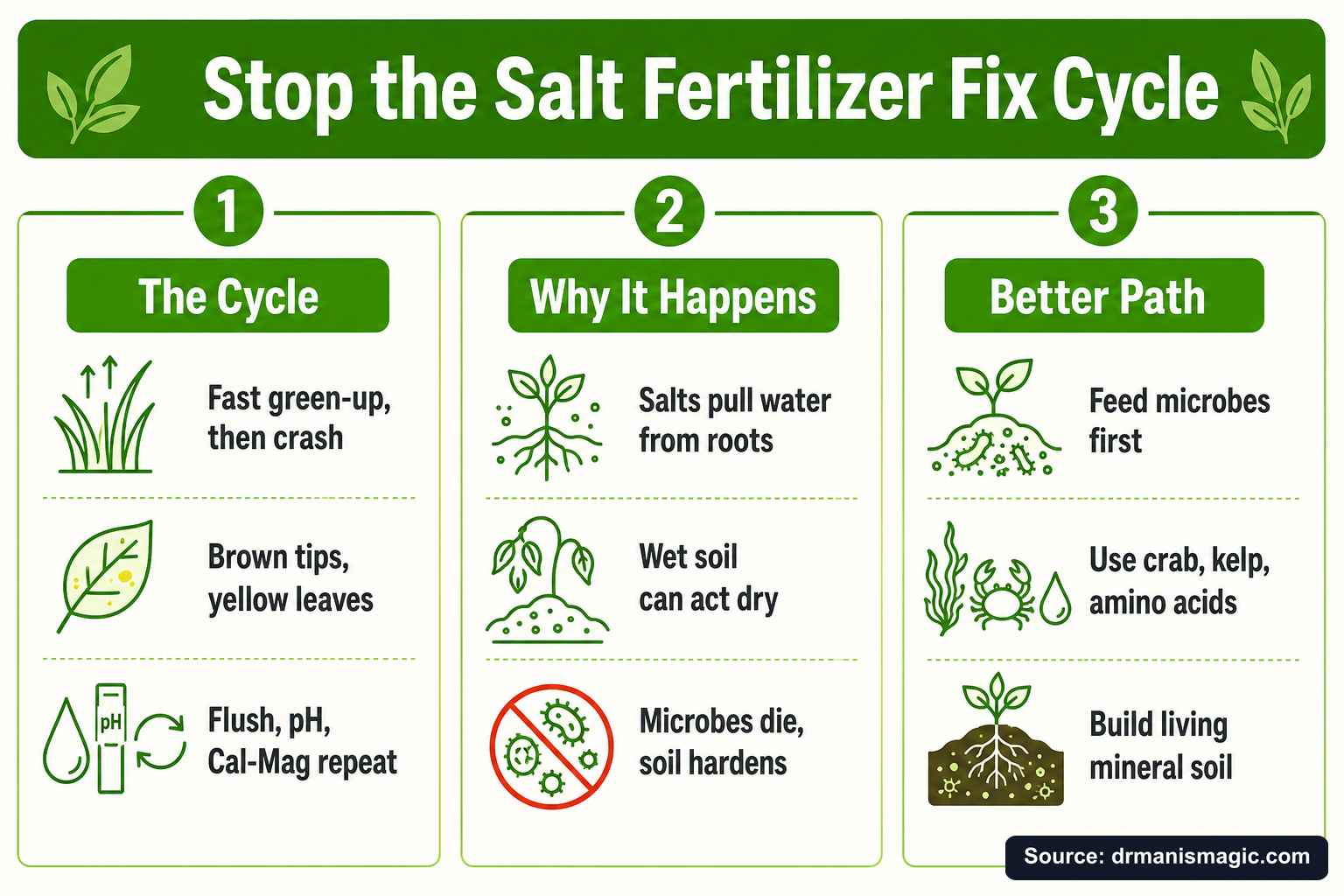
Then, about six weeks later, the leaf tips start turning brown. The lower leaves go yellow. You water more. You flush the pot. You Google "why are my plant leaves burning." Someone in a Facebook group says you need Cal-Mag. Someone else says flush with water. Another person says your pH is off. You buy a pH meter. You buy Cal-Mag. You buy a flushing agent. You spend another forty dollars fixing a problem you did not know you were creating. Sound familiar? That cycle — green up, crash, fix, repeat — is not bad luck. It is not your fault. It is the predictable result of how salt-based fertilizers work. And once you understand the mechanism, the whole thing makes total sense.
After growing over 250,000 trees at our South Texas nursery, we watched this pattern play out again and again. Growers using conventional soluble fertilizers would chase problems endlessly. The plants would look okay for a while, then slowly get weaker. The soil would get harder. The roots would shrink. The fixes would multiply. We learned — the hard way — that the problem was not the grower. The problem was the product. And the root cause is something most fertilizer companies never explain to you. Let's change that right now.

Plant Super Boost
Key Takeaways
- Salt-based fertilizers deliver fast nutrition but create a chemical drought in the root zone, pulling water away from roots even when the soil feels moist.
- High salt levels destroy the beneficial microbes that naturally cycle nutrients, leaving your plant dependent on you for every single feeding.
- The fix-it cycle — flush, pH-correct, add Cal-Mag, re-feed — is not a coincidence. It is a predictable consequence of salt accumulation in the soil.
- Organic fertilizers like crab, kelp, and amino acids work differently: they feed the microbes first, and the microbes feed the plant in a slow, steady, natural rhythm.
- The Three Plant Pillars — mineral soil, live microbes, and organic fertilizer — break the dependency loop and build a self-sustaining growing system.
- Some conventional fertilizers contain biosludge fillers and PFAS "forever chemicals" — a serious concern for food gardens, lawns, and families with children or pets.
- You can break the cycle. The recovery steps are simple, and plants respond faster than most people expect.
What Exactly Is a "Salt-Based" Fertilizer?
Quick Answer: Most synthetic fertilizers are made from mineral salts — compounds like ammonium nitrate, potassium chloride, and superphosphate. When dissolved in water, they release ions plants can absorb immediately. That sounds great, but those same salt ions change how water moves in the soil, and not in your plant's favor.
When most people hear "salt," they think of table salt. But in chemistry, a salt is any compound formed when an acid meets a base. Most synthetic fertilizers are built from these kinds of mineral salts. Names like ammonium nitrate, monoammonium phosphate, and potassium chloride are all salts. They dissolve fast. They deliver nutrients immediately. And they carry a hidden cost that takes weeks or months to show up.
The key number here is called the salt index. Every fertilizer has one. It measures how much osmotic pressure the fertilizer creates in the soil water. The higher the number, the more stress it puts on roots and soil life. Most synthetic fertilizers have very high salt indexes. According to Colorado State University Extension, excess fertilizer salts can cause foliar burn, root damage, and wilting even when soil moisture is adequate.
That last part is worth reading twice. Wilting when the soil is wet. That is the core of the problem. And it has a name: osmotic stress, sometimes called physiological drought or chemical drought.
What Is Osmotic Stress and Why Does It Happen With Synthetic Fertilizers?
Quick Answer: Osmotic stress happens when dissolved salts in the soil water create more pulling force than the roots can overcome. The plant cannot drink, even if the soil is soaking wet. This is sometimes called chemical drought or physiological drought — and it is one of the main reasons plants wilt, yellow, or scorch after a heavy synthetic fertilizer application.
Here is a simple way to picture osmosis. Water always moves from where there are fewer dissolved particles toward where there are more. That is how plant roots drink. The inside of a root cell has more dissolved nutrients than the surrounding soil water, so water flows in. The root drinks.
Now add a pile of soluble salt fertilizer. Suddenly the soil water has a very high concentration of dissolved ions. More than the inside of the root cell. Water now flows the wrong direction — out of the root and into the soil. The plant is losing moisture even though the soil is wet. That is chemical drought.
Utah State University Extension describes this plainly: salts bind water strongly enough that plants can wilt even when moisture is visibly present in the soil. The roots are surrounded by water they cannot reach. It is like being in the ocean — water everywhere, and not a drop to drink.
This is why leaf tips burn after overfertilizing. The outer edges of leaves are the farthest from the water supply. When osmotic stress cuts off water flow, those edges die first. Classic fertilizer burn is not a chemical toxicity problem. It is a dehydration problem. Caused by salt.
How Do Salt Fertilizers Destroy the Microbes That Actually Feed Your Plants?
Quick Answer: Soil microbes are living organisms. High salt concentrations dehydrate and kill them the same way they stress plant roots. Since microbes are responsible for cycling roughly 75% of the nitrogen and 65% of the phosphorus your plants actually use, killing them means your plant loses its natural nutrient engine — and becomes completely dependent on you to replace it artificially, forever.
Here is the part fertilizer companies never put on the bag.
Your soil is not dirt. It is a living system. A single tablespoon of healthy garden soil contains more living organisms than there are people on earth. Bacteria. Fungi. Mycorrhizae. These microbes are not passengers. They are workers. According to the University of Minnesota Extension, soil biological processes supply roughly 75% of plant-available nitrogen and 65% of available phosphorus. These microbes break down organic matter. They fix nitrogen from the air. They release nutrients slowly, at exactly the pace the plant needs. They are the nutrient engine.
Salt destroys that engine.
When you pour a high-salt fertilizer into the soil, the same osmotic pressure that dehydrates roots also dehydrates microbes. Microbial cells are tiny. They are fragile. Salt spikes kill them. Repeated applications keep killing them. Over time, your soil goes from a living, self-sustaining ecosystem to something closer to dead sand — biologically empty, structurally weak, and completely dependent on your next fertilizer application to provide any nutrition at all.
Penn State Extension describes soil microbes as the workforce behind carbon, nitrogen, sulfur, and phosphorus cycling. When that workforce is gone, the cycling stops. And you have to do the job yourself, by hand, every few weeks, forever. That is the fix-it cycle. That is the dependency the big chemical companies profit from.
Dr. Mani Skaria — plant pathologist, founder of the Clean Citrus Program in Texas, and the scientist behind Dr. Mani's Magic — watched this happen across decades of research. He saw growers working harder and harder, spending more and more, while their plants slowly got weaker. The salt was not feeding the system. It was dismantling it.
What Is the Full Chain of Events That Creates the Fix-It Cycle?
Quick Answer: Salt-based fertilizers trigger a cascade: high electrical conductivity in the soil leads to osmotic stress, which causes root dehydration, microbial die-off, nutrient lockout, and structural soil breakdown. Each problem creates the next, and each "fix" — flushing, pH correction, Cal-Mag, aeration — only addresses one link in the chain while the others remain broken.
Let's walk through the chain slowly. Once you see it, you cannot unsee it.
- You apply a soluble salt fertilizer. Electrical conductivity (EC) in the soil water spikes. EC is just a measure of how many dissolved ions are in the water. High EC means high salt load.
- Osmotic stress kicks in. Roots cannot absorb water normally. The plant starts to dehydrate from the inside, even if you are watering regularly.
- Beneficial microbes start dying. The high-salt environment is lethal to bacteria, fungi, and mycorrhizae. The living nutrient engine shuts down.
- Nutrients get locked up. Even nutrients already in the soil become harder to access without microbes to convert them into plant-available forms. Deficiency symptoms appear — yellow leaves, weak stems, poor flowering.
- You flush or leach the soil. This is the standard fix. Water heavily to push salts down and out. But in compacted or poorly structured soil, this creates waterlogging. Low oxygen. The perfect conditions for Pythium and Phytophthora — the root rot pathogens.
- Root rot pressure builds. Oxygen-starved roots in wet soil are vulnerable. Disease moves in. Now you need a fungicide. Or you lose the plant.
- You re-apply fertilizer to "fix" the yellowing. The cycle starts again.
Every product you buy to fix the problem was created by the problem. That is not a conspiracy theory. That is just business logic. If your plants stayed healthy, you would not need flushing agents, pH correctors, Cal-Mag supplements, and fungicides. The companies that sell you the fertilizer also sell you the remedies. It is a very profitable loop.
See also: The Hidden Reason Synthetic Fertilizers Cause Root Rot
Salt Damage vs. Overwatering vs. True Root Rot: How Do You Tell the Difference?
Quick Answer: Salt damage looks like drought stress with brown leaf edges in moist soil. Overwatering looks like yellowing and soft stems in constantly wet soil. True root rot shows dark, mushy roots with a sour smell. All three can exist at the same time — and salt-based fertilizers can cause all three simultaneously through the leaching paradox.
| Symptom | Salt / Fertilizer Burn | Overwatering | Root Rot (Pythium / Phytophthora) |
|---|---|---|---|
| Leaf edges | Brown, crispy tips and margins | Yellow, soft, drooping | Yellow to brown, wilting despite wet soil |
| Soil moisture | Often moist or wet | Consistently wet | Often wet, poor drainage |
| Root appearance | Stunted, brown tips | Pale, waterlogged | Dark brown or black, mushy, sour smell |
| Soil surface | White crust visible on top or pot edges | Algae or moss on surface | May look normal on surface |
| Common trigger | Heavy synthetic fertilizer application | Too frequent watering, poor drainage | Salts + leaching + compacted soil + low oxygen |
| Best first step | Stop feeding, flush once with clean water | Let soil dry, improve drainage | Remove affected roots, improve drainage, add live microbes |
The tricky part is that all three conditions often overlap. Salt damage weakens roots. Weakened roots cannot handle excess moisture. Poor drainage means flushing makes things wetter. Wetter, oxygen-starved soil breeds Pythium and Phytophthora. And the whole time, you are staring at yellow leaves wondering if you are watering too much or too little.
The white crust on the rim of a pot or on the soil surface is a giveaway. That is salt residue. If you see it, salt has been building up. The roots below are under stress whether the top of the plant looks okay or not.
Why Does Organic Fertilizer Break the Fix-It Cycle?
Quick Answer: Organic fertilizers work by feeding soil microbes first. The microbes digest the organic material and release nutrients slowly, in plant-ready forms, at the pace the plant naturally needs. This mirrors how nutrition works in nature — no spikes, no osmotic crashes, no microbial die-off. The plant gets steady nutrition, and the soil gets healthier with every application instead of more depleted.
This is the part most gardening content gets wrong. People say organic fertilizers are "gentler" or "safer." True. But that misses the real magic.
Organic fertilizer does not just avoid killing microbes. It feeds them. It is their food source. The microbes eat the organic material first. They digest it. They multiply. And in the process of eating and living and dying, they convert that material into forms the plant can absorb directly through its roots. Amino acids. Nitrates. Phosphate ions. All delivered in a slow, steady trickle — exactly the way nature intended.
Think of it like this. A salt-based fertilizer is like handing a starving person an IV drip of pure glucose. Fast. Immediate. But if you do it too often, or at the wrong concentration, you damage the body. And you never rebuild the person's ability to digest real food.
Organic fertilizer is like feeding someone a nourishing meal. The body digests it. Absorbs what it needs. The digestive system stays healthy and strong. The person can feed themselves better and better over time.
When microbes die after doing their job, they release everything they stored — nutrients, proteins, minerals — directly into the root zone. It is a natural time-release system. One application keeps feeding the plant long after you put it down. That is why organic-fed plants do not crash between feedings. There is no crash. There is no spike. Just steady, quiet nourishment.
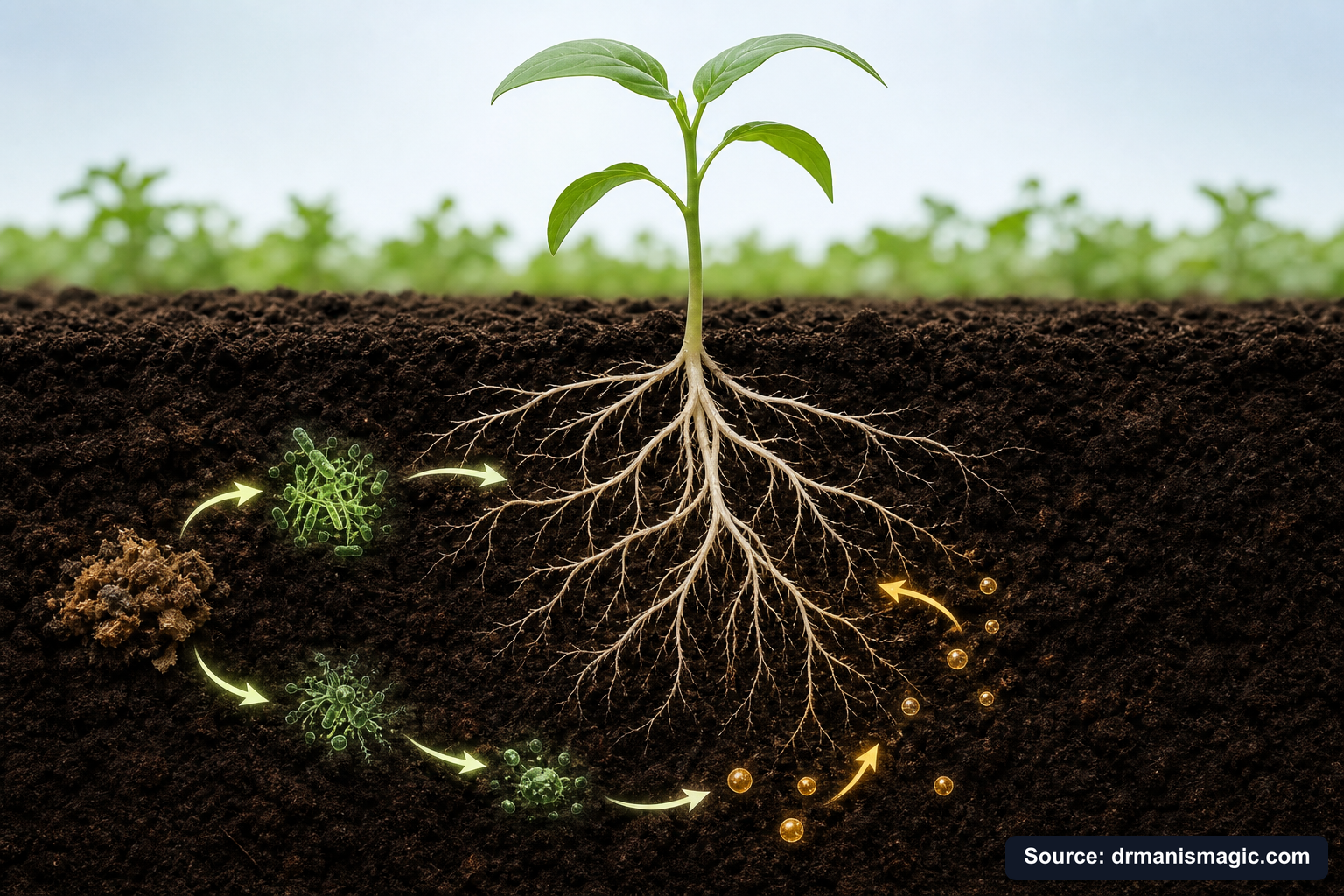
And because there is no osmotic pressure spike, the roots stay hydrated. The microbes stay alive. The soil structure improves. Every application makes the next one work better. That is the opposite of the fix-it cycle. That is a self-reinforcing system of health.
This is Pillar Three of the Three Plant Pillars — the framework Dr. Mani Skaria developed after decades of testing across 250,000-plus trees at our South Texas nursery. Organic fertilizer is not just a "nice to have." It is the fuel that powers the whole biological engine.
You Never Had a Brown Thumb.
You were handed the wrong tools. This free guide hands you the right ones.
You watered it. You fed it. It died anyway.
It was never you. It was the dirt, the salt food, and the bad advice.
This guide shows you what really went wrong, and how to fix it for good.
- Why your plants really died, and why it was never your fault
- The salt hiding in your plant food that quietly burns the roots
- The hidden killer in almost every bag of store soil
- The tiny helpers that grow a whole forest for free
- The rescue trick that brings a half dead plant back to life

What Makes Crab Shells, Kelp, and Amino Acids Different From Regular Fertilizer?
Quick Answer: Crab shells, cold-processed kelp, and amino acids are three of the most biologically active organic fertilizer ingredients available. Crab shells contain chitin, which naturally suppresses soil pathogens. Kelp delivers plant hormones, trace minerals, and biostimulants that regulate growth. Amino acids provide nitrogen in a form plants and microbes can use immediately, without any salt-based chemistry involved.
Let's break each one down simply.
Crab Shells and Chitin
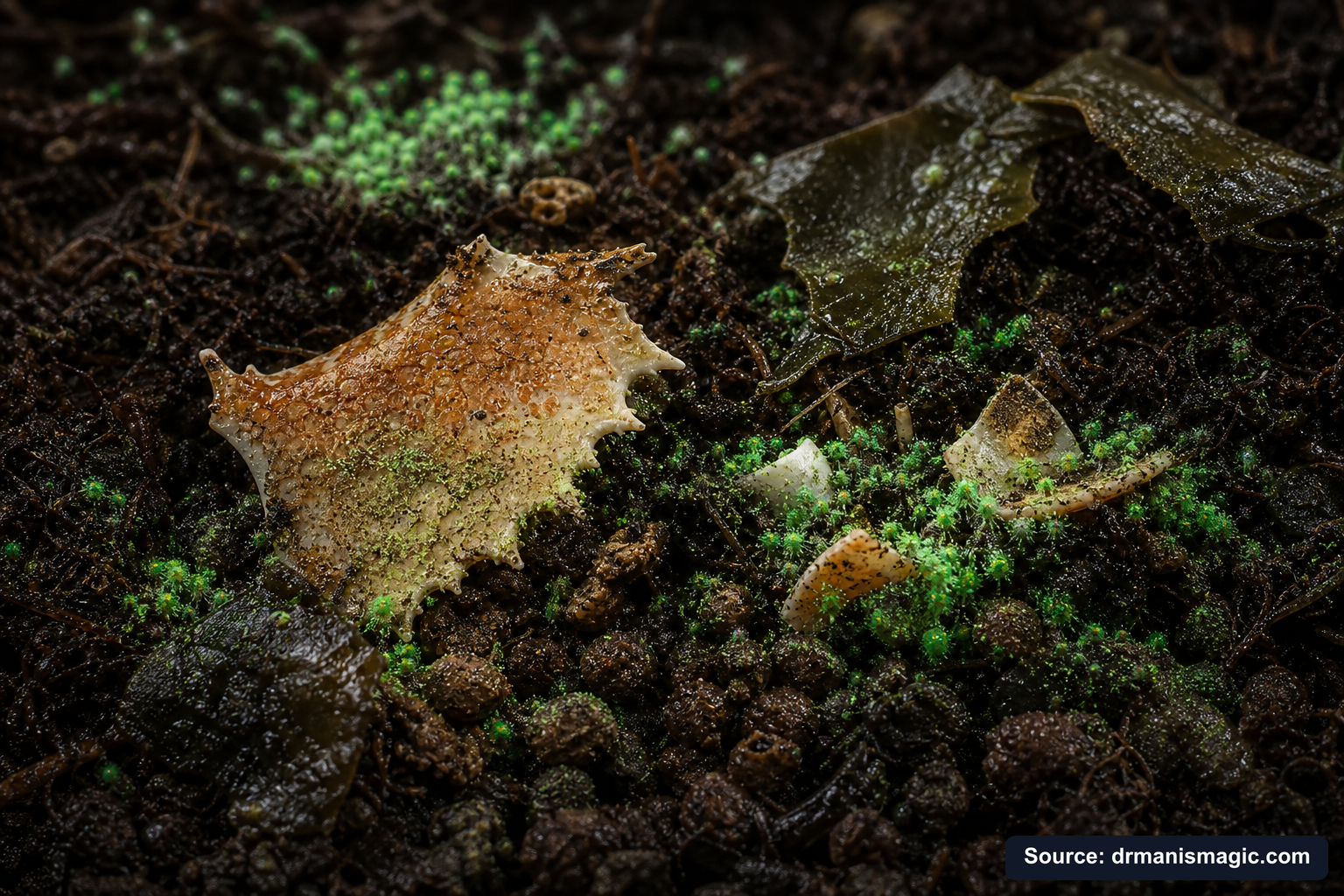
Crab shells are rich in a compound called chitin. Chitin is fascinating. It is the same material that makes up the outer shell of insects and the cell walls of many harmful fungi. When you add chitin to soil, the microbes that eat chitin — called chitinase-producing bacteria — multiply rapidly. These microbes naturally suppress soil pathogens. They eat the chitin in the crab shells, and in doing so, they build up defenses against chitin-coated threats like root-knot nematodes and fungal pathogens. Your plant's immune system gets a boost from the ground up. Crab shells also supply calcium and magnesium — the same nutrients that build woody stems, strong cell walls, and disease-resistant tissue.
Cold-Processed Kelp
Kelp is a marine plant that grows incredibly fast. To do that, it produces a rich cocktail of natural plant hormones called auxins and cytokinins. These hormones regulate root development, cell division, and fruit set. When cold-processed kelp is applied to soil, those hormones transfer to your plant. Root growth accelerates. Fruit set improves. Stress tolerance goes up. Kelp also carries over 60 trace minerals and natural carbohydrates that feed soil microbes directly. It is one of the most complete biostimulants in nature. And because it is cold-processed — not heat-treated — those hormones and living compounds stay intact and active.
Amino Acids as Nitrogen
Most synthetic fertilizers deliver nitrogen as nitrate or ammonium — ionic salts. Fast. High salt index. Osmotic stress risk. Amino acids are different. They are the building blocks of protein. Plants can absorb certain amino acids directly through roots and leaves without any conversion needed. For others, soil microbes help break them down into usable nitrogen. Either way, the process is gentle. No salt spike. No osmotic crash. And because amino acids are protein-based, they also feed the microbial community, continuing that nourishing cycle.
Put these three ingredients together — crab shells, cold-processed kelp, and amino acids — and you have a fertilizer that feeds the plant, feeds the microbes, suppresses pathogens, stimulates hormones, delivers trace minerals, builds soil structure, and does all of it without a single salt ion causing osmotic stress. That is what Crab, Kelp & Amino Acids is built around.
What About Biosludge and PFAS in Fertilizers — Should You Be Worried?
Quick Answer: Some fertilizers, both synthetic and labeled "organic," use treated municipal waste — called biosludge — as a filler. Biosludge can contain PFAS compounds, sometimes called "forever chemicals," which do not break down in soil and can accumulate in food crops. For edible gardens, lawns used by children, and any plant you plan to eat, this is a legitimate concern worth checking on every product label.
This is the part that does not show up on the front of the bag.
Biosludge is treated municipal wastewater sludge. In plain English: processed human waste. It is cheap, it is plentiful, and it is used as a filler in a surprising number of fertilizers — including some marketed as organic. The problem is that biosludge can carry PFAS compounds. PFAS stands for per- and polyfluoroalkyl substances. These are synthetic chemicals used in nonstick cookware, stain-resistant fabrics, food packaging, and firefighting foam. They do not break down. In soil, they accumulate. In plants, they can be taken up through roots. In people, they build up over time and have been linked to hormone disruption and other health concerns.
If you are growing food — vegetables, fruit trees, herbs — or if children or pets play on your lawn, this matters. A lot.
Dr. Mani's Magic Crab, Kelp & Amino Acids contains zero biosludge, zero PFAS, and zero synthetic salts. Every ingredient is traceable, clean, and sourced with the same care we would want in our own backyard. Because it is our backyard. We test everything on our own trees, in our own nursery, in South Texas. Our family lives here. Our grandchildren play here. We are not going to cut corners on what goes in the ground.
And one more thing about smell. If you have ever used fish emulsion, you know the problem. It goes anaerobic. It smells like rotting sewage. You cannot enjoy your garden for days after applying it. Our formula does not do that. It smells like earth. Because it is stable, living nutrition — not rotting waste.
Synthetic vs. Slow-Release vs. Organic: Which Fertilizer Strategy Actually Works?
Quick Answer: Synthetic fertilizers deliver fast but brittle results with high salt risk. Slow-release synthetics reduce burn risk but often use plastic coatings that leave microplastics in the soil. Organic fertilizers like crab, kelp, and amino acids work slowly and gently, feed soil biology, build long-term resilience, and carry almost no risk of overfeed burn — making them the only strategy that improves soil health with every application.
| Feature | Synthetic Fast-Release | Synthetic Slow-Release (Coated) | Organic (Crab, Kelp, Amino Acids) |
|---|---|---|---|
| Speed of results | Fast (days) | Medium (weeks) | Steady (weeks to months, building) |
| Salt index | High | Medium to high | Very low |
| Microbial impact | Kills beneficial microbes | Reduces microbial activity | Feeds and supports microbes |
| Osmotic stress risk | High | Moderate | Minimal |
| Root burn risk | High if overapplied | Lower, but possible | Very low |
| Soil structure over time | Degrades | Neutral to slightly negative | Improves with each application |
| Plastic residue in soil | No | Yes (polymer coating) | No |
| PFAS / biosludge risk | Possible | Possible | Zero (clean inputs) |
| Long-term dependency | Creates it | Reduces it slightly | Breaks it |
| Works for lawns, trees, houseplants, gardens | Yes, with risk | Yes, with risk | Yes, safely |
Slow-release synthetic fertilizers are often marketed as the "safer" middle ground. And it is true that coating a salt-based fertilizer in a polymer shell releases it more gradually, reducing the osmotic spike. But those polymer shells are plastic. They break down slowly in the soil, adding microplastics to your garden over time. And the core chemistry is still salt-based. The microbes still take a hit. The soil still gets no biological benefit. You are just slowing down the same problem.
The only strategy that makes soil measurably better over time is organic. Not because it is trendy. Because of basic biology. Feed the microbes. Let the microbes feed the plant. Let the plant feed itself, with your help getting the system started. That is nature's design. We did not invent it. We just stopped fighting it.
See also: Why Most Fertilizers Are Actually Salt in Disguise
What Are the Three Plant Pillars and How Do They Stop the Fix-It Cycle Permanently?
Quick Answer: The Three Plant Pillars — mineral-based soil for drainage and root oxygen, live microbes for nutrient cycling and disease resistance, and organic fertilizer for slow, biology-friendly nutrition — work together as a system. When all three are in place, the fix-it cycle stops because there is nothing left to fix. The soil improves. The roots strengthen. The plant feeds itself naturally.
After thirty years of growing at US Citrus Nursery, Dr. Mani Skaria identified three things that, when done right together, make nearly every plant problem go away.
The first is mineral-based soil. Most potting mixes are made from pine bark and sawdust. Organic material. It decomposes. As it breaks down, it compacts. It steals oxygen from the root zone. It holds water too long. Roots suffocate. Root rot follows. Mineral-based soil — true sandy loam from South Texas, rich in silica — does not decompose. It maintains structure permanently. Roots breathe. Water drains. Oxygen flows. The soil you plant in today is the same soil your plant will thrive in ten years from now. No repotting every season. No compaction spiral.
The second is live microbes. Bacteria, fungi, mycorrhizae. These are the living nutrient engine we talked about earlier. They cycle nutrients. They suppress pathogens. They extend root reach far beyond what the plant could manage alone. Without them, even perfect soil and perfect fertilizer deliver less. With them, everything else works twice as hard. Plant Super Boost delivers stabilized, living microbes in liquid form — easy to apply, fast to establish, and formulated so they do not die in the bottle before they reach your plant.
The third is organic fertilizer. Not because it is chemical-free. Because it feeds the system, not just the plant. It feeds microbes. Microbes feed roots. Roots feed the whole plant. Slowly. Steadily. Without spikes, crashes, burns, or fixes.
When all three pillars are in place — the right soil, the right biology, the right nutrition — the fix-it cycle breaks. There is nothing to fix. The system runs itself, the way nature intended, and you get to enjoy the garden instead of chasing problems through it.
What Should You Do If You Have Already Been Using Salt-Based Fertilizers?
Quick Answer: Stop feeding immediately, flush the soil once with clean water, let it dry appropriately, and then begin rebuilding with live microbes and organic fertilizer. Most plants respond within a few weeks. The soil takes longer to recover, but each biology-friendly application accelerates the process.
Good news. Plants are resilient. And soil biology, once you stop killing it, recovers faster than you would expect. Here is a simple recovery checklist:
- Stop all synthetic fertilizer applications immediately. Give the soil a break. Do not add more salt while you are trying to reduce it.
- Flush the soil once with clean water. A slow, thorough watering — enough to drain out the bottom of the pot or soak through the bed — pushes accumulated salts down and away from the active root zone. Do this once, not repeatedly. Repeated flushing in poorly draining soil creates the waterlogging problem.
- Check your drainage. If water sits on the surface for more than a minute, your soil structure is compromised. This is the moment to consider switching to a mineral-based, permanently structured soil that drains freely and keeps oxygen moving to roots. See also: Why Most Potting Mix Collapses Within 6-12 Months
- Apply live microbes. Once the salt load drops, introduce live bacteria, fungi, and mycorrhizae. They recolonize the root zone quickly and begin rebuilding the nutrient cycling system within days.
- Begin organic fertilizer at the next feeding cycle. Start at the recommended rate. Organic inputs carry almost no burn risk, so you do not need to be timid. The microbes will do the conversion work for you.
- Be patient for two to four weeks. You will not see the same instant green-up you got from synthetic fertilizer. What you will see is steadier, stronger, more sustained growth — without the crash that comes after.
- Watch the roots, not just the leaves. Healthy roots are white or light tan, firm, and numerous. If you see dark, mushy, or sparse roots, continue the microbial treatment and ensure drainage is working correctly before adding any fertilizer.
We have walked thousands of growers through this process. Most are surprised by how quickly their plants respond once the salt load clears and biology returns to the root zone. The plant was not broken. The system was. Fix the system, and the plant fixes itself.
For a broader look at how these principles apply across every type of plant you grow, the Free Plant Care Field Guide walks through it step by step, in plain language, for any plant — lawns, fruit trees, houseplants, flower beds, vegetable gardens, and more.
The Real Cost Is Not the Money You Spent on the Wrong Products
Here is what Dr. Mani tells every grower who comes to him after years of struggling.
You can always earn more money. You cannot earn back time.
The number one thing people tell us they want — more than any specific plant variety, more than any specific result — is to see something they planted actually bear fruit in their lifetime. To taste something they grew. To walk out to their backyard and pick something off a branch that they put in the ground with their own hands. That desire is not small. It is primal. It is one of the oldest human drives there is. We were made to tend gardens. That impulse never left us.
But every year spent in the fix-it cycle is a year that plant did not thrive. Every season of chasing pH and burning leaf tips and flushing pots and re-buying products is a season of standing still. Or worse — going backwards. Salt accumulates. Roots shrink. Biology collapses. The plant that should have been producing by now is still struggling to survive.
The good news is the alternative is not complicated. It is actually simpler. One soil. One microbial drench. One organic fertilizer. Three pillars. A system that runs itself once you set it up correctly. That is what Dr. Mani spent thirty years building. Not because it sounds good on paper. Because it is what actually worked on 250,000 trees in the real Texas heat, in real containers, in real soil, for real growers.
If you are ready to stop fixing and start growing, the Three Plant Pillars system is a good place to start. Read through it. See what pillar you might be missing. Your plants have been waiting for this a long time. So have you.
Frequently Asked Questions
If you have ever watched your plants green up fast and then crash a few weeks later, you already know something is wrong. These questions come from real gardeners who were tired of chasing fixes that never seemed to stick. The answers below are grounded in what Dr. Mani learned growing over 250,000 trees in South Texas.
What exactly makes a fertilizer "salt-based" and why does that matter for my plants?
Most synthetic fertilizers are built from mineral salts like ammonium nitrate and potassium chloride. They dissolve fast and push nutrients into your plant quickly. The problem is they raise osmotic pressure in your soil. That means water gets pulled away from roots even when the soil feels wet. Your plant is sitting in moisture and still getting dehydrated. That is the hidden trap most bag labels never mention.
Why do my plants look great at first and then start declining a few weeks after feeding?
That is the salt cycle in action. The first feeding looks like a win. But salt builds up in your soil over time. It starts killing the beneficial microbes that naturally move nutrients to your roots. Once those microbes are gone, your plant has no backup system. It depends entirely on you for every single meal. Miss a feeding or over-feed slightly and the whole thing tips over fast.
How does salt buildup actually damage the soil over time?
Salt accumulation makes your soil harder and more compacted. Roots shrink. Water drains poorly. The living ecosystem that should be working for your plant gets wiped out. Dr. Mani watched this happen repeatedly at the US Citrus Nursery. Growers using conventional fertilizers kept seeing their soil get tighter and their plants get weaker season after season. The soil stopped being alive and started being a problem.
Is the fix-it cycle of flushing, adding Cal-Mag, and adjusting pH really caused by the fertilizer itself?
Yes. That whole cycle is a predictable result of using salt-based products. Salt locks up certain nutrients in the soil. That creates deficiencies that look like disease or poor watering. So you buy a pH meter. Then Cal-Mag. Then a flushing agent. Each fix creates a new imbalance. You are not solving the root problem. You are just managing the symptoms of a system that was never designed to be self-sustaining.
What do organic fertilizers like crab, kelp, and amino acids do differently?
They feed your soil microbes first. The microbes then break those nutrients down and deliver them to your roots slowly and steadily. There is no salt spike. There is no osmotic crash. Dr. Mani's Magic Crab, Kelp, and Amino Acids fertilizer works this way on purpose. It builds long-term health in the soil instead of creating a quick hit followed by a hard landing. Your plants get fed the way nature intended.
Can salt-based fertilizers actually harm my family, pets, or the environment?
This is a serious concern. Some conventional fertilizers contain biosludge fillers and PFAS compounds, which are sometimes called forever chemicals. These do not break down. They move through soil and into water. If you grow food, walk barefoot on your lawn, or have children and pets playing outside, that matters. Dr. Mani's Magic products use clean, organic inputs with no synthetic salts, no plastic coatings, and nothing you would not want near your family.
How do the Three Plant Pillars stop the fix-it cycle for good?
The Three Plant Pillars work together as a system. Mineral-based Super Soil gives roots room to breathe and never compacts. Plant Super Boost adds live microbes that protect roots and unlock nutrients naturally. Organic fertilizer feeds those microbes without salt damage. When all three are in place, your soil becomes self-sustaining. The endless loop of flush, fix, and re-feed stops because the soil is doing its job the way it was always supposed to.
About the Author
Ron Skaria, MD
Ron Skaria, MD, is the co-founder of Dr. Mani's Magic and the son of Dr. Mani. He trained as a medical doctor and now works full time on the family farm in Hargill, Texas, building Dr. Mani's Magic alongside his dad. He wrote the Brown Thumb Field Guide to put his father's 48 years of plant science into plain words any gardener can use. His belief is simple. You never had a brown thumb. You just never had the right help.


