


Why Organic Fertilizers Don't Feed Plants Directly | Dr. Mani's Magic
Why Organic Fertilizers Don't Feed Plants Directly (And Why That's Actually Their Superpower)
Picture this. You're standing in your backyard on a warm Saturday morning. Coffee in hand. The sun is just coming up. You look at your lemon tree, your garden beds, your lawn. You want them to explode with life. So you drive to the hardware store, grab a bag of fertilizer, and scatter it around. You water it in. You wait.
A week passes. Then two. Maybe you get a little flush of green. But something feels off. The leaves look pale. The soil feels hard. And that nagging question won't leave you alone: Why isn't this working? You fed the plant. You did what the bag said. So what went wrong?
Here is the thing nobody tells you at the big box store. Fertilizer does not work the way you think it does. Especially the organic kind. And once you understand what is really happening underground, right there in the dark below your feet, everything changes. You stop chasing quick fixes. You stop wasting money. And your plants start doing something remarkable. They actually thrive. Let's pull back the curtain and show you exactly what is going on.

Organic Fertilizer | Crab, Kelp & Amino Acids
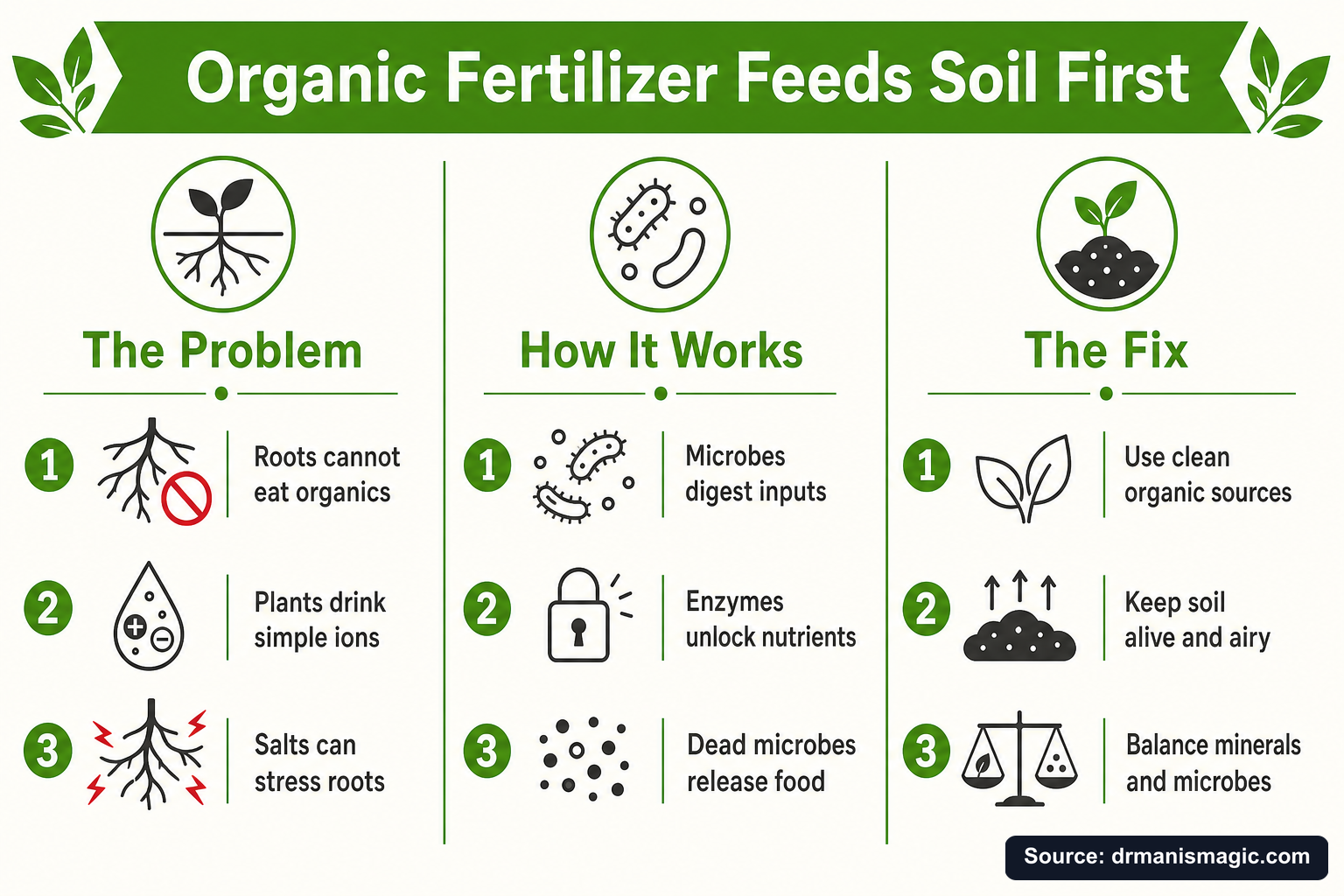
Key Takeaways
- Organic fertilizers do not feed plant roots directly. They feed the soil microbes first, and the microbes convert nutrients into forms the plant can actually absorb.
- Plants can only drink nutrients in specific chemical forms, like nitrate and phosphate. It does not matter if those ions came from a bag of kelp or a synthetic salt. The form is what counts.
- Synthetic fertilizers are salt-based. Salt burns roots, kills beneficial microbes, and can cause a condition called osmotic stress, which makes plants wilt even when the soil is wet.
- Organic inputs like crab meal, kelp, and amino acids feed the living soil ecosystem. When microbes eat and then die, they release a slow, steady trickle of nutrition that mirrors how nature has always worked.
- The Three Plant Pillars, developed by Dr. Mani Skaria after growing over 250,000 trees at US Citrus Nursery in South Texas, are the foundation for any plant to thrive: mineral soil, live microbes, and organic fertilizer.
- Some organic fertilizers still contain biosludge and PFAS "forever chemicals." Clean inputs matter. Always check the source.
- Yellowing leaves, wilting, and poor growth are not always a fertilizer problem. Oxygen, drainage, salt buildup, and soil biology often control whether nutrients can be released and absorbed at all.
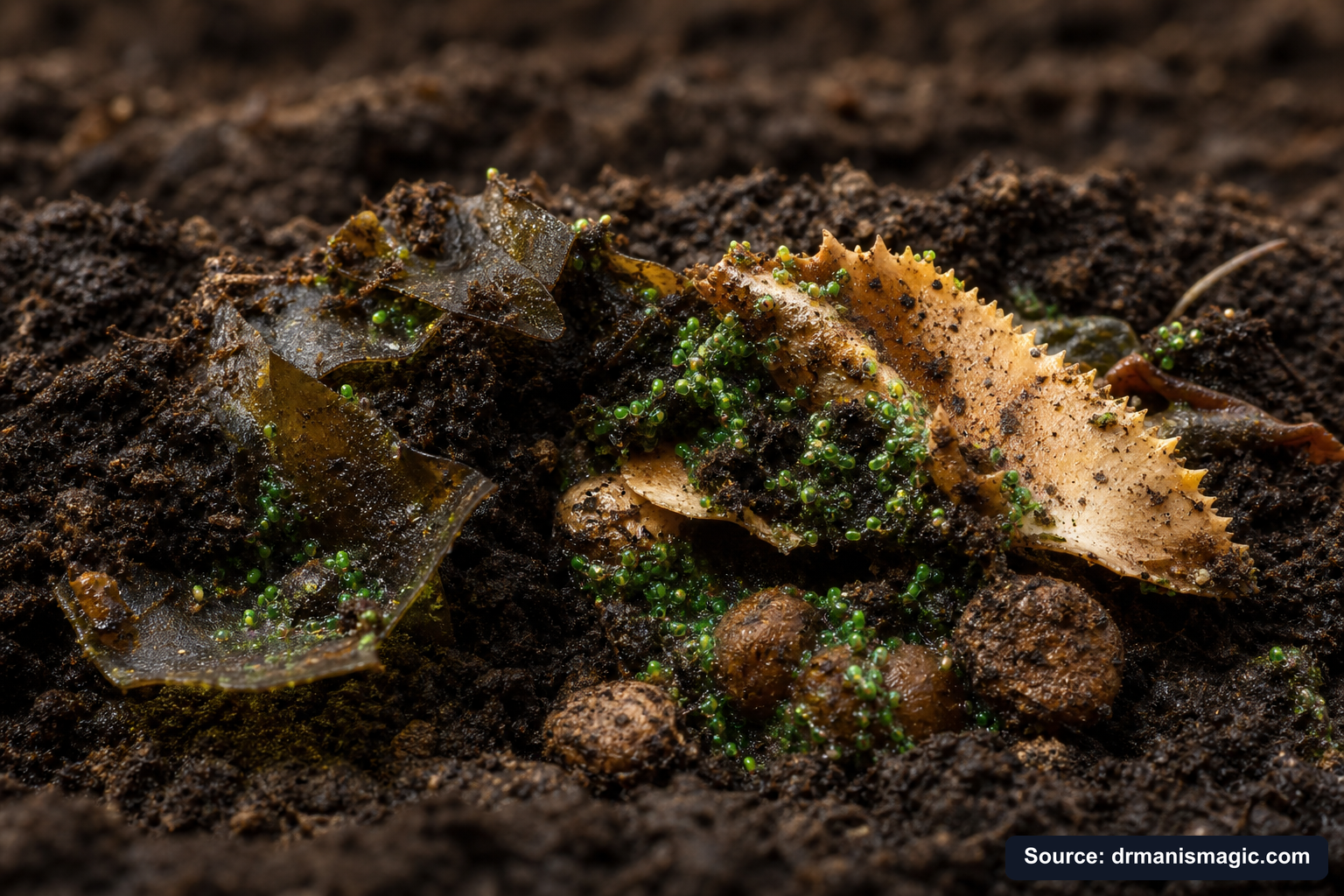
What Does "Feeding the Soil, Not the Plant" Actually Mean?
Quick Answer: It means organic fertilizer is not delivered straight to the root. Instead, it feeds billions of tiny microbes in the soil. Those microbes digest the organic material, break it down into simple chemical forms, and release those forms where roots can absorb them. The plant drinks the result, not the original ingredient.
Think of it like this. You cannot eat a raw wheat field. But a baker can take that wheat, mill it, mix it, bake it, and hand you a warm loaf of bread. Now you can eat it.
Organic fertilizer is the wheat field. The microbes in your soil are the baker. And the plant is you, waiting at the table.
When you sprinkle crab meal or kelp or compost onto your soil, the plant's roots cannot grab that material directly. The nutrients inside are locked up in complex organic molecules. Proteins. Shells made of a substance called chitin. Long chains of carbon and nitrogen bonded together. Roots cannot break those bonds. Roots are not built for that job.
But microbes are.
Bacteria, fungi, actinomycetes, and other tiny organisms swarm over that organic material. They eat it. They digest it. As they do, they release the nutrients locked inside into simpler forms. Nitrate. Ammonium. Phosphate. Potassium ions. These are the forms a root can actually absorb, the way a straw can only sip liquid, not solid food.
Oregon State University Extension confirms this directly: plants do not differentiate between nutrients from organic and synthetic fertilizers because the absorbed forms are chemically identical. The difference is in how the nutrient gets there, not what it is once the root absorbs it.
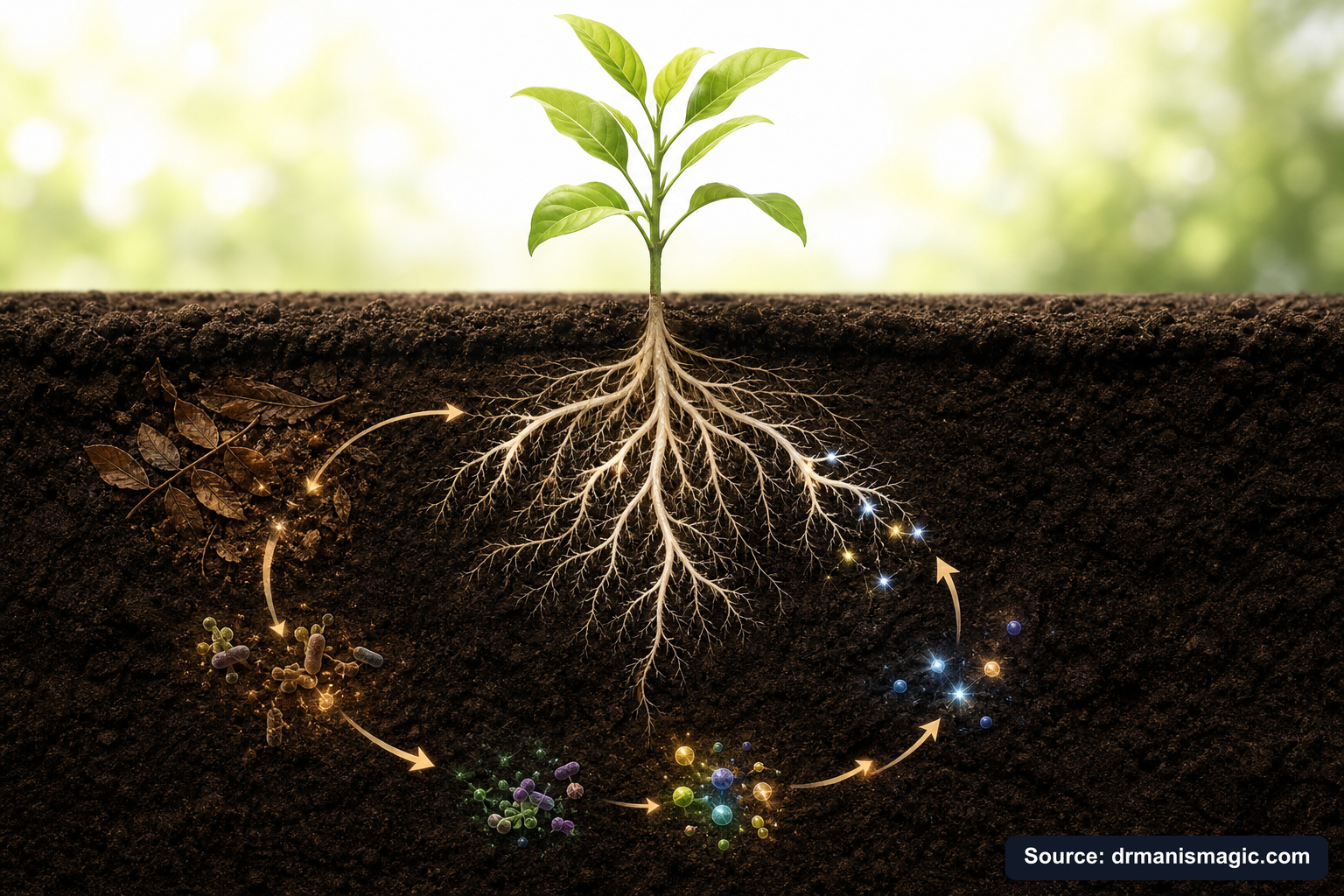
So "feeding the soil, not the plant" is not mystical gardening language. It is a precise description of a biological pipeline. Organic matter goes in. Microbes process it. Simple ions come out. Roots drink the ions. Plant grows.
That pipeline is the secret. And when you protect it instead of poisoning it, everything changes.
How Do Microbes Actually Convert Organic Fertilizer Into Plant Food?
Quick Answer: Microbes eat organic material and use enzymes to break large molecules into simple ions like nitrate, phosphate, and potassium. When those microbes die, they release everything stored in their bodies back into the soil. This creates a natural, slow time-release system that keeps feeding your plant long after you apply the fertilizer.
Here is the process, step by step, in plain language.
You apply an organic fertilizer. Let's say it contains crab shell, kelp, and amino acids. That material lands in your soil. Bacteria and fungi smell it immediately. Literally. They detect chemical signals and move toward the food source.
They begin secreting enzymes. These enzymes are like tiny molecular scissors. They cut big protein chains into smaller pieces. They break down chitin, the hard shell material in crab, into simple sugars and nitrogen compounds. They dissolve kelp's complex carbohydrates into usable fragments.
As the microbes feed and multiply, they release nitrogen as ammonium. Other bacteria then convert that ammonium into nitrate, the form most plants prefer to drink. Phosphorus gets released from organic bonds and becomes phosphate. Potassium and trace minerals are freed up too.
Now here is the part most people miss.
When those microbes die, and they do die, their entire bodies become food. And microbial bodies are packed with nutrients. Nitrogen. Phosphorus. Trace minerals. All of it gets released back into the soil solution right at the root zone. It is a second wave of feeding, automatic and free, powered entirely by biology.
Penn State Extension describes this process as microbial mineralization, and their research emphasizes that the speed of this process depends on soil temperature, moisture, and oxygen levels. Cold, dry, or waterlogged soils slow the pipeline to a crawl.
This is why organic fertilizer behaves like a slow, steady drip rather than a flood. And that slow drip is exactly what plants evolved to expect. It mirrors the pace of nature. Leaves fall. Microbes eat them. Nutrients return to the soil. Roots drink. Trees grow. Season after season. Century after century.
After growing more than 250,000 trees at US Citrus Nursery in South Texas, we can tell you from experience: when this pipeline is healthy and humming, plants do not just survive. They flourish in a way that synthetic shortcuts can never replicate.
Why Do Roots Need Oxygen to Absorb Any Nutrients at All?
Quick Answer: Roots breathe oxygen to produce the energy they need to absorb nutrients. Without oxygen, roots cannot actively pull in minerals from the soil. Overwatering, compaction, and soggy soil cut off that oxygen supply. When that happens, organic fertilizer stops working, not because the fertilizer is bad, but because the root system cannot function.
This is the missing piece almost nobody talks about. And it explains so much confusion.
You fertilized. You watered. The plant still looks terrible. Why?
Because nutrients cannot get into the plant if the roots cannot breathe.
Root cells use a process called active transport to pull mineral ions from the soil solution into the plant. Active transport requires energy. Energy requires oxygen. No oxygen means no energy. No energy means no nutrient uptake. The roots just sit there, surrounded by nutrition they cannot use.
This is also why organic fertilizer performs poorly in waterlogged, compacted, or airless soil. Remember those microbes that convert organic material into plant-available ions? They also need oxygen. They are aerobic organisms. Drown them and they go dormant. The biological pipeline shuts down.
That is why the very first of Dr. Mani's Three Plant Pillars is mineral-based soil. Not bark-heavy potting mix. Not sawdust sludge that compacts and rots. Real mineral soil with structure, drainage, and air pockets that keep both roots and microbes breathing.
Without oxygen in the root zone, nothing else works. Not the fertilizer. Not the microbes. Not the water you so carefully applied. The whole system stalls. This is one of the most important things we learned growing trees in South Texas. Get the oxygen right first, and everything downstream gets easier.
What Is the Difference Between Organic Fertilizer and Synthetic Fertilizer?
Quick Answer: Synthetic fertilizers are salt-based and release nutrients instantly, but the salt damages roots, kills beneficial microbes, and builds up in soil over time. Organic fertilizers release nutrients slowly through microbial activity. They support the soil food web instead of harming it. The end product absorbed by the root is the same ion. The journey and the damage are completely different.
Let's look at this side by side.
| Feature | Synthetic Fast-Release Fertilizer | Synthetic Slow-Release Fertilizer | Organic Fertilizer (Crab, Kelp, Amino Acids) |
|---|---|---|---|
| How it releases nutrients | Immediately dissolves in water | Dissolves through plastic coating over weeks | Microbes break it down over weeks and months |
| Salt content | Very high salt index | High salt index inside the coating | Very low to none |
| Effect on microbes | Burns and kills beneficial microbes | Still releases salt; harms microbes over time | Feeds and supports microbes |
| Risk of root burn | High. Osmotic stress pulls water out of roots | Moderate. Risk if coating breaks down fast | Very low. Protein-bound nitrogen regulates uptake |
| Soil residue | Salt accumulation over time | Plastic prills left in soil | Organic matter improves soil over time |
| PFAS or biosludge risk | Some contain biosludge fillers | Some contain biosludge fillers | Depends on source. Clean brands have zero PFAS, zero biosludge |
| Long-term soil health | Declines over time | Declines over time | Improves over time |
The salt issue is the core problem with synthetic fertilizers. Salt is a powerful molecule. When you put too much salt near a root, it creates what scientists call osmotic stress. The salt pulls water out of the root cells instead of letting water in. The plant wilts even when the soil is wet. It feels thirsty in a puddle. That is physiological drought, and it is one of the cruelest tricks salt plays.
At the same time, that salt is killing the bacteria and fungi in your soil. The very microbes that would otherwise be unlocking nutrients for your plant. So you get a double loss. Roots are stressed. Biology is dead. The soil becomes a sterile medium that can only function if you keep adding more synthetic fertilizer. You become dependent. The plant becomes dependent. And the big chemical companies keep cashing your checks.
See also: Why Most Fertilizers Are Actually Salt in Disguise
See also: The Hidden Reason Synthetic Fertilizers Cause Root Rot
What Makes Crab Meal, Kelp, and Amino Acids Special as Organic Inputs?
Quick Answer: Crab meal contains chitin, a natural compound that activates plant immune responses and feeds beneficial fungi. Kelp is loaded with natural hormones called auxins that stimulate root growth, plus trace minerals the plant needs in small amounts. Amino acids provide nitrogen in a pre-digested form that microbes and roots can use quickly, without the salt damage of synthetic nitrogen.
These three ingredients are not random. There is a reason they work together so well. Let's break each one down.
Crab Meal and Chitin: The Immune Activator
Crab shells are made of a substance called chitin. It is the same material found in insect exoskeletons and fungal cell walls. When chitin enters your soil, something fascinating happens. Certain beneficial bacteria and fungi that eat chitin as food begin to multiply rapidly. And as they multiply, the plant's root zone becomes flooded with these chitin-eating microbes.
Here is where it gets interesting. When pathogens like Pythium and Phytophthora, the organisms responsible for root rot, try to invade, they also have chitin in their cell walls. But the beneficial chitin-eating microbes are already there, already active, already competing for space. The plant's immune system also gets a signal from chitin breakdown products, a kind of biological alarm that says "something with chitin is here, be ready." The plant stiffens its defenses. Roots get a layer of protection that no synthetic fertilizer can provide.
Crab meal also brings calcium and magnesium. Calcium builds strong cell walls. Magnesium sits at the center of every chlorophyll molecule. Without magnesium, the plant cannot photosynthesize. These are not minor nutrients. They are structural and foundational.
Kelp: The Hormone and Mineral Delivery System
Cold-processed kelp is one of the most nutrient-dense materials on earth. Kelp grows in the ocean, pulling up trace minerals from seawater that most soils have lost over centuries of farming and development. When you add kelp to your soil, you are adding a broad-spectrum mineral supplement that covers gaps your soil tests might not even catch.
But the minerals are only part of the story. Kelp contains natural plant hormones called auxins and cytokinins. These hormones tell roots to grow longer and branch out more. They tell the plant to push new shoots. They signal cells to divide faster. The result is a plant with a more extensive root system, better at finding water and nutrients in the soil.
Kelp also carries natural carbohydrates that feed soil microbes directly. So it does double duty: feeding the plant through hormone signals and feeding the soil ecosystem through organic carbon.
Amino Acids: Pre-Digested Nitrogen the Plant Loves
Most nitrogen in organic fertilizers has to be broken down through multiple microbial steps before a root can absorb it. Amino acids skip most of those steps. They are already in a form that is very close to what the plant needs. Some amino acids can even be absorbed directly through roots and leaves with very little processing required.
This gives organic fertilizer with amino acids a speed advantage over other organic sources, without the salt damage of synthetic nitrogen. It is like giving the biological pipeline a head start. The microbes still benefit. The plant still gets fed. But the lag time between application and visible results gets shorter.
Amino acids also build proteins inside the plant, support enzyme function, and contribute to chlorophyll production. They are the building blocks of everything the plant makes internally.
When you combine crab meal, kelp, and amino acids together in one product, you are covering macronutrients, trace minerals, biological stimulants, immune activation, and hormone signaling all at once. It is a complete system, not a single ingredient patch.
Can Organic Fertilizer Still Burn Plants or Cause Problems?
Quick Answer: True organic fertilizers made from crab, kelp, and amino acids carry very low burn risk because nutrients are protein-bound and release slowly. However, some products labeled "organic" still use biosludge fillers, which can carry PFAS forever chemicals. High application rates of any nitrogen source can also cause issues if soil biology is absent. Always check the source and start with recommended rates.
The myth that "organic fertilizer cannot burn plants" is mostly true but not always true. Here is the nuance.
Most burn risk with synthetic fertilizers comes from the salt. High salt concentration near a root creates osmotic stress. The root loses water instead of gaining it. That is where the scorched leaf edges come from. That is where the brown leaf tips appear. That is root burn.
Organic fertilizers with low salt indexes, like those built from chitin, kelp, and amino acids, have almost no burn risk under normal use. The nutrients are locked inside protein structures. They release only as microbes digest them. The root zone never gets flooded with ions all at once. The plant regulates how much it receives.
But here is what you need to watch for.
Some products marketed as "organic" use biosludge as a filler. Biosludge is treated municipal waste. Human sewage, to be direct about it. And municipal waste carries PFAS, also called "forever chemicals," compounds that do not break down in soil or in your body. They accumulate. They have been linked to health problems in ongoing research. They can end up in the food you grow.
At US Citrus Nursery, when we developed our own fertilizer, this was a line we refused to cross. Zero biosludge. Zero PFAS. Zero synthetic salts. We did not want to feed our 250,000 trees with materials we would not put in our own garden. And we do not expect you to either.
Always ask where the nitrogen in your organic fertilizer comes from. If the label does not clearly state the ingredients, that is a signal worth paying attention to.
You Never Had a Brown Thumb.
You were handed the wrong tools. This free guide hands you the right ones.
You watered it. You fed it. It died anyway.
It was never you. It was the dirt, the salt food, and the bad advice.
This guide shows you what really went wrong, and how to fix it for good.
- Why your plants really died, and why it was never your fault
- The salt hiding in your plant food that quietly burns the roots
- The hidden killer in almost every bag of store soil
- The tiny helpers that grow a whole forest for free
- The rescue trick that brings a half dead plant back to life

Why Does Organic Fertilizer Sometimes Seem Slow or Stop Working?
Quick Answer: Organic fertilizer depends on living microbes, warm temperatures, moisture, and oxygen to release nutrients. When soil is cold, dry, compacted, or waterlogged, microbial activity slows and the nutrient pipeline stalls. The fertilizer is still there, but the biological machinery needed to unlock it has gone quiet. Fix the soil conditions first, and the fertilizer starts working again.
This is the question that trips up a lot of gardeners. They switch to organic. They apply it faithfully. And they feel like nothing is happening. They miss the instant green-up of the synthetic stuff. They wonder if organic is just a scam.
It is not a scam. But it is conditional.
Remember the baker analogy? The baker can only bake bread if the oven is working. If the oven is cold, the bread does not rise. The wheat is still there. The yeast is still there. But without heat, nothing happens.
Soil microbes are your oven. And they need specific conditions to run hot.
- Temperature: Microbial activity slows dramatically below 50 degrees Fahrenheit and speeds up as soil warms. This is why organic fertilizers applied in late fall or early winter may not show results until spring, when the soil warms and microbes wake back up.
- Moisture: Microbes need water to function. Bone-dry soil halts the biological pipeline. But so does waterlogged soil, because waterlogging cuts off oxygen, which microbes need just as much as roots do.
- Oxygen: Compacted soil, heavy clay, and overwatering all reduce soil oxygen. Without oxygen, aerobic microbes go dormant. Anaerobic conditions can develop, which favor harmful bacteria and fungal pathogens like Pythium and Phytophthora instead of beneficial organisms.
- Biology: If your soil has been treated with synthetic fertilizers, fungicides, or herbicides repeatedly, the microbial population may be severely reduced. There are not enough microbes left to efficiently process the organic material you applied. The warehouse is stocked but the workers went home.
This is exactly why the Three Plant Pillars work as a system, not as individual pieces. Mineral-based soil handles the oxygen and drainage problem. Live microbials like Plant Super Boost rebuild the biological workforce. And organic fertilizer provides the raw material for the whole process to run. Remove any one pillar, and the system loses its power.
Organic vs. Synthetic: A Side-by-Side Look at What Happens Underground
Here is a visual comparison of what happens below the surface after you apply each type of fertilizer. Same soil. Same plant. Completely different outcomes over time.
| What Happens Underground | After Synthetic Fertilizer | After Organic Fertilizer (Crab, Kelp, Amino Acids) |
|---|---|---|
| Week 1 | Salt dissolves. Ions flood the root zone. Osmotic pressure spikes. Microbes begin to die near salt concentration zones. | Microbes detect organic material. Begin digesting. Slow release begins. Root zone undisturbed. |
| Week 2-4 | Plant shows fast green-up from nitrogen spike. But root fine hairs are damaged by salt. Microbial population declining. | Chitin-eating microbes multiply. Amino acid nitrogen becomes available. Kelp hormones stimulate root branching. |
| Month 2-3 | Salt accumulates. More fertilizer needed to maintain growth. Soil biology further suppressed. Nutrient leaching begins. | Dead microbes release stored nutrients. Second wave of feeding begins automatically. Soil structure improving. |
| Month 6+ | Soil becomes increasingly dependent on inputs. Organic matter declining. Root health compromised. Stress responses visible. | Soil food web stronger. Root system more extensive. Plant resilience to drought, pests, and disease increasing. |
| Long term | Declining soil health. Higher input costs. Plants less able to handle stress without intervention. | Self-reinforcing biological system. Lower input needs over time. Plants increasingly resilient and productive. |
The contrast is stark. And it mirrors exactly what we observed growing tree after tree, season after season, in South Texas. The synthetic path gives you a sprint. The organic path gives you a marathon. And most gardeners, if they are honest, want the marathon. They want trees and gardens that last for years. They want to see fruit on their branches for seasons to come, not just one quick flush before things start circling downward.
See also: How Salt-Based Feeding Quietly Destroys Root Systems
How Do You Know If Your Plant's Problem Is Fertilizer, Salt, or Root Rot?
Quick Answer: Salt damage shows as brown leaf edges on otherwise green leaves, often after fertilizing. Root rot from pathogens like Pythium or Phytophthora shows as mushy roots, yellowing leaves, and wilting that does not improve with water. Overwatering alone shows similar symptoms but roots are white and firm. Diagnose from the roots up, not the leaves down.
Yellow leaves are the number one reason people reach for fertilizer. But yellow leaves are not a diagnosis. They are a symptom. And the wrong treatment can make things much worse.
Here is a quick diagnostic guide.
| Symptom | Salt Damage / Osmotic Stress | Overwatering (No Root Rot Yet) | True Root Rot (Pythium / Phytophthora) |
|---|---|---|---|
| Leaf color | Green leaves with brown, crispy edges and tips | Yellowing, especially lower leaves | Yellowing and wilting across the canopy |
| Wilting behavior | Wilts even when soil is moist | Wilts but soil is soggy | Wilts and does not recover even after reducing water |
| Root appearance | Fine roots dark or brittle; larger roots may be intact | Roots white and firm but oxygen-deprived | Roots brown, black, mushy, or with foul odor |
| Soil smell | Normal or slightly off | Sour or anaerobic smell | Strong rotting or sewage smell |
| Recent fertilizer? | Yes, often synthetic or high-salt organic | No clear connection | Often connected to waterlogged soil conditions |
| Fix | Flush with water, switch to organic low-salt inputs, rebuild microbes | Improve drainage, reduce watering, add oxygen to root zone | Remove affected roots if possible, improve drainage, add beneficial microbes |
If you suspect salt damage or root rot, here is a recovery checklist you can follow.
- Stop all synthetic fertilizer immediately. Adding more salt to a stressed plant makes things worse, not better.
- Check drainage. Lift the pot or dig near the root zone. Is water pooling? Is the soil dense and airless? That must be fixed first.
- Flush the soil. For potted plants, water heavily until water runs freely from the bottom. This helps move accumulated salts down and out.
- Inspect the roots. Healthy roots are white or cream-colored and firm. Brown, mushy, or black roots indicate rot. Trim damaged roots with clean scissors if you can access them.
- Add live microbes. Beneficial bacteria and mycorrhizal fungi help outcompete pathogens like Pythium and Phytophthora and rebuild the root zone biology. This is not optional in recovery. It is the engine of healing.
- Switch to mineral-based soil if the current soil is bark-heavy, compacted, or holds too much water. Roots need air as much as they need water.
- Resume feeding with a clean organic fertilizer only after drainage is restored and roots show signs of recovery. Start at half the recommended rate.
See also: The Osmotic Shock Your Plants Feel From Synthetic Nutrients
Do Plants Care Whether Nutrition Comes From Organic or Synthetic Sources?
Quick Answer: No. Once a nutrient is in plant-available ion form, the root absorbs it the same way regardless of origin. A nitrate ion from kelp and a nitrate ion from a synthetic bag are chemically identical. What differs is the journey, the salt load, the microbial impact, and the long-term soil health effects. The plant does not care about marketing categories. Chemistry is chemistry.
This is an important truth to hold onto. Organic gardening sometimes gets wrapped in language that sounds almost spiritual. "The plant knows the difference." "Natural nutrition is superior."
The plant does not know the difference between a nitrate from kelp and a nitrate from a synthetic bag. The root absorbs the ion. Full stop.
But here is what the plant does experience differently.
It experiences the salt. It experiences the dead soil biology. It experiences the compaction that comes from bark-based potting mix breaking down into sludge. It experiences the plastic prills left in the soil from coated synthetic fertilizers. It experiences the PFAS compounds from biosludge fillers. It experiences the absence of kelp hormones that would have triggered more root growth. It experiences the missing chitin signal that would have primed its immune system.
The downstream effects are completely different even if the ion is identical.
So the right framing is not "organic is magic and synthetic is evil." The right framing is: what does the full journey look like? What does the soil look like after six months of each approach? What do the roots look like? What does the microbial population look like? What does the plant look like not just in week two, but in year two?
When you ask those questions, the answers are not even close.
What Is the Nutrient Pathway From Fertilizer to Root? (The Full Picture)
Quick Answer: Organic fertilizer moves through a four-step pipeline before roots can use it: the organic material is applied, microbes decompose it, mineralization releases ions into the soil solution, and roots absorb those ions. Each step requires oxygen, moisture, temperature, and a living microbial workforce. When all conditions are right, this pipeline runs continuously and feeds the plant long after a single application.
Let's trace the full journey one time, from bag to branch.
Step 1: Application. You sprinkle organic fertilizer onto or into the soil. Crab meal. Kelp. Amino acids. The granules sit in the root zone. They are not yet plant food. They are raw ingredients.
Step 2: Microbial decomposition. Bacteria and fungi begin breaking down the organic material. Enzymes cut large molecules into smaller pieces. This is the most temperature and oxygen-sensitive step. It is also where chitin gets processed, where kelp carbohydrates get digested, and where amino acids begin releasing their nitrogen.
Step 3: Mineralization. As decomposition proceeds, nitrogen locked in organic bonds gets released as ammonium (NH4+). Nitrifying bacteria then convert some of that ammonium into nitrate (NO3-). Phosphorus is released as phosphate (HPO4-). Potassium and trace minerals enter the soil solution as ions. Now we have plant-available nutrition.
Step 4: Root uptake. Root hairs come into contact with the soil solution. Through a combination of passive diffusion and active transport powered by oxygen, they pull ions across the root membrane and into the plant. From there, the plant uses nitrogen to build proteins and chlorophyll. Phosphorus powers energy transfer. Potassium regulates water and enzyme activity. Calcium builds cell walls. And so on through all twelve essential nutrients.
Step 5 (the bonus): The microbes that ran this whole process eventually die. Their bodies, packed with nutrients, decompose in turn. A second release of nutrition enters the soil. No additional application needed. The system feeds itself.
This is what a healthy, living soil looks like in operation. It is not magic. It is biology. And it is the same biology that has grown forests, prairies, and jungles for millions of years without a single bag of synthetic fertilizer.
The Free Plant Care Field Guide from Dr. Mani's Magic walks you through exactly how to set up this system for any plant you are growing, from citrus trees to houseplants to garden beds to lawns.
What Does Volcanic Ash Add That Other Fertilizers Miss?
Quick Answer: Volcanic ash provides silica and a broad spectrum of trace minerals that most fertilizers completely ignore. Silica strengthens plant cell walls, making stems more rigid and leaves more resistant to insects and disease. Trace minerals like molybdenum, boron, and manganese are needed in tiny amounts but are essential for enzyme function, nutrient conversion, and reproduction. Without them, even a well-fed plant can stall.
Most fertilizers focus on the big three: nitrogen, phosphorus, and potassium. NPK. It is on every bag. It is what the industry has trained us to think about.
But plants need twelve essential nutrients. And beyond those twelve, they benefit from trace elements that soils have slowly lost over decades of growing, harvesting, and not returning organic matter.
Volcanic ash is one of nature's great remineralizers. When volcanoes erupt, they bring material up from deep in the earth, material rich in minerals that surface soils have been losing for generations. Silica. Iron. Manganese. Zinc. Copper. Boron. Molybdenum.
Silica is particularly interesting. It is not officially listed as an essential plant nutrient by most textbooks. But research increasingly shows that silica strengthens cell walls, improves drought tolerance, reduces pest damage, and even helps plants better absorb other nutrients. Plants grown with adequate silica tend to stand straighter, resist insects better, and maintain greener leaves under stress.
When you include volcanic ash in an organic fertilizer blend, you are covering the trace mineral gaps that most products do not even acknowledge. The Law of the Minimum applies here. If even one essential nutrient is missing, the whole plant system runs at the limit of that deficiency, no matter how much of everything else you provide. Volcanic ash is the insurance policy against hidden deficiencies.
Is Organic Fertilizer Better for Lawns, Gardens, and Houseplants Too? Not Just Trees?
Quick Answer: Yes. The same biology that feeds a citrus tree feeds a lawn, a rose bush, a vegetable garden, or a potted fiddle-leaf fig. The Three Plant Pillars apply to any plant that grows in soil. The specific inputs and ratios may shift, but the fundamental system is identical: healthy soil structure, living microbes, and clean organic nutrition.
We built this system growing citrus. But we quickly saw it applied everywhere.
The grass in your lawn has the same basic needs as a lemon tree. Roots that can breathe. Microbes that unlock nutrients. Organic nitrogen that feeds without burning. The same salt damage that hurts a tree hurts turf. The same root rot pathogens that attack citrus attack roses and tomatoes.
The Three Plant Pillars are a first-principles framework. They describe what any plant needs at the most fundamental biological level. Once you understand those principles, you stop bouncing between twenty different products for twenty different plants. You stop reading contradictory advice on gardening forums. You stop wondering why the expensive fertilizer you bought is not doing anything.
You have a system. One that works with nature instead of against it. One that gets better over time instead of creating dependency. One that does not require protective gear, re-entry intervals, or cancer-risk labels.
We have seen this work on citrus in South Texas. On lawns in suburbs. On houseplants in apartments. On vegetable gardens and flower beds and small orchards. The biology is the same. The system is the same. The results speak for themselves.
You can get money back. You cannot get time back. Every season you spend chasing synthetic shortcuts is a season your soil biology gets weaker, your roots get more fragile, and your plants move further from the thriving garden you imagined. The best time to switch was years ago. The second best time is right now.

Bringing It All Together: The Gardening System That Works With Nature
Here is the simple truth underneath all of this.
Organic fertilizer does not feed your plant directly. It feeds the invisible workforce in your soil. Those workers, billions of bacteria and fungi and other microorganisms, digest the organic material and convert it into the exact chemical forms your roots can absorb. When they finish eating, they die. And when they die, they release everything stored in their bodies back into the root zone. A second wave of nutrition, free of charge, delivered automatically.
This is not a slow-release gimmick. It is how forests have grown without human help for millions of years. It is how prairies regenerate after fire. It is how life on earth recycles itself endlessly.
When you add synthetic salt-based fertilizers, you short-circuit this system. You flood the root zone with ions all at once. The osmotic pressure burns root hairs. The salt kills the microbes. The biological pipeline collapses. You get a quick green-up, then a slow decline, then a dependency on ever-increasing inputs just to stay in place.
The alternative is to build the system properly from the start. Mineral-based soil that drains well and keeps roots breathing. Live microbials that rebuild the biological workforce. And clean organic fertilizer made from crab, kelp, amino acids, and volcanic ash, with zero synthetic salts, zero biosludge, and zero PFAS.
That is the Three Plant Pillars. That is what Dr. Mani Skaria developed over 40 years of research and 250,000 trees. That is what we use at US Citrus Nursery. And that is what we made available so you can use it for any plant you are growing, anywhere in the USA.
If you want to start with the organic fertilizer piece, Crab, Kelp & Amino Acids is our complete, clean-input granular fertilizer built exactly around the principles in this article. It contains crab meal for chitin and calcium, cold-processed kelp for hormones and trace minerals, amino acids for fast-available nitrogen, and volcanic ash for broad-spectrum micronutrients. No fillers. No salt. No PFAS. No smell. Just the biology your plants were designed to work with.
Your garden is waiting. Your plants are ready. And the system that makes them thrive has been there in the soil all along. You just needed someone to show you how it works.
Frequently Asked Questions
Organic fertilizer is one of the most misunderstood tools in gardening. People use it wrong, expect it to work like a synthetic, and then give up. These questions come up again and again from real growers. Get the answers right here so you stop wasting time and start seeing real results.
What are two disadvantages of organic fertilizer?
First, organic fertilizer works slowly. It needs soil microbes to break it down before your plant can use it. If your soil has no living microbes, nothing happens. That is why Dr. Mani built Plant Super Boost into the Three Plant Pillars system. Second, many organic products on the market are low quality or even contaminated with biosludge and PFAS chemicals. Clean inputs matter. Always check where your fertilizer comes from. Dr. Mani's Crab, Kelp, and Amino Acids fertilizer uses only clean, USA-sourced ingredients with no foul smell and no hidden toxins.
How often should you use organic fertilizer?
For most plants, apply every four to six weeks during the active growing season. Vegetables and heavy feeders can go every three to four weeks. Trees and shrubs do well with one or two applications per year. Because organic fertilizer feeds soil microbes first, it releases slowly and steadily. It will not burn your roots. But without live microbes in the soil, even the best organic fertilizer sits there doing nothing. That is why Pillar Two, live microbials like Plant Super Boost, is not optional.
Is organic fertilizer safer than synthetic fertilizer?
Yes, and the difference is bigger than most people realize. Synthetic fertilizers are salt-based. Salt burns roots, kills beneficial microbes, and can poison your soil over time. Dr. Mani proved this across 250,000 trees at US Citrus Nursery. Organic fertilizer feeds the soil ecosystem instead of shocking it. That means safer soil for your kids, your pets, and your own bare feet on the grass. No re-entry warnings. No harvest waiting periods. No cancer risk labels on the bottle.
How long does organic fertilizer take to work?
Expect to see changes in two to six weeks. Microbes need time to digest the organic material and release nutrients in forms the root can drink. Soil temperature and moisture speed this up or slow it down. Here is the key most people miss: if your soil is dead from years of synthetic fertilizers, the breakdown process stalls. That is why Dr. Mani always starts with Plant Super Boost to reintroduce live bacteria, fungi, and mycorrhizae before expecting organic fertilizer to perform.
Is too much organic fertilizer bad for plants?
Yes. Concentrated organic inputs like blood meal or bone meal can still cause nutrient overload and even osmotic stress if you pile on too much. The difference is that organics cause harm much more slowly than synthetics. The soil ecosystem acts as a buffer. Still, more is not always better. Follow the application rates, water thoroughly after each feeding, and let the living soil do its job. The Three Plant Pillars system is designed so nothing works against itself.
How long does organic fertilizer last in the soil?
After you apply it, dry organic fertilizer typically feeds your plants for four to six weeks. Liquid organics last two to four weeks. In the bag, kept dry and cool, granular fertilizer can last several years. Liquid formulas are trickier. Heat and air exposure can break them down or grow mold. Dr. Mani's Crab, Kelp, and Amino Acids fertilizer is shelf-stable and odor-free because it is formulated without fish emulsion or rotting organic matter. It smells like earth, not sewage.
What plants benefit most from organic fertilizer?
Every plant benefits from organic fertilizer when the Three Plant Pillars are in place. Citrus trees, tropical trees, vegetables, flowers, houseplants, and lawn grass all respond to the slow, steady nutrition that organics provide. Dr. Mani tested this across 250,000 trees at US Citrus Nursery and in container plants, gardens, and a working citrus grove. The answer is not about which plant benefits most. It is about building the right foundation first: mineral soil, live microbes, then organic fertilizer. After that, every plant wins.
About the Author
Dr. Mani Skaria, PhD
Dr. Mani Skaria, PhD, is a plant pathologist and the scientific founder of Dr. Mani's Magic. He earned his doctorate at Purdue University and spent 48 years studying how plants, soil, and living microbes work together, including his years as Professor Emeritus at Texas A&M and as a member of the USDA NAREEE Advisory Board. He invented micro-budding, a method for growing healthier, stronger trees, and has grown more than 250,000 trees on the family farm in Hargill, Texas - US Citrus Nursery. His life's work takes real lab science and practical experience and turns it into simple, safe, organic plant care anyone can use at home.


