


The Role of Springtails in Fungal Balance and Living Soil Health | Dr. Mani's Magic
The Role of Springtails in Fungal Balance: How Tiny Soil Arthropods Regulate Mold, Mycorrhizae, and Living Soil
You're repotting your lemon tree on the back patio. You tip the pot sideways, slide out the root ball, and suddenly — they scatter. Dozens of tiny white specks, no bigger than a pinhead, jumping in every direction. Some leap. Some tumble. Some vanish into the loose soil before you can get a good look.
Your first instinct? Panic. Something is wrong. Something is eating your plant. You reach for your phone and start typing "tiny jumping bugs in soil." And then you fall into a rabbit hole of conflicting advice, chemical product listings, and forum arguments that leave you more confused than when you started.
Here is what most websites will never tell you: those tiny jumping specks are almost certainly springtails. And they are not your enemy. They are one of the most important, underappreciated workers in your entire soil ecosystem. They are part of the invisible workforce that keeps fungal communities in balance, recycles nutrients back to your roots, and signals whether your soil is truly alive. After testing over 250,000 trees at our South Texas nursery, we have learned to read the soil like a story — and springtails are one of the most telling characters in it.

Plant Super Boost
Key Takeaways
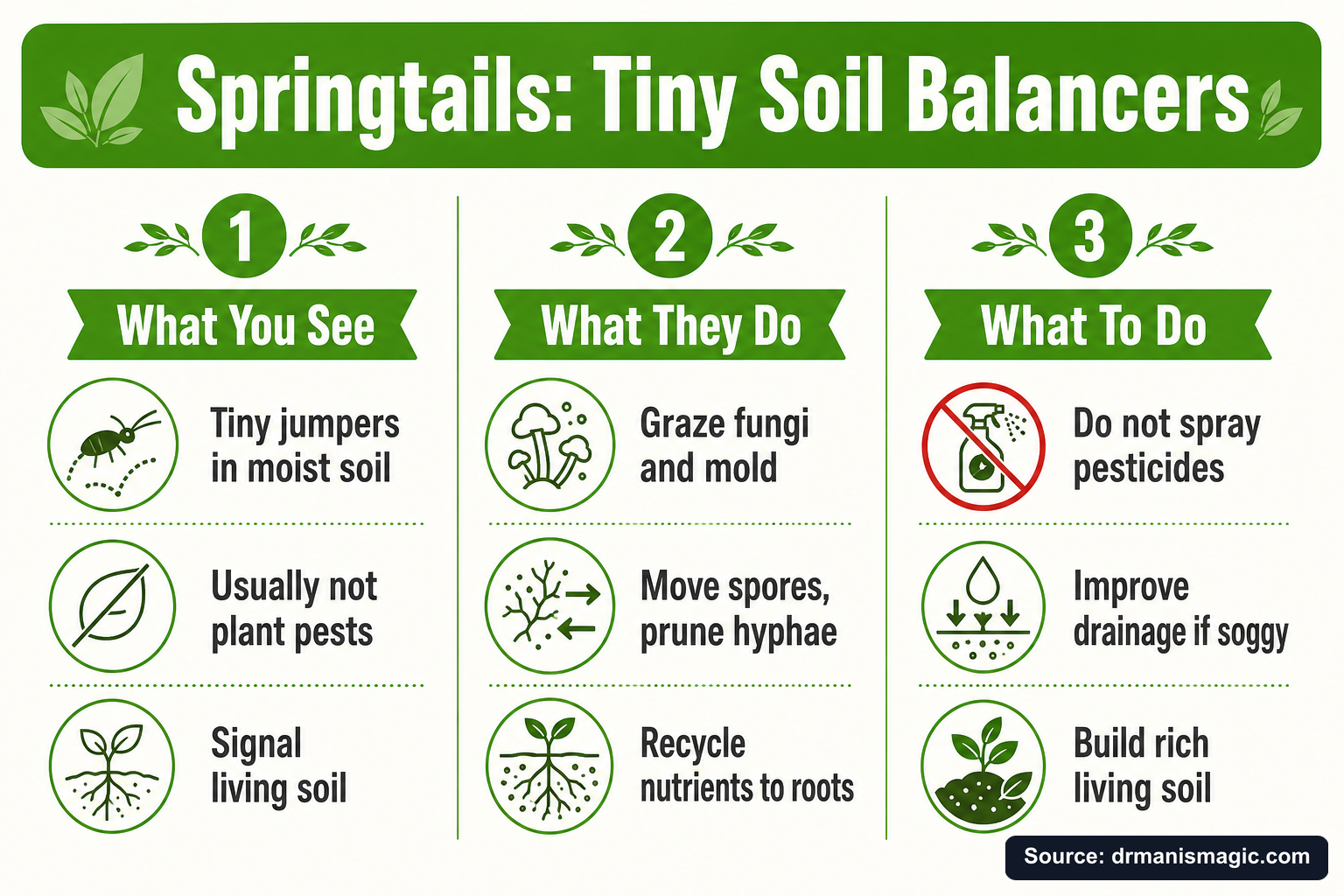
- Springtails are tiny soil arthropods that eat fungi, bacteria, mold, and decaying matter — they are almost always beneficial or neutral.
- High springtail populations usually mean your soil has moisture, organic matter, and active microbial life — that is a good sign, not a bad one.
- Springtails help regulate fungal communities by grazing hyphae, moving spores, and cycling nutrients back to plant roots.
- Their relationship with mycorrhizal fungi is nuanced — light grazing can stimulate healthy fungal growth, but heavy grazing in depleted soil can reduce mycorrhizal benefit.
- Springtails are part of the soil food web, connecting fungi and bacteria below to mites, beetles, and spiders above.
- Pesticides used to kill springtails typically cause far more damage to beneficial soil biology than the springtails themselves ever would.
- Restoring a living soil — with genuine live microbes, mineral-based structure, and organic nutrition — creates the conditions where the whole food web, including springtails, keeps itself in balance.
What Are Springtails and Why Are They in Your Soil?
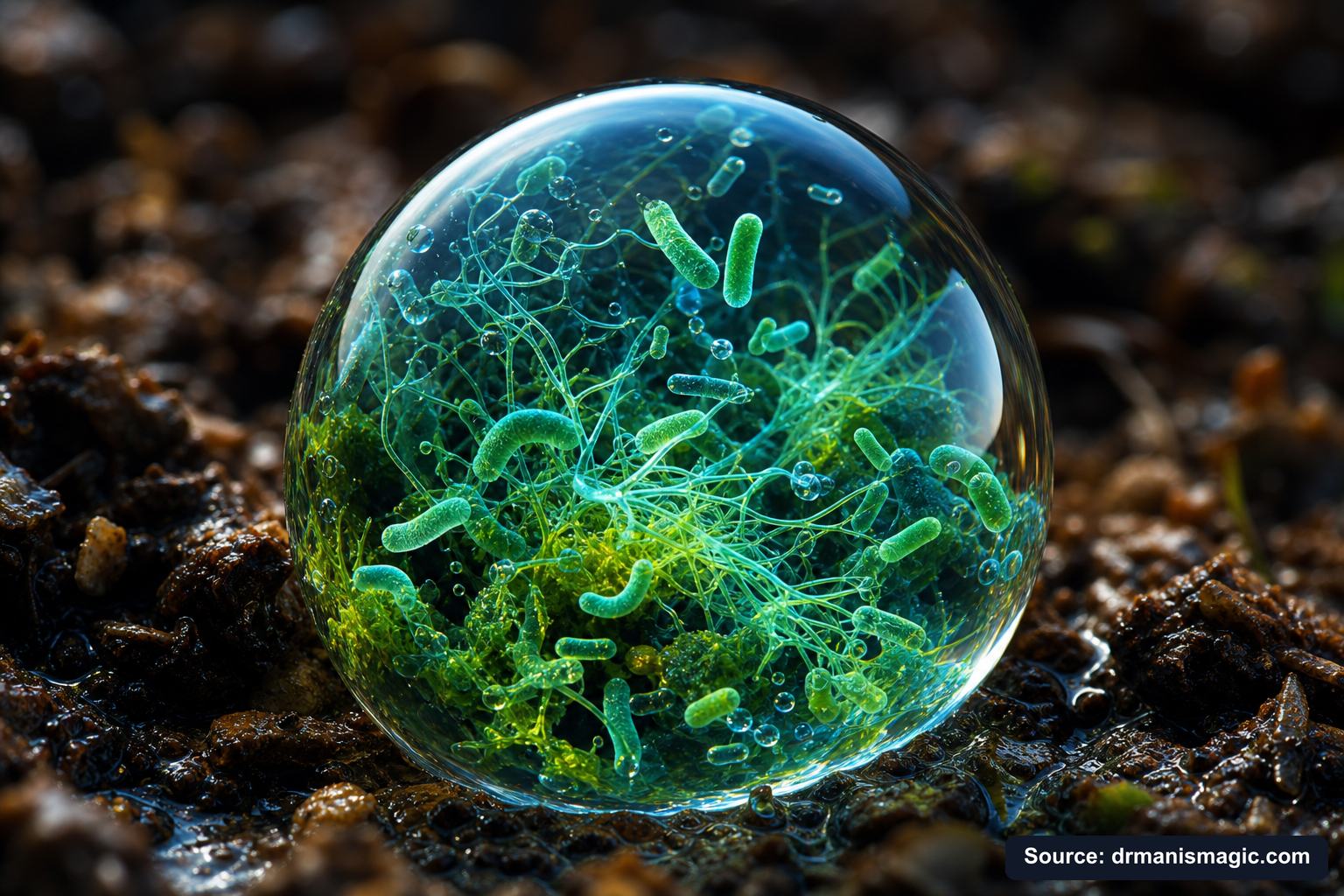
Quick Answer: Springtails are tiny six-legged arthropods in the group Collembola that live in moist soil, compost, and mulch. They eat fungi, bacteria, algae, mold spores, and decaying organic matter. They are almost never harmful to plants and are almost always a sign of biological activity in your soil.
Springtails belong to an ancient group called Collembola. Scientists believe they have been living in soil for over 400 million years. They are not insects — they are a separate class of arthropod — but they look similar. Most are white, gray, or dark brown. Most are smaller than a sesame seed. And they get their name from a forked tail-like structure called a furcula that snaps against the ground and launches them into the air when disturbed.
That little jump is the giveaway. If you see tiny organisms leaping when you disturb your soil, you are almost certainly looking at springtails. Fungus gnat larvae, root aphids, and mites do not jump. Springtails do.
They are drawn to two things above everything else: moisture and microbial food. Wet soil full of fungal threads and decomposing organic matter is paradise to a springtail. That is why you find them most often in overwatered pots, rich compost, freshly mulched garden beds, and the moist top layer of a healthy lawn.
According to the University of California Integrated Pest Management Program, springtails are classified as nuisance pests only when they migrate indoors during wet weather — not because they damage plants. Outdoors and in garden soil, they are considered beneficial decomposers. That distinction matters enormously when you are deciding whether to spray or leave them alone.
What Do Springtails Actually Eat? Understanding Their Diet in the Soil Food Web
Quick Answer: Springtails eat fungi, bacteria, algae, mold spores, pollen, and decaying plant material. They do not eat living roots or healthy plant tissue. Their feeding activity recycles nutrients, prunes fungal growth, and stimulates microbial turnover — all of which benefit your plants.
This is the part most people get wrong. Springtails are not herbivores. They are microbivores and decomposers. That means they eat microbes and dead organic matter, not your living roots.
Think of them as tiny pruning crews working inside your soil. When fungal threads — called hyphae — grow too thick or too dense in one area, springtails graze them back. That grazing stimulates the fungus to push new growth in other directions, just the way pruning a hedge makes it fill in thicker. The result is a more distributed, more resilient fungal network.
Their diet includes:
- Saprophytic fungi (fungi that decompose dead organic matter)
- Bacteria colonies in the soil
- Algae on moist soil surfaces
- Mold spores, including some pathogenic mold spores
- Pollen and decaying plant material
- Yeasts and actinomycetes (bacteria that look like fungi)
Here is something important: springtails do not selectively eat only harmful fungi. They eat what is available and what tastes good to them. Some fungi are more palatable than others. Saprophytic fungi that break down dead matter are often preferred. Pathogenic fungi that attack living roots may be avoided. Mycorrhizal fungi — the beneficial fungi that partner with your plant roots — can be grazed too, but usually only when other food sources run low.
That is the nuance most articles miss entirely. And it changes how you think about the whole system.
How Do Springtails Regulate Fungal Balance in Living Soil?
Quick Answer: Springtails regulate fungal balance through grazing, spore dispersal, and nutrient recycling. Moderate grazing prunes fungal hyphae and stimulates microbial turnover. They also carry spores on their bodies, spreading beneficial fungi to new areas. The result is a more diverse, resilient fungal community in your soil.
Imagine your soil as a city. Fungal threads are the roads. Bacteria are the shops along those roads. Springtails are the maintenance crews who keep traffic flowing — clearing overgrowth, spreading materials to new neighborhoods, and making sure no single part of the city gets too congested.
The role of springtails in fungal balance works through three main mechanisms.
Mechanism 1: Grazing and Hyphal Pruning
When springtails graze fungal hyphae, they do not destroy the fungal network. They trim it. This pruning effect can actually stimulate fungal growth in adjacent areas, increase the surface area of the fungal network, and shift which fungal species dominate. In soils with good organic matter, this creates a more diverse and balanced fungal community — one where no single species takes over completely.
Mechanism 2: Spore Dispersal
Springtails carry fungal spores on their bodies as they move through the soil. When they travel from one area to another, they plant those spores in new locations. This is how beneficial fungi spread through your soil without any help from you. It is a natural seeding system that has been running for hundreds of millions of years.
Mechanism 3: Nutrient Recycling
When springtails eat fungi and bacteria, they digest the nutrients locked inside those organisms and release them back into the soil in simpler forms that plant roots can absorb. This is called the microbial loop, and it is one of the most important nutrient delivery systems in any healthy soil. Without it, nutrients get locked up inside dead microbial bodies and never reach your roots.
Research from North Carolina State University's Department of Entomology notes that Collembola play a critical role in the detrital food web by fragmenting organic matter and stimulating microbial activity — processes that directly influence how quickly nutrients become available to plants.
Do Springtails Eat Mycorrhizal Fungi? The Nuanced Answer
Quick Answer: Springtails can graze mycorrhizal fungi, but whether this helps or hurts your plant depends on the situation. Light grazing in soil rich with organic matter often stimulates mycorrhizal growth. Heavy grazing in depleted soil can reduce mycorrhizal benefit. The key is building soil that supports the whole food web, not eliminating springtails.
This is the most important question living-soil growers ask. And it deserves a real answer, not a simple yes or no.
Mycorrhizal fungi are the crown jewel of plant root partnerships. These fungi extend your root system by ten to a hundred times, deliver water and phosphorus directly to roots, and build disease resistance. They are Pillar 2 of the Three Plant Pillars — the microbial muscle that makes everything else work.
Here is what the research actually shows about springtails and mycorrhizae:
| Soil Condition | Springtail Population | Effect on Mycorrhizae | Net Result for Plant |
|---|---|---|---|
| Rich in organic matter, diverse fungi | Moderate | Light grazing stimulates hyphal regrowth | Positive — more mycorrhizal spread |
| Moderate organic matter, balanced food web | Low to moderate | Minimal grazing, mostly saprophytic fungi eaten | Neutral to positive |
| Low organic matter, few fungal species | High | Heavy grazing on mycorrhizal hyphae | Negative — reduced mycorrhizal benefit |
| Sterile, salt-damaged, or chemically treated | Very low or absent | No grazing, but also no functioning mycorrhizae | Poor — biology is missing entirely |
The pattern is clear. The problem is never the springtails. The problem is the condition of the soil they live in. When soil is alive and diverse, springtails are a net positive. When soil is depleted and starved of organic matter, any grazing pressure — even moderate — becomes a problem because there is not enough fungal resilience to recover.
The solution is not to eliminate springtails. The solution is to build soil so rich in microbial life that the whole food web functions in balance. That is exactly what the Three Plant Pillars are designed to do.
What Does the Soil Food Web Look Like and Where Do Springtails Fit?
Quick Answer: The soil food web is a layered system of organisms that feed on each other and cycle nutrients back to plant roots. Springtails sit in the middle — eating fungi and bacteria, being eaten by mites and predatory beetles, and connecting the microbial layer to the larger predator layer. Remove them and the whole cycle slows down.
Most people think of soil as dirt. Dead stuff. Something to hold a plant up while you pour water on it.
It is not. A single teaspoon of healthy soil contains more living organisms than there are people on Earth. Billions of bacteria. Miles of fungal threads. Thousands of protozoa. Hundreds of nematodes. And yes — springtails, mites, and other tiny arthropods that most gardeners never think about.
Here is how the food web layers connect:
| Layer | Key Organisms | What They Eat | What They Deliver to Plants |
|---|---|---|---|
| Plant roots (base) | Your citrus, garden, houseplant, lawn | Water, nutrients, sunlight | Sugars fed to soil microbes through roots |
| Primary decomposers | Bacteria, saprophytic fungi | Dead organic matter, plant sugars | Nutrient cycling, disease suppression, soil structure |
| Fungal partners | Mycorrhizal fungi (AMF, ectomycorrhizae) | Plant sugars | Phosphorus, water, pathogen protection |
| Microbial grazers | Protozoa, bacterial-feeding nematodes | Bacteria | Nitrogen released near roots when they excrete |
| Fungal grazers | Springtails, some mites | Fungi, bacteria, mold, algae | Nutrient recycling, spore dispersal, fungal pruning |
| Predators | Predatory mites, spiders, centipedes, beetles | Springtails, other mites, nematodes | Population regulation, nutrient release |
Springtails sit right in the middle of this web. They are consumers of the microbial layer and food for the predator layer. Pull them out — or kill them with pesticides — and you break connections above and below simultaneously. The nutrient recycling slows. The predator population crashes. The fungal communities go unregulated. And your plant feels all of it in ways you may not see until months later.
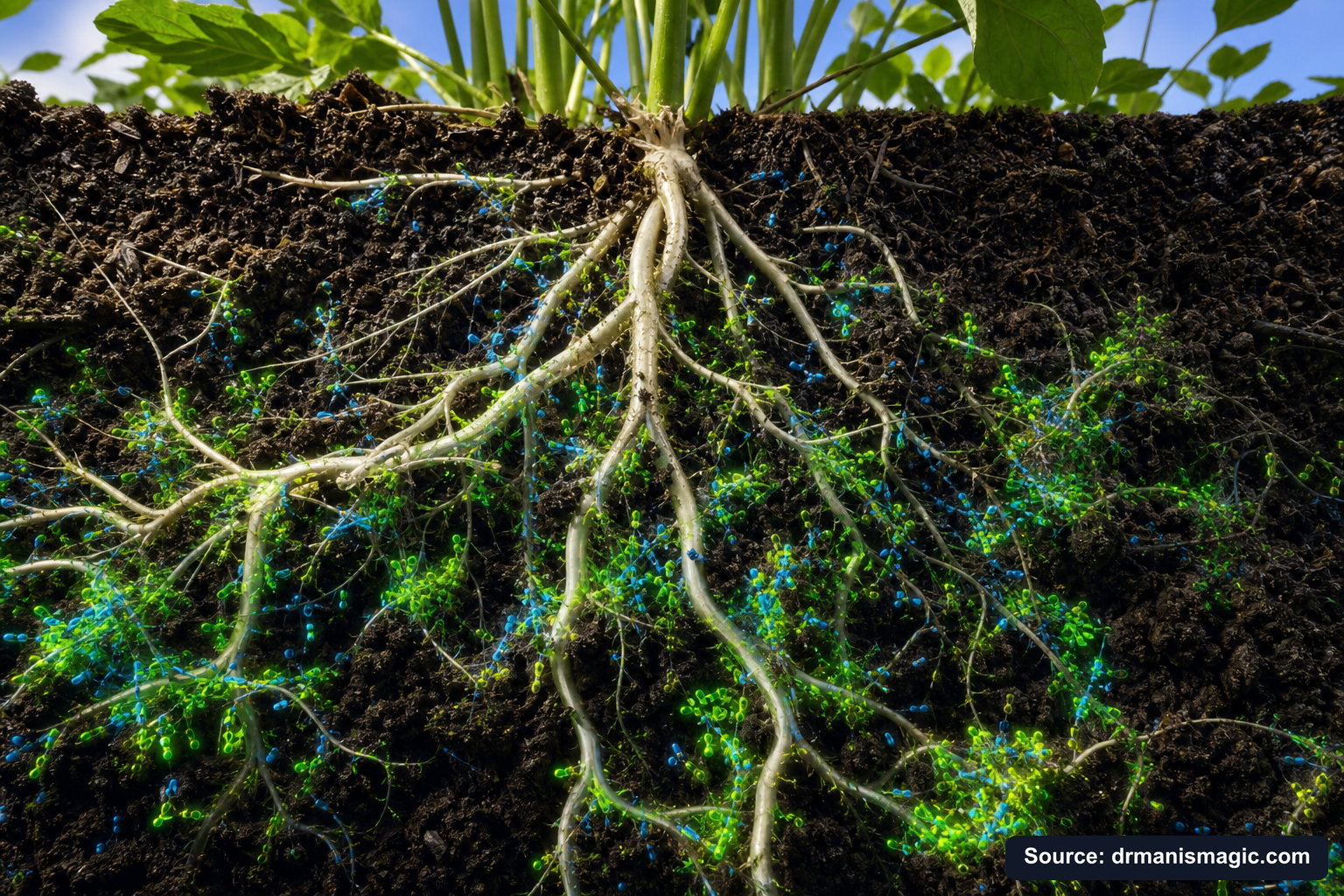
This is why we say the soil is a living system, not just a growing medium. Damage one part and the ripple moves through every other part.
You Never Had a Brown Thumb.
You were handed the wrong tools. This free guide hands you the right ones.
You watered it. You fed it. It died anyway.
It was never you. It was the dirt, the salt food, and the bad advice.
This guide shows you what really went wrong, and how to fix it for good.
- Why your plants really died, and why it was never your fault
- The salt hiding in your plant food that quietly burns the roots
- The hidden killer in almost every bag of store soil
- The tiny helpers that grow a whole forest for free
- The rescue trick that brings a half dead plant back to life

Springtails vs. Fungus Gnats vs. Root Aphids: How to Tell the Difference
Quick Answer: Springtails jump when disturbed and do not damage roots. Fungus gnat larvae are white worm-like larvae with black heads that live near the soil surface and can damage fine roots. Root aphids are pear-shaped, slow-moving, and cluster on roots. Springtails are harmless. The others may need attention.
This is the identification question that brings most people to this article. You found something tiny in your soil and you need to know whether to panic or relax.
Here is the quick field guide:
- Springtails: Tiny, white, gray, or dark. Jump instantly when disturbed. No visible legs from a distance. Found in moist topsoil and compost. Do not damage plant tissue. Harmless.
- Fungus gnat larvae: White, worm-like, with a shiny black head. Do not jump. Live in the top inch of soil. Can damage fine feeder roots and seedlings in large numbers. Indicate overwatering.
- Root aphids: Pear-shaped, white or yellowish, slow-moving. Found clustered on roots when you unpot the plant. Cause yellowing, wilting, and stunted growth. Need attention.
- Mites: Eight-legged, very slow, often reddish or brown. May cluster near the soil surface or on leaves. Some are predatory and beneficial. Others can damage plant tissue.
The single most reliable test for springtails: poke the soil gently. If the organisms jump, they are springtails. Everything else stays put or moves slowly.
And if the answer is springtails? Put down the pesticide bottle. Read on.
When Are High Springtail Populations a Warning Sign?
Quick Answer: High springtail numbers in containers usually mean the soil is too wet, has excess decaying organic matter, or has active fungal growth near the surface. They are not causing those problems — they are responding to them. Reduce moisture, improve drainage, and the population will self-regulate.
Springtails do not create problems. They reveal them. This is a critical distinction.
When you see a large springtail population — especially in a houseplant pot or citrus container — ask yourself these questions:
- Is the soil staying wet for more than a week between waterings?
- Is there visible mold or white fuzzy growth on the soil surface?
- Does the potting mix smell sour or musty?
- Are you using a bark-heavy potting mix that is breaking down and compacting?
- Is there decaying organic matter sitting on top of the soil?
If you answered yes to any of those, the springtails are simply feeding on what is available. Fix the moisture and drainage problem and their numbers will naturally decline. This is exactly why Pillar 1 of the Three Plant Pillars matters so much — mineral-based soil that drains well and never compacts eliminates the soggy, decaying conditions that cause springtail explosions in the first place. Our Super Soil is built around Rio Grande Valley sandy loam that drains freely and never breaks down into the sludge that conventional potting mixes become.
The worst thing you can do is spray a pesticide. Here is why. Broad-spectrum pesticides kill springtails, yes. They also kill the bacteria, fungi, protozoa, and beneficial nematodes that those springtails were feeding on. You have just wiped out the entire microbial layer of your soil food web to eliminate an organism that was not hurting your plant. The root zone becomes biologically sterile. Pathogenic fungi and bacteria — the ones that cause root rot and disease — face no competition and explode in population. Your plant gets worse, not better.
See also: The Hidden Reason Synthetic Fertilizers Cause Root Rot
How Do Salt-Based Fertilizers and Fungicides Destroy the Soil Biology Springtails Depend On?
Quick Answer: Salt-based fertilizers kill beneficial bacteria and fungi in the root zone by drawing water out of microbial cells through osmotic shock. Synthetic fungicides kill both pathogenic and beneficial fungi indiscriminately. Both inputs collapse the microbial food source that springtails and the rest of the soil food web depend on — leaving soil biologically dead and unable to regulate itself.
Here is the ugly truth that the big chemical companies have never wanted you to know.
When you pour a salt-based synthetic fertilizer on your soil, you are not just feeding your plant. You are creating a salt environment that draws water out of every living microbial cell in the root zone. Bacteria shrivel. Fungal hyphae collapse. Protozoa die. The microbes that feed springtails — and that protect your roots — are gone.
No microbial food source means no springtails. No springtails means no fungal regulation. No fungal regulation means saprophytic and pathogenic fungi can grow unchecked. And without the microbial competition that normally suppresses pathogens, root rot fungi find open territory.
Synthetic fungicides make this worse. They are designed to kill fungi — but they cannot distinguish between the Fusarium causing root rot and the mycorrhizal fungi keeping your roots healthy. They kill both. Then the pathogenic fungi, which recover faster than beneficial fungi in a disturbed environment, come back first and stronger.
This is the cycle that keeps so many gardeners buying more products and getting worse results every season. It is not your fault. The system was designed to sell inputs, not to build living soil.
After growing over 250,000 trees at our South Texas nursery, we learned that the real answer is never more chemistry. It is more biology. Restore the microbial community. Feed it with organic nutrition that does not burn. Give it mineral-based soil that breathes. And let the food web — springtails and all — regulate itself the way nature designed it to.
Why Do Dead or Dried Microbial Products Fail to Restore Soil Food Web Biology?
Quick Answer: Most commercial microbial products use dried or powdered organisms that have very low viability by the time you use them. Others are liquid products that have gone anaerobic and smell foul — meaning the microbes are dying. Neither type can rebuild a genuine soil food web. You need genuinely live, full-spectrum microbes to restart the biology that springtails and your roots depend on.
You have probably seen the microbial products at the garden center. Powder in a jar. Liquid in a bottle that smells like something went wrong inside it. Maybe you have tried them and seen underwhelming results. There is a reason for that.
Most of those products fall into one of three categories, and none of them work the way living soil biology works.
The first category is dried or powdered lab-grown microbes. These are manufactured in large factory vats, dried into powder, and sold under dozens of brand names. The hope is that the dormant spores will reactivate when you add water. After testing dozens of these products on our trees at US Citrus Nursery, we found they simply do not deliver results. The reactivation rate is too low. The species diversity is too narrow.
The second category is liquid compost-tea-style products that go anaerobic in the bottle. You can smell them the moment you open the cap — a sour, sewage-like odor that tells you the microbes have died and the product has fermented. Some residual benefit exists from humic and fulvic acids, but the living biology is gone.
The third category is lactobacillus-based products. Lactobacillus is vigorous and stays alive, but it is not a soil organism. It belongs in your yogurt. In soil, it outcompetes the beneficial bacteria your plants actually need.
What genuinely works is what we built the Dr. Mani's Magic line around: Plant Super Boost, a living microbial formula harvested from active compost and stabilized through an all-natural proprietary process that keeps the organisms alive without going anaerobic. It contains over 2,000 species of bacteria, 400 to 500 species of fungi including mycorrhizae, plus protozoa and nematodes — the full cast of characters that make up a functioning soil food web. It smells earthy because it is not rotting. And you can literally see the microbes moving under a microscope.
That is the difference between a product that restores soil biology and one that just looks like it might.
How Can You Rebuild Soil Biology After Chemical Damage or Sterile Conditions?
Quick Answer: Rebuilding damaged soil biology requires removing stressors first, then reintroducing organic matter, live microbes, and proper structure. It takes consistent monthly applications of live microbials, organic nutrition, and well-draining mineral soil to restore a functioning food web. There are no shortcuts, but the results compound over time.
If your soil has been through rounds of synthetic fertilizer, fungicide, or pesticide, it is not dead forever. But it is going to take more than one application of anything to bring it back.
Here is a practical recovery protocol based on what we have used at US Citrus Nursery to restore biologically depleted growing media:
- Stop adding salt-based fertilizers and synthetic fungicides immediately. You cannot build biology while continuing to destroy it. The stressors have to stop first.
- Improve drainage and aeration. If you are using a bark-heavy potting mix that has compacted, transition to a mineral-based soil that does not decompose and holds air in the root zone. Roots need oxygen. Compressed, soggy soil is a pathogen playground.
- Add genuine live microbials monthly. Use a full-spectrum living product that has not dried out or gone anaerobic. Apply consistently — not just once. Damaged soils need repeated inoculation because the environment has been altered and biology needs time to establish and multiply.
- Feed the microbes with organic nutrition. Live bacteria and fungi need organic matter to eat. A slow-release organic fertilizer made from ingredients like crab meal, kelp, and amino acids feeds both your plant and the microbial community simultaneously, without the salt that kills the biology you are trying to restore.
- Be patient and consistent. You cannot recover in a week what was damaged over months or years. But within one growing season of consistent application, most growers see measurable improvement — greener leaves, stronger root systems, and soil that smells earthy and alive instead of sour or sterile.
The springtails will come back on their own when the soil is ready for them. You do not need to add them. Restore the fungal and bacterial communities they feed on, and they will find their way in through drainage holes, open soil surfaces, and the air itself. They have been doing it for 400 million years.
See also: Why Most Fertilizers Are Actually Salt in Disguise

What Practical Steps Can You Take Right Now for Better Fungal Balance in Your Soil?
Quick Answer: Start by fixing drainage and stopping salt-based inputs. Then add genuine live microbials monthly and switch to an organic slow-release fertilizer. This combination restores the bacterial and fungal communities that regulate themselves — and that springtails, your roots, and the entire soil food web depend on.
You do not need to become a soil scientist. You do not need to buy twenty different products or memorize a complicated schedule. The Three Plant Pillars give you the foundation in the simplest possible form:
- Mineral-based soil that drains freely and never compacts or robs your roots of oxygen.
- Live microbials applied monthly to keep the invisible workforce stocked and working.
- Organic slow-release fertilizer that feeds your plant and its microbial partners without salt damage.
When all three are in place, something remarkable happens. The soil starts to regulate itself. Beneficial fungi spread. Bacteria cycle nutrients. Protozoa and nematodes keep bacterial populations balanced. Springtails prune fungal overgrowth and spread spores to new areas. Predatory mites keep the springtail population from getting out of hand. And your plant sits at the center of all of it, absorbing nutrients that the whole web delivered to its roots — without you having to do anything except water consistently.
That is what healthy soil actually looks and feels like. Dark, earthy-smelling, loose, and teeming with invisible life. Not the gray, compacted, sterile stuff that comes in a bag from a big box store.
Dr. Mani spent 40 years as a professor of plant pathology at the Texas A&M Citrus Center learning what living soil actually does for a plant. The answer he found was always the same: when the biology is right, the plant takes care of itself in ways no chemical input can replicate. That is the foundation of everything we make at Dr. Mani's Magic.
One more thing worth saying plainly: you cannot get time back. Every season you spend fighting your soil instead of working with it is a season you do not get to enjoy the harvest. We hear it constantly from growers — they want to see their trees produce fruit while they still can. The path to that is not another bottle of synthetic fertilizer or another round of pesticide. It is a living soil, built once, maintained simply, and allowed to do what it has been doing for hundreds of millions of years.
If you want to explore the full Three Plant Pillars system and see the products we developed and tested on over 250,000 trees, you can find everything at the Three Plant Pillars bundle builder — or grab the Free Plant Care Field Guide to start with the basics. No guesswork. No jargon. Just the system that works — proven in the field, safe for your family, and made right here in the USA.
Frequently Asked Questions
When you spot tiny jumping specks in your soil, your first reaction is panic. That is completely normal. But before you reach for a spray bottle, you need the truth about what springtails actually do and why killing them could be the worst thing you do to your plants. These questions come up constantly, and we are answering them straight from 30 years of growing over 250,000 trees in South Texas.
What do springtails actually do in your soil?
Springtails eat fungi, mold, bacteria, and decaying organic matter. Think of them as a tiny cleanup crew working around the clock for free. As they feed and move through the soil, they break down waste and push nutrients back toward your roots. They also create tiny tunnels that let air and water move more freely. Healthy soil has springtails. Depleted, dead soil usually does not.
Are springtails good or bad for my plants?
Almost always good. Springtails signal that your soil is alive with moisture and microbial activity. They graze on harmful mold and fungal overgrowth before it becomes a real problem. They rarely touch healthy plant roots or green tissue. The only time they become a minor nuisance is when soil is so overwatered and depleted that they have nothing else to eat. Fix the soil, and the problem fixes itself.
Can springtails hurt my mycorrhizal fungi?
This is the nuanced part. Light grazing by springtails on fungal threads can actually stimulate healthier fungal regrowth, similar to how light pruning encourages a plant to push out stronger new growth. But in soil that is already weak and stripped of biology, heavy springtail populations can reduce the mycorrhizal benefit your roots receive. The answer is not to kill the springtails. The answer is to build a stronger living soil so the whole system stays in balance.
Why do springtails keep coming back no matter what I do?
Because you are fighting the symptom instead of the cause. Springtails thrive wherever there is moisture and organic material to eat. If your potting mix is made from decomposing pine bark and sawdust, it holds water and breaks down into exactly the food source springtails love. Switching to a mineral-based soil that drains properly and does not decompose removes the conditions that cause springtail explosions in the first place. That is the real fix.
Should I use pesticides to get rid of springtails?
No. This is one of the most damaging mistakes a gardener can make. Pesticides used to kill springtails wipe out the beneficial bacteria, fungi, and mycorrhizae living in your soil at the same time. You end up with dead soil that cannot support your plant long term. We have seen this pattern play out across thousands of trees. Killing the visible symptom while destroying the invisible foundation leaves your plant more vulnerable, not less.
What is the scientific classification of springtails?
Springtails belong to a group called Collembola. They are not true insects even though they have six legs. True insects have external mouthparts. Springtails have mouthparts tucked inside their heads, which puts them in a separate class called Entognatha. They have been living in soil for over 400 million years. They are ancient, they are everywhere, and they are part of the soil food web that keeps your plants alive.
What real problems do springtails cause?
Outdoors and in garden beds, springtails cause almost no real plant damage. Indoors, large populations can migrate through windows and become a nuisance in living spaces during wet weather. In severely overwatered pots with weak, depleted soil, they can nibble tender seedling tissue when their preferred food runs out. The root cause in every case is the same: poor soil structure and excess moisture. Solve those two things and springtail problems become a non-issue.
About the Author
Dr. Mani Skaria, PhD
Dr. Mani Skaria, PhD, is a plant pathologist and the scientific founder of Dr. Mani's Magic. He earned his doctorate at Purdue University and spent 48 years studying how plants, soil, and living microbes work together, including his years as Professor Emeritus at Texas A&M and as a member of the USDA NAREEE Advisory Board. He invented micro-budding, a method for growing healthier, stronger trees, and has grown more than 250,000 trees on the family farm in Hargill, Texas - US Citrus Nursery. His life's work takes real lab science and practical experience and turns it into simple, safe, organic plant care anyone can use at home.


