


The Soil Food Web Explained Without Jargon | Dr. Mani's Magic
The Soil Food Web Explained Without Jargon: What's Really Happening Under Your Feet
Picture this. You've just fertilized your lawn. The bag promised lush, thick green grass. You followed the directions. You watered it in. And two weeks later, half the grass looks burnt. Your neighbor's tree looks the same way it did last spring, even though you've been feeding it all season. You stand there staring, hands on your hips, wondering what went wrong.
Here's what nobody told you. The answer isn't on the surface. It's underground. Right now, beneath every square inch of healthy soil, there's a hidden world that has been running quietly for billions of years. It's a living, breathing system of creatures so small you can't see most of them. They eat, hunt, die, and release nutrients. They build tunnels. They protect roots. They feed your plants better than any bag of fertilizer ever could. And most of us have been accidentally killing them for decades.
This is the soil food web. And once you understand it, everything you thought you knew about feeding plants will change. We've grown over 250,000 trees at our South Texas nursery. We've watched this system succeed when we work with it, and we've watched plants fail when we fight against it. What follows is the plain-English version of what nobody in the fertilizer aisle is telling you.

Organic Fertilizer | Crab, Kelp & Amino Acids
Key Takeaways
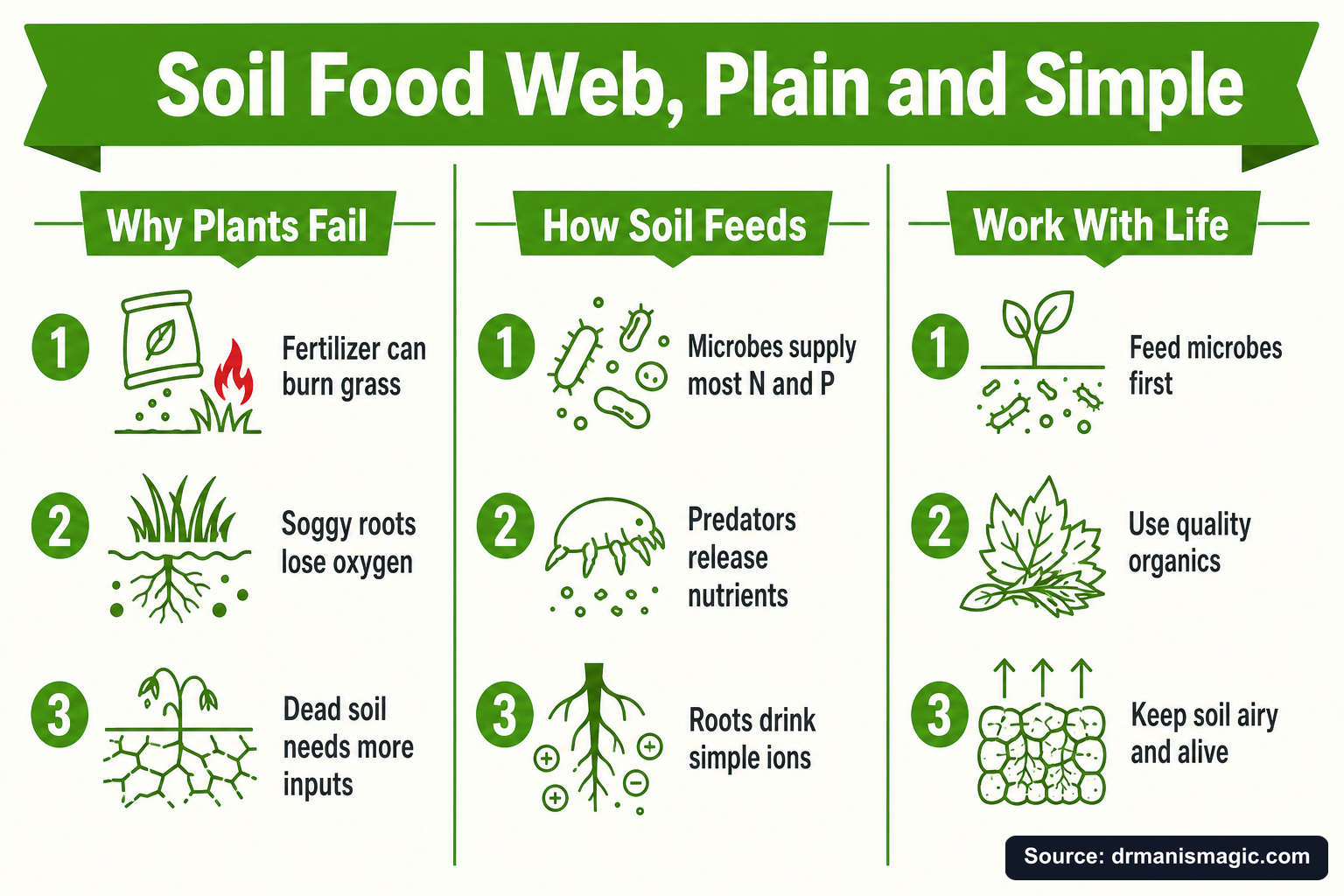
- The soil food web is an underground chain of living creatures that recycles dead matter into food your plant roots can actually drink in.
- Microbes, not fertilizer bags, supply most of the nitrogen and phosphorus your plants need. University of Minnesota Extension research shows soil biological processes supply about 75% of plant-available nitrogen and 65% of available phosphorus.
- Salt-based synthetic fertilizers kill the very microbes that feed your plants, creating a cycle of dependence that benefits fertilizer companies, not your garden.
- Overwatering is not just too much water. It is too little air in the root zone. Roots breathe oxygen. When soil pores fill with water, roots suffocate and root-rot organisms like Phytophthora move in.
- Organic fertilizers like those made from crab, kelp, and amino acids feed the microbes first. The microbes then feed your plant in a slow, steady, natural way that mirrors how it works in the wild.
- Some organic amendments including biosolids and poorly sourced compost can carry PFAS "forever chemicals." Source quality matters as much as organic labeling.
- The Three Plant Pillars, mineral-based soil, live microbes, and organic fertilizer, give any plant the foundation it needs to thrive without guesswork.
What Is the Soil Food Web in Simple Terms?
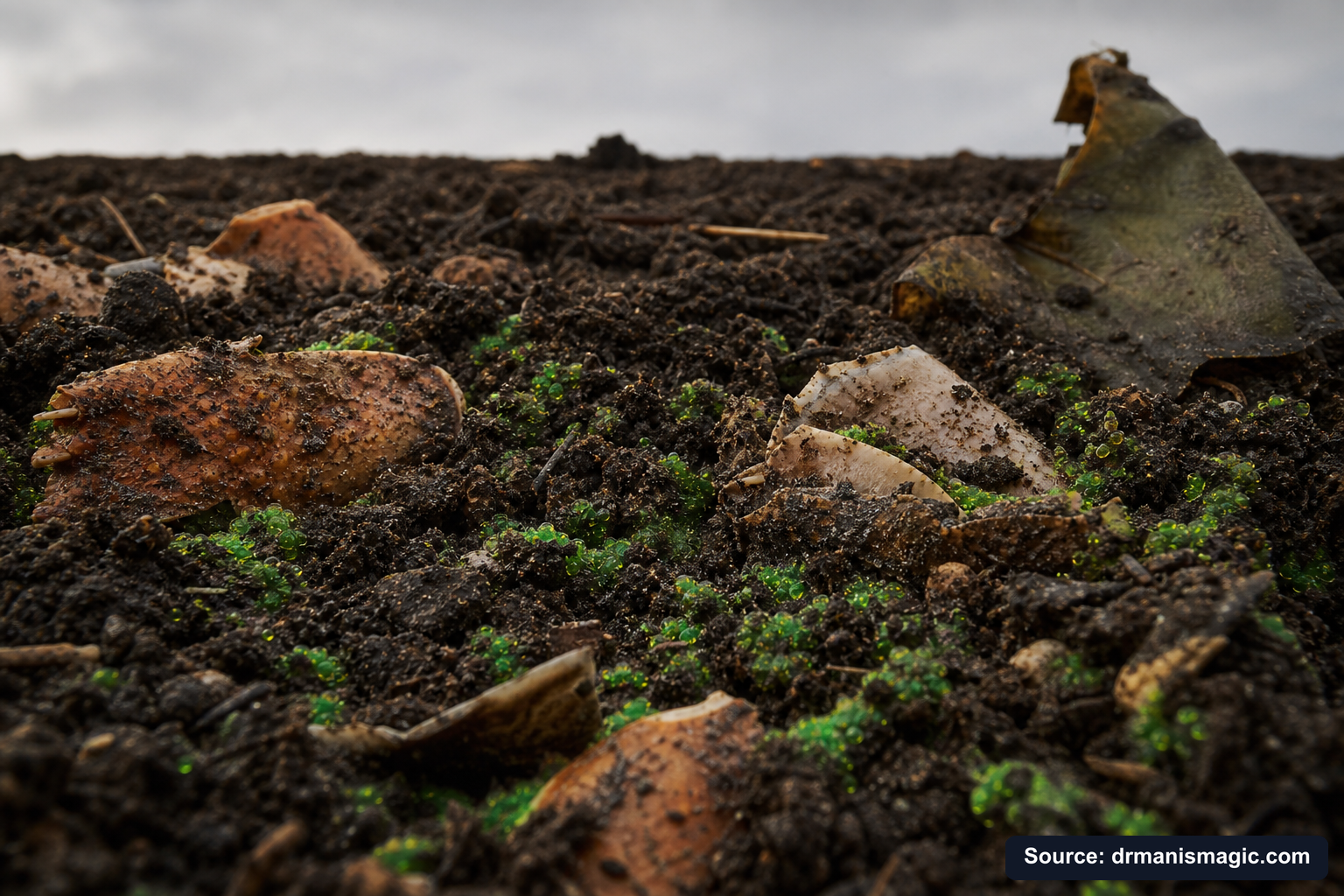
Quick Answer: The soil food web is the underground chain of eat-and-be-eaten life that turns dead leaves, old roots, and minerals into plant food. Bacteria eat organic matter. Tiny predators eat bacteria. When they die, they release nutrients right next to plant roots. Plants eat those nutrients. The cycle repeats.
Think of it like a neighborhood grocery store, kitchen, and cleanup crew all working together underground.
Your plant roots are the restaurants. They actually leak sugars out of their tips on purpose. That sounds wasteful. But it's brilliant. Those sugar leaks attract hungry bacteria and fungi like a neon sign. The microbes come running. They eat the sugars and the dead organic matter all around them. Then predators show up. Tiny creatures called protozoa and nematodes eat the bacteria. When those predators die and break down, all the nutrients locked inside them spill out right next to the roots. The plant soaks them up. And the whole beautiful cycle starts again.
According to University of Minnesota Extension, soil biological processes supply roughly 75% of the nitrogen and 65% of the phosphorus available to plants. That means the ground is doing most of the feeding. You just have to stop getting in its way.
The players in this web include:
- Bacteria: The smallest and most numerous. They break down almost everything and release nutrients as they go.
- Fungi: Long, thread-like structures that act like underground delivery routes. They reach far beyond what roots can touch and bring water and minerals back.
- Protozoa: Single-celled hunters that eat bacteria and release nitrogen when they do.
- Nematodes: Microscopic roundworms. Some eat bacteria. Some eat fungi. Some eat each other. All of them release nutrients when they die.
- Earthworms: The tunnel builders. They break up compacted soil, pull organic matter down into deeper layers, and leave behind nutrient-rich castings.
- Arthropods: Tiny insects and mites that shred bigger pieces of organic matter into smaller ones so bacteria can finish the job.
Every single one of these creatures has a job. Remove them and the system breaks down. The soil goes silent. And your plants start to struggle no matter how much you fertilize.
See also: Why Most Fertilizers Are Actually Salt in Disguise
How Does the Soil Food Web Actually Feed Your Plants?
Quick Answer: Microbes eat dead organic matter and each other. Every time they eat and die, nutrients locked inside their bodies get released as simple compounds near plant roots. Plants absorb those compounds through root hairs. It's a slow, steady, natural delivery system that runs on its own when the soil is healthy.
Here is the part most fertilizer companies never explain. Plants cannot eat a leaf. They cannot eat a dead bug. They cannot eat a handful of compost right off the ground. Roots can only absorb nutrients in very simple dissolved forms, mostly ions floating in water around the root zone.
So how does a fallen leaf become plant food? The soil food web is the answer.
A leaf lands on the ground. Fungi send out threads and start breaking it apart. Bacteria swarm in and digest the smaller pieces. A protozoan eats a thousand bacteria in one afternoon. It releases a burst of nitrogen ions right next to a root hair. The root soaks it up. Done. That is the whole trick.
Now here is what makes organic fertilizer like crab, kelp, and amino acids so powerful when you understand this system. When you apply an organic fertilizer, the microbes eat it first. They use it as their food. They grow and multiply. Then, when those microbes die, they release everything they ate, all those nutrients, directly into the root zone in exactly the simple form the plant can drink in. It is a built-in time-release system. Nature invented it. We did not.
That process mirrors what university extension researchers studying soil biology describe as the living engine behind decomposition and nutrient cycling. It works for grapes. It works for lawns. It works for roses, houseplants, fruit trees, and vegetable gardens. Same system. Same rules everywhere.
Organic fertilizer feeds the microbes. The microbes feed the plant. That is the whole loop. And it keeps running long after you put the bag away.
Why Do Salt-Based Fertilizers Break the Soil Food Web?
Quick Answer: Synthetic fertilizers are salt-based. Salt pulls water out of microbes and fine root hairs through osmotic stress, essentially dehydrating and killing them. This destroys the soil food web, forces plants to depend on your next bag, and creates a cycle of decline that benefits fertilizer companies, not your plants.
This is the part that should make you angry. Not at yourself. At the system that kept this from you.
When you pour a salt-based synthetic fertilizer onto your soil, something invisible happens. Salt is what scientists call osmotically active. That means it pulls water out of anything nearby. Cells. Roots. Microbes. If a bacterium is sitting next to a high-salt fertilizer granule, water rushes out of the bacterium and it shrivels and dies. The same thing happens to the delicate root hairs that do most of the absorbing. They dry out from the inside. This is called osmotic stress. Some call it physiological drought. Your plant can be sitting in moist soil and still be dying of thirst because the salt is pulling water away from the roots.
Every microbial massacre clears the battlefield. The soil food web collapses. The nutrients that were cycling naturally stop cycling. Now the plant is completely dependent on whatever you pour out of the next bag. That is not an accident. That is a business model.
Dr. Mani Skaria spent over 40 years as a plant pathologist and Professor Emeritus at the Texas A&M Citrus Center watching this pattern repeat. Synthetic fertilizer spikes cause a brief burst of green. Then the soil gets quieter. The roots get weaker. The plant needs more fertilizer to keep up. The cycle tightens.
And it gets worse. Many synthetic slow-release fertilizers are coated with plastic shells. Those shells break down in the soil and leave microplastic residue behind. Some fertilizers and so-called organic products use biosludge, which is treated municipal waste, as filler. Biosludge can carry PFAS compounds, the "forever chemicals" that do not break down. Penn State Extension has documented PFAS concerns associated with land-applied biosolids. You could be adding forever chemicals to the soil where your kids play, your dog runs, and your vegetables grow.
Our Crab, Kelp & Amino Acids fertilizer contains zero biosludge, zero PFAS, zero synthetic salts, and zero plastic-coated prills. It was built from the ground up to work with the soil food web, not against it.
See also: The Hidden Reason Synthetic Fertilizers Cause Root Rot
What Does Overwatering Really Do to the Soil Food Web?
Quick Answer: Overwatering is not just too much water. It fills the air pockets in soil with water, removing the oxygen roots need to breathe. Oxygen-starved roots become weak and attract root-rot organisms like Phytophthora and Pythium. The soil food web also collapses when air disappears, because most beneficial soil microbes need oxygen to survive.
Roots breathe. That surprises people. We think of roots as drinkers, not breathers. But roots need oxygen just as much as they need water. Soil is not a solid block. Healthy soil is full of tiny air pockets between particles. Roots breathe the oxygen in those pockets. Microbes breathe it too.
When you water too much, too often, those pockets fill with water and stay filled. The oxygen runs out. Roots start to suffocate. And then something even worse happens. The beneficial aerobic microbes, the ones that need oxygen to live, start to die off. The soil food web weakens. And in their place, anaerobic organisms that thrive without oxygen take over. Two of the most destructive are Phytophthora and Pythium. These are the main culprits behind what gardeners call root rot.
University extension researchers studying basic soil components confirm that waterlogged soil creates exactly these conditions, oxygen stress followed by root rot pathogen activity. It applies to every plant type. Houseplants. Lawn grass. Fruit trees. Ornamentals. Vegetable gardens. The root zone does not care what is growing above it. Take away the oxygen and it starts to fail.
This is why the mineral-based soil in the Three Plant Pillars framework matters so much. Most bagged potting mixes are made from pine bark, wood chips, and other organic material that breaks down over time and compacts into a soggy, airless sludge. Water pools. Roots suffocate. Root rot follows.
Mineral-based soil made from sandy loam, like the Super Soil Dr. Mani developed from South Texas silica-rich soil, does not compact. It does not decompose. Water flows through it freely. Air stays in the pores. Roots breathe and the soil food web has the oxygen it needs to keep running.
Deep, infrequent watering is almost always better than shallow, frequent watering. Let the top inch or two dry out between waterings. Give the roots time to breathe. The soil food web will thank you.
How Do You Tell Salt Damage, Overwatering, and Root Rot Apart?
Quick Answer: Salt damage shows as brown leaf tips and edges with the damage appearing first at the leaf margins. Overwatering causes yellowing, wilting even in wet soil, and eventually root darkening. True root rot from Phytophthora or Pythium shows as dark, mushy roots with a sour smell. Check the roots before adding more fertilizer or water.
This is where most gardeners lose precious time. They see a sick plant and reach for fertilizer or a watering can, when the real problem is the opposite of what they think. Getting this diagnosis right can save a plant and save you months of frustration.
| Symptom | Salt Damage / Fertilizer Burn | Overwatering | Root Rot (Phytophthora / Pythium) |
|---|---|---|---|
| Leaf color | Brown tips and edges first; center stays green | Yellowing all over; sometimes pale green | Yellow, then brown; wilting despite wet soil |
| Wilting | Wilts even in moist soil (osmotic stress) | Wilts; soil feels wet | Severe wilting; soil may be wet or dry |
| Root appearance | Fine roots dry, brittle, brown at tips | Roots pale to brown; slightly soft | Roots dark brown or black; mushy; sour smell |
| Soil condition | May look fine; white crust on surface possible | Consistently wet; drainage poor | Wet, compacted, or poorly drained |
| When it appears | Shortly after fertilizer application | Slowly over weeks of frequent watering | Spreads quickly once established |
| First response | Flush soil with plain water; stop synthetic fertilizer | Let soil dry out; improve drainage | Remove affected roots; improve soil aeration; stop watering temporarily |
University of Maryland Extension's guidance on salt and fertilizer damage in trees echoes this same diagnostic framework. The key rule is: always check the roots before adding more of anything. Pull the plant from its pot or dig gently near the root zone. Healthy roots are white or tan and firm. Sick roots are dark and soft. What you see there tells you everything.
What Is the Difference Between Synthetic Fertilizer, Organic Fertilizer, and Soil Amendments?
Quick Answer: Synthetic fertilizers are salt-based and fast. They force nutrients into the plant but kill microbes and build up salt in the soil. Organic fertilizers feed the microbes first, which then feed the plant slowly and safely. Soil amendments like kelp, chitin from crab shells, and volcanic ash add biology and trace minerals that support the whole soil food web long-term.
Not all plant nutrition is the same. Here is a side-by-side look at the main types and what they really do.
| Input Type | What It Feeds | Speed | Main Benefit | Main Risk | Best Use Case |
|---|---|---|---|---|---|
| Synthetic fast-release fertilizer | Plant directly (bypasses soil) | Very fast | Quick green-up | Salt index damage; kills microbes; osmotic stress; root burn | Not recommended for ongoing use |
| Synthetic slow-release (coated prills) | Plant directly over time | Slow | Less burn risk than fast-release | Plastic coating residue in soil; still salt-based | Limited; still disrupts soil biology |
| Biosolids / biosludge-based "organic" | Soil and plant | Moderate | Adds nitrogen and organic matter | PFAS forever chemicals; heavy metals; pathogen risk | Avoid in edible gardens; avoid near children and pets |
| Organic fertilizer (chitin, kelp, amino acids) | Microbes first, then plant | Slow and steady | Feeds soil food web; no salt; no PFAS | Very low; minimal over-application risk | All plants, all seasons, containers and ground |
| Compost (well-sourced) | Soil biology and structure | Slow | Adds organic matter; feeds microbes | Source quality varies; some carry pathogens or PFAS | Soil top-dressing and bed building |
| Kelp / marine biostimulants | Microbes and plant hormone pathways | Moderate | Natural growth hormones (auxins, cytokinins); trace minerals | Minimal when used as directed | Bloom boosting, stress recovery, trace mineral support |
| Volcanic ash / minerals | Soil mineral bank | Very slow | Silica, trace minerals; strengthens cell walls | Very low | Long-term soil mineral building |
The key insight from that table is this. Synthetic fertilizers skip the kitchen. They try to deliver a meal directly to the plant without going through the soil food web at all. That bypasses the whole living system. It works for one season. Then the soil gets quieter, the microbes die off, and you have to keep adding more and more just to hold steady. That is the slow-drain on your time and your garden.
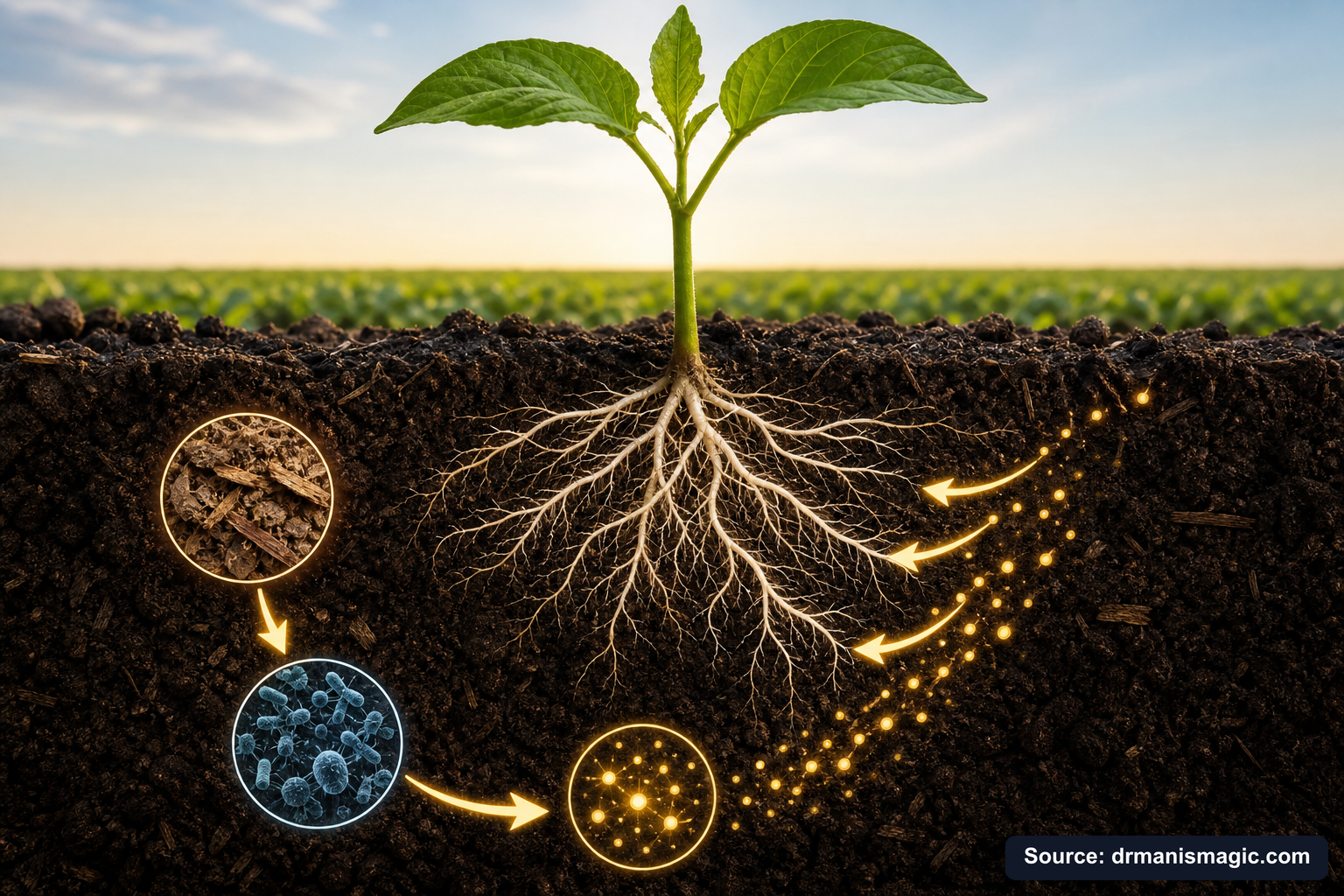
Organic inputs feed the kitchen first. The microbes prepare the meal. The plant eats at its own pace. The soil gets richer. The plant gets stronger. The cycle builds on itself instead of collapsing.
You Never Had a Brown Thumb.
You were handed the wrong tools. This free guide hands you the right ones.
You watered it. You fed it. It died anyway.
It was never you. It was the dirt, the salt food, and the bad advice.
This guide shows you what really went wrong, and how to fix it for good.
- Why your plants really died, and why it was never your fault
- The salt hiding in your plant food that quietly burns the roots
- The hidden killer in almost every bag of store soil
- The tiny helpers that grow a whole forest for free
- The rescue trick that brings a half dead plant back to life

Why Does Chitin From Crab Shells Matter for Plant Health?
Quick Answer: Chitin is a natural compound found in crab and shrimp shells. When added to soil, it feeds specific bacteria that also break down the outer shells of fungal pathogens and pest insects. This activates the plant's own natural defense system, making it more resistant to soil diseases and root-feeding insects without any synthetic chemicals.
This one surprises almost everyone. Crab shells are not just a source of calcium and nitrogen. They contain a compound called chitin. Chitin is the structural material that makes up the hard outer shells of insects and the cell walls of many harmful fungi.
Here is the interesting part. When you add chitin to soil, certain bacteria that specialize in eating chitin multiply rapidly. They feast on it. And because those same bacteria also eat the chitin in the shells of fungal pathogens and soil-dwelling pest larvae, your plant's root zone becomes a naturally hostile environment for those attackers.
At the same time, the plant itself senses chitin in the soil and reads it as a signal that something with a shell is nearby. The plant ramps up its own immune response. It produces protective compounds. It thickens cell walls. It gets ready to fight. All from a natural cue in the soil.
This is one of the reasons crab-based fertilizers do more than just feed plants. They arm them. No synthetic pesticide required. No warning labels. No re-entry intervals. No fear when your dog runs through the garden.
What Does Kelp Actually Do That Regular Fertilizer Cannot?
Quick Answer: Kelp is not just a nutrient source. It contains natural plant hormones called auxins and cytokinins that signal roots to grow and cells to divide. Cold-processed kelp also delivers trace minerals and complex carbohydrates that feed soil microbes and improve stress tolerance in ways that synthetic fertilizers simply cannot replicate.
Kelp is one of the fastest-growing organisms on the planet. A giant kelp frond can grow two feet in a single day. It does this without soil, without fertilizer, and in cold, salt water. It has figured out how to build growth signals directly into its own tissue.
Those growth signals are called auxins and cytokinins. They are natural plant hormones. When cold-processed kelp is added to soil or applied to plants, those hormones signal root cells to divide and elongate. More roots. More surface area. More nutrient and water uptake. More resilience when drought or heat stress hits.
Kelp also carries a broad spectrum of trace minerals that land-based soils often lack. It contains natural carbohydrates that feed beneficial bacteria and fungi in the root zone. And because it is cold-processed rather than heated, those live compounds stay intact and active when they reach your garden.
No salt-based synthetic fertilizer delivers any of this. It can push nitrogen and phosphorus into the plant. But it cannot send the hormonal signals that tell roots to grow deeper or tell cells to prepare for stress. Kelp does both. That is why it belongs in the same bag as the crab and the amino acids. They each do something different. Together, they cover what your plant needs from multiple directions at once.
What Are Amino Acid Fertilizers and Why Are They Better Than Synthetic Nitrogen?
Quick Answer: Amino acids are the building blocks of proteins. As a nitrogen source, they are already partially processed, which means the plant and its microbes absorb them with very little effort. Unlike synthetic nitrogen salts that stress the root zone, amino acid nitrogen supports microbes, feeds the plant gently, and leaves no salt residue behind.
Nitrogen is the nutrient plants need the most. It builds chlorophyll, the green pigment that captures sunlight. It builds amino acids and proteins. It drives every stage of growth from new leaves to fruit development.
But the form nitrogen comes in matters enormously. Synthetic nitrogen comes in the form of ammonium nitrate or urea salts. They dissolve fast. They spike the soil with high concentrations. And they carry a salt load that pulls water away from roots and microbes through osmotic stress, what some researchers call physiological drought. The plant might green up fast. But underneath, the damage is accumulating.
Amino acid nitrogen is different. It is already partially broken down into a form that microbes can use immediately with very little energy. Microbes take it in, grow, and then release their nitrogen as they die off in a gentle, steady stream right next to the roots. The plant never gets shocked. There is no salt spike. There is no sudden burn. The whole process runs at the pace nature intended.
This matters for every plant you own. Lawn grass, potted orchids, backyard lemon trees, raised bed tomatoes. Every root system responds better to a steady trickle than a sudden flood followed by a drought.
What Are the Three Plant Pillars and Why Do They Work Together?
Quick Answer: The Three Plant Pillars are the foundation Dr. Mani Skaria developed after decades of growing plants at US Citrus Nursery. Pillar One is mineral-based soil for drainage and oxygen. Pillar Two is live microbes to run the soil food web. Pillar Three is organic fertilizer to feed the microbes and the plant. Miss any one and the system weakens.
After 30-plus years growing plants in South Texas, testing thousands of inputs, and watching over 250,000 trees go from seed to harvest, Dr. Mani Skaria identified something that the fertilizer industry never wanted to say out loud. Plants do not need more products. They need the right foundation. Three things. That is all.
Think of it like building a house. You can have beautiful furniture and new appliances. But if the foundation cracks and the walls have no structure, none of it matters. The Three Plant Pillars are the foundation that makes everything else work.
Pillar One: Mineral-Based Soil. Most potting mixes are made from pine bark and wood chips. They feel light and fluffy when you open the bag. But within six to twelve months, they break down and compact into an airless, waterlogged sludge. Roots suffocate. Root rot moves in. Mineral-based soil made from sandy loam does not decompose. It stays open. Water drains freely. Roots breathe. The soil food web has the oxygen it needs to function.
Pillar Two: Live Microbes. You can have perfect soil. But without the living organisms to run the nutrient cycle, the soil is just a container. Live bacteria, fungi, and mycorrhizae are the workers that turn organic matter into plant food, build disease resistance, and connect roots to nutrients far beyond what the roots could reach alone. Adding live microbials to your soil is like turning on the engine of the soil food web.
Pillar Three: Organic Fertilizer and Biostimulants. With the right soil structure and the microbes alive and active, organic fertilizer becomes the fuel that keeps the whole system running. Slow-release, biology-friendly nutrition from sources like crab, kelp, and amino acids feeds the microbes, supports the plant, and builds long-term soil health without the salt damage, PFAS risk, or microbial destruction of synthetic alternatives.
Get all three working together and something remarkable happens. Plants stop struggling. They start thriving. Not because you forced them with chemicals, but because you gave them the conditions they evolved to live in.
Explore the Three Plant Pillars bundle to see how they work together as a complete system.
How Do You Know If Your Soil Food Web Is Broken?
Quick Answer: Signs of a broken soil food web include plants that need constant fertilizing to look healthy, leaves that yellow despite regular feeding, roots that smell sour or look dark and mushy, soil that stays wet and compacted, and a history of synthetic fertilizer use. If your plants never seem to get better no matter what you add, the underground system may be the problem.
You cannot see the soil food web. But you can read the signals it sends up through your plants. Here is what a struggling underground system looks like from the surface.
- Leaves that yellow despite regular fertilizing
- Plants that green up briefly after feeding but fade within weeks
- A history of synthetic fertilizer use, especially heavy or frequent applications
- Soil that compacts easily and drains poorly
- White crust on the surface of container soil (salt accumulation)
- Roots that look dark, feel mushy, or smell sour
- Recurring fungal problems or root rot even after treatment
- Grass that has thin patches that do not fill in despite reseeding
If you are nodding at several of those, the soil food web has likely been disrupted. The good news is that it is resilient. Given the right conditions, it rebuilds. It just needs you to stop adding salt, start adding biology, and give it time.
What Can You Do This Weekend to Start Rebuilding Healthy Soil?
Quick Answer: Stop all synthetic fertilizer immediately. Flush containers with plain water to push out accumulated salt. Add a live microbial product to reintroduce beneficial organisms. Apply an organic, slow-release fertilizer to feed the recovering web. Improve drainage if soil stays wet. Mulch around trees and garden beds to protect surface biology. Give it 30 days before judging results.
You do not need to tear everything up and start over. You need to stop the harm and start supporting the system that is already trying to recover. Here is a simple recovery checklist.
- Stop synthetic fertilizer immediately. Every bag you skip is a day the microbes get to recover without being burned again.
- Flush containers with plain water. Run water slowly through pots until it drains freely from the bottom. This pushes out accumulated salt. Do this once and then let the soil dry slightly before watering again.
- Check drainage and fix it first. If your pot or bed holds water, no amount of good biology will survive. Make sure water can move through freely. For containers, consider repotting into a mineral-based, well-draining mix.
- Add live microbials to the root zone. Liquid microbial products drench directly into the soil where the web needs rebuilding. Apply monthly for best results.
- Switch to an organic, slow-release fertilizer. One that is free of synthetic salts, biosludge, and PFAS. Apply it at the recommended rate and let the microbes do the slow, steady work they were built to do.
- Mulch around garden beds and trees. A two to three inch layer of organic mulch over the soil surface keeps it cool, holds moisture, and feeds surface fungi. Do not pile it against the trunk or stem.
- Water deeply and infrequently. Deep water trains roots to grow down. Shallow, frequent watering trains roots to stay near the surface where they are vulnerable. Let the top inch or two dry before watering again.
For a deeper look at the full care system that works alongside these steps, download the Free Plant Care Field Guide from Dr. Mani's Magic. It walks you through the whole process without jargon or guesswork.
See also: How Salt-Based Feeding Quietly Destroys Root Systems
What Does "Organic" Really Mean on a Fertilizer Bag? A Warning About Biosludge and PFAS
Quick Answer: "Organic" on a fertilizer label does not automatically mean safe. Some organic fertilizers use biosolids, which is treated municipal waste, as filler. Biosolids can carry PFAS forever chemicals and heavy metals. Always check whether your fertilizer is free of biosludge and PFAS, especially if you grow edibles, have children, or have pets that contact the soil.
The word organic has a complicated life on fertilizer bags. It technically means carbon-based, not necessarily clean, not necessarily safe, and definitely not always good for the soil food web.
Here is what most people do not know. Treated municipal waste, often called biosolids or biosludge, is a legal filler ingredient in many fertilizers marketed as organic. That municipal waste can contain PFAS compounds, the synthetic chemicals that do not break down in soil, water, or the human body. They accumulate. Penn State Extension has documented the PFAS risk associated with biosolid land applications and the challenges of removing those compounds once they are in the soil.
Some organic fertilizers also use fish emulsion or blood and bone products that go anaerobic in the bag or on the soil, creating a powerful and deeply unpleasant odor. This is not a minor inconvenience. It is a sign of poor microbial stability in the product itself. You do not want rotting inputs anywhere near plants you harvest and eat, or in a garden where you spend time with family.
The right question to ask about any fertilizer is not just whether it is organic. Ask whether it is free of biosludge. Ask whether it has been tested for PFAS. Ask whether the nitrogen source is stable and microbially friendly or whether it will go rancid and create harmful anaerobic conditions.
Dr. Mani's Magic Crab, Kelp & Amino Acids uses none of those fillers. It is built from crab shells, cold-processed kelp, volcanic ash, and amino acids. No biosludge. No PFAS. No synthetic salts. No plastic coatings. No smell that drives your dog out of the yard. It works with the soil food web because every ingredient in it was chosen to support that web rather than exploit it.
Read verified experiences from growers across the country on our customer reviews page.
The Bottom Line: Feed the Cycle, Not Just the Plant
Here is the simplest version of everything in this article.
There is a living system under your feet that has been feeding plants for millions of years. Bacteria, fungi, protozoa, nematodes, and earthworms work together to recycle dead matter into plant food, build soil structure, suppress disease, and move water and minerals to roots. This is the soil food web. It runs on organic matter, oxygen, and moisture. It dies when salt floods in. It suffocates when water fills all the air pockets. It collapses when there is nothing left to eat.
Most of modern gardening advice was written by companies that profit when your plants struggle. Synthetic fertilizers create a cycle of dependence. They bypass the soil food web entirely, burn the microbes that power it, and leave behind salt and sometimes PFAS that make the problem worse over time. You buy more. They sell more. Your garden never quite gets there.
The alternative is to feed the cycle instead of forcing the plant. Mineral-based soil that does not compact. Live microbes that run the nutrient loop. Organic fertilizer with no salts, no biosludge, no forever chemicals. Slow-release nutrition that feeds the microbes first, and through them, feeds the plant in the gentle, steady way it evolved to be fed.
That is the Three Plant Pillars. Dr. Mani built it after 40 years of plant pathology research and over 250,000 trees grown in South Texas. It works for citrus trees and it works for lawns, houseplants, vegetable gardens, flowers, shrubs, and orchards. The rules underground are the same everywhere. Feed the system and the system feeds the plant.
You cannot get those months back. Every season you spend fighting the wrong battle is a season your tree is not growing, your garden is not producing, and your lawn is not the thick, barefoot-friendly green it could be. The best time to start building real soil was years ago. The second best time is right now.
If you are ready to stop guessing and start growing, explore the Crab, Kelp & Amino Acids fertilizer and the rest of the Dr. Mani's Magic line. It comes with a 30-day money-back guarantee. No risk. Just the chance to finally give your plants the foundation they have always needed.
Frequently Asked Questions
Most gardeners spend years fighting their plants without ever knowing what is happening underground. These questions cut straight to the truth about your soil, your roots, and why the right foundation changes everything. Once you understand what is living beneath your feet, you will never look at a bag of fertilizer the same way again.
What is the soil food web in simple terms?
The soil food web is the underground chain of living things that turns dead leaves, old roots, and minerals into food your plants can actually use. Bacteria eat organic matter. Tiny predators eat the bacteria. When those predators die, they release nutrients right next to your roots. Your plant drinks those nutrients up. Then the whole cycle starts over. It is nature's grocery store, and it runs 24 hours a day without any help from a fertilizer bag. At Dr. Mani's Magic, our Three Plant Pillars are built around keeping this system alive and thriving.
Why does the soil food web matter for my garden or lawn?
Because it is doing most of the work. University of Minnesota Extension research shows that soil biology supplies roughly 75% of the nitrogen and 65% of the phosphorus your plants need. That means the ground feeds your plants far more than anything you pour on top. When you kill the microbes with salt-based synthetic fertilizers, you cut off your plant's main food supply. We proved this across 250,000 trees at our South Texas nursery. Work with the soil food web and your plants thrive. Fight it and they slowly starve.
What kills the soil food web and how do I stop it?
Salt-based synthetic fertilizers are the biggest culprit. They give your plant a quick jolt but wipe out the bacteria and fungi doing the real feeding work underground. Most potting mixes made from pine bark and sawdust also break down fast, compact into a soggy mess, and choke out the oxygen roots need to breathe. At Dr. Mani's Magic, we built our Super Soil from mineral-based sandy loam that never compacts, and our Plant Super Boost puts live microbes back in your soil so the food web can do its job again.
What is the simplest definition of soil?
Soil is the living material that covers the ground and holds your plant's roots. It is made of minerals, organic matter, water, and air. Healthy soil is not just dirt. It is a living ecosystem packed with bacteria, fungi, and tiny creatures all working together. Most store-bought potting mixes are missing the mineral base and the living biology that make real soil powerful. That is exactly why Dr. Mani engineered Super Soil from silica-rich sandy loam straight from the Rio Grande Valley.
What are the main living things in the soil food web?
The main players are bacteria, fungi, protozoa, nematodes, and micro-arthropods. Bacteria and fungi break down organic matter first. Protozoa and nematodes eat the bacteria and fungi. When they die, they release nutrients right where roots can grab them. Earthworms tunnel through and open up air passages. Every creature has a job. Dr. Mani's Plant Super Boost puts live bacteria, fungi, and mycorrhizae directly into your soil so this whole system kicks into gear fast, even if your soil has been damaged by years of chemical use.
What are the four main parts of healthy soil?
Healthy soil is made of four things working together: minerals, organic matter, water, and air. Minerals give structure. Organic matter feeds the microbes. Water carries nutrients to roots. Air lets roots breathe. Most people forget about air. When soil compacts or stays too wet, oxygen disappears and roots suffocate. That is when root rot sets in. Dr. Mani's Super Soil is engineered to keep all four parts in balance permanently, so your roots always have room to breathe, drink, and grow.
How does organic fertilizer connect to the soil food web?
Organic fertilizer feeds the microbes first. The microbes then feed your plant in a slow, steady stream that mirrors exactly how nature works in the wild. Dr. Mani's Crab, Kelp, and Amino Acids fertilizer works this way. It delivers nitrogen, phosphorus, and potassium from earth-born sources without the salt burn that wipes out your soil biology. No plastic coatings. No toxic runoff. No smell. Just clean, slow-release nutrition that builds long-term health chemicals can never touch. Your soil food web stays intact and your plants keep getting stronger month after month.
About the Author
Ron Skaria, MD
Ron Skaria, MD, is the co-founder of Dr. Mani's Magic and the son of Dr. Mani. He trained as a medical doctor at Baylor College of Medicine, did his residency at UT Health Science Center - San Antonio and fellowship training at Texas Tech University. He now works full time on the family farm at US Citrus and US Citrus Nursery in Hargill, Texas, building Dr. Mani's Magic alongside his dad. He wrote the Brown Thumb Field Guide to put his father's 48 years of plant science into plain words any gardener can use. His belief is simple. You never had a brown thumb. You just never had the right help.


