


The Role of Nematodes in Nutrient Cycling and Soil Health | Dr. Mani's Magic
The Role of Nematodes in Nutrient Cycling: How Tiny Soil Worms Unlock Plant Food You Never Knew Was There
Picture this. You're standing in your backyard, staring at a plant that just won't perform. The leaves are pale. The growth is slow. You've watered it. You've fed it. You've talked to it. Nothing. So you grab a shovel, dig down around the roots, and lift out a clump of soil. You squint at it. It looks fine. Just... dirt.
But here's what you can't see with your naked eye. Inside that clump, right now, there are millions of creatures working. Bacteria eating dead leaves. Fungi threading through mineral particles. Protozoa chasing bacteria. And winding through all of it — nematodes. Tiny, threadlike animals so small that 100 of them could stretch across a single grain of rice. Most people hear the word "nematode" and think "pest." They think crop damage and root galls and problems. But that's the story the pest-control industry wants you to believe. The real story is completely different. And once you understand it, you'll never look at a handful of dirt the same way again.
That pale, struggling plant in your yard? The problem almost certainly isn't what's above the soil. It's what's missing below it. The nutrient cycle is broken. And nematodes — the right kind of nematodes — are one of the keys to fixing it. After growing more than 250,000 trees at our South Texas nursery, we've learned that healthy plants start with a healthy soil food web. Nematodes are part of that web. Here's what they actually do, and how to get more of the good ones working for you.
Key Takeaways
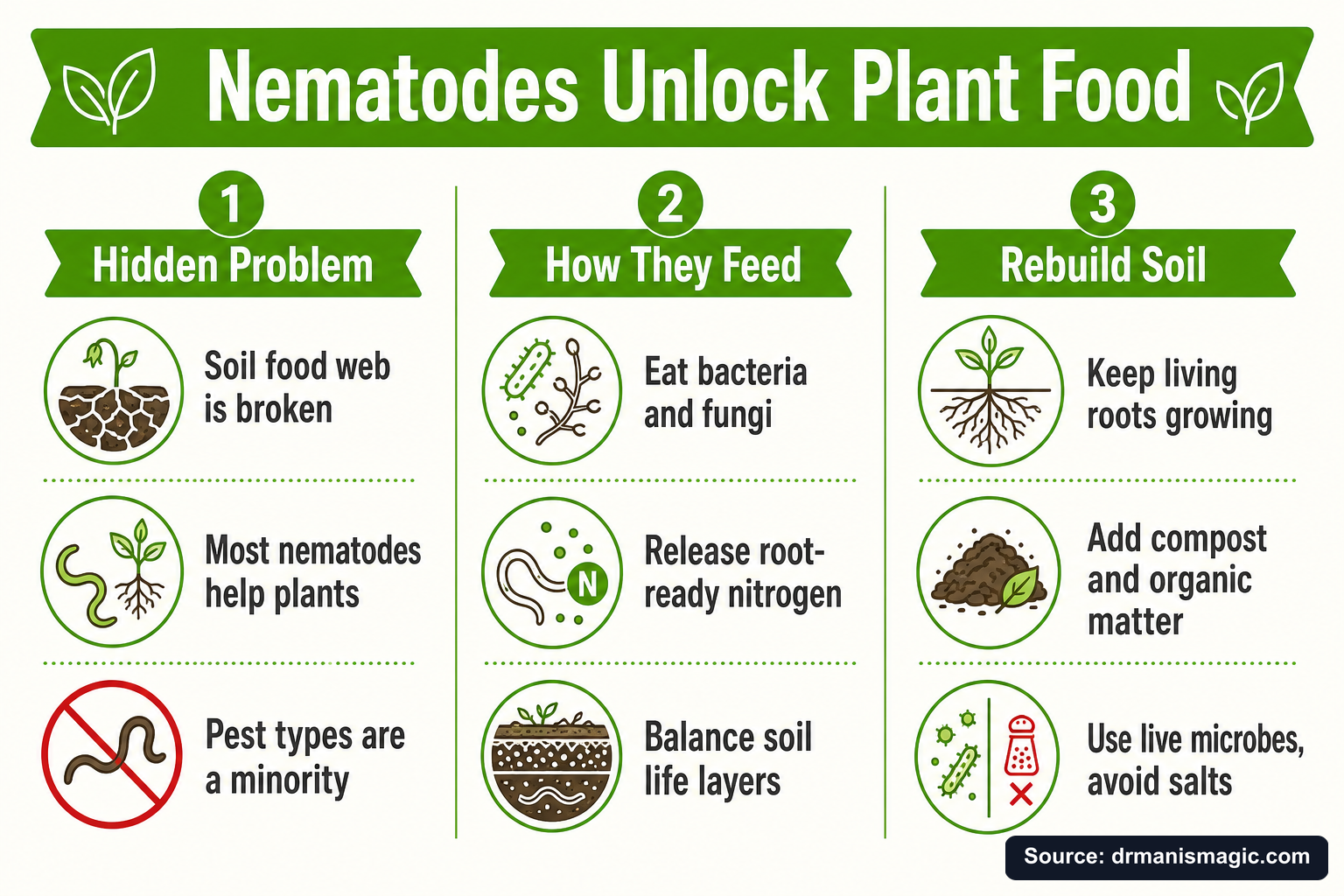
- Most nematodes in healthy soil are beneficial, not harmful — they feed on bacteria and fungi and release plant-available nutrients as a result.
- Beneficial nematodes are part of the soil food web, a living nutrient-cycling machine that feeds plants naturally without synthetic fertilizers.
- Bacterial-feeding and fungal-feeding nematodes are the most important nutrient mineralizers — they eat microbes and excrete nitrogen in a form plant roots can absorb immediately.
- Salt-based synthetic fertilizers, herbicides, pesticides, and fungicides destroy the soil food web, wiping out the nematodes and microbes that cycle nutrients for free.
- Rebuilding a healthy nematode population requires rebuilding the food supply first: living roots, organic matter, compost, and full-spectrum live microbials.
- Dead, dried, or foul-smelling microbial products can't rebuild a broken soil food web — you need genuinely live biology that includes bacteria, fungi, protozoa, and nematodes together.
- The Three Plant Pillars — mineral-based soil, live microbials, and organic fertilizer — create the exact conditions beneficial nematodes need to survive and thrive.
What Are Nematodes and Why Do They Get Such a Bad Reputation?
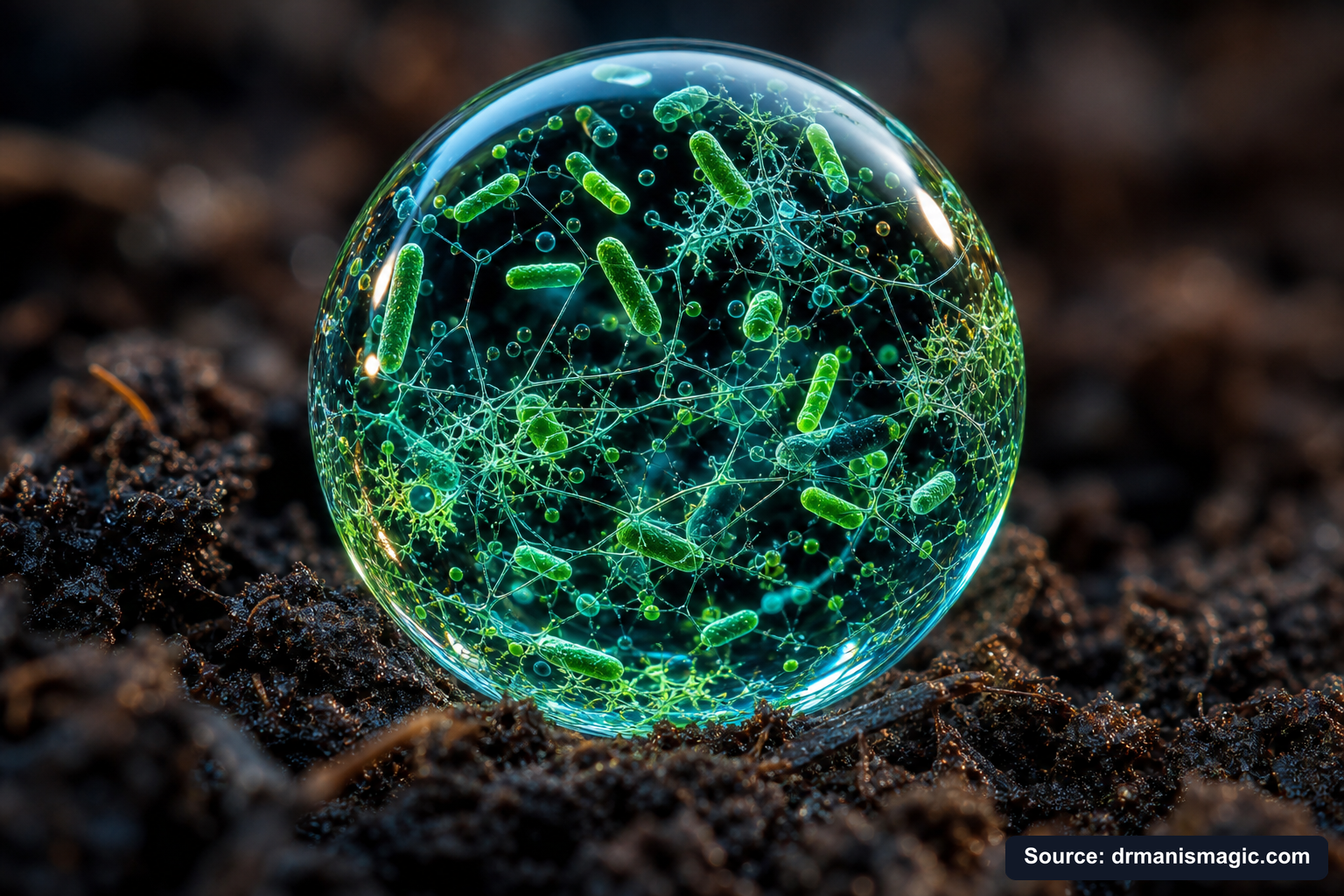
Quick Answer: Nematodes are microscopic worms that live in soil. Most of them are beneficial — they eat bacteria and fungi and release nutrients that feed plants. Only a small group, called plant-parasitic nematodes, cause damage. Confusing these two groups is one of the most common and costly mistakes in modern gardening.
Nematodes are the most abundant animals on Earth. There are more nematodes in a single teaspoon of healthy garden soil than there are people in a major city. Most of them never touch a plant root. They're too busy doing something far more important.
The bad reputation comes from one specific group: plant-parasitic nematodes. These are the ones that drill into roots, cause knobby galls, and stunt growth. They're real. They're a genuine problem in certain soils and crops. But they represent only a fraction of the nematode population in a healthy, biologically active soil.
The other groups — the ones almost nobody talks about — are the heroes of the story. University of California research on soil biology identifies at least five functional groups of free-living nematodes that contribute positively to soil health and nutrient cycling. Understanding the difference is the first step to rebuilding soil that actually works for your plants.
| Nematode Type | What They Eat | Role in the Soil | Good or Bad for Plants? |
|---|---|---|---|
| Bacterial-feeding nematodes | Bacteria | Mineralize nitrogen; release plant-available nutrients | Very good |
| Fungal-feeding nematodes | Fungi, fungal hyphae | Regulate fungal populations; release nutrients | Very good |
| Omnivorous nematodes | Bacteria, fungi, other nematodes | Regulate multiple food web layers | Generally good |
| Predatory nematodes | Other nematodes, protozoa | Control populations; transfer nutrients up the food web | Good (balance) |
| Entomopathogenic nematodes | Soil insects and grubs | Biological pest control | Good (pest control) |
| Plant-parasitic nematodes | Plant root tissue | Root damage, galling, stunted growth | Bad |
The takeaway is simple. When someone says "nematodes are bad for your garden," they're only talking about one type out of six. That's like saying all dogs are dangerous because one breed can bite. The other five types are doing invisible, essential work that keeps your plants fed without you ever opening a bag of fertilizer.
What Is the Soil Food Web and Where Do Nematodes Fit In?
Quick Answer: The soil food web is a living community of organisms — bacteria, fungi, protozoa, nematodes, and more — that work together to break down organic matter and release nutrients in forms plant roots can absorb. Nematodes sit near the middle of this web, eating microbes and making nutrients available to plants.
Think of the soil food web like a kitchen crew in a great restaurant. Each member has a job. Mess with one, and the whole meal falls apart.
Here's how it works, in plain language.
Dead leaves fall. Grass clippings decompose. Roots die back. All of that organic matter lands in the soil. Bacteria and fungi are the first crew on the scene. They rush in and break down the material. But here's the catch: they lock the nutrients inside their own tiny bodies. A bacterium holding nitrogen isn't releasing that nitrogen to your plant. The nitrogen is trapped — immobilized — inside the microbe.
This is where nematodes become essential.
Bacterial-feeding nematodes swim through the thin water films around soil particles. They find bacteria. They eat them. And because bacteria are so rich in nitrogen relative to what the nematode needs, the nematode excretes the excess nitrogen directly into the soil water — as ammonium. That ammonium is immediately available for plant roots to absorb. No middleman. No salt. No synthetic process. Just biology doing what it evolved to do over millions of years.
According to USDA Natural Resources Conservation Service soil biology research, this process — called nitrogen mineralization through microbial grazing — is one of the most significant natural pathways for plant-available nitrogen in agricultural soils. It happens in the rhizosphere, the thin zone of soil right around living roots, where root exudates attract and feed the bacterial and fungal communities that nematodes then graze.
The cycle looks like this:
- Plant roots release sugars into the soil (root exudates)
- Bacteria and fungi rush to the root zone, attracted by the food
- Bacteria and fungi multiply, immobilizing nitrogen, phosphorus, and other nutrients in their bodies
- Nematodes (and protozoa) graze on the bacteria and fungi
- Excess nitrogen is excreted as ammonium — right next to the root where the plant can grab it
- The plant uses that nitrogen to grow leaves, fruit, and new roots
- New roots release more exudates and the cycle continues
This is how a forest feeds itself. This is how a meadow stays green without anyone applying fertilizer. This is how nature has grown plants since long before humans started selling bags of synthetic nutrients at big box stores.
How Do Nematodes Actually Release Nutrients for Your Plants?
Quick Answer: Bacterial-feeding and fungal-feeding nematodes eat microbes that contain more nitrogen than the nematode can use. The excess nitrogen gets excreted as ammonium — a form plants absorb directly through roots. This process, called nitrogen mineralization, happens continuously in healthy soil right in the root zone where plants need it most.
The mechanism is elegant. And once you understand it, you'll see why synthetic fertilizers — however convenient they seem — can never fully replace it.
Bacteria have a carbon-to-nitrogen ratio of roughly 5:1. That means for every 5 parts of carbon in a bacterium, there's 1 part of nitrogen. Nematodes, like all animals, need more carbon relative to nitrogen for their own body maintenance. So when a nematode eats a bacterium, it keeps the carbon for energy and excretes the extra nitrogen. That nitrogen comes out as ammonium — NH4+ — which dissolves in soil water and moves directly to root surfaces.
Fungal-feeding nematodes do the same thing with fungi. They graze on fungal hyphae — the long threads that fungi use to explore soil — and release nutrients that were locked inside the fungal tissue.
What makes this so powerful is the location. The grazing happens in the rhizosphere, right next to the root. The plant doesn't have to search for the nutrient. The nutrient is delivered directly to the doorstep. That's a level of precision no synthetic fertilizer can match. Synthetic fertilizers apply nutrients broadly. They don't respond to what the plant actually needs right now, in this spot, at this moment.
North Carolina State University Extension research on soil food webs confirms that nematode grazing on bacteria can contribute significantly to plant nitrogen supply in biologically active soils, with estimates ranging from 20% to over 50% of crop nitrogen needs in well-managed organic systems.
Nematodes also help cycle phosphorus, calcium, magnesium, sulfur, and micronutrients through the same grazing process. Every nutrient that gets locked inside a bacterium or fungus gets unlocked when a nematode eats that microbe. The soil food web is essentially a slow-release nutrient system that runs on biology instead of chemistry.
What Destroys Beneficial Nematodes in Your Soil?
Quick Answer: Synthetic herbicides, salt-based fertilizers, broad-spectrum pesticides, and synthetic fungicides all damage or destroy the bacteria and fungi that nematodes depend on for food. When the food disappears, so do the nematodes. Bare soil, compaction, and frequent tillage also eliminate the habitat nematodes need to survive.
Here's the part that stings a little. Because the practices that destroy beneficial nematodes are exactly the ones that most commercial gardening advice recommends.
Salt-based synthetic fertilizers are the biggest culprit. When you pour synthetic fertilizer onto soil, the high salt concentration pulls water out of bacterial cells through osmosis. Bacteria shrink and die. Fungi retreat. The food supply for nematodes collapses. The nematode population crashes. And without nematodes mineralizing nutrients, the plant becomes entirely dependent on the next dose of synthetic fertilizer.
That's not a gardening system. That's an addiction cycle. And it's designed to keep you buying.
Broad-spectrum pesticides don't just kill the target pest. They ripple through the soil food web. Herbicides like glyphosate have been shown in multiple university studies to reduce beneficial soil microbe populations, which reduces the food available to nematodes. Synthetic antifungals wipe out the fungi that fungal-feeding nematodes depend on. Even heavy tillage destroys the physical structure of soil — the pores and channels that nematodes travel through.
The result is a soil that looks like dirt but functions like concrete. Sterile. Lifeless. Dependent on chemical inputs to produce any response at all.
See also: The Hidden Reason Synthetic Fertilizers Cause Root Rot
| Practice or Input | Effect on Beneficial Nematodes | Better Alternative |
|---|---|---|
| Salt-based synthetic fertilizers | Kill bacteria and fungi that nematodes eat; collapses food supply | Organic slow-release fertilizer (no salts) |
| Synthetic herbicides (e.g., glyphosate) | Disrupts microbial communities; reduces nematode food web | Mechanical weeding, mulch, living roots |
| Broad-spectrum pesticides | Non-selective toxicity; reduces microbial diversity | Targeted organic pest control |
| Synthetic antifungals | Eliminates fungal-feeding nematode food source | Live microbial inoculants; compost |
| Heavy tillage / bare soil | Destroys physical habitat; exposes nematodes to UV and drying | No-till; mulch; cover crops |
| Compaction | Eliminates pore space nematodes travel through | Mineral-based aerated soil; no compaction |
| Compost + organic matter | Feeds bacteria and fungi — builds nematode food supply | Do more of this |
| Living roots year-round | Root exudates feed rhizosphere microbes; supports nematodes | Do more of this |
| Full-spectrum live microbials | Rebuilds the bacteria and fungi that nematodes depend on | Do more of this |
| Mulch | Maintains moisture; feeds surface bacteria; protects nematode habitat | Do more of this |
Beneficial Nematodes vs. Plant-Parasitic Nematodes: How Do You Tell the Difference?
Quick Answer: You can't tell them apart visually without a microscope and training. The practical difference is in what you observe above ground. Plant-parasitic nematodes cause root galls, yellowing, wilting, and stunted growth even with adequate water and nutrients. Beneficial nematodes are associated with vigorous, healthy plants and no root damage. Soil testing is the only definitive way to identify which types you have.
This is where most gardening content leaves you stranded. They tell you nematodes exist. They don't tell you how to know which ones you're dealing with.
Here's a practical framework.
If your plant is struggling — yellowing leaves, wilting despite regular water, stunted growth, poor fruit set — and you've ruled out overwatering, underwatering, and nutrient deficiency, then root damage from plant-parasitic nematodes is worth investigating. Pull a root and look for swollen, knotted galls. That's the signature of root-knot nematodes, the most common plant-parasitic species in warm climates.
If your soil is biologically active — dark, earthy-smelling, crumbly, full of organic matter — the nematodes present are most likely beneficial free-living types. Healthy soil with diverse organic inputs naturally keeps plant-parasitic nematode populations in check, because the predatory and omnivorous nematodes keep them suppressed.
The single most reliable action you can take is to send a soil sample to a university extension diagnostic lab. Texas A&M AgriLife Extension, for example, offers nematode population analysis that identifies species and density. That data tells you exactly what you're working with.
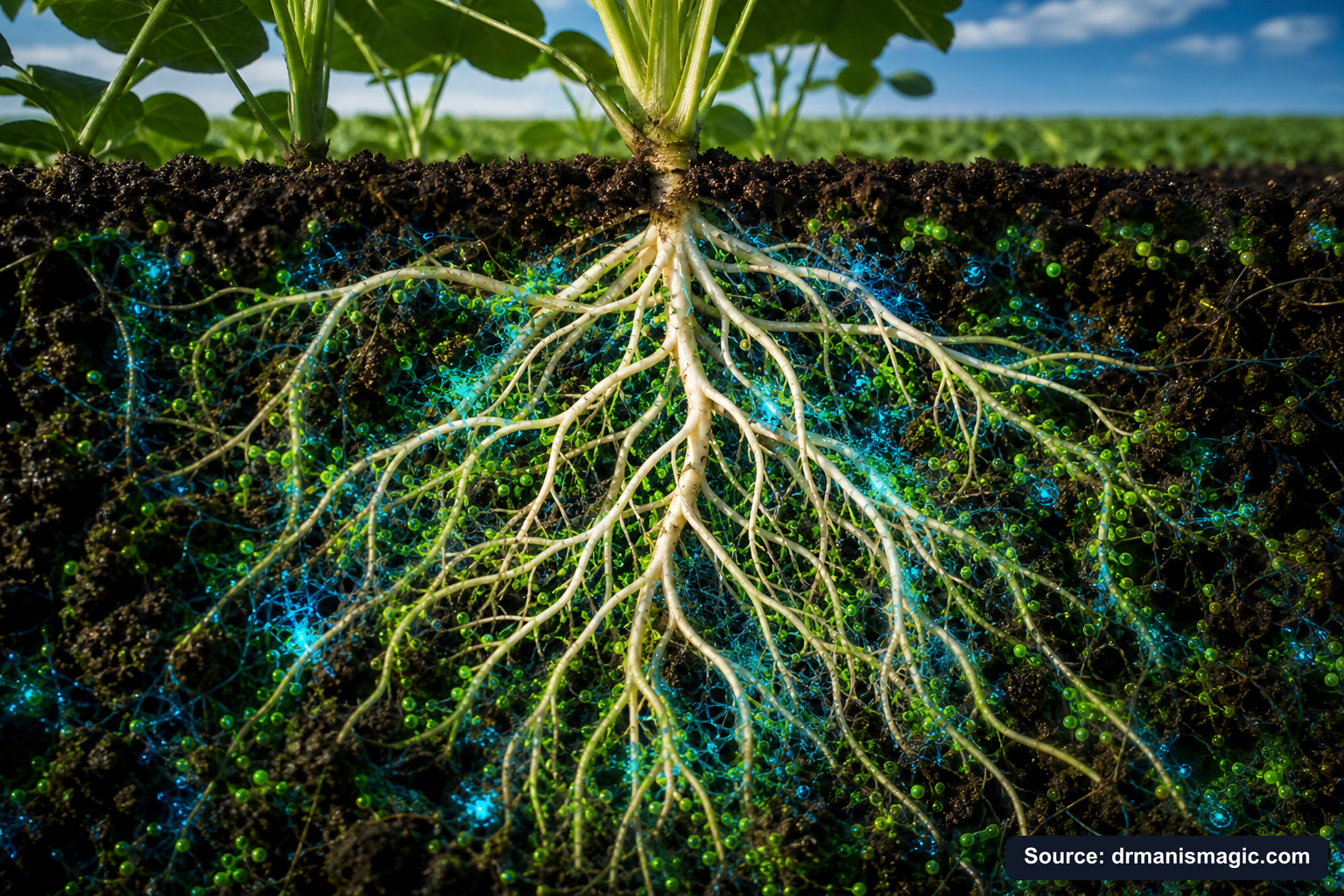
But here's the bigger picture. Soils with rich, diverse microbial communities and abundant beneficial nematodes are naturally more resistant to plant-parasitic nematode outbreaks. Biology suppresses biology. When you build the soil food web, you're not just adding nutrients — you're building a defense system.
You Never Had a Brown Thumb.
You were handed the wrong tools. This free guide hands you the right ones.
You watered it. You fed it. It died anyway.
It was never you. It was the dirt, the salt food, and the bad advice.
This guide shows you what really went wrong, and how to fix it for good.
- Why your plants really died, and why it was never your fault
- The salt hiding in your plant food that quietly burns the roots
- The hidden killer in almost every bag of store soil
- The tiny helpers that grow a whole forest for free
- The rescue trick that brings a half dead plant back to life

How Do Nematodes, Protozoa, Bacteria, and Fungi Work Together as a Team?
Quick Answer: Bacteria and fungi break down organic matter and immobilize nutrients in their bodies. Protozoa and nematodes graze on those microbes and release the nutrients as plant-available forms. Mycorrhizal fungi extend root reach to capture those nutrients. Together, these organisms form a complete, self-sustaining nutrient-cycling system that is far more efficient than any synthetic fertilizer program.
Nobody works alone in the soil food web. Understanding the team is what separates gardeners who fight nature from gardeners who work with it.
Here's the lineup.
Bacteria are the first responders. They colonize organic matter within hours of it hitting the soil. They fix atmospheric nitrogen (in the case of nitrogen-fixing species), solubilize phosphorus locked in mineral particles, and produce enzymes that break down complex organic compounds. They are the foundation of the food web. Without bacteria, nothing else works.
Fungi do what bacteria can't. They send long threadlike hyphae through soil, crossing distances that bacteria never could. They connect distant organic matter to the root zone. Mycorrhizal fungi — the famous white fuzz you sometimes see on healthy roots — form direct partnerships with plant roots, extending their reach by hundreds of times and trading phosphorus, zinc, copper, and water for sugars from the plant. Fungal-feeding nematodes regulate fungal populations and release nutrients from fungal tissue.
Protozoa are microscopic single-celled organisms that graze heavily on bacteria. Like nematodes, they eat nitrogen-rich bacteria and excrete the excess as ammonium. Protozoa and nematodes together are the primary drivers of biological nitrogen mineralization in the rhizosphere. They work as partners in the same process, just at different scales.
Nematodes operate at a slightly larger scale than protozoa. They travel through soil pores and water films, grazing on bacteria and fungi in the deeper layers of the soil profile. They also serve as prey for larger predators — beetles, centipedes, earthworms — which moves nutrients further up the food chain and eventually back into the plant-available pool.
Mycorrhizal fungi tie the whole system together at the root. They capture the ammonium and other nutrients released by protozoa and nematodes and deliver them directly to root cells in exchange for plant sugars. This is why plants with healthy mycorrhizal associations grow faster, resist drought better, and produce more fruit than plants without them.
At our nursery at US Citrus in South Texas, we have watched this system work on more than 250,000 trees. When the soil food web is intact — bacteria, fungi, protozoa, nematodes, and mycorrhizae all present and active — trees grow faster, fight off disease better, and produce more fruit. When the web is broken by synthetic inputs, growth stalls. Leaves pale. Fruit sets poorly. Time gets wasted. And time, unlike money, never comes back.
That's why the Three Plant Pillars exist. Not as a marketing concept. As a reflection of how the soil food web actually works.
Why Do Most Microbial Products Fail to Rebuild the Soil Food Web?
Quick Answer: Most commercial microbial products are either dried powders with low-viability spores or smelly liquids where the microbes have already died. Dead microbes can't graze. Dead microbes can't mineralize nutrients. Rebuilding a living soil food web — including beneficial nematodes — requires genuinely live, full-spectrum biology that reaches your plants alive and active.
This is the part most companies don't want you to know.
Walk into any garden center and you'll find shelves of microbial products. Bags of mycorrhizal powder. Bottles of "beneficial bacteria." Liquid concentrates with long lists of species names and impressive-sounding CFU counts. They look scientific. They feel authoritative. And most of them don't work the way you hope.
Here's why.
The majority of these products are made in large industrial fermentation facilities. Microbes are grown in giant vats, then dried into powder form. The idea is that the dormant spores will reactivate when you add water and pour them into soil. In theory, that sounds reasonable. In practice, after testing dozens of these products on our trees in South Texas, we have seen little to no measurable benefit. The viability is simply too low by the time the product reaches you, gets stored on a shelf, and finally gets applied.
The second category is liquid products made from compost extracts or earthworm castings. These start with genuinely alive biology. But without active aeration, the microbes consume the available oxygen in the liquid and go anaerobic — meaning they switch to a low-oxygen fermentation process that kills the beneficial aerobic species. The telltale sign? The bottle stinks. That smell is biology dying. Some value remains from the organic compounds like humic acid, but the living microbial workforce is largely gone.
A third category uses lactobacillus bacteria — the same culture in yogurt. These stay alive vigorously. Too vigorously. They crowd out other beneficial species and don't belong in soil at all.
None of these approaches rebuild the full soil food web. And without bacteria and fungi present in sufficient living numbers, there is nothing for beneficial nematodes to eat. The nematode population cannot recover. The nutrient cycle stays broken.
See also: Why Most Fertilizers Are Actually Salt in Disguise
| Product Type | Are Microbes Alive at Application? | Spectrum of Organisms | Odor | Supports Nematode Food Web? | Our Assessment |
|---|---|---|---|---|---|
| Dried powder (lab-grown) | Low viability | Narrow (2-5 species) | Neutral | No | Avoid — we've seen no results |
| Rehydrated dried powder | Low viability | Narrow | Neutral | No | Avoid |
| Fresh compost tea (under 24 hours) | Moderate (if aerated) | Partial — depends on compost source | Earthy | Partially | Use immediately — time-sensitive |
| Old compost tea (over 24 hours) | Mostly anaerobic — dying | Partial | Strong stench | No | Not recommended |
| Lactobacillus-based products | High | Single dominant species | Sour | No — crowds out beneficials | Avoid for soil use |
| Plant Super Boost (stabilized, full-spectrum) | High — visibly active under microscope | 2,000+ bacteria species; 400-500 fungi including mycorrhizae; plus protozoa and nematodes | Earthy — no stench | Yes — complete food web in a bottle | Recommended |
What makes Plant Super Boost different is not a marketing claim. It comes from a genuinely different production method. Dr. Mani partnered with a world-renowned compostologist — a man who advised royal families and governments on farming practices before being quietly pushed out by large chemical interests — who developed an all-natural stabilization technique that keeps the full spectrum of compost-derived microbes alive without going anaerobic. The microbes don't rot. They don't stink. You can put a drop under a microscope and watch them move. That's not a metaphor. That's actual living biology, ready to go to work in your soil the moment you pour it.
And unlike products with biosludge, PFAS, or synthetic salts, Plant Super Boost contains zero of those contaminants. Zero PFAS. Zero biosludge. Zero synthetic salts. Made in the USA from American materials.
How Can You Actively Rebuild Beneficial Nematode Populations in Your Soil?
Quick Answer: Rebuild the food supply first — bacteria and fungi — and beneficial nematodes will follow. Add organic matter, keep living roots in the soil year-round, reduce tillage, maintain moisture, and apply a full-spectrum live microbial product regularly. Nematode populations recover in weeks to months when conditions are right. Recovery takes time and repeated effort, especially in soils damaged by years of synthetic inputs.
You can't pour nematodes into a bottle and sell them as a soil amendment. That's not how this works. What you can do is create the conditions where beneficial nematodes thrive naturally — and the fastest path there is rebuilding the bacterial and fungal communities they depend on for food.
Here is a practical recovery framework, built from what we've learned growing 250,000 trees in South Texas:
Step-by-Step Soil Food Web Recovery
- Stop the damage first. Cut back or eliminate salt-based synthetic fertilizers, synthetic herbicides, and broad-spectrum pesticides. Every application resets the clock on microbial recovery. You can't rebuild a food web while the food is being poisoned.
- Fix the physical soil structure. Nematodes travel through water films in soil pores. Compacted soil has no pores. If your soil is hard, dense, and drains poorly, beneficial nematodes can't move through it. This is why Pillar One of the Three Plant Pillars — mineral-based soil with proper drainage and aeration — is foundational. Roots need to breathe. Nematodes need to travel.
- Feed the bacteria and fungi. Add compost, aged organic matter, or a quality organic mulch. These are the food sources that bacteria and fungi need to multiply. More bacteria and fungi means more food for nematodes. This is the single most important step in nematode population recovery.
- Keep living roots in the soil. Root exudates are the engine of the rhizosphere. They attract bacteria and fungi. They create the hot zone of microbial activity where nematode grazing and nutrient mineralization happen. Bare soil is dead soil. Keep something growing.
- Apply full-spectrum live microbials monthly. Damaged soils need repeated inoculation. The biology doesn't recover in a single application. Apply a genuinely live, full-spectrum microbial product — one that includes bacteria, fungi, protozoa, and nematodes together — on a monthly schedule. This rebuilds the food web layer by layer.
- Maintain consistent moisture. Nematodes live and move in water films. Soil that dries out completely loses its nematode population fast. Consistent moisture — not waterlogged, not bone dry — keeps the food web active and the nematodes mobile.
- Be patient and consistent. Soils damaged by years of synthetic inputs can take a full growing season or more to show measurable biological recovery. That's not failure. That's biology working on biology's timeline. The key is to stop losing ground and start building. Every month of consistent organic inputs moves you forward.
One more thing worth saying out loud. You cannot get time back. Every season you spend fighting your soil with the wrong inputs is a season of growth you don't get to see. A fruit tree that could have produced its first harvest three years from now instead takes six, because the soil food web was too broken to deliver the nutrition the roots needed. We hear from gardeners all the time who tell us their deepest wish is to see fruit on a tree they planted themselves — to taste something they actually grew — before too many seasons pass. That wish is real. And the path to it runs through the soil.
The Free Plant Care Field Guide walks you through the complete Three Plant Pillars system in plain language, step by step, so you're never guessing what to do next.
What Do Nematodes Mean for Container Plants, Houseplants, and Potted Trees?
Quick Answer: Container and potted plants start with sterile growing media that contains no beneficial nematodes, no bacteria, no fungi — nothing. Every nutrient has to come from what you add. This is why container plants are the most dependent on the Three Plant Pillars: mineral-based soil for structure, live microbials to establish the food web, and organic fertilizer to feed both the plant and the microbes.
Here's a hard truth about container gardening that nobody at the big box store will tell you.
That bag of potting mix you're using? It started sterile. It has no beneficial bacteria. No fungi. No nematodes. No soil food web at all. Just decomposing organic matter — usually pine bark and peat — that breaks down over months, compacts, steals oxygen from roots, and eventually turns into a root-choking sludge.
A potted plant in that kind of mix is completely on its own. It has no food web to deliver nutrients. No nematodes to mineralize nitrogen. No mycorrhizal fungi to extend its root reach. Every nutrient it gets has to come directly from what you pour on it. And if what you're pouring is a salt-based synthetic fertilizer, you're simultaneously feeding the plant a short-term nutrient hit and destroying any chance of building the biological community it needs for long-term health.
We've watched this pattern repeat on our trees at US Citrus Nursery for decades. The synthetic-fertilizer approach produces a brief flush of growth, then stalls, then declines. The salt builds up. The microbes disappear. The roots struggle. The plant becomes fragile. Then one stress event — a cold snap, a dry week, a pest — topples it.
The solution is to bring the soil food web into the container from the start. Mineral-based soil that doesn't compact and doesn't steal oxygen. A monthly application of genuinely live microbials that establish bacteria, fungi, protozoa, and nematodes in the root zone. And an organic fertilizer that feeds the plant and the microbes together, without the salt that kills both.
That's the Three Plant Pillars applied to container gardening. And it works the same way whether you're growing a Meyer lemon on a patio, a fiddle-leaf fig in a living room, or a rose bush in a planter box.
What Can You Do Right Now to Put This Into Action?
You've just learned something that most gardeners — including people who have been gardening for decades — don't know. The soil beneath your plants is not an inert growing medium. It's a living ecosystem. And the nematodes inside it — the ones you've probably never thought about — are part of an invisible workforce that has been feeding plants naturally for millions of years.
The role of nematodes in nutrient cycling isn't a textbook concept. It's happening — or failing to happen — in your garden right now. In your containers. In your lawn. Around every root in every pot on your porch.
The question isn't whether the soil food web matters. It does. The question is whether yours is working for you or against you.
If your plants are struggling despite your best efforts, the answer is almost certainly below the surface. The bacteria and fungi are depleted. The nematodes have no food. The nutrient cycle is broken. And no amount of synthetic fertilizer will fix a broken biology. It will only mask the problem — briefly — while making it worse.
The path forward is simple, even if it takes some time. Stop the inputs that destroy the food web. Rebuild the physical soil structure so nematodes and microbes can move. Add organic matter and living roots to feed the bacteria and fungi. And apply genuinely live, full-spectrum microbials regularly to establish and maintain the biological community your plants evolved to depend on.
If you want to see what a living soil food web looks like — and what it can do for any plant, from a backyard citrus tree to an indoor houseplant — the best next step is to explore the complete Three Plant Pillars system and see the tools we've developed and proven across more than 250,000 trees in South Texas.
Your plants are waiting. The soil food web is ready to be rebuilt. And the season you start is the season you stop wasting time.
Ready to bring your soil food web back to life? Start with the Three Plant Pillars bundle — the same system we use on our own trees, designed to work for any plant, anywhere. Backed by a 30-day money-back guarantee. No risk. Just results.
Frequently Asked Questions
Most gardeners never think about nematodes. But these tiny soil creatures are working right now, either for your plants or against them. Understanding what they do, and how to support the good ones, could be the difference between a garden that struggles and one that explodes with life. Here are the questions we hear most often.
Are nematodes good or bad for my garden?
Most nematodes are good. Only a small group, called plant-parasitic nematodes, cause root damage. The rest are beneficial. They eat bacteria and fungi in your soil, then release nutrients that plant roots can absorb right away. Think of them as tiny nutrient miners working for free. In healthy, living soil, the good nematodes far outnumber the bad ones.
How do nematodes help plants get nutrients?
Beneficial nematodes eat bacteria and fungi that are full of nitrogen. When they digest those microbes, they release nitrogen in a simple form that plant roots can drink up immediately. This is called nutrient mineralization. It happens naturally in living soil. No synthetic fertilizer needed. The more living biology in your soil, the more of this free plant food gets unlocked every single day.
Can synthetic fertilizers hurt nematodes?
Yes, and this is a big deal. Salt-based synthetic fertilizers, herbicides, pesticides, and fungicides all damage or destroy the soil food web. That includes the bacteria and fungi nematodes feed on. When the food supply disappears, the nematodes disappear too. The nutrient cycle breaks down. Your plant starves even when you keep feeding it. This is exactly why the Three Plant Pillars start with living biology, not chemicals.
How do I get more beneficial nematodes in my soil?
You cannot just add nematodes and expect results. You have to rebuild their food supply first. That means living roots, organic matter, and full-spectrum live microbials that include bacteria and fungi. Dr. Mani's Magic Plant Super Boost does exactly this. It delivers live bacteria, fungi, and mycorrhizae that feed the soil food web. When the food web is healthy, beneficial nematodes follow naturally.
Does the type of soil I use affect nematodes?
Absolutely. Dense, compacted, oxygen-starved soil kills beneficial soil life fast. Most store-bought potting mixes break down into a soggy mess that chokes roots and wipes out microbes. Dr. Mani's Magic Super Soil uses mineral-based sandy loam from South Texas. It does not compact. It drains well. It stays open and airy. That structure gives beneficial nematodes and microbes the oxygen-rich environment they need to survive and work.
We tested this on over 250,000 trees. What did we learn about soil biology?
We learned that healthy plants always start below the surface. At our South Texas nursery, tree after tree showed us that when the soil food web is alive and working, plants fight off disease on their own, grow faster, and produce more. Nematodes are part of that web. When we stopped using synthetic inputs and started supporting living soil biology, everything changed. That discovery became the Three Plant Pillars system.
What is the easiest first step to improve my soil biology today?
Stop using salt-based fertilizers and chemical sprays. They wipe out the biology you are trying to build. Then add live microbials. Dr. Mani's Magic Plant Super Boost brings in live bacteria, fungi, and mycorrhizae that feed the soil food web and create the conditions beneficial nematodes need to thrive. Pair it with mineral-based Super Soil and our organic Crab, Kelp, and Amino Acids fertilizer, and you have all Three Plant Pillars working together.
About the Author
Dr. Mani Skaria, PhD
Dr. Mani Skaria, PhD, is a plant pathologist and the scientific founder of Dr. Mani's Magic. He earned his doctorate at Purdue University and spent 48 years studying how plants, soil, and living microbes work together, including his years as Professor Emeritus at Texas A&M and as a member of the USDA NAREEE Advisory Board. He invented micro-budding, a method for growing healthier, stronger trees, and has grown more than 250,000 trees on the family farm in Hargill, Texas - US Citrus Nursery. His life's work takes real lab science and practical experience and turns it into simple, safe, organic plant care anyone can use at home.


