


Why Tilled Soil Breaks Fungal Networks and Costs Your Plants | Dr. Mani's Magic
Why Tilled Soil Breaks Fungal Networks (And What It Costs Your Plants)
Picture this. You rent a rototiller on a Saturday morning. The engine roars. The blades dig in. Within an hour, you've turned your whole garden bed into a fluffy, chocolate-brown blanket of loose soil. It looks perfect. It smells earthy and fresh. You feel like you've done something good.
But six inches underground, something invisible just got destroyed. Thousands of tiny threads — thinner than a human hair — got sliced to pieces. Those threads were alive. They were working. They were the hidden plumbing system your plants depended on to drink, eat, and fight disease. In the time it took you to finish your coffee, you cut off your garden's underground internet. And most gardeners never find out why their plants seem to stall a few months later.
This article is about what those threads actually are, what happens the moment a blade hits them, and how long it really takes to get them back. After growing over 250,000 trees at our South Texas nursery, we learned this lesson the hard way. Now we want to save you the time — because time, once spent, never comes back.
Key Takeaways
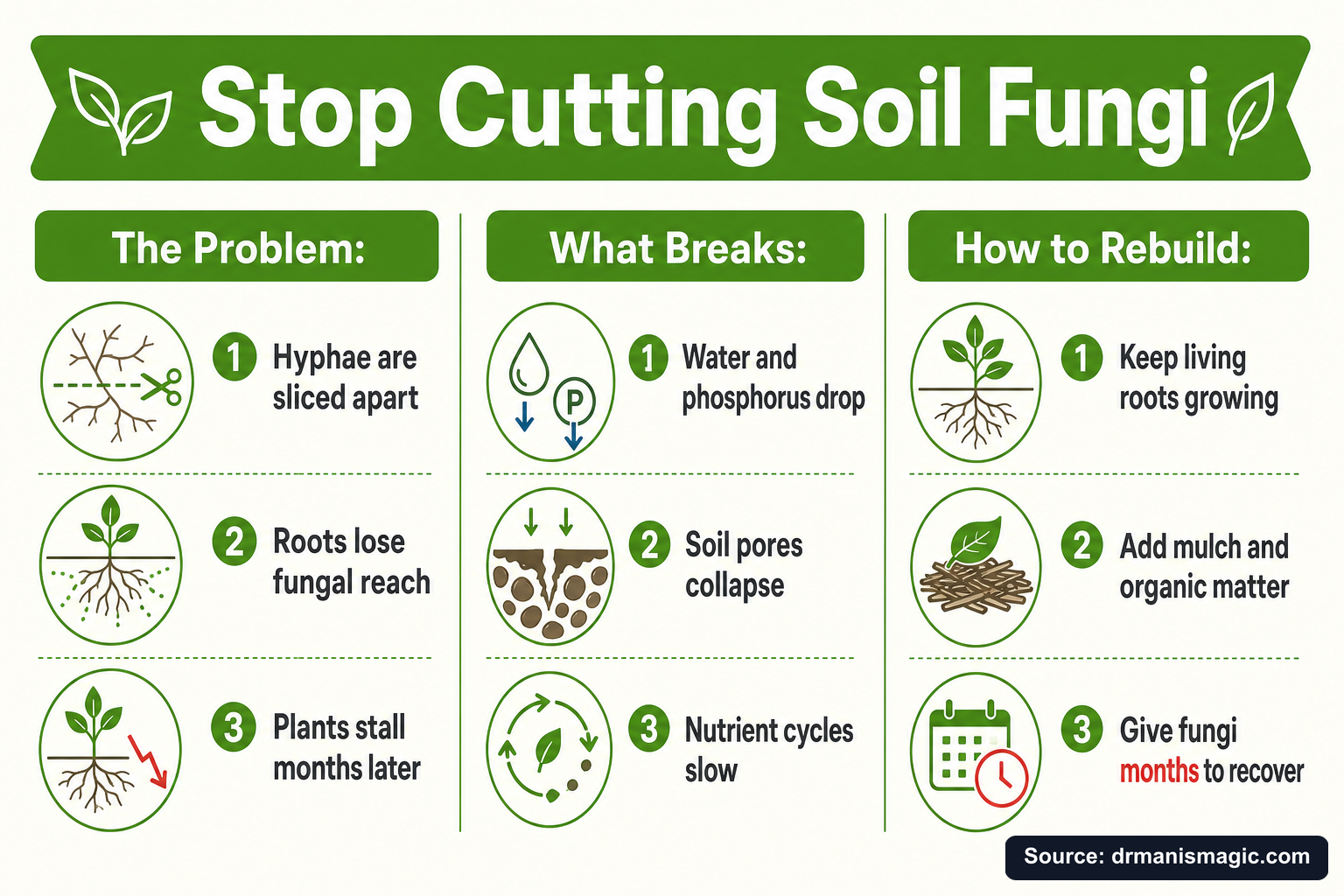
- Tillage physically severs fungal hyphae — the microscopic threads that carry water and nutrients to plant roots.
- The damage happens in three layers: broken fungal threads, collapsed soil structure, and disrupted predator-prey nutrient cycling.
- Bacterial communities bounce back in days. Fungal networks can take months to years to fully recover.
- Tilled soils tend to lose organic matter faster, drain worse, and become more vulnerable to disease and erosion.
- Recovery requires living roots, organic matter, moisture, low chemical stress, and time — not just a one-time microbe product.
- When tillage is still justified, a clear repair plan with cover, roots, mulch, and live microbes can speed recovery.
- The Three Plant Pillars — mineral soil, live microbials, and organic fertilizer — give your soil the best possible environment to rebuild.
What Are Fungal Networks and Why Do They Live in Your Soil?
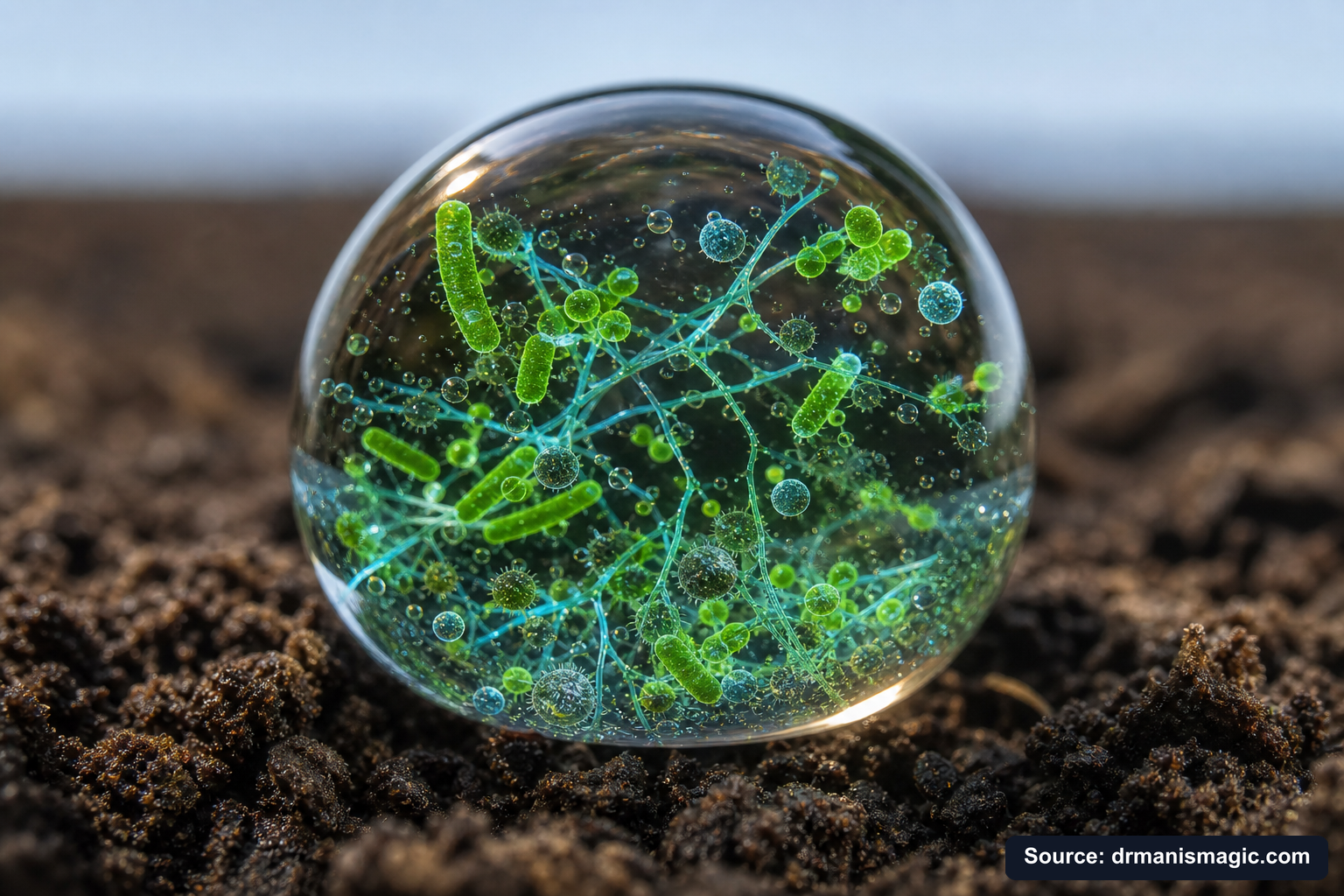
Quick Answer: Fungal networks are webs of microscopic threads called hyphae that grow through soil and connect to plant roots. They act like a delivery system, moving water, phosphorus, and other nutrients directly into roots in exchange for sugars the plant produces. Without them, plants work much harder just to eat and drink.
Under every healthy lawn, garden, or forest floor lives a web you can't see without a microscope. Scientists call these threads hyphae. The fungi that form them are called arbuscular mycorrhizal fungi, or AMF for short. Don't let the name scare you. Think of them as tiny supply chains.
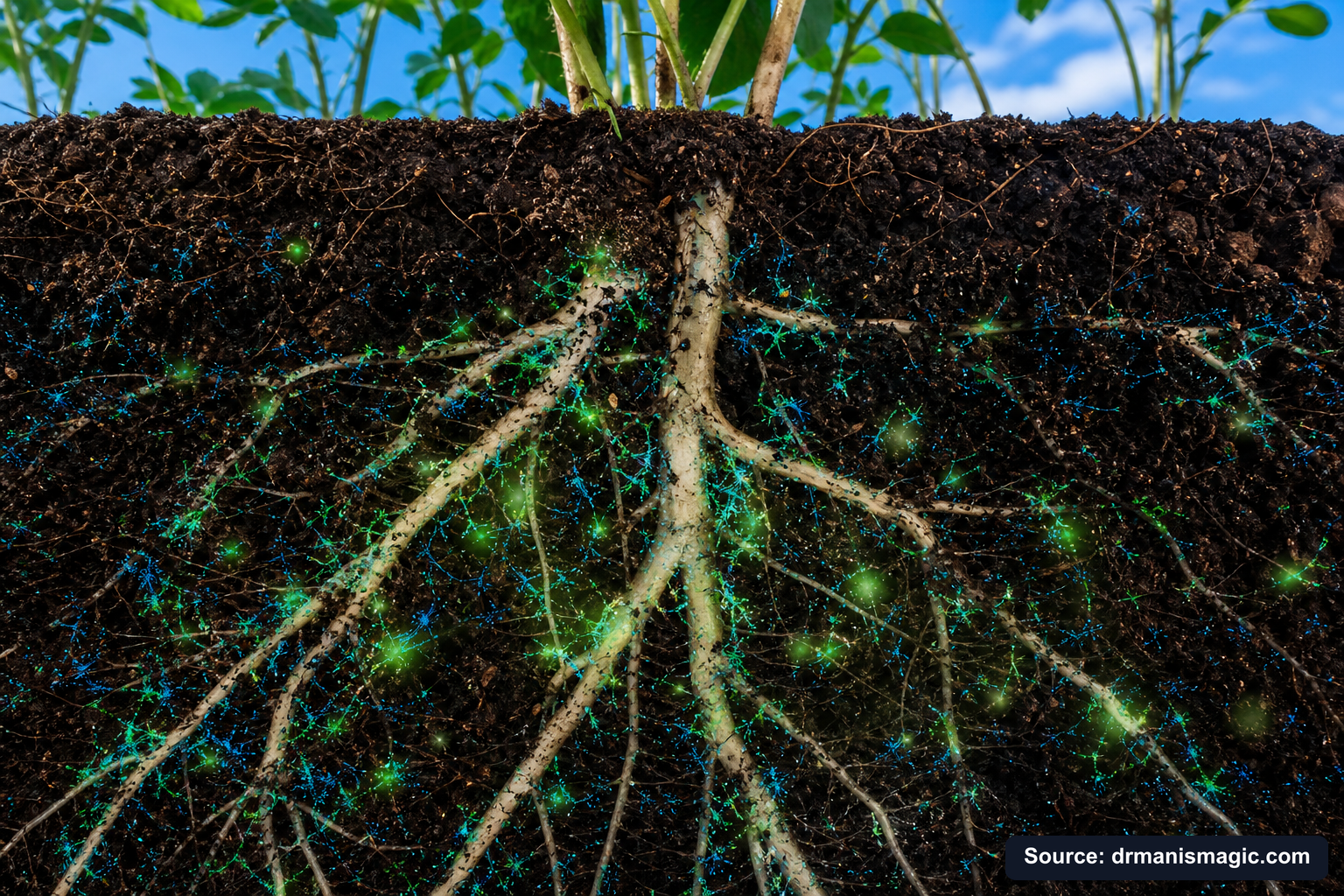
Here's how it works. A plant's roots can only reach so far. But fungal hyphae extend far beyond where roots can go — sometimes ten times farther into the soil. They mine phosphorus, zinc, and water from spaces roots can never touch. Then they deliver those resources directly into the root. In return, the plant feeds the fungi sugar. It's a trade deal that has been running for roughly 400 million years.
When you walk through a forest and pull up a weed, you've probably seen fuzzy white threads clinging to the roots. That's mycorrhizae at work. Those weeds grow so aggressively because they have this fungal partnership fully firing. Your tomatoes, fruit trees, flowers, and lawn grasses all want the same thing.
The University of Minnesota Extension describes healthy soil as a living ecosystem where fungi, bacteria, protozoa, and nematodes work together to cycle nutrients and hold structure. Disrupt that web, and the whole system slows down.
What Exactly Happens to Fungal Networks When You Till?
Quick Answer: Tilling physically cuts fungal hyphae into fragments, the same way scissors cut thread. The longer and more connected those threads were, the more is lost in a single pass. Active hyphal length drops sharply, reducing the root's reach for water and phosphorus — sometimes within hours of disturbance.
This is not a theory. Peer-reviewed research published in Soil Systems confirms that conventional tillage physically fragments extraradical hyphal networks, reducing active hyphal length, root-to-soil exploration, phosphorus uptake, and the production of glomalin — a sticky protein fungi make that holds soil particles together.
Think of it this way. Imagine you spent six months carefully weaving a fishing net. Every knot, every crossing, built by living organisms over weeks. Now run a rototiller through it. The threads don't reconnect. They have to be regrown from scratch. And regrowth requires the right conditions: living roots nearby, moisture, oxygen, no chemical interference, and enough time.
Zero-till and no-till systems consistently show more intact AMF hyphae, better phosphorus uptake, and stronger soil aggregation compared to conventionally tilled plots. That's not marketing. That's what the data shows, consistently, across decades of soil science research.
But here's what most articles miss. The damage isn't just biological. It's structural and ecological too. Which brings us to the three breaks.
What Are the Three Breaks Tillage Causes in Soil?
Quick Answer: Tillage causes three layers of damage at once: it physically severs fungal hyphae, it collapses the pore and aggregate structure that gives soil its texture, and it breaks the predator-prey feeding cycles that recycle nutrients through bacteria, fungi, protozoa, nematodes, and arthropods. Most gardeners only hear about the first one.
We call these the three breaks. Understanding all three is how you understand why tilled soil can look perfect and still perform poorly.
Break One: Physical Breakage of Fungal Hyphae
This is the most talked-about damage. Blades, shovels, and rototiller tines slice through hyphal threads on every pass. The fungal network loses continuity. Colonization rates drop. The root system loses its extended reach. Phosphorus uptake falls. Water stress increases. The plant is now alone in the soil, doing everything by itself.
Break Two: Architectural Collapse of Soil Structure
Fungal hyphae don't just feed plants. They physically glue soil particles together into clusters called aggregates. These aggregates create pores — air pockets and water channels — that let roots breathe and water drain. When hyphae are severed, aggregate stability falls. Pores collapse. The fluffy soil you created with your rototiller compacts back down within weeks, often worse than before. Organic matter gets exposed to oxygen and burns off faster. Erosion risk climbs. Your soil literally falls apart.
Break Three: Trophic Disruption of the Soil Food Web
This is the one almost no article explains. Soil is not just fungi and bacteria. It's a whole food chain. Bacteria eat organic matter. Protozoa eat bacteria. Nematodes eat protozoa. Arthropods eat nematodes. Every step of this cycle releases nutrients in plant-available form. When tillage happens, it scrambles the whole chain. It triggers a short-term bacterial flush — fast bacteria that thrive on disturbance surge briefly — but the slower, more complex fungal pathways that drive long-term nutrient cycling and disease suppression get wiped out. The NRCS confirms that tillage shifts soil food webs toward bacterial-dominated communities, which are less efficient at retaining carbon, cycling nutrients slowly, and building stable soil over time.
| Break | What Gets Damaged | Immediate Effect | Long-Term Effect |
|---|---|---|---|
| Break 1: Biological | Fungal hyphae, mycorrhizal colonization | Less phosphorus and water uptake | Weaker root systems, slower growth, more disease |
| Break 2: Architectural | Soil aggregates, pore networks, glomalin | Compaction, poor drainage, exposed organic matter | Erosion, loss of organic matter, structural instability |
| Break 3: Trophic | Predator-prey cycles (bacteria, protozoa, nematodes) | Short bacterial flush, disrupted nutrient cycling | Less carbon retention, fewer slow-release nutrients, weakened disease suppression |
Does Tilling Kill Mycorrhizal Fungi Permanently?
Quick Answer: No, tilling does not permanently kill mycorrhizal fungi. But it does break their networks and reset colonization. How fast they return depends on whether living roots, organic matter, moisture, and low chemical stress are present. Full network recovery — especially the complex, multi-season connections — can take two to three years or longer without help.
Here's the nuance most people want but almost nobody gives them. Tilling does not sterilize your soil. The organisms survive as spores and fragments. But survival is not the same as function. A severed hyphal network is not working. A spore sitting dormant in dry, compacted, chemical-laden soil is not feeding your plants.
Recovery is really ecological succession — the same process that happens when a forest regrows after a fire. It's slow, it's sequential, and it requires the right conditions at each stage. Bacteria come back fast. Simple fungi follow. The complex, deep mycorrhizal networks that take years to build — those come back last, if ever, without help.
This is why gardeners often say their soil "feels dead" after years of tilling. It's not that all the biology is gone. It's that the system has been reset to an early, immature stage over and over again, never allowed to grow into the complex, disease-suppressing, nutrient-cycling ecosystem it's trying to become.
How Long Do Fungal Networks Take to Recover After Tilling?
Quick Answer: Bacterial activity can rebound within days when moisture and carbon return. But meaningful mycorrhizal colonization takes weeks to months, and full network continuity — with stable aggregates, balanced predator-prey cycles, and disease suppression — typically requires two or more growing seasons of low-disturbance, root-covered, organically fed soil.
Here is a practical recovery timeline based on what we've observed across our nursery and what soil science consistently shows:
- Day 0 — Disturbance: Hyphae are severed. Aggregates collapse. Surface dries quickly. Organic matter is exposed to oxygen and begins to oxidize.
- Week 1 — Bacterial Flush: Fast-growing bacteria surge on the exposed organic matter. This looks like activity but is mostly short-term decomposition. Fungi are largely absent from the active network.
- Month 1 — Root Recolonization Begins: If living roots are present and the soil is moist, fungal spores begin germinating and colonizing new roots. This is the most critical window. No roots, no recovery.
- Season 1 — Cover Crop and Mulch Phase: With consistent root cover, organic mulch on the surface, and reduced disturbance, hyphal threads begin rebuilding. Aggregate stability starts returning. Nutrient cycling improves slowly.
- Year 2 to 3 — Network Continuity Phase: Mycorrhizal networks begin connecting multiple plants. Glomalin production picks up. Predator-prey cycles restabilize. Disease suppression improves. Soil holds structure through rain and heat.
The Penn State Extension describes this rebuilding process and emphasizes that continuous living roots, reduced disturbance, and organic inputs are the three most important drivers of soil food web recovery.
No-Till vs. Conventional Tillage: Which Is Better for Soil Biology?
Quick Answer: No-till systems consistently outperform conventional tillage for fungal network health, aggregate stability, carbon retention, and disease suppression. But no-till is not always possible or practical. The real goal is minimizing unnecessary disturbance and recovering quickly when disturbance is unavoidable.
This is the "vs" question everyone searches. Here's an honest answer.
| Factor | No-Till / Reduced Disturbance | Conventional Tillage |
|---|---|---|
| Active hyphal length | High — networks stay intact | Low — networks severed on each pass |
| Mycorrhizal colonization rate | Higher, faster establishment | Lower, slower recolonization |
| Soil aggregate stability | Stronger — glomalin preserved | Weaker — aggregates collapse |
| Organic matter retention | Better — less oxidation exposure | Worse — organic matter burns off faster |
| Disease suppression | Better — complex microbial community | Reduced — food web simplified |
| Short-term bacterial flush | Lower | Higher (looks like activity, isn't sustainable) |
| Carbon cycling efficiency | Slower, more stable, less loss | Faster, more volatile, more carbon lost to air |
| Erosion risk | Lower — structure intact | Higher — structure compromised |
No-till wins on every biological metric. But here's the honest caveat. Sometimes you have to till. Severe compaction. A new bed being built from scratch. Drainage repair. A complete reset from invasive perennial weeds. Chemical contamination or anaerobic soil. In those cases, one-time disturbance with a solid recovery plan is better than never starting at all.
The goal is not to never touch the soil again. The goal is to till only when necessary, recover intentionally, and avoid the trap of tilling every single season as if the biology doesn't matter.
You Never Had a Brown Thumb.
You were handed the wrong tools. This free guide hands you the right ones.
You watered it. You fed it. It died anyway.
It was never you. It was the dirt, the salt food, and the bad advice.
This guide shows you what really went wrong, and how to fix it for good.
- Why your plants really died, and why it was never your fault
- The salt hiding in your plant food that quietly burns the roots
- The hidden killer in almost every bag of store soil
- The tiny helpers that grow a whole forest for free
- The rescue trick that brings a half dead plant back to life
When Is Tilling Still Worth It — And What Should You Do Right After?
Quick Answer: Tilling makes sense for severe compaction, new bed creation, drainage repair, invasive perennial weed resets, and contaminated or anaerobic soil remediation. When it is justified, follow it immediately with cover crops, mulch, living roots, reduced future disturbance, and a full-spectrum microbial inoculant to restart the biological clock.
We're not anti-tilling. We're pro-thinking-before-you-till. Here are the situations where it is genuinely justified, and the repair steps that should follow every single time.
Tillage is worth it when:
- You're building a brand new bed in ground that has never been cultivated
- Soil is so compacted that water pools and roots can't penetrate
- You're correcting drainage problems or installing amendments at depth
- Invasive perennial weeds like bindweed or bermudagrass have taken over completely
- Soil has been contaminated, gone anaerobic, or is being transitioned from long-term chemical use
Your recovery checklist after tilling:
- Get roots back in the ground immediately. Plant a cover crop, transplant seedlings, or sow seeds within days. No bare soil. Bare soil is biologically stalled soil.
- Cover the surface with mulch. Two to four inches of wood chips, straw, or compost blanket the surface, reduce moisture loss, feed surface fungi, and protect aggregate formation.
- Add a full-spectrum live microbial inoculant. Spores are present but dormant. Introducing live, active biology accelerates recolonization. This is one of the most practical uses of a quality microbial product.
- Stop the chemical inputs. Synthetic salt-based fertilizers, herbicides, and fungicides all slow or halt microbial recovery. Use organic fertilizer instead — one that feeds the soil and works with the microbes rather than burning them out.
- Resist the urge to till again. Every additional pass resets the clock. Let the soil rest. Let the roots run. Let the fungi reconnect.
- Feed the soil organically, not synthetically. Slow-release organic fertilizer builds the carbon base that fungi and bacteria need to thrive. Salt-based products do the opposite — they raise soil salinity, which is toxic to the very microbes you're trying to rebuild.
- Give it time — and add biology every month. Fungal networks don't rebuild in a week. Monthly applications of live microbes keep recolonization pressure high while the natural system rebuilds itself from the roots up.
See also: The Hidden Reason Synthetic Fertilizers Cause Root Rot — because what you put in after tilling matters just as much as the tillage decision itself.
What Is the Soil Food Web and Why Does It Collapse After Tilling?
Quick Answer: The soil food web is the full community of organisms — bacteria, fungi, protozoa, nematodes, and arthropods — that feed on each other in a chain that releases nutrients, builds structure, and suppresses disease. Tilling collapses this chain by favoring fast-growing bacteria while eliminating the slower, more complex fungal pathways that make the system stable and productive long-term.
Most people think of soil as dirt. It isn't. A single teaspoon of healthy soil contains more living organisms than there are people on Earth. Bacteria, fungi, protozoa, nematodes, mites, springtails — all of them linked in a feeding chain that does invisible, essential work for your plants every single day.
Here's how the cycle works in healthy, undisturbed soil:
- Bacteria and fungi break down organic matter and release nutrients in plant-available forms.
- Protozoa eat bacteria and release even more nitrogen when they excrete waste — right at the root zone where plants can absorb it.
- Nematodes eat protozoa and bacteria, cycling nutrients one step further.
- Arthropods (mites, springtails) shred larger organic matter, creating more surface area for bacteria and fungi to work on.
- Mycorrhizal fungi tie the whole system together structurally, connecting roots across distances and holding soil aggregates in place with glomalin.
Tillage scrambles this entire chain. It's not just that fungi get cut. It's that the whole predator-prey balance shifts. Fast bacterial species surge. Slow fungal species retreat. The nutrient cycling that was quiet, steady, and efficient becomes erratic, shallow, and nutrient-leaking.
| Organism | Primary Role | Tillage Impact | Recovery Speed |
|---|---|---|---|
| Bacteria (general) | Break down organic matter, cycle nutrients, fix nitrogen | Surge briefly after disturbance, then decline | Days to weeks |
| Mycorrhizal fungi (AMF) | Extend root reach, deliver phosphorus and water, produce glomalin | Hyphae severed, colonization reset | Months to years |
| Saprophytic fungi | Decompose woody residues, build soil carbon | Networks disrupted, populations reduced | Months |
| Protozoa | Eat bacteria, release nitrogen at root zone | Population disrupted when bacterial community shifts | Weeks to months |
| Nematodes (beneficial) | Eat bacteria and protozoa, cycle nutrients, suppress pathogens | Disrupted by physical disturbance and community shift | Months |
| Soil arthropods | Shred organic matter, create habitat for smaller organisms | Directly displaced or killed by mechanical tillage | Months to years |
Why Do Most Microbial Products Fail to Rebuild Tilled Soil?
Quick Answer: Most microbial products on the market are either dried lab-grown spores that don't reactivate well in real soil conditions, or liquid compost teas that go anaerobic in the bottle and smell foul because the microbes are dying. Neither delivers the broad-spectrum, live, active biology that tilled soil actually needs to recover.
This is something we've seen firsthand, tested across hundreds of trials, and watched happen to gardeners who came to us frustrated. They bought a microbial product. They followed the directions. Nothing changed.
Here's why. There are three common forms of microbial products on the market:
Form 1: Dried powder from lab-grown cultures. These are made in large fermentation vats, dried into powder, and sold in packets. The theory is that dormant spores will reactivate when you add water. In our experience — and after testing dozens of batches — these products produce little to no measurable benefit. The organisms either don't reactivate in field conditions, or the narrow spectrum of lab-selected species doesn't reflect the complex diversity that real soil needs.
Form 2: Liquid compost tea that has gone anaerobic. You can smell these the moment you open the cap. That sour, rotting, sewage-like odor is not earthiness — it's the smell of biology dying without oxygen. Once a compost tea goes anaerobic, the beneficial aerobic organisms are dead or dying. You're essentially pouring fermented liquid onto your plants and hoping for the best. Some benefit comes from residual humic and fulvic acids, but the living microbe population is gone.
Form 3: Lactobacillus-based products. Yes, like in yogurt. Easy to make, vigorously alive. But lactobacillus tends to outcompete and crowd out the beneficial microbes your plants actually need. It belongs in your gut, not your garden.
After growing over 250,000 trees at US Citrus Nursery, and testing every product category extensively, we found only one approach that delivers genuinely live, broad-spectrum biology: full-spectrum microbes harvested from active compost and stabilized using an all-natural method so they never go anaerobic.
That's what Plant Super Boost is. Harvested from hand-crafted compost — not grown in a lab. Stabilized so it stays alive and active in the bottle. No foul smell. No dead powder. And if you put a drop under a microscope, you can actually see the microbes moving. We have multiple lab analyses that confirm it. This is not a marketing claim. It's verifiable biology.
Plant Super Boost contains over 2,000 species of bacteria, 400 to 500 species of fungi including mycorrhizae, plus protozoa and nematodes — the full cast of characters your soil food web needs to rebuild after disturbance. Zero PFAS. Zero biosludge. Zero synthetic salts. Proudly made in the USA.
What Can You Do Right Now to Protect or Rebuild Your Soil Biology?
Quick Answer: Stop unnecessary tilling, keep living roots in the ground as much as possible, apply organic mulch, switch from salt-based fertilizers to organic slow-release feeding, and add a full-spectrum live microbial inoculant monthly to keep recolonization pressure working in your favor. These five steps form the foundation of soil recovery under any circumstances.
Whether you just tilled last weekend or you've been doing it for twenty years, the good news is the same. Soil biology wants to recover. It's trying to recover right now. Your job is to stop fighting it and start helping it.
Here's how the Three Plant Pillars apply directly to soil recovery after tillage:
Pillar One: Mineral-Based Soil Foundation. Most potting mixes and garden soils made from pine bark and organic matter compact down fast, especially after tilling. They lose structure. Roots suffocate. A mineral-based soil — built around sandy loam and silica-rich materials — holds its structure, drains properly, and gives fungi and bacteria the stable, aerated environment they need to thrive. You can learn more about that approach through our Super Soil.
Pillar Two: Live Microbials. You've already read why this matters. Get biology back into the soil fast. Apply monthly. Don't expect one treatment to rebuild what took nature decades to build — but know that consistent, live microbial applications dramatically shorten the recovery window.
Pillar Three: Organic Fertilizer. Salt-based synthetic fertilizers are the single fastest way to undo everything you're trying to rebuild. High salinity kills the very microbes you're reintroducing. Organic slow-release fertilizer — like our Crab, Kelp and Amino Acids formula — feeds the soil food web, not just the plant directly. It works with microbes instead of against them.
The complete Three Plant Pillars system was developed and proven across our nursery operations in South Texas, tested on over 250,000 trees, and refined over more than 30 years by Dr. Mani Skaria — Professor Emeritus of Plant Pathology, inventor of micro-budding, and founder of the Clean Citrus Program in Texas. This isn't a system built to sell products. It's a system built to grow plants. We made the products because we needed them ourselves.
You can get money back. You can't get time back. Every season you spend fighting soil that's biologically broken is a season your plants spend struggling instead of thriving. We've watched gardeners spend years — sometimes a decade — wondering why their trees never really took off, never produced the way they imagined, never gave them that moment of standing in their own backyard picking their own fruit. And almost every time, the answer was in the soil.
See also: Why Most Fertilizers Are Actually Salt in Disguise — because understanding what's been damaging your soil biology is just as important as knowing how to rebuild it.
If you're ready to stop guessing and start growing with a system that's been proven in the field, our Free Plant Care Field Guide is a good place to begin. It walks you through the Three Plant Pillars in plain language, with no jargon and no upsell — just the real foundation your plants have been waiting for.
Frequently Asked Questions
Tilling looks like progress. The soil gets fluffy. The rows look clean. But something important is dying underground every time those blades spin. These questions come up again and again from gardeners who want to know why their plants stall after a fresh till. The answers may surprise you.
Why does tilling destroy soil fungal networks?
Fungal threads called hyphae grow through soil like tiny supply lines. They carry water and nutrients directly to plant roots. A single pass with a tiller slices those threads into useless fragments. The plant loses its underground delivery system overnight. At our South Texas nursery, we watched this happen across thousands of trees. The plants looked fine at first. Then they stalled. The fungal network was gone, and nothing replaced it fast enough.
Why shouldn't you rototill your garden?
Rototilling feels productive but it works against you. It breaks apart the natural air pockets roots need to breathe. It brings buried weed seeds up to the surface where they explode into a new crop of problems. It shreds earthworms and beneficial fungi that took years to build. The soil looks loose and perfect on day one. By month three, it is compacted, weedy, and struggling. You spent time and money to make things worse.
How long does it take for fungal networks to recover after tilling?
Bacteria bounce back in days. Fungi take much longer. Depending on how often the soil has been tilled, how many chemicals have been used, and what is growing in the bed, a full fungal recovery can take months or even years. That is time your plants spend working harder just to eat and drink. Every season you wait is a season without the fruit, flowers, or growth you were hoping to see. Time lost in the garden never comes back.
How often should soil be tilled?
As rarely as possible. Many experienced growers have moved to a no-till approach entirely. If you must till, once a year in early spring or late fall is the maximum. Each pass destroys more of the living soil web you need. A better approach is to top-dress with compost and let roots, worms, and microbes work it down naturally. That is how soil builds real strength over time instead of slowly falling apart.
What are the biggest causes of soil damage in home gardens?
The four biggest culprits are tilling, synthetic salt-based fertilizers, chemical pesticides, and poor drainage. Tilling breaks fungal networks. Salt-based fertilizers burn out the beneficial microbes that make nutrients available to roots. Pesticides and herbicides wipe out the living soil ecosystem. Poor drainage suffocates roots and breeds rot. Our Three Plant Pillars address all of this at once with mineral-based soil, live microbials, and organic fertilizer working together the way nature intended.
What does the Bible say about caring for the soil?
Genesis 2:15 calls us to tend and keep the garden. Proverbs 12:11 says diligent work in the land leads to plenty. These are not just old words. They point to something real. We were made to nurture living things. That drive has never left us. The number one thing people tell Dr. Mani is that they want to see fruit growing from their own tree while they still can. That desire is built into who we are. Do not waste another season fighting against nature instead of working with it.
Why are more gardeners moving away from tilling?
Because the results speak for themselves. No-till gardens hold more water, grow fewer weeds, resist disease better, and produce more over time. Tilling releases carbon stored in the soil, speeds up erosion, and creates a hard compacted layer just below the blade depth. We proved this across more than 250,000 trees at our South Texas nursery. When you stop disturbing the soil and start feeding the living biology inside it with the right microbes and organic inputs, everything changes fast.
About the Author
Dr. Mani Skaria, PhD
Dr. Mani Skaria, PhD, is a plant pathologist and the scientific founder of Dr. Mani's Magic. He earned his doctorate at Purdue University and spent 48 years studying how plants, soil, and living microbes work together, including his years as Professor Emeritus at Texas A&M and as a member of the USDA NAREEE Advisory Board. He invented micro-budding, a method for growing healthier, stronger trees, and has grown more than 250,000 trees on the family farm in Hargill, Texas - US Citrus Nursery. His life's work takes real lab science and practical experience and turns it into simple, safe, organic plant care anyone can use at home.


