


Why Microbial Diversity Matters More Than Products for Plants | Dr. Mani's Magic
Why Microbial Diversity Matters More Than Products (And What That Means for Your Plants)
Picture yourself walking through an old forest. No one fertilizes it. No one sprays it. No one repots it every spring. Yet the trees are massive. The soil is dark and spongy under your boots. You can smell something rich and alive — like rain and earth and something ancient. You reach down and grab a handful of soil. It crumbles perfectly between your fingers, almost warm. That smell? That feeling? That is what billions of invisible workers smell like when they are doing their job.
Now picture your plant at home. Maybe it is in a pot. Maybe it is in your backyard. It gets water. It gets fertilizer from the hardware store. And yet it just... sits there. Pale. Slow. A little sad. You have tried more products. A different fertilizer. A fancy spray. Nothing sticks. The forest never needed any of that. So what does the forest know that your garden does not?
The answer is not a product. The answer is a community. A living, breathing, invisible workforce of bacteria, fungi, protozoa, and nematodes working together in the soil. When that community is healthy and diverse, your plants thrive almost by themselves. When it is gone or broken, no product in the world can fully replace it. That is the heart of why microbial diversity matters more than products. And once you understand it, gardening will never feel the same again.

Organic Fertilizer | Crab, Kelp & Amino Acids
Key Takeaways
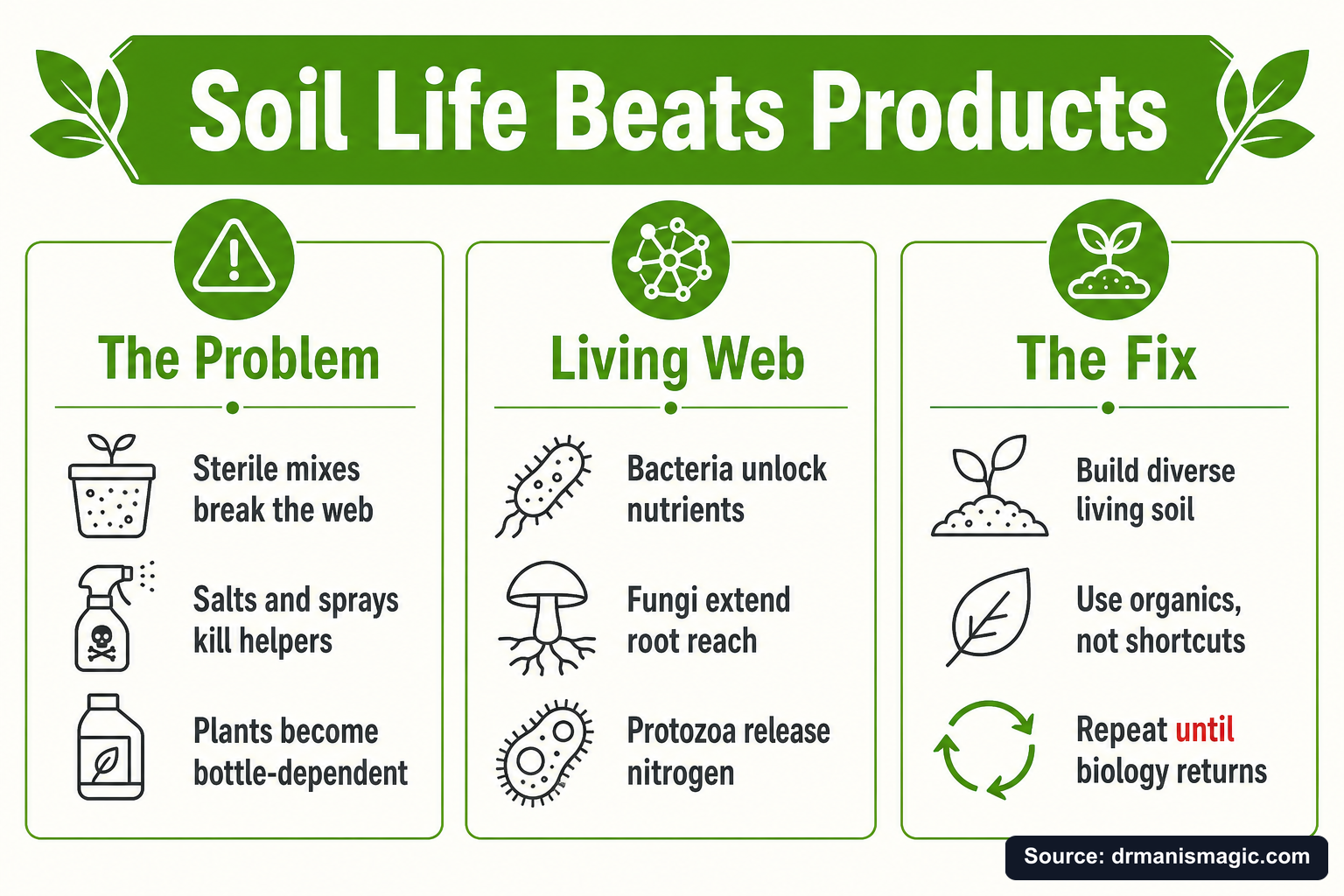
- The soil food web is a living community of bacteria, fungi, protozoa, and nematodes that supplies up to 75% of plant-available nitrogen naturally.
- Microbial diversity, not a single bottled strain, is what creates resilient, self-sustaining soil.
- Most commercial microbial products use dried, lab-grown spores or go anaerobic in the bottle — meaning the microbes are largely dead before they reach your plant.
- Salt-based synthetic fertilizers, herbicides, fungicides, and sterile potting mixes all destroy soil biology and need to be addressed before any product can work.
- Dr. Mani's Magic Plant Super Boost uses a proprietary all-natural stabilization method to deliver genuinely live, full-spectrum microbes — bacteria, fungi, mycorrhizae, protozoa, and nematodes — that you can actually see moving under a microscope.
- The Three Plant Pillars (mineral-based soil, live microbials, organic fertilizer) create the habitat where microbial communities can thrive and do their work for you.
- Rebuilding damaged soil biology takes consistent, repeated application — but when it clicks, the results feel like magic.
What Is the Soil Food Web and Why Does It Feed Your Plants?
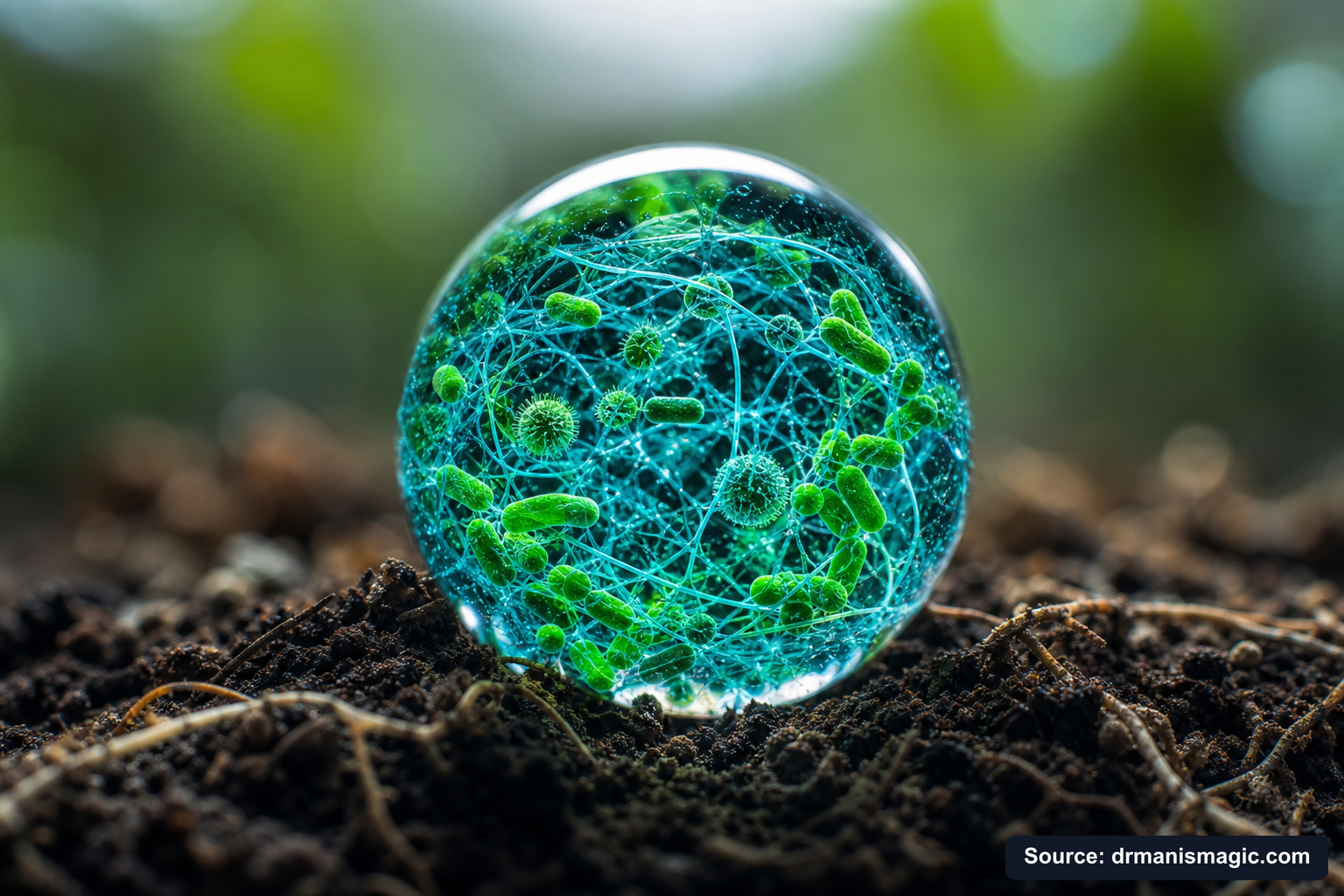
Quick Answer: The soil food web is the interconnected community of bacteria, fungi, protozoa, nematodes, and other organisms living in healthy soil. Together they cycle nutrients, suppress disease, improve drainage, and deliver plant food in forms roots can actually absorb — without you needing to add anything extra.
The soil food web is not a product. It is an ecosystem. Think of it like a city underground.
Bacteria are the frontline workers. They break down organic matter and make nutrients available. Fungi stretch like invisible highways through the soil, connecting plants to minerals far beyond where roots can reach. Protozoa eat bacteria and release nitrogen right next to roots — like a slow, steady drip of plant food. Nematodes eat fungi and bacteria and protozoa, keeping the whole community in balance.
According to the University of Minnesota Extension, soil biological processes supply roughly 75% of plant-available nitrogen and 65% of available phosphorus — not from fertilizer bags, but from living organisms doing their job in balanced, diverse soil. That is a staggering number. Three out of every four units of nitrogen your plant uses comes from the biology living around its roots.
When you have a diverse soil food web, your plant is plugged into a nutrient delivery system that runs 24 hours a day, 7 days a week. When that web is broken — by synthetic fertilizers, herbicides, fungicides, compaction, or sterile potting mixes — your plant is cut off. Alone. Dependent on whatever you pour out of a bottle.
Here is what that community looks like when it is working:
| Organism | What It Does for Your Plant | What Destroys It |
|---|---|---|
| Bacteria | Break down organic matter, fix nitrogen from air, suppress pathogens, improve soil structure | Salt-based fertilizers, herbicides, broad-spectrum pesticides |
| Fungi (including mycorrhizae) | Extend root reach up to 100x, unlock phosphorus, improve drought resistance, suppress root rot | Synthetic fungicides, fumigation, tilling, sterile potting mix |
| Protozoa | Eat bacteria and release nitrogen right at the root zone in plant-ready form | Pesticides, drying out, chemical overload |
| Beneficial Nematodes | Keep bacterial and fungal populations in balance, suppress harmful pest nematodes | Broad-spectrum nematicides, harsh chemical inputs |
| Organic Matter | Feeds the whole food web, holds moisture, buffers pH, stores nutrients | Bare soil, synthetic inputs, compaction, no plant cover |
After growing more than 250,000 trees at our South Texas nursery, we can tell you this: the trees that thrived the most were not the ones that got the most fertilizer. They were the ones with the most alive, diverse soil around their roots.
Why Does Microbial Diversity Beat Any Single Microbial Product?
Quick Answer: A single microbial strain does one job. A diverse microbial community does hundreds of jobs simultaneously — nutrient cycling, disease suppression, drought protection, root development, and soil structure. No product can replicate that complexity. Products are tools. Diversity is the foundation.
Here is the honest truth most microbial product marketing will never tell you.
One strain of bacteria can fix nitrogen. Another breaks down phosphorus. A specific fungus extends roots. A protozoa releases nutrients. A nematode controls harmful pests. These jobs overlap and depend on each other. When you pour in one strain of bacteria from a lab, you are hiring one worker for a job that needs an entire city crew.
The University of Minnesota Extension states it plainly: inoculated organisms generally will not last long if the environment is unsuitable. And if the environment is suitable, the organisms are often already present. That is a polite way of saying: fix the habitat first, and the microbes will come. Buy a bottle without fixing the habitat, and the microbes will die.
Microbial diversity gives you:
- Redundancy — if one species struggles, another picks up the slack
- Multiple nutrient pathways working at once
- Natural disease suppression through competition and predation
- Resilience against drought, heat, salt, and stress
- Soil structure built by glomalin (a sticky protein made by mycorrhizal fungi) that holds particles together and keeps drainage perfect
A single product cannot give you any of that. Diversity can. That is why our Three Plant Pillars start with habitat — mineral-based soil that breathes, organic fertilizer that feeds the web without burning it, and live full-spectrum microbials to seed the community.
What Kills Soil Microbial Diversity (And Why Most Gardens Are Starting From Zero)?
Quick Answer: Salt-based synthetic fertilizers, herbicides, fungicides, pesticides, fumigation, sterile potting mixes, and compaction all destroy soil biology. Most store-bought potting mixes start completely sterile. Most chemically managed lawns and gardens have heavily depleted microbial communities — meaning your plants are already working without their natural support system.
Think about the products you have used. The bright blue fertilizer crystals. The weed killer. The fungicide spray. The fresh bag of potting mix from the hardware store. Every single one of those can wipe out your soil food web.
Salt-based synthetic fertilizers are the biggest culprit most gardeners never suspect. High salt concentration in the root zone draws water out of microbial cells through osmosis — essentially dehydrating and killing the microbes you need most. The plant gets a short burst of green, and you think it worked. But underground, the community is shrinking. Within a few cycles, you have a plant that is addicted to inputs and helpless without them.
Herbicides like glyphosate disrupt microbial communities directly. Broad-spectrum fungicides cannot tell the difference between the fungus causing root rot and the mycorrhizal fungi protecting the root. They kill both. Sterile potting mix — the kind in almost every bag at every big box store — starts with zero microbes by design. It is a biological blank slate. A desert in a bag.
See also: The Hidden Reason Synthetic Fertilizers Cause Root Rot
Here is what that damage looks like over time, and why so many gardeners feel stuck:
- You use synthetic fertilizer. Plants green up fast. Looks great.
- Salt builds up. Microbes start dying. Roots get stressed.
- Disease pressure increases because there are no beneficial microbes to suppress pathogens.
- You spray a fungicide. It kills the remaining helpful fungi.
- Plants look worse. You add more fertilizer. The cycle repeats.
- After a few seasons, you have expensive inputs, poor results, and soil that barely functions.
This is not your fault. You were sold products instead of solutions. The system was designed this way.
Are Most Microbial Products on the Market Actually Alive?
Quick Answer: Most are not — at least not in any meaningful way. Dried powdered products rely on dormant spores that rarely reactivate in field conditions. Liquid compost-tea style products often go anaerobic in the bottle, meaning the microbes die and begin to rot before you ever open the cap. The telltale sign is the smell.
Walk into any garden center and you will see a wall of microbial products. Bags of powder. Bottles of brown liquid. Labels with long scientific names and big CFU numbers. It looks impressive. But here is what is actually happening inside most of those containers.
Most microbial products fall into one of three categories, and all three have serious problems.
The first type: dried lab-grown powders. A few large factories produce these for dozens of brands. They brew up bacteria in giant vats, dry them into powder, and hope the dormant spores reactivate when you add water. We have tested dozens of batches at our nursery. We have seen very little response in our plants. The environment in a pot or garden bed is nothing like the lab conditions those strains were bred in. They arrive, find an unfamiliar world, and most do not survive.
The second type: bottled liquid products derived from compost or worm castings. These start with real biology. But they go anaerobic — meaning they run out of oxygen and the microbes begin to die and ferment — usually within 24 hours of being bottled. By the time it ships to you, sits in a warehouse, and arrives at your door, you are pouring a bottle of dying or dead microbes onto your plants. The smell tells you the truth. If it stinks like sewage, the microbes are gone.
The third type: lactobacillus-based products, like fermented rice water. Lactobacillus stays alive easily. But it is so aggressive it crowds out the beneficial microbes you actually need. It belongs in yogurt, not your soil.
| Product Type | Microbial Viability at Use | Spectrum of Organisms | Odor | Our Verdict |
|---|---|---|---|---|
| Dried lab powder | Low — dormant spores rarely reactivate | Narrow (1-5 strains) | Neutral | Avoid — we saw no plant response |
| Rehydrated dry powder | Low — same issue | Narrow | Neutral | Avoid |
| Bottled compost tea (old) | Very low — anaerobic die-off | Partial | Strong stench | Not recommended — microbes are dying |
| Fresh compost tea (<24 hrs) | Moderate — if actively aerated | Broad | Earthy | Good if you make it yourself and use immediately |
| Lactobacillus products | High — but wrong organism | Single dominant strain | Sour | Crowds out beneficial microbes — avoid in soil |
| Plant Super Boost (stabilized, full-spectrum) | High — visible under microscope | 2,000+ bacteria; 400-500 fungi; mycorrhizae; protozoa; nematodes | Earthy — no stench | Harvested from real compost, stabilized naturally, genuinely alive |
That earthy smell matters more than you think. It is the smell of a living, aerobic microbial community — the same smell that hits you when you dig into rich forest soil. If your microbial product smells like a sewer, the biology is already dead.
You Never Had a Brown Thumb.
You were handed the wrong tools. This free guide hands you the right ones.
You watered it. You fed it. It died anyway.
It was never you. It was the dirt, the salt food, and the bad advice.
This guide shows you what really went wrong, and how to fix it for good.
- Why your plants really died, and why it was never your fault
- The salt hiding in your plant food that quietly burns the roots
- The hidden killer in almost every bag of store soil
- The tiny helpers that grow a whole forest for free
- The rescue trick that brings a half dead plant back to life

What Makes Mycorrhizal Fungi So Powerful (And Why Commercial Mycorrhizal Products Often Disappoint)?
Quick Answer: Mycorrhizal fungi connect to about 80% of land plants and can extend the root system up to 100 times, unlocking water, phosphorus, and disease resistance that roots alone cannot reach. But Colorado State University Extension notes that commercial mycorrhizal inoculants are unnecessary and often ineffective in most established soils — they only shine in sterile, fumigated, or severely disturbed conditions.
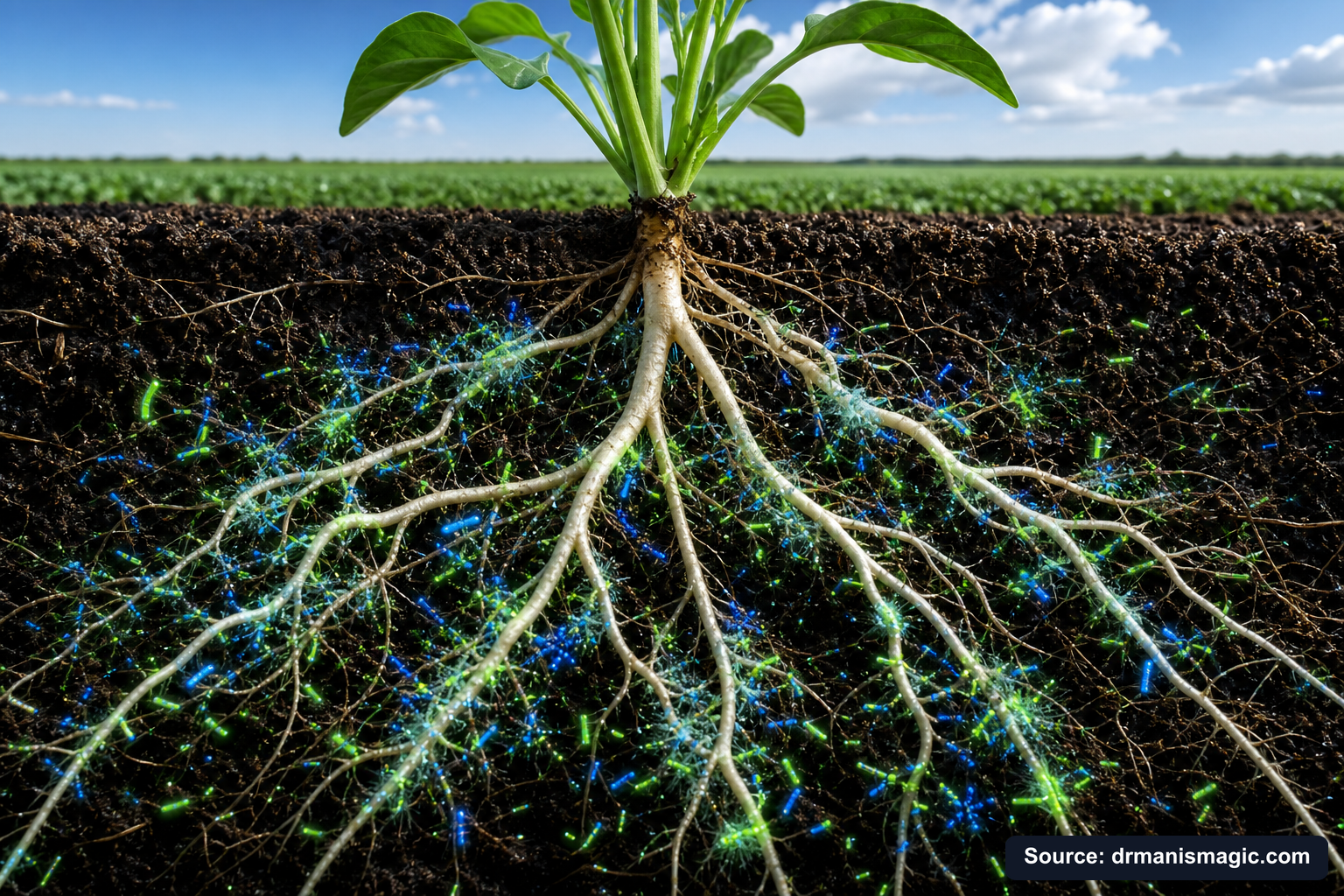
Mycorrhizal fungi are the most remarkable organisms most gardeners have never thought about. They are not just helpful. They are ancient partners. Plants and mycorrhizae have been working together for over 400 million years. Long before humans, before agriculture, before fertilizer bags, this partnership was feeding forests.
Here is how it works. The fungus wraps around and grows into the plant root. The plant feeds the fungus sugars it makes from sunlight. In return, the fungus sends out thread-like strands called hyphae — so fine you cannot see them with the naked eye — that reach deep into soil spaces roots could never enter. Those threads pull in water, phosphorus, zinc, and copper and deliver them straight to the root.
Pull up a weed in your yard and look at the roots. See white fuzzy threads clinging to them? That is mycorrhizae. That is why weeds grow so aggressively. They have the fungal partnership fully active. Your potted citrus or garden tomato, sitting in sterile potting mix, does not have that advantage. It is competing alone.
However — and this is important — simply buying a bag of mycorrhizal powder from a shelf rarely solves the problem. Colorado State University Extension is direct about this: mycorrhizal inoculation shows real results mainly in highly disturbed, sterile, fumigated, or construction-fill soils. In a normal garden bed with intact biology, the fungi are often already there. What they need is habitat, not more spores poured on top.
The lesson: do not chase the mycorrhizal product. Chase the conditions that let mycorrhizae thrive. That means organic matter, living roots, minimal disturbance, no synthetic fungicides, and genuinely live inoculants when the soil has been damaged or is truly sterile.
Live Microbes vs. Dead Microbes: Why the Difference Changes Everything
Quick Answer: Live microbes establish in your soil, reproduce, and build a lasting community. Dead microbes, whether dried to a powder or killed in an anaerobic bottle, cannot colonize roots, cannot cycle nutrients, and cannot suppress disease. You are paying for biology that cannot do biology.
Think about it this way. If you wanted to start a garden, you would not plant dead seeds. You would not hire workers who cannot move. You would not build a team out of fossils.
Yet that is exactly what most bottled microbial products deliver. Dead or dying organisms in a powder or a foul-smelling liquid. The label might list twenty strains with impressive Latin names. The CFU count might be in the billions. But if those organisms are not alive and metabolically active when they hit your soil, none of that matters.
Genuinely live microbes do something dead ones cannot. They establish. They colonize root surfaces. They reproduce and spread through the root zone. They form the beginning of a diverse community that grows over time. That community then builds the habitat for other organisms. Protozoa arrive. Nematodes follow. The food web begins to rebuild itself from a living seed.
That is exactly what we built Plant Super Boost to deliver. Our compostologist partner — a world-renowned expert who has advised royal families and governments on agricultural soil health — developed a proprietary all-natural stabilization method that keeps the full spectrum of microbes alive in the bottle without going anaerobic. No stench. No rotting. Just living biology, stable on your shelf, ready to activate the moment it hits your soil. Take a drop and put it under a microscope. You will see organisms moving. That is real. We have lab analyses to confirm it.
Zero PFAS. Zero biosludge. Zero synthetic salts. Just the same biology that makes forest soil smell alive.
When Should You Actually Use a Microbial Inoculant?
Quick Answer: Use a microbial inoculant when your soil is sterile, severely damaged, or biologically depleted — such as fresh potting mix, fumigated soil, construction fill, or soil damaged by years of synthetic inputs. Healthy, undisturbed garden soil may already have good biology. The goal is to restore the habitat and then seed it with living organisms.
Not every garden needs a microbial product poured on it every week. But most gardens in America do need some biological restoration, and here is why.
Decades of synthetic fertilizer use, herbicide application, and sterile potting mix have stripped the biology from most managed soils. The average suburban lawn has been drenched in salt-based inputs. The average container plant sits in a bag of pine bark that started sterile and stays that way. Even in-ground garden beds have been disturbed, compacted, and chemically managed in ways that push microbial diversity to near zero.
Use this simple decision framework:
| Your Situation | Microbial Inoculant Needed? | Priority Action |
|---|---|---|
| Fresh sterile potting mix | Yes — strongly | Add live full-spectrum inoculant immediately |
| Fumigated or solarized soil | Yes — strongly | Restore organic matter first, then inoculate |
| Construction fill or subsoil | Yes — strongly | Add organic matter, correct drainage, then inoculate |
| Soil damaged by years of synthetics | Yes — regularly | Switch to organic inputs, flush salts, inoculate monthly |
| Healthy, undisturbed garden bed with organic matter | Maybe — low priority | Focus on habitat quality; inoculant may already be present |
| Legume planting (beans, peas, clover) | Yes — specific Rhizobium strains | Use species-matched inoculant at planting |
| Container citrus or tropical tree | Yes — always | Mineral-based soil plus live inoculant monthly |
The rule of thumb: if the soil has been disturbed, sterilized, or chemically managed, the biology needs help. Restore the habitat. Then seed it with genuinely live, diverse organisms. Repeat monthly because container environments and chemically managed soils constantly pressure microbial communities back toward depletion.
How Do You Actually Rebuild Soil Biology After It Has Been Damaged?
Quick Answer: Rebuilding damaged soil biology takes a staged approach: stop the damage, restore organic matter and aeration, correct salt buildup, and then apply genuinely live, full-spectrum microbials consistently over several months. There is no instant fix. But with the right foundation, the results build on themselves fast.
This is the part most articles skip. They tell you to "add microbes" but they do not tell you what to do when the microbes keep dying because the conditions that killed them in the first place are still there.
Think of it like trying to plant a garden in a parking lot. You can dump seeds all day. Nothing grows until you fix the pavement.
Here is the step-by-step recovery plan we use at our nursery for biologically depleted soils:
- Stop the damage first. Eliminate or dramatically reduce synthetic herbicides, salt-based fertilizers, and broad-spectrum fungicides. You cannot rebuild what you keep destroying.
- Fix the physical structure. Compacted, waterlogged, or bark-heavy potting mix chokes roots and microbes alike. Our Super Soil mineral-based blend provides the drainage and aeration that microbes need to breathe and spread.
- Flush accumulated salts. Deep watering — enough to push salts down and out of the root zone — gives the recovering microbial community a fighting chance. Do this before inoculating.
- Add organic matter. Compost, mulch, and cover crops feed the food web. No food, no microbes. Even a thin layer of compost as a top dressing starts the process.
- Apply genuinely live, full-spectrum microbials. This is where Plant Super Boost earns its place. Pour it on monthly — not as a one-time fix, but as a consistent reseed of the community while conditions rebuild.
- Switch to organic, non-salt fertilizer. Our Crab, Kelp & Amino Acids slow-release formula feeds your plants without burning the microbes you just restored. Salt kills microbes. Organic nutrients feed them.
- Be patient but consistent. Biology rebuilds in layers. The first month you will see subtle changes. By month three, you will see root development you have not seen before. By month six, the soil will feel different in your hands — alive, crumbly, rich-smelling.
We tested this exact process across 250,000-plus trees at US Citrus Nursery. Trees in mineral-based soil with live microbials and organic fertilizer did not just survive. They thrived in ways that trees grown in conventional potting mix with synthetic inputs simply could not match.
See also: How Salt-Based Feeding Quietly Destroys Root Systems
What Is the Three Plant Pillars System and How Does It Create Lasting Microbial Diversity?
Quick Answer: The Three Plant Pillars are the foundation Dr. Mani Skaria developed after 40 years of plant science and 250,000 trees tested at US Citrus Nursery: mineral-based soil for drainage and aeration, live full-spectrum microbials for soil biology, and organic fertilizer that feeds the plant without poisoning the microbes. Together, they create the conditions where microbial diversity builds itself over time.
Dr. Mani Skaria spent 40 years as a Professor of Plant Pathology at the Texas A&M Citrus Center. He traveled the world. He tested hundreds of products and systems. And what he found again and again was that the plants that thrived were not the ones that received the most inputs. They were the ones that had the most life in their soil.
That discovery became the Three Plant Pillars.
Pillar One: Mineral-Based Soil. Most potting mixes are made from pine bark and wood fiber that breaks down within months, compacting into a root-choking sludge that blocks oxygen and holds too much water. Our Super Soil uses sandy loam from the Rio Grande Valley — mineral-based, permanent, and silica-rich. It does not decompose. It does not steal oxygen. Roots breathe. Microbes spread. Water drains perfectly.
Pillar Two: Live Microbials. This is where the invisible workforce lives. Without a consistent supply of genuinely alive, diverse microbes, the soil food web cannot establish or maintain itself — especially in containers, sterile potting media, or chemically managed soil. Plant Super Boost delivers bacteria, fungi, mycorrhizae, protozoa, and nematodes that are alive and active, not dried or dying.
Pillar Three: Organic Fertilizer. Salt-based synthetic fertilizers are a microbial massacre. They burn roots, kill beneficial bacteria, and create dependency. Our Crab, Kelp & Amino Acids formula is a slow-release organic blend that delivers nitrogen, phosphorus, potassium, and trace minerals in forms the plant and the microbes both love. No synthetic salts. No PFAS. No biosludge.
When all three work together, something remarkable happens. The soil becomes self-sustaining. Nutrients cycle. Disease pressure drops. Roots go deep. Plants stop struggling and start thriving. You stop chasing problems and start enjoying the garden you always wanted.
The number one thing we hear from people — more than any other request — is that they want to see fruit on a tree they planted while they still have time to enjoy it. Not in twenty years of slow, struggling growth. Now. Soon. In a season that feels like a reward instead of a chore. Time is the one thing you cannot buy back. The right foundation gets you there faster. The wrong inputs waste years you will never recover.
What Can You Do Right Now to Start Building Microbial Diversity?
Quick Answer: Start by removing what is killing your microbes — synthetic salt fertilizers and broad-spectrum chemicals — then add organic matter, improve soil drainage and aeration, and apply a genuinely live, full-spectrum microbial inoculant monthly. These steps work for any plant: potted trees, gardens, lawns, houseplants, or orchards.
You do not need to overhaul everything at once. You need to start. Today. Because every week you wait is another week the soil food web sits depleted while your plants do the best they can without it.
Here is the simplest version of the path forward:
- Stop using salt-based synthetic fertilizers. Flush the root zone with clean water to push accumulated salts down and out.
- If you are in containers or raised beds, consider switching to a mineral-based soil that does not compact and does not steal oxygen from roots.
- Add organic matter — compost, mulch, or organic slow-release fertilizer — to feed the food web.
- Apply a genuinely live, full-spectrum microbial product monthly. Not a dried powder. Not a smelly bottle. Something alive enough to see under a microscope.
- Reduce disturbance. Every time you till or disturb soil, you shred the fungal networks that took months to build.
- Be consistent. Biology rebuilds in layers. Show up every month and it compounds into something extraordinary.
The forest does not buy products. The forest builds a community. That community feeds the trees, protects the trees, and sustains the trees through drought and disease and seasons of every kind. You can build that same community in your backyard, your garden, your containers, and your lawn. It just needs the right habitat and a living seed to start from.
We have spent more than 30 years in Hargill, South Texas, growing citrus, tropical trees, houseplants, and vegetables using exactly this approach. We built our own products because nothing on the market did what nature actually does. And we offer them directly to you — no middleman, no big box store markup, no guesswork — with a 30-day money-back guarantee because we know they work.
If you are ready to stop buying products that promise magic and start building the real thing — the invisible workforce that makes plants thrive like they do in that ancient, unfertilized, magnificent forest — explore the Three Plant Pillars bundle and see what your soil has been waiting for.
Frequently Asked Questions
Most gardeners never ask why their plants struggle. They just buy another product and hope for the best. These questions cut straight to the truth about what is really happening in your soil and why microbial diversity is the missing piece nobody told you about.
Why does microbial diversity in soil matter more than any single fertilizer or product?
Because no single product can do what a whole community does. Bacteria, fungi, protozoa, and nematodes all work together. Each one handles a different job. Bacteria break down matter. Fungi carry nutrients to roots. Protozoa release nitrogen right where roots drink it in. When that team is diverse and thriving, your plant gets fed around the clock. One bottled product alone cannot replicate that. Dr. Mani proved this across 250,000 citrus trees. The community wins every time.
What kills microbial diversity in my garden soil?
Salt-based synthetic fertilizers are the number one killer. They burn off the living community in your soil every time you apply them. Herbicides, fungicides, and cheap sawdust potting mixes all do serious damage too. Even sterile potting mix from a big box store starts your plant off with zero biology. Once the community is gone, your plant is on its own. That is when things go pale, slow, and sad. And no amount of extra product fixes a dead soil community.
How do I know if the microbial product I buy actually has live microbes in it?
Most bottled microbials use dried, lab-grown spores. By the time they reach you, the microbes are largely dead. Some go anaerobic in the bottle and start to rot. That is why they smell terrible. Dr. Mani's Magic Plant Super Boost uses a special all-natural stabilization method developed right here in South Texas. The microbes stay alive and active. You can actually see them moving under a microscope. If your bottle smells like sewage, the biology is already gone.
What are the real benefits of having a diverse microbial community around my plant roots?
A diverse microbial community does things no fertilizer bag can match. It supplies up to 75 percent of your plant's nitrogen naturally. It fights off root diseases before they start. It opens up compacted soil so roots can breathe and push deep. It connects roots to minerals far beyond where they could ever reach alone. Your plant becomes tougher, more colorful, and more productive. Think of it as hiring a full crew instead of one tired worker.
What conditions help microbial communities grow and stay strong in my soil?
Microbes need three things to thrive. First, they need a home. Mineral-based soil with good drainage and aeration gives them space to breathe and move. Compacted, rotting sawdust mix suffocates them. Second, they need food. Organic matter and organic fertilizers feed the community without burning it. Third, they need to be left alone. Stop using salt-based fertilizers and harsh chemicals. That is exactly what Dr. Mani's Three Plant Pillars are built around. Soil, microbes, and organic fertilizer working together.
How long does it take to rebuild microbial diversity in damaged soil?
It takes consistent effort, but results start showing within weeks. The first month you will notice your plant looking more alert. Leaves get greener. New growth appears. Over several months the whole root zone comes alive. Dr. Mani has seen this happen in nursery trees, backyard gardens, lawns, and houseplants. The key is staying the course. Stop the chemicals. Feed the biology. Give it the right soil structure. Nature moves fast once you stop fighting it.
Can I build healthy microbial diversity in a container or pot, not just in the ground?
Absolutely. This is one of the biggest myths in gardening. People think microbes only work in the ground. Not true. Dr. Mani's Magic Super Soil is a mineral-based blend made from sandy loam from the Rio Grande Valley. It does not break down or compact like wood-based potting mix. It stays open and airy so microbes can live and work. Add Plant Super Boost and organic fertilizer and your container becomes a living ecosystem. The same biology that powers an old forest can power your patio pot.
About the Author
Ron Skaria, MD
Ron Skaria, MD, is the co-founder of Dr. Mani's Magic and the son of Dr. Mani. He trained as a medical doctor at Baylor College of Medicine, did his residency at UT Health Science Center - San Antonio and fellowship training at Texas Tech University. He now works full time on the family farm at US Citrus and US Citrus Nursery in Hargill, Texas, building Dr. Mani's Magic alongside his dad. He wrote the Brown Thumb Field Guide to put his father's 48 years of plant science into plain words any gardener can use. His belief is simple. You never had a brown thumb. You just never had the right help.


