


What Plants Are Really Asking For (It's Not Fertilizer) | Dr. Mani's Magic
What Plants Are Really Asking For (It's Not What You Think)
Picture this. You're standing in your backyard on a Saturday morning, coffee in hand, staring at a plant that should be thriving. You watered it. You fed it. You followed the instructions on the bag. And yet, here it is. Yellowing. Drooping. Quietly giving up.
You've done everything the big box store told you to do. And it still looks like it's dying. So you buy another product. Then another. More money. More time. More frustration. And somewhere in the back of your mind, a little voice whispers the cruelest thing: "Maybe you just have a brown thumb."
That voice is wrong. The deck was stacked against you from the start. Because what your plant is really asking for has almost nothing to do with the products on that shelf. It lives underground, invisible to the naked eye, and it's been quietly waiting for you to discover it. Once you do, everything changes. We're going to show you exactly what that is.

Plant Super Boost
Key Takeaways
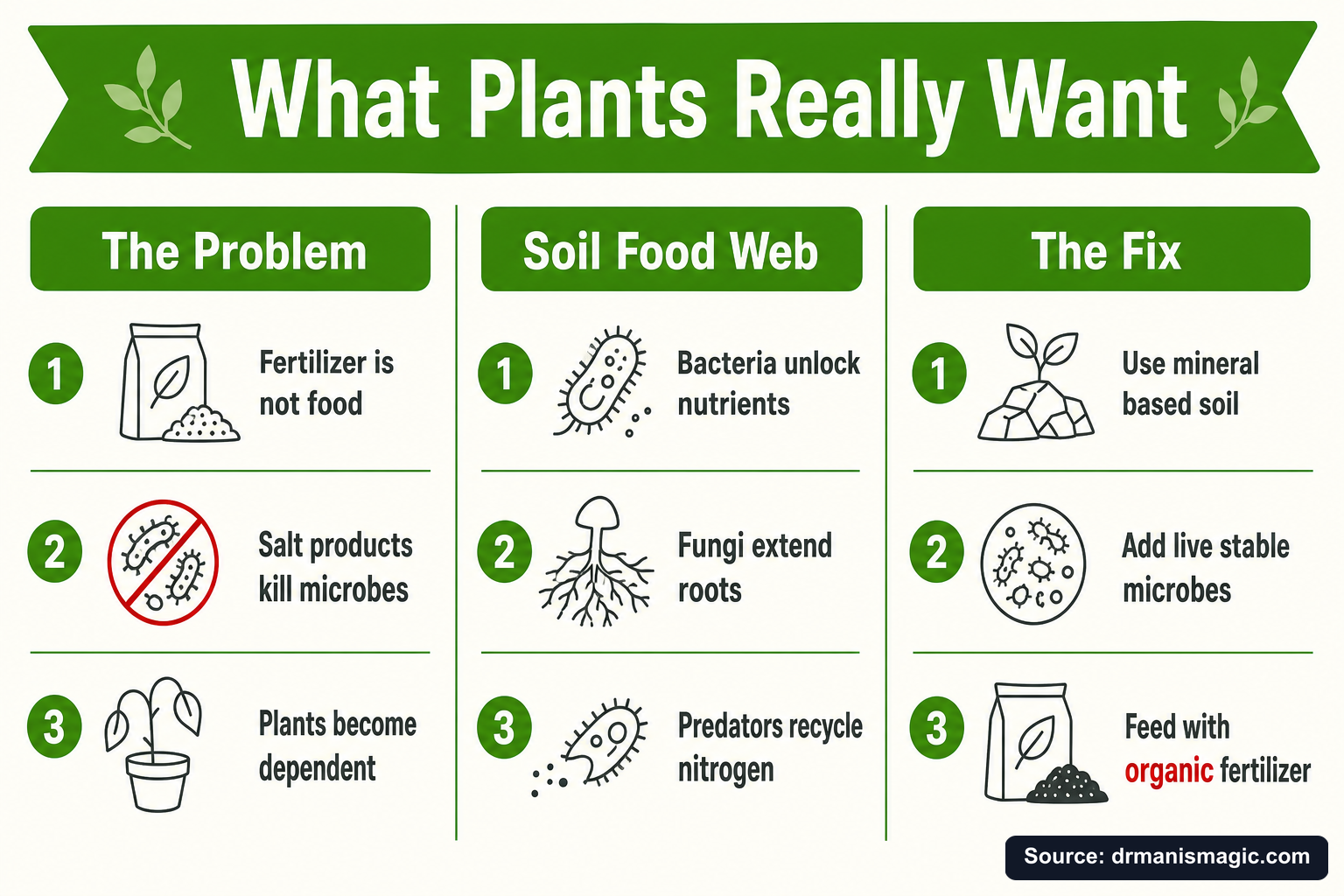
- Plants are not asking for more fertilizer. They are asking for a living root zone full of beneficial microbes, oxygen, and balanced moisture.
- Up to 75% of plant-available nitrogen and 65% of available phosphorus come from soil biological processes, not synthetic fertilizers.
- The soil food web, including bacteria, fungi, protozoa, and beneficial nematodes, is the invisible workforce that cycles nutrients directly to your roots.
- Salt-based synthetic fertilizers quietly kill the microbes your plant depends on, creating a cycle of dependency and decline.
- Most microbe products on store shelves are either dead powder or smelly, dying liquids. Live, stabilized microbes are what actually work.
- The Three Plant Pillars (mineral-based soil, live microbials, organic fertilizer) give any plant the foundation it needs to become nearly bulletproof.
- Damaged soil can recover, but it takes the right steps and consistent biology. You can start today.
Why Do Plants Struggle Even When You Fertilize Them?
Quick Answer: Most fertilizers are salt-based, which means they kill the beneficial microbes your plant needs to absorb nutrients. Without living soil biology, your plant can't access what's already in the ground. You end up feeding the bag's numbers, not the plant's actual roots.
Here is the part nobody tells you at the garden center.
Plants do not eat fertilizer the way you eat a sandwich. They cannot just scoop up nitrogen and phosphorus directly from the soil. Most of those nutrients are locked inside organic matter, mineral particles, and the atmosphere. They need to be unlocked.
Who does the unlocking? Microbes.
According to University of Minnesota Extension, soil biological processes supply roughly 75% of plant-available nitrogen and 65% of available phosphorus. That means the majority of what your plant eats comes from living organisms in the soil, not the bag you bought.
So when you pour salt-based synthetic fertilizer onto your soil, here is what actually happens. The high salt concentration acts like a desert to microscopic life. It pulls water out of bacterial cells through osmosis and kills them. The very workers your plant needs to unlock nutrients get wiped out. The plant gets a quick sugar rush from the soluble salts, looks green for a week, and then crashes harder than before.
And now the fertilizer company gets to sell you another bag.
Dr. Mani Skaria, plant pathologist, Professor Emeritus, and founder of the Clean Citrus Program in Texas, watched this cycle play out for decades. After growing over 250,000 trees at US Citrus Nursery in South Texas, he knew the answer was not another chemical. It was the invisible life beneath the surface. The soil food web.
See also: Why Most Fertilizers Are Actually Salt in Disguise
What Is the Soil Food Web and Why Should You Care About It?
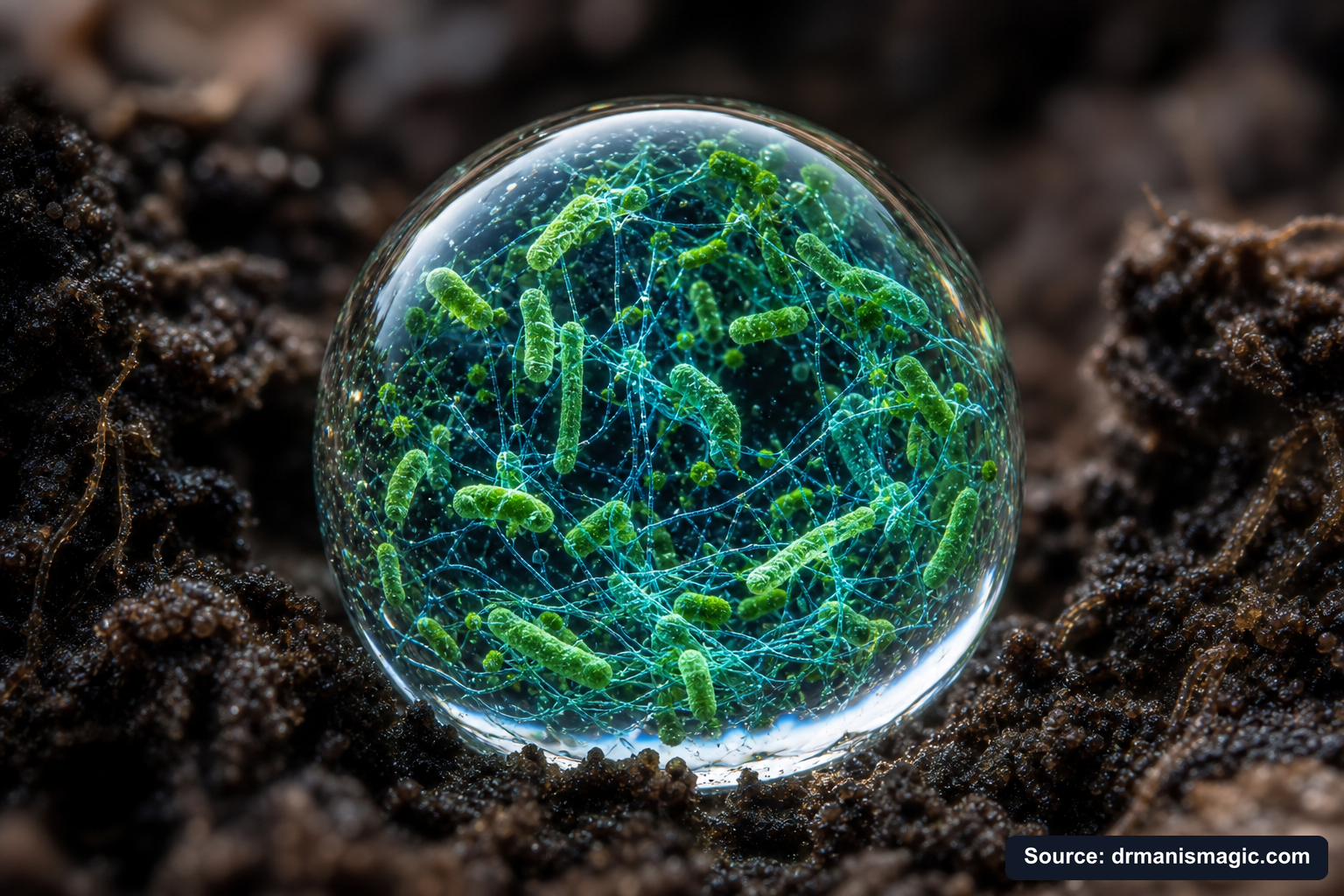
Quick Answer: The soil food web is the community of living organisms in healthy soil that work together to feed your plant. Bacteria break down organic matter. Fungi extend root reach. Protozoa and nematodes eat bacteria and release plant-available nutrients. Together, they run a nutrient recycling system that no fertilizer bag can replicate.
Walk into any old-growth forest. Nobody is fertilizing those trees. Nobody is watering them on a schedule. Nobody is buying bags of slow-release pellets and sprinkling them around the base of a 200-year-old oak. And yet those trees are magnificent.
How?
The answer is right under your feet. Colorado State University Extension describes healthy soil as a living ecosystem, not an inert medium. Inside that ecosystem is an entire workforce that never clocks out.
Here is how the system works, layer by layer.
Bacteria are the first responders. Billions of them live in a thin layer of soil right around your roots called the rhizosphere. They break down organic material and release nutrients in forms roots can actually absorb. They also produce compounds that help build soil structure and fight off harmful organisms.
Fungi, especially mycorrhizal fungi, are the long-distance haulers. They grow thread-like structures called hyphae that extend your plant's root system by hundreds of times. Those threads reach pockets of phosphorus, water, and micronutrients that roots alone could never find. If you have ever pulled up a weed and seen fuzzy white threads clinging to the roots, those are mycorrhizae. That is exactly why weeds grow so aggressively. They have a fungal army working for them. Your plants deserve the same.
Protozoa are the overlooked heroes. Most soil biology content skips right over them. But here is what they do. Protozoa eat bacteria. And when they eat bacteria, they release ammonium, which is plant-available nitrogen, directly into the root zone. They are essentially a slow, steady nitrogen delivery system operating inches from your roots. No truck, no bag, no schedule.
Beneficial nematodes play a similar predator role. They graze on bacteria and fungi, releasing nutrients through the same cycle. Some also attack soil-dwelling pests and harmful pathogens, acting as a natural pest defense system.
Together, these organisms form the soil food web. A self-sustaining, nutrient-cycling, plant-feeding machine. Built by nature. Destroyed by modern gardening habits.
| Organism | Primary Job | Benefit to Your Plant |
|---|---|---|
| Bacteria | Break down organic matter, fix atmospheric nitrogen, suppress pathogens | Release plant-available nutrients; fight root disease |
| Mycorrhizal Fungi | Extend root system through hyphae, solubilize phosphorus | Dramatically increase water and nutrient uptake; drought tolerance |
| Protozoa | Eat bacteria and release ammonium in the root zone | Steady nitrogen delivery right where roots can grab it |
| Beneficial Nematodes | Graze on bacteria and fungi, attack soil pests | More nutrient cycling; natural pest suppression |
| Earthworms | Physically restructure soil, create air channels | Better drainage, aeration, and nutrient distribution |
What Does the Rhizosphere Actually Mean for Your Plant's Health?
Quick Answer: The rhizosphere is the thin zone of soil right around your roots. It is the most biologically active place in any garden. Roots feed microbes with sugar through their root tips, and microbes deliver nutrients and protection in return. Damage this zone and your plant loses its entire support system.
Imagine your plant's roots as a neighborhood. The streets are the root channels. The businesses are the microbes. And the currency that keeps everything running is a sugary liquid that roots actually secrete on purpose.
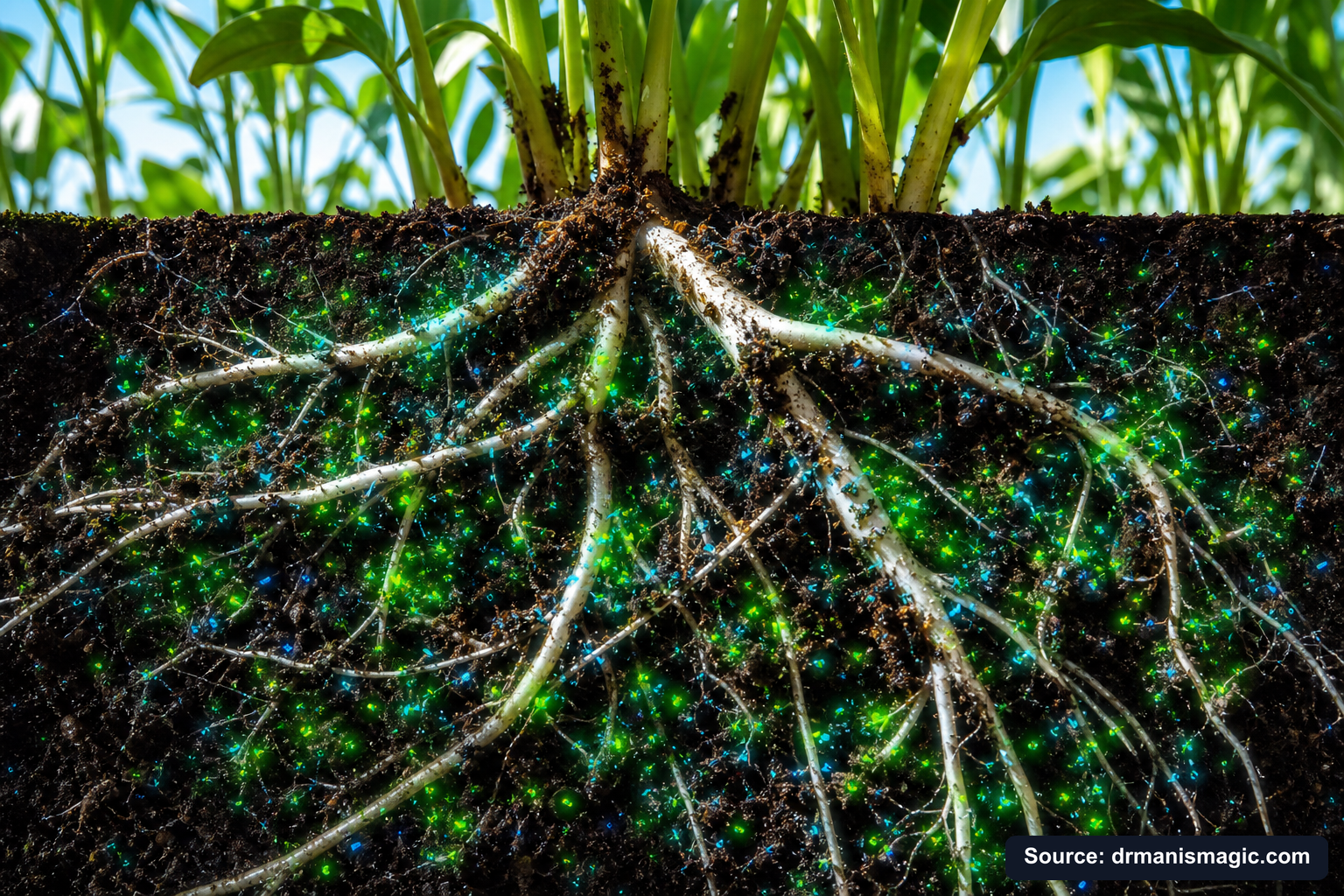
Plants are not passive. They actively pump sugars, amino acids, and other compounds out of their root tips to attract and feed the microbes they need most. Scientists call these root exudates. Plants are essentially placing a grocery order underground, and the microbes show up to fill it.
In return, those microbes bring nutrients to the root surface that the plant cannot reach on its own. They produce hormones that stimulate root growth. They form physical barriers against pathogens. They build the kind of soil structure that holds just enough water without drowning the roots.
It is a negotiation. A living, breathing partnership that has been running for 400 million years.
When you drench that zone with synthetic fertilizers, pesticides, or fungicides, you disrupt the negotiation. The microbes die. The roots stop secreting exudates because there is nobody to feed. The partnership dissolves. And your plant is suddenly alone in a hostile, sterile environment, completely dependent on whatever you pour on it next.
That is the trap. And it was not your fault for falling into it. It was designed that way.
What Kills the Microbes in Your Soil and How Bad Is the Damage?
Quick Answer: Salt-based synthetic fertilizers, herbicides like glyphosate, broad-spectrum pesticides, and synthetic fungicides all destroy beneficial soil microbes. The damage can be severe and long-lasting. Container soils and potting mixes start sterile and have no biology at all. Recovery requires consistent reintroduction of live microbes alongside the right soil and fertilizer conditions.
Let's talk about what is actually happening in that bag of potting mix you bought.
It started sterile. Most commercial potting mixes are made from pine bark, wood chips, and peat. These materials are processed, often heat-treated, and contain almost no living biology. They are essentially inert. No bacteria. No fungi. No protozoa. No soil food web at all.
Then you add a synthetic fertilizer. The high salt concentration in that fertilizer creates an osmotic environment that would kill or impair any microbes that managed to find their way in. So now you have sterile media plus a microbial death sentence.
Add a fungicide to protect against root rot, and you have just wiped out the beneficial fungi your plant uses to extend its root system and fight disease in the first place.
This is the cruel irony. The products sold to protect your plant are often the exact products destroying its underground support system.
And over time, even garden beds in the ground take a beating. Decades of herbicide use, synthetic fertilizer applications, and pesticide treatments have left many American soils biologically depleted. The organisms that once made those soils rich and productive have been quietly eliminated.
The good news is that soil can recover. It takes the right inputs, time, and a commitment to stop doing the things that caused the damage. We will walk you through exactly how in a moment.
See also: The Hidden Reason Synthetic Fertilizers Cause Root Rot
Are Most Microbe Products on the Market Actually Alive?
Quick Answer: Most commercial microbe products are either dried powders with low viability or liquids that have gone anaerobic and are actively dying. After testing dozens of products at US Citrus Nursery, we found that dried lab-grown microbes showed no measurable benefit. Only genuinely live, stabilized microbes from a compost-derived source produced real results.
This is the part that might surprise you.
Walk down the garden aisle at any big box store and you will find shelves full of microbial products. Bags of powder. Little bottles with impressive-sounding organisms listed on the label. They all promise to transform your soil. And almost none of them work.
Here is why.
Most of these products are made in large industrial facilities. Companies can order specific bacterial or fungal strains off a checklist, grow them in giant fermentation vats, then dry them into powder. The idea is that the dormant spores will reactivate when you add water and pour them into soil.
In theory, it sounds reasonable. In practice, it fails almost every time. After testing dozens of batches on our 250,000-plus trees at US Citrus Nursery, we saw no meaningful response from dried, lab-grown microbe products. The reactivation rates are too low. The organisms are the wrong species for your specific soil environment. And there is no food web context for them to plug into.
The second type is the compost tea approach. Some companies harvest microbes from compost or worm castings and bottle them as a liquid. Fresh compost tea is genuinely powerful. But here is the problem. The moment those microbes are bottled and sealed, they start consuming the available oxygen. Within 24 to 48 hours, the environment goes anaerobic. The beneficial aerobic microbes die. The bottle starts to smell like a swamp, or worse. By the time it reaches your doorstep, you are pouring dying organisms onto your plant and hoping for the best.
You can usually tell by the smell. If it smells like rotting sewage, the biology is gone. What you have left is some humic acid and a bad odor.
There is a third approach that does not belong in your soil at all. Lactobacillus, the same bacteria in your yogurt, is easy to grow and stays alive for a long time. Some products use it because it is cheap and viable. But lactobacillus is an aggressive colonizer that crowds out the beneficial organisms your plant actually needs. It belongs in your gut, not your garden.
| Product Type | Viability at Use | Microbial Spectrum | Odor | Real-World Result |
|---|---|---|---|---|
| Dried powder (lab-grown) | Very low | Narrow (1-3 species) | Minimal | No measurable benefit in our testing |
| Dried powder rehydrated into liquid | Very low | Narrow | Minimal | Same issue; avoid |
| Compost tea, fresh under 24 hours | Moderate (if aerated) | Broad | Earthy | Strong results but very time-sensitive |
| Compost tea, over 24 hours (bottled) | Low (anaerobic) | Partial | Strong stench | Microbes dying; not recommended |
| Lactobacillus-based products | High | Single aggressive species | Low | Crowds out beneficial organisms; avoid |
| Plant Super Boost (stabilized, full-spectrum) | High | 2,000+ bacteria species; 400-500 fungi incl. mycorrhizae; protozoa and nematodes | Earthy, not foul | Live microbes confirmed under microscope and by lab analysis |
You Never Had a Brown Thumb.
You were handed the wrong tools. This free guide hands you the right ones.
You watered it. You fed it. It died anyway.
It was never you. It was the dirt, the salt food, and the bad advice.
This guide shows you what really went wrong, and how to fix it for good.
- Why your plants really died, and why it was never your fault
- The salt hiding in your plant food that quietly burns the roots
- The hidden killer in almost every bag of store soil
- The tiny helpers that grow a whole forest for free
- The rescue trick that brings a half dead plant back to life

How Did Dr. Mani's Magic Solve the Dead Microbe Problem?
Quick Answer: Dr. Mani's Magic Plant Super Boost uses a proprietary all-natural stabilization technique to keep a full spectrum of compost-derived microbes genuinely alive in the bottle, without going anaerobic or producing odor. The microbes are visible under a microscope and confirmed alive by independent lab analysis. It smells earthy because it is not rotting.
The solution came from an unlikely partnership.
Dr. Mani Skaria spent decades searching for what actually worked. Not what the chemical companies claimed worked. What actually, measurably made plants healthier and stronger. Through what can only be described as a providential meeting, he connected with a world-famous compostologist. This was a man who had advised royal families and governments on farming practices across the globe, a man who had been quietly blacklisted by large chemical companies after citrus groves started showing dramatic results with his methods.
This expert knew a secret. Not just that microbes mattered, which most people in the field already understood. He knew how to keep them alive in a bottle without going anaerobic. Without the stench. Without the death spiral that turns a promising product into swamp water.
That technique became the foundation of Plant Super Boost.
The microbes in Plant Super Boost are not grown in an industrial lab and dried into a powder. They are harvested from actively managed, hand-crafted compost, the same way nature produces them. They include over 2,000 species of bacteria, 400 to 500 species of fungi including mycorrhizae, plus protozoa and beneficial nematodes. A complete, full-spectrum soil food web in a bottle.
Then, using that natural stabilization technique, they are preserved alive without fermentation and without oxygen depletion. The result is a product that smells earthy, not foul, because nothing is rotting. And if you take a drop of Plant Super Boost and look at it under a microscope, you will see movement. Living organisms, visibly active, ready to go to work the moment they hit your soil.
Zero PFAS. Zero biosludge. Zero synthetic salts.
The compostologist eventually joined the Dr. Mani's Magic team at US Citrus Nursery. Together, they built a system to bypass the big chemical companies and big box stores entirely and bring genuinely live biology directly to the everyday gardener. Made in the USA, tested on 250,000 trees, and backed by a 30-day money-back guarantee.
What Are the Three Plant Pillars and Why Do All Three Matter?
Quick Answer: The Three Plant Pillars are mineral-based soil, live microbials, and organic fertilizer. They work together as a system. Miss one and the other two underperform. Get all three right and your plant has the foundation to grow strong, fight disease, and produce fruit or flowers the way nature intended.
After 30-plus years of growing citrus, houseplants, and tropical trees in South Texas, Dr. Mani identified the three things that separate thriving plants from struggling ones. He called them the Three Plant Pillars.
Think of it like a three-legged stool. Pull out one leg and the whole thing falls over.
Pillar One: Mineral-Based Soil. Most potting mixes are made from pine bark, sawdust, and other organic materials that decompose over time. As they break down, they compact. They steal oxygen from roots. They create the perfect environment for root rot. And within six to twelve months, what looked like good soil turns into a root-choking sludge.
Mineral-based soil does not decompose. It is built from silica-rich sandy loam from the Rio Grande Valley. It holds its structure permanently. Roots breathe. Water drains. And the soil you plant in today is the same quality soil two years from now. You stop the cycle of re-potting, re-purchasing, and wondering why your plant keeps declining.
Pillar Two: Live Microbials. This is the invisible workforce we have been talking about throughout this entire article. Bacteria, fungi, protozoa, and beneficial nematodes. They unlock nutrients, protect roots, fight pathogens, and build the kind of soil structure that makes everything else work. Without them, even the best soil and the best fertilizer underperform.
Pillar Three: Organic Fertilizer. Not synthetic salts. Organic, slow-release nutrition from crab, kelp, and amino acids. These inputs feed the plant gently, the way nature intended, without burning roots or killing the microbes from Pillar Two. They supply the full spectrum of macronutrients, micronutrients, hormones, and carbohydrates that support healthy growth over the long term.
When all three pillars are in place, something shifts. The plant stops struggling and starts thriving. You stop chasing problems and start harvesting results.
Does Fungicide Use Destroy Mycorrhizal Networks in Your Soil?
Quick Answer: Yes. Synthetic fungicides do not distinguish between harmful pathogens and beneficial mycorrhizal fungi. Regular fungicide applications can significantly reduce or eliminate mycorrhizal networks in your root zone, removing one of your plant's most important nutrient-gathering and disease-fighting allies.
This is one of the most common traps in modern gardening.
You notice a little fungal problem on your plant. You apply a fungicide. The visible problem goes away. But underground, the beneficial mycorrhizal network your plant spent months building gets wiped out at the same time.
Now your root system is smaller. Your plant's access to phosphorus drops. Its drought tolerance weakens. Its disease resistance decreases. And because the mycorrhizal fungi that help build soil aggregation are gone, your soil structure starts to deteriorate too.
A few weeks later, another problem appears. You reach for another product. The cycle continues.
This is why the approach at Dr. Mani's Magic focuses on building a biology-rich root zone that is resilient enough to suppress pathogens on its own, rather than reaching for a fungicide every time something goes wrong. When beneficial microbes are thriving and diverse, they crowd out harmful organisms through competition. They produce compounds that inhibit pathogens. They build the kind of immune system underground that makes chemical intervention less necessary.
Prevention, not reaction. Biology, not chemistry.
How Do You Recover Soil That Has Been Damaged by Chemicals or Salt?
Quick Answer: Damaged soil can recover, but it requires stopping the inputs that caused the harm, restoring drainage and oxygen, adding live microbes consistently, feeding biology with organic matter, and giving the system time. Recovery is not instant, but most soils show meaningful improvement within one growing season when the right steps are followed.
This is the question we hear most often. "I've been using synthetic fertilizers for years. My soil looks dead. Is it too late?"
It is almost never too late. But recovery requires a real plan, not just swapping one product for another.
Here is the step-by-step recovery process we recommend based on decades of work at US Citrus Nursery:
- Stop the inputs that are causing harm. This means no more salt-based synthetic fertilizers, no broad-spectrum herbicides, and no preventative fungicide applications if you can avoid them. You cannot rebuild biology while continuing to destroy it.
- Check drainage. Compacted, waterlogged soil is hostile to aerobic microbes. If water pools around your plant for more than a few hours after watering, you have an oxygen problem. Loosen the soil if possible, or consider repotting into mineral-based soil that drains freely.
- Leach salt buildup. If your soil has been receiving synthetic fertilizers for years, salt has accumulated. Deep, thorough watering can help flush excess salts below the root zone. Do this before you start rebuilding biology.
- Add live, full-spectrum microbes. This is the most critical step. Apply a genuinely live microbial inoculant monthly. Not dried powder. Not smelly liquid. Live organisms that can establish, multiply, and begin rebuilding the food web.
- Feed the biology with organic matter. Compost, organic mulch on the surface, and organic fertilizers all give microbes the carbon they need to thrive. Without food, even live microbes cannot sustain themselves.
- Keep living roots in the soil. Roots feed microbes through exudates. Bare soil between plants loses biology faster. Keep something growing to maintain the root-microbe partnership.
- Be patient and consistent. Biological recovery is not a one-time event. It takes several months of consistent support. But within one growing season, most growers see measurable improvement in root health, plant color, disease resistance, and overall vigor.
You can get money back. You cannot get time back. The best time to start was last season. The second best time is right now.
Live Microbes vs. Dried Microbes: Which One Actually Works in Real Gardens?
Quick Answer: Live, compost-derived microbes with a full spectrum of species consistently outperform dried, lab-grown powders in real garden conditions. Dried products have poor reactivation rates and a narrow species range. Live products that maintain viability through natural stabilization deliver the diverse, active biology that soil food webs require.
Let's make this comparison simple.
Think about the difference between a living forest floor and a bag of mulch from a hardware store. One is teeming with billions of organisms working in complex, interrelated cycles. The other is processed, inert, and biologically empty.
Dried microbe powders are closer to the bag of mulch. The organisms were once alive. They may have been impressive in a lab setting. But by the time they go through the drying process, sit in a warehouse, ship to a store, sit on a shelf, and finally reach your hands, the viability is a fraction of what the label implies. And even if some do reactivate, they are typically two or three isolated species dropped into a complex ecosystem they were never part of. They do not integrate. They do not thrive. And in our testing across 250,000-plus trees, we did not see the results.
Live, stabilized, compost-derived microbes are different. They come from a biologically active source. They include the full web of organisms that naturally work together: bacteria that fix nitrogen, fungi that extend roots, protozoa that cycle nutrients, nematodes that suppress pests. And when they are preserved through a natural stabilization method that keeps them aerobic and active, they arrive at your plant ready to work.
That is the difference between a product that looks impressive on a label and one that actually changes what happens underground.
What Can You Do Starting Today to Give Your Plants What They Actually Need?
Quick Answer: Start with the Three Plant Pillars: get your soil structure right, add live microbes monthly, and switch to organic fertilizer that feeds your plants without killing the biology you are building. Even one change, like adding live microbials to what you are already doing, will produce noticeable results within weeks.
You do not have to overhaul everything at once.
But here is what we know after 30-plus years of growing, testing, and watching plants respond. The moment you stop fighting nature and start working with it, everything gets easier. Plants that used to struggle start to show new growth. Leaves that were yellowing come back green. Roots that were weak and shallow start to push deeper.
The brown thumb disappears. Because it was never yours to begin with.
Dr. Mani built the Three Plant Pillars framework because he wanted to give any gardener, regardless of experience, a first-principles foundation that works. Mineral-based soil that breathes. Live microbes that do the invisible heavy lifting. Organic fertilizer that feeds without burning.
One of the most common things people tell us is that they want to see their tree bear fruit in their lifetime. They want to walk outside, reach up, and pull something they grew from their own branch. That desire is as old as humanity itself. We were made to tend gardens. The drive to grow something has never left us.
But here is the hard truth. If you keep doing things the old way, with salt-based fertilizers and dead potting mixes and no living biology, you will keep losing time. A few months of progress, then a stall, then a slow decline. More money, more frustration, more years gone. The worst part is not the money. It is the time you cannot get back.
You deserve a system that actually works. One built on the laws of nature, not the marketing budgets of chemical companies.
Download the Free Plant Care Field Guide from Dr. Mani's Magic to see the full Three Plant Pillars system laid out step by step, in plain language, with no guesswork. It is the same foundation we use for every tree, garden, and houseplant in our South Texas nursery. And it is yours, free, because education is 90% of what we do here.
Your plants have been asking for the right thing all along. Now you know what it is.
Frequently Asked Questions
Plants are not mysterious. They follow simple laws of nature. Once you understand what they are really asking for, everything clicks into place. These are the questions we hear most from gardeners who are tired of guessing and ready to grow something real.
Why do my plants keep struggling even when I fertilize them?
Most fertilizers are salt-based. That salt kills the beneficial microbes in your soil. And those microbes are the ones that actually unlock nutrients for your plant roots. Without living soil biology, your plant cannot absorb what it needs, no matter how much fertilizer you pour on. You end up feeding a number on a bag, not your actual plant. Dr. Mani proved this over 30 years and 250,000 trees in South Texas. The fix starts underground, not on a shelf.
What do plants actually need to thrive?
Plants need three things working together. First, mineral-based soil that drains well and lets roots breathe. Second, live microbes in the soil that unlock nutrients and fight off disease. Third, organic fertilizer that feeds slowly and does not burn. Dr. Mani calls these the Three Plant Pillars. When all three are in place, your plant stops struggling and starts growing the way nature intended. Miss even one pillar and you are fighting uphill the whole time.
Is it true that I just have a brown thumb?
No. That is a lie the big chemical companies benefit from. A brown thumb is not a personality trait. It is a symptom of bad information and bad inputs. You were sold salt-based fertilizers that burn roots. You were sold sawdust-based potting mix that rots and chokes roots. Nobody told you about the living soil biology your plant depends on. Once you fix the foundation with the right soil, live microbes, and organic fertilizer, the brown thumb disappears. We have seen it happen thousands of times.
What is the most important thing missing from most potting soil?
Oxygen and permanence. Most potting mixes are filled with pine bark and wood chips that break down fast. As they decompose, they compact around roots and cut off airflow. Roots need oxygen to grow. Dr. Mani's Magic Super Soil is built on mineral-based sandy loam from the Rio Grande Valley. It does not break down. It stays loose and airy for years. Your roots can breathe, spread, and pull in nutrients the way they are supposed to.
Do live microbes really make a difference for any plant?
Yes, for every plant. Grass, flowers, fruit trees, houseplants, vegetables. All of them depend on soil biology. Bacteria and fungi break down organic matter and deliver nutrients directly to roots. They also protect against disease and root rot. Dr. Mani's Magic Plant Super Boost contains live, stabilized microbes that arrive active and ready to work. Most products on store shelves have dead powder or dying liquid. Live microbes are what actually move the needle, and we tested this on over 250,000 citrus trees before bringing it to you.
How long before I see results from switching to the Three Plant Pillars?
Most people notice a difference within 30 days. Roots strengthen first, then you start seeing new growth, deeper color, and better resistance to stress. The longer you stay with the system, the stronger your plants become. Here is what matters most though. Every month you spend using salt-based fertilizers and dead soil is a month of growth you cannot get back. You can always earn more money. You cannot earn more time. The best day to start is today.
Are Dr. Mani's Magic products safe for kids, pets, and the environment?
Yes. The entire Dr. Mani's Magic line is built around organic inputs. No synthetic salt fertilizers. No plastic-coated slow-release chemicals. No harsh pesticides. The Crab, Kelp, and Amino Acids fertilizer does not smell bad either, which is a real problem with fish emulsion products. You can walk barefoot in your yard. Your dog can roll in the grass. Your kids can play in the garden. Everything is made in the USA and designed to work with nature, not against it.
About the Author
Dr. Mani Skaria, PhD
Dr. Mani Skaria, PhD, is a plant pathologist and the scientific founder of Dr. Mani's Magic. He earned his doctorate at Purdue University and spent 48 years studying how plants, soil, and living microbes work together, including his years as Professor Emeritus at Texas A&M and as a member of the USDA NAREEE Advisory Board. He invented micro-budding, a method for growing healthier, stronger trees, and has grown more than 250,000 trees on the family farm in Hargill, Texas - US Citrus Nursery. His life's work takes real lab science and practical experience and turns it into simple, safe, organic plant care anyone can use at home.


