


Why Healthy Growth Starts Underground: The Soil Food Web Explained | Dr. Mani's Magic
Why Healthy Growth Starts Underground: The Invisible World Your Plants Can't Live Without
Picture this. You walk out to your backyard on a Saturday morning, coffee in hand. The air smells like fresh earth after rain. You look at your lemon tree, your rose bed, your potted fig by the patio. You've watered. You've fertilized. You've done everything the bag told you to do.
But something is off. The leaves are a little pale. Growth has slowed. A few yellow leaves flutter to the ground. You feel that familiar knot in your stomach. The one that says, "Am I losing it again?" You've spent real money. Real time. And the clock keeps ticking. Because here's the truth most gardening advice will never tell you: the problem almost certainly started before you ever saw a single symptom. It started underground, weeks or months ago, in a world so small you can't see it with your naked eye.
What lives beneath your soil determines everything that grows above it. The color of your leaves. The weight of your fruit. The smell of your flowers. The strength of your lawn. And once you understand what's really happening down there, gardening stops feeling like guesswork and starts feeling like magic. That's exactly what Dr. Mani Skaria discovered after 40 years of plant science and 250,000 trees grown at US Citrus Nursery in South Texas. This is that story.

Plant Super Boost
Key Takeaways
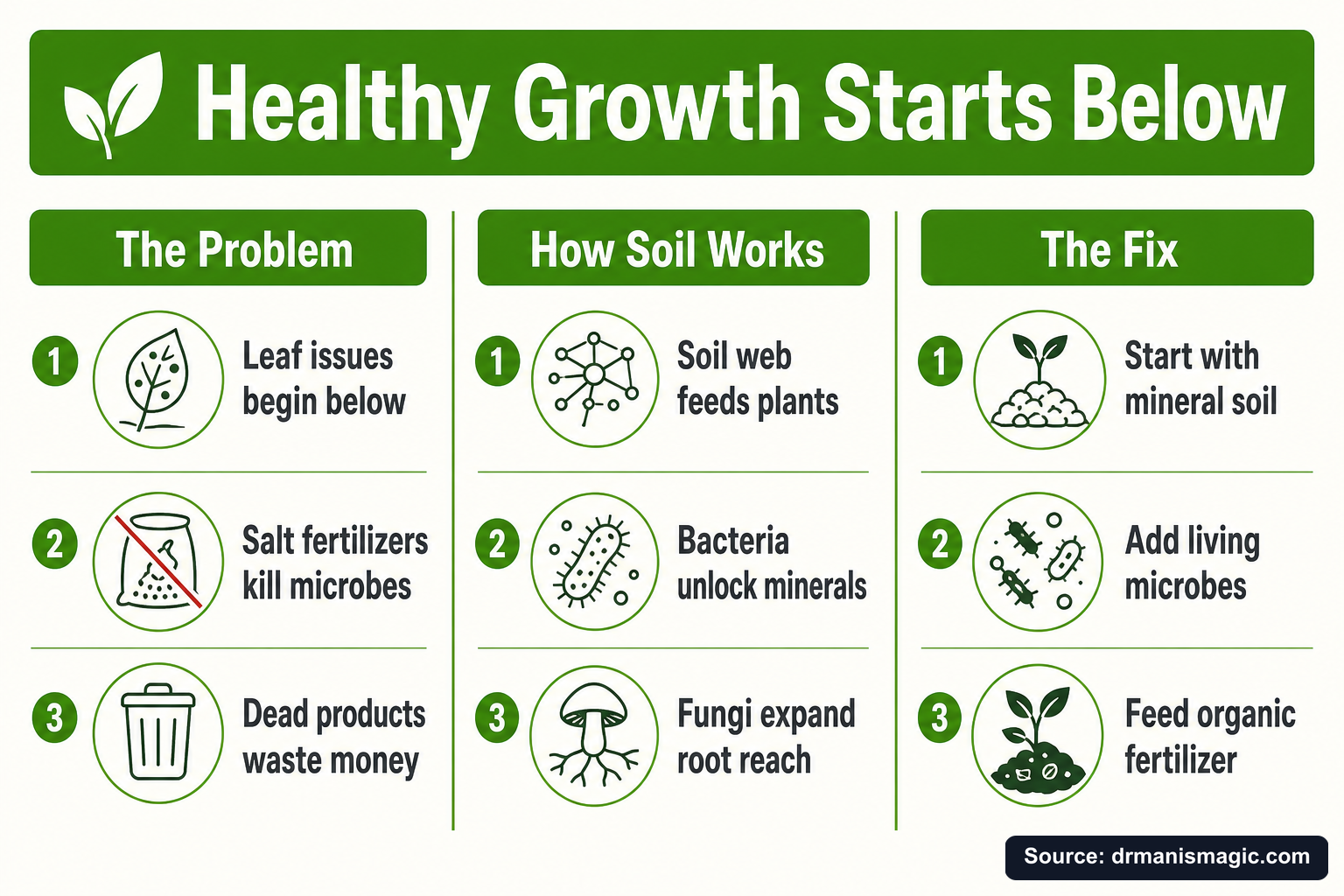
- Healthy plant growth is controlled underground, in the root zone, long before any leaf or flower shows a problem.
- The soil food web is a living chain of bacteria, fungi, protozoa, nematodes, and earthworms that converts raw minerals and organic matter into food plants can actually use.
- Mycorrhizal fungi can extend your plant's root reach up to 700 times, dramatically improving water and nutrient absorption.
- Salt-based synthetic fertilizers kill the beneficial microbes your plants depend on, creating a cycle of dependency that hurts long-term growth.
- Most microbial products on the market are either dried and dead or rotting in a smelly bottle by the time you pour them.
- The Three Plant Pillars (mineral soil, live microbes, organic fertilizer) work together as a system. Missing any one breaks the chain.
- Damaged soil biology can be restored, but it takes the right inputs, in the right order, applied consistently over time.
What Is Actually Happening in Healthy Soil Right Now?
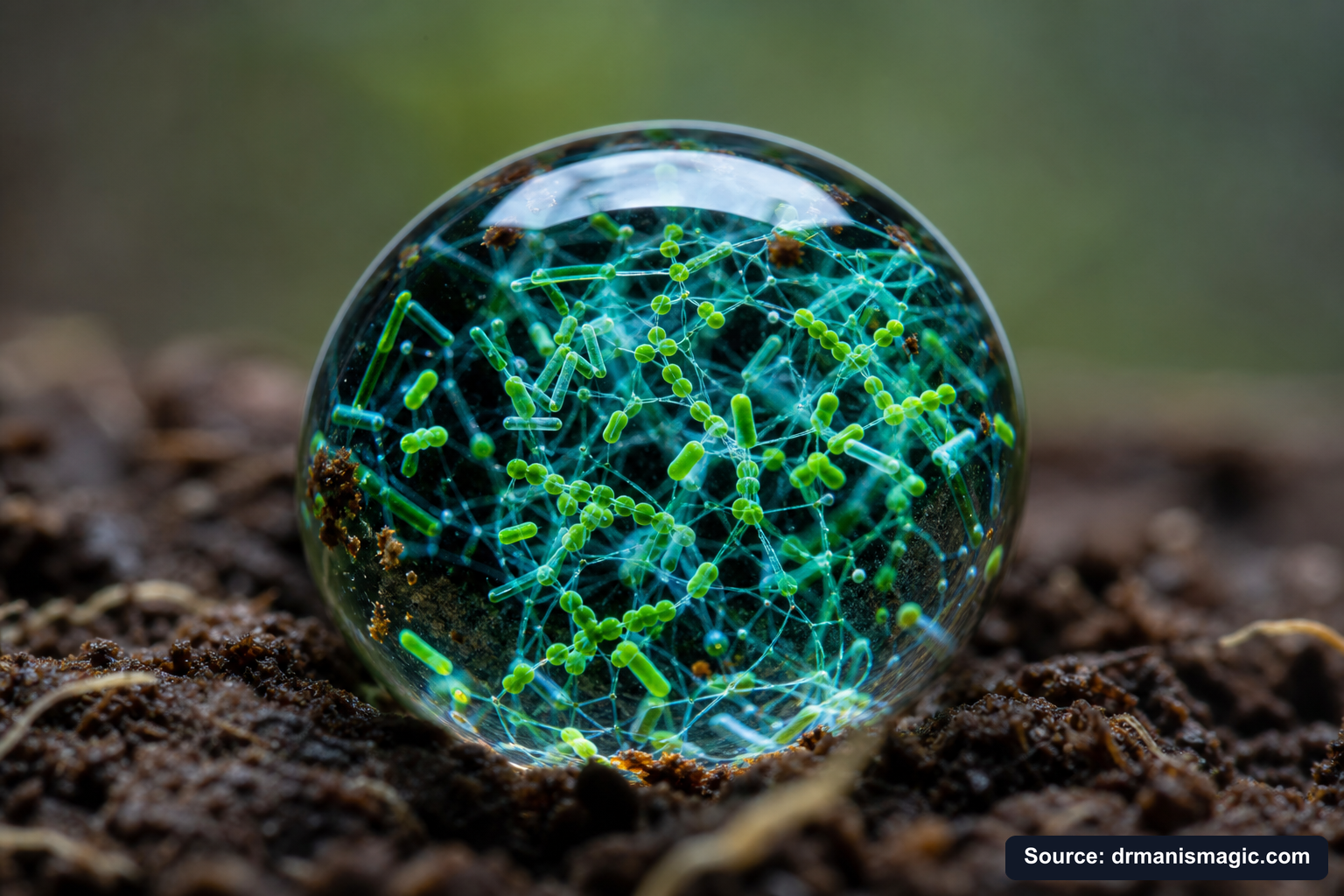
Quick Answer: Healthy soil is not just dirt. It is a living ecosystem packed with billions of bacteria, fungi, protozoa, nematodes, and tiny animals that work together to feed your plants, protect their roots, build soil structure, and manage water. This underground workforce does more for your plant than any bag of fertilizer ever could.
Reach down and grab a handful of healthy garden soil. Really feel it. It is loose and crumbly. It smells earthy, almost sweet. That smell has a name: geosmin. It is produced by bacteria called actinomycetes, and your nose can detect it at concentrations as low as 5 parts per trillion. You are literally smelling life.
That single handful holds more living organisms than there are people on Earth. We are talking billions of bacteria, miles of fungal threads, thousands of protozoa, and entire populations of microscopic worms called nematodes. This is the soil food web. And it is the engine behind every healthy plant you have ever seen.
According to the Utah State University Extension, the soil food web describes the community of organisms living all or part of their lives in the soil. These organisms cycle nutrients, build structure, and create the conditions that allow plants to thrive. Without them, soil is just ground-up rock.
Here is the part that will change the way you look at every plant you own. Your plant's roots are not passive pipes just sitting there waiting to absorb water. They are active participants in a two-way conversation with the underground world. Roots release sugars, amino acids, and other compounds called root exudates. They do this on purpose. They are feeding the microbes that live around them. In return, those microbes unlock nutrients the plant cannot reach on its own, fight off disease organisms, and build the physical structure that lets roots breathe and expand. It is a deal that has been running for 400 million years.
When you disrupt that deal, with chemical salts, with sterile potting mix, with fungicides that kill everything indiscriminately, you do not just slow growth. You break the oldest partnership in plant history.
Who Are the Members of the Soil Food Web and What Does Each One Do?
Quick Answer: The soil food web is made up of bacteria, fungi, protozoa, beneficial nematodes, and larger animals like earthworms. Each plays a unique role: bacteria and fungi lock up and transform nutrients, protozoa and nematodes graze on those microbes and release nutrients right next to the roots, and fungi build soil structure and extend the root's reach. Together, they run a natural timed-release fertility system.
Most gardening content talks about bacteria and fungi, then stops. That leaves out the most interesting part of the story. Let's walk through the whole cast, because every player matters.
Bacteria: The Nutrient Miners
Bacteria are the most abundant life forms in soil. A single teaspoon of healthy soil contains between 100 million and 1 billion bacterial cells. They break down organic matter, convert atmospheric nitrogen into forms plants can use, and release minerals locked in rock particles. They are also fast. A bacterial population can double in as little as 20 minutes under ideal conditions. Think of bacteria as the foundation crew. They process the raw materials.
Fungi: The Web Builders and Long-Distance Haulers
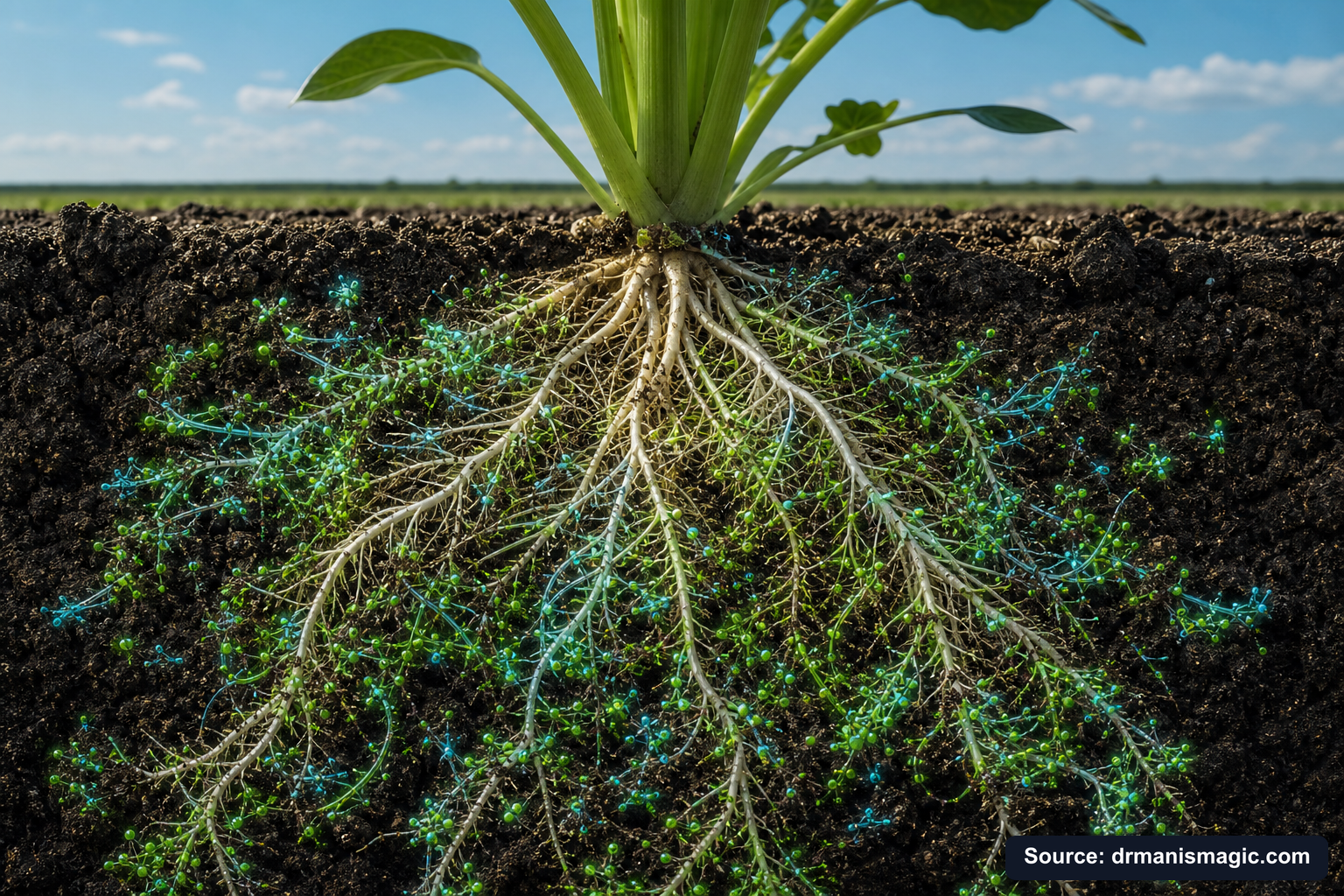
Fungi grow as long, thread-like structures called hyphae. These threads weave through soil, connecting particles and creating aggregates that keep soil loose and well-drained. But the real headline is mycorrhizal fungi. These form a direct partnership with plant roots, physically extending them. One study from Rutgers University Extension notes that mycorrhizal networks can expand a plant's effective root surface area by as much as 700 times. That means more water. More phosphorus. More minerals. Pulled from a vastly larger zone of soil than the roots could ever reach alone.
Here is something most people have never noticed. Pull up a healthy weed from your garden. Look at the roots closely. See those fuzzy white threads clinging to them? That is mycorrhizae. That is why weeds grow so aggressively. They have a fungal partner working overtime on their behalf. Your garden plants deserve the same advantage.
Protozoa: The Nutrient Releasers Nobody Talks About
This is where it gets really interesting. Protozoa are single-celled organisms that feed on bacteria. They graze on the bacterial population like tiny cattle. When they eat bacteria, they cannot use all the nitrogen inside those bacterial cells. So they release the excess as ammonium, right next to the roots, right where the plant can grab it. This is the predator-prey nutrient release mechanism. It is one of the most important processes in soil fertility, and almost nobody talks about it. The protozoa are essentially running a just-in-time delivery service for plant-available nitrogen.
Beneficial Nematodes: The Pest Police and Nutrient Cyclers
Not all nematodes are bad. Most are. But beneficial nematodes prey on harmful ones, on soil-dwelling pest larvae, and on bacteria and fungi. They do for nutrient cycling at a slightly larger scale what protozoa do at the microscopic scale. They also release plant-available nitrogen when they feed. Beneficial nematodes are one of nature's best built-in pest management systems, and they thrive only when the rest of the soil food web is healthy.
Earthworms: The Master Tillers
Earthworms are the heavy equipment of the soil food web. They eat organic matter and microbes, then excrete them as castings that are extraordinarily rich in plant-available nutrients. As they tunnel, they create channels that improve drainage, aeration, and root penetration. A healthy worm population is one of the best signs of living soil.
| Organism | Primary Role | Key Benefit to Your Plant | What Kills Them |
|---|---|---|---|
| Bacteria | Decompose organic matter, fix nitrogen, solubilize minerals | Nutrient availability, disease suppression, soil structure | Synthetic salt fertilizers, fungicides, herbicides |
| Mycorrhizal Fungi | Extend root surface area, transport phosphorus and water | Drought tolerance, phosphorus uptake, root growth | Synthetic fungicides, high phosphorus fertilizers, soil disturbance |
| Other Fungi | Decompose tough organic material, build soil aggregates | Soil structure, aeration, nutrient cycling | Broad-spectrum fungicides, tilling, salts |
| Protozoa | Graze on bacteria, release excess nitrogen near roots | Timed-release nitrogen delivery, bacterial population control | Drying, chemical inputs, compaction |
| Beneficial Nematodes | Prey on harmful nematodes and pest larvae, cycle nutrients | Pest management, nutrient release | Broad-spectrum pesticides, dry soils, chemical inputs |
| Earthworms | Physically till soil, produce nutrient-rich castings | Aeration, drainage, nutrient cycling | Synthetic pesticides, compaction, waterlogging |
Why Do Plant Problems Show Up in Leaves Before You Suspect the Roots?
Quick Answer: By the time you see a yellow leaf, pale color, slow growth, or dropping fruit, the root zone has usually been struggling for weeks or months. Roots and their microbial partners are the first to feel stress from salt damage, compaction, disease, or biology loss. Symptoms above ground are the last signal, not the first.
Think of your plant like a building. The leaves, flowers, and fruit are the floors you live on. The roots are the foundation. When a foundation starts to crack, you do not see it right away. The ceiling looks fine. The walls look fine. Then one day, a door will not close. Then a crack appears above a window. By then, the foundation damage has been going on for a long time.
Root problems work the same way. Yellowing leaves are not the start of a problem. They are the announcement that a problem has been building underground, quietly, for a while.
Here is what typically happens. Salt-based fertilizer is applied. The salt damages the beneficial microbes in the rhizosphere, the zone of soil right around the roots. Without those microbes, nutrient cycling slows. The plant cannot pull up iron, manganese, or zinc efficiently anymore, even if those minerals are sitting right there in the soil. A few weeks later, you notice lighter leaf color. You apply more fertilizer, which adds more salt, which kills more microbes. The cycle tightens.
Or a commercial fungicide is applied to stop a fungal disease. It works on the pathogen, but it also wipes out the mycorrhizal fungi protecting the roots. Without that fungal network, the plant loses its extended reach for water. In the next dry spell, the plant wilts faster than it should. You water more. Overwatering in soil without good microbial structure leads to waterlogging, and waterlogging leads to root rot. The original fungicide probably caused the very condition it was meant to prevent.
This is not bad luck. It is cause and effect. And it starts underground, every single time.
What Does the Rhizosphere Actually Mean and Why Should You Care?
Quick Answer: The rhizosphere is the thin zone of soil directly surrounding plant roots, roughly the width of a few grains of sand. It is the most biologically active place on Earth, packed with microbes attracted by the sugars and compounds roots release. What happens in this tiny zone determines your plant's ability to eat, drink, fight disease, and grow.
The rhizosphere is not a place you can see. It is a thin shell around each root tip, maybe a few millimeters thick. But in that tiny space, there can be up to 1,000 times more microbial activity than in surrounding soil. Roots pump out a constant stream of sugars, vitamins, and amino acids to feed the microbes they want nearby. This is called the rhizosphere effect, and it is one of the most important biological phenomena in all of plant science.
Plants are not passive. They are actively recruiting their microbial workforce, feeding it, managing it, and relying on it for survival. A plant with a rich, diverse rhizosphere community is a plant that can fight disease, handle drought, absorb nutrients efficiently, and push out strong, healthy growth above ground.
A plant in sterile potting mix, or in soil damaged by years of synthetic inputs, does not have that workforce. It is trying to grow alone. And it shows.
After more than 30 years of growing at US Citrus Nursery and testing across 250,000 trees, Dr. Mani Skaria came to a simple conclusion. The plants that thrived were the ones with the richest underground biology. Every time. Without exception. That insight became the foundation of the Three Plant Pillars.
How Do Salt-Based Fertilizers Damage the Soil Food Web?
Quick Answer: Salt-based synthetic fertilizers raise the salt concentration around roots and microbes. Microbes lose water through osmosis and die or go dormant. Mycorrhizal fungi are especially vulnerable. Over time, the living biology in your soil collapses, nutrients become locked up even though they are physically present, and your plant becomes entirely dependent on the next chemical application to survive.
Here is the thing about salt. It pulls water out of cells through a process called osmosis. That is how salt preserves meat. It pulls moisture out and kills bacteria. The same thing happens in your soil when you apply a salt-based fertilizer. The beneficial bacteria and fungi around your roots lose water. They shrink. Many die. The population crashes.
Now, a conventional fertilizer company will tell you this is fine because the plant gets a quick hit of nutrients anyway. And it does. For a while. But you have just dismantled part of the crew that was running the nutrient cycling operation. The next week, the plant has to rely on the chemical again. And the week after. The cycle deepens. Your plant becomes an addict, dependent on the next dose because its natural support system has been stripped away.
This is not a conspiracy theory. It is basic soil chemistry. Dr. Mani saw it play out across field after field, tree after tree, during his decades at the Texas A&M Citrus Center and at US Citrus Nursery. The trees that got the most synthetic fertilizer often looked the greenest for a month or two. Then they would plateau. Then they would decline. Because beneath the surface, the biology was dying.
See also: The Hidden Reason Synthetic Fertilizers Cause Root Rot
See also: How Salt-Based Feeding Quietly Destroys Root Systems
You Never Had a Brown Thumb.
You were handed the wrong tools. This free guide hands you the right ones.
You watered it. You fed it. It died anyway.
It was never you. It was the dirt, the salt food, and the bad advice.
This guide shows you what really went wrong, and how to fix it for good.
- Why your plants really died, and why it was never your fault
- The salt hiding in your plant food that quietly burns the roots
- The hidden killer in almost every bag of store soil
- The tiny helpers that grow a whole forest for free
- The rescue trick that brings a half dead plant back to life

Are Mycorrhizal Fungi Products Worth Buying or Is It Just Marketing?
Quick Answer: Mycorrhizal fungi products can be genuinely valuable, especially in sterile potting mixes, recently fumigated soil, or any container where native fungi are absent. However, most dried or powdered mycorrhizal products have very low survival rates by the time you apply them. Product viability, strain diversity, and how the microbes are preserved matter enormously. Live, full-spectrum products from non-lab sources perform far better.
The honest answer is: it depends on what you are buying.
Mycorrhizal fungi are real. Their benefits are well-documented. But the gap between a genuinely live, full-spectrum mycorrhizal product and a powdered factory product sitting on a shelf is enormous. Most products you see in big box stores are made by multiplying specific fungal strains in industrial vats, then drying them into a powder. The hope is that the spores will reactivate when they hit wet soil.
After testing dozens of these products across thousands of trees at US Citrus Nursery, Dr. Mani's team found the same result again and again. The dried, powdered, lab-grown products simply did not move the needle. The plants did not respond. The biology was not there.
Why? Because drying, shipping, and sitting on a shelf under fluorescent lights for months is brutal on living organisms. Spore survival rates drop dramatically. And even when some spores survive, lab-grown strains raised in sterile industrial conditions are not the same as microbes that evolved in actual soil ecosystems, alongside the full diversity of bacteria, protozoa, and nematodes they depend on.
There is a second problem. Some liquid microbial products are made from compost tea or earthworm castings. These can be excellent when fresh. But by the time they travel across the country and sit in a warehouse, they have often gone anaerobic. The microbes have run out of oxygen. They are fermenting. The bottle fizzes when you open it. It smells like sewage. Those microbes are dying, not working.
Then there is a third category: lactobacillus-based products. Yes, like yogurt bacteria. These are extremely vigorous and stay alive easily. But they crowd out the beneficial microbes you actually want. Lactobacillus belongs in your gut, not your garden.
| Product Type | Microbial Viability at Use | Spectrum of Organisms | Odor | Real-World Results |
|---|---|---|---|---|
| Dry/powdered lab-grown microbes | Very low | Narrow (1-5 strains) | Neutral | Minimal to no plant response seen in testing |
| Dry microbes rehydrated in liquid | Very low | Narrow | Neutral to mild | Same poor results as above |
| Compost tea, fresh (under 24 hours) | Moderate to high | Broad, natural spectrum | Earthy, slightly sour | Good when truly fresh; time-sensitive |
| Compost tea, old (over 24 hours) | Low (anaerobic) | Partial | Strong, foul smell | Diminishing returns; some humic/fulvic benefit remains |
| Lactobacillus-based products | High | Very narrow | Sour | Crowds out beneficial microbes; not recommended |
| Plant Super Boost (stabilized, full-spectrum, compost-sourced) | High | 2,000+ bacteria, 400-500 fungi including mycorrhizae, protozoa, nematodes | Earthy, not foul | Visible microbial activity under microscope; lab-verified; consistent plant response |
What Is the Dr. Mani's Magic Approach to Keeping Microbes Alive?
Quick Answer: Plant Super Boost uses a proprietary all-natural stabilization technique developed by a world-renowned compost expert to keep a full-spectrum community of bacteria, fungi, protozoa, and nematodes alive in liquid form without going anaerobic. The microbes are harvested from real hand-crafted compost, not grown in a lab, and you can see them moving under a microscope. It smells earthy because the biology is living, not rotting.
The story behind Plant Super Boost starts with a man most people have never heard of.
He was a world-famous compostologist. He had advised the farming operations of royal families and governments on multiple continents. He had figured out how to stabilize living compost biology in liquid form, keeping the full spectrum of microbes alive without oxygen depletion, without fermentation, without the rotting smell that kills the appeal and the effectiveness.
Then some large citrus groves started seeing extraordinary results with his methods. And the big chemical companies noticed. He was blacklisted. His production stopped. For years, he went quiet.
Then, through what Dr. Mani describes as a providential meeting, this compostologist connected with US Citrus Nursery in South Texas. He joined the team. His technique became the foundation of Plant Super Boost. The goal was simple: take the magic of steaming-hot, fresh compost, the kind that makes gardeners everywhere describe their results as unbelievable, and put it in a bottle that anyone in America could use.
Fresh compost is teeming with life. A compost pile running at full biological activity can hit temperatures above 140 degrees Fahrenheit. That heat is generated by microbial metabolism. It is life producing heat as a byproduct of work. When you turn that into a fresh compost tea and apply it within 24 hours, the results can be remarkable. But most gardeners do not have the time, space, or muscle to build and maintain a living compost operation.
Plant Super Boost solves that. The microbes are harvested from real compost, not a factory. They are stabilized through an all-natural method that keeps them alive without going anaerobic. Take a drop under a microscope and you will actually see them moving. That is not marketing language. That is verifiable biology, backed by multiple independent lab analyses.
It also does not stink. That matters more than people realize. Some of the most popular organic liquid products on the market smell so bad that pet dogs become ill from them, indoor application becomes impossible, and people stop using them. A product you stop using because of the smell is a product that stops helping your plants. Plant Super Boost smells like earth because the biology inside it is alive and stable, not decomposing.
Zero PFAS. Zero biosludge. Zero synthetic salts. That is the standard every Dr. Mani's Magic product is held to.
What Happens to Soil Biology After Chemical Damage and How Do You Restore It?
Quick Answer: Soil damaged by synthetic herbicides, pesticides, fungicides, or salt-based fertilizers can be restored, but the process takes consistent effort over time. The biology does not bounce back after one application. Repeated introduction of live, full-spectrum microbes combined with organic inputs, proper drainage, and avoidance of further chemical damage is the only reliable path back to living soil.
Here is the part nobody wants to hear. If your soil has been on a diet of synthetic fertilizers, herbicides, and broad-spectrum pesticides for years, one bottle of anything is not going to fix it overnight. The damage accumulated gradually. The recovery works the same way.
But here is the part that should give you real hope. Soil biology is remarkably resilient when given the right conditions. The microbes want to come back. The mycorrhizal networks want to rebuild. You just have to stop the inputs that are killing them and start adding the inputs that support them, consistently.
Dr. Mani's team learned this the hard way across thousands of trees and years of trials. Recovery is not a single event. It is a direction. And once you start moving in the right direction with all Three Plant Pillars working together, the results build on themselves. Roots get stronger. Nutrient cycling improves. Disease pressure drops. Fruit production increases. The plants start to look and feel the way they were always meant to.
You can get money back. You cannot get time back. The best time to start building living soil was ten years ago. The second best time is right now. Because every season you spend in the old cycle, your plants are not just standing still. They are quietly losing ground underground, where you cannot see it yet.
A Practical Soil Recovery Checklist
- Stop the bleeding first. Eliminate or reduce synthetic salt fertilizers, broad-spectrum pesticides, and systemic fungicides. You cannot rebuild biology while actively killing it.
- Improve physical structure. If your plant is in potting mix that has been in the container for more than a year, consider transitioning to a mineral-based soil like Super Soil that does not compact and decompose into root-choking sludge.
- Introduce live, full-spectrum microbes. Apply a genuine live microbial product monthly. Consistency matters because environmental pressures, sterile inputs, and residual chemicals continue to challenge the recovering biology.
- Feed the microbes with organic nutrition. Organic fertilizers like crab meal, kelp, and amino acids feed both the plant and the microbial community. They do not spike salt levels. They support the biology you are trying to rebuild.
- Add organic matter slowly. Compost, mulch, and biochar give microbes habitat and food. Biochar in particular acts like a long-term apartment complex for beneficial organisms in your soil.
- Manage moisture carefully. Waterlogged soil goes anaerobic and kills aerobic microbes. Bone-dry soil kills them too. Consistent, appropriate moisture is essential for microbial survival.
- Be patient and consistent. Expect meaningful improvement in 30 to 60 days. Expect the full effect over a growing season. The biology builds on itself once it gains a foothold.
What Are the Three Plant Pillars and Why Does Missing Even One Break the System?
Quick Answer: The Three Plant Pillars are mineral-based soil, live microbials, and organic fertilizer. They work as an interdependent system. Mineral soil gives roots oxygen and drainage. Live microbes unlock nutrients and protect against disease. Organic fertilizer feeds the plant and the biology without salt damage. Remove any one pillar and the system weakens. All three together make plants nearly bulletproof.
Dr. Mani did not invent the Three Plant Pillars from a theory. He found them through failure. Decades of watching what happened when one piece was missing. Trees in great soil with no biology. Trees with biology but suffocating in decomposing bark mix. Trees with organic fertilizer but no microbial community to activate it. Each one missing something. Each one falling short.
The Three Plant Pillars are not a marketing framework. They are a description of how plants evolved to grow over 400 million years. Plants evolved in mineral-rich soil with a thriving microbial community and organic nutrient cycling. They did not evolve to be fed salt pellets in pine bark. When you put them back in conditions that match their evolutionary design, they respond accordingly.
Pillar One: Mineral-Based Soil. Most potting mixes are made from pine bark, wood chips, and other organic materials that decompose over time. As they break down, they compact. They drain poorly. They steal oxygen from roots. They become toxic. A mineral-based soil made from sandy loam, silica-rich material that does not decompose, gives roots permanent structure. Drainage stays consistent. Oxygen stays available. Roots can push deep and wide without fighting for air.
Pillar Two: Live Microbials. This is the pillar most people skip, not because they do not believe in microbes, but because they have tried products that did not work. Dried powders. Smelly liquids. Lactobacillus mixes. None of them deliver the full-spectrum, genuinely alive biology that the rhizosphere needs. When the microbes are truly live and truly diverse, the difference is visible within weeks.
Pillar Three: Organic Fertilizer. Slow-release, salt-free nutrients from sources like crab meal, kelp, and amino acids do something synthetic fertilizers cannot. They feed the plant gently, in forms that work with the microbial community instead of against it. They supply not just nitrogen, phosphorus, and potassium, but trace minerals, hormones, vitamins, and carbohydrates that keep the whole system running. No plastic coating. No PFAS. No biosludge. No salt buildup that burns roots and kills microbes.
When all three pillars are in place, something shifts. The plant stops being fragile. Drought hits and the mycorrhizal network pulls water from a wider zone. Disease pressure rises and the diverse microbial community crowds out the pathogens. Nutrients become available when the plant needs them, not in a single salt spike that burns and fades. Growth becomes consistent. Color improves. Fruit sets more reliably. The whole system hums.
Live Microbes vs. No Microbes: What the Research and Real-World Testing Both Show
Quick Answer: Plants grown with a living, diverse microbial community consistently outperform those in biologically depleted soil on every measurable marker: growth rate, nutrient uptake, disease resistance, drought tolerance, and fruit or flower production. This holds true across lawns, houseplants, orchards, gardens, and container trees. The research and 250,000 trees of real-world testing at US Citrus Nursery point to the same conclusion.
The science here is not new or fringe. Research from land-grant universities and agricultural extension programs across the country consistently confirms that living soil biology drives plant performance. The USDA Natural Resources Conservation Service describes soil health as fundamentally dependent on biological activity. Extension programs at institutions like Texas A&M, where Dr. Mani spent decades as a professor and researcher, have long recognized the central role of the rhizosphere microbiome in plant nutrition and disease suppression.
What US Citrus Nursery added to the academic foundation was scale and real-world verification. Not a controlled greenhouse experiment with 50 plants. Over 250,000 trees, over more than three decades, in the variable heat, drought, and alkaline soils of South Texas. The trees that had living biology in the root zone outperformed the others. Every time. Not by a little. By a lot.
The same principles held when the team tested across houseplants, tropical trees, and flowering plants. Biology in the root zone is not a citrus-specific phenomenon. It is a plant-universal one. Every plant that has ever grown in natural soil has been supported by this invisible workforce. Container plants and chemically managed gardens are the exception in nature, not the rule. The Three Plant Pillars are about closing the gap between how plants are grown and how plants evolved to grow.
See also: Why Most Fertilizers Are Actually Salt in Disguise
What Can You Do Right Now to Start Building Living Soil?
Quick Answer: Start by stopping the inputs that harm biology. Then introduce live microbes consistently. Pair them with organic fertilizer that does not contain synthetic salts. Make sure your soil structure allows drainage and oxygen to reach roots. These four moves, applied together, begin reversing biological depletion within weeks and build toward a self-sustaining underground ecosystem over one growing season.
You do not have to overhaul everything at once. You do not need a PhD in soil science or a compost pile the size of a barn. You need to start moving in the right direction, today, with the right tools.
Here is what that looks like in practice.
Look at the soil your plants are currently in. If it is a potting mix from a big box store that has been in the container for more than a year, it is likely compacting. The organic material is breaking down. The roots are probably struggling for oxygen. That is Pillar One failing.
Think about what you have been feeding your plants. If it comes in a brightly colored bag with a three-number ratio on the front, it is almost certainly salt-based. That is Pillar Three working against your biology.
And ask yourself honestly: have you ever applied genuinely live, full-spectrum microbes to your soil? Not a dried powder. Not a smelly liquid. Actual living biology from a verified, compost-sourced product? If not, Pillar Two is missing entirely.
When all three are addressed together, the results can feel almost shocking. Gardeners who have spent years fighting yellowing leaves, slow growth, and repeated plant loss describe the change as the closest thing to gardening magic they have ever experienced. That is not an accident. That is what happens when you stop working against nature and start working with it.
For a complete step-by-step guide that walks you through the Three Plant Pillars in plain language, pick up the Free Plant Care Field Guide. It covers every plant type, every growing situation, and every common problem, without jargon and without guesswork.
The dream most plant owners share is simple. To walk out into their backyard and pick something they grew themselves. To smell a flower they coaxed from a bare stem. To taste a piece of fruit from a tree they planted with their own hands. That dream is not out of reach. It is not reserved for people with green thumbs or professional gardeners. It is available to anyone who understands what is actually happening underground.
The invisible workforce beneath your soil has been waiting. It just needs the right conditions to come to life. Give it mineral soil to breathe in. Give it live biology to work with. Give it organic nutrition that supports rather than destroys. And then step back and watch what happens above ground.
If you are ready to give your plants the underground foundation they were designed to thrive in, explore what Plant Super Boost can do for your root zone. It is the simplest, most direct way to introduce a full-spectrum living microbial community to your soil today. Your plants have been waiting for this longer than you know.
Frequently Asked Questions
Most gardeners look above the soil for answers. But the real story is happening underground, right now, in a world you cannot see. These are the questions Dr. Mani hears most often from plant owners who are tired of guessing and ready to grow something real.
What actually promotes healthy plant growth?
Healthy plant growth starts underground, not on the shelf. Your plant needs three things working together: mineral-based soil that lets roots breathe, live microbes that unlock nutrients and fight disease, and organic fertilizer that feeds slowly without burning. Dr. Mani calls these the Three Plant Pillars. Skip any one of them and your plant is fighting uphill. Get all three right and growth almost takes care of itself. That is exactly what happened across 250,000 trees grown at US Citrus Nursery in South Texas.
What are the signs that something is wrong underground before I see it above ground?
Pale leaves, slow growth, and yellowing are the last warning signs, not the first. By the time you see them, the damage underground started weeks or months ago. Compacted soil, dead microbes, and salt buildup from synthetic fertilizers quietly choke your roots long before a single leaf turns yellow. If your plant looks a little off and you cannot figure out why, the answer is almost always in the soil.
What are the biggest factors that affect how well my plants grow?
Four things control your results. First, soil structure. If roots cannot breathe and drain, nothing else matters. Second, microbial life. Without bacteria, fungi, and mycorrhizae in the soil, nutrients stay locked up and diseases win. Third, fertilizer quality. Salt-based synthetics kill the microbes you need. Organic, slow-release inputs feed your plant and protect the underground ecosystem at the same time. Fourth, consistency. Nature rewards patience and punishes shortcuts.
What is the best way to feed my plants for long-term growth?
Organic, slow-release fertilizer is the answer. Dr. Mani's Magic Crab, Kelp, and Amino Acids fertilizer feeds your plants with earth-born nutrients they can actually use. It releases slowly, so roots get steady nutrition without the burn. It also protects the live microbes in your soil instead of wiping them out. Synthetic fertilizers are salt-based. They give a quick green flush and then damage the underground system your plant depends on for the long haul.
What triggers real, lasting growth in plants?
Live microbes are the trigger most gardeners never know about. Bacteria and mycorrhizal fungi attach to your plant's roots and extend their reach up to 700 times. That means more water, more nutrients, and stronger defenses against disease. Plant Super Boost delivers live, stable microbes straight to your root zone. Most microbial products on the market are already dead or rotting by the time you open the bottle. Plant Super Boost is different because the microbes are stabilized and alive when they reach you.
What three practices make the biggest difference for plant health?
Dr. Mani's Three Plant Pillars answer this exactly. Start with mineral-based soil that drains well and never breaks down into root-choking sludge. Add live microbials that build a living ecosystem around your roots. Then feed with organic fertilizer that nourishes without toxins. This is not theory. It is the same system proven on 250,000 citrus trees in South Texas and tested on houseplants, tropical trees, lawns, and gardens. Get the foundation right and the rest of gardening becomes the fun part.
Which nutrients matter most for plant growth, and why do most fertilizers get this wrong?
Plants need nitrogen, phosphorus, and potassium, plus trace minerals for color, resilience, and fruit quality. Most fertilizers deliver these as synthetic salts that absorb fast but burn roots and destroy the soil microbes that make nutrients available in the first place. Dr. Mani's Crab, Kelp, and Amino Acids fertilizer delivers the same core nutrients in organic form, slowly and safely. Your plants get fed. Your microbes stay alive. And your soil gets healthier every single month instead of more depleted.
About the Author
Ron Skaria, MD
Ron Skaria, MD, is the co-founder of Dr. Mani's Magic and the son of Dr. Mani. He trained as a medical doctor at Baylor College of Medicine, did his residency at UT Health Science Center - San Antonio and fellowship training at Texas Tech University. He now works full time on the family farm at US Citrus and US Citrus Nursery in Hargill, Texas, building Dr. Mani's Magic alongside his dad. He wrote the Brown Thumb Field Guide to put his father's 48 years of plant science into plain words any gardener can use. His belief is simple. You never had a brown thumb. You just never had the right help.


