


Why Plants Need Biology, Not Just Chemistry to Truly Thrive | Dr. Mani's Magic
Why Plants Need Biology, Not Just Chemistry: The Living Secret Behind Every Thriving Garden
Picture this. You're standing in your backyard on a Saturday morning, coffee in hand, staring at a plant that should be thriving. You fed it. You watered it. You followed the instructions on the bag. But the leaves are yellowing. The growth has stalled. Something is wrong, and you can't figure out what.
So you go back to the store. You buy more fertilizer. Maybe a different brand this time. You try again. Same result. Months pass. Maybe a year. And somewhere in the back of your mind, a quiet fear creeps in. Maybe I just don't have a green thumb. Maybe this is just how it goes for people like you.
Here is what nobody at that store told you. The problem was never the nutrients. The problem was that your soil was missing something invisible. Something alive. The chemistry was there. The biology wasn't. And without biology, chemistry is just salt sitting in dirt, waiting for something that never comes. After growing over 250,000 trees at our South Texas nursery, we learned this the hard way — and then we found the answer. Let us show you what we found.

Plant Super Boost
Key Takeaways
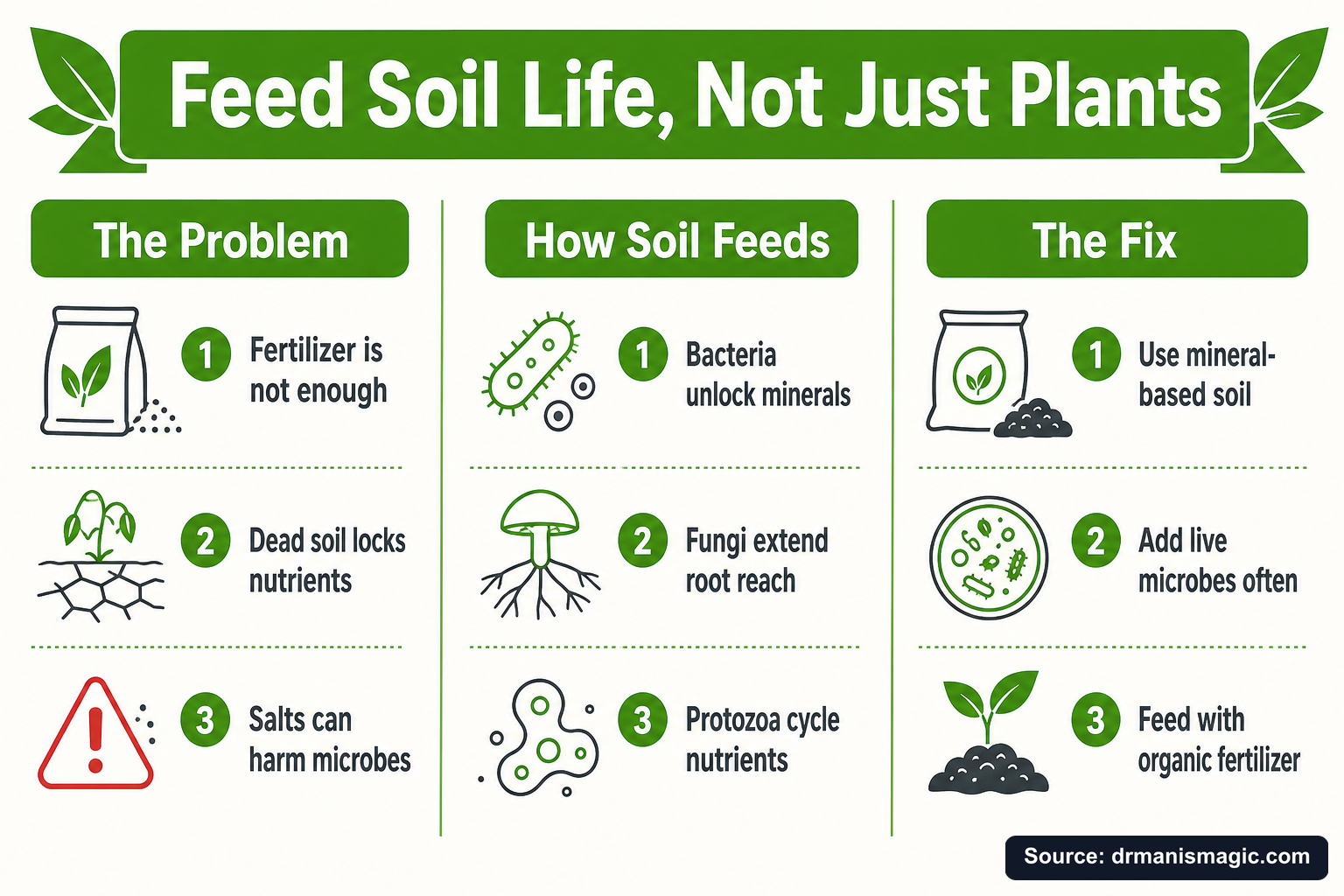
- Chemistry provides the elements. Biology is what makes those elements available to your plant. Without living soil, nutrients sit locked up and unused.
- The soil food web — bacteria, fungi, protozoa, and nematodes — is the invisible workforce that turns raw minerals into plant food, right at the root zone.
- Salt-based synthetic fertilizers kill the very microbes your plant depends on, creating a vicious cycle of dependency and decline.
- Most commercial microbial products contain dead or dying organisms that cannot help your plant — because they were dried, stored badly, or never truly alive.
- Live, stabilized microbes applied consistently are the key to rebuilding soil biology, especially in damaged, compacted, or chemically treated soil.
- The Three Plant Pillars — mineral-based soil, live microbials, and organic fertilizer — work together as a complete system, not as separate fixes.
- You can start rebuilding your soil biology today, and most plants show a visible response within the first 30 days.
Why Is Fertilizer Not Enough to Grow a Healthy Plant?
Quick Answer: Fertilizer adds chemical elements to soil, but it cannot make those elements available to plant roots. That job belongs to living soil organisms. Without bacteria, fungi, and other microbes, nutrients sit locked in forms plants cannot absorb — no matter how much fertilizer you apply.
Think of it this way. Imagine you walked into a grocery store and every shelf was stocked full of food. Cans, boxes, produce, meat — everything you could ever need. But every item was sealed inside a vault made of steel, and you had no key. You would starve. That is exactly what happens when you add chemical fertilizer to dead soil.
The nutrients are technically there. Nitrogen. Phosphorus. Potassium. All the letters on the bag. But locked in forms the roots simply cannot use. According to the University of Minnesota Extension, biological processes in healthy soil supply roughly 75% of the plant-available nitrogen and 65% of the available phosphorus that plants actually absorb. Not the fertilizer bag. The living biology in the ground.
Salt-based fertilizers can actually make this worse. They push a quick flush of soluble nutrients past the roots — a temporary green-up — while quietly burning and killing the very microbes that could have made your soil self-sustaining. You get a short burst. Then a crash. Then you buy more fertilizer. The cycle repeats. The soil gets weaker every year.
This is not an accident. It is the business model.
See also: Why Most Fertilizers Are Actually Salt in Disguise
What Is the Soil Food Web, and Why Should You Care?
Quick Answer: The soil food web is the community of living organisms — bacteria, fungi, protozoa, beneficial nematodes, and more — that work together to cycle nutrients, suppress disease, build soil structure, and feed plant roots. It is the engine of all plant life on earth, and most modern gardening practices quietly destroy it.
Walk into an old-growth forest. No one fertilizes that forest. No one tills it, sprays it, or amends it. Yet the trees are massive. The undergrowth is lush. The soil is dark, rich, and alive. How?
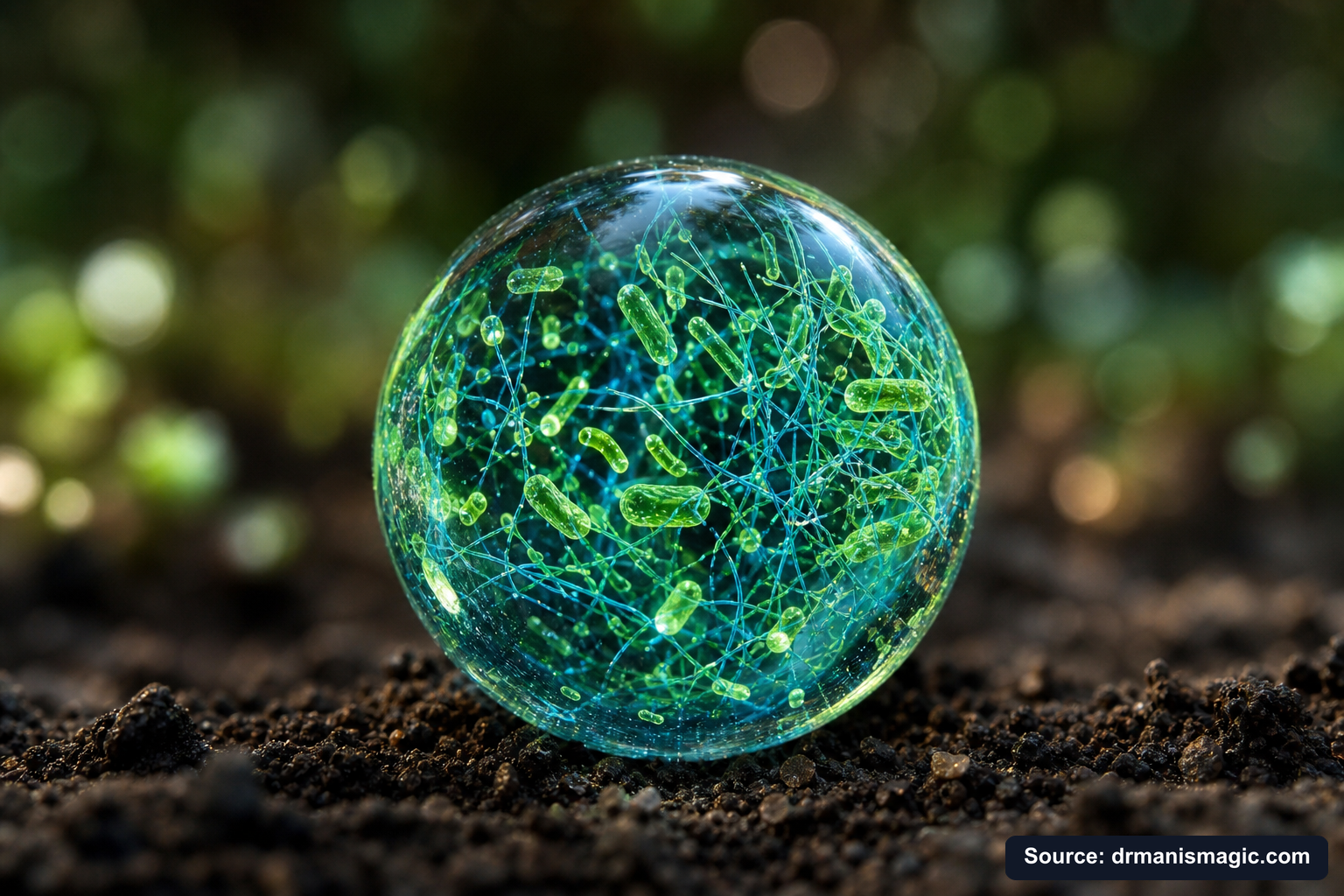
The answer is underground. Beneath your feet, in every square inch of healthy forest soil, there are more living organisms than there are people on earth. Billions of bacteria. Miles of fungal threads. Tiny animals called protozoa grazing on bacteria and releasing nutrients as they go. Beneficial nematodes patrolling the root zone, keeping pathogens in check.
This is the soil food web. It is the original plant care system — the one every plant on this planet evolved alongside for millions of years. Penn State Extension describes key microbial services as nitrogen fixation, phosphorus solubilization, pathogen suppression, stress improvement, and decomposition-driven soil aggregation. In plain English: microbes feed your plant, protect it from disease, help it survive drought, and build the structure that lets roots breathe.
When you understand the soil food web, everything changes. You stop thinking of soil as dirt. You start thinking of it as a living community — one you are either supporting or destroying with every input you use.
| Organism | What It Does | Why Your Plant Needs It |
|---|---|---|
| Bacteria | Decompose organic matter, fix nitrogen from air, solubilize locked phosphorus, suppress pathogens, produce growth hormones | Converts raw materials into plant-available food; first line of defense against disease |
| Fungi (including mycorrhizae) | Extend root systems by up to 1,000x, improve drought and salt tolerance, produce glomalin to build soil structure, suppress root rot pathogens | Massively expands the plant's ability to reach water and nutrients; builds soil aggregation |
| Protozoa | Graze on bacteria and release plant-available nitrogen as waste near the root zone | The "missing middle" — unlocks the nutrients bacteria hold and delivers them directly to roots |
| Beneficial Nematodes | Graze on bacteria and fungi, release nutrients, suppress pest nematodes and soil-borne pathogens | Completes the nutrient cycling loop; natural pest control in the root zone |
| Earthworms | Mix and aerate soil, produce castings rich in plant-available nutrients and microbes | Physical soil engineers; amplify microbial activity wherever they travel |
What Is the Missing Middle That Most Gardeners Never Hear About?
Quick Answer: Protozoa and beneficial nematodes are the overlooked middle layer of the soil food web. They graze on bacteria and fungi, then release plant-available nitrogen and phosphorus as waste products — right at the root zone. A soil with bacteria and fungi but no grazers is like having a kitchen full of food with no chef to serve it.
Here is the part nobody talks about. Most gardening advice stops at "add bacteria and fungi." And yes, those are critical. But there is a step in between that makes all the difference.
Bacteria and fungi do something remarkable. They eat organic matter — dead leaves, root debris, old mulch — and they hold the nutrients from that material inside their own tiny bodies. The nitrogen is there. The phosphorus is there. But it is locked inside the microbial biomass. Your plant still cannot reach it.
Enter the protozoa. These single-celled organisms graze on bacteria the way cows graze on grass. When a protozoan eats a bacterium, it digests the nutrients it needs and excretes the rest as waste. That waste is ammonium — one of the most plant-available forms of nitrogen that exists. And it happens right next to the root, where the plant can grab it immediately.
Beneficial nematodes do the same thing at a slightly larger scale. They graze on bacteria and fungi, releasing nutrients in plant-available forms and suppressing the harmful pest nematodes that cause root damage.
This is the complete nutrient cycle. Organic matter goes in. Bacteria and fungi break it down. Protozoa and nematodes graze and release. Plant roots absorb. It is elegant. It is ancient. And most modern growing systems have wiped it out entirely.
When Dr. Mani Skaria tested this system across our nursery in South Texas — on 250,000 citrus trees, on tropical trees, on houseplants, on gardens — the results were not subtle. Plants fed by a complete, living soil food web simply performed at a different level than plants grown in chemically managed, biologically dead soil.
How Do Salt-Based Fertilizers Quietly Destroy Your Soil Biology?
Quick Answer: Salt-based synthetic fertilizers draw water out of microbial cells through osmotic pressure, killing beneficial bacteria and fungi the same way salt kills a slug. Over time, repeated applications strip the soil of its living community, leaving behind a sterile growing medium that becomes completely dependent on chemical inputs to function.
Imagine pouring a handful of salt onto a garden slug. You have seen what happens. The water is pulled out of the slug's body. It shrivels and dies. That exact same process — called osmotic stress — happens to your beneficial bacteria and fungi every time you apply a salt-based fertilizer to your soil.
The plant gets a quick green burst from the soluble nutrients. It looks great for a few weeks. But underground, the microbial community is taking a hit. The bacteria population shrinks. The fungi retreat. The protozoa have nothing to graze on. The nutrient cycling slows. And the next time you need to feed your plant, the soil biology is a little weaker than it was before.
Do this for a season. Two seasons. Five years. The soil becomes a chemical dependency case. It cannot function without the next application. The plant is not thriving — it is surviving on an IV drip.
And there is something worse hiding in many conventional fertilizers. Biosludge — treated sewage waste used as a nitrogen source — can carry PFAS "forever chemicals" and heavy metals into your soil and eventually into your food. At Dr. Mani's Magic, our products contain Zero PFAS, Zero Biosludge, and Zero Synthetic Salts. Because what you put on your soil ends up in your body.
See also: The Hidden Reason Synthetic Fertilizers Cause Root Rot
Chemical Fertility vs. Biological Fertility: What Is the Real Difference?
Quick Answer: Chemical fertility means nutrients are present in the soil. Biological fertility means nutrients are available, cycling, and being delivered to plant roots by living organisms. You can have high chemical fertility and still grow a struggling plant. You cannot have high biological fertility without a thriving soil food web.
This is the distinction that changes everything. Chemistry and biology are not the same thing. They are not even playing the same game.
A soil test can show you plenty of phosphorus. But if the mycorrhizal fungi that shuttle phosphorus to root tips are dead, your plant is phosphorus-deficient. It does not matter what the test says. What matters is what the roots can actually reach.
| Factor | Chemical Fertility (Conventional) | Biological Fertility (Living Soil) |
|---|---|---|
| Nutrient presence | High — added by fertilizer inputs | Moderate — from organic matter and mineral weathering |
| Nutrient availability to roots | Short burst, then locked up or leached | Steady, cycling supply delivered near roots by microbes |
| Nutrient cycling | None — requires repeated applications | Self-sustaining through microbial decomposition and grazing |
| Disease suppression | None — no biological competition with pathogens | Strong — diverse microbes crowd out and antagonize pathogens |
| Drought resilience | Low — roots depend on external inputs | High — mycorrhizal fungi extend water reach dramatically |
| Salt tolerance | Low — salts accumulate and stress roots | Higher — beneficial microbes improve ion balance at roots |
| Soil structure | Degrades over time — compaction, poor drainage | Improves over time — glomalin from fungi builds aggregates |
| Recovery after stress | Slow — no biological buffer | Fast — living community responds and rebounds |
| Long-term cost | Rising — dependency grows, soil worsens | Declining — soil improves and becomes more self-sufficient |
The table above tells a story. Chemistry gives you a starting point. Biology gives you a destination. And the destination — a living, self-sustaining soil that feeds and protects your plants through every season — is something chemistry alone can never build.
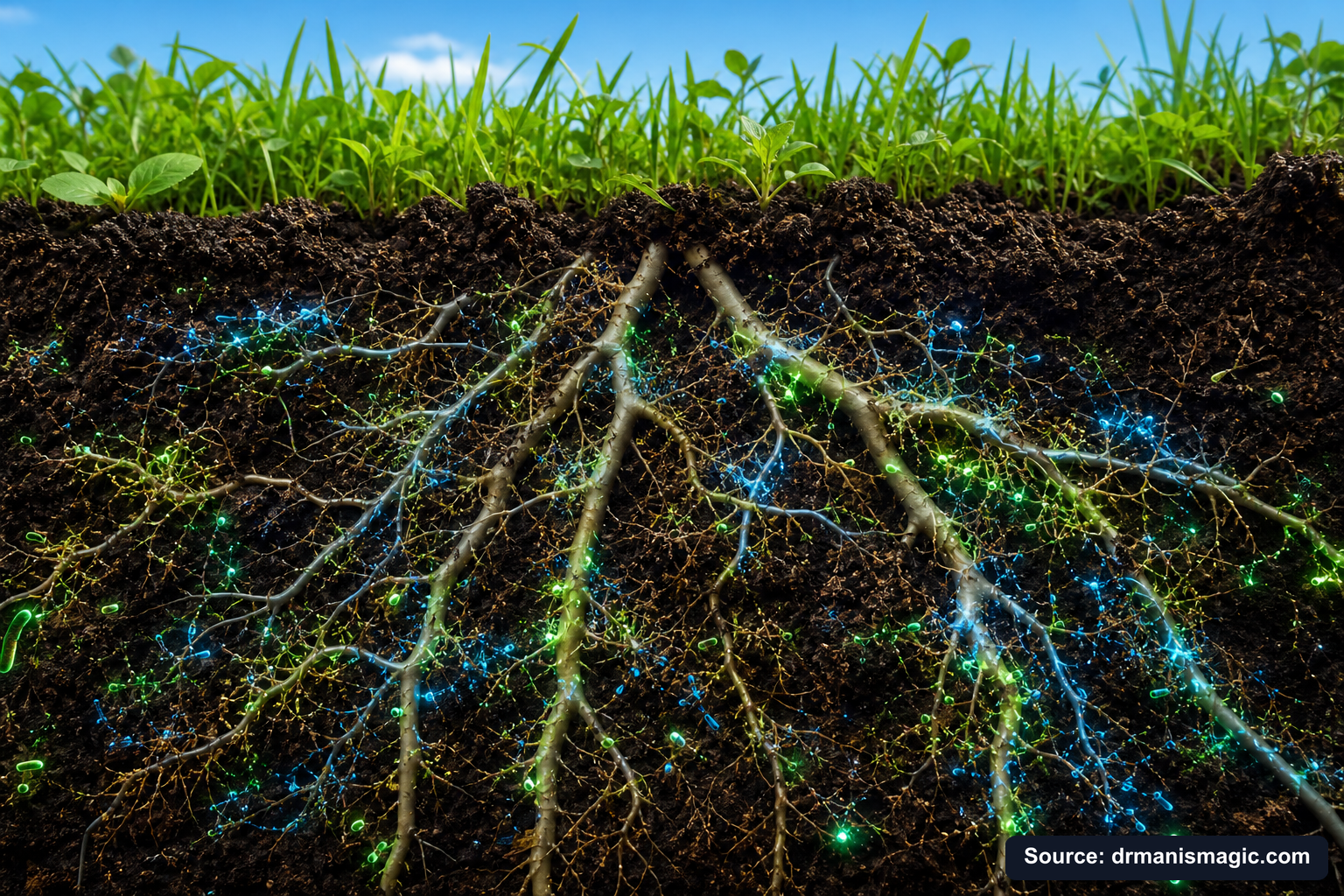
This is the foundation of the Three Plant Pillars: mineral-based soil for structure and drainage, live microbials for the invisible workforce, and organic fertilizer that feeds both the plant and the biology without burning either one. All three work together. Miss one and the system wobbles. Get all three right and your garden becomes what we call practically bulletproof.
You Never Had a Brown Thumb.
You were handed the wrong tools. This free guide hands you the right ones.
You watered it. You fed it. It died anyway.
It was never you. It was the dirt, the salt food, and the bad advice.
This guide shows you what really went wrong, and how to fix it for good.
- Why your plants really died, and why it was never your fault
- The salt hiding in your plant food that quietly burns the roots
- The hidden killer in almost every bag of store soil
- The tiny helpers that grow a whole forest for free
- The rescue trick that brings a half dead plant back to life

Why Are Most Microbial Products on the Market Not Working?
Quick Answer: Most commercial microbial products contain organisms that are already dead or dying by the time you use them. They are dried into powders in factories, rehydrated, or fermented into liquids that go anaerobic during shipping. Dead microbes cannot colonize roots, cycle nutrients, or suppress pathogens — no matter how impressive the label looks.
Walk into any garden center today and you will find shelves full of products promising living microbes. Bottles with impressive scientific names. Bags with high CFU counts. Labels that look serious and authoritative.
Here is what most of those labels do not tell you.
The majority of commercial microbial products are made in one of a handful of large factories. Specific beneficial species are grown in giant fermentation vats, then dried into powder form. The hope is that the dormant spores will "wake up" when you add water and pour them into soil. We have tested dozens of these products on our trees. The results were consistently disappointing. The plants did not respond. The biology did not establish.
The second type is liquid products made from compost tea or earthworm castings. These can be effective — but only when they are fresh, actively aerated, and used within hours of brewing. By the time a compost-based liquid product travels through a warehouse, sits on a shelf, and arrives at your door, it has often gone anaerobic. The microbes are dying or dead. You can smell it. The bottle may even fizz when you open it — that is fermentation gas, the signature of a dead microbial product. You might still get some benefit from the humic and fulvic acids in the liquid. But the living biology is gone.
There is a third category worth mentioning: lactobacillus-based products. Yes, the same bacteria in yogurt. They are easy to grow and very vigorous. But they are so aggressive that they outcompete and crowd out the beneficial microbes you actually need in soil. Lactobacillus belongs in your gut, not your garden.
The real question to ask about any microbial product is simple: Are the organisms actually alive when they reach my plant?
| Product Type | Viability at Use | Spectrum of Organisms | Odor | Our Assessment |
|---|---|---|---|---|
| Dried / powdered lab microbes | Very low | Narrow (a few selected species) | Neutral | We saw no measurable results in repeated tests. Avoid. |
| Dry microbes added to liquid | Very low | Narrow | Neutral to mild | Same issue as dried powder. Label looks good; results do not follow. |
| Compost tea, fresh (under 24 hours, aerated) | Moderate | Broad, natural | Earthy | Excellent if you brew it yourself and use it immediately. Impractical for most. |
| Compost tea, old (over 24 hours) | Low — anaerobic | Partial — many dead | Strong, foul | Not recommended. The smell tells you everything you need to know. |
| Lactobacillus-based products | High — but harmful in soil | Very narrow | Sour | Outcompetes beneficial microbes. Keep it in your yogurt. |
| Plant Super Boost — stabilized, full-spectrum, compost-harvested | High — confirmed by lab analysis and microscopy | 2,000+ bacteria species; 400–500 fungi including mycorrhizae; protozoa and nematodes | Earthy — not foul | Organisms are visibly alive under a microscope. Stabilized without going anaerobic. |
What Makes Plant Super Boost Different From Every Other Microbial Product?
Quick Answer: Plant Super Boost is harvested from real compost — not lab-grown — and then stabilized through a proprietary all-natural technique that keeps the organisms alive without fermentation or drying. The microbes are visibly active under a microscope and confirmed by multiple lab analyses. It smells earthy because it is not rotting. That is the difference between a living product and a dead one.
The story behind Plant Super Boost is one of the most unusual in modern gardening.
Dr. Mani Skaria spent decades studying plant health at the Texas A&M Citrus Center, testing products from around the world. He knew microbes mattered. He had seen compost work like magic on trees. Gardeners everywhere describe fresh compost as transformative — and the reason is simple. Fresh, active compost is teeming with billions of living organisms. The heat you feel from a healthy compost pile — sometimes over 140 degrees — is not decomposition. It is life. It is biological activity so intense it generates warmth.
The challenge was getting that living biology into a bottle that could be shipped across the country without dying.
Through a remarkable turn of events, Dr. Mani connected with a world-class compostologist — a scientist who had advised the farming practices of royal families and governments on multiple continents. This expert had developed a natural technique to stabilize the full spectrum of microbes from fresh compost, keeping them alive and active without the product going anaerobic. When his methods started producing dramatic results in large citrus operations, he was quietly blacklisted by major chemical companies. At one point, he feared for his safety and stopped producing entirely.
Years later, through what Dr. Mani describes as a providential meeting, this expert joined the US Citrus Nursery team. Together, they built what became Plant Super Boost.
The result is a liquid microbial product that contains over 2,000 species of bacteria, 400 to 500 species of fungi including mycorrhizae, plus protozoa and beneficial nematodes. Take a drop and look at it under a microscope — you can see the organisms moving. Multiple lab analyses confirm the viability. And when you open the bottle, it smells like fresh earth. Not sewage. Not fermentation. Earth. Because the microbes are alive and stable, not dying and rotting.
That is the difference between chemistry and biology. And it is the difference between a product that works and one that just looks good on a shelf.
What Destroys the Biology in Your Soil — and How Do You Know If Your Soil Is Biologically Dead?
Quick Answer: Synthetic herbicides, salt-based fertilizers, broad-spectrum pesticides, and synthetic fungicides all kill or suppress beneficial soil microbes. Signs of biologically dead soil include compaction, poor drainage, yellowing plants that do not respond to fertilizer, recurring disease, and soil that smells flat or chemical instead of earthy.
If you have ever used Roundup in a garden bed, applied a synthetic weed-and-feed to your lawn, or treated plants with a broad-spectrum fungicide, you have likely done significant damage to your soil biology. Most of these products are not selective. They do not distinguish between a harmful fungus and a mycorrhizal fungus that has been feeding your tree's roots for three seasons.
Here is what biologically damaged soil looks and feels like. It is gray or pale brown instead of dark. It has no earthy smell — that smell, by the way, comes from a compound called geosmin produced by actinobacteria, a sign of healthy microbial activity. The soil clumps poorly or turns to powder. Water either pools on top or races straight through without soaking in. Plants grow slowly, show yellowing between leaf veins, and develop recurring disease problems despite treatment.
Sound familiar? If so, you are not dealing with a nutrient problem. You are dealing with a biology problem. And more fertilizer will not fix it. It may actually make it worse.
The good news is that soil biology can be rebuilt. It takes time, consistency, and the right inputs. But the turnaround is often faster than people expect — especially when you stop the inputs that are doing the damage and start replacing them with ones that support life.
How Do You Rebuild Biologically Dead or Damaged Soil?
Quick Answer: Rebuilding soil biology requires stopping harmful inputs, adding organic matter, inoculating with live full-spectrum microbes, and giving the community time to establish. Most plants begin showing visible improvement within 30 days of the first consistent application. Full biological restoration takes multiple seasons, but the momentum builds quickly.
Here is a practical step-by-step recovery plan. Whether you have a container plant, a raised bed, a lawn, or a backyard orchard, these steps apply.
- Stop the killers first. Eliminate or drastically reduce salt-based synthetic fertilizers, broad-spectrum pesticides, and synthetic fungicides. You cannot rebuild biology while simultaneously poisoning it. This one step alone will begin shifting the balance underground.
- Check your soil structure. If you are growing in a container or raised bed, consider whether your growing medium is mineral-based and well-draining, or whether it is decomposing bark and sawdust that has compacted and is stealing oxygen from roots. Roots need to breathe. If your soil smells sour or has turned dark and dense, the structure is working against you. Super Soil is a permanent mineral-based solution engineered for exactly this problem.
- Add organic matter to feed the biology. Compost, mulch, and organic top-dressings give soil microbes the raw material they need to thrive. A two to three inch layer of organic mulch on the soil surface is one of the highest-return investments in any garden. It feeds bacteria and fungi while protecting moisture and regulating temperature.
- Inoculate with live, full-spectrum microbes. This is the step most people skip or do poorly. Apply a genuinely living microbial product monthly, especially in the first season of recovery. Make sure the organisms are actually alive — not dried powder, not old fermented liquid. Plant Super Boost was designed specifically for this step.
- Feed the system with organic, non-salt fertilizer. Once biology begins establishing, support it with slow-release organic nutrition that feeds both the plant and the microbes. Crab, kelp, and amino acid-based fertilizers provide a complete spectrum of macronutrients, micronutrients, and biostimulants without the salt that would undo your biological work. Our Crab, Kelp & Amino Acids formula was built for exactly this purpose.
- Minimize soil disturbance. Every time you till, dig, or disturb soil, you break the fungal networks that took weeks or months to build. Mycorrhizal hyphae are fragile. Let them grow. If you must dig, be targeted and deliberate.
- Be consistent and patient. Biology does not respond to a one-time application. It builds over time. Each monthly application of live microbes adds to the population. Each addition of organic matter feeds the community. Each season without salt-based inputs allows the biology to strengthen. The results compound. And they last.
We have seen this recovery process work on everything from houseplants in apartments to large backyard orchards to lawns that had been chemically managed for decades. The timeline varies. The direction does not. Biology always responds when you give it what it needs.
What Does This Mean for You Right Now?
Quick Answer: Every day your soil biology is depleted is a day your plant is working harder than it should for less than it deserves. Time is the one thing you cannot buy back. The best moment to start building living soil was years ago. The second best moment is right now.
Here is something Dr. Mani hears more than almost anything else from gardeners across the country. More than any question about fertilizer or disease or pests. People say — sometimes almost in a whisper — "I just want to see fruit on my tree while I still can."
That desire runs deep. Deeper than gardening. It is tied to something primal — the human urge to nurture, to grow, to tend a living thing and watch it give back. We were made for this. And when it fails, over and over, because of bad advice and worse products, something in us dims a little.
You can get money back. You cannot get time back. Every year spent fighting your soil with the wrong tools is a year of growth your plant will never give you. The tree you planted three years ago could have been producing fruit today if the biology had been right from the start. That is not a small thing. That is the whole point.
The Three Plant Pillars — mineral-based soil, live microbials, organic fertilizer — are not complicated. They are not expensive. They are just aligned with the way nature actually works. And when you align with nature instead of fighting it, everything changes fast.
Plants that were stalled begin moving. Leaves that were yellowing turn green. Roots that were weak begin pushing out. The soil starts smelling like soil again — that deep, earthy smell that tells you something alive is happening underground.
We built the Free Plant Care Field Guide to walk you through the full system, step by step, without jargon, without guesswork. It is the same foundation we use on every tree at our South Texas nursery. The same system behind 250,000 trees and a 4.9-star rating from over 2,400 real growers.
And everything we make — Super Soil, Plant Super Boost, Crab, Kelp & Amino Acids — carries a 30-day money-back guarantee. Zero PFAS. Zero Biosludge. Zero Synthetic Salts. Made in the USA. If your plants do not respond within 30 days, we will refund you. No argument, no runaround, no kid in a vest shrugging at you.
If you are ready to stop fighting your soil and start working with it, the best place to begin is with the biology. Give your roots the invisible workforce they were always meant to have. Start with Plant Super Boost — and watch what happens when chemistry finally has biology to work with.
Frequently Asked Questions
A lot of gardeners are confused about why their plants keep struggling even when they follow the instructions on the fertilizer bag. These questions come up again and again. The answers below cut through the noise and show you exactly what is really going on inside your soil.
Why is fertilizer alone not enough to grow healthy plants?
Fertilizer adds chemical elements to your soil. But those elements stay locked up unless living organisms unlock them. Bacteria, fungi, and other microbes break nutrients down into forms plant roots can actually absorb. Without that living biology, you are pouring money into dirt and waiting for something that never comes. We proved this across 250,000 trees at our South Texas nursery. Chemistry without biology is just salt sitting in the ground.
Are plants biological or chemical organisms?
Plants are 100 percent biological. They are living things with cells, metabolism, and the ability to grow and respond to their environment. But here is the part most people miss. Plants depend on other living things in the soil to survive. The bacteria and fungi around the roots are part of the plant's biology too. When you kill those microbes with synthetic fertilizers, you are cutting off your plant from its own life support system.
Does plant biology really depend on chemistry?
Yes, and that is exactly the point. Biology and chemistry are not opposites. Biology uses chemistry. Living microbes in the soil run chemical reactions that turn raw minerals into food your plant can eat. The problem is when you skip the biology and go straight to synthetic chemistry. Salt-based fertilizers short-circuit the whole system. They burn your microbes and leave your soil weaker every single season.
What is the soil food web and why does it matter for my garden?
The soil food web is the community of tiny living organisms working underground every single day. Bacteria, fungi, protozoa, nematodes. They are your invisible workforce. They break down organic matter, unlock nutrients, fight off disease, and feed your roots. When this web is healthy, your plants are practically bulletproof. When it is dead from chemical overuse, your garden slowly falls apart no matter how much you spend trying to fix it.
Why do most microbial products from the store not work?
Most store-bought microbial products are dead before you open the bottle. They were dried out, stored badly, or never truly alive to begin with. Dead microbes cannot help your plants. Dr. Mani discovered a special all-natural method to keep microbes alive and active inside the bottle so they go to work the moment you apply them. That is what makes Plant Super Boost different from anything else on the shelf.
Is botany just chemistry with plants?
Botany covers chemistry, but it is much bigger than that. It includes the living relationships between plants, soil, microbes, water, and light. That is why the Three Plant Pillars work so well together. Mineral-based soil gives roots room to breathe. Live microbes unlock nutrients and fight disease. Organic fertilizer feeds the whole system slowly and safely. No single chemical can replace that complete living system. Nature does not work that way.
Why is plant biology important for a home gardener?
Because without understanding it, you will keep repeating the same cycle. Buy fertilizer. See a short burst of growth. Watch things stall. Lose time you can never get back. Understanding that your soil needs to be alive changes everything. Once you set up the right biology with the right soil, microbes, and organic fertilizer, your plants stop struggling and start thriving on their own. That is the whole mission behind Dr. Mani's Magic.
About the Author
Ron Skaria, MD
Ron Skaria, MD, is the co-founder of Dr. Mani's Magic and the son of Dr. Mani. He trained as a medical doctor at Baylor College of Medicine, did his residency at UT Health Science Center - San Antonio and fellowship training at Texas Tech University. He now works full time on the family farm at US Citrus and US Citrus Nursery in Hargill, Texas, building Dr. Mani's Magic alongside his dad. He wrote the Brown Thumb Field Guide to put his father's 48 years of plant science into plain words any gardener can use. His belief is simple. You never had a brown thumb. You just never had the right help.


