


The Hidden Cost of Sterile Growing Media for Your Plants | Dr. Mani's Magic
The Hidden Cost of Sterile Growing Media: What You Lose When You Kill the Soil Food Web
Picture this. You're repotting your favorite tree. You slice open a fresh bag of potting mix. It smells clean. Almost chemical-clean. You fill the pot, tuck in the roots, water it in. Everything looks perfect.
Three months later, the leaves are pale yellow. The tree looks tired. You've fed it. You've watered it right. You've done everything the bag told you to do. But something is wrong. Something invisible. Something nobody warned you about when you bought that clean, fluffy, "professional grade" potting mix.
That smell? That clean, almost sterile smell? That was the first clue. Because healthy soil doesn't smell like nothing. Healthy soil smells like earth after a rainstorm. Rich. Alive. That's the smell of billions of microbes doing their jobs. And that bag you just opened? Those microbes were gone before the bag was sealed. What you planted your tree in wasn't soil. It was a biological ghost town. And your plant is paying the price right now.

Organic Fertilizer | Crab, Kelp & Amino Acids
Key Takeaways
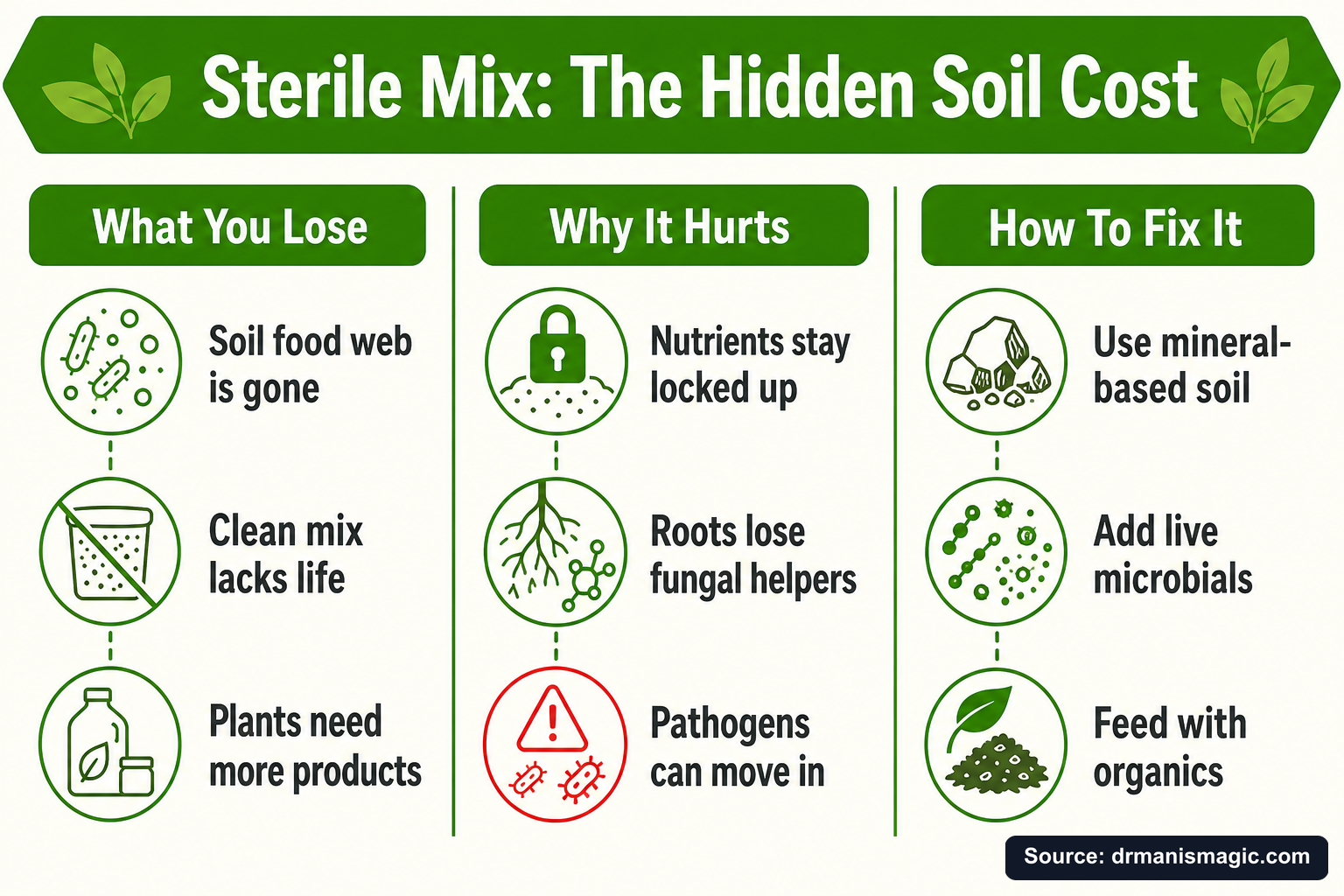
- Sterile growing media removes the entire soil food web — bacteria, fungi, protozoa, and nematodes — leaving plants without their invisible support system.
- Biological vacancy is the real hidden cost: when beneficial microbes are gone, opportunistic pathogens can move in first.
- Plants in sterile media become dependent on more fertilizers, more fungicides, and more products — not less.
- Sterile media has real short-term uses (seed starting, cuttings, disease quarantine) but becomes costly as a long-term growing strategy.
- Not all microbial products work. Dried powders and smelly liquids are largely dead before they reach your roots.
- The Three Plant Pillars — mineral-based soil, live microbials, and organic fertilizer — are the proven framework for rebuilding real soil biology.
- You can restore biology to dead media in 30 to 90 days with the right approach, but you must start today. Time lost in bad soil is time you never get back.
What Does "Sterile Growing Media" Actually Mean?
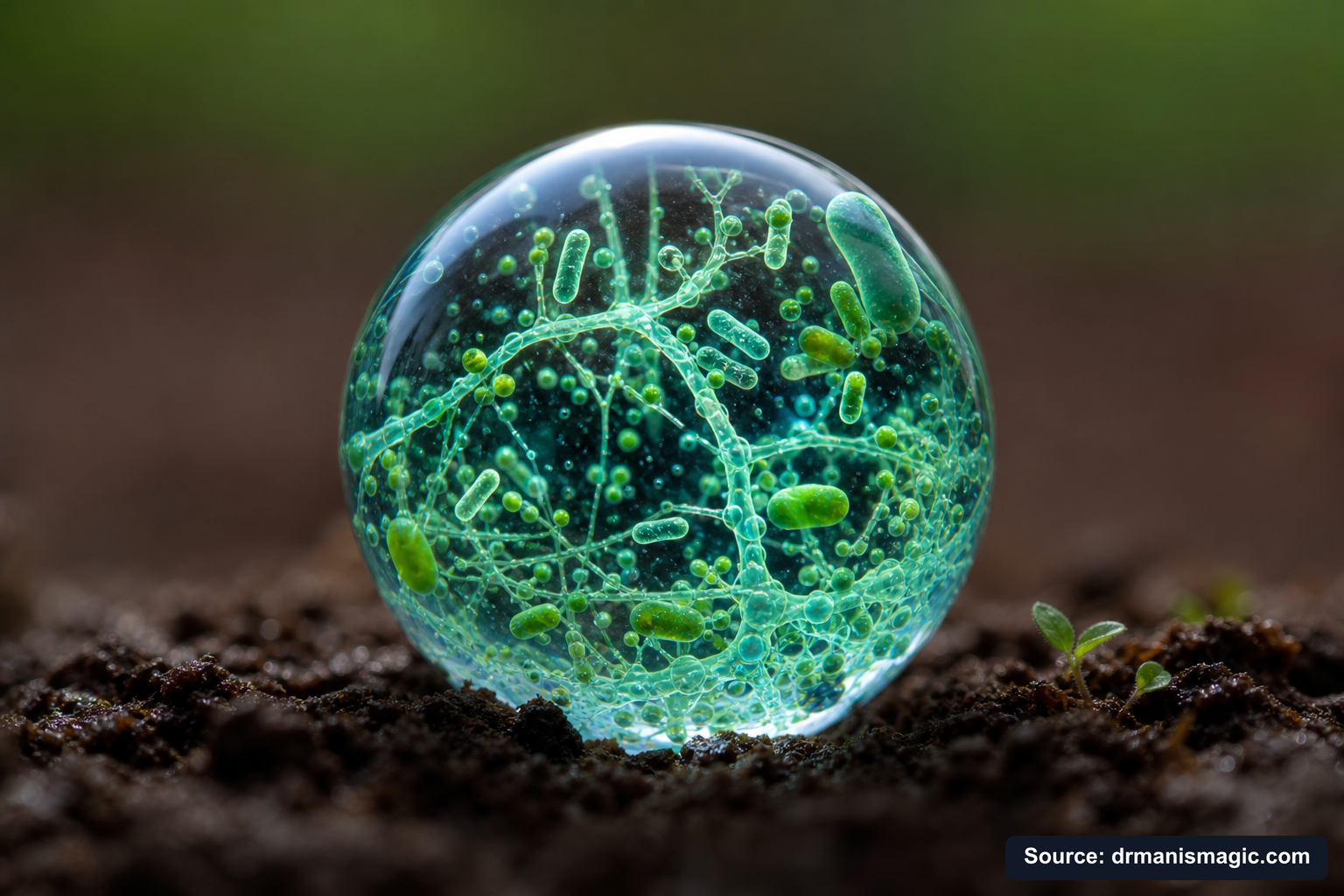
Quick Answer: Sterile growing media is any potting mix, soilless substrate, or bagged soil that has been heat-treated, chemically sanitized, or manufactured from inert materials like peat or coco coir — removing virtually all living organisms in the process. It is biologically empty from the moment it is bagged.
Sterile. Pasteurized. Soilless. Inert. These words get used interchangeably at garden centers, but they all point to the same reality: the living biology has been removed.
Here is the short breakdown:
- Sterilized media has been heated above 250°F, killing everything — pathogens, weed seeds, AND beneficial organisms.
- Pasteurized media has been heated to a lower temperature (around 180°F) to reduce pathogens while theoretically preserving some beneficial life. In practice, most beneficial fungi and many bacteria don't survive commercial processing.
- Soilless / peat-based / coco-based mixes are built from materials that never had a soil food web to begin with. Peat moss is ancient, compressed organic matter. Coco coir is shredded coconut husks. Neither carries a living ecosystem.
- Bark-heavy potting mixes — the kind you find at every big box store — start with pine bark sawdust and wood chips. They decompose fast. As they break down, they steal oxygen from roots and turn into compacted, suffocating sludge. They're also biologically sparse from day one.
Here's something most people don't know. The reason manufacturers sterilize media is completely valid in the short term. It reduces damping-off diseases in seedlings. It eliminates weed seeds. It prevents fungus gnats. For a commercial nursery running thousands of seed trays, a clean sterile medium is a practical necessity.
The problem isn't sterilization itself. The problem is what happens next. Most growers — home gardeners, container fruit tree owners, houseplant lovers — never add the biology back. They treat sterile media as a permanent home for their plants. And that's where the real cost begins.
According to University of Minnesota Extension, healthy productive soil can contain hundreds of millions to a billion bacteria per teaspoon, meters of fungal hyphae, thousands of protozoa, and beneficial nematodes — all working together as an ecosystem. When you remove that community, you don't just lose organisms. You lose every service they provided.
What Invisible Services Does the Soil Food Web Actually Provide?
Quick Answer: The soil food web provides nutrient cycling, disease suppression, water retention, root stimulation, and structural support — all for free, powered by the sun through plant roots. Strip it away and you must replace every one of those services with bottles and bags of products, forever.
This is the part nobody talks about. The soil food web isn't just a fun science fact. It's a full-service operation running 24 hours a day, 7 days a week, deep inside the root zone of every healthy plant on earth.
Think about a forest. No one fertilizes it. No one sprays it. No one waters it on a schedule. Yet the trees are enormous. The soil is dark and rich and smells incredible. The roots spread wide and deep. That forest is running entirely on the power of its soil biology.
After growing over 250,000 trees at our South Texas nursery, we can tell you exactly what that invisible workforce does — and exactly what your plant loses when it's gone.
| Organism | What It Does for Your Plant | What You Lose Without It |
|---|---|---|
| Bacteria | Break down organic matter into plant-available nutrients; fix atmospheric nitrogen; suppress pathogens; build soil structure | Locked-up nutrients; nitrogen deficiency; disease vulnerability; compacted media |
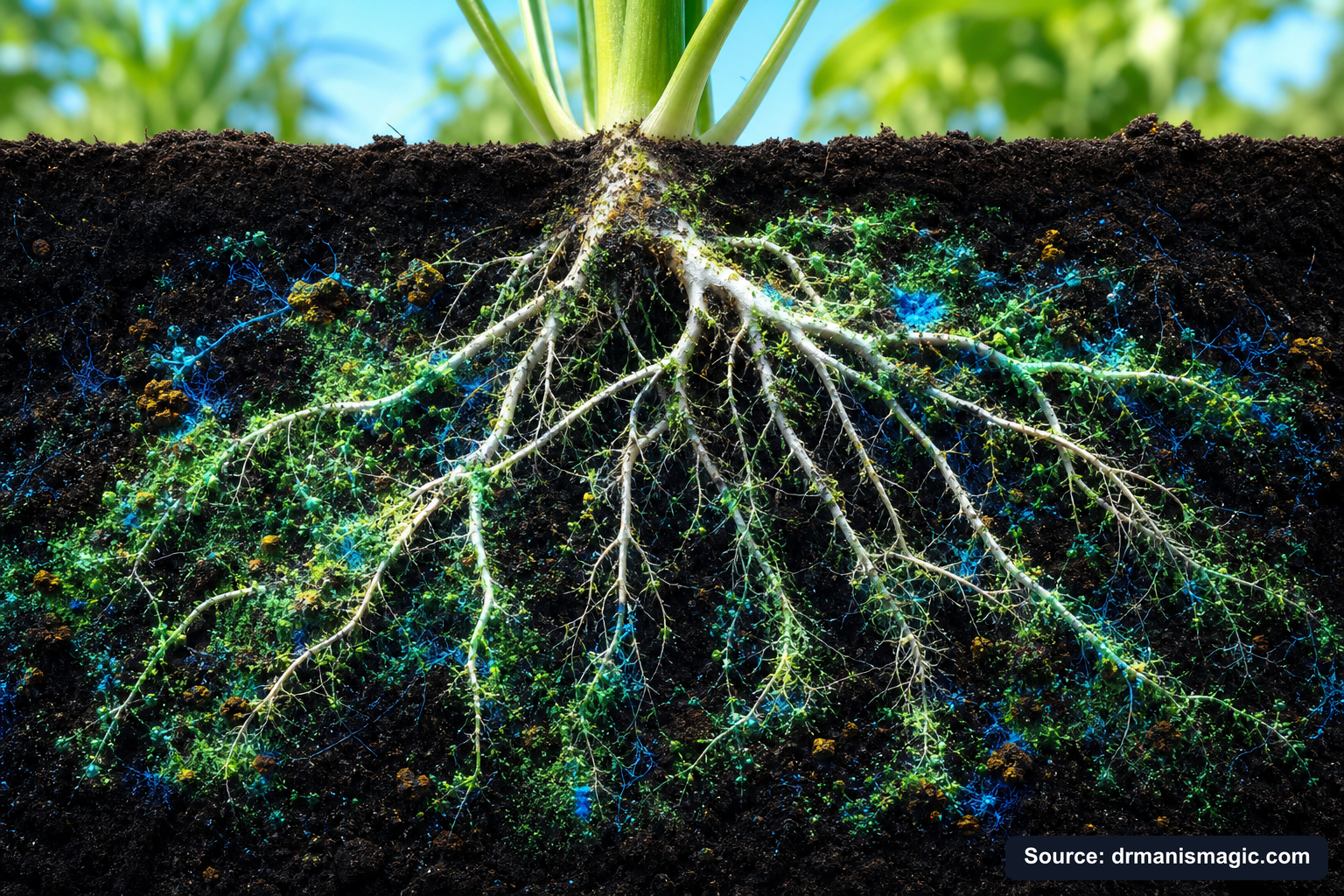
| Mycorrhizal Fungi | Extend root surface area by up to 1,000x; deliver water and phosphorus; produce glomalin that holds soil particles together; suppress root rot | Stunted roots; phosphorus deficiency; poor water uptake; increased root rot risk |
| Other Beneficial Fungi | Decompose carbon; produce enzymes that unlock bound nutrients; protect against fungal pathogens | Slow decomposition; nutrient lockup; increased disease pressure |
| Protozoa | Eat bacteria and release nitrogen in plant-available form right in the root zone; cycle nutrients rapidly | Slower nitrogen cycling; less precise nutrient delivery to roots |
| Beneficial Nematodes | Graze on bacteria and fungi; release nutrients; suppress pest insects and root pathogens | Nutrient cycling gaps; increased pest nematode risk; weaker natural disease control |
| Microarthropods | Shred organic matter into smaller pieces; create channels for air and water; move microbes through soil | Slower breakdown; poor aeration; reduced microbial distribution |
Most people have heard of bacteria and mycorrhizal fungi. But protozoa and nematodes? Almost nobody talks about those in home gardening circles. That's a gap the big chemical companies are happy to leave unfilled. Because the moment you understand that protozoa are releasing a steady drip of perfectly sized nitrogen molecules right at your root tips, you start asking why your fertilizer bag doesn't mention any of this.
The short answer: because fertilizer companies profit when you buy fertilizer. Microbes would do much of that work for free.
What Is the Real Hidden Cost of Biological Vacancy in Your Potting Mix?
Quick Answer: When all beneficial microbes are gone, the growing medium becomes an open invitation for harmful organisms to colonize first. You also lose free nutrient cycling, disease buffering, and root support — and must replace each service with purchased inputs, indefinitely, while your plant remains fragile and dependent.
Here's a concept most gardening content ignores completely. It's called ecological vacancy.
Nature hates a vacuum. When beneficial microbes are stripped from growing media, that space doesn't stay empty. Something moves in. And in a biologically empty environment with no established community to keep things in balance, the first colonizers can take over completely.
Those first colonizers are often opportunistic pathogens. Root rot fungi. Harmful bacteria. Fungus gnat larvae. The very problems that sterile media was supposed to prevent can come roaring back — and now there's no biological defense force to stop them.
Penn State Extension describes mature soil communities as providing "functional redundancy" — meaning multiple organisms can perform the same job, so the system keeps working even under stress. In sterile media, that redundancy is zero. One bad event — a fungal spore in the water, a pathogen on a new plant, an overwatering session — and there's nothing to buffer it.
This is why plants in sterile media often look fine for a few weeks, then suddenly crash. The media gave them a clean start. But without biology, there was nothing to sustain them.
And here's the money problem. When biology is absent, you become the biology. You have to:
- Apply fertilizer constantly, because there are no microbes mineralizing nutrients from organic matter
- Monitor pH obsessively, because microbial acids naturally buffer pH in living soil
- Water more precisely, because mycorrhizal fungi aren't helping roots find and hold moisture
- Apply fungicides, because there's no competitive exclusion from beneficial organisms
- Re-pot more often, because bark-based media compacts and collapses within 6 to 12 months
Every one of those steps costs money. But more importantly, every one of those steps costs time. And time is the one thing you cannot buy back.
See also: The Hidden Reason Synthetic Fertilizers Cause Root Rot
When Is Sterile Growing Media Actually a Good Idea?
Quick Answer: Sterile media is the right choice for short-term, high-sanitation situations — seed starting, rooting cuttings, tissue culture propagation, and quarantining new or diseased plants. The mistake is treating sterile media as a permanent home for established plants.
Let's be fair here. Sterile growing media isn't evil. It has real, legitimate uses.
Here's when sterile media makes sense:
- Seed starting: Baby seedlings are vulnerable to damping-off fungus. A clean, sterile medium gives them a safe launch pad before they're strong enough to handle a full biological ecosystem.
- Rooting cuttings: Same logic. A sterile propagation medium reduces the chance of rot while roots are forming.
- Quarantine: Bringing in a new plant from an unknown source? Keeping it in sterile media while you observe it for pests or disease is smart biosecurity.
- Tissue culture: Commercial plant propagation at a laboratory scale requires absolute sterility.
- High-sanitation nursery production: Managing thousands of seedlings at commercial scale, sterile media reduces loss from soil-borne pathogens.
The problem isn't using sterile media to start. The problem is never transitioning the plant into a living system. Most commercial nurseries sell you a tree that started in sterile media and never had biology added back. You bring it home. You put it in a pot of more sterile bagged mix. You fertilize it with salt-based fertilizer that kills what few microbes might have survived. And then you wonder why the tree struggles.
That's not a brown thumb. That's a system that was designed — intentionally or not — to keep you buying more products.
We saw this pattern across 250,000 trees at our nursery in Hargill, Texas. Trees grown in biologically rich, mineral-based soil with live microbials outperformed trees in sterile commercial mixes every single time. Not by a little. By a mile.
What Happens to Your Plant When Synthetic Fertilizers Replace Living Biology?
Quick Answer: Salt-based synthetic fertilizers temporarily feed the plant but simultaneously kill the beneficial microbes the plant needs for long-term health. The result is a cycle of dependency — more fertilizer needed every season, increasing salt buildup in the media, progressive microbial die-off, and a plant that looks fed but is actually getting weaker every month.
Here's the lie you've been sold since the 1950s. Miracle-Gro and the companies that followed them told America that plants need to be "fed." Feed the plant. Pour blue liquid on it. Watch it green up. Done.
But plants don't eat the way you and I eat. Plants eat through chemistry. And a big part of that chemistry is run by microbes. When you pour salt-based fertilizer into biologically empty media, you're doing two things at once. You're giving the plant a quick jolt of nutrients. And you're making it harder for any surviving microbes to live in that media ever again.
Salts draw water out of microbial cells through osmosis. The same way salt on a slug kills it. Every application of synthetic salt-based fertilizer is a small massacre in the root zone. And over weeks and months, the salt accumulates. The media becomes more hostile. The roots start to struggle. The plant looks like it needs more fertilizer. You add more. The cycle accelerates.
Dr. Mani Skaria — Professor Emeritus of Plant Pathology, founder of the Clean Citrus Program in Texas, and the plant scientist behind Dr. Mani's Magic — watched this play out across decades of research at the Texas A&M Citrus Center. The trees fed with salt-based synthetic fertilizers showed short-term green-up followed by long-term decline. The trees supported by live microbials and organic fertilizer kept getting stronger year after year.
See also: Why Most Fertilizers Are Actually Salt in Disguise
You Never Had a Brown Thumb.
You were handed the wrong tools. This free guide hands you the right ones.
You watered it. You fed it. It died anyway.
It was never you. It was the dirt, the salt food, and the bad advice.
This guide shows you what really went wrong, and how to fix it for good.
- Why your plants really died, and why it was never your fault
- The salt hiding in your plant food that quietly burns the roots
- The hidden killer in almost every bag of store soil
- The tiny helpers that grow a whole forest for free
- The rescue trick that brings a half dead plant back to life

Live Microbes vs. Dead Microbe Products: What Is the Real Difference?
Quick Answer: Most commercial microbial products contain dried, dormant, or already-dead organisms that show little to no effect in real garden conditions. Truly live, full-spectrum microbials harvested from active compost and properly stabilized — like Plant Super Boost — deliver the kind of visible, measurable results that dried powders simply cannot replicate.
This is where it gets interesting. And a little maddening.
The market for microbial garden products has exploded. Walk down any garden center aisle and you'll see dozens of bottles promising bacteria, mycorrhizae, and "soil food web support." But here's what most people don't know about those products.
Almost all of them start at the same handful of giant manufacturing facilities. Companies order specific microorganism strains off a checklist, have them grown in vats, dried into powder, and packaged under dozens of different brand names. The hope is that when you add water, the dormant spores will "wake up" and colonize your soil.
After testing dozens of these products across our nursery operations, we can tell you plainly: they don't work. Not consistently. Not noticeably. The organisms may be technically present on paper, but they aren't thriving. They aren't establishing. They aren't doing the work.
Then there are the compost tea-style liquids. These are better in theory — microbes harvested from real compost, suspended in water. The problem is time. Compost tea goes anaerobic within about 24 hours unless it's constantly aerated. By the time it ships from a warehouse, sits in a distribution center, rides a truck to your door, and sits on your shelf, the microbes have died. The bottle smells like sewage. That stench? That's the smell of dead and dying organisms fermenting. Some people still use it and see minor benefits from residual humic acids and fulvic acids. But the living biology is gone.
There's a third approach that's worse than either: lactobacillus-based products. Yes, like the bacteria in your yogurt. Lactobacillus is vigorous and stays alive. But it's so aggressive it crowds out the beneficial organisms you actually want. It belongs in your gut, not your garden soil.
| Product Type | Microbe Viability at Use | Spectrum of Organisms | Odor | Real-World Results |
|---|---|---|---|---|
| Dried powder (lab-grown, bottled) | Very low — dormant or dead | Narrow — a few selected strains | Minimal | Little to no observable effect |
| Dry powder rehydrated into liquid | Very low | Narrow | Minimal | Same poor results as dry |
| Compost tea (fresh, under 24 hours) | Moderate with active aeration | Broad but inconsistent | Earthy | Good if used immediately — not practical for most gardeners |
| Compost tea (over 24 hours old) | Low — anaerobic die-off | Partial | Strong, sewage-like stench | Not recommended |
| Lactobacillus-based products | High — but wrong organisms | Narrow — one organism type | Sour | Crowds out beneficial microbes |
| Plant Super Boost (stabilized, full-spectrum, compost-harvested) | High — genuinely alive | 2,000+ bacteria species; 400-500 fungi including mycorrhizae; protozoa; nematodes | Earthy — not foul | Visible microbial activity under microscope; confirmed by lab analysis |
The difference with Plant Super Boost starts with how it's made. The microbes are harvested from actively managed compost — real, living compost teeming with a full-spectrum community. Then a proprietary all-natural stabilization process keeps those organisms alive and active without forcing them into anaerobic conditions. They don't rot. They don't stink. You can take a single drop under a microscope and literally see them moving.
Zero PFAS. Zero biosludge. Zero synthetic salts. And a 30-day money-back guarantee, because we know it works.
This product line came from a world-famous compostologist who had advised royal families and governments on farming practices — until he was effectively blacklisted by large chemical interests when his methods started showing dramatic results in commercial citrus groves. Through what Dr. Mani calls a providential meeting, that expert joined the team at US Citrus Nursery. That partnership became the foundation of Dr. Mani's Magic.
What Does Sterile Media Do to Long-Term Container Plants and Fruit Trees?
Quick Answer: Long-term container plants and fruit trees suffer most from sterile media because they live in it for years. Without biology, the media compacts, nutrients lock up, roots circle and suffocate, and the tree stagnates — wasting months and years of growing time that cannot be recovered.
If you have a lemon tree, an orange tree, a fig, or any fruiting tree in a container, this section is written specifically for you.
Container plants don't have the luxury of a connected underground ecosystem. They can't send roots 20 feet in any direction searching for microbes, water, and nutrients. They live in whatever you put them in. Which means if that media is biologically dead, they are completely dependent on you to supply every single thing the soil food web would normally provide.
And here's what happens over time in sterile bark-based potting mix. The pine bark and wood chips start to decompose. As they break down, they consume nitrogen — pulling it away from your tree's roots. The particles compact. Drainage slows. Oxygen is squeezed out of the root zone. Root rot fungi — with no biological competition — find easy footing. The roots start to die from the tips inward.
The leaves yellow. You think it needs fertilizer. You add more salt-based product. The salt burns the already struggling roots. The tree slows down. Stops fruiting. Maybe drops its leaves. You wonder what went wrong.
Nothing went wrong with you. Everything went wrong with the foundation.
The number one thing we hear from plant owners — the single most common request Dr. Mani gets — is that they want to see fruit on their tree while they still have years ahead to enjoy it. Not in a decade. Now. And the heartbreaking truth is that most people are planting trees in media that will guarantee they wait far longer than they should.
Time in a bad growing system isn't just wasted money. It's wasted years of watching a tree that should be producing sit there struggling. You can earn back money. You cannot earn back time.
This is exactly why the Three Plant Pillars exist. Mineral-based soil that doesn't compact or decompose. Live microbials that restore biological function. Organic fertilizer that feeds the plant AND the microbes simultaneously. When all three are in place, the tree stops struggling and starts thriving. Fast.
How Do You Recover Biology in Sterile or Depleted Growing Media?
Quick Answer: Restoring soil biology to sterile or depleted media takes 30 to 90 days with the right steps: introduce live microbials, add organic carbon as microbial food, stop applying salt-based inputs, manage moisture correctly, and repeat applications monthly. One application is rarely enough — damaged ecosystems need consistent rebuilding.
Here is the good news. Biological vacancy is not permanent. You can rebuild the soil food web — in containers, in raised beds, in garden soil, even in old tired potting mix.
But you need to understand one thing first. Adding microbes to dead media is like moving workers into an empty building with no furniture, no food, and no electricity. They need habitat. They need food. They need the right conditions. Without those, even live inoculants won't establish.
Here is a practical recovery protocol we've refined across our nursery and grove operations:
- Stop the damage first. Eliminate or dramatically reduce salt-based synthetic fertilizers. Avoid broad-spectrum fungicides. Every application of these is undoing the recovery you're trying to build.
- Add organic carbon as microbial food. Worm castings, compost, or a quality organic fertilizer like Crab, Kelp & Amino Acids gives microbes something to eat. No food, no colony. It's that simple.
- Introduce genuinely live, full-spectrum microbials. Apply Plant Super Boost as a soil drench — 2 ounces per gallon of water, poured directly into the root zone. For larger areas, use a hose-end sprayer. The microbes need to physically reach the roots.
- Manage moisture carefully. Microbes need moisture to move and multiply, but they also need oxygen. Soggy media kills the aerobic organisms you're trying to establish. Water deeply, then let the media partially dry before watering again.
- Keep applying monthly. Container environments and damaged soils don't rebuild overnight. Environmental pressures — residual salts, temperature swings, incoming pathogens — keep knocking the population back. Monthly applications maintain the biological momentum.
- Let roots grow into the biology. Plant roots actively recruit microbes by releasing sugars called exudates. The more roots explore the media, the faster the microbial community establishes and expands. Don't prune roots unnecessarily during recovery.
- Be patient, but expect early signs. Within 30 days, most plant owners notice improved color and new growth energy. Full biological establishment takes 60 to 90 days in a recovering system.
One important note. If your media is heavily compacted, bark-based, and waterlogged, you may need to repot into a mineral-based growing medium before recovery can really take hold. Microbes need structure and air to live. They can't establish in collapsed, oxygen-depleted media no matter how good the inoculant is.
See also: How Salt-Based Feeding Quietly Destroys Root Systems
Sterile vs. Living Growing Media: A Side-by-Side Comparison
Quick Answer: Sterile media is appropriate for short-term, high-sanitation use cases. Living, biologically active media is appropriate for any plant that will live in that medium for more than a few weeks. The long-term cost of sterile media — in products, time, and plant health — far exceeds any short-term sanitation benefit for established plants.
Let's put it side by side so the choice is clear.
| Factor | Sterile / Inert Media | Living Biologically Active Media |
|---|---|---|
| Disease prevention at start | Excellent — no pathogens present | Good — beneficial organisms crowd out pathogens |
| Disease resilience over time | Poor — no biological defense as pathogens arrive | Strong — diverse community provides competitive exclusion |
| Nutrient availability | Entirely dependent on fertilizer applications | Ongoing microbial mineralization feeds roots continuously |
| Water retention and drainage | Declines as media compacts; no fungal water channels | Maintained by glomalin, fungal hyphae, and microbial aggregates |
| Root system development | Limited to physical space; no mycorrhizal extension | Mycorrhizal fungi extend effective root surface up to 1,000x |
| Media longevity | Bark-based mixes collapse in 6 to 12 months | Mineral-based living media is essentially permanent |
| Input costs over time | High — fertilizer, fungicide, wetting agents, re-potting | Low — biology replaces most purchased inputs |
| Best use case | Seed starting, cuttings, quarantine, short-term propagation | All established plants: containers, beds, orchards, houseplants, lawns |
| Risk of opportunistic pathogen colonization | High — ecological vacancy invites first colonizers | Low — established communities resist invasion |
The choice isn't complicated once you see it this way. Sterile media is a tool for a specific job. The moment that job is done — the seed has sprouted, the cutting has rooted, the quarantine period is over — the plant needs biology. Every week it spends in biological vacancy is a week of slower growth, greater vulnerability, and wasted time.
What Can You Do Right Now to Give Your Plants a Living Foundation?
Here's the truth we've learned after three decades of growing in South Texas, after Dr. Mani spent 40 years studying plant pathology, after we've shipped over 250,000 trees to gardeners all across America.
The reason most plants struggle isn't water. It isn't sunlight. It isn't the gardener's skill. It's the foundation. Get the foundation right and everything else becomes easier. Your plant becomes — almost — bulletproof.
The Three Plant Pillars are that foundation. Mineral-based soil that doesn't compact or suffocate roots. Live, full-spectrum microbials that restore the invisible workforce your plant evolved with. Organic fertilizer that feeds both the plant and the biology simultaneously, without salt, without PFAS, without biosludge, and without the chemical smell that sends your pets running.
If you have plants right now sitting in sterile potting mix, in old compacted bark media, or in any container that's never had living biology added to it, the best time to change that was the day you planted them. The second best time is today.
Start with the Free Plant Care Field Guide — it walks you through the Three Plant Pillars step by step, in plain language, with no guesswork. If you want to go further and give your plants everything they need to truly thrive, explore the full Dr. Mani's Magic line at drmanismagic.com.
Your plants are waiting. And the clock on your growing season is already running.
Frequently Asked Questions
Sterile growing media is one of the biggest hidden traps in gardening today. Most people never find out why their plants stall and slowly decline. These questions cut straight to the truth so you can stop losing time and start growing plants that actually thrive.
Why does sterile potting mix hurt my plants over time?
Sterile potting mix has zero living biology in it. No bacteria. No fungi. No microbes at all. Plants depend on those tiny organisms to unlock nutrients in the soil and fight off disease. Without them, your plant is on its own. It might look okay at first. But after a few months, the leaves go pale, growth slows, and nothing you do seems to fix it. The soil is the problem, not your green thumb.
What is the soil food web and why does it matter for my plants?
The soil food web is a living community of bacteria, fungi, protozoa, and other microbes that work together underground. They break down organic matter, unlock nutrients, and protect roots from disease. Think of it as your plant's immune system and feeding crew all in one. When you plant in sterile media, that whole crew is gone. Your plant is left defenseless and hungry no matter how much fertilizer you pour on top.
Can I just add fertilizer to fix sterile growing media?
Fertilizer alone will not fix dead soil. Most fertilizers, especially synthetic ones, are salt-based. They feed the plant for a short burst but wipe out any microbes trying to move back in. You end up in a cycle of buying more and more product while your plant slowly gets weaker. Dr. Mani tested this on over 250,000 citrus trees at US Citrus Nursery. The answer is not more fertilizer. The answer is rebuilding the living biology in your soil first.
What are the Three Plant Pillars and how do they fix this problem?
The Three Plant Pillars are the framework Dr. Mani developed after 35 years of plant science. Pillar One is mineral-based soil that drains well and never compacts. Pillar Two is live microbials that bring back the beneficial bacteria and fungi your plant needs. Pillar Three is organic fertilizer that feeds your plant slowly and naturally without burning roots or killing microbes. All three work together. Miss one and the whole system is weaker.
How is Dr. Mani's Magic Super Soil different from regular potting mix?
Regular potting mix is mostly pine bark and sawdust. It breaks down fast, compacts into a soggy mess, and chokes roots of oxygen. Super Soil is built on sandy loam from South Texas. It is mineral-based, so it does not decompose. Roots can breathe, water drains properly, and the soil stays loose and alive for years. You buy it once and it keeps working. No more replacing dead soil every season.
How fast can I restore living biology to a pot with dead sterile media?
With the right approach, you can start seeing real improvement in 30 to 90 days. The key is adding live microbes that are actually alive when they reach your roots. Most dried powders and smelly liquid products are largely dead before you ever open the bottle. Dr. Mani's Magic Plant Super Boost uses a special stabilization method to keep beneficial bacteria, fungi, and mycorrhizae alive in the bottle so they go to work the moment you water them in.
What does healthy soil actually smell like, and why does it matter?
Healthy soil smells like the earth after a rainstorm. Rich, deep, alive. That smell comes from billions of active microbes doing their jobs. If your potting mix smells like nothing or smells chemical-clean, that is a warning sign. It means the biology is gone. Plant Super Boost smells earthy because the microbes inside it are stable and alive, not rotting. That smell tells you something real is in there, something your plant can actually use.
About the Author
Dr. Mani Skaria, PhD
Dr. Mani Skaria, PhD, is a plant pathologist and the scientific founder of Dr. Mani's Magic. He earned his doctorate at Purdue University and spent 48 years studying how plants, soil, and living microbes work together, including his years as Professor Emeritus at Texas A&M and as a member of the USDA NAREEE Advisory Board. He invented micro-budding, a method for growing healthier, stronger trees, and has grown more than 250,000 trees on the family farm in Hargill, Texas - US Citrus Nursery. His life's work takes real lab science and practical experience and turns it into simple, safe, organic plant care anyone can use at home.


