


Why Fungi Are the Architects of Soil Structure | Dr. Mani's Magic
Why Fungi Are the Architects of Soil Structure (And Why Your Plants Pay the Price When They're Gone)
Picture this. You dig your hands into a garden bed that has never been touched by chemicals. The soil crumbles between your fingers like chocolate cake. It smells like a forest after rain. It feels alive. There are no clumps. No hard crust. No grey, sticky mess. Just loose, dark, breathing earth that your roots could push through like butter.
Now picture the soil in most suburban backyards. Hard. Grey. Dusty when dry. Slick when wet. Water sits on top instead of soaking in. Roots hit a wall. Plants struggle for no obvious reason. You water. You fertilize. You try everything. And still, something is missing. That something has a name. It lives underground. And most gardeners have never heard of it.
What you felt in that first garden was not luck. It was not fancy soil from a bag. It was the work of fungi. Invisible, threadlike, endlessly patient fungi that spend their entire lives weaving soil particles together into something extraordinary. Take them away and soil stops working. Put them back and everything changes. This is the story of why fungi are the architects of soil structure, what happens when they disappear, and how to bring them home.
Key Takeaways
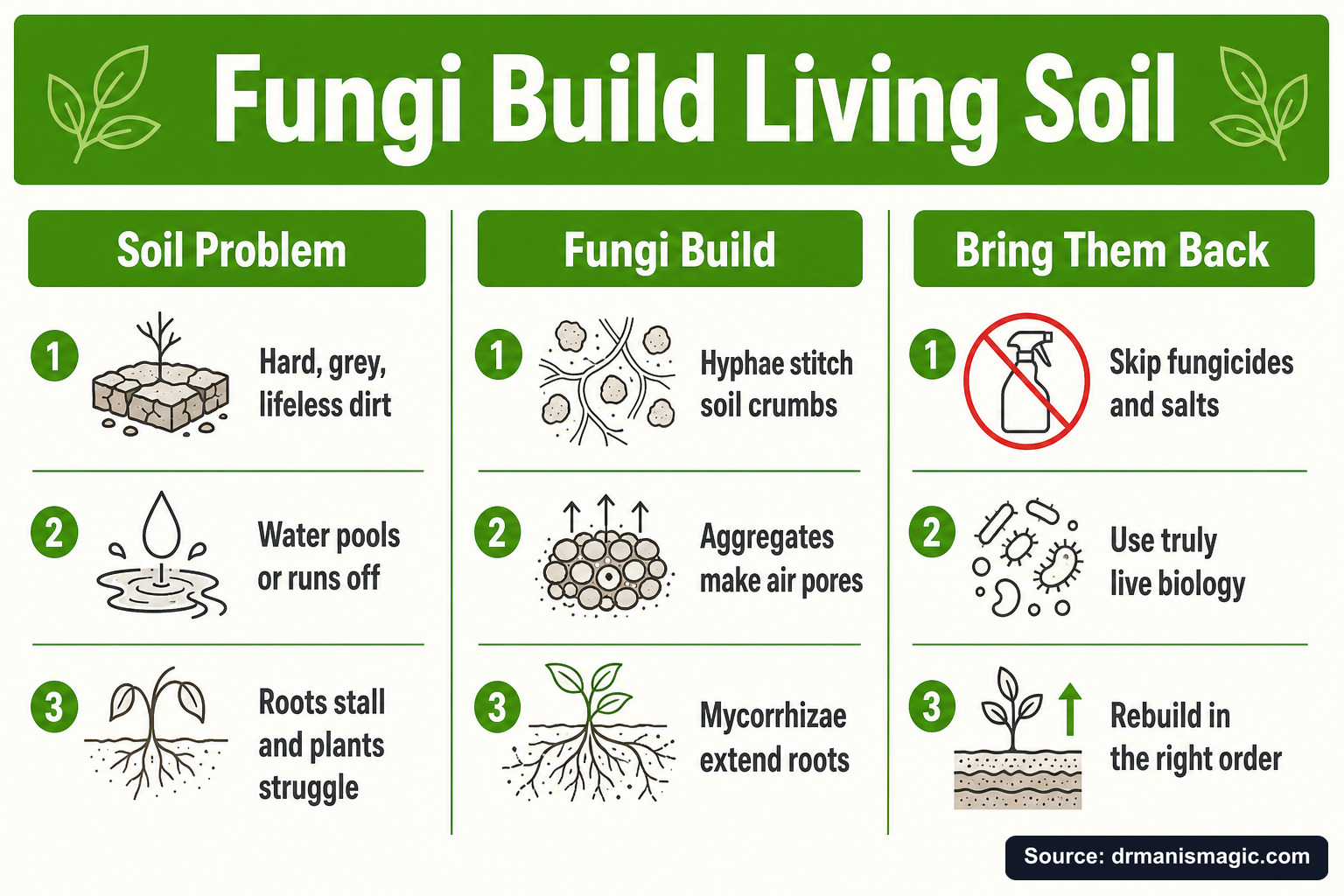
- Fungi grow microscopic threads called hyphae that physically stitch soil particles into crumbly, breathable clumps called aggregates.
- Mycorrhizal fungi attach directly to plant roots and extend the root system up to 100 times its normal reach.
- Healthy soil structure is not a physical property. It is a living, biological process driven by fungi, bacteria, roots, and the entire soil food web working together.
- Fungicides, salt-based fertilizers, synthetic herbicides, and soil sterilization wipe out beneficial fungi and collapse soil structure over time.
- Most store-bought microbial products are either dead on arrival or anaerobic and rotting. Genuinely live biology is rare, and it matters enormously.
- Damaged soil can recover, but it takes the right steps in the right order, not just a product poured on top.
- The Three Plant Pillars, developed and tested on over 250,000 trees at US Citrus Nursery in South Texas, give your soil the foundation it needs to rebuild living structure that lasts.
What Do Fungi Actually Do in Soil?
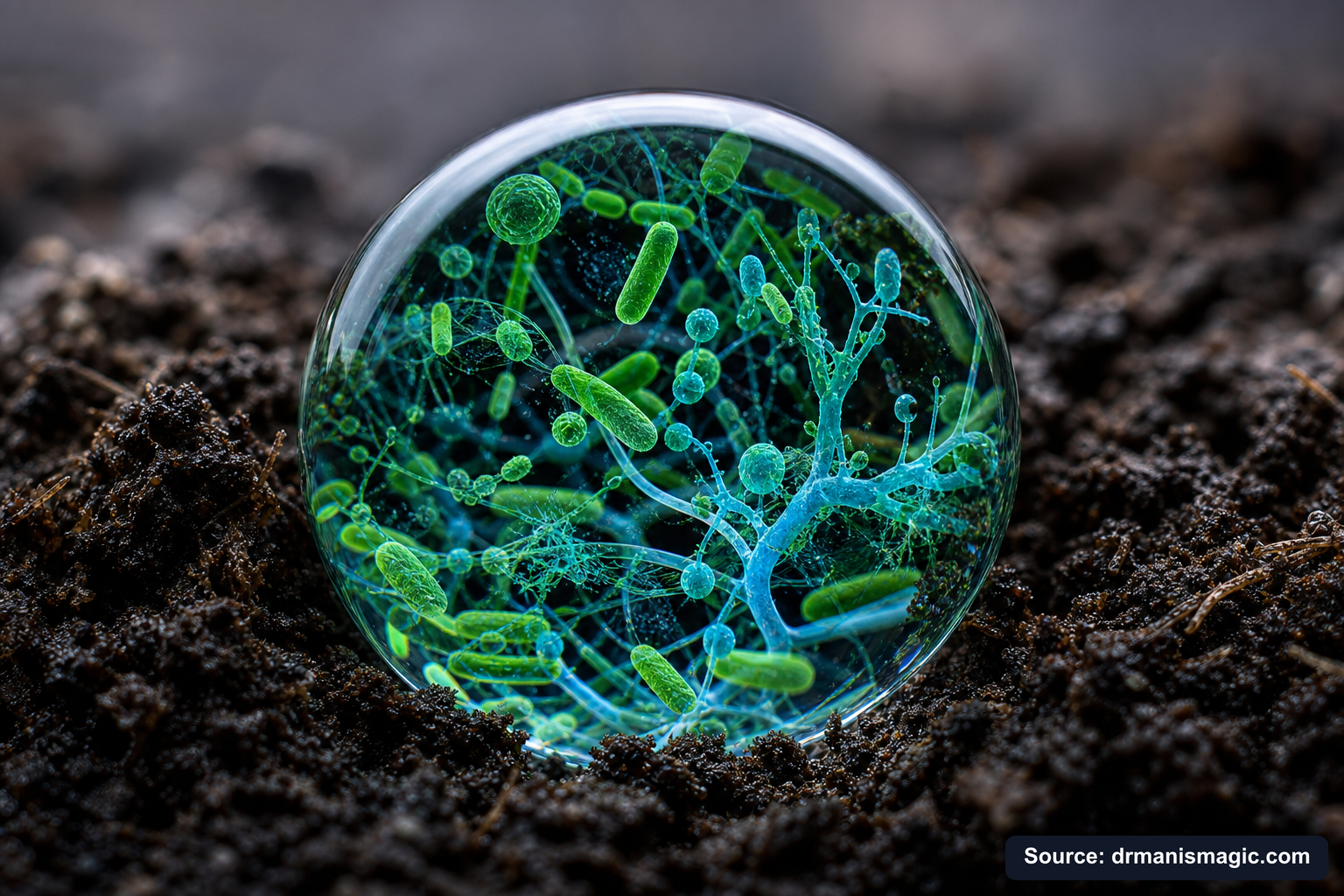
Quick Answer: Fungi grow long, hair-thin threads called hyphae that wrap around and glue soil particles together into stable clumps. These clumps create pore space for air, water, and roots. Without fungi, soil compacts, water runs off, roots suffocate, and plants struggle no matter how much fertilizer you add.
Fungi are builders. Not in a metaphorical sense. In a very literal, physical sense.
Every fungus in your soil is growing a network of threads called hyphae. Each thread is thinner than a human hair. But together, they form a web that stretches for miles inside a single tablespoon of healthy soil. As these threads grow outward, they wrap around sand grains, clay particles, and bits of organic matter. They pull those particles together and bind them into small, stable clumps called aggregates.
Those aggregates are everything. When soil is full of them, you get that crumbly, chocolate-cake texture that every gardener loves. Between the aggregates are pores. Those pores hold air, hold water, and give roots a pathway to grow. Roots can breathe. Water drains at the right speed. Nutrients move freely.
When fungi are gone, the particles fall apart. Clay flattens into sheets. Sand stays loose and useless. The pores collapse. Water sits on top or rushes straight through. Roots hit hard zones. The whole system breaks down, and no amount of fertilizer fixes it because the structure that was supposed to deliver those nutrients no longer exists.
According to the University of Maryland Extension, fungal hyphae, roots, earthworms, and sticky microbial substances are among the primary builders of soil crumb structure, pore space, and aggregate stability. This is not a fringe idea. It is basic soil science.
What Are Mycorrhizal Fungi and Why Do They Matter More Than Any Other Fungi?
Quick Answer: Mycorrhizal fungi form a direct partnership with plant roots, extending far beyond where roots can reach. They pull in water and nutrients and deliver them straight to the plant. In return, the plant feeds the fungi sugar. This partnership builds soil structure, improves drought resistance, and makes plants dramatically stronger.
Not all fungi in your soil are created equal. The most powerful ones for plant health are called mycorrhizal fungi, and they do something remarkable.
They actually plug into the root itself.
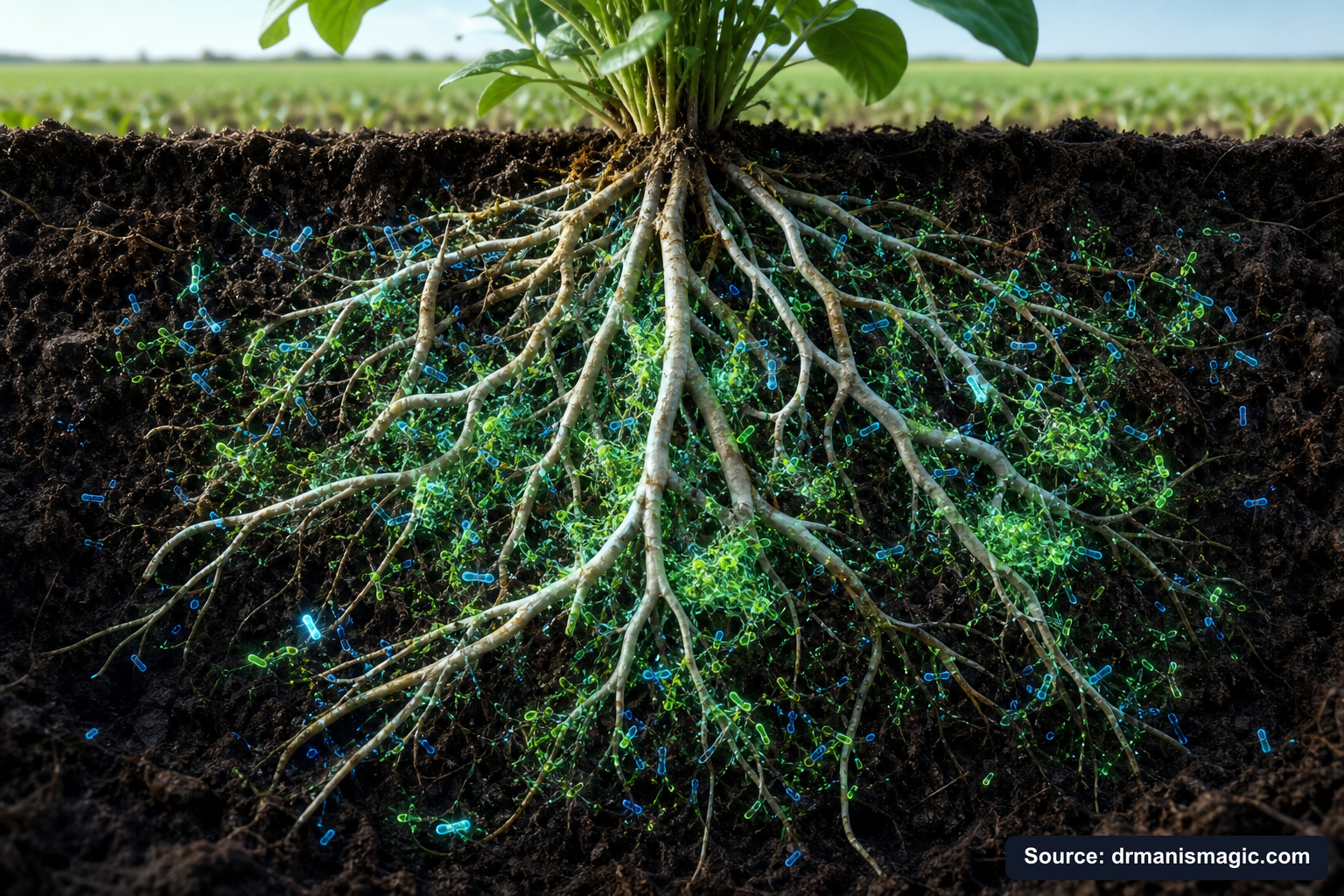
Arbuscular mycorrhizal fungi, the most common type, grow threads inside and around root cells and then send a second network of threads out into the surrounding soil. That outer network, called extraradical hyphae, can extend up to 100 times further than the root alone could ever reach. It is like giving your plant a second, invisible root system that covers ten times the ground.
Through that network, the plant gets water during dry spells. It gets phosphorus, zinc, and other minerals locked in soil particles that roots could never break down alone. And the fungi get sugar, which the plant produces through photosynthesis and pumps down into its roots as payment.
This partnership has been running for over 400 million years. Plants and mycorrhizal fungi evolved together. Most plants on Earth depend on this relationship to survive. Corn. Tomatoes. Citrus. Roses. Lawns. Orchards. Houseplants. Almost everything you grow has roots that are designed to connect with these fungi.
When you sterilize your potting mix, drench your soil with fungicide, or pour on salt-based fertilizer season after season, you break that connection. The plant is left with just its own roots. And its own roots are never enough.
At US Citrus Nursery in South Texas, we have grown over 250,000 trees. We have watched what happens when mycorrhizal networks are intact versus when they are destroyed. The difference in root density, fruit set, drought recovery, and disease resistance is not small. It is dramatic. We do not guess about this. We have seen it with our own eyes, season after season, tree after tree.
How Does the Whole Soil Food Web Build Soil Structure Together?
Quick Answer: Fungi are the lead architects, but they work inside a larger living system. Bacteria glue the tiniest particles together. Fungi bind larger clumps and build the main structural framework. Protozoa and nematodes eat bacteria and release nutrients. Earthworms shred residues and dig channels. All of them together create soil structure as a living, ongoing process.
Soil structure is not a thing. It is a process. It is alive. It is happening right now in every healthy garden bed, and it stops the moment the living community inside is wiped out.
Here is how the team works together.
Bacteria are the fast workers. They eat simple sugars and root exudates, the liquid food that plant roots leak into the soil to attract helpers. As bacteria eat and die, they release sticky substances that glue the very smallest soil particles together into tiny micro-aggregates. Think of these as the bricks.
Fungi are the structural engineers. Their hyphae grow through and around those micro-aggregates, binding them into larger macro-aggregates. These are the walls and floors of your soil architecture. Mycorrhizal fungi are especially important here because their extraradical hyphae stabilize larger clumps and contribute to erosion resistance. The University of Minnesota Extension describes this soil food web as a dynamic community where every organism plays a role in cycling nutrients and building structure.
Protozoa and nematodes are the grazers. They eat bacteria and fungi. When they digest them, they release locked-up nutrients in forms that plant roots can actually absorb. They are the nutrient delivery service.
Earthworms are the heavy equipment. They shred plant residues, mix organic matter deep into the soil, and leave behind casts that are some of the most fertile, structurally perfect soil you can find. Their tunnels become permanent channels for air and water.
Take any one of these players out and the system weakens. Take most of them out, which is what happens in sterilized, salt-loaded, fungicide-treated soil, and the whole structure collapses.
| Soil Organism | What It Does | How It Builds Structure | What Destroys It |
|---|---|---|---|
| Bacteria | Decompose simple carbon, fix nitrogen, release sticky proteins | Glue the tiniest particles into micro-aggregates | Salt-based fertilizers, chlorinated water, herbicides |
| Mycorrhizal Fungi | Connect to roots, extend nutrient reach, stabilize macro-aggregates | Bind larger clumps, build pore networks, resist erosion | Fungicides, synthetic fertilizers, soil sterilization |
| Saprophytic Fungi | Decompose tough, woody carbon like bark and stems | Create channels and thread-bound aggregates in decomposing matter | Fungicides, compaction, lack of organic matter |
| Protozoa | Graze on bacteria, release nutrients in plant-available forms | Fuel bacterial growth that supports micro-aggregate formation | Pesticides, soil fumigation, drying out |
| Nematodes (beneficial) | Graze on bacteria and fungi, cycle nutrients | Support organism turnover that feeds aggregate-building processes | Fumigants, broad-spectrum pesticides |
| Earthworms | Shred residues, mix organic matter, create permanent channels | Build macropores, leave highly fertile casts, improve drainage | Compaction, synthetic pesticides, salt accumulation |
| Plant Roots | Leak exudates to feed bacteria and fungi, physically break hardpan | Create channels, support mycorrhizal networks, hold aggregates together | Root rot from compaction, overwatering, salt burn |
Is Glomalin Really the "Soil Superglue" Everyone Talks About?
Quick Answer: Glomalin-related soil protein is a real substance produced by mycorrhizal fungi, and it is genuinely associated with stronger, more stable soil aggregates. But calling it simple "superglue" oversimplifies a complex process. The science is solid: mycorrhizal fungi help hold soil together. The exact chemistry is still being studied.
You have probably seen headlines calling glomalin the superglue of the soil. The basic idea is true, but the full story is more interesting.
When mycorrhizal fungi grow their hyphae through soil, they produce a protein called glomalin-related soil protein, or GRSP. This protein coats their hyphae and is deposited into the soil as the hyphae grow and die. Research has found that soils with more GRSP tend to have more water-stable aggregates, meaning the clumps hold together even when wet and resist erosion.
So yes, there is a real biological glue at work. The fungi are genuinely holding soil together.
The nuance is that scientists are still working out exactly what glomalin is, how to measure it precisely, and how much of the aggregate-binding effect comes from glomalin versus the physical binding from hyphae themselves versus the sticky substances produced by bacteria. The full picture involves all of these working together.
What matters practically is this: more mycorrhizal fungi means more aggregate stability. More aggregate stability means better soil structure. Better soil structure means healthier plants. The mechanism has layers of complexity that researchers are still exploring, but the outcome is not in doubt.
When you hear us say that fungi are the architects of soil structure, this is part of what we mean. It is not just the physical threads. It is the whole biological conversation happening between fungi, soil particles, bacteria, and plant roots.
What Are the Real Signs of Fungal-Rich, Biologically Healthy Soil?
Quick Answer: Healthy fungal-rich soil crumbles like cake, drains fast, smells like a forest, and shows white fuzzy threads in mulch or around roots. Plants in it recover quickly from dry spells, resist disease, and grow visibly stronger than plants in dead, compacted soil.
You do not need a lab to know if your soil has living fungi in it. Your senses will tell you.
Get close to a garden bed or a pot where fungal life is thriving. Smell it. Healthy soil smells earthy, rich, almost sweet. That smell comes from a compound called geosmin, produced by soil bacteria. Where you smell geosmin, bacteria are active. Where bacteria are active, fungi usually are too.
Now look at the texture. Pick up a handful and squeeze it. Does it hold a shape and then crumble apart easily? That crumbly structure is fungal aggregate at work. Does it pack into a solid lump that stays stuck? That is dead, compacted soil with no biological structure.
Pull up a weed and look at the roots. Do you see white fuzzy threads clinging to them? Those are mycorrhizal hyphae. That weed is thriving partly because it has a fungal partner feeding it. Your garden plants deserve the same partnership.
Here are the signs to look for, and the warning flags to watch out for.
| Sign of Healthy Fungal Soil | Sign of Depleted Fungal Soil |
|---|---|
| Crumbles like chocolate cake when squeezed | Packs into a hard lump or falls apart like dry dust |
| Smells earthy and fresh after rain | Smells sour, chemical, or has no smell at all |
| Water soaks in within seconds | Water pools on top or runs off the surface |
| White fuzzy threads visible on roots and mulch | Roots look bare, brown, or circling in a hard ball |
| Plants recover quickly after a dry week | Plants wilt fast and stay wilted even after watering |
| Earthworms present when you dig | No earthworms visible, soil is grey or orange-tinged |
| Woody mulch or compost decomposes slowly and evenly | Organic matter disappears quickly or sits slimy and matted |
Dr. Mani Skaria, Professor Emeritus of Plant Pathology and founder of the Clean Citrus Program in Texas, spent forty years studying exactly these signs in citrus orchards and nursery containers. The nursery test results were consistent. When the fungi were alive and active, the trees showed all of the healthy signs above. When fungal populations crashed from fungicide use or salt-based inputs, the warning flags appeared within a single growing season.
What Destroys Soil Fungi and Collapses Soil Structure?
Quick Answer: Fungicides are the most direct threat. But salt-based synthetic fertilizers, herbicides, soil fumigation, solarization, repeated tilling, and sterilized potting mixes all kill or prevent fungal growth. Once the fungi are gone, soil loses its structure and plants become dependent on chemical inputs just to survive.
Here is a pattern we have watched play out thousands of times at our nursery and in the gardens of our customers.
Someone buys a plant. They pot it in bagged potting mix from a big box store. They feed it with a fast-acting synthetic fertilizer. The plant looks good for a few weeks. Then it stalls. Then the leaves yellow. Then root rot sets in. They add more fertilizer. They add fungicide because they see some discoloration. The plant gets worse. They give up and buy another one. The cycle repeats.
What is actually happening is a biological collapse in slow motion.
Bagged potting mixes are sterilized. They start with zero living fungi. The synthetic fertilizer is salt-based. High salt levels kill the bacteria and fungi that would normally colonize the root zone. The fungicide finishes off anything that survived. The soil loses all biological structure. Roots hit compacted, airless zones. Water stops draining properly. Root rot pathogens, which thrive in dead, anaerobic soil, move in.
The plant was never given a chance. And the company selling you more fertilizer, more fungicide, and another bag of potting mix next season profits every time this happens.
This is not a conspiracy theory. It is simple business logic. A healthy plant with living soil does not need much. A struggling plant in dead soil needs something new every few weeks. We built our entire line around breaking this cycle. See also: The Hidden Reason Synthetic Fertilizers Cause Root Rot.
You Never Had a Brown Thumb.
You were handed the wrong tools. This free guide hands you the right ones.
You watered it. You fed it. It died anyway.
It was never you. It was the dirt, the salt food, and the bad advice.
This guide shows you what really went wrong, and how to fix it for good.
- Why your plants really died, and why it was never your fault
- The salt hiding in your plant food that quietly burns the roots
- The hidden killer in almost every bag of store soil
- The tiny helpers that grow a whole forest for free
- The rescue trick that brings a half dead plant back to life

Fungi vs. Bacteria: Who Does What in Building Soil Structure?
Quick Answer: Bacteria build the small-scale glue that holds the tiniest particles together. Fungi build the large-scale framework that connects those small clumps into the stable, breathable aggregates you can feel and see. Both are essential, but fungi create the structural architecture that makes soil feel alive.
People often ask which is more important for soil structure, bacteria or fungi. The honest answer is both. But they work at different scales and on different materials.
Bacteria are fast. They eat simple sugars and root exudates. They multiply quickly. They produce sticky proteins and polysaccharides that bind the very smallest particles, sand grains, clay flakes, and tiny organic bits, into micro-aggregates. These micro-aggregates are the foundation. Without bacteria, you cannot build anything larger.
But bacteria cannot build the large, stable macro-aggregates that give soil its crumbly texture. That is the job of fungi. Fungal hyphae physically thread through and around the micro-aggregates, stitching them into larger clumps. The hyphae also produce glomalin-related proteins that coat and stabilize these larger structures. Mycorrhizal fungi extend this work even further by connecting plant roots to the network, pulling the whole system together.
Think of it this way. Bacteria are the mortar. Fungi are the rebar. The rebar does not replace the mortar. But without the rebar, the structure has no tensile strength. One strong rain event, one dry spell, one disturbance, and it falls apart.
This is why a soil full of only bacteria, which is what you often get after fungicide use or in heavily fertilized potting mixes, still collapses under stress. The bacteria are there. The mortar is there. But the rebar is gone.
Can Sterile or Damaged Soil Come Back to Life?
Quick Answer: Yes, damaged soil can recover, but it takes the right steps in the right order. You cannot just pour a product on dead soil and wait for magic. You need to stop the damage first, restore organic matter, introduce genuinely live biology, keep the soil covered, plant living roots, and give it time and consistent care.
This is the question we hear most often. And the answer is yes, with one important word attached to it. Yes, but.
Yes, but you have to stop doing what killed it in the first place.
Yes, but you need genuinely live biology, not dead powder or rotting liquid.
Yes, but it takes repeated applications and time because you are rebuilding a living ecosystem, not just filling a hole.
Here is the recovery roadmap we have developed after decades of watching soil come back from the dead in our nursery, our grove, and in the gardens of over 10,000 customers across the country.
- Stop the damage. No more fungicides. No more salt-based synthetic fertilizers. No more herbicides on or near your growing area. You cannot rebuild a house while someone keeps knocking down the walls.
- Check your soil chemistry. High salt levels, extreme pH, or heavy chemical residues all slow recovery. A simple soil test from your local extension office tells you where you stand. If salt levels are high, flush the soil with clean, non-chlorinated water over several weeks.
- Add mature compost or biologically active organic matter. This feeds the recovering microbial community and provides habitat for fungi to colonize. Even a thin layer of compost worked into the top few inches helps enormously.
- Keep the soil covered. Bare soil loses moisture, overheats, and gives fungal hyphae nowhere to anchor. Mulch, cover crops, or even fallen leaves protect the soil surface and feed the fungi beneath.
- Plant living roots. Roots leak exudates that feed bacteria and attract mycorrhizal fungi. An empty pot or bare bed recovers much more slowly than one with something growing in it. Even a fast-growing cover crop helps.
- Introduce genuinely live, full-spectrum biology. This is where product choice matters enormously. More on that in the next section.
- Reduce disturbance and be patient. Tilling, compaction, and repeated digging break fungal hyphae. Let the network grow undisturbed. Check for signs of recovery, crumbly texture, white threads, earthworm activity, and give it at least one full growing season before judging results.
Time is the one resource you cannot buy back. We hear from gardeners all the time who spent years fighting their soil with the wrong products, only to watch things get worse each season. The real cost of the old approach is not just money. It is seasons. It is years of growth that your plants could have been building but were not. The best time to start rebuilding your soil biology was the day you first noticed the problem. The second best time is today.
Why Do Most Microbial Products Fail to Rebuild Soil Fungi?
Quick Answer: Most products on the market either contain dried, dormant spores that rarely reactivate in real soil conditions, or they are liquid products that have gone anaerobic, meaning the microbes are dying in a rotting, foul-smelling brew. Neither type delivers genuinely live, active fungi to your soil in meaningful numbers.
Walk into any garden center and you will see shelves of microbial products. Bags of mycorrhizal powder. Bottles of biological inoculants. Little packets of beneficial fungi to stir into your potting mix. The labels promise everything.
Most of them do not work. Not because the idea is wrong. The idea is completely right. But because of how they are made.
Here is what happens behind the scenes.
Most dry microbial products are manufactured in large industrial facilities. Specific strains of bacteria or fungi are grown in giant tanks, then dried into powder form. The theory is that the spores will stay dormant in the bag and then reactivate when they hit wet soil. In practice, we have tested dozens of these products on our citrus trees and seen essentially no measurable benefit. The drying process, the storage conditions, and the journey from factory to shelf to your garden kills most of what was ever alive in them.
The liquid products have a different problem. Many are made by harvesting microbes from compost or earthworm castings and turning them into what is essentially a compost tea. When fresh, within the first twenty-four hours, this can be genuinely powerful. But by the time it gets bottled, shipped, and sits on a shelf for weeks or months, the microbes have gone anaerobic. They are fermenting. Dying. The bottle may fizz when you open it. It almost certainly smells terrible, like a sewer or rotting vegetables. That smell is not a quirk. It is evidence. The microbes are dead or dying.
Some of the benefit you might see from these products comes not from living microbes but from the organic compounds in the liquid, things like humic acid and fulvic acid. Those have some value. But they are not the same as a thriving, living microbial community in your soil.
We also need to talk about lactobacillus, the bacteria in yogurt. It is easy to grow, stays alive, and sounds appealing on a label. The problem is that lactobacillus is so vigorous it crowds out the beneficial soil organisms you actually want. It does not belong in your garden any more than it belongs in your engine oil.
| Product Type | Viability When You Use It | Microbe Spectrum | Smell | Our Verdict |
|---|---|---|---|---|
| Dry/powdered lab microbes | Very low. Most are dead by the time you open the bag. | Narrow. Usually 1-5 specific strains. | Neutral or faintly musty | We tested dozens. Saw no consistent results. Avoid. |
| Dry microbes added to liquid | Low. Same dormancy issues, harder to detect. | Narrow | Usually neutral | Same problem as above, just harder to spot. Avoid. |
| Compost tea (fresh, under 24 hours) | Moderate to good, if actively aerated and used immediately | Broad and natural | Earthy, slightly sweet | Excellent when fresh. Requires time and effort to maintain. |
| Compost tea (old, over 24 hours) | Low. Anaerobic and dying. | Partial. Pathogen risk increases. | Strong, foul odor. Sometimes fizzes. | Not recommended. More harm than good in most cases. |
| Lactobacillus-based products | High. It stays alive. | Very narrow. Dominates and crowds out others. | Sour, fermented | Wrong organism for soil. Belongs in yogurt, not your garden. |
| Fresh active compost (on-site) | High. Teeming with life when hot and fresh. | Broad and diverse | Rich, earthy | Excellent source. Requires space, time, and physical effort. |
| Plant Super Boost (stabilized, full-spectrum) | High. Live microbes stabilized using an all-natural method. Visible under microscope. | 2,000+ bacteria species, 400-500 fungi including mycorrhizae, plus protozoa and nematodes | Earthy. Not foul. Not anaerobic. | Harvested from real compost, not a factory. Stabilized without going anaerobic. Our recommended solution. |
What Makes Plant Super Boost Different From Every Other Microbial Product?
Quick Answer: Plant Super Boost is harvested from real, hand-crafted compost and then stabilized using an all-natural technique that keeps the full spectrum of microbes alive without letting them go anaerobic. It does not smell foul. You can see the living organisms move under a microscope. It contains over 2,000 bacterial species and 400-500 fungal species including mycorrhizae, protozoa, and nematodes, in a single bottle.
The story behind Plant Super Boost starts with a smell.
Dr. Mani Skaria, after forty years of working with plants at the Texas A&M Citrus Center and running US Citrus Nursery in South Texas, was searching for a microbial product that actually worked. He had tried the powders. He had tried the bottled liquids. He had watched his trees respond to fresh compost with remarkable vitality and then watched bottled products produce nothing.
The breakthrough came through a chance meeting with a world-renowned compost expert. A man who had advised royal families and governments on agricultural practices across the globe, and who had been quietly pushed out of mainstream channels when large citrus groves started showing results that threatened the chemical companies he competed with. Through what Dr. Mani describes as a providential meeting, this expert joined the team at US Citrus Nursery.
The secret he brought was a proprietary, all-natural method to stabilize the full spectrum of microbes found in living, hot compost. A compost pile at peak activity can reach 140 degrees Fahrenheit or higher. That heat is biological energy. It is the sign of trillions of organisms doing their work. The challenge has always been bottling that energy before it collapses into anaerobic decay.
Plant Super Boost solved that problem. The microbes inside it are alive. Not dormant spores hoping to reactivate. Genuinely alive, visibly moving under a microscope, confirmed by multiple independent lab analyses. The bottle does not stink because the microbes are not rotting. It smells earthy because the organisms inside are stable, active, and ready to work the moment they hit your soil.
It contains no synthetic salts. No biosludge. No PFAS compounds. No plastic-coated slow-release chemicals. It is made in the USA, tested on 250,000 trees, and backed by a 30-day money-back guarantee. If you are not happy with the results within 30 days, we give you your money back. No arguing. No fine print.
You simply mix two ounces into a gallon of water and drench your soil. Or pour the whole bottle into a hose-end sprayer and cover an entire lawn or garden bed in minutes. Apply monthly. Watch what happens over the following weeks as crumbly structure returns, roots extend, and your plants start responding the way they were always designed to.
For guidance on using the full Three Plant Pillars system together, including soil, microbes, and organic fertilizer in one complete approach, visit our Free Plant Care Field Guide where we walk through the whole system step by step.
How Do the Three Plant Pillars Restore Fungal Soil Architecture?
Quick Answer: The Three Plant Pillars work together to give fungi the habitat, food, and protection they need to rebuild soil structure. Mineral-based soil provides permanent aeration and drainage so fungal hyphae can grow freely. Live microbials reintroduce the full fungal and bacterial community. Organic fertilizer feeds the system without the salt that kills it.
Fungi cannot build structure in dead soil alone. They need the right conditions. They need air. They need water that moves correctly. They need organic food sources to grow through. They need bacteria to partner with. They need living plant roots to connect to. And they need to be free from the salt and chemical assault that kills them.
This is exactly why the Three Plant Pillars, the framework developed and proven at US Citrus Nursery, address all three of these needs at once.
Pillar One: Mineral-Based Soil. Most potting mixes are built on bark and wood particles that decompose within months. As they break down, they compact, steal oxygen from roots, and create the airless, waterlogged conditions that kill fungi and invite root rot. Our Super Soil is built on silica-rich sandy loam from the Rio Grande Valley that does not decompose. It stays open and aerated permanently. Fungal hyphae can grow through it freely. Roots can breathe. Water drains at the right speed. The physical habitat for biological life is stable from day one.
Pillar Two: Live Microbials. You need to reintroduce the biology that has been stripped away by decades of chemical inputs and sterilized growing media. Plant Super Boost delivers the full spectrum of organisms, fungi, bacteria, protozoa, and nematodes, in a genuinely live form that can establish, multiply, and begin building soil structure within weeks of application.
Pillar Three: Organic Fertilizer. Salt-based synthetic fertilizers are one of the primary causes of fungal death in managed soils. Our Crab, Kelp and Amino Acids fertilizer delivers a complete spectrum of nutrients in a slow-release, non-salt form that feeds the plant without burning the biology. It works with the microbial community instead of against it. No synthetic salts. No biosludge. No PFAS.
Miss any one of these pillars and the system limps. Get all three working together and soil structure rebuilds from the inside out. Plants become, in Dr. Mani's words, practically bulletproof. See also: Why Most Fertilizers Are Actually Salt in Disguise.
What Can You Do Right Now to Bring Soil Fungi Back to Your Garden?
Quick Answer: Start by stopping the inputs that kill fungi, mainly salt-based fertilizers and fungicides. Then add mature compost or biologically active organic matter, keep the soil covered, plant living roots, and apply genuinely live microbial biology consistently every month. Improvement starts within weeks. Full recovery takes one to two growing seasons.
You do not have to rebuild everything at once. Start with what you can do today.
Look at what you are currently putting on your soil. If it is a granular fertilizer with a high NPK number and a bright blue color, it is almost certainly salt-based. Stop using it. The salt is doing more damage to your fungal community than the nitrogen is helping your plants.
If you have been treating for fungal disease with a broad-spectrum fungicide, talk to your local university extension office about targeted alternatives. Broad-spectrum fungicides do not know the difference between the pathogen you are targeting and the mycorrhizal network your plant depends on.
Add a layer of compost or mulch to your soil surface. Even two inches makes an enormous difference. It feeds the fungi. It keeps the soil moist. It protects the surface from temperature swings that kill microbes. It gives earthworms habitat and food.
If you have pots or beds in compacted, sterilized growing media, consider mixing in mineral-based soil to restore aeration. Roots need oxygen. Fungi need oxygen. Compacted, bark-based potting mix becomes an airless sludge within six to twelve months and nothing thrives in it.
Then start applying live biology consistently. Not once. Every month. Because the pressures that killed your fungal community, the chemical residues, the sterile inputs, the salt accumulation, are still present and still working against recovery. Consistent monthly applications of a full-spectrum live microbial product give the good organisms the numbers they need to outcompete the bad ones and start rebuilding structure.
The gardeners who see the most dramatic results with our system are not the ones who do everything perfectly from day one. They are the ones who commit to the process. They stop the damage. They restore the conditions. They feed the biology. And they give it time.
One of the most common things Dr. Mani hears from people when they first contact us is some version of the same wish. They want to see something growing, something they planted with their own hands, bearing fruit and thriving, while they still have time to enjoy it. That wish is not small. It is tied to something deeply human, the drive to nurture, to tend, to see the results of care and patience made real in the world around us. The old approach, the salt-based fertilizers, the sterilized mixes, the cycle of product after product that never quite works, does not just waste money. It wastes seasons. Years. Time you cannot get back.
The fungi have been doing this work for 400 million years. They know exactly what to do. Your job is to stop fighting them and start giving them what they need.
If you want to explore the complete Three Plant Pillars system and see how mineral soil, live microbials, and organic fertilizer work together as one foundation, the Three Plant Pillars bundle builder is a good place to start. It is the same system we use on our own trees, tested on over 250,000 plants, and available directly to you, no big box store, no corporate middleman, no guesswork required.
Frequently Asked Questions
Most gardeners never think about what is happening underground. But that invisible world is running the show. These questions get right to the heart of why fungi matter, what happens when they disappear, and how the Three Plant Pillars developed at US Citrus Nursery can bring your soil back to life.
What do fungi actually do inside the soil?
Fungi grow tiny threads called hyphae. Those threads wrap around soil particles and glue them into small, crumbly clumps called aggregates. Those clumps create air pockets and drainage channels. Roots breathe. Water soaks in. Nutrients move freely. Without fungi doing this work, soil flattens out, compacts, and stops functioning no matter how much fertilizer you pour on top.
Why are fungi so important for plant health?
Fungi are the bridge between your soil and your plant roots. Mycorrhizal fungi attach directly to roots and stretch the root system up to 100 times its normal reach. That means your plant can pull in far more water and nutrients than it ever could alone. They also fight off harmful pathogens in the soil. Lose your fungi and your plant loses its most powerful ally underground.
What kills beneficial soil fungi?
Salt-based synthetic fertilizers are one of the biggest killers. They burn the soil and wipe out the microbes living there. Fungicides, synthetic herbicides, and cheap potting mixes full of decomposing wood also destroy fungal networks over time. Most gardeners do not realize they are slowly stripping their soil of the very life that makes plants grow. Dr. Mani saw this pattern across decades of nursery work and built a solution around it.
What is the structure of soil fungi called?
The basic building block is called a hypha. It is a single thread thinner than a human hair. A mass of hyphae tangled together is called mycelium. That mycelium is what physically stitches your soil together. In one healthy tablespoon of living soil, the total length of fungal threads can stretch for miles. That is how much structural work is happening right under your feet.
Are the fungi in store-bought microbial products actually alive?
Most are not. This is one of the biggest problems in the gardening industry. Many bottled microbial products sit on shelves too long or use the wrong preservation method. By the time you pour them on your plants, the biology is dead. Dr. Mani's Magic Plant Super Boost uses a special stabilization method that keeps the bacteria, fungi, and mycorrhizae genuinely alive and active. You can smell the difference. It smells like earth, not rot.
Can damaged soil with no fungi recover?
Yes, but you have to do it in the right order. You cannot just pour a product on dead soil and hope for the best. The Three Plant Pillars give you the correct sequence. First, you need a mineral-based soil that does not compact or suffocate roots. Second, you introduce live microbial biology. Third, you feed everything with organic fertilizer that does not burn the microbes you just added. This system was tested on over 250,000 trees at US Citrus Nursery in South Texas.
What are the three most important roles fungi play in nature?
Fungi decompose dead organic matter and recycle nutrients back into the soil. They form partnerships with plant roots called mycorrhizae that dramatically expand a plant's ability to feed and drink. And they suppress harmful pathogens by outcompeting them in the soil. Every one of these roles directly affects how well your plants grow. When you protect your fungi, you protect everything above ground too.
About the Author
Ron Skaria, MD
Ron Skaria, MD, is the co-founder of Dr. Mani's Magic and the son of Dr. Mani. He trained as a medical doctor at Baylor College of Medicine, did his residency at UT Health Science Center - San Antonio and fellowship training at Texas Tech University. He now works full time on the family farm at US Citrus and US Citrus Nursery in Hargill, Texas, building Dr. Mani's Magic alongside his dad. He wrote the Brown Thumb Field Guide to put his father's 48 years of plant science into plain words any gardener can use. His belief is simple. You never had a brown thumb. You just never had the right help.


