


Why Fungi Are Better at Mining Minerals Than Roots | Dr. Mani's Magic
Why Fungi Are Better at Mining Minerals Than Roots (And What That Means for Your Garden)
Picture your tomato plant on a hot August afternoon. The leaves are broad and reaching. The roots are digging down, searching. But here is the thing most gardeners never see. Right now, invisibly, a network of fungal threads is doing something your plant's own roots simply cannot do. Those threads are slipping into soil pores so small a human hair would not fit. They are dissolving locked-up minerals with tiny chemical keys. They are hauling phosphorus, zinc, and copper back to your plant's roots like a crew of underground miners working a twelve-hour shift.
Your roots are doing their best. But roots are thick. They are slow. And the moment they pull a nutrient from the soil nearby, that patch goes empty. Scientists call it a depletion zone. Your root just ran out of road. The fungus, though? It keeps going. Past the depletion zone. Into pores your roots will never reach. Into mineral deposits your plant would never find on its own.
This is not a small edge. This is the difference between a plant that struggles and a plant that thrives. We have watched it happen across more than 250,000 trees at our South Texas nursery. And once you understand what fungi actually do underground, you will never look at a bag of fertilizer the same way again. Keep reading, because this story gets better.
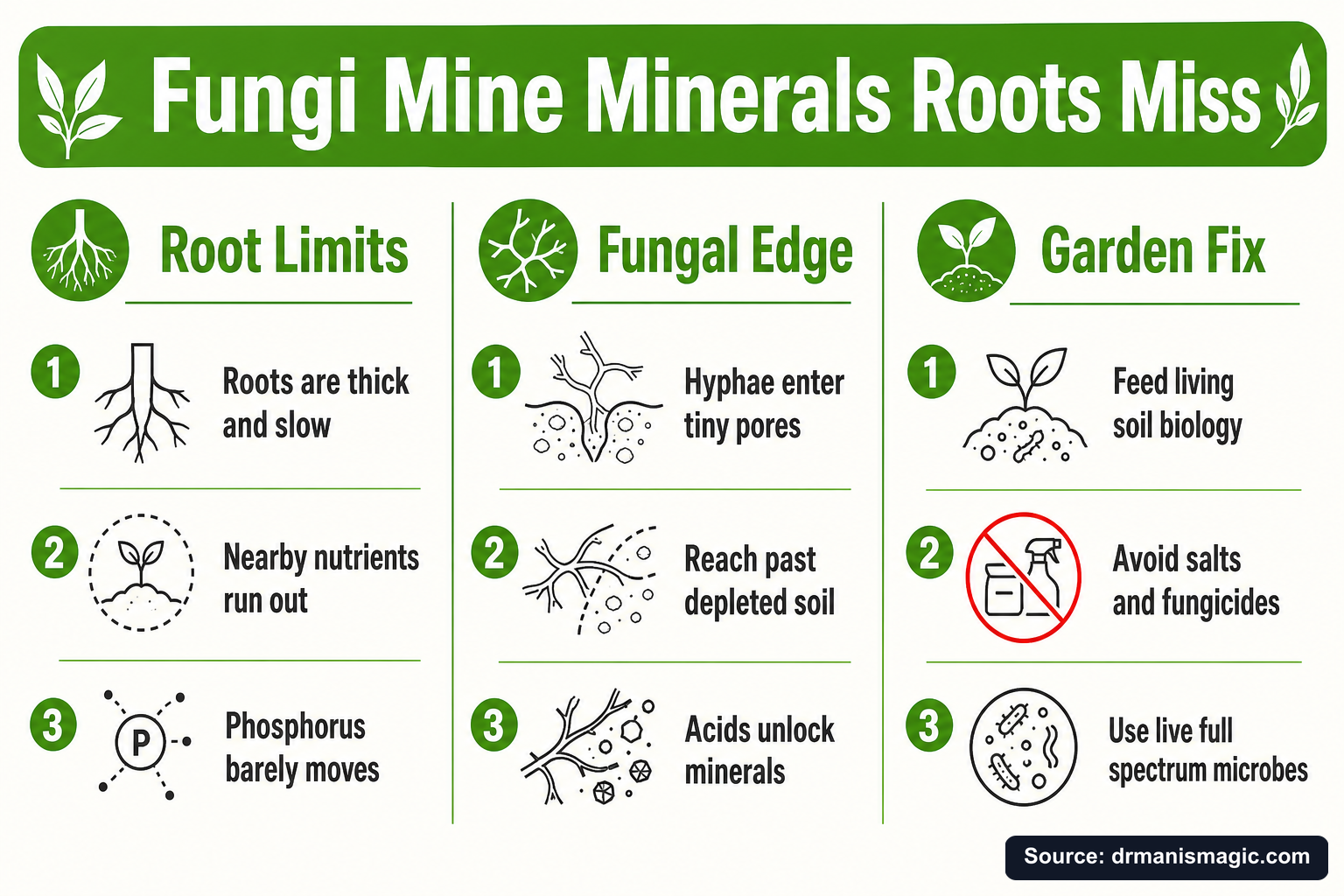
Key Takeaways
- Fungal hyphae are thinner than roots and reach minerals inside tiny soil pores that roots physically cannot enter.
- Mycorrhizal fungi extend your plant's mineral-mining range far beyond the phosphorus depletion zone that forms around every root.
- Fungi dissolve locked minerals using organic acids and enzymes, then transport them back to plant roots in a direct exchange for sugars.
- The full soil food web — bacteria, fungi, protozoa, and nematodes — works together as a mineral-cycling economy, not just a single fungal trick.
- Dead, dried, or foul-smelling microbial products fail to deliver this benefit because the microbes are already gone before they reach your soil.
- Salt-based fertilizers and synthetic fungicides kill the very fungi that make this system work.
- Restoring live biology through repeated applications of stabilized, full-spectrum microbes is how damaged soil comes back to life.
What Is the Difference Between a Root Hair and a Fungal Hypha?
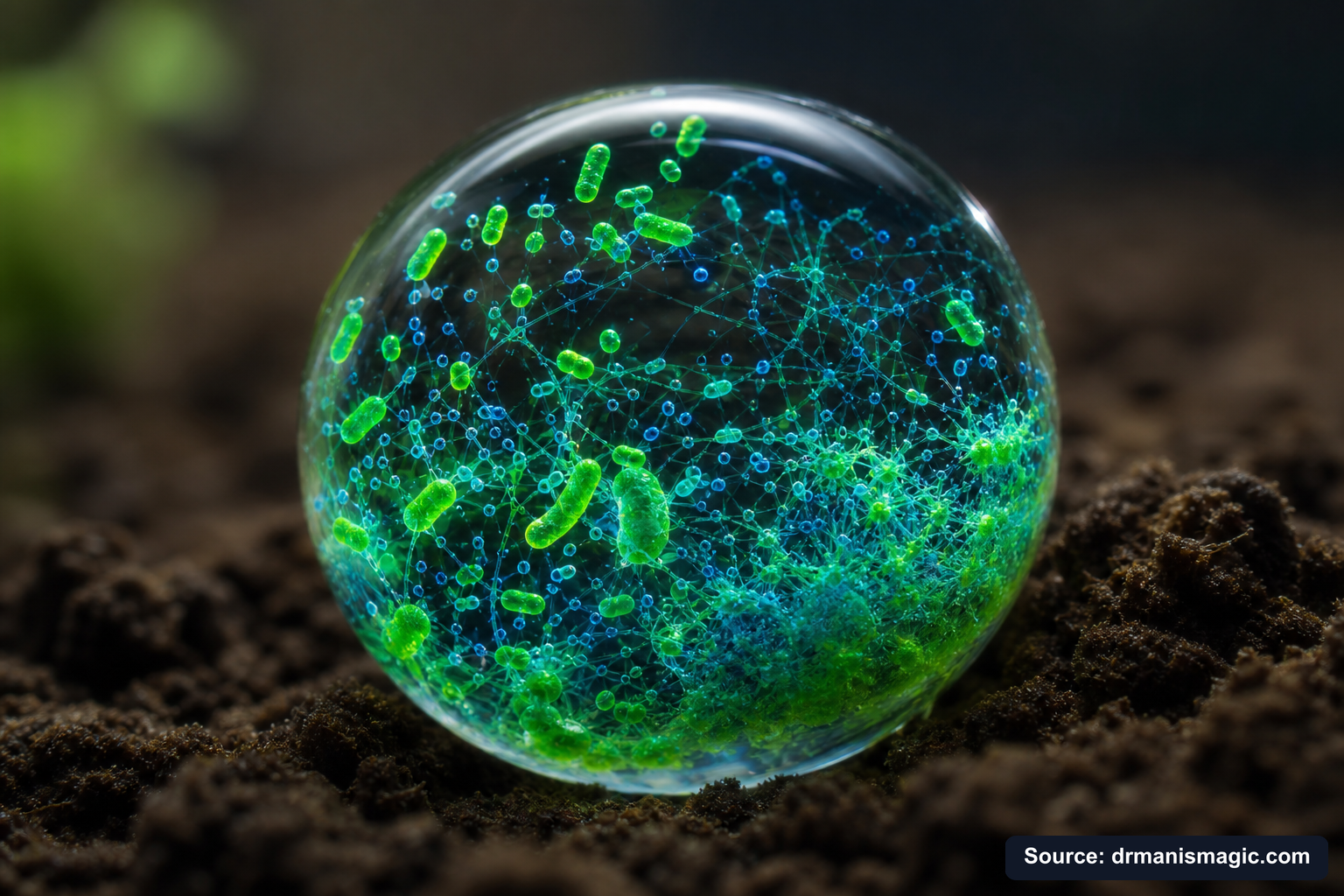
Quick Answer: A root hair is roughly 10 to 20 micrometers wide and can only grow where the root itself goes. A fungal hypha is 2 to 5 micrometers wide and explores independently through soil pores the root will never reach, covering hundreds of times more surface area at a fraction of the physical cost to the plant.
Think of your plant's roots like a garden hose. Thick, sturdy, good at moving water. Now think of fungal hyphae as a million threads of spider silk spreading out in every direction from the end of that hose. The spider silk goes places the hose never could.
Root hairs grow off the surface of roots and do pick up nutrients. But they are limited. They only live for a few days. They cannot move. And they need to be very close to the mineral they are trying to absorb.
Fungal hyphae are different in almost every way.
- They are 2 to 10 times thinner than root hairs.
- They can travel centimeters to meters away from the root tip.
- They squeeze into micro-pores in soil aggregates that roots physically cannot enter.
- They live much longer than root hairs and keep exploring as long as the plant feeds them sugars.
Penn State Extension notes that arbuscular mycorrhizal (AM) fungi are especially effective for phosphorus, one of the most immobile nutrients in soil. Phosphorus does not flow to roots the way water does. It just sits there, waiting for something to come get it. Roots run out of reach quickly. Fungal hyphae do not.
The University of Minnesota Extension reports that plants with active mycorrhizal networks show measurably higher uptake of phosphorus, potassium, zinc, copper, manganese, iron, calcium, and magnesium compared to plants without fungal partners. That is not one mineral. That is the whole mineral cabinet.
| Feature | Root Hair | Fungal Hypha |
|---|---|---|
| Width | 10 to 20 micrometers | 2 to 5 micrometers |
| Reach beyond root | Very short, millimeters | Centimeters to meters |
| Access to micro-pores | No | Yes |
| Lifespan | Days | Weeks to months |
| Mineral dissolution ability | Limited | Organic acids and enzymes |
| Soil aggregate building | No | Yes, via glomalin protein |
| Carbon cost to plant | Low | Up to 20% of photosynthate |
| Return on investment | Moderate | Very high in living soils |
Your plant actually pays the fungus in sugar. Up to 20 percent of the carbon a plant captures through photosynthesis flows down to the roots and out to fungal partners. That is a serious investment. And plants have been making this trade for over 400 million years. Evolution does not keep a bad deal for 400 million years.
Why Is Phosphorus the Big Problem Fungi Solve?
Quick Answer: Phosphorus is nearly immobile in soil. It bonds tightly to soil particles and barely moves toward roots on its own. Roots quickly create an empty depletion zone around themselves. Fungal hyphae extend past that zone, reach phosphorus deposits roots cannot touch, and chemically dissolve them for transport back to the plant.
Here is something that surprises most gardeners. You can have plenty of phosphorus in your soil and still have a phosphorus-deficient plant. How? Because phosphorus does not flow. It does not ride water to the root the way nitrogen does. It just sits there, bonded to clay particles and mineral surfaces, going nowhere.
Roots pull phosphorus from the zone immediately around them. Once that zone is depleted, it stays depleted. The root cannot go get more fast enough. It can only wait for more to slowly diffuse in, and that diffusion rate is painfully slow.
Fungi solve this in three ways at once.
- Physical reach. Hyphae extend well past the depletion zone and find fresh phosphorus deposits.
- Chemical dissolution. Fungi release organic acids and phosphatase enzymes that break the bonds holding phosphorus to soil particles, making it plant-available.
- Transport. The dissolved phosphorus moves back through the hyphal network directly to the root surface, where the plant absorbs it in exchange for sugar.
This is not a slow drip. This is an active, living supply chain operating continuously inside your soil. Penn State Extension specifically highlights AM fungi as the most effective biological mechanism for immobile phosphorus delivery in most agricultural and garden soils.
Now here is the problem most gardeners accidentally create. When you dump high-phosphorus fertilizer on your plants, the fungi sense that phosphorus is already abundant. They stop working as hard. The plant may even reduce the number of fungal connections it maintains. You paid for fertilizer and accidentally fired your best mineral miners. That is a trade most people do not know they are making.
How Does the Whole Soil Food Web Cycle Minerals to Your Plant?
Quick Answer: Fungi and bacteria lock minerals into their own bodies. Then protozoa and nematodes eat those microbes and release the nutrients right next to plant roots in plant-available form. This grazing cycle, not just fungi alone, is how minerals move from locked soil particles into your plant's leaves and fruit.
Here is the part of the story most fertilizer companies will never tell you. Because if you understood it, you might stop buying their products.
The soil food web is not just fungi. It is an entire economy. And every player has a job.
Bacteria and fungi are the miners and processors. They pull minerals from organic matter and from the soil itself. They lock those minerals into their own tiny bodies. At this point the minerals are not yet available to your plant. They are locked inside microbial biomass.
Then the grazers show up.
Protozoa and beneficial nematodes eat the bacteria and fungi. When they do, they release the minerals those microbes were holding. And here is the beautiful part. Protozoa and nematodes tend to graze right in the rhizosphere, the zone right around your roots. So the nutrients get released exactly where your plant can grab them.
This is not a theory. University of Minnesota Extension and Colorado State University Extension both describe this grazing-and-release mechanism as a core driver of plant-available nitrogen and other nutrients in healthy soils. UC Davis Nemaplex documents the critical role of beneficial nematodes in this nutrient cycling process.
Think of it like this. Bacteria and fungi are grocery stores. They stock the shelves with minerals. Protozoa and nematodes are the delivery trucks. They pick up the goods and drop them off at your plant's front door.
| Player | Primary Role | How It Helps Your Plant |
|---|---|---|
| Bacteria | Decompose organic matter, fix nitrogen, solubilize minerals | Release nutrients, suppress pathogens, build soil structure |
| Mycorrhizal Fungi | Extend root reach, dissolve phosphorus, transport minerals | Massively increase mineral uptake, especially for immobile nutrients |
| Other Fungi | Decompose tough organic compounds, build soil aggregates via glomalin | Improve drainage, aeration, long-term nutrient cycling |
| Protozoa | Graze bacteria and fungi near roots | Release plant-available nitrogen and minerals in the root zone |
| Beneficial Nematodes | Graze bacteria, fungi, and pest larvae | Nutrient cycling, pest suppression, pathogen control |
| Arthropods and Earthworms | Fragment organic matter, aerate soil, move microbes | Speed up decomposition, create channels for roots and water |
| Plant Roots | Anchor plant, absorb water and nearby nutrients, feed microbes sugars | The hub that starts and sustains the whole exchange |
When all of these players are present and working together, your soil becomes nearly self-sustaining. Minerals cycle. Nutrients arrive at roots. Diseases get crowded out. Plants grow without you having to do much at all.
That is exactly how plants survive in nature with no fertilizer bags, no spray schedule, and no one watching over them. The invisible workforce handles it.
Remove one layer of that workforce and the whole system slows down. Remove several layers and it collapses. That is what happens in most managed soils today, and it is not your fault. The system was set up to sell you inputs, not to build your soil's natural power.
What Kills Mycorrhizal Fungi and Breaks the Mineral Mining Network?
Quick Answer: Synthetic fungicides, salt-based fertilizers, high phosphorus inputs, pesticides, and glyphosate-based herbicides all damage or destroy mycorrhizal fungi. Sterile potting mixes start with zero fungi. Fumigated, tilled, or chemically treated soils can have their fungal networks destroyed in a single season.
This is the part of the story that stings a little. Because most standard gardening advice, most big box store products, and most conventional fertilizer programs do exactly the things that destroy this system.
Here is what breaks the mineral mining network.
- Synthetic fungicides. These do not just kill bad fungi. They kill the good ones too. One application can wipe out mycorrhizal networks that took months to build.
- Salt-based fertilizers. High salt concentrations in the root zone stress and kill beneficial bacteria and fungi. Your plant might green up fast, but the underground crew takes the hit. Then when you stop fertilizing, there is nothing left to support the plant naturally. See also: The Hidden Reason Synthetic Fertilizers Cause Root Rot
- High phosphorus inputs. As noted above, flooding the soil with phosphorus tells fungi they are not needed. The plant reduces its fungal connections and the network shrinks.
- Glyphosate and broad-spectrum herbicides. These disrupt microbial communities in ways that are still being studied, but the evidence of harm to beneficial microbes continues to grow.
- Sterile potting mix. Most commercial potting mixes are either sterilized or made from materials that contain no living biology. You are starting at zero every time you pot a plant in that mix.
- Soil fumigation and aggressive tilling. These physically destroy the hyphal networks that fungi spend months building.
After growing over 250,000 trees at our South Texas nursery, we have seen the difference between soil with live biology and soil without it. The plants in living soil are more vigorous. They bounce back from stress faster. They need less intervention. And they start producing fruit and flowers sooner, which matters more than most people admit.
People tell Dr. Mani all the time that their number one wish is to see their tree bear fruit while they still can. Not next decade. Now. The fastest path to that is not more fertilizer. It is building the underground system that makes a plant truly powerful. Time is the one thing you cannot get back. Every season spent feeding the wrong way is a season that cannot be recovered.
You Never Had a Brown Thumb.
You were handed the wrong tools. This free guide hands you the right ones.
You watered it. You fed it. It died anyway.
It was never you. It was the dirt, the salt food, and the bad advice.
This guide shows you what really went wrong, and how to fix it for good.
- Why your plants really died, and why it was never your fault
- The salt hiding in your plant food that quietly burns the roots
- The hidden killer in almost every bag of store soil
- The tiny helpers that grow a whole forest for free
- The rescue trick that brings a half dead plant back to life

Why Do Most Mycorrhizal Inoculant Products Fail to Deliver?
Quick Answer: Most commercial mycorrhizal products use dried, lab-grown spores that have very low viability by the time they reach your soil. Others are liquid compost tea products that have gone anaerobic during shipping, meaning the microbes are dying or already dead. Neither delivers the live, active biology your plant's roots need.
This is where the market gets messy. And honestly, a little dishonest.
Walk into any garden center and you will find bags and bottles claiming to contain mycorrhizal fungi. Some have impressive numbers on the label. Millions of spores per gram. Dozens of species listed.
Here is what those labels do not tell you.
Most of these products come from a small number of large commercial labs. The microbes are grown in vats, then dried into powder. The idea is that the dried spores will wake up when you add water and pour them on soil. We have tested dozens of batches of these products at US Citrus Nursery. Across the board, we saw no measurable benefit to the plants. The spores do not reliably reactivate. Or if they do, they are weak.
The second category is liquid compost tea products. These start with real biology. But by the time the bottle ships to a warehouse, sits on a shelf, and gets shipped to you, the microbes have often gone anaerobic. They are fermenting. They are dying. You can tell because the bottle makes a hissing sound when opened. And it smells like something went very wrong.
We are not being mean about this. It is just physics. Microbes need oxygen. They need the right conditions. Put them in a sealed bottle for weeks and most will not survive the journey.
Here is what actually works. Fresh compost, steaming hot and alive, teeming with every microbe your soil needs. Gardeners who apply fresh compost describe the results as almost magical. Because it is. The problem is most people do not have the time, space, or physical ability to manage a proper compost pile and brew fresh compost tea every month.
That is the exact problem Dr. Mani set out to solve.
| Product Type | Viability When Used | Microbial Spectrum | Smell | Our Assessment |
|---|---|---|---|---|
| Dry/powdered lab microbes | Very low | Narrow, single or few species | Neutral | We saw no consistent results across dozens of batches |
| Rehydrated dry microbes in liquid | Very low | Narrow | Neutral | Same problem as dry powder, harder to identify |
| Old compost tea (over 24 hours) | Low, anaerobic | Partial | Strong, foul | Microbes dying or dead; some humic acid value remains |
| Fresh compost tea (under 24 hours, aerated) | Moderate to high | Broad but variable | Earthy, fresh | Excellent if you can manage the process yourself |
| Fresh active compost (on-site) | High | Broad, natural | Earthy | Fantastic source; requires time, space, and effort |
| Plant Super Boost (stabilized, full-spectrum) | High | 2,000+ bacteria, 400-500 fungi including mycorrhizae, plus protozoa and nematodes | Earthy, not foul | Harvested from real compost, stabilized by natural method, visible live microbes under microscope |
The solution we found came through a remarkable meeting. Dr. Mani connected with a world-renowned compostologist who had spent decades advising farming programs for royal families and governments. This expert had discovered a natural, proprietary way to stabilize live compost microbes without killing them and without letting them go anaerobic. When applied correctly, the biology stays alive. The bottle does not stink. And under a microscope, you can actually see the microbes moving.
That method became the foundation of Plant Super Boost. It contains over 2,000 species of bacteria, 400 to 500 species of fungi including mycorrhizae, plus protozoa and nematodes. The full food web in a bottle. Zero synthetic salts. Zero biosludge. Zero PFAS. Backed by multiple independent lab analyses confirming live microbial activity.
When Does Adding Mycorrhizal Fungi Actually Make a Difference?
Quick Answer: Mycorrhizal inoculants make the biggest difference in sterile potting mixes, transplanted seedlings, disturbed or fumigated soils, newly constructed beds, and container plants. In already-healthy field soils with established native fungal populations, the benefit may be smaller but maintaining regular applications still supports the broader soil food web.
Not every garden needs the same help. Here is a plain-English guide to when restoring fungi matters most.
Where it matters most:
- Potted plants and container gardens. These start in sterile or near-sterile mix with essentially zero native biology.
- Transplants and seedlings. The act of transplanting severs young root systems and disrupts any early fungal connections.
- Newly built raised beds with purchased soil or fill dirt.
- Soils that have received repeated synthetic fungicide or herbicide applications.
- Soils fumigated before planting, common in commercial nursery and some home settings.
- Urban and suburban soils that have been graded, compacted, or covered with concrete and then exposed.
- Any plant that has been in decline despite regular watering and fertilizing, where the issue may be biological, not nutritional.
Where native populations may already exist:
- Undisturbed native soil that has never been fumigated or heavily treated.
- Mature forest gardens or food forests with established ecology.
- Soils managed organically for many years with regular compost additions.
Even in healthy field soils, regular additions of live microbiology help maintain diversity and support the parts of the food web that get depleted by environmental pressure, seasonal stress, and natural microbial competition from pathogens.
The key insight is this. In nature, microbes are being constantly replenished. Rain carries microbes. Animals carry microbes. Fallen leaves decompose and feed microbes. In a container on your patio, a raised bed in your backyard, or a garden in a suburb where the topsoil was scraped away during construction, that natural replenishment does not happen. You have to be the rain.
How Do You Bring Dead or Depleted Soil Back to Life?
Quick Answer: Restoring a depleted soil food web takes repeated applications of live microbiology, stopping inputs that kill microbes, improving soil structure for oxygen flow, and feeding the biology with organic matter and organic fertilizer. It does not happen overnight, but most plants show improvement within one to two months of consistent treatment.
If your soil has been through the wringer, whether from years of synthetic fertilizers, herbicide treatments, or just sitting in a bag on a shelf, here is a straightforward recovery path.
- Stop the damage first. Discontinue salt-based synthetic fertilizers, broad-spectrum fungicides, and glyphosate-based herbicides. You cannot rebuild biology while actively killing it.
- Fix the physical structure. If you are in a container or raised bed, make sure your growing medium drains well and does not compact. Roots and microbes both need oxygen. Waterlogged, compacted soil suffocates everyone. Consider a mineral-based soil that does not decompose and collapse over time.
- Introduce live, full-spectrum biology. Apply a live microbial product monthly. Consistency matters more than a single large dose. The goal is to build a community, not spike a number.
- Feed the biology with organic matter. Organic fertilizers give microbes the carbon and nutrients they need to thrive. Salt-based fertilizers starve and kill them. Slow-release organics from sources like crab meal, kelp, and amino acids feed the soil and the plant simultaneously without the salt burn. See also: Why Most Fertilizers Are Actually Salt in Disguise
- Be patient and consistent. A depleted soil may take two to six months of consistent biological support before you see the full effect. The plant will show you. New growth becomes greener. Leaves thicken. Fruit sets more reliably. Root systems explored under the pot show white, healthy growth instead of brown, mushy tips.
- Do not skip months. In managed environments like containers and manicured gardens, the pressures that destroy microbes do not stop. You need to keep the reinforcements coming.
- Observe and trust the process. The first sign things are working is often subtle. A little more vigor. A little more green. Then one morning you walk outside and the difference is obvious.
The Three Plant Pillars system is built exactly around this recovery process. Mineral soil that breathes. Live microbials that work. Organic fertilizer that feeds without burning. When all three are in place, the system reinforces itself. Each pillar makes the others stronger.
Fungi vs. Roots: Why Your Plant Chose to Work With Both
Quick Answer: Roots and fungi do not compete. They solve different problems. Roots anchor the plant, move water, and absorb nutrients close in. Fungi extend the mineral-mining network far beyond what roots can reach, access immobile nutrients through chemical means, and connect the plant to the broader soil food web. Together they are far more capable than either alone.
It would be a mistake to think of roots and fungi as rivals. They are partners with different job descriptions.
Roots are the infrastructure. They are the anchor, the water highway, the close-range nutrient absorber. They are built to last and to handle the mechanical demands of holding a plant upright through decades of wind and weather.
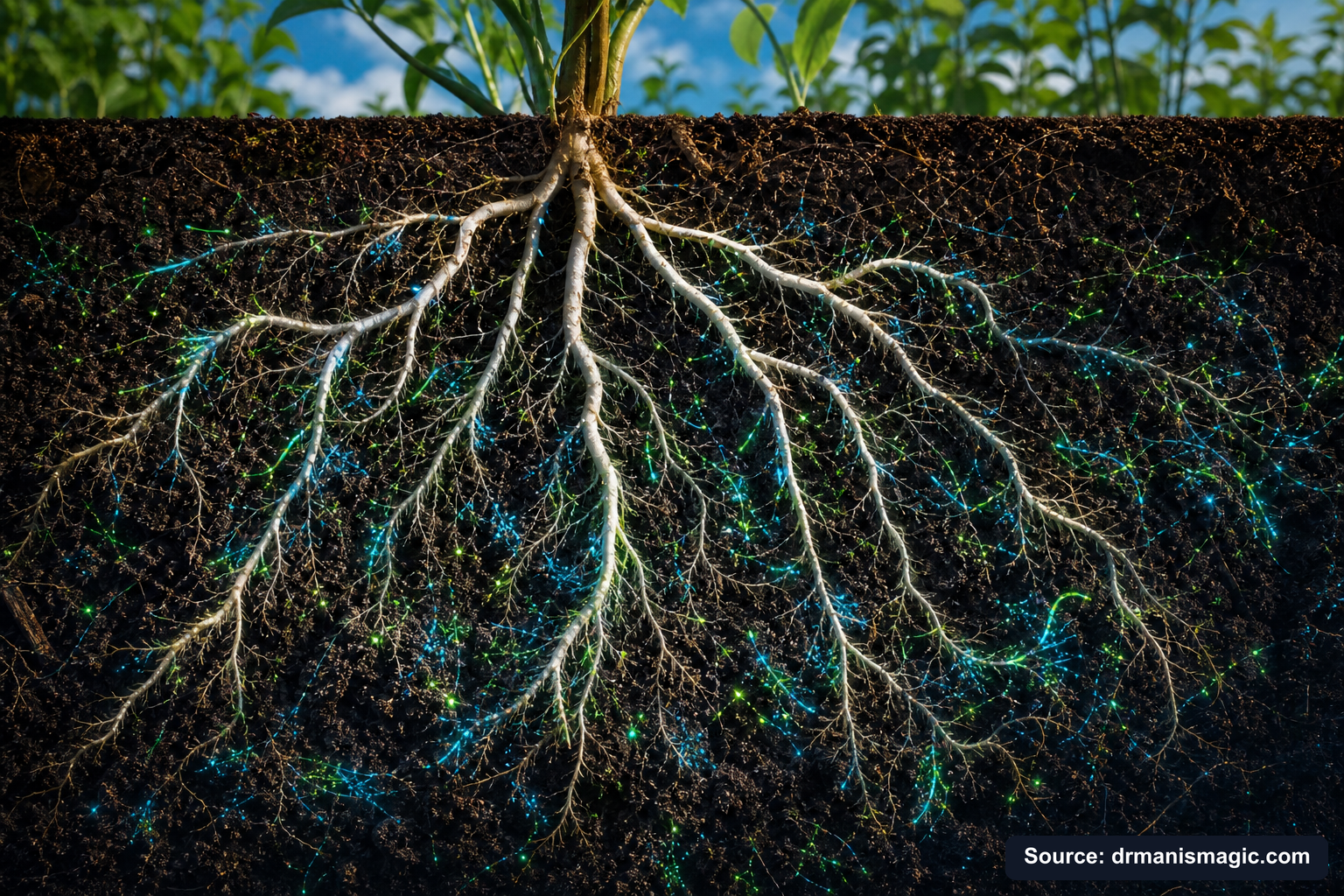
Fungi are the scouts and miners. They are built to explore, to dissolve, to transport, and to connect. A single teaspoon of healthy soil can contain several yards of fungal hyphae. Those hyphae are working constantly, mapping the mineral landscape around your plant and pulling resources back to where they are needed.
The plant itself manages this relationship intelligently. When nutrients are abundant, it invests less in fungal partnerships. When nutrients are scarce, it increases the flow of sugar to its fungal partners and expands the network. The plant is not passive in this relationship. It is an active manager of an underground workforce.
That is the real reason plants evolved this partnership 400 million years ago. Not because fungi are a nice-to-have. Because fungi solve problems that roots simply cannot. And in nutrient-scarce environments, which is most of the natural world, that difference is survival.
Now add the bacteria that fix nitrogen from the air. Add the protozoa that graze bacteria and release minerals next to roots. Add the nematodes that cycle nutrients and suppress pathogens. Add the earthworms that aerate and move microbes through the soil profile. And you have something that no fertilizer program has ever replicated, a self-sustaining, self-regulating, mineral-cycling economy that your plant evolved to live inside.
That is what a living soil does. That is what we have spent thirty years learning to protect and restore at US Citrus Nursery. And that is what we built the Dr. Mani's Magic line to help you do in your own garden, your own containers, your own backyard.

What Can You Do Right Now to Put Fungi Back to Work?
You now know more about what happens underground than most gardeners ever learn. You know why fungi mine minerals better than roots. You know how the full soil food web cycles nutrients to your plant. You know why most microbial products fail before they even reach your soil. And you know what it takes to build the living system back.
The good news is that living soil responds fast when you give it what it needs. Most plants show visible improvement within a month of consistent biological support. Not five years from now. Not next season. Within weeks, you can see greener leaves, stronger stems, and more vigorous new growth telling you the underground crew is back on the job.
You cannot get back the time you spent trying the old way. The seasons that passed with struggling plants and disappointing harvests. But you can decide today to stop working against the natural order and start working with it.
The best time to restore your soil's biology was ten years ago. The second best time is right now.
If you want to see what a full-spectrum live microbial product looks like and how it fits into the complete Three Plant Pillars system, explore the Free Plant Care Field Guide at Dr. Mani's Magic. It walks you through the whole system, step by step, with no jargon and no guesswork. Just the honest, science-backed approach we developed growing a quarter million trees in South Texas, now available for every plant in your home and garden.
Frequently Asked Questions
Most gardeners never think about what is happening underground. But the invisible world beneath your soil is where plants win or lose. These questions cut straight to what fungi do, why your roots need them, and how the Three Plant Pillars put this underground power to work for you.
What is the relationship between fungi and plant roots?
It is a trade deal. Your plant sends sugars down to the fungi. The fungi send back phosphorus, zinc, copper, and other hard-to-reach minerals. Scientists call this a mycorrhizal relationship. Over 90 percent of plants on earth depend on it. Without live fungi in the soil, your plant is working with one hand tied behind its back. We have watched this play out across more than 250,000 trees at our South Texas nursery.
Why are fungi better at mining minerals than roots alone?
Roots are thick. Fungal threads, called hyphae, are 2 to 5 times thinner. They slip into tiny soil pores your roots will never reach. They also travel centimeters to meters past the area your roots have already drained dry. Scientists call that drained area a depletion zone. Your roots stop there. Fungi keep going. That is the difference between a plant that struggles and a plant that explodes with growth.
What do fungi actually do inside the soil?
Fungi do three big jobs. First, they dissolve locked-up minerals using natural acids and enzymes, then carry those minerals back to your roots. Second, they break down dead organic matter and release nutrients plants can actually use. Third, their thread-like networks bind soil particles together, creating air pockets so roots can breathe. Healthy soil is alive. Dead soil is just expensive dirt.
Do salt-based fertilizers hurt the fungi in my soil?
Yes, and badly. Salt-based synthetic fertilizers burn the very fungi your plant depends on. They wipe out the microscopic crew doing the underground mining work. You might see a quick green flush after applying them, but you are slowly destroying the living system that makes long-term growth possible. That is the trap the big chemical companies never tell you about. Dr. Mani saw this firsthand and built the Three Plant Pillars to fix it.
What is Plant Super Boost and how does it bring fungi back to life in my soil?
Plant Super Boost is a live microbial product packed with bacteria, fungi, and mycorrhizae. Most microbial products on the market are dead by the time they reach your door. Dr. Mani uses a special stabilization method to keep these microbes alive in the bottle. You mix it with water and pour it on your plants. The living fungi get to work fast, rebuilding the underground mining network your soil has been missing. It does not smell bad either.
Can fungi help my plants handle drought and pests without chemicals?
Absolutely. Active mycorrhizal fungi improve how your plant pulls in water during dry spells. They also crowd out harmful soil pathogens, giving your plant natural disease resistance. When your soil food web is healthy, your plant is not defenseless. It has a whole underground army working for it around the clock. This is exactly why plants grown with the Three Plant Pillars become practically bulletproof compared to plants fed only synthetic fertilizers.
How do I know if the fungi in my soil are actually alive and working?
Dead fungi do nothing. If your microbial product smells rotten or has been sitting on a shelf for years, the microbes are likely gone. Living fungi produce results you can see. Roots grow thicker and deeper. Leaves get darker and more vibrant. Fruit fills out faster. At our nursery, we have tested live microbials on citrus, tropical trees, houseplants, and gardens for decades. The difference between living soil and dead soil shows up fast, usually within the first month.
About the Author
Ron Skaria, MD
Ron Skaria, MD, is the co-founder of Dr. Mani's Magic and the son of Dr. Mani. He trained as a medical doctor at Baylor College of Medicine, did his residency at UT Health Science Center - San Antonio and fellowship training at Texas Tech University. He now works full time on the family farm at US Citrus and US Citrus Nursery in Hargill, Texas, building Dr. Mani's Magic alongside his dad. He wrote the Brown Thumb Field Guide to put his father's 48 years of plant science into plain words any gardener can use. His belief is simple. You never had a brown thumb. You just never had the right help.


