


Why Sterile Soil Starves Plants Even When It Looks Healthy | Dr. Mani's Magic
Why Sterile Soil Starves Plants (Even When It Looks Fine)
Picture this. You just bought a beautiful potted plant. The soil looks dark and rich. You water it faithfully. You give it the right amount of sun. You even talk to it a little, because you read somewhere that helps.
And then, slowly, it starts to fade. The leaves go pale. Growth stalls. You add more fertilizer. Nothing. You water more. Still nothing. The plant just sits there, slowly losing the fight. And you stand there wondering what you did wrong.
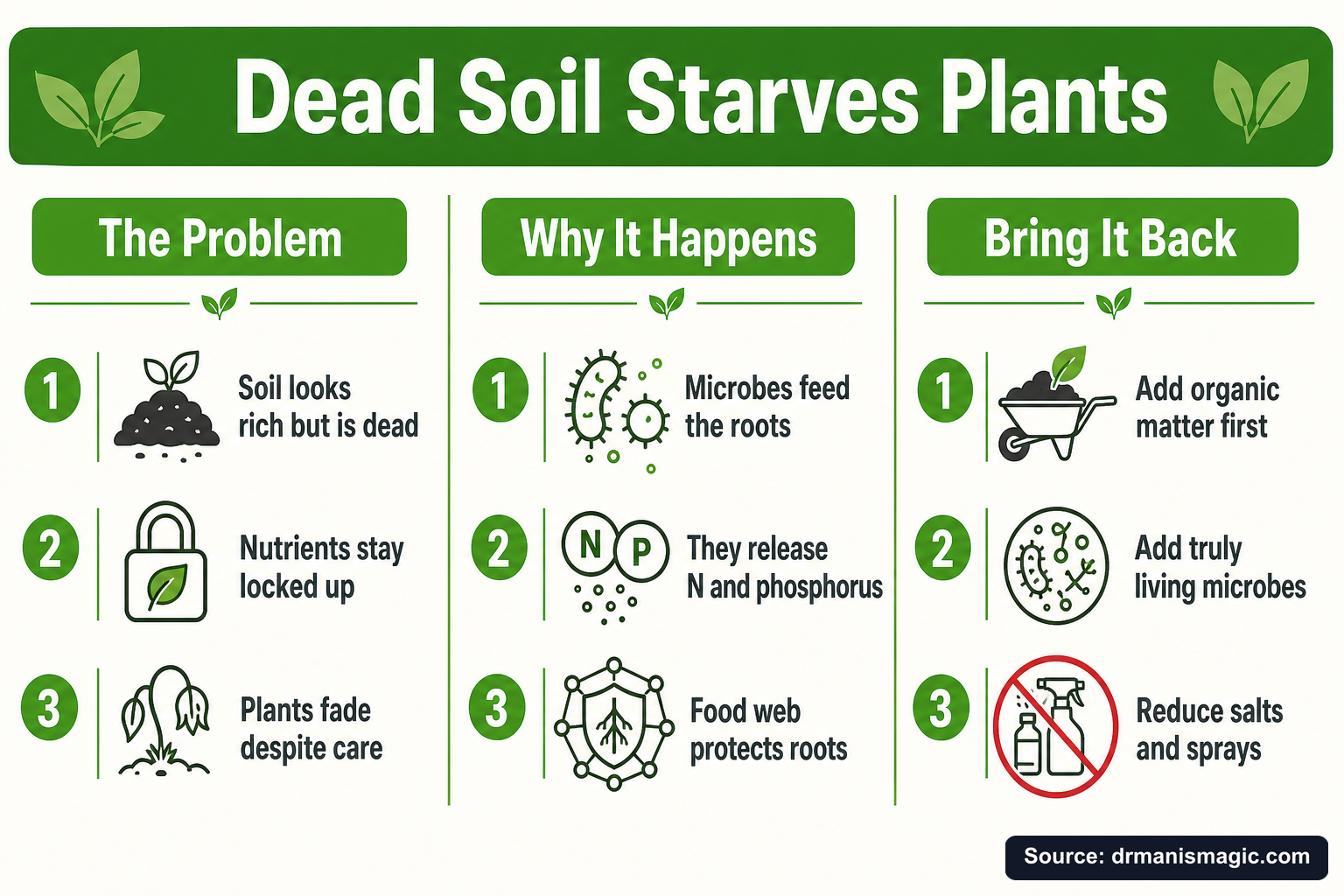
Here is the thing. You probably did not do anything wrong. The soil did. Not because it was dirty or diseased. But because it was dead. And dead soil, no matter how dark and fluffy it looks, cannot feed a plant the way living soil can. That is the real secret nobody at the garden center ever told you. Nutrients can be sitting right there in the soil, and your plant can still starve. This article explains exactly why, and what you can do about it today.

Plant Super Boost
Key Takeaways
- Sterile soil can contain minerals and still starve your plant, because nutrients locked in soil need living microbes to become plant-available.
- The soil food web, made up of bacteria, fungi, protozoa, and nematodes, is the engine that cycles nutrients, suppresses disease, and builds strong roots.
- University research shows that soil biology supplies roughly 75% of plant-available nitrogen and 65% of available phosphorus, making microbes a major fertility engine, not a bonus.
- Sterilization, whether from heat, fumigation, salt-based fertilizers, or pesticides, collapses this biological system and leaves plants dependent on soluble inputs and perfect watering.
- Most bagged potting mix starts biologically dead, which is why container plants often plateau and decline without microbial support.
- Dead, dried, or foul-smelling microbial products are poor substitutes for genuinely live biology.
- Sterile soil can recover, but it needs the right steps in the right order, starting with organic matter, living biology, and reduced disturbance.
What Is Sterile Soil, and Why Does It Matter to Your Plants?
Quick Answer: Sterile soil is soil with no living microorganisms. It can result from heat treatment, chemical fumigation, salt buildup, pesticide overuse, or simply buying fresh bagged potting mix. Without microbes, the nutrient cycling system that feeds plants collapses, even if minerals are chemically present in the soil.
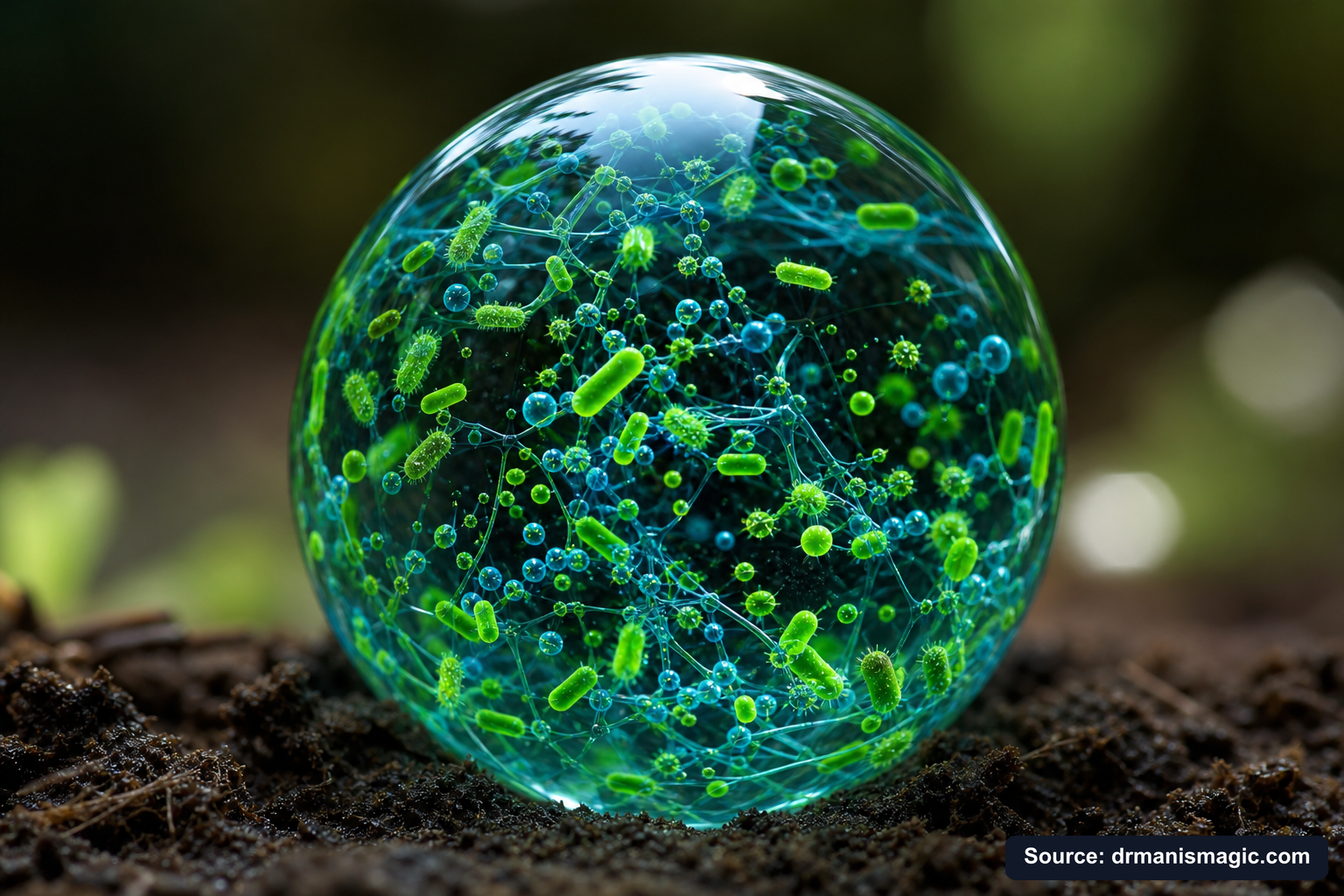
Sterile soil means no living organisms are present. No bacteria. No fungi. No protozoa. No nematodes. Just minerals and particles sitting there, doing almost nothing.
Now, here is where it gets interesting. Sterile soil is not always bad on purpose. Seed-starting mixes are often sterilized to kill pathogens that could wipe out fragile seedlings. Lab experiments use sterile media so researchers can control variables. That makes sense in a controlled setting.
But here is the problem. Once that seedling outgrows its tray and moves into your garden or a big pot, it needs a living world around its roots to thrive long-term. And most people never make that transition. They keep planting in sterile or biologically depleted soil and wonder why their plants eventually plateau and decline.
There is also a difference between soil that was sterilized intentionally and soil that became dead over time. Overfertilizing with salt-based products, spraying herbicides and fungicides, compacting soil, or leaving it bare and dry, all of these practices slowly kill the microbial community. The soil looks the same from the outside. But underground, the invisible workforce has been wiped out.
See also: The Hidden Reason Synthetic Fertilizers Cause Root Rot
How Does the Soil Food Web Actually Feed Your Plants?
Quick Answer: The soil food web is a community of bacteria, fungi, protozoa, and nematodes that work together to break down organic matter, release nutrients in plant-available forms, extend root reach, and suppress disease. Without this web, nutrients stay locked up and plants cannot access them no matter how much fertilizer you add.
Think of the soil food web as a living marketplace happening right under your feet, every single day. Your plant's roots are the storefront. The microbes are the workers, suppliers, and security team all rolled into one.
Here is how it works in plain language.
Your plant's roots release sugars into the soil. These sugars attract bacteria and fungi like a magnet. The microbes eat the sugars and in return, they break down organic matter and release nutrients the plant can actually absorb. They also produce hormones that stimulate root growth, fight off harmful pathogens, and build the tiny tunnels and channels that let air and water move through the soil properly.
According to University of Minnesota Extension, soil biological processes supply roughly 75% of plant-available nitrogen and 65% of available phosphorus. Read that again. Three out of every four units of nitrogen your plant uses comes from biological activity in the soil, not from the fertilizer bag. That is not a supporting role. That is the main event.
Penn State Extension describes the rhizosphere, the zone of soil right around the roots, as a microbial hotspot where bacteria, fungi, protozoa, and nematodes interact in a constant cycle of carbon, nitrogen, sulfur, and phosphorus exchange. This is not a simple two-player game. It is a whole community working in layers.
Each member of this community plays a different role. Here is how the team breaks down:
| Soil Organism | Primary Job | What the Plant Gets |
|---|---|---|
| Bacteria | Break down simple carbon compounds, fix atmospheric nitrogen, solubilize phosphorus | Available nitrogen, phosphorus, and other nutrients released fast |
| Mycorrhizal Fungi | Extend root surface area up to 1,000x, transfer water and nutrients, produce glomalin to bind soil aggregates | Better drought tolerance, improved nutrient uptake, stronger soil structure |
| Other Beneficial Fungi | Decompose tough plant residues like lignin, suppress root pathogens | Nutrient cycling from complex materials, disease protection |
| Protozoa | Graze on bacteria, releasing nitrogen in plant-available forms | Steady supply of mineralized nitrogen right at the root zone |
| Beneficial Nematodes | Feed on bacteria, fungi, and harmful nematodes, releasing additional nutrients | Nutrient mineralization, suppression of harmful root pests |
Notice something? Protozoa and beneficial nematodes are on that list. Most gardening content stops at bacteria and fungi. But protozoa and nematodes are the final step in the nutrient release chain. They graze on microbes and excrete nitrogen directly into the root zone in a form plants can grab immediately. Remove them, and you lose a critical piece of the nutrient delivery system.
When you plant in sterile soil, you are removing this entire team from the game. The plant can still photosynthesize. It can still drink water. But the trading partners are gone. The marketplace is empty. And over time, the plant starves, even if there are technically minerals present in the soil.
What Happens Inside the Soil When It Gets Sterilized?
Quick Answer: Sterilization collapses the entire causal chain of soil health. Decomposition slows, nitrogen and phosphorus stay locked in unavailable forms, mycorrhizal networks disappear, disease-suppressive checks and balances break down, and soil structure weakens. Plants then become completely dependent on soluble fertilizers and perfect watering to survive.
Walk through the chain of events step by step.
First, the microbes die. Whether from heat, chemical fumigation, salt-based fertilizer overuse, or a heavy pesticide application, the biological community collapses. This happens faster than most people realize.
Second, decomposition slows to a crawl. Organic matter stops being broken down into nutrients. Plant residues sit there. The recycling engine shuts off.
Third, nutrient cycling breaks down. Nitrogen stays locked in organic forms no plant can use. Phosphorus binds tightly to soil particles and becomes unavailable. Micronutrients like iron, zinc, and manganese become inaccessible without the microbial chemistry to release them.
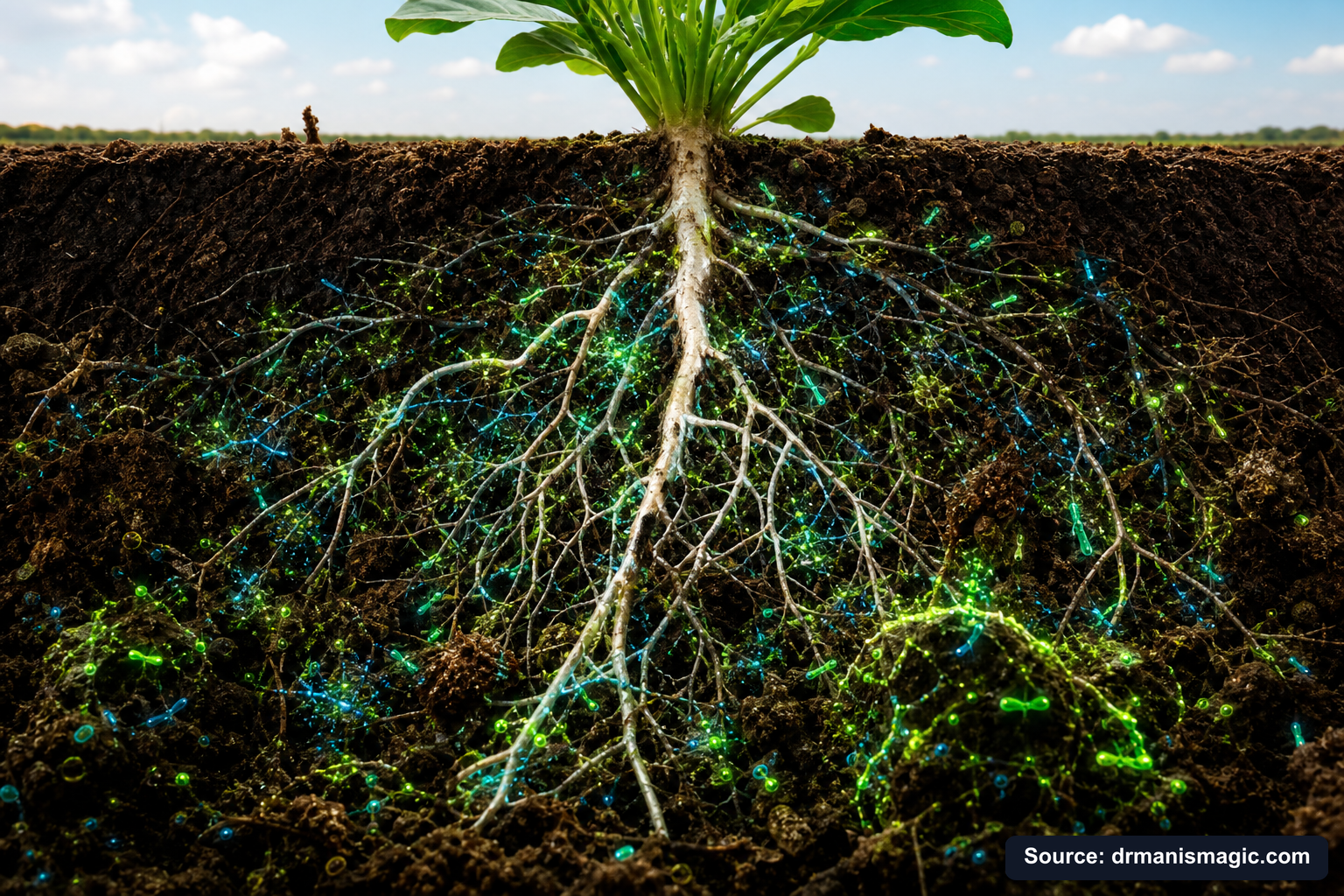
Fourth, the mycorrhizal network disappears. Those white fuzzy threads you sometimes see on healthy roots when you pull a weed, those are mycorrhizal fungi. They extend the root system by hundreds of times in surface area. They move water and nutrients into the plant from far beyond where the roots can physically reach. In sterile soil, they are gone. The plant is suddenly blind and deaf to a huge portion of its own growing zone.
Fifth, disease suppression collapses. In living soil, beneficial bacteria and fungi physically crowd out pathogens. They compete for space and food. They produce natural antibiotics. They signal the plant's immune system to stay on alert. Without them, harmful organisms move in and find zero competition. Root rot, fungal diseases, and bacterial infections spread unchecked.
Sixth, soil structure degrades. Mycorrhizal fungi produce a sticky protein called glomalin that glues soil particles into aggregates. These aggregates create the tiny air pockets and water channels roots need to breathe and grow. Without fungi, soil collapses into a dense, airless layer. Water pools instead of draining. Roots suffocate.
The end result? A plant that is completely dependent on you. It needs exactly the right amount of soluble fertilizer, exactly the right watering schedule, and perfect conditions to survive. There is no buffer. There is no resilience. One missed watering, one slight over-feeding, and it tips over the edge.
After growing over 250,000 trees at our South Texas nursery, we saw this pattern repeat over and over. The plants in biologically dead media needed constant intervention. The plants in living soil practically took care of themselves.
Can Plants Grow in Sterile Soil at All?
Quick Answer: Yes, plants can survive in sterile soil short-term, especially with soluble fertilizers and careful watering. But they cannot thrive long-term without biological support. They lack resilience, disease suppression, and the ability to access bound nutrients, making them fragile and dependent on constant inputs.
Here is the honest answer, and we want to give you credit for asking the right question.
Yes. Plants can grow in sterile soil. Greenhouses do it all the time using sterile media and liquid nutrient solutions. Hydroponic systems grow plants in pure water with no soil at all. That works in a controlled environment with precise inputs.
But notice what those systems require. Constant monitoring. Precise nutrient concentrations. Perfect pH. Regular flushing to prevent salt buildup. Continuous replacement of nutrients the soil biology would otherwise cycle for free.
In your backyard or on your patio? That level of control is almost impossible to maintain. And when something goes slightly off, the plant has no buffer, no biological safety net to catch it.
There is also the short-term versus long-term reality. Sometimes sterilizing pathogen-loaded soil helps in the short run. If your soil has a bad fungal disease, removing that pathogen by sterilization can prevent immediate plant death. That is a legitimate use of sterilization.
But then what? The pathogens come back before the beneficial organisms do, because harmful microbes are often faster to recolonize. You are right back where you started, except now you have also wiped out the beneficial biology that would have fought those pathogens in the first place.
Long-term plant health, disease suppression, and stress resilience all depend on a living, diverse soil community. Sterilization can buy time. It cannot replace biology.
Is Sterile Soil the Same as Dead Soil, Old Potting Mix, or Depleted Garden Soil?
Quick Answer: Not exactly. Sterile soil has zero organisms by design. Dead soil and old potting mix have lost most biological activity over time through depletion, salt accumulation, or compaction. Depleted garden soil is biologically weakened but not fully dead. All of them share the same core problem: not enough living biology to support healthy plants.
These terms get mixed up constantly, and that confusion leads to wrong solutions. Here is a simple breakdown.
| Soil Type | Cause | Biology Present? | Main Problem | First Step to Fix |
|---|---|---|---|---|
| Sterilized Soil | Heat treatment or fumigation | None intentionally | No nutrient cycling, no disease suppression | Inoculate with live full-spectrum microbes, add compost |
| Old Potting Mix | Organic matter decomposed, compacted over time | Very little | Poor drainage, low oxygen, nutrient depletion | Refresh with mineral-based soil, add live microbes |
| Salt-Damaged Soil | Overuse of synthetic fertilizers | Low to none | Salt kills beneficial microbes, locks up nutrients, stresses roots | Flush with water to leach salts, then rebuild biology |
| Fumigated Soil | Chemical biocides applied to kill pathogens | None | Pathogens return before beneficial organisms; no buffer | Inoculate with live microbes, add organic matter |
| Pesticide-Damaged Soil | Repeated herbicide, fungicide, pesticide use | Reduced and imbalanced | Microbial diversity collapsed, weak cycling | Stop disturbance, add compost, inoculate, mulch |
| Living Soil | Undisturbed, organic matter present, diverse inputs | High diversity | None when well-managed | Maintain with organic fertilizer and regular microbial support |
The most common situation we see? Old potting mix. Someone plants a tree or a houseplant in a bag of store-bought potting mix. Within six to twelve months, that mix has compacted, the organic bark material has started to rot, oxygen is squeezed out of the root zone, and whatever trace biology was present has died off. The plant looks okay for a while on the nutrients in the mix. Then it stalls. Then it slowly declines. And the gardener blames themselves.
It is not your fault. It is the soil.
See also: Why Most Fertilizers Are Actually Salt in Disguise
You Never Had a Brown Thumb.
You were handed the wrong tools. This free guide hands you the right ones.
You watered it. You fed it. It died anyway.
It was never you. It was the dirt, the salt food, and the bad advice.
This guide shows you what really went wrong, and how to fix it for good.
- Why your plants really died, and why it was never your fault
- The salt hiding in your plant food that quietly burns the roots
- The hidden killer in almost every bag of store soil
- The tiny helpers that grow a whole forest for free
- The rescue trick that brings a half dead plant back to life

Why Do Most Bagged Potting Mixes Start Biologically Dead?
Quick Answer: Most commercial potting mixes are made from pine bark, peat, and wood fibers that are processed, screened, and often pasteurized before bagging. This kills most microbial life. What little biology survives the processing dies during storage. By the time the bag reaches your hands, it is biologically empty.
Walk into any big box store and grab a bag of potting mix. It smells earthy. It feels soft. It looks like it should be full of life.
But here is what is actually inside. Shredded pine bark. Peat moss. Maybe some perlite or wood chips. These are all organic materials, which sounds good. The problem is they are dead organic materials. They have been processed, screened, and stored. Any microbial life that was present is long gone by the time the bag hits the shelf.
And here is the ugly truth about organic matter in potting mix. It decomposes. That decomposing process steals oxygen from the root zone. It compacts the mix into a dense, airless sludge. It creates conditions where harmful pathogens thrive and roots suffocate. Root rot does not usually come from overwatering alone. It comes from a combination of poor soil structure and no beneficial biology to fight off the pathogenic fungi that cause it.
We have watched this happen with our own trees over decades at US Citrus Nursery. The trees in bark-heavy potting mix looked fine for a few months. Then the slow decline began. The trees in mineral-based soil with live microbial support just kept growing.
That is exactly why Pillar One of the Three Plant Pillars is mineral-based soil. Not organic potting mix. Mineral-based soil does not decompose. It does not compact. It does not steal oxygen. It gives roots room to breathe and grow while the microbial community does its work.
Are Live Microbial Products Actually Worth It, or Are They All Hype?
Quick Answer: Live microbial products absolutely work when the microbes inside are genuinely alive, full-spectrum, and stabilized correctly. Most commercial products fail because they use dried, lab-grown spores that do not reactivate well, or liquid compost teas that go anaerobic and die before you pour them out. The difference between live and dead biology is everything.
This is where most gardeners get burned. The microbial product market has exploded. Shelves are full of bottles and packets promising living biology. But most of them deliver something closer to microbial graveyard dust.
Here is the real breakdown of what you are likely buying and what actually works.
The most common products are dry powders made in large factories. Companies grow specific bacterial strains in giant vats, dry them into spores, and package them. The hope is that adding water will reactivate those spores in your soil. We have tested dozens of these products across our nursery. We have seen no consistent results. The narrow spectrum of organisms and the low survival rate after drying make these products largely ineffective in real garden conditions.
The second common category is liquid products made from compost or worm castings. These can contain broad-spectrum biology, which is better. But here is the problem. Once that liquid is bottled and sits on a shelf or in a shipping container, the microbes inside consume the available oxygen and go anaerobic. That means they start dying. The telltale sign? The bottle stinks. Sometimes it fizzes when you open it. That is fermentation gas from dying microbes. Some benefit remains from the organic compounds like humic acid. But the living biology you paid for is mostly gone.
The third category is lactobacillus-based products, similar to what you find in yogurt. These are easy to grow and stay alive. But they aggressively outcompete beneficial soil microbes and do not belong in garden soil. They belong in your gut, not your roots.
| Product Type | Microbe Viability at Use | Spectrum of Organisms | Smell | Our Assessment |
|---|---|---|---|---|
| Dry powder, lab-grown | Very low | Narrow, 1-5 species | Neutral | Avoid. We saw no results after dozens of trials. |
| Rehydrated dry powder | Very low | Narrow | Neutral | Same problem. Skip it. |
| Compost tea, fresh under 24 hours | Moderate if aerated | Broad, natural | Earthy | Works well but requires effort and timing. |
| Compost tea, old over 24 hours | Low, anaerobic | Declining | Strong, foul | Not recommended. Microbes are dying. |
| Lactobacillus-based products | High | Very narrow | Sour | Avoid in soil. Crowds out beneficial organisms. |
| Plant Super Boost (stabilized, full-spectrum) | High | 2,000+ bacteria, 400-500 fungi including mycorrhizae, plus protozoa and nematodes | Earthy, not foul | Harvested from real compost, stabilized naturally. Visible under microscope. |
The reason Plant Super Boost works differently is simple. It is harvested from real, hand-crafted compost, not grown in a factory vat. And it uses a proprietary all-natural stabilization technique developed by a world-renowned compost expert who worked with royal families and governments before being blacklisted by large chemical companies when his methods started showing dramatic results in commercial citrus groves. His technique keeps the microbes alive without letting them go anaerobic. That is why the bottle smells earthy instead of foul. That is why you can take a drop and see living organisms moving under a microscope. Lab analyses confirm it. The biology is real, and it is alive when it reaches you.
Zero PFAS. Zero biosludge. Zero synthetic salts. And a 30-day money-back guarantee because we know it works.
How Do Salt-Based Fertilizers Make Sterile Soil Worse?
Quick Answer: Salt-based synthetic fertilizers raise the salt concentration around roots and microbes. High salt pulls water out of microbial cells through osmosis, killing beneficial bacteria and fungi. This wipes out the nutrient cycling team, forces plants into dependency on soluble inputs, and creates a vicious cycle of needing more and more fertilizer as the biology continues to collapse.
Here is the cycle that traps millions of gardeners every year and they never even know it is happening.
You notice your plant is pale and struggling. You go to the store and buy a synthetic fertilizer. You feed the plant. It greens up fast. You feel great. A few weeks later, it starts to fade again. You feed it again. And again. And the doses start feeling like they need to be bigger and more frequent just to get the same response.
Sound familiar? That is not a coincidence. That is the salt cycle at work.
Synthetic fertilizers are salt-based compounds. When you add them to soil, they raise the salt concentration in the root zone. That salt does two things. First, it pulls water out of plant roots through a process called osmotic stress, the same reason you get thirsty after eating salty food. Second, it pulls water out of microbial cells and kills them. Both the beneficial bacteria and the mycorrhizal fungi that were helping your plant access nutrients are now dead or severely weakened.
With the biology gone, the soil cannot cycle nutrients anymore. The plant becomes completely dependent on whatever soluble fertilizer you add next. And because the biology is not there to buffer and regulate, those soluble nutrients often flush out with the next watering before the plant can use them. So you add more. And the salt builds up further. And more biology dies.
You can get your money back. You cannot get your time back. Months and years spent in this cycle are months and years your plants are not thriving the way they should be. That is the real cost nobody talks about.
How Do You Bring Sterile or Dead Soil Back to Life?
Quick Answer: Reviving sterile or dead soil is absolutely possible. Nature does it all the time after disturbances like wildfires and floods. The key is rebuilding microbial habitat with organic matter, live biology, moisture, aeration, and reduced disturbance, in that order. Recovery takes time, but you can see real improvement within weeks when the right steps are followed.
The good news? Soil can recover. Nature is extraordinarily resilient. After a wildfire, after a flood, after complete devastation, the soil food web rebuilds itself. It just does it faster and better when you help.
Here is a practical recovery checklist you can start today.
- Stop the disturbance first. Stop applying synthetic fertilizers, broad-spectrum pesticides, and fungicides. Every application resets the biological clock back to zero. You cannot rebuild what you keep destroying.
- Test your soil's basic health. Check pH, salt concentration (EC), and nutrient levels if possible. If salt buildup is the issue, flush the soil thoroughly with clean water several times before adding anything else. High phosphorus levels can also suppress mycorrhizal fungi, so avoid adding more phosphorus during early recovery.
- Add finished compost or biologically active organic matter. Compost provides food and habitat for microbes to colonize. Even a thin layer worked into the top few inches makes a real difference. This is the food supply that allows the biological community to rebuild.
- Inoculate with a full-spectrum live microbial product. Adding biology accelerates recovery dramatically. Use a product with genuinely live organisms, not dried spores or foul-smelling anaerobic liquids. Apply monthly to maintain populations while the community re-establishes.
- Maintain moisture without waterlogging. Microbes need moisture to move and reproduce, but anaerobic conditions kill beneficial aerobic organisms. Consistent moisture with good drainage is the goal.
- Mulch the surface. A layer of organic mulch keeps soil temperature stable, holds moisture, reduces erosion, and feeds surface-dwelling decomposers. This is one of the simplest things you can do and it makes a large difference.
- Be patient and keep feeding the system. Microbial communities rebuild in layers. The fastest responders arrive first. The more complex organisms like mycorrhizal networks and protozoa take longer to establish. Expect to see gradual improvement over weeks and months, not overnight. Keep applying live biology monthly to support the process.
We have watched this recovery process happen with our own plants at US Citrus Nursery. Soil that looked and behaved like concrete, compacted, pale, biologically empty, came back to life when we followed these steps. The plants responded. Growth returned. Disease pressure dropped. The soil started doing its job again.
What Can You Do Right Now to Feed Your Soil's Invisible Workforce?
You do not need to understand every detail of the soil food web to start benefiting from it. You just need to stop fighting it and start feeding it.
The Three Plant Pillars that Dr. Mani Skaria developed after 35 years of plant science and 250,000 trees exist for exactly this reason. Mineral-based soil that does not decompose and collapse. Live, full-spectrum microbes that do the invisible nutrient work for you. Organic fertilizer that feeds your plant gently without burning the biology supporting it.
When all three are in place, something remarkable happens. Your plant stops being fragile. It stops needing constant intervention. The soil becomes a self-renewing system. Roots grow deeper. Leaves get greener. Fruits actually form. The whole picture you imagined when you first bought that plant or planted that tree, it becomes possible.
People come to us all the time with one simple wish. They want to see fruit on a tree they planted with their own hands. They want to harvest something. They want to know their effort meant something. That is not too much to ask. But it only happens when the foundation is right. Sterile soil will steal that moment from you one slow month at a time.
The biology was always the answer. Now you know why.
If you want to start rebuilding your soil's living workforce today, Plant Super Boost is the simplest first step. Just mix two ounces into a gallon of water and pour it around your plant's roots. Monthly. That is it. Let the invisible team do the rest.
Frequently Asked Questions
If your plants look fine but keep fading anyway, you are not alone. Most gardeners never get told the real reason their soil stops working. These questions cut straight to the truth so you can stop guessing and start growing.
Why do plants grow slower in sterilized soil?
Sterilized soil has no living microbes. That means no bacteria, no fungi, no mycorrhizae. Those tiny organisms are the ones that unlock nutrients and deliver them to your roots. Without them, nutrients just sit in the soil doing nothing. Your plant starves even when food is technically present. Dr. Mani proved this across 250,000 citrus trees. The Three Plant Pillars start with live microbial muscle for a reason. Dead soil equals slow, struggling plants.
Why does soil lose its ability to feed plants over time?
Soil loses its feeding power when the living biology inside it dies off. Salt-based fertilizers, pesticides, and compaction all kill beneficial microbes. Once they are gone, nutrients lock up and roots suffer. You can keep adding fertilizer and nothing changes. That is the trap. Dr. Mani watched it happen for years before he cracked the code. The fix is restoring living biology with something like Plant Super Boost, which puts real, live microbes back to work in your soil.
What is the point of sterilizing soil, and when does it hurt your plants?
Sterilizing soil makes sense for tiny seedlings because it kills harmful pathogens that could wipe them out early. But here is the problem. Once your plant grows up and moves into a bigger pot or garden, it needs a living soil world around its roots. Most people never make that switch. They keep using biologically dead soil and wonder why growth stalls. Sterile soil is a starting point, not a long-term home. Plants need living biology to truly thrive.
Which type of soil makes plants grow the fastest?
Loamy, mineral-rich soil with strong drainage and living biology wins every time. That is exactly why Dr. Mani built Super Soil from sandy loam straight out of the Rio Grande Valley. It does not compact. It does not rot. Roots can breathe and push deep. Pair that mineral base with live microbes from Plant Super Boost and slow-release organic fertilizer, and you have all Three Plant Pillars working together. That is the fastest, most natural path to explosive plant growth.
Can sterile soil ever recover and become healthy again?
Yes, but it needs the right steps in the right order. You cannot just add water and hope. You need living biology reintroduced into the soil. That means cutting out salt-based fertilizers that keep killing your microbes, adding organic matter, and using a real live microbial product. Plant Super Boost delivers live bacteria, fungi, and mycorrhizae that go straight to work rebuilding your soil ecosystem. Once that foundation is alive again, everything else starts clicking into place fast.
Do the products you put on your soil affect your family and pets?
Absolutely, and this matters more than most gardeners realize. Synthetic fertilizers and chemical pesticides leave residue on grass, soil, and plants. Kids play barefoot on that grass. Pets roll in it and lick their paws. Dr. Mani built the Three Plant Pillars around organic inputs for exactly this reason. Crab, kelp, and amino acid fertilizer feeds your plants without toxic salts. Plant Super Boost smells earthy, not chemical. You can enjoy your backyard without fear of what is soaking into your skin or your dog.
How long does it take to see results after fixing dead soil?
Most people using Dr. Mani's Magic products notice real changes within 30 days. Roots start responding fast when live microbes and proper soil structure work together. Color improves. New growth appears. The plant stops fading and starts pushing. That said, the deeper truth is about time. You can always earn more money, but you cannot get back the months or years a struggling plant costs you. The best time to fix your soil was last season. The second best time is right now.
About the Author
Ron Skaria, MD
Ron Skaria, MD, is the co-founder of Dr. Mani's Magic and the son of Dr. Mani. He trained as a medical doctor at Baylor College of Medicine, did his residency at UT Health Science Center - San Antonio and fellowship training at Texas Tech University. He now works full time on the family farm at US Citrus and US Citrus Nursery in Hargill, Texas, building Dr. Mani's Magic alongside his dad. He wrote the Brown Thumb Field Guide to put his father's 48 years of plant science into plain words any gardener can use. His belief is simple. You never had a brown thumb. You just never had the right help.


