


The Sticky Substance That Holds Soil Together: What Is Glomalin? | Dr. Mani's Magic
The Sticky Substance That Holds Soil Together (Glomalin): What Most Articles Get Wrong
Reach down and grab a handful of dirt from a healthy garden. Go ahead. Feel it. It crumbles apart in loose, dark clumps. It smells like rain and earth and something alive. It doesn't pack into a hard brick. It doesn't turn to powder and blow away in the wind. It holds together just enough.
Now grab a handful of dirt from a neglected lawn. Or from a pot where a plant slowly died. Dry. Dusty. Lifeless. Like sand with the soul sucked out. You could blow on it and watch it drift. That difference you're feeling in your hands? That's not just organic matter. That's not just compost. That's the work of something invisible. Something most gardeners have never heard of. It's called glomalin. And the story behind it is one of the most fascinating things happening under your feet right now.
A USDA soil scientist named Sara F. Wright discovered glomalin in 1996. She was studying soil fungi and noticed something sticky coating the fungal threads in the dirt. It was everywhere. And it turned out to be one of the main reasons healthy soil holds together in those beautiful, crumbly, life-giving clumps. Understanding glomalin changed how scientists think about soil. And it might just change how you think about your plants. Let's dig in.

Organic Fertilizer | Crab, Kelp & Amino Acids
Key Takeaways
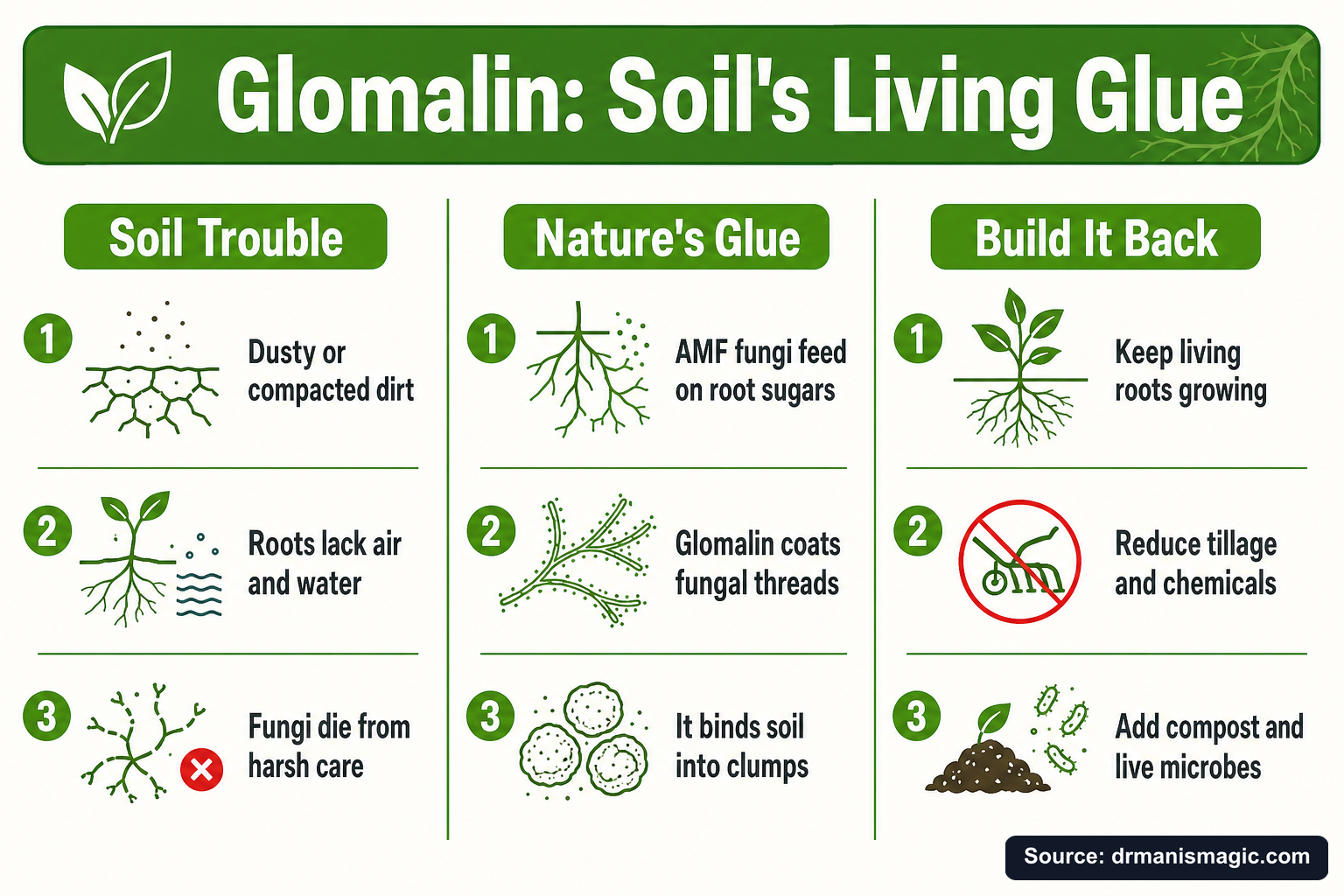
- Glomalin is a sticky protein-like substance made by mycorrhizal fungi — it acts like nature's glue for soil particles.
- Without glomalin and healthy soil biology, dirt turns to dust or compacted mud, and roots struggle to breathe.
- Glomalin is not made by one molecule alone — it's part of a whole soil food web that includes bacteria, protozoa, nematodes, and earthworms.
- Synthetic fertilizers, pesticides, and tillage destroy the fungi that make glomalin — killing your soil's structure from the inside out.
- You can rebuild glomalin levels by keeping living roots in the ground, reducing disturbance, and adding live microbials back to your soil.
- Most bottled microbial products are dead on arrival — dried powders or smelly liquids that can't do what fresh, living biology can.
- The Three Plant Pillars — mineral soil, live microbes, and organic fertilizer — work together to restore and maintain the biology that makes glomalin possible.
What Exactly Is the Sticky Substance That Holds Soil Together?
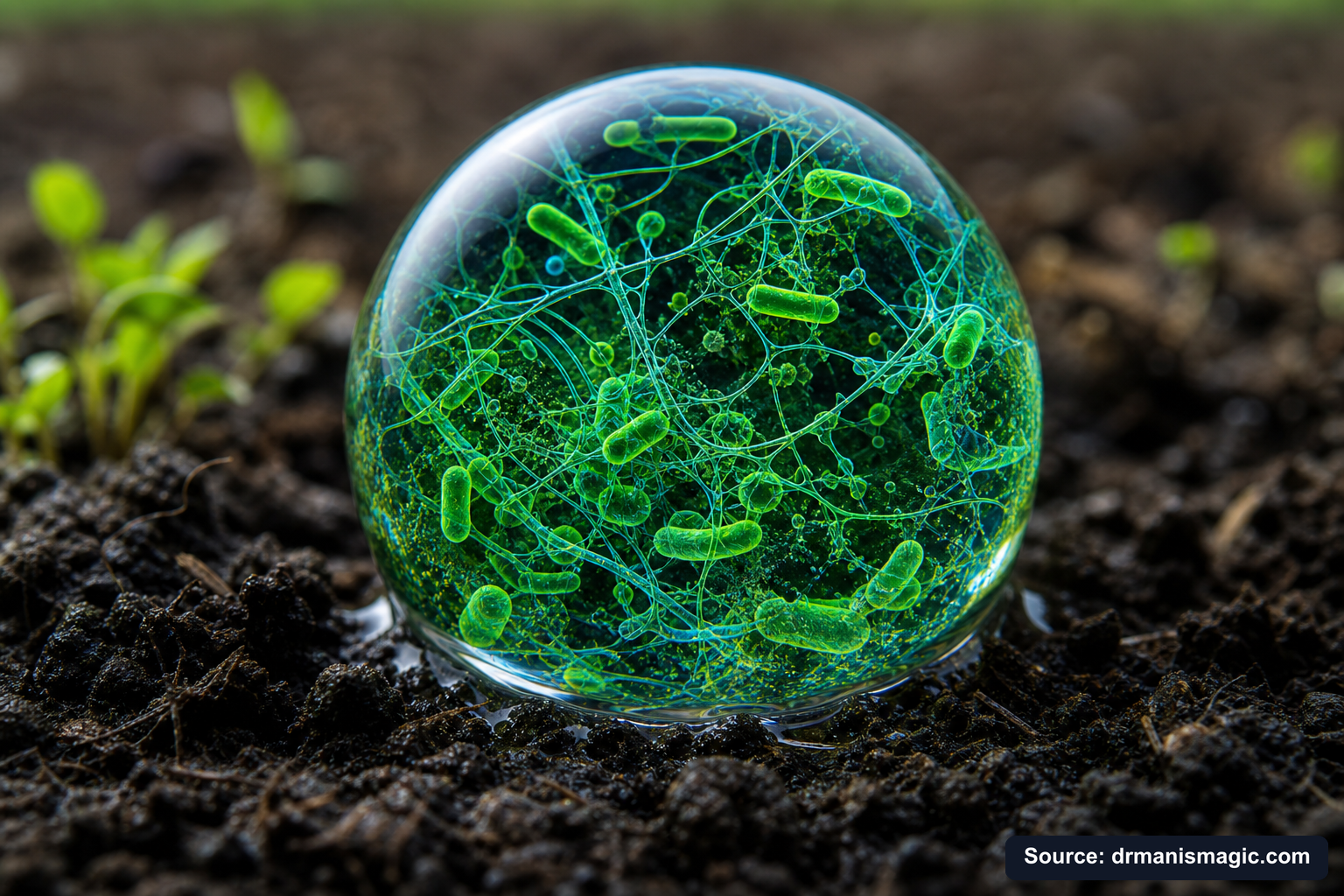
Quick Answer: Glomalin is a sticky, protein-rich substance produced by a type of soil fungus called arbuscular mycorrhizal fungi (AMF). It coats fungal threads in the soil and acts like biological glue, binding sand, silt, clay, and organic matter into stable clumps. Healthy soil needs it. Most damaged soils don't have enough.
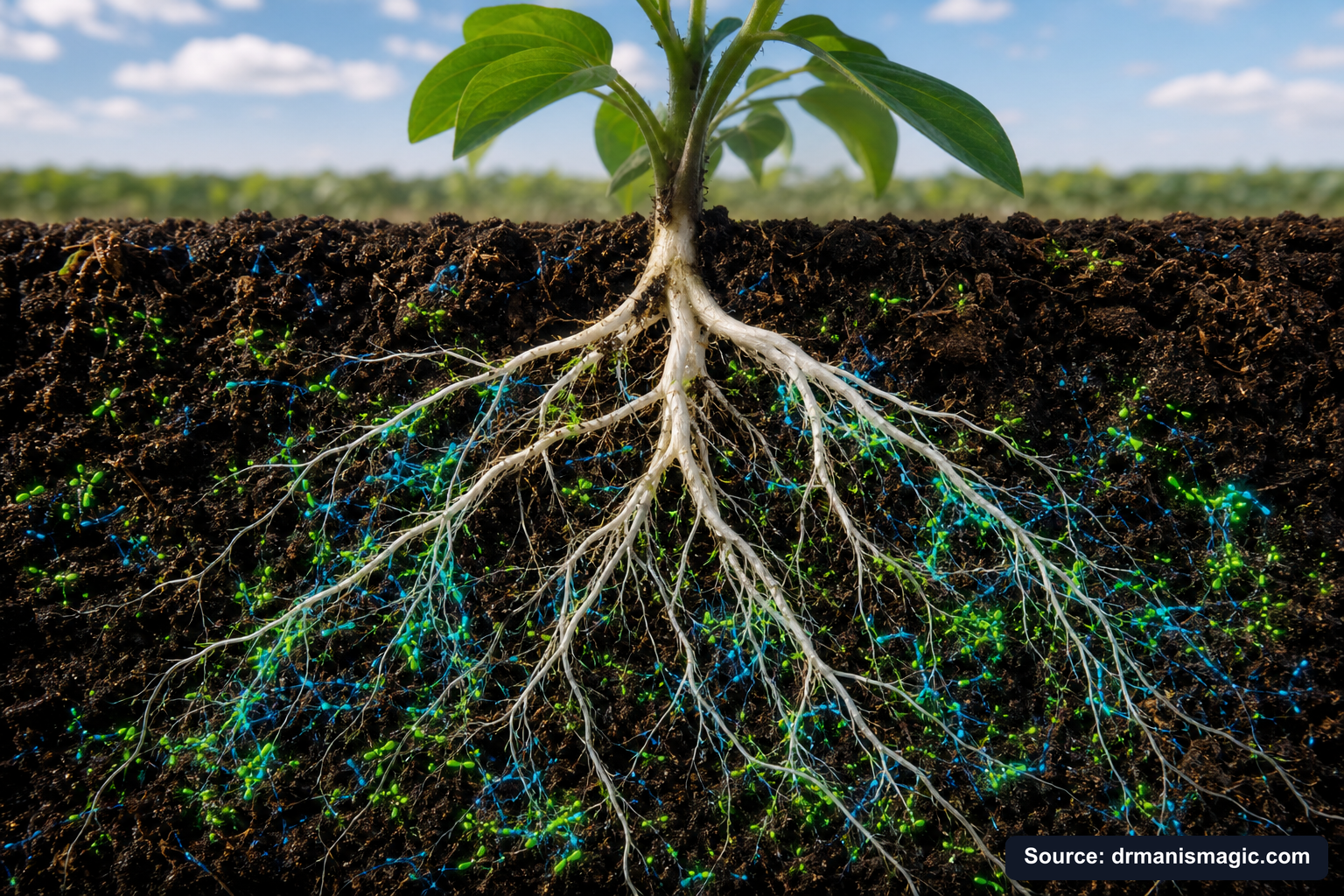
Glomalin is made by arbuscular mycorrhizal fungi, or AMF for short. These are a family of fungi that live in a partnership with plant roots. The plant feeds them sugars. The fungi extend far out into the soil, pulling in water and nutrients the roots can't reach on their own. It's a deal that's been working for over 400 million years.
As these fungi grow their thread-like structures called hyphae through the soil, they coat those threads in glomalin. Think of it like a waxy, sticky glue that coats microscopic spider webs woven through the dirt. That coating grabs onto soil particles — grains of sand, bits of clay, fragments of old roots, pieces of organic matter — and pulls them together into stable clumps called aggregates.
Those aggregates are everything. They create the air pockets roots need to breathe. They hold water without drowning roots. They resist erosion when it rains hard. They give soil that beautiful, crumbly texture that tells an experienced grower: this is alive.
According to USDA-ARS research, glomalin may account for 27% of the carbon stored in soil globally. That's an enormous number. It also helps explain why healthy, fungus-rich soils hold carbon out of the atmosphere for decades. The sticky stuff isn't just good for your garden. It's part of how the planet breathes.
Scientists now use the term glomalin-related soil protein, or GRSP, because when they extract and measure glomalin in a lab, they're also picking up other heat-stable proteins, lipids, and humic materials. So "glomalin" is a useful label and a powerful concept, but the full picture is even richer than one molecule. More on that in a moment.
Why Does Healthy Soil Form Clumps Instead of Dust or Mud?
Quick Answer: Healthy soil forms crumbles because living roots, fungi, bacteria, and organic matter work together to bind particles into stable aggregates. Glomalin from mycorrhizal fungi is one of the strongest biological glues involved. Without these living organisms, soil particles fall apart into dust or compress into hard, airless clay.
Most people think soil is just dirt. Something passive. Something that holds a plant up while you pour fertilizer on it. That's the lie the big chemical companies quietly profit from. Real soil is a living city. Billions of organisms per teaspoon. And the structure of that city — the roads, the walls, the architecture — is built by biology.
Here's how it works in plain language:
- Living roots push through the soil, releasing sugars and carbohydrates that feed microbes. No living roots, no food for the microbes.
- Mycorrhizal fungi colonize the roots and grow their thread-like hyphae out into the soil. As they grow, they coat those threads in glomalin — the sticky glue.
- Bacteria produce their own sticky substances called polysaccharides and biofilms. These act like a second layer of biological cement.
- The sticky threads and films wrap around soil particles, binding sand grains, clay bits, and organic fragments into clumps called aggregates.
- Protozoa, nematodes, and earthworms move through the soil, eating bacteria and fungi, and depositing their own contributions to the structure.
- Organic matter from decomposing leaves, roots, and plant debris adds the carbon backbone that keeps it all together long-term.
Remove any one of those steps and the soil structure weakens. Remove several of them — say, by tilling repeatedly, spraying synthetic herbicides, and dumping salt-based fertilizer — and you end up with the hard, cracked, dusty soil that frustrates gardeners everywhere.
Penn State Extension describes soil aggregation as a community function, not the job of any one ingredient. That's exactly right. Glomalin is a star player. But it needs the whole team on the field.
What Is the GRSP Controversy and Why Does It Matter to Gardeners?
Quick Answer: When scientists measure "glomalin" in a soil test, they use a heat-and-chemical extraction process that pulls up more than just pure fungal protein. The result — called glomalin-related soil protein or GRSP — may include non-fungal proteins, humic materials, and lipids. It's still a valuable soil health indicator, but glomalin is not one magic molecule with a simple on/off switch.
Here's something most online articles skip right past. The word "glomalin" gets thrown around like it's a perfectly defined, isolated compound. Like you could buy it in a bottle and pour it on your garden. That's not quite right.
When researchers measure glomalin, they boil soil in a citrate solution and collect what comes out. That extract — GRSP — strongly correlates with healthy soil structure, water-stable aggregates, and carbon storage. It is a reliable sign that good biology is happening. But it's not necessarily a single pure protein from one type of fungus.
Modern scientific reviews note that GRSP is an operationally defined mixture. It may contain non-mycorrhizal heat-stable proteins, humic materials, and other compounds alongside genuine AMF glomalin. This doesn't make glomalin less important. It makes the story richer. It tells us that soil health is never about one silver bullet. It's always about the whole system.
For you as a gardener, this means one thing: don't chase glomalin as an ingredient. Chase the conditions that produce it. Living roots. Healthy fungi. Reduced disturbance. Organic matter. That's what builds aggregated, structured, life-giving soil.
See also: The Hidden Reason Synthetic Fertilizers Cause Root Rot
What Destroys Glomalin and Soil Structure in Home Gardens?
Quick Answer: Tillage physically breaks apart fungal hyphae, cutting off glomalin production. Salt-based synthetic fertilizers harm the beneficial fungi that make glomalin. Herbicides like glyphosate disrupt soil microbial communities. Bare soil with no living roots starves the fungi. Any one of these weakens soil structure. All of them together can leave soil biologically dead.
This is where the system gets rigged against you. And it's not an accident.
Big box stores sell you synthetic fertilizers that are essentially salt. High-salt inputs damage the very microbes that build soil structure. The fungi that produce glomalin are especially sensitive. Broad-spectrum herbicides like glyphosate — used routinely on lawns and gardens — have been shown to disrupt soil microbial communities significantly. Fungicides wipe out beneficial fungi along with the bad ones. Repeated tilling shreds the fungal thread networks that carry glomalin through the soil.
Every one of those common practices takes a bite out of your soil's biology. And once the biology weakens, glomalin production slows. Aggregates fall apart. Soil compacts. Water pools instead of draining. Roots suffocate. And you're back at the garden center, spending money on more products that make the problem worse.
We've watched this cycle play out across 30 years and more than 250,000 trees at our South Texas nursery. Soils treated with synthetic inputs slowly lose their structure. Soils managed with living biology get better over time. The difference is visible. Tangible. You can feel it in your hands.
| Practice or Input | How It Damages Biology | Effect on Glomalin and Structure | Better Alternative |
|---|---|---|---|
| Salt-based synthetic fertilizers | High salts harm beneficial bacteria and fungi | Less glomalin, weaker aggregates, compaction | Organic slow-release fertilizer |
| Broad-spectrum herbicides (glyphosate) | Disrupts soil microbial communities | Reduced AMF colonization, less glomalin | Mechanical weeding, targeted organic control |
| Synthetic fungicides | Kills beneficial fungi alongside pathogens | Direct loss of glomalin-producing organisms | Biological controls, live microbial inoculants |
| Repeated tillage | Physically shreds fungal hyphae networks | Breaks existing aggregates, slows regrowth | No-till or minimal disturbance methods |
| Bare soil / no living roots | Removes the sugar supply that feeds fungi | Fungi starve and die, glomalin depletes | Cover crops, perennial plants, ground covers |
| Excess phosphorus fertilizer | Plants stop feeding AMF when phosphorus is already abundant | Reduced fungal colonization, less glomalin | Moderate phosphorus; use organic sources |
| Compaction from foot traffic or machinery | Crushes pore spaces, limits oxygen to microbes | Suffocates soil biology, disrupts structure | Aeration, mulch pathways, limit heavy traffic |
How Do Mycorrhizal Fungi Produce Glomalin and Build Soil Structure?
Quick Answer: Mycorrhizal fungi grow thread-like structures called hyphae through the soil. As they grow, they coat those threads with glomalin — a sticky, waxy substance that binds soil particles into stable clumps called aggregates. This happens naturally wherever living roots and healthy fungi coexist. It cannot happen without the fungi, and the fungi cannot survive without living plant hosts.
Picture a spider spinning a web through your soil. Now imagine that web is coated in something sticky. Every time a soil particle — a grain of sand, a speck of clay, a crumb of organic matter — brushes against that web, it sticks. Over time, those particles cluster into a little ball. Then more particles stick. The ball grows. You end up with a soil aggregate: a stable, porous, living clump of earth.
That's glomalin at work. The fungal threads are the scaffold. The glomalin is the glue. And it's happening right now in every healthy patch of soil on the planet — in forest floors, in prairie roots, in the dirt beneath old trees that have never been touched by a synthetic input.
The University of Minnesota Extension notes that mycorrhizal fungi can extend a plant's effective root system by up to 700 times its original size. That's an almost unimaginable reach. And every inch of that extended network is coated in glomalin, building structure as it grows.
The key thing to understand: glomalin is a byproduct of healthy fungal activity. You can't buy it in a bottle. But you can create the conditions where fungi thrive and produce it naturally. That's the whole game.
What Is the Full Soil Food Web That Supports Glomalin Production?
Quick Answer: Glomalin is produced by mycorrhizal fungi, but those fungi are part of a much larger underground community. Bacteria, protozoa, nematodes, arthropods, and earthworms all support the system. Bacteria produce their own sticky polysaccharides. Protozoa and nematodes cycle nutrients back to plants. Earthworms physically mix and aerate. It takes the whole crew working together to build great soil structure.
Here's what most articles miss: glomalin is the star of this story, but it doesn't work alone. The soil food web is a whole cast of characters, and every one of them plays a role in building the structure that makes your garden thrive.
| Organism | What It Does | Contribution to Soil Structure |
|---|---|---|
| Mycorrhizal fungi (AMF) | Colonize plant roots, extend nutrient and water access | Produce glomalin; hyphae physically bind soil particles |
| Other beneficial fungi | Decompose organic matter, suppress pathogens | Contribute hyphae networks that stabilize aggregates |
| Beneficial bacteria | Fix nitrogen, solubilize phosphorus, suppress disease | Produce polysaccharides and biofilms that cement particles |
| Protozoa | Eat bacteria and fungi, release nutrients in plant-available forms | Drive nutrient cycling that feeds fungi and roots |
| Beneficial nematodes | Eat bacteria, fungi, and pest organisms | Support nutrient cycling and pathogen suppression |
| Earthworms | Physically mix and aerate soil, shred organic matter | Create macro-pores and deposit casts that stabilize structure |
| Arthropods and soil insects | Shred organic matter, create channels | Improve aeration and water infiltration |
This is why we talk about the Three Plant Pillars as a system, not a set of separate tips. You need mineral-based soil that gives all these organisms room to breathe. You need live microbials that bring the right organisms back when they've been depleted. And you need organic fertilizer that feeds the whole community without burning it with salt. Miss one pillar and the system limps. Get all three right and the system hums.
You Never Had a Brown Thumb.
You were handed the wrong tools. This free guide hands you the right ones.
You watered it. You fed it. It died anyway.
It was never you. It was the dirt, the salt food, and the bad advice.
This guide shows you what really went wrong, and how to fix it for good.
- Why your plants really died, and why it was never your fault
- The salt hiding in your plant food that quietly burns the roots
- The hidden killer in almost every bag of store soil
- The tiny helpers that grow a whole forest for free
- The rescue trick that brings a half dead plant back to life
Live Microbial Products vs. Dead Powder Products: Which Actually Build Glomalin?
Quick Answer: Only living, active mycorrhizal fungi can produce glomalin. Dried powder microbial products often have very low viability by the time they reach your garden. Smelly liquid products have often gone anaerobic — meaning the microbes are dying. Genuinely live, stabilized microbial products are the only way to deliver working biology to your soil quickly and consistently.
This is where the market gets messy. Walk into any garden store and you'll see shelves of microbial products. Powders. Liquids. Granules. They all promise to boost your soil biology. Most of them don't deliver.
Here's the honest breakdown. We've tested dozens of these products across our nursery operations. We grew 250,000 trees. We needed to know what actually worked.
| Product Type | Typical Viability | Smell | Does It Build Soil Biology? | Our Verdict |
|---|---|---|---|---|
| Dried / powdered lab-grown microbes | Very low by purchase date | Little to none | Rarely — spores often don't reactivate | Avoid. We saw no meaningful plant response. |
| Dried microbes added to liquid | Low | Usually mild | Unlikely — same viability problem | Avoid. Pretty bottle, poor results. |
| Compost tea — fresh under 24 hours | Moderate if aerated | Earthy to slightly sour | Yes, when truly fresh and applied immediately | Good option if you can make it yourself fresh. |
| Compost tea — older than 24 hours | Low — anaerobic | Strong and foul | Minimal — microbes are dying or dead | Not recommended. The stench tells the story. |
| Fresh active compost | High on-site | Earthy, warm | Yes — excellent when freshly made | Great if you have the time and setup. |
| Lactobacillus-based products | High — very vigorous | Sour, fermented | No — dominates and crowds out beneficial microbes | Avoid in soil. Belongs in yogurt, not your garden. |
| Plant Super Boost (stabilized full-spectrum) | High — stabilized, not anaerobic | Earthy — not foul | Yes — 2,000+ bacteria, 400-500 fungi including mycorrhizae, protozoa and nematodes | Our top recommendation. Visible live microbes under a microscope. |
The problem with most bottled microbial products is simple. They're made in large factory vats. The organisms are dried into powder and shipped. By the time the powder reaches your garden and gets wet, most of the microbes are dead. No living organism. No active hyphae. No glomalin.
The smelly liquid products have a different problem. They started with good biology — often from compost — but the microbes ran out of oxygen in the bottle and went anaerobic. That fizzing, foul smell is microbes dying. Some humic and fulvic acids survive, which is why people see a little benefit. But the actual living biology? Gone.
Dr. Mani's Magic Plant Super Boost is different because of a proprietary, all-natural stabilization technique developed by a world-renowned compost scientist who partnered with our nursery. The microbes are harvested from active compost — not grown in a lab vat. They're stabilized so they stay alive without going anaerobic. You can take a single drop and look at it under a microscope. You'll see movement. Living organisms. The real thing. And it doesn't smell bad because nothing is rotting.
That's the difference between a product built to sell and a product built to grow.
How Do You Increase Glomalin in Your Soil? A Practical Recovery Plan
Quick Answer: You increase glomalin by rebuilding the fungi that make it. Keep living roots in the ground year-round, reduce tillage and chemical inputs, add organic matter as mulch or compost, manage phosphorus at moderate levels, and inoculate with live mycorrhizal fungi when biology has been depleted. Recovery takes time and consistent effort — but it works.
Here's the practical truth. You can't sprinkle glomalin on your garden like a spice. But you can rebuild the conditions that produce it. And once those conditions are in place, the biology does the rest — quietly, invisibly, continuously, the way it has for hundreds of millions of years.
Colorado State Extension notes that soil biological communities can recover significantly with consistent management changes, though severely degraded soils may take several seasons to rebuild meaningful aggregate stability. The good news: you'll see improvement within weeks of the first changes. The soil doesn't need decades to respond. It just needs the right inputs and some peace.
Here is a step-by-step recovery plan:
- Stop the bleeding first. Cut out salt-based synthetic fertilizers. Stop broad-spectrum herbicides and fungicides where possible. These are the main killers of the biology you're trying to rebuild. Every time you apply them, you reset the clock.
- Keep living roots in the ground. This is the single most important thing you can do. Living roots feed fungi with sugars. No roots, no fungi. No fungi, no glomalin. Use cover crops in bare beds. Keep perennial plants in rotation. Never leave soil bare for extended periods.
- Reduce tillage dramatically. Every time you till, you shred fungal hyphae networks. Those networks took months to build. Till once and you're starting over. Shift to surface mulching and spot weeding instead.
- Add organic matter as mulch or compost. Woody mulch, straw, leaf litter, and compost feed the fungal community and provide the carbon backbone for aggregate formation. Layer it on top. Let it break down slowly. This is how forests work.
- Inoculate with live mycorrhizal fungi. If your soil has been chemically treated, fumigated, or left bare for a long time, the native AMF population may be very low. A genuine live microbial inoculant like Plant Super Boost delivers mycorrhizal fungi, beneficial bacteria, protozoa, and nematodes directly to the root zone. Apply monthly for best results.
- Moderate your phosphorus applications. When phosphorus is very high in the soil, plants stop feeding their fungal partners because they don't need the help. This reduces AMF colonization and glomalin production. Use organic, slow-release phosphorus sources and let the biology regulate uptake naturally.
- Give it time and repeat applications. Biology doesn't rebuild in a week. Keep at it. Monthly microbial applications, consistent organic fertilizer, and reduced chemical inputs add up over a season. By the second or third month you'll feel the difference in your soil. By the second season, your soil will look and smell different too.
The University of Maryland Extension confirms that management practices supporting living root systems and reduced disturbance consistently produce higher glomalin-related soil protein levels and better aggregate stability across soil types. This isn't theory. It works in backyards, in container gardens, in orchards, and on lawns. We've seen it in our own nursery, in our grove, and in thousands of gardens across the country.
Do Mycorrhizal Inoculants Actually Work, and When Should You Use Them?
Quick Answer: Yes, but only when the product contains genuinely living, viable organisms — and only when the soil conditions support their survival. Inoculants work best in sterile or fumigated media, newly planted containers, restored or eroded soils, and any environment where natural AMF populations have been wiped out. In biologically active, undisturbed garden soil, native populations may already be doing the job.
This is where a lot of gardeners waste money. They buy a mycorrhizal inoculant and pour it into a thriving garden bed that already has healthy native fungi. The inoculant does little because the job is already being done. Or worse, they buy a dead powder product, apply it to a depleted soil, and wonder why nothing happens.
The decision is actually pretty simple once you know the rules.
Use a live inoculant when:
- You're planting in sterile potting mix (most commercial mixes have no native biology)
- Your soil has been fumigated, heavily tilled, or treated with broad-spectrum chemicals
- You're starting plants in a container with no prior microbial history
- You're working on a restoration site, a new build, or mined/eroded subsoil
- You've been using salt-based fertilizers for years and your soil feels dead
- Your plants show signs of stunted growth, yellowing, poor fruiting, or weak immunity despite adequate water and nutrients
When native biology may already be sufficient:
- Established garden beds that have never been chemically treated
- Forest soil or old prairie soil with intact plant communities
- Soil that already smells rich and earthy, crumbles well, and supports diverse plant life
The catch: most of us don't have that second scenario in our backyards. We've been pouring synthetic inputs on our soil for decades. Our lawns have been sprayed. Our potted plants are in sterile commercial mixes. Our garden beds have been tilled and amended with products that carry more salt than biology. For most home gardeners, a live microbial inoculant isn't a luxury. It's a repair tool.
What matters most when choosing an inoculant: verify that the organisms are genuinely alive at the time of use, not just listed on a label. That means looking for products not dried into powder, not sitting in a foul-smelling liquid, and not stored in conditions that kill the biology before it reaches you. A product that smells like living earth — not sewage — and that shows visible microbial activity under a microscope is the real thing.
How Does Glomalin Connect to Carbon Storage, Drought Resilience, and Erosion?
Quick Answer: Glomalin and the aggregates it creates trap and store carbon in soil for decades. Those same aggregates hold water like tiny sponges during drought and resist being washed away during heavy rain. Healthy glomalin levels mean your soil retains more moisture, loses less topsoil to erosion, and stores more carbon long-term — all from the same invisible biological process.
The benefits of glomalin reach way beyond a crumbly handful of garden dirt. This is where the story gets genuinely exciting.
When fungal hyphae bind soil particles into aggregates, those aggregates trap carbon-rich organic matter inside their structure. That carbon stays locked in the aggregate — protected from decomposition — sometimes for decades. Soil with high GRSP levels is a carbon storage system. It's one reason scientists studying climate solutions keep coming back to soil biology as a key tool.
Those same aggregates create pore spaces in the soil — tiny channels and cavities that act like sponges. During a dry stretch, those pores hold water close to roots. During a heavy rain, water infiltrates quickly instead of running off the surface and taking your topsoil with it. Soil with strong aggregate structure resists erosion. It retains moisture longer. It bounces back from weather extremes faster.
For you as a gardener: this means the same biology that holds your soil together also makes your plants more drought-tolerant, your garden more resistant to washout, and your topsoil more likely to be there next season. It all comes from the same invisible workforce.
And here's the part that makes us feel something every time we think about it. The people who buy cheap fertilizer and skip the biology aren't just losing a little plant growth. They're losing structure. Losing water-holding capacity. Losing carbon. Losing resilience. One season at a time, their soil gets a little worse. And they can't quite figure out why their plants need more and more inputs to do less and less.
You can't get that time back. The best time to start rebuilding your soil biology was years ago. The second-best time is right now.
See also: Why Most Fertilizers Are Actually Salt in Disguise
What Can You Do Right Now to Start Rebuilding Glomalin in Your Soil?
Quick Answer: Start with the Three Plant Pillars: get your soil structure right, introduce live microbes, and switch to organic fertilizer that feeds biology instead of burning it. Every one of these changes helps restore the conditions that produce glomalin naturally. You don't need to do everything at once — but every step forward counts, and the biology responds faster than most people expect.
Let's make this real. Here's what you can actually do this week.
Step 1: Stop the damage. Look at what you're currently putting on your soil. If it's a salt-based synthetic fertilizer, set it aside. If you've been using broad-spectrum weed killers or fungicides routinely, scale back where you can. This alone gives your existing biology room to recover.
Step 2: Add living biology. If your soil has been chemically treated or you're growing in commercial potting mix, the native mycorrhizal population is likely very low. A genuinely live microbial inoculant is the fastest way to reintroduce the fungi that make glomalin. Two ounces of Plant Super Boost mixed into a gallon of water and poured on your soil monthly. That's it. Simple.
Step 3: Switch to organic fertilizer. Organic, slow-release fertilizer feeds your plants without burning the microbial community. It works with the biology, not against it. Our Crab, Kelp and Amino Acids blend is formulated specifically for this — no synthetic salts, no biosludge, no PFAS. Zero Synthetic Salts. Zero Biosludge. Zero PFAS. Just the nutrients your plants and your microbes need, in forms they can actually use.
Step 4: Mulch your bare soil. A layer of wood chip mulch, straw, or shredded leaves over bare soil does more than you might think. It feeds the fungi. It moderates temperature and moisture. It prevents the crust that blocks water and oxygen. It's free or nearly free. Do it today.
Step 5: Keep something growing. Bare soil is a biological desert. Even a simple ground cover or cover crop keeps living roots in the soil, feeding the fungal network that produces glomalin. The fungi don't thrive without a plant host. Give them one.
We've seen this work on citrus trees, on houseplants, on lawns, on flower gardens, and on vegetable beds. After 30 years and more than 250,000 trees, we know what the biology looks like when it's alive and what it looks like when it's dead. The difference is not subtle. It shows up in the color of the leaves, the strength of the fruit, the texture of the soil in your hands, and the smell when you open the bag.
You were made to grow things. That drive to nurture — to plant something and watch it thrive — it's as old as humanity. The frustration of watching plants struggle and die after you've invested time, money, and care into them is one of the most common things we hear from gardeners. We hear it every day. And almost every time, the root cause traces back to the same thing: missing biology.
The sticky substance that holds soil together is made by living organisms. Those organisms need a living soil to thrive in. And that living soil is something you can rebuild — one step, one season, one application at a time. You won't just see it in your soil. You'll taste it in your fruit. You'll smell it when you walk through your garden. You'll feel it every time you reach down and pick up a handful of rich, crumbly, alive earth.
That's what healthy soil feels like. And it's within reach for every gardener who decides to work with nature instead of against it.
If you want a complete, proven starting point — the soil, the living microbes, and the organic fertilizer that work together as a system — explore the Three Plant Pillars bundle and see how Dr. Mani's Magic can help you build the kind of soil that actually holds together.
Frequently Asked Questions
Most gardeners never hear the word glomalin. But it explains why some soil feels rich and alive while other soil feels like dead dust. These questions cut straight to what glomalin is, why it disappears, and how the Three Plant Pillars help bring it back to your garden.
What is glomalin and why does it matter for your plants?
Glomalin is a sticky, protein-like substance made by mycorrhizal fungi in your soil. Think of it as nature's glue. It binds sand, clay, and organic bits into crumbly clumps that let roots breathe and drink. Without it, soil either turns to hard brick or blows away like powder. Dr. Mani's Magic Plant Super Boost puts live mycorrhizal fungi back into your soil so your plants can start building glomalin again fast.
What percentage of soil carbon does glomalin store?
USDA research found that glomalin holds about 27 percent of total soil carbon. That is huge. Humic acid, which most people thought was the big carbon holder, only stores around 8 percent. Healthy, fungus-rich soil locks carbon away for decades. That is one more reason why killing your soil fungi with synthetic salt-based fertilizers is such a costly mistake for your garden and your wallet.
What destroys glomalin levels in your soil?
Synthetic fertilizers, pesticides, and heavy tilling all kill the mycorrhizal fungi that make glomalin. No fungi means no glomalin. No glomalin means soil that falls apart, compacts, and drowns roots. This is exactly the trap big chemical companies set up. You buy their products, your soil biology dies, your plants struggle, and you buy more. Dr. Mani broke that cycle with the Three Plant Pillars after testing on over 250,000 citrus trees.
What are the four main components of healthy soil?
Healthy soil has four parts: mineral matter, organic matter, air, and water. Air and water fill the spaces between soil particles and make up about half the soil's total volume. Roots need all four in balance. That is why Dr. Mani's Super Soil uses mineral-based sandy loam from South Texas. It never compacts or rots away like sawdust-based potting mixes, so air and water stay balanced year after year.
How do you rebuild glomalin in damaged or depleted soil?
You rebuild glomalin by bringing live mycorrhizal fungi back to your soil. Keep living roots in the ground as long as possible. Stop tilling and disturbing the soil. Stop using synthetic fertilizers that burn out your soil biology. Then add live microbials like Dr. Mani's Magic Plant Super Boost. It carries live bacteria, fungi, and mycorrhizae straight to your roots. Most powder products on store shelves are already dead. Plant Super Boost is alive when it reaches you.
What roles does glomalin play beyond just holding soil together?
Glomalin does more than glue soil particles. It sequesters carbon for the long term, improves water retention, boosts nutrient availability, and even helps lock down soil pollutants. It supports the whole soil food web including bacteria, protozoa, and earthworms. When you use the Three Plant Pillars together, mineral soil plus live microbes plus organic fertilizer, you create the exact conditions where glomalin can do all of these jobs at once.
Can you add too much organic matter when trying to boost soil health?
Yes, you can overdo it. Too much compost can spike phosphorus levels in your soil to the point where it becomes a pollutant and actually blocks nutrient uptake. More is not always better. That is why Dr. Mani's Magic uses slow-release organic fertilizer made from crab, kelp, and amino acids. It feeds your plants steadily without overloading your soil. The goal is balance, not a flood of nutrients your plants cannot use.
About the Author
Dr. Mani Skaria, PhD
Dr. Mani Skaria, PhD, is a plant pathologist and the scientific founder of Dr. Mani's Magic. He earned his doctorate at Purdue University and spent 48 years studying how plants, soil, and living microbes work together, including his years as Professor Emeritus at Texas A&M and as a member of the USDA NAREEE Advisory Board. He invented micro-budding, a method for growing healthier, stronger trees, and has grown more than 250,000 trees on the family farm in Hargill, Texas - US Citrus Nursery. His life's work takes real lab science and practical experience and turns it into simple, safe, organic plant care anyone can use at home.


