


How Fungi Build Long-Term Soil Fertility in Your Garden | Dr. Mani's Magic
How Fungi Build Long-Term Soil Fertility (And Why Most Gardens Never Let Them)
Picture this. You pull a weed out of a crack in your driveway. You didn't water it. You didn't fertilize it. You didn't buy it from a nursery. Yet there it is — thick, green, almost offensively healthy. You look down at the roots. And clinging to those roots, like tiny white threads of silk, is something alive. Something you've never been told about.
That fuzzy white web? That's fungi. Specifically, mycorrhizal fungi. And those little threads are the reason that weed beat every odd and grew through solid concrete while your potted lemon tree in premium bag-store soil is struggling to push out a single new leaf. The weed had an invisible workforce. Your tree probably doesn't. Not yet.
Here's what nobody tells you at the garden center: the secret to long-term soil fertility isn't a fertilizer. It isn't a spray. It isn't even the soil itself. It's the invisible living network underneath — the bacteria, fungi, protozoa, and nematodes that have been quietly running the world's greatest nutrient factory for hundreds of millions of years. Once you understand how that network works, everything about growing plants changes. And once you know how to rebuild it, your plants will never struggle the same way again.
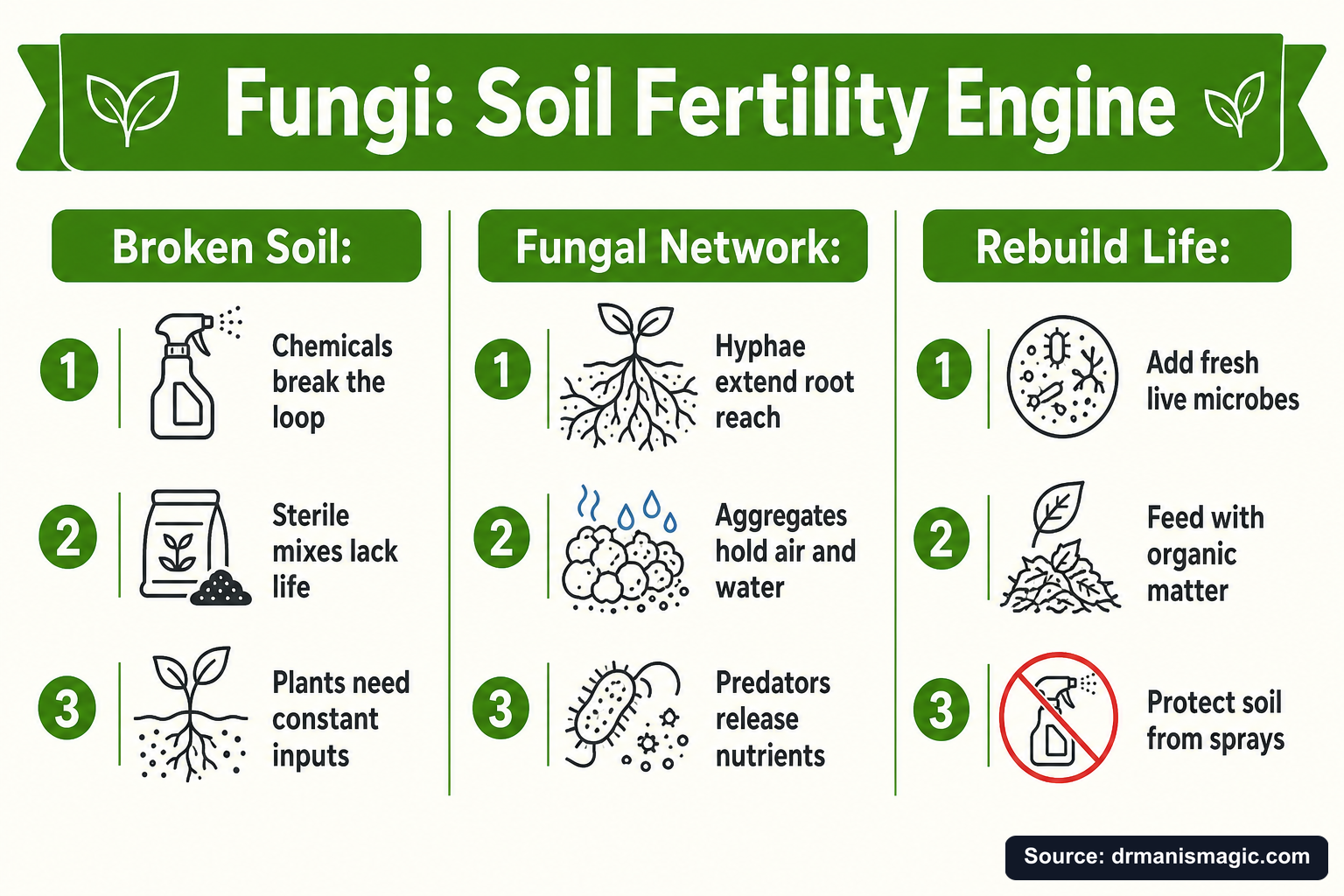
Key Takeaways
- Fungi are not just decomposers — they are the infrastructure of long-term soil fertility, binding particles, storing nutrients, and extending root reach.
- The soil food web is a complete nutrient loop: plant roots feed fungi and bacteria, and protozoa and nematodes release those nutrients back to the plant in usable form.
- Synthetic fertilizers, herbicides, fungicides, and pesticides break this loop and leave plants dependent on chemical inputs to survive.
- Most commercial microbial products are either dead powder or smelly, anaerobic liquid — neither works the way fresh, living biology does.
- Damaged or sterile soils can recover, but it takes time, the right inputs, and repeated applications of genuinely live microbes.
- The Three Plant Pillars — mineral soil, live microbials, and organic fertilizer — are the proven framework for rebuilding and sustaining this living system.
- After growing over 250,000 trees at US Citrus Nursery in South Texas, we learned that biology, not chemistry, is what makes plants truly bulletproof.
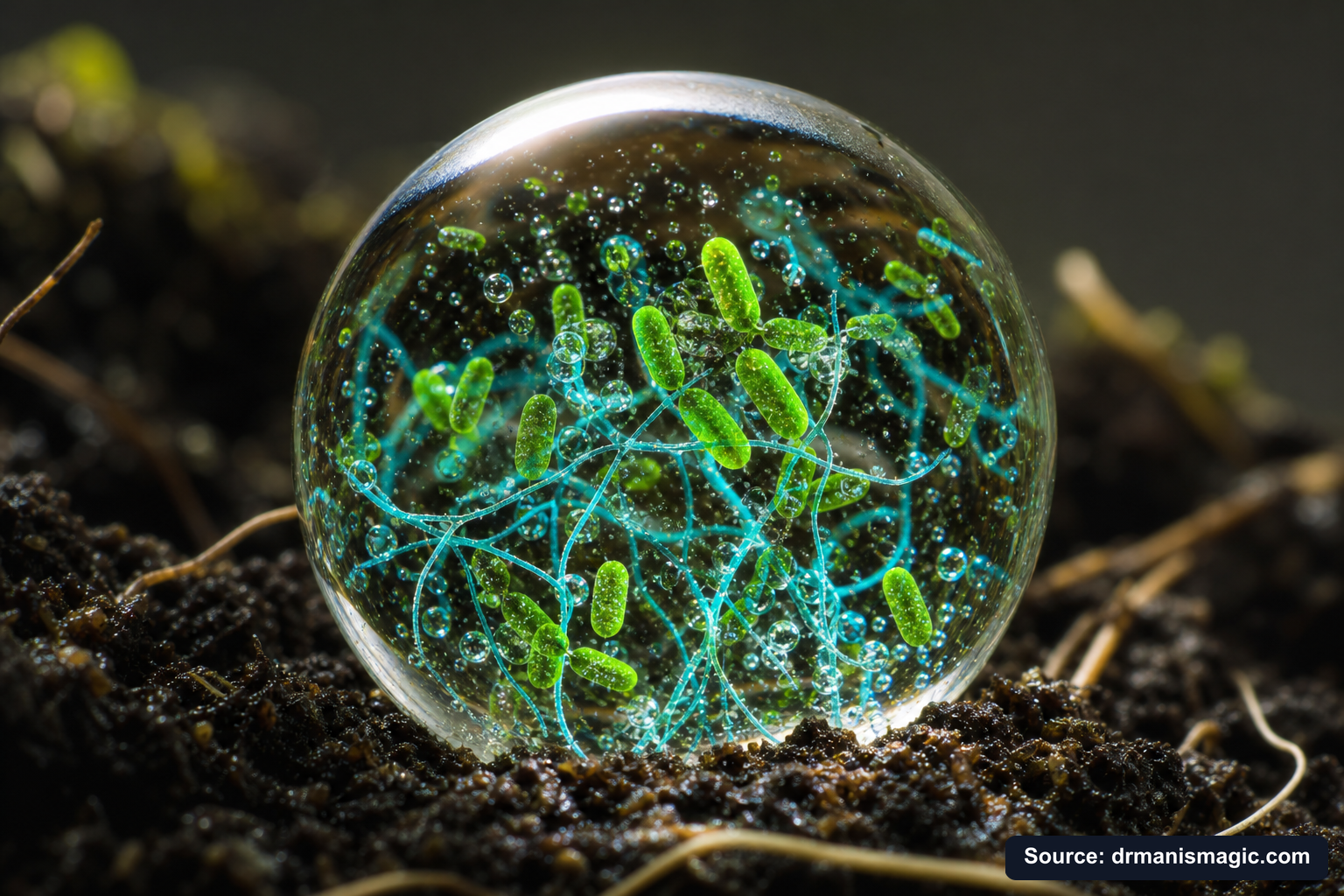
What Do Fungi Actually Do for Your Soil?
Quick Answer: Fungi build long-term soil fertility by extending root reach, capturing and holding nutrients, gluing soil particles into stable clumps, storing carbon, and connecting the entire soil food web into a living nutrient engine that keeps working even when you're not.
Fungi are builders. Think of them as the contractor who frames the house before anyone else moves in.
When fungal hyphae — those thread-like structures — grow through soil, they do several things at once. They physically wrap around soil particles and bind them together into clumps called aggregates. Those aggregates create the pore spaces that let air and water move through soil. Without them, soil collapses into a dense, suffocating slab. Roots can't breathe. Water pools and rots. Plants struggle.
Mycorrhizal fungi — the specific kind that partner with plant roots — go even further. According to research from the University of California Agriculture and Natural Resources, mycorrhizal networks can increase the effective absorptive surface area of plant roots by up to 700 times. UC ANR extension research confirms these fungi are especially critical for phosphorus uptake, because phosphorus moves slowly through soil and roots alone can't reach it fast enough.
But here's the part most people miss. Fungi don't do this alone. They are one piece of a much bigger machine.
What Is the Soil Food Web and Why Does It Build Fertility?
Quick Answer: The soil food web is the complete community of organisms — fungi, bacteria, protozoa, nematodes, and roots — that cycle nutrients in a continuous loop. Plants feed the web with sugar. The web feeds the plant with released nutrients. Break any link in that loop and fertility collapses.
The soil food web is the most underappreciated story in all of gardening. Let's walk through it step by step because once you see how it works, you'll never think about fertilizer the same way.
It starts with your plant's roots. Plants release sugars, proteins, and acids through their roots — a process called exudation. This is not an accident. The plant is deliberately feeding the soil around it. Those sugars attract bacteria and fungi. The bacteria and fungi multiply. They start breaking down organic matter, capturing nutrients like nitrogen, phosphorus, and sulfur, and locking those nutrients inside their own bodies.
Now the nutrients are trapped in microbial biomass. The plant can't access them yet. Here's where the next players come in.
Protozoa — tiny single-celled animals — graze on bacteria. Nematodes — microscopic worms — graze on both bacteria and fungi. When they eat, they release the nutrients locked inside those microbes directly into the root zone in plant-available form. This is the step that almost no gardening article talks about. It's called predator-driven mineralization. And it's the reason healthy soil feeds plants continuously without any fertilizer input at all.
Oregon State University's Extension Service describes this predator-prey relationship as one of the most important nutrient delivery mechanisms in natural ecosystems. OSU Extension notes that nitrogen released by protozoa grazing in the rhizosphere is often the primary source of plant-available nitrogen in undisturbed soils.
| Organism | What It Does | Key Nutrient Role | What Harms It |
|---|---|---|---|
| Mycorrhizal Fungi | Extends root reach, binds soil aggregates, delivers phosphorus and water | Phosphorus, water, micronutrients | Synthetic fungicides, high phosphorus fertilizer, bare soil |
| Decomposer Fungi | Breaks down woody organic matter, creates stable carbon | Carbon storage, nutrient immobilization | Fungicides, tillage, compaction |
| Bacteria | Fixes nitrogen, solubilizes minerals, decomposes residues, suppresses pathogens | Nitrogen, sulfur, trace minerals | Salt-based fertilizers, herbicides, pesticides |
| Protozoa | Grazes on bacteria, releases nutrients into root zone | Plant-available nitrogen and phosphorus | Pesticides, soil compaction, drought |
| Beneficial Nematodes | Grazes on fungi and bacteria, suppresses pest nematodes | Nitrogen and sulfur release | Fumigants, nematicides, bare soil |
| Plant Roots | Feeds the web with carbon exudates, receives nutrients in return | Carbon input to soil food web | Root rot, salt burn, compaction, sterile soil |
When all of these players are present and working together, you have a self-renewing fertility engine. The plant grows. The plant feeds the web. The web feeds the plant. Around and around it goes, building more fertility with each cycle.
When that web is broken — by synthetic inputs, bare soil, compaction, or sterile potting mix — the loop stops. And you're left feeding your plant by hand, chasing symptoms, buying more products, wondering why nothing seems to work long-term. We've seen this play out on hundreds of thousands of trees. It always comes back to the biology.
How Do Fungal Hyphae Build Soil Structure That Lasts?
Quick Answer: Fungal hyphae physically weave through soil, gluing particles into stable aggregates with a sticky protein called glomalin. These aggregates create pore spaces for air, water, and roots. They also lock carbon inside, protecting it from breakdown. This structure can persist for months or years after the fungi that built it are gone.
Here's something remarkable. The glue that holds soil together is made by fungi.
Mycorrhizal fungi produce a protein called glomalin. It coats fungal threads and the soil particles they touch. It acts like a natural cement, holding aggregates together even through wetting, drying, and disturbance. Research from the USDA Agricultural Research Service has shown that glomalin can account for 27 to 37 percent of the carbon stored in soil aggregates — making it one of the most important carbon storage compounds we know of.
Why does this matter for your garden? Because aggregate structure is what separates healthy, living soil from a bag of brown powder.
Healthy aggregates let water soak in instead of running off. They hold air pockets that roots need to breathe. They protect organic matter from rapid decomposition, keeping nutrients available over time instead of all at once. They create the physical habitat that bacteria, protozoa, and nematodes need to survive drought, wetting cycles, and temperature swings.
When you pour salt-based fertilizer into your soil or drench it with synthetic fungicide, you don't just affect the chemistry. You collapse this physical architecture. The aggregates break apart. The pore spaces fill in. Water starts pooling. Oxygen disappears. And suddenly you have the exact conditions that cause root rot — not because you overwatered, but because the biology that used to manage water for you is gone.
This is why Pillar One of the Three Plant Pillars starts with mineral-based soil. Sand and silica don't collapse. They don't decompose. They hold structure permanently so that the biological work fungi do can actually accumulate over time instead of being buried in compacting bark.
What Destroys Soil Fungi and How Long Does Recovery Take?
Quick Answer: Synthetic fungicides, herbicides like glyphosate, salt-based fertilizers, soil fumigation, steam sterilization, and long stretches of bare soil all damage or eliminate beneficial fungi. Recovery timelines range from weeks for basic bacterial activity to years for full fungal network rebuilding — but you can speed it up significantly with the right steps.
Most gardeners never know they've destroyed their soil biology. It's invisible. There's no warning label on a bag of synthetic fertilizer that says "kills beneficial fungi." But that's exactly what happens.
Salt-based fertilizers pull water out of microbial cells through osmosis — the same way salt draws moisture out of meat to preserve it. High salt concentrations kill bacteria and fungi directly and suppress the ones that survive. Do this season after season and you've created a biological desert that needs more and more chemical input just to maintain the same result. See also: The Hidden Reason Synthetic Fertilizers Cause Root Rot.
Synthetic fungicides are even more direct. They're designed to kill fungi. They don't distinguish between the Phytophthora causing your root rot and the mycorrhizal network that was protecting your roots from Phytophthora in the first place. Both get hit. The pathogen often recovers first because it's a specialist in disturbed environments. The beneficial network takes much longer to return.
Herbicides like glyphosate are documented to disrupt soil microbial communities, particularly bacteria involved in nutrient cycling. Fumigation and steam sterilization wipe the slate completely clean — useful in some nursery contexts but devastating if you then refill with sterile inputs and no biological inoculant.
Here's the honest timeline for a damaged soil recovering:
- Days to weeks: Basic bacterial activity begins returning if organic matter is present.
- Weeks to months: Protozoa and nematode populations begin rebuilding if bacteria are present to graze on.
- Months to years: Fungal hyphal networks begin regrowing, aggregate structure starts improving.
- Years to decades: Full native fungal diversity and deep soil food web complexity — without help.
With the right inoculants, organic matter, and consistent inputs, you can compress that timeline dramatically. But you have to give the biology something to work with. You cannot rush nature by adding more chemistry. You can only support it.
You Never Had a Brown Thumb.
You were handed the wrong tools. This free guide hands you the right ones.
You watered it. You fed it. It died anyway.
It was never you. It was the dirt, the salt food, and the bad advice.
This guide shows you what really went wrong, and how to fix it for good.
- Why your plants really died, and why it was never your fault
- The salt hiding in your plant food that quietly burns the roots
- The hidden killer in almost every bag of store soil
- The tiny helpers that grow a whole forest for free
- The rescue trick that brings a half dead plant back to life

Live Microbes vs. Dead Powder: Why Most Microbial Products Don't Work
Quick Answer: Most commercial microbial products are either dry powders with low-viability spores that rarely activate, or anaerobic liquids that have gone rotten before they reach you. Neither delivers the full-spectrum, living biology that roots actually need. The difference between a live microbe and a dead one is the difference between a key that opens the lock and one that just scratches the surface.
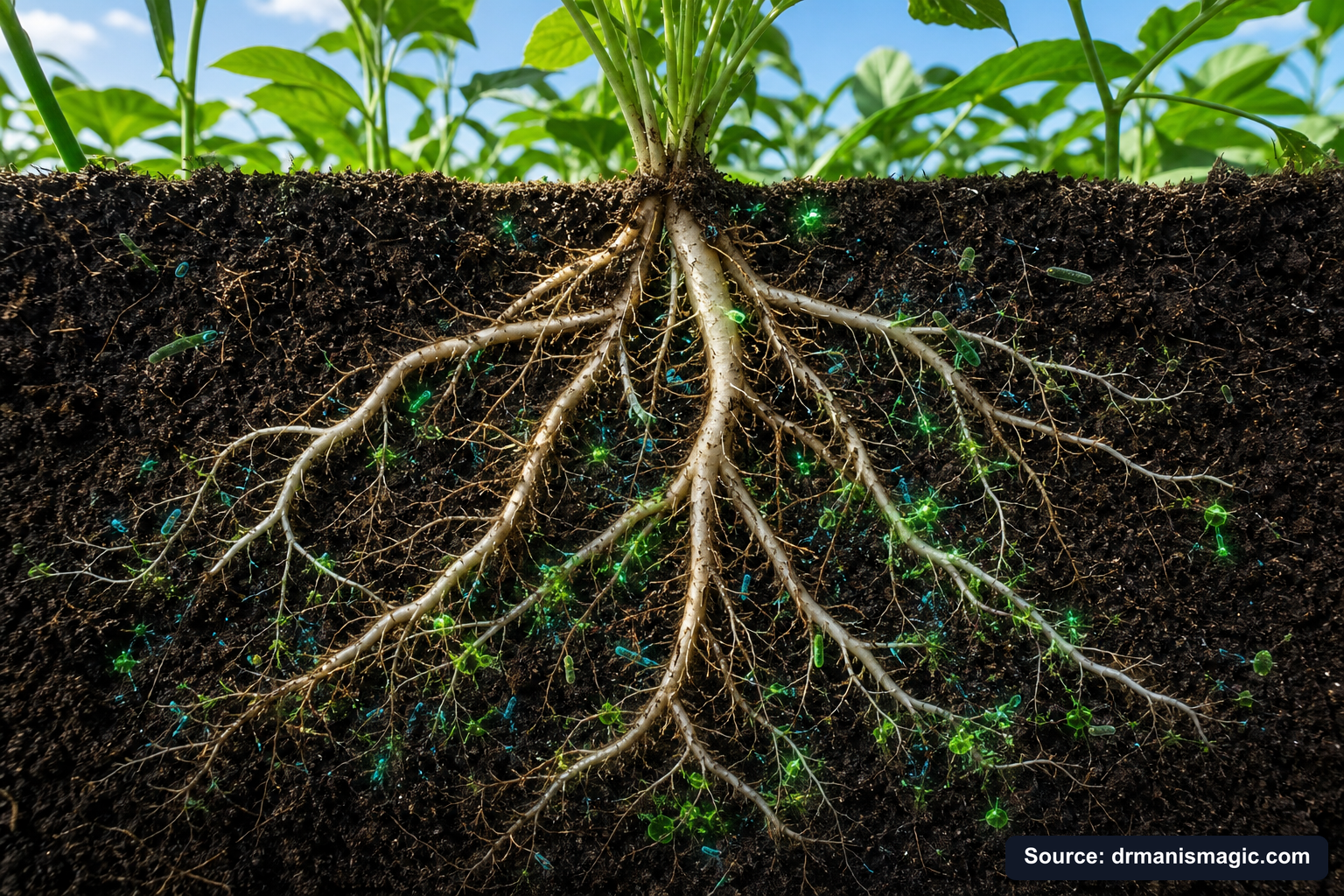
Walk into any garden center and you'll see shelves of microbial products. Bags of powder. Bottles of liquid. All promising to transform your soil.
Here's what most of them actually contain.
The powder products are made in giant factory vats where specific bacterial or fungal species are grown, then spray-dried into dormant spores. The idea is that when you add water, the spores wake up and colonize your soil. We've tried dozens of batches of these products on our own trees over three decades. The results? Virtually nothing. The spores rarely reactivate under real-world soil conditions, and even when they do, they represent a narrow slice of the diversity that a healthy soil food web needs.
The liquid products made from compost tea or earthworm castings start out promising — fresh compost tea is genuinely teeming with life. But by the time it's bottled, shipped, stored on a shelf, and reaches your hands, it has often gone anaerobic. The microbes have died and started fermenting. You know this product when you smell it. That sulfur-and-sewage stench? That's anaerobic decay. You're pouring dying biology onto your plants and hoping for the best.
There's a third category worth mentioning: lactobacillus-based products. Lactobacillus is easy to culture, vigorous, and stays alive. But it's a competitive organism that crowds out the beneficial bacteria and fungi your soil actually needs. It belongs in your yogurt. Not your garden.
| Product Type | Viability at Use | Microbial Spectrum | Odor | Our Assessment |
|---|---|---|---|---|
| Dry/powdered lab microbes | Very Low | Narrow (1-5 species) | Neutral | We've seen no results. Avoid. |
| Dry microbes added to liquid | Very Low | Narrow | Neutral to mild | Same problem. Avoid. |
| Compost tea (fresh, under 24 hours) | Moderate if aerated | Partial spectrum | Earthy | Good if made fresh on-site. Time-sensitive. |
| Compost tea (older, over 24 hours) | Low — anaerobic | Partial, dying | Strong stench | Not recommended. Microbes are dying. |
| Lactobacillus-based products | High | Narrow — competitive | Mild/sour | Crowds out beneficial microbes. Avoid for soil. |
| Fresh active compost | High | Broad, natural | Earthy, hot | Excellent. Requires on-site production. |
| Plant Super Boost (stabilized, full-spectrum) | High — live at point of use | 2,000+ bacteria; 400-500 fungi including mycorrhizae; protozoa and nematodes | Earthy — not rotten | Harvested from real compost. Stabilized naturally. Visible under microscope. |
The reason Plant Super Boost works differently is because of a proprietary, all-natural stabilization process developed by a world-renowned compostologist who spent decades advising farming programs for royal families and governments. He was eventually blacklisted by large chemical companies after growers using his methods started seeing extraordinary results. After a providential meeting with Dr. Mani Skaria, he joined our team at US Citrus Nursery and we built the Dr. Mani's Magic line around his breakthrough.
The result is a full-spectrum liquid microbial inoculant that doesn't go anaerobic, doesn't stink, and actually contains living organisms you can see moving under a microscope. Zero PFAS. Zero biosludge. Zero synthetic salts. Backed by multiple independent lab analyses and a 30-day money-back guarantee.
Should You Buy Mycorrhizal Inoculant, or Does Your Soil Already Have It?
Quick Answer: If your soil has never been fumigated, sterilized, over-fertilized with synthetic salts, or left bare for long periods, native mycorrhizal networks may already be present. But most container soils, potting mixes, and chemically managed garden beds are functionally sterile. In those cases, inoculation with a genuinely live, full-spectrum product is not optional — it's the fastest path back to healthy soil.
This is the question most gardeners eventually ask. And the honest answer is: it depends on what your soil has been through.
Natural, undisturbed soils in forests, meadows, and native landscapes are usually rich with mycorrhizal fungi. The network is already there. Adding inoculant to these soils may provide little benefit because the native biology outcompetes whatever you add anyway.
But that is not the situation most gardeners are dealing with.
If you're growing in containers, you're almost certainly starting with sterile potting mix. The bag says "premium." What it actually contains is pine bark, peat, and perlite — none of which support a meaningful microbial ecosystem. As the bark decomposes, it consumes oxygen and creates the compacted, airless conditions where root rot thrives. There are no native fungi in that bag. There never were.
If you're growing in a lawn or garden bed that has received synthetic fertilizer for years, the microbial diversity is likely severely depleted. High-phosphorus synthetic fertilizers specifically suppress mycorrhizal colonization — the plant stops signaling for fungal partners when it's being flooded with soluble phosphorus. Remove the fertilizer and the plant tries to rebuild the partnership, but the fungi may not be there anymore.
If your soil has ever been fumigated, solarized, treated with broad-spectrum herbicide, or left bare and exposed to UV for a full season, you are essentially starting from zero.
In all of these situations, inoculation with a live, full-spectrum microbial product is not a luxury. It's the first step back toward a self-sustaining system. And critically, it needs to be repeated. Not because the microbes die immediately, but because the environmental pressures — salt residue, sterile inputs, chemical carryover — continue working against them. Monthly applications rebuild the population faster than those pressures can strip it down.
How Do You Rebuild a Damaged or Sterile Soil? A Practical Recovery Protocol
Quick Answer: Rebuilding damaged soil biology requires removing the inputs that harm microbes, adding organic matter as food and habitat, introducing genuinely live microbes repeatedly, keeping living roots in the soil, and being patient. Microbial activity can return in weeks. Full fungal network recovery takes months. But every step you take in the right direction compounds.
If your soil has been through the chemical wringer, here's what to do. Not theories. Actual steps.
- Stop the damage first. Put down the synthetic fertilizers, herbicides, and broad-spectrum fungicides. You cannot rebuild biology while actively destroying it. If you have salt buildup from years of synthetic inputs, flush with plain water — rainwater is ideal — to leach excess salts before adding anything else.
- Test your pH and salt levels. Most beneficial bacteria and fungi prefer a pH between 6.0 and 7.0. Outside that range, even live microbes struggle to establish. Correct pH before inoculating. High electrical conductivity (salt) readings tell you the flushing isn't done yet.
- Add organic matter as food and habitat. Fungi and bacteria need carbon to eat. Compost, mulch, and organic fertilizer like our Crab, Kelp and Amino Acids give the recovering microbial community something to work with. Spread two to three inches of compost or organic mulch on the surface and let it work down naturally.
- Introduce genuinely live microbes. Apply a full-spectrum microbial inoculant monthly. This is not optional in damaged soils. You are restocking a depleted ecosystem. Think of it like replanting a forest after a fire — you have to bring the seeds back before the forest can regrow itself.
- Keep living roots in the soil. Plant roots feed the microbial community. Bare soil is a dead end for biology. If you're between seasons or recovering a bed, plant a cover crop — even a simple one. Living roots exudate sugars. Those sugars feed bacteria and fungi. The web starts rebuilding.
- Avoid re-sterilizing. Every time you apply a synthetic fungicide, herbicide, or salt-heavy fertilizer after inoculating, you set the clock back. The recovery compounds when you let it. It stalls when you interrupt it.
- Be realistic about time. Basic microbial activity returns in weeks. Protozoa and nematode populations take months to rebuild. Fungal hyphal networks and meaningful aggregate structure can take a full growing season or more. You will not see everything overnight. But you will see your plants respond — sometimes within weeks — as the nutrient delivery system starts functioning again.
We have watched this recovery happen on thousands of trees at our nursery in South Texas. Trees that looked like they were on their way out turned around when the biology came back. Not because we threw more chemistry at them. Because we gave the invisible workforce what it needed to get back to work.
What Does This Look Like for Citrus, Orchards, Containers, and Home Gardens?
Quick Answer: The soil food web operates the same way whether you're growing citrus in South Texas, tomatoes in a raised bed, or a fiddle-leaf fig on a sunny windowsill. The inputs change slightly. The biology is the same. And the Three Plant Pillars give you a single framework that works for all of it.
After growing over 250,000 trees at US Citrus Nursery, Dr. Mani Skaria — Professor Emeritus of Plant Pathology, inventor of micro-budding, and founder of Texas's Clean Citrus Program — has tested this framework on everything from lemon trees to houseplants to grass. The results are consistent. When the biology is right, plants thrive. When it's gone, they struggle no matter how much you spend on other inputs.
For citrus and orchard trees: mycorrhizal fungi are especially critical because trees live in the same spot for decades. The network they build compounds over years. Disturbing it with synthetic fungicide or salt fertilizer sets back years of biological investment. Use organic fertilizer that works with the microbes, not against them. Apply live microbials monthly, especially in the first two years of establishment.
For container plants: potting mix is almost always sterile. You are starting from zero. Mineral-based soil like our Super Soil gives the microbial community a stable, non-decomposing home. Bark-based mixes collapse within six to twelve months, creating the compacted, airless conditions that make root rot almost inevitable regardless of how well you care for the plant. See also: Why Most Fertilizers Are Actually Salt in Disguise.
For lawns and garden beds: the surface area involved means you need a hose-end sprayer to apply microbials efficiently. Pour a full 32-ounce bottle of Plant Super Boost into a hose-end sprayer and connect it to your garden hose. The dilution that comes out is a nearly perfect working concentration. Cover the whole bed or lawn in minutes. Then let the biology do the rest.
For houseplants: even indoor plants benefit from a living root zone. A monthly pour of diluted microbials restocks the beneficial community that breaks down organic fertilizer and makes nutrients available. It also helps suppress the pathogenic fungi that cause root rot in overwatered pots.
One framework. Every plant. That's the point of the Three Plant Pillars. You get the system right once and then you garden. You stop chasing problems and start enjoying the results.

What Can You Do Right Now to Start Building Long-Term Soil Fertility?
Quick Answer: Start by identifying what has harmed your soil biology — synthetic fertilizers, fungicides, sterile potting mix, bare soil — then remove those inputs and begin rebuilding with organic matter, live microbes, and mineral-based soil structure. You don't have to do everything at once. One step today compounds into real results over a single growing season.
You now know something most gardeners never learn. The fertility in your soil is not a chemistry problem. It is a biology problem. And biology, once you understand it, is actually the simpler solution.
You don't need a shelf full of products with warning labels and re-entry intervals. You don't need to decode conflicting advice from a hundred different gardening forums. You don't need to worry about what splashed on your hands or what your kids tracked in from the yard.
You need three things working together: soil that doesn't collapse, biology that stays alive, and food that feeds both the plant and the microbes. That's it. That's the whole system. Dr. Mani figured this out over 40 years of research, 35 years of growing, and 250,000 trees of real-world proof. He built products around it so you don't have to reinvent anything.
The best time to plant a tree was ten years ago. The second best time is today. And more than the money, what nobody ever gets back is the time. The seasons. The years of harvests you could have had. Every spring you spend fighting poor soil with chemistry instead of working with biology is a season you won't get back. That weed growing through your driveway figured this out without any help. Your plants deserve the same invisible workforce working for them.
If you want to understand the complete system — mineral soil, live microbes, and organic fertilizer working together — the Free Plant Care Field Guide is the best place to start. It's the same knowledge we use on every tree that leaves our nursery, written in plain language so anyone can follow it. No guesswork. No jargon. Just the foundation your plants have been waiting for.
Frequently Asked Questions
Most gardeners never learn how fungi actually build soil fertility. That means years of wasted money, dead plants, and frustration. These questions cut straight to what matters so you can stop guessing and start growing.
What do fungi actually do to build long-term soil fertility?
Fungi are builders. Their tiny thread-like roots, called hyphae, wrap around soil particles and glue them together. That creates air pockets so roots can breathe. Mycorrhizal fungi also stretch out way beyond your plant's roots to grab water and nutrients your plant could never reach alone. Research shows they can grow the effective root surface area by up to 700 times. That is not a small deal. That is the difference between a thriving plant and a struggling one.
Why do most store-bought soils kill the fungi your plants need?
Most bagged potting mixes are full of pine bark and sawdust. That stuff breaks down fast. As it rots, it compacts and chokes out oxygen. Fungi need air and space to survive. No air means no fungi. No fungi means no living soil. Dr. Mani's Magic Super Soil uses mineral-based sandy loam from South Texas. It does not break down. It does not compact. Roots breathe. Fungi thrive. Plants explode with growth.
Do synthetic fertilizers hurt the fungi in your soil?
Yes, and badly. Synthetic fertilizers are salt-based. Salt pulls water out of living cells. It wipes out the bacteria and fungi your plant depends on. You get a quick green flush, then a long slow decline. Your plant becomes addicted to the chemical and loses its natural support system. That is not feeding your plant. That is a slow trap. Organic fertilizer, like Dr. Mani's crab, kelp, and amino acids blend, feeds the soil life instead of burning it.
What is the soil food web and why does it matter for your garden?
The soil food web is the full community of tiny living things working underground. Fungi, bacteria, protozoa, and nematodes all play a role. Fungi and bacteria grab nutrients. Protozoa eat them and release those nutrients right next to plant roots in a form plants can use. It is a complete loop. When that loop is working, your plant gets fed automatically. When it is broken, your plant starves no matter how much fertilizer you pour on.
How does Dr. Mani's Plant Super Boost help rebuild fungal life in your soil?
Plant Super Boost is packed with live bacteria, fungi, and mycorrhizae. Most microbial products on the market are either dead powder or smelly liquid that has gone bad. Plant Super Boost uses a special stabilization method so the microbes stay alive in the bottle and go to work the moment you water them in. Dr. Mani tested this on over 250,000 citrus trees at US Citrus Nursery in South Texas. The results were faster growth, stronger roots, and plants that fought off disease on their own.
How long does it take for fungi to rebuild soil fertility after damage?
Damaged soil can recover, but it takes time and the right inputs. You cannot fix years of synthetic fertilizer use overnight. The good news is that plants respond fast when you give them live microbes, mineral-based soil, and organic fertilizer together. Most people using all Three Plant Pillars see real improvement within 30 days. Long-term fertility builds from there and keeps getting stronger every season.
Can you build healthy fungal soil in a container or pot, not just in the ground?
Absolutely. Dr. Mani built the entire Three Plant Pillars system with container growing in mind. His citrus nursery grows thousands of trees in pots. The key is starting with mineral-based soil that does not compact, adding live microbials like Plant Super Boost, and feeding with slow-release organic fertilizer. That combination works in a five-gallon pot on a patio just as well as it works in a large backyard garden bed.
About the Author
Ron Skaria, MD
Ron Skaria, MD, is the co-founder of Dr. Mani's Magic and the son of Dr. Mani. He trained as a medical doctor at Baylor College of Medicine, did his residency at UT Health Science Center - San Antonio and fellowship training at Texas Tech University. He now works full time on the family farm at US Citrus and US Citrus Nursery in Hargill, Texas, building Dr. Mani's Magic alongside his dad. He wrote the Brown Thumb Field Guide to put his father's 48 years of plant science into plain words any gardener can use. His belief is simple. You never had a brown thumb. You just never had the right help.


