


Why Living Soil Is Self-Healing: The Soil Food Web Explained | Dr. Mani's Magic
Why Living Soil Is Self-Healing: The Soil Food Web Explained
Picture this. You're kneeling in your backyard, hands in the dirt, staring at a plant that just won't quit. No one waters the weeds along your fence line. Nobody fertilizes the oak tree at the edge of your property. Nobody sprays anything on the grass growing through the cracks in the sidewalk. Yet all of it grows. All of it thrives. You've spent good money on bags, bottles, and boxes. They haven't. So what do they know that you don't?
The answer is buried about two inches below your feet. It's alive, it's invisible, and it has been running the greatest self-repair operation on Earth for millions of years. Scientists call it the soil food web. Dr. Mani Skaria, the plant pathologist and citrus scientist who built US Citrus Nursery from the ground up, calls it the real secret behind every healthy plant he's ever grown. And after 30-plus years of growing over 250,000 trees in South Texas, he's seen what happens when it works, and what happens when it doesn't.
Here's the thing nobody tells you at the garden center: healthy soil isn't a substance. It's a system. A living, breathing, self-correcting ecosystem packed with bacteria, fungi, protozoa, nematodes, and more. And when that system is intact, the soil literally heals itself. It rebuilds structure, recycles nutrients, fights off disease, and keeps your plants fed without you doing much at all. The moment that system gets broken, everything struggles. This article will show you exactly how that system works, what breaks it, and how to bring it back to life.

Plant Super Boost
Key Takeaways
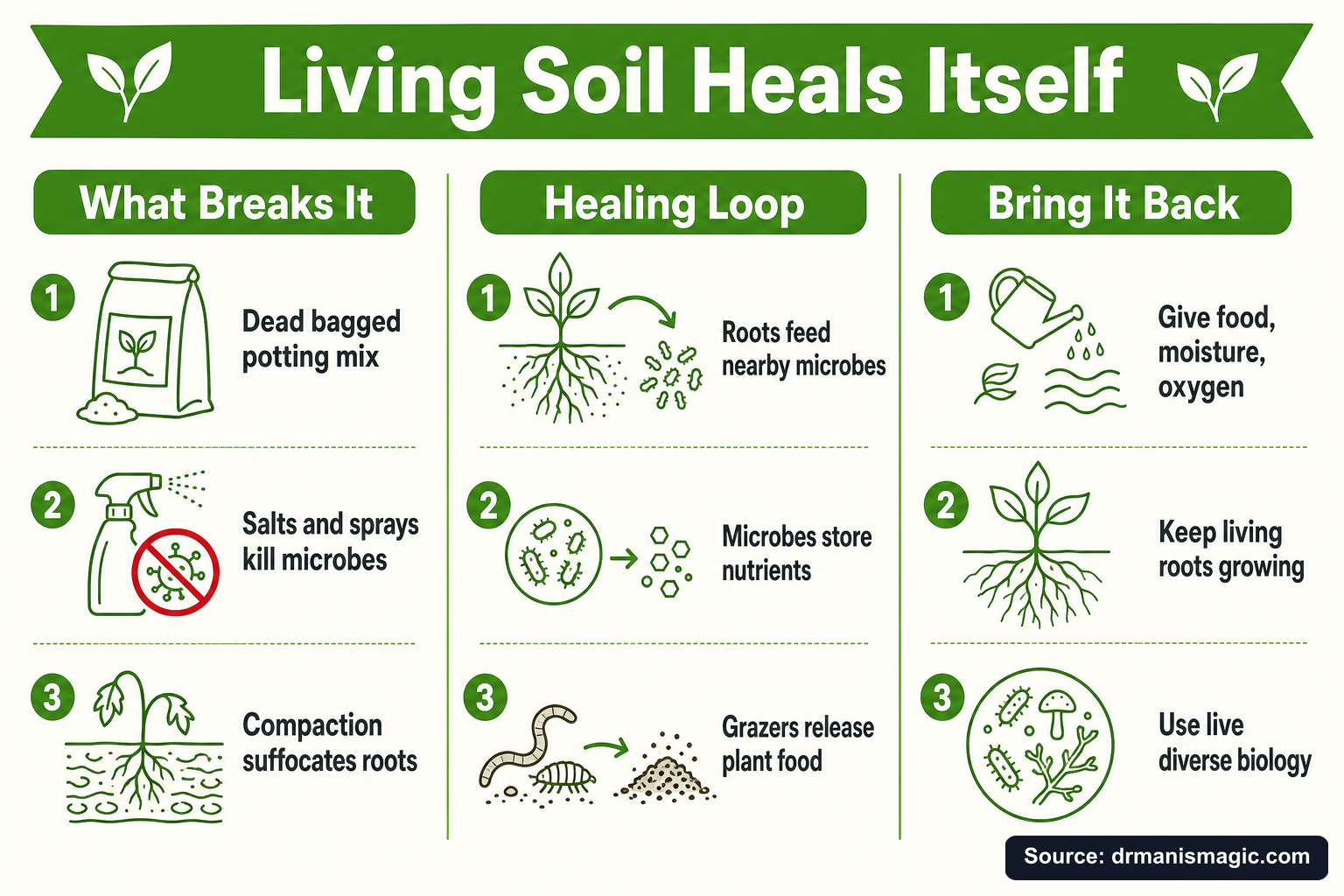
- Living soil is not a substance. It's a dynamic ecosystem called the soil food web, and it is designed by nature to self-repair.
- Bacteria, fungi, protozoa, and nematodes form a cycle that continuously rebuilds soil structure, cycles nutrients, and suppresses disease.
- The rhizosphere, the thin zone around plant roots, is the command center of soil self-healing. Roots and microbes feed each other in a non-stop loop.
- Salt-based fertilizers, synthetic herbicides, fungicides, and pesticides break the soil food web and stop self-healing dead in its tracks.
- Dead or dried microbial products sold in big box stores rarely work. Living, stabilized microbes are the only kind that reliably restart the healing cycle.
- Soil can recover from most damage when given food, moisture, oxygen, living roots, and diverse biology. Some damage, like heavy salt buildup or fumigation, takes longer and needs help.
- The Three Plant Pillars (mineral-based soil, live microbials, organic fertilizer) are the fastest way to rebuild a broken soil food web in any container, raised bed, or garden.
What Does "Living Soil" Actually Mean?
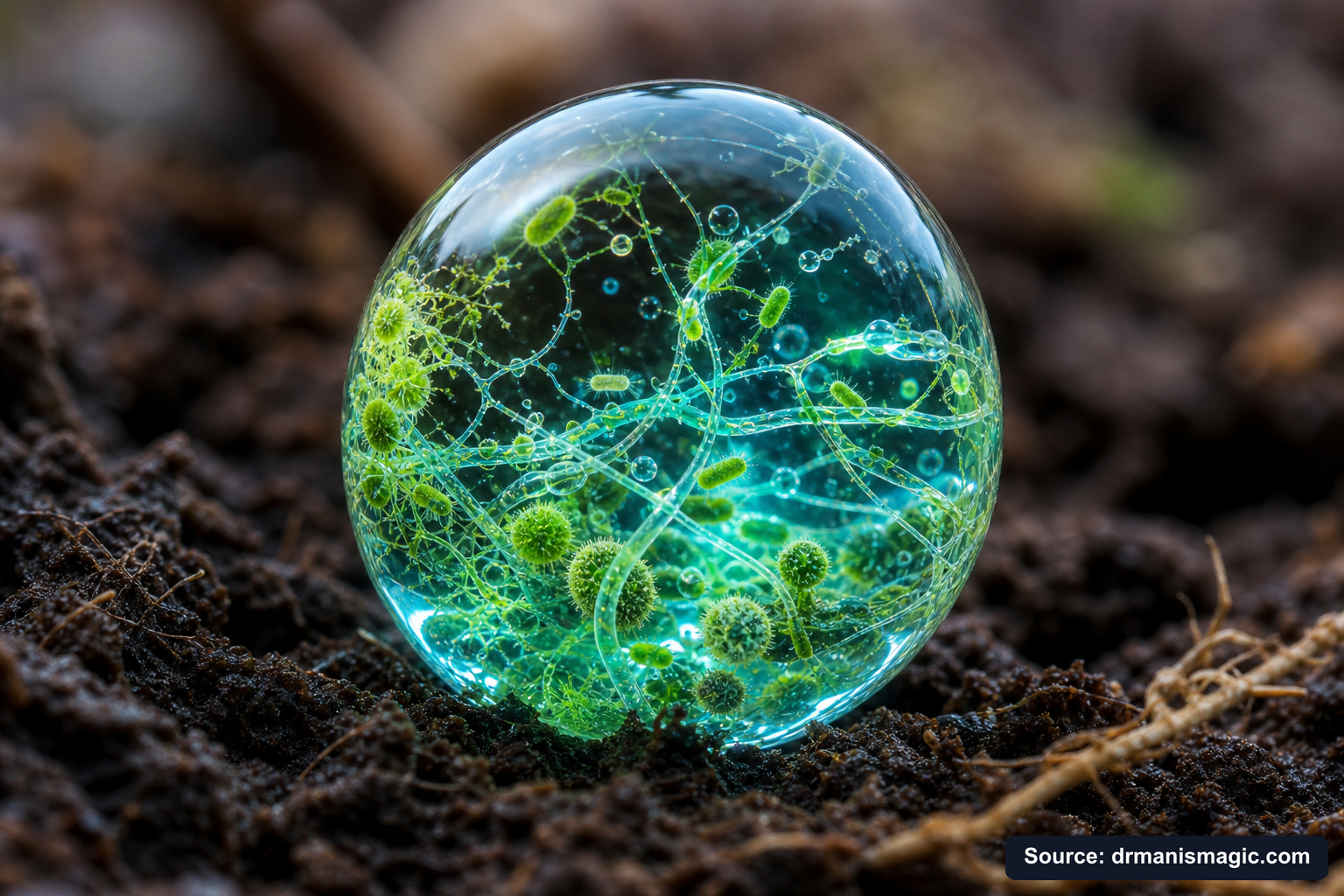
Quick Answer: Living soil is soil that contains a thriving community of bacteria, fungi, protozoa, nematodes, earthworms, and other organisms that work together to cycle nutrients, build structure, and suppress disease. It is not just dirt with fertilizer added. It is a functioning ecosystem that feeds and protects plants the way nature intended.
Most people think of soil as a growing medium. A place to stick a root and add water. Big box stores sell you bags of it. Garden centers stack it by the pallet. And almost all of it is biologically dead on arrival.
Real living soil is something entirely different. It is teeming with life. One teaspoon of healthy forest soil contains more microorganisms than there are people on Earth. Bacteria by the billions. Fungi spreading their thread-like hyphae through every crack and pore. Tiny protozoa grazing on bacteria. Microscopic nematodes hunting protozoa. Earthworms tunneling, shredding, and casting. Roots threading through it all, feeding the community and being fed in return.
According to the University of Minnesota Extension, soil biology is one of the most critical and most overlooked factors in plant health. The microorganisms in living soil are not passengers. They are the engine. They drive nutrient cycling. They build the physical architecture that lets roots breathe. They fight off the pathogens that cause root rot and disease. Without them, soil is just a pile of minerals sitting there doing nothing.
That is what most potting mix is. A pile of organic matter (usually pine bark or sawdust) that breaks down over time, compacts into a dense sludge, and suffocates roots. No structure. No biology. No self-healing. Just slow decay.
Living soil, by contrast, is a system that builds itself, repairs itself, and feeds your plants with almost no help from you. The question is: how does it do that?
How Does the Soil Food Web Create a Self-Healing Loop?
Quick Answer: The soil food web is a chain of organisms where each one feeds on another, releasing nutrients that plants can absorb. Bacteria and fungi break down organic matter. Protozoa and nematodes eat bacteria and release nitrogen. Earthworms aerate and enrich. Roots feed sugars back to microbes. This loop runs continuously and rebuilds soil after almost any disturbance.
Think of it as a city that never sleeps. Every organism has a job. Every job connects to every other job. And when something goes wrong, the system reroutes around the damage and repairs itself.
Here is how the loop works, step by step.
First, bacteria and fungi go to work on organic matter. A fallen leaf. A dead root. An old piece of mulch. They break it down into simpler compounds and pull the nutrients inside. They do not release those nutrients yet, though. They hold them. This is called immobilization, and it is actually a feature, not a bug. It keeps nutrients locked safely in biological storage so rain cannot wash them away.
Next, protozoa and nematodes graze on the bacteria and fungi. They eat the microbes and release the stored nutrients as waste. That waste is plant-available nitrogen, phosphorus, and other minerals. It lands right in the root zone, right where the plant needs it. This is called the microbial loop, and according to Penn State Extension, it is responsible for a significant portion of the nitrogen that plants absorb from healthy soil.
Meanwhile, mycorrhizal fungi extend their hyphae far beyond what roots could ever reach on their own, sometimes hundreds of times farther. They mine water and phosphorus from deep in the soil and deliver it directly to the roots. In exchange, the plant gives them sugars through its roots. It is one of the oldest trades on Earth, dating back over 400 million years.
And as all of this is happening, fungi and bacteria produce sticky compounds (including one called glomalin, made by mycorrhizal fungi) that glue soil particles together into clumps called aggregates. Those aggregates create pores. Pores let in oxygen. Oxygen lets roots breathe. And breathing roots grow deep, anchor plants, and pull up even more water and nutrients.
The whole system feeds itself. Organic matter feeds microbes. Microbes feed plants. Plants feed microbes through root exudates. More plants mean more organic matter. More organic matter means more microbes. Around and around it goes. That is the self-healing loop.
| Organism | Primary Job in the Soil | Self-Healing Contribution |
|---|---|---|
| Bacteria | Decompose organic matter, fix nitrogen, solubilize phosphorus | Nutrient cycling, pathogen suppression, aggregate formation |
| Mycorrhizal Fungi | Extend root networks, deliver water and phosphorus | Aggregate building (glomalin), drought resistance, structure repair |
| Other Fungi | Break down tough residues like wood and bark | Carbon recycling, aggregate formation, pore creation |
| Protozoa | Graze on bacteria, release plant-available nitrogen | Nutrient release, bacterial population balance |
| Nematodes (beneficial) | Graze on bacteria, fungi, and protozoa | Nutrient release, pest suppression, food web regulation |
| Earthworms | Shred organic matter, tunnel through soil | Aeration, drainage, casting enrichment, pore creation |
| Arthropods (mites, beetles) | Shred larger organic debris into smaller pieces | Accelerate decomposition, feed bacteria and fungi |
| Living Roots | Feed microbes with sugar exudates, create channels | Microbe recruitment, aggregate stabilization, food web activation |
Why Is the Rhizosphere the Command Center of Soil Self-Healing?
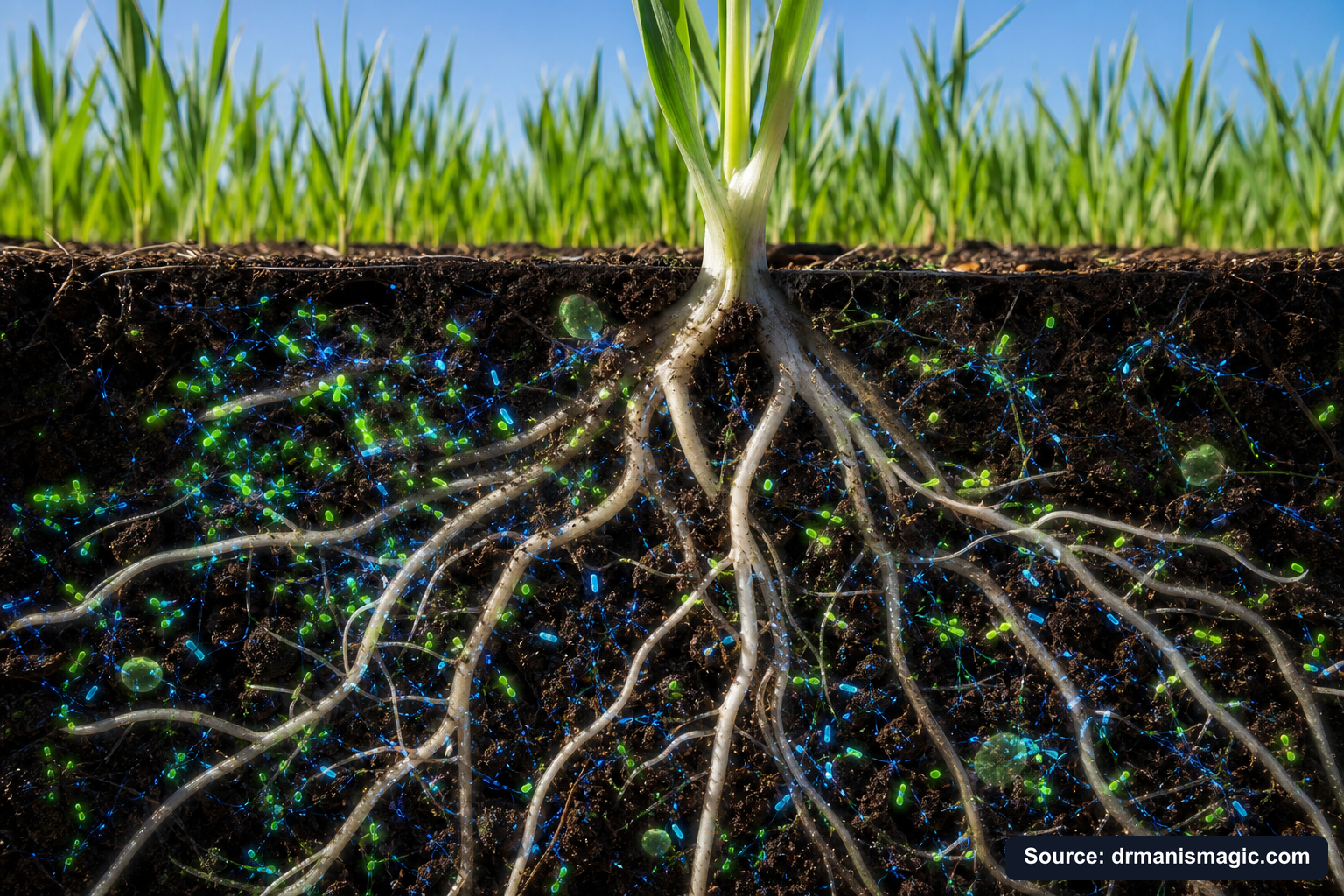
Quick Answer: The rhizosphere is the thin zone of soil directly surrounding a plant's roots. It is the most biologically active place on Earth. Roots pump sugars, amino acids, and other compounds into this zone to attract and feed specific microbes. Those microbes cycle nutrients, suppress pathogens, and rebuild structure right where the plant needs it most. No living roots, no rhizosphere, no self-healing.
Here is something most gardening advice never tells you. Plants are not passive. They are not sitting there waiting for you to feed them. They are actively managing their own soil.
Through their roots, plants pump out a steady stream of sugars, proteins, vitamins, and other compounds. Scientists call these root exudates. And plants do not release them randomly. They release specific compounds to attract specific microbes, the ones the plant needs most at that moment. Hungry for phosphorus? The root signals for phosphorus-solubilizing bacteria. Under attack from a fungal pathogen? The root calls in bacteria that produce natural antibiotics.
This is the rhizosphere at work. It is essentially a plant-managed immune system living in the soil. And it only functions when living roots are present.
This is why bare, rootless soil heals slowly. And why dead soil in a pot with no plant in it stays dead. The roots are the recruiters. Without them, the microbial army has no commander and no food source.
It is also why cover crops are so powerful in damaged garden beds. They put living roots in the ground quickly, restart the rhizosphere, and begin rebuilding the food web from the bottom up.
What Breaks the Self-Healing Cycle in Living Soil?
Quick Answer: Salt-based synthetic fertilizers, broad-spectrum herbicides, fungicides, pesticides, compaction, waterlogging, and repeated sterilization all damage or destroy the soil food web. When the microbes are killed and the food web collapses, soil loses its ability to cycle nutrients, suppress disease, or repair its own structure. The plant is left defenseless.
This is where most gardening advice goes completely off track. And it is not an accident.
The salt-based synthetic fertilizer industry has been the dominant voice in American gardening since the 1950s. It started with the Green Revolution and the push for fast, measurable results. Feed the plant directly. Skip the biology. That approach worked in the short term. It looked great on a label. And it created customers who kept coming back because their soil kept getting worse.
Here is what salt-based fertilizers actually do to the soil food web. They raise the electrical conductivity of the soil. That means the soil becomes more salty. Bacteria and fungi are sensitive to osmotic stress, which is the pulling of water out of their cells by high-salt environments. High salt concentrations kill them or drive them out. When the microbes die, the nutrient cycling stops. The pathogen suppression stops. The aggregate building stops. The soil becomes inert. Compacted. Prone to disease.
And then your plant starts struggling. So you add more fertilizer. The cycle deepens.
Herbicides like glyphosate disrupt microbial communities in the soil. Broad-spectrum fungicides kill the mycorrhizal fungi along with the pathogens they were supposed to stop. Pesticides reduce arthropod and nematode diversity. Compaction from foot traffic or heavy equipment collapses the pore structure that microbes and roots depend on. Waterlogging drives out the oxygen that aerobic bacteria need to survive.
Each of these is a punch to the soil food web. One punch, the soil can recover from. But year after year of synthetic salts, herbicide applications, and fungicide treatments? The food web does not just weaken. It collapses.
See also: The Hidden Reason Synthetic Fertilizers Cause Root Rot
Living Soil vs. Sterile Soil: What Is the Real Difference?
Quick Answer: Living soil contains a diverse, active community of microorganisms that cycle nutrients, build structure, and suppress disease continuously. Sterile soil has none of that. It is essentially an inert medium. Plants in sterile soil depend entirely on whatever you add from the outside. Plants in living soil are supported by a system that feeds and protects them around the clock.
Scientists have actually studied what happens when you take perfectly healthy soil and kill everything in it. They do this by autoclaving it (extreme heat) or irradiating it. Then they plant in it and watch what happens.
The results are striking. Plants in sterilized soil grow poorly, show increased disease susceptibility, and fail to take up nutrients efficiently, even when fertilizer is added. When researchers then reintroduce even a small amount of healthy living soil, recovery begins. Microbial communities recolonize from the living fraction. Nutrient cycling restarts. Plant health improves.
The takeaway? The biology is not a bonus feature. It is the foundation. Everything else is secondary.
Now think about what most people are growing their plants in. Bagged potting mix from a big box store. It starts sterile. It is mostly pine bark and wood fiber, which breaks down, compacts, and robs oxygen from roots within months. There are no microbes of consequence in it. It is essentially a temporary scaffold, not a living system.
| Feature | Living Soil (Active Soil Food Web) | Sterile or Biologically Depleted Soil |
|---|---|---|
| Nutrient cycling | Continuous, self-renewing through microbial activity | Dependent entirely on external inputs |
| Disease suppression | Active, through competition and antibiosis | Absent; pathogens colonize unchallenged |
| Soil structure | Aggregates formed by fungal hyphae and bacterial exudates | Collapses over time; compaction and poor drainage |
| Root health | Supported by mycorrhizal networks and beneficial bacteria | Roots alone, prone to rot and stress |
| Response to stress (drought, flood, heat) | Buffered by microbial diversity and aggregate pores | Immediate damage; no buffering capacity |
| Long-term fertility | Self-building; improves with time and organic matter | Depletes; requires increasing external inputs |
| Smell | Rich, earthy (petrichor from actinobacteria) | Flat, musty, or no odor |
| Self-healing after disturbance | Yes, through biological succession and recolonization | No; damage is permanent without intervention |
You Never Had a Brown Thumb.
You were handed the wrong tools. This free guide hands you the right ones.
You watered it. You fed it. It died anyway.
It was never you. It was the dirt, the salt food, and the bad advice.
This guide shows you what really went wrong, and how to fix it for good.
- Why your plants really died, and why it was never your fault
- The salt hiding in your plant food that quietly burns the roots
- The hidden killer in almost every bag of store soil
- The tiny helpers that grow a whole forest for free
- The rescue trick that brings a half dead plant back to life

Can Dead or Damaged Soil Actually Become Living Again?
Quick Answer: Yes. Soil can recover from most biological damage when you stop what is killing the microbes, add organic matter, maintain moisture and oxygen, introduce living roots, and replenish the microbial community with genuinely live biology. Recovery takes weeks to months depending on how badly the soil food web was disrupted. Some damage, like severe salt buildup or fumigation, takes longer and needs extra help.
This is the question that matters most. Not just "is living soil healthy?" but "can I get it back once it's gone?"
The answer is yes. With conditions. And with the right tools.
Research on soil recolonization after sterilization shows that microbial communities begin to return as soon as living biology is reintroduced, either from nearby soil, organic amendments, or microbial inoculants. The succession follows a pattern: fast-growing bacteria colonize first, then fungi begin to establish, then the grazers (protozoa and nematodes) follow the food. Within weeks, a basic food web can be functioning again. Full restoration of a complex, diverse community takes months.
The key variables are: Does the soil have food for the microbes (organic matter)? Does it have oxygen (drainage and aeration)? Does it have moisture? Are there living roots present? And is new biology being introduced?
If the answer to all five is yes, recovery begins immediately.
If salt buildup is severe, you may need to flush the soil with clean water several times before microbes can survive. If a systemic herbicide or broad-spectrum fungicide was applied, you need to wait for it to break down before reintroducing biology. If the soil is compacted to the point of zero porosity, physical loosening is needed before anything else can work.
But here is the hopeful truth. Soil wants to be alive. The biology wants to come back. Your job is just to stop fighting it and start helping it.
A Practical Soil Recovery Checklist
- Stop the damage first. No more synthetic herbicides, salt-based fertilizers, or broad-spectrum fungicides. You cannot rebuild what you keep tearing down.
- Check and correct pH. Most soil microbes thrive between pH 6.0 and 7.0. Outside that range, even good biology struggles to function.
- Flush salt-damaged soil. If you have been using synthetic fertilizers, water deeply several times to push accumulated salts below the root zone before you do anything else.
- Add diverse organic matter. Compost, mulch, aged wood chips. This is food for the bacteria and fungi. Without it, the food web has nothing to eat.
- Get living roots in the ground fast. Plant a cover crop, add transplants, or simply keep existing plants in place. Living roots restart the rhizosphere and recruit microbes.
- Inoculate with genuinely live biology. Not dried powder from a factory. Not a smelly bottle of dead compost tea. Use a stabilized, full-spectrum microbial product with verified live organisms. More on this in the next section.
- Mulch the surface. A two-to-three inch layer of organic mulch keeps moisture in, moderates temperature, feeds surface-dwelling organisms, and protects the recovering food web from UV and drying out.
Why Do Most Microbial Products Fail to Restart the Soil Food Web?
Quick Answer: Most microbial products on the market are either lab-grown organisms dried into powder (which rarely reactivate effectively in soil) or compost-based liquids that have gone anaerobic and smell terrible because the microbes are dying. Neither type reliably restores the soil food web. You need genuinely live, stabilized, full-spectrum biology to get real results.
Walk into any garden center today and you will see a wall of microbial products. Bags of mycorrhizal powder. Bottles of "beneficial bacteria." Compost teas in plastic jugs. The labels look impressive. The claims are bold. And most of them do very little.
Here is what is actually happening inside those products.
The majority of powdered microbial products are made in large industrial fermentation facilities. A handful of bacterial strains are grown in giant vats, then dried into spores and packaged. The hope is that those spores will reactivate when they hit moist soil. In practice, the reactivation rate is low, the spectrum is narrow, and the organisms have been bred for factory conditions, not for competing in a complex living soil environment. At US Citrus Nursery, after testing dozens of these products across tens of thousands of trees, Dr. Mani's team saw little to no measurable improvement in plant health. The plants did not respond.
The second category is liquid compost-tea-style products. These start with real biology from compost or earthworm castings, which is a promising base. But most of them go anaerobic in transit. Anaerobic means the oxygen runs out, the beneficial aerobic microbes die, and the remaining organisms are the ones that thrive without oxygen. The telltale sign? The bottle stinks. Sometimes it fizzes when you open it. That fizz is fermentation gas. Those microbes are dying. You are pouring a bottle of biological wreckage onto your plants.
You may get some benefit from the humic acids and fulvic acids that survive in the liquid. But the living biology you were paying for? Gone.
There is a third category worth mentioning: lactobacillus-based products, similar to the bacteria in yogurt. These are easy to grow and vigorous. But they are so competitive that they crowd out the beneficial microbes you actually want in your soil. Lactobacillus belongs in your gut, not in your garden bed.
| Product Type | Viability at Use | Microbial Spectrum | Odor | Real-World Results |
|---|---|---|---|---|
| Dried/powdered lab microbes | Low (spores rarely reactivate well) | Very narrow (3-10 strains) | None | Minimal to none in field testing |
| Rehydrated dried powder | Low | Narrow | None | Same as above; not recommended |
| Compost tea (fresh, under 24 hours, aerated) | Moderate | Broad but variable | Earthy to slightly sour | Good when truly fresh; impractical for most gardeners |
| Compost tea (old, over 24 hours) | Very low (anaerobic) | Degraded | Strong, foul smell | Not recommended; biology largely dead |
| Lactobacillus-based products | High | Narrow (lactobacillus dominant) | Sour/fermented | Crowds out beneficial microbes; not recommended for soil |
| Plant Super Boost (stabilized, full-spectrum) | High (verified live under microscope) | 2,000+ bacteria, 400-500 fungi including mycorrhizae, plus protozoa and nematodes | Earthy, not foul | Consistent results across 250,000+ trees at US Citrus Nursery |
What Makes Plant Super Boost Different From Every Other Microbial Product?
Quick Answer: Plant Super Boost is harvested from natural compost and stabilized using a proprietary all-natural technique that keeps the full-spectrum microbial community alive without going anaerobic. It contains over 2,000 species of bacteria, 400 to 500 species of fungi including mycorrhizae, plus protozoa and nematodes. You can see the live microbes moving under a microscope. It does not smell bad because it is not rotting.
The story behind Plant Super Boost is one of the most interesting in all of American gardening history.
Dr. Mani had spent decades watching the soil biology research accumulate. He knew that fresh compost worked almost like magic on plants. He had seen it firsthand on his citrus trees and grove in South Texas. A fresh compost application would light up the rhizosphere, and plants that had been struggling would visibly respond within weeks. The problem was obvious: how do you bottle that? How do you ship it to a gardener in Minnesota or Oregon and have it still be alive and effective when it arrives?
The breakthrough came through a providential meeting with a world-renowned compostologist, someone who had advised the agricultural practices of royal families and governments around the world. This person had developed a natural, proprietary technique to stabilize the full microbial spectrum of active compost without the biology dying off or going anaerobic. When he shared it with Dr. Mani, both of them knew immediately what it meant. Fresh compost in a bottle. Shipped anywhere. Still alive on delivery.
That is what became Plant Super Boost. And unlike the powder products and stinking compost teas, this one has lab analyses behind it. And if you take a single drop and put it under a microscope, you can watch the microbes moving. They are alive. They are ready to work.
Zero synthetic salts. Zero biosludge. Zero PFAS. Made in the USA. And it smells like rich earth, not a sewage treatment plant, because it is not rotting. It is alive.
That distinction matters more than most people realize. A product that smells like death is delivering death to your soil. A product that smells like a forest floor after rain is delivering life.
How Do the Three Plant Pillars Work Together to Create Self-Healing Soil?
Quick Answer: The Three Plant Pillars are mineral-based soil (for drainage, aeration, and permanent structure), live microbials (for the soil food web that cycles nutrients and suppresses disease), and organic fertilizer (for slow-release nutrition that feeds plants and microbes without killing them with salt). Together they recreate the conditions of natural living soil in any container, raised bed, or garden.
Here is the elegant truth that Dr. Mani discovered after three decades of growing at US Citrus Nursery. You do not need to understand every detail of soil science to grow extraordinary plants. You just need to get three things right. And when you do, the soil takes care of almost everything else.
Pillar One is the mineral foundation. Most potting mixes are organic-based. Pine bark. Wood fiber. Peat. These materials break down over time. As they decompose, they compact. As they compact, they block oxygen from reaching roots. Roots without oxygen cannot function. They rot. And rotted roots cannot absorb anything, no matter how much you feed the plant above.
Dr. Mani's solution was to build a soil around a mineral base, specifically the silica-rich sandy loam from the Rio Grande Valley. Mineral soil does not decompose. It does not compact. It provides permanent structure. Roots can breathe. Water drains. And the microbial community has a stable habitat to colonize and maintain.
Pillar Two is live microbials. The soil food web we have been discussing throughout this article. Without it, even perfect mineral soil is just a growing medium. With it, the soil becomes a self-sustaining ecosystem that cycles nutrients, fights pathogens, and supports roots with an invisible workforce 24 hours a day.
Pillar Three is organic fertilizer. Not salt-based synthetic chemicals that kill the microbes you just added. Not slow-release plastics coating that leaches toxins. Organic fertilizer made from crab, kelp, and amino acids delivers nitrogen, phosphorus, potassium, trace minerals, and biostimulants in a slow-release form that works with the microbial community, not against it. The microbes help break down and deliver these nutrients. The nutrients help the microbes thrive. It is another self-reinforcing loop.
You can explore the complete Three Plant Pillars system here and see exactly how to apply it to your own plants.
When all three pillars are in place, something shifts. The soil stops being something you have to constantly manage and starts being something that manages itself. Plants become, as Dr. Mani puts it, practically bulletproof. They fight off pests with stronger natural defenses. They recover from drought faster. They resist disease because the beneficial microbes are crowding out the pathogens. And they produce the kind of lush growth, vibrant blooms, and abundant fruit that most people only see in gardening magazines.
How Long Does It Take for Living Soil to Heal Itself?
Quick Answer: Mildly depleted soil can show improvement in two to four weeks after microbial reintroduction and organic matter addition. Moderately damaged soil typically shows meaningful recovery in one to three months. Severely damaged soil, such as fumigated, heavily compacted, or high-salt ground, may take six months to a year or longer. Ongoing microbial applications speed up recovery at every stage.
Time is the one thing you cannot buy back. Dr. Mani hears this from gardeners all the time. They want to see fruit on the trees they plant. They want to see the flowers bloom. They want to walk through a garden they grew themselves before another season slips by.
Soil recovery does not have to be slow. Not if you give it what it needs quickly.
The fastest recoveries happen when you stop the damage immediately, introduce live biology right away, add organic matter to feed it, and keep living roots in the ground. In containers and raised beds where you control every variable, you can see measurable improvement within a month. Yellowing plants green up. Root systems expand. Fruiting improves. The difference between a plant in dead potting mix and a plant in living soil supported by Plant Super Boost can be visible in as little as three to four weeks.
In garden beds with years of synthetic fertilizer history, it takes longer. The salt has to flush. The microbial community has to rebuild. The aggregate structure has to re-form. But it does happen. And every month of organic inputs and live microbial applications moves the soil further down the recovery path.
The worst mistake gardeners make at this point is giving up after the first month and going back to the salt-based shortcuts. That resets the clock and destroys the progress. Consistency is everything. Monthly applications of live microbials. Regular organic feeding. No synthetic disruptors. Give the food web food, water, oxygen, and time, and it will do the rest.
When Can Living Soil Not Heal Itself?
Quick Answer: Living soil has real limits. Severe salt accumulation, soil fumigation, heavy metal contamination, herbicide carryover, persistent waterlogging, and extreme compaction can overwhelm the soil food web's ability to self-repair without significant intervention. In these cases, physical remediation, flushing, and aggressive biological reintroduction are needed before natural self-healing can resume.
This is the honest part of the conversation. Living soil is powerful. But it is not magical in the fantasy sense. There are conditions under which the self-healing loop cannot restart on its own.
Soil fumigation is one. Fumigants like methyl bromide or chloropicrin do not just kill pathogens. They sterilize the soil almost completely. The food web is gone. Recolonization from neighboring areas happens slowly, over months or years, unless you actively reintroduce biology.
Herbicide carryover is another. Certain residual herbicides stay active in soil for months or even years. Until they break down, they continue suppressing microbial activity even after you stop applying them. You can add all the biology you want, but if the herbicide is still present, the microbes cannot establish.
Severe salt accumulation from years of synthetic fertilizer use raises electrical conductivity to levels where most beneficial microbes cannot survive. Flushing the soil with clean water multiple times is a prerequisite before biological recovery can begin.
Persistent waterlogging drives out the oxygen that aerobic bacteria and fungi depend on. Anaerobic conditions favor pathogens and fermentation organisms. Until drainage is corrected, the food web cannot rebuild.
The good news is that these extreme conditions are the exception, not the rule. Most garden soil, most potted plants, most raised beds are not in these extreme states. They are just biologically depleted. Salt-stressed. Low on organic matter. Missing the microbial community they need. And those soils respond remarkably well to the right inputs.
What Can You Do Right Now to Start Building Living Soil?
Quick Answer: Start by stopping what is killing your soil biology. Then add organic matter, introduce live microbials, switch to organic fertilizer, and keep living roots in the ground. If you are growing in containers or raised beds, the Three Plant Pillars system gives you the fastest path to a living, self-healing root zone for any plant.
You do not have to overhaul everything today. But you do have to start somewhere. Because here is the truth about time and plants: the best day to build living soil was years ago. The second best day is today.
Every month you spend pouring salt-based fertilizer into biologically dead potting mix is a month your plants are struggling unnecessarily. Every application of broad-spectrum herbicide is another step backward in a soil that is already trying to recover. And every season that passes without living biology in your root zone is a season of growth and fruit and flowers that you will never get back.
The path forward is not complicated. Stop the disruptors. Add organic matter. Introduce live, stabilized biology. Feed with organic slow-release nutrients that work with the microbes, not against them. Get living roots in the ground. Mulch the surface. And be consistent.
Whether you are growing citrus trees in containers on a patio in Texas, tending a backyard vegetable garden in Ohio, nurturing houseplants in a Minnesota apartment, or trying to bring a lawn back to life after years of chemical treatments, the biology is the same. The soil food web is the same. The Three Plant Pillars are the same.
After more than 30 years and 250,000 trees at US Citrus Nursery, that is what Dr. Mani Skaria learned. And it is why he built the Dr. Mani's Magic line: to bring the power of a living, self-healing soil food web to every gardener in America, in a bottle that you can use today without a PhD, without a compost pile, and without a background in plant pathology.
If you want to see what genuinely live, stabilized, full-spectrum soil biology looks like and smells like (earthy, not foul), and what it does to plants that have been struggling in dead soil, start with the Free Plant Care Field Guide. It walks you through the Three Plant Pillars system step by step, for any plant, in any setting. No guesswork. No jargon. Just the foundation that makes everything else work.
Your soil wants to be alive. It has been trying to heal itself this whole time. Give it what it needs, and watch what happens.
Frequently Asked Questions
Living soil is the single biggest factor standing between a struggling plant and one that practically takes care of itself. After 30 years and 250,000 trees grown in South Texas, Dr. Mani Skaria has seen this truth play out over and over again. These are the questions people ask most when they finally start to understand what healthy soil actually does.
What are the real benefits of living soil?
Living soil feeds your plants without you doing much at all. The bacteria, fungi, and other tiny organisms inside it break down nutrients, fight off disease, and build strong root systems naturally. You get bigger blooms, juicier fruit, and healthier grass. Dr. Mani proved this across 250,000 citrus trees at US Citrus Nursery. When the soil food web is working, your plants stop struggling and start thriving on their own.
What is living soil actually made of?
Living soil is not just dirt. It is a working ecosystem. It needs a solid mineral base for structure and drainage, aeration material so roots can breathe, and biological fuel like compost or organic amendments to feed the microbes. Dr. Mani's Three Plant Pillars match this perfectly: mineral-based soil, live microbials, and organic fertilizer. Each pillar does a different job. Together, they build a soil that feeds and protects your plants around the clock.
Can you reuse living soil, or do you have to replace it?
Yes, you can absolutely reuse it. In fact, good living soil gets better over time. Most store-bought potting mixes break down fast because they are full of wood and bark that rot and compact. Dr. Mani's Super Soil uses a mineral-based sandy loam from South Texas that does not decompose. You can use it permanently. Just recharge the microbes with Plant Super Boost and feed with organic fertilizer, and your soil keeps improving season after season.
Why is putting your hands in soil good for you?
Healthy soil contains friendly bacteria that actually boost your mood. When you touch or breathe in soil, certain microbes trigger your brain to release serotonin, the same feel-good chemical that makes you feel calm and happy. That is not a coincidence. That is nature doing what it was designed to do. Gardening with clean, chemical-free soil like Dr. Mani's Super Soil means you get that benefit without worrying about what is soaking into your skin.
Is soil really an antidepressant?
Science says yes. Specific bacteria found in healthy soil have been shown to reduce inflammation in the brain and boost the production of serotonin and dopamine. These are the same pathways that antidepressant medications target. This is one more reason why chemical fertilizers and synthetic pesticides cause real harm. They wipe out the very microbes that make gardening feel good. Healthy, living soil does something no pill bottle can: it connects you to something real.
What destroys living soil and stops it from healing itself?
Salt-based synthetic fertilizers are the number one killer. They wipe out the bacteria and fungi that make soil self-healing. Herbicides, fungicides, and most chemical pesticides do the same thing. Even most store-bought potting mixes arrive biologically dead. Once the soil food web is broken, your plants have no defense and no natural food source. That is why Dr. Mani built the Three Plant Pillars around live microbes, mineral soil, and organic fertilizer. It rebuilds what chemicals destroy.
What are the five core things healthy soil does for your plants?
Healthy living soil anchors roots and gives them room to grow. It stores and cycles nutrients so plants can eat on their own schedule. It filters water and prevents root rot. It suppresses disease by keeping harmful organisms outnumbered. And it builds long-term resilience so your plants can handle heat, drought, and pests without falling apart. Dr. Mani's Three Plant Pillars are designed to restore all five of these functions fast, whether you are growing citrus trees, houseplants, vegetables, or grass.
About the Author
Ron Skaria, MD
Ron Skaria, MD, is the co-founder of Dr. Mani's Magic and the son of Dr. Mani. He trained as a medical doctor at Baylor College of Medicine, did his residency at UT Health Science Center - San Antonio and fellowship training at Texas Tech University. He now works full time on the family farm at US Citrus and US Citrus Nursery in Hargill, Texas, building Dr. Mani's Magic alongside his dad. He wrote the Brown Thumb Field Guide to put his father's 48 years of plant science into plain words any gardener can use. His belief is simple. You never had a brown thumb. You just never had the right help.


