


Why Not All Nematodes Are Bad for Your Soil and Plants | Dr. Mani's Magic
Why Not All Nematodes Are Bad: The Good, the Bad, and the Invisible World Under Your Feet
You pull a struggling plant out of its pot. The leaves are yellow. The roots look brown and mushy. You've done everything right — or so you thought. You watered it. You fertilized it. You gave it sun. And still, it's dying.
Someone online tells you it might be nematodes. You Google it. Every result shows tiny worm-like creatures destroying plant roots. Your stomach drops. You picture an invisible army eating your garden alive. You reach for the pesticide. You want them all dead.
Stop right there. Because what you're about to do could make everything worse. Here's the truth most gardening sites won't tell you: the vast majority of nematodes in your soil are not destroying your plants. They are feeding them. They are recycling nutrients. They are regulating the soil community. They are part of the reason forests grow without a single bag of fertilizer. Killing them all is like burning your house down to get rid of one bad neighbor.

Plant Super Boost
Key Takeaways
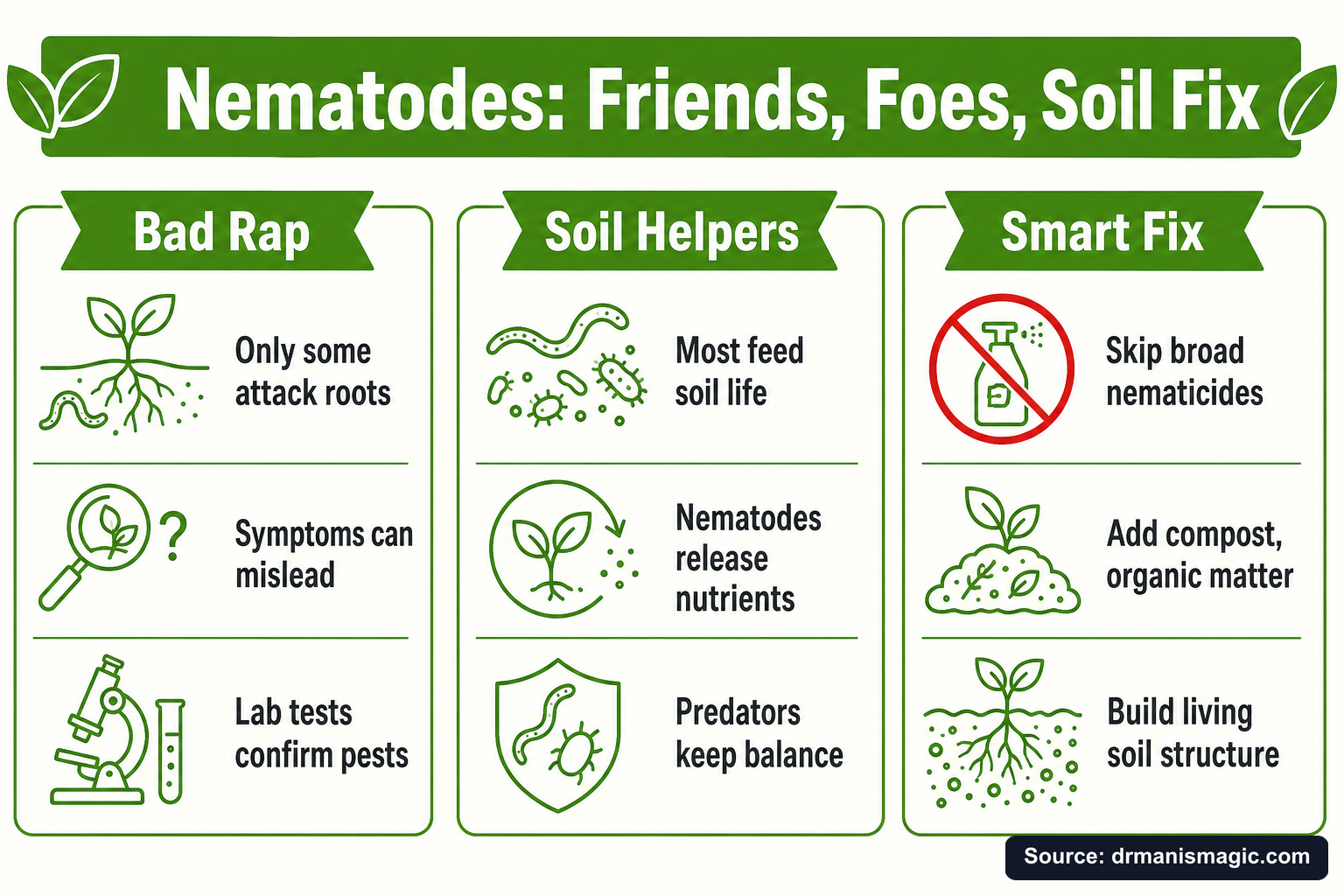
- Most nematodes in healthy soil are beneficial. Only a small group — plant-parasitic nematodes — actually harm roots.
- Beneficial nematodes recycle nutrients, regulate bacteria and fungi, and act as living indicators of soil health.
- The soil food web connects bacteria, fungi, protozoa, and nematodes in a nutrient-cycling system that feeds your plants for free.
- Commercially available "beneficial nematodes" are a separate category used to control soil pests like grubs and fungus gnats.
- Killing all nematodes with pesticides destroys the good ones and collapses your soil biology.
- Rebuilding a living soil — with the right microbes, organic matter, and proper soil structure — is the real solution to nematode-related plant problems.
- Dr. Mani's Magic Three Plant Pillars give your soil the foundation it needs for a thriving, self-regulating underground ecosystem.
Are Nematodes Bad for Plants?
Quick Answer: Most nematodes are not bad for plants. Of the many thousands of nematode species living in soil, only a small fraction are plant-parasitic. The rest recycle nutrients, eat harmful bacteria and fungi, and help regulate the underground ecosystem. Indiscriminate nematicide use destroys the beneficial majority along with the few harmful ones.
Most nematodes are completely harmless to your plants. In fact, they are helpful.
Think of it this way. Your gut has trillions of microbes. Some cause disease. Most keep you healthy. You would never take an antibiotic that wiped out every microbe in your body just because a few were bad. The same logic applies underground.
Nematodes are microscopic roundworms. They live in every handful of healthy soil. There can be millions of them in a single square foot of garden bed. University of Florida IFAS research identifies at least five distinct functional groups of nematodes in soil — and only one of those groups, the plant-parasitic nematodes, causes root damage.
The other four groups? They are working for you.
Here is how each group actually behaves:
| Nematode Type | What They Eat | Do They Harm Plants? | Effect on Nutrient Cycling | How They Are Detected |
|---|---|---|---|---|
| Plant-Parasitic | Plant root cells | Yes — they damage and deform roots | Negative — reduce root function | Lab soil assay required |
| Bacterial-Feeders | Soil bacteria | No | Positive — release nitrogen and other nutrients from bacteria | Soil food web analysis |
| Fungal-Feeders | Soil fungi | No | Positive — release nutrients locked in fungal tissue | Soil food web analysis |
| Predatory / Omnivorous | Other nematodes, protozoa, small invertebrates | No | Positive — regulate microbial populations, prevent overdominance | Soil food web analysis |
| Insect-Parasitic (Entomopathogenic) | Soil-dwelling insects and larvae | No — beneficial biocontrol agents | Neutral to positive — reduce pest pressure | These are purchased and applied as biocontrol products |
The plant-parasitic nematodes are real. They exist. But they are one piece of a much larger, mostly helpful community. And according to Ask Extension, nematode damage is not usually diagnosed by casual observation — and standard soil tests do not screen for plant-parasitic nematodes at all. That yellow leaf you are blaming on nematodes? It is more likely a soil biology problem, a salt buildup issue, or a microbe deficiency.
What Is the Soil Food Web and Why Do Nematodes Live In It?
Quick Answer: The soil food web is the living network of bacteria, fungi, protozoa, nematodes, and other organisms that recycle nutrients in the soil. Nematodes sit just above microbes in this web, grazing on bacteria and fungi to release plant-available nutrients. A healthy food web means your plants get fed naturally, without synthetic inputs.
Picture your soil as a city. Not a dead, empty city. A living, buzzing, 24-hour city where trillions of invisible workers never stop moving.
At the base of that city, bacteria and fungi break down organic matter. They are the recyclers. They take dead leaves, old roots, and bits of compost and turn them into nutrients plants can actually use.
Then come the grazers. Protozoa and nematodes eat the bacteria and fungi. When they do, they release the nutrients locked inside those microbial bodies — nitrogen, phosphorus, all the good stuff — directly into the soil water where plant roots can drink it up.
The USDA Natural Resources Conservation Service explains it plainly: protozoa and nematodes graze on bacteria and fungi, help control their populations, and release plant-available nutrients in the process. This is the original slow-release fertilizer. It has been running without human help for millions of years.
Above the grazers come the predators. Predatory nematodes eat other nematodes. They keep the whole community in balance. No single species takes over. No single pathogen explodes unchecked.
Then come the plants themselves. Their roots release sugars called exudates into the soil. These sugars feed the bacteria and fungi. The bacteria and fungi feed the nematodes. The nematodes release nutrients back to the roots. It is a closed loop of generosity that costs the plant almost nothing and pays back everything.
This is why a forest floor that has never seen a bag of fertilizer grows towering trees. The food web does the feeding. The nematodes are a critical link in that chain.
Wisconsin Extension researchers point out that nematodes are actually easier to study as indicators of soil health than bacteria and fungi themselves, because nematodes respond visibly to changes in microbial abundance, organic inputs, and soil disturbance. A healthy nematode community signals a healthy microbial community. Wisconsin Extension's soil health research confirms that nematode diversity is one of the most reliable proxies for overall soil food web function.
When you sterilize your soil, spray broad-spectrum pesticides, or drench with salt-based synthetic fertilizers, you collapse this food web. The bacteria die. The fungi shrink. The beneficial nematodes disappear. And now there is nothing keeping the plant-parasitic nematodes in check. You actually make the problem worse while thinking you are fixing it.
See also: The Hidden Reason Synthetic Fertilizers Cause Root Rot
How Do You Know If Harmful Nematodes Are Actually Causing Your Plant Problems?
Quick Answer: You cannot diagnose plant-parasitic nematode damage by looking at leaves or roots alone. The symptoms — yellowing, stunted growth, wilting — look identical to root rot, salt stress, and nutrient deficiency. A proper diagnosis requires sending a soil sample to a laboratory that tests specifically for plant-parasitic nematodes. Do not treat until you know what you are treating.
Here is what plant-parasitic nematode damage actually looks like — and why it is so easy to misdiagnose.
The plant looks wilted, even when the soil is wet. The leaves turn yellow. Growth slows or stops. The roots, if you dig them up, may show small bumps called galls, or they may look brown and stubby instead of long and white.
Sound familiar? That also describes root rot from overwatering. Salt burn from synthetic fertilizer. Compacted soil that suffocates roots. A potting mix that has decomposed into an oxygen-stealing sludge. All of these look the same from the outside.
This is why Ask Extension specifically warns gardeners: do not assume nematodes are the culprit without a lab test. A standard soil test — the kind you order for NPK levels — does not test for plant-parasitic nematodes at all. You need to send a separate soil sample to a university extension lab or a certified soil biology lab and ask specifically for a nematode assay.
Before spending money on a nematode test, ask yourself these questions first:
- Am I using a synthetic, salt-based fertilizer? Salt stress mimics nematode damage perfectly.
- Is my soil a bark-heavy potting mix that has been in the pot more than a year? Decomposed potting mix compacts and kills roots without any nematodes involved.
- Have I used a broad-spectrum pesticide or fungicide recently? These destroy the beneficial biology that keeps pathogens and harmful nematodes in check.
- Is there standing water or poor drainage? Root rot from overwatering is the most common cause of the symptoms people blame on nematodes.
If you have eliminated those causes and still suspect nematodes, then get the lab test. It is the only honest diagnosis.
What Are Beneficial Nematodes and Do They Actually Work?
Quick Answer: Beneficial nematodes — specifically entomopathogenic species like Steinernema and Heterorhabditis — are living organisms you purchase and apply to soil to kill soil-dwelling pests like grubs, fungus gnat larvae, and vine weevils. They work by entering insects and releasing bacteria that kill the host. They do not harm plants, earthworms, or pets.
Walk into any garden center and you will find little packages or sponges labeled "beneficial nematodes." These are not the same free-living nematodes already living in your soil. These are a specific type: entomopathogenic nematodes, meaning they parasitize insects.
The two most common species sold commercially are Steinernema feltiae and Heterorhabditis bacteriophora. They hunt soil-dwelling insect larvae. When they find a host — a grub, a fungus gnat larva, a vine weevil — they enter it and release bacteria that kill the insect within a few days. Then the nematodes feed, reproduce, and spread through the soil looking for more prey.
Cornell University's Integrated Pest Management program confirms that Heterorhabditis bacteriophora is an effective biological control agent for white grubs and other soil pests when applied correctly. The word "correctly" is doing a lot of work in that sentence.
Here is what most people get wrong when they buy beneficial nematodes:
- They store them at room temperature. Nematodes die. They need refrigeration until use.
- They apply them in hot, dry soil. Nematodes need moisture to move through soil. Irrigate before and after application.
- They apply them in full sun. UV light kills nematodes. Apply in the evening or on a cloudy day.
- They use a pump sprayer with too much pressure. High pressure tears nematodes apart. Use a coarse nozzle and low pressure.
- They buy old stock. Check the expiration date. If the nematodes are not alive, nothing will happen.
The viability checklist below covers what to verify before you spend money on these products:
- Check the expiration date before purchasing. Live nematodes have a short shelf life.
- Ask if the product was refrigerated during shipping and storage.
- Match the species to the target pest. Not all beneficial nematodes kill all pests.
- Check soil temperature. Most species need soil between 42°F and 86°F to be active.
- Water the soil deeply before applying.
- Apply in the evening or on a cloudy day to avoid UV exposure.
- Use low-pressure equipment. Gentle agitation in the tank. Coarse spray nozzle.
- Water again immediately after applying to drive nematodes into the soil.
- Reapply according to label instructions. One application is rarely enough.
You Never Had a Brown Thumb.
You were handed the wrong tools. This free guide hands you the right ones.
You watered it. You fed it. It died anyway.
It was never you. It was the dirt, the salt food, and the bad advice.
This guide shows you what really went wrong, and how to fix it for good.
- Why your plants really died, and why it was never your fault
- The salt hiding in your plant food that quietly burns the roots
- The hidden killer in almost every bag of store soil
- The tiny helpers that grow a whole forest for free
- The rescue trick that brings a half dead plant back to life

What Kills Beneficial Nematodes and Collapses the Soil Food Web?
Quick Answer: Salt-based synthetic fertilizers, broad-spectrum pesticides, synthetic herbicides like glyphosate, and synthetic antifungals all damage or destroy beneficial nematodes and the bacteria and fungi they depend on for food. Sterilized potting mix starts with zero biology. Chemical inputs finish off whatever survives. The result is a lifeless growing medium where plant-parasitic organisms face no competition.
This is the part nobody at the garden center tells you.
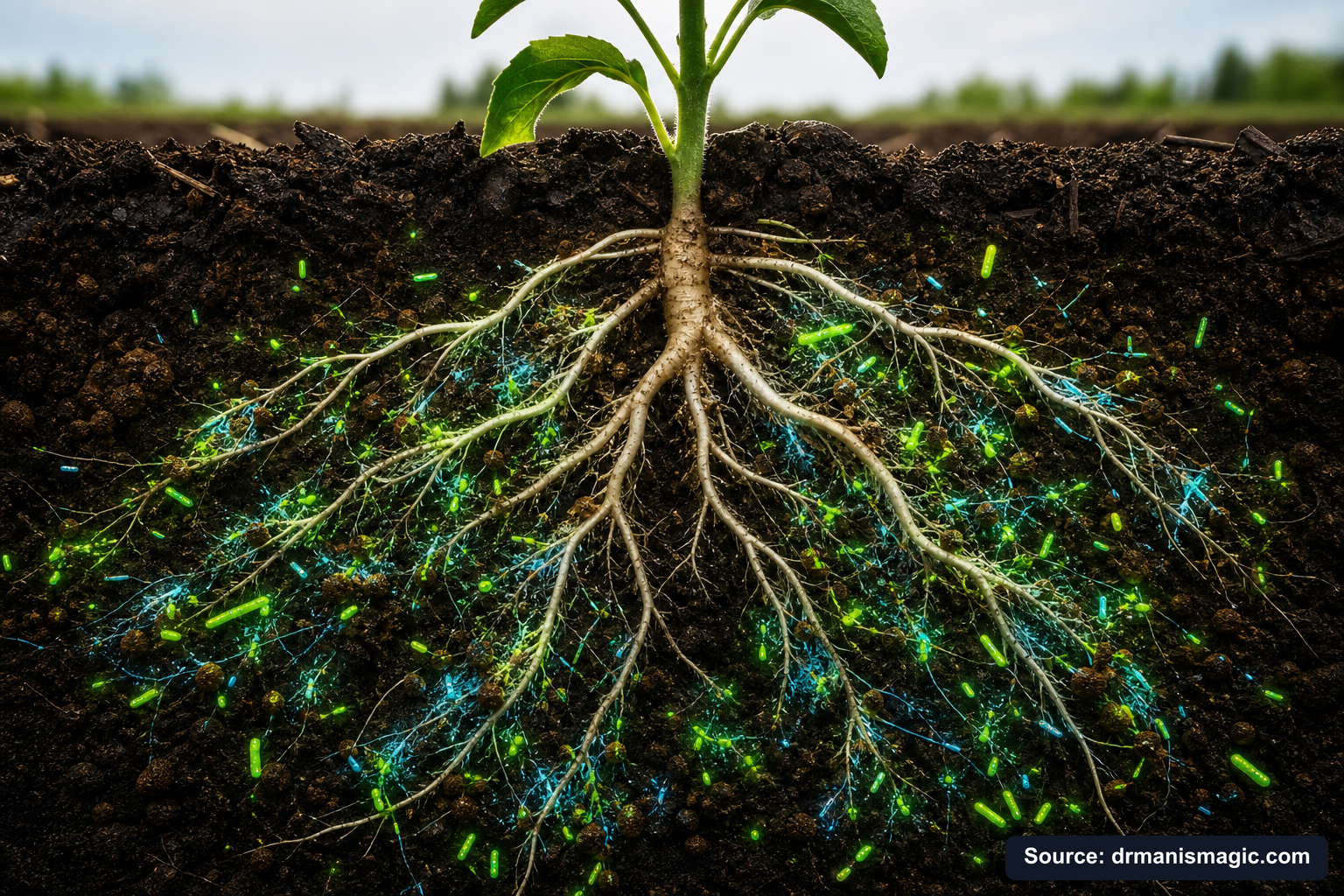
Every time you pour salt-based synthetic fertilizer into your soil, you are not just feeding your plant. You are salting the battlefield. Beneficial bacteria shrink back. Mycorrhizal fungi retreat. The food web thins out. The nematodes that fed on those bacteria and fungi — the good ones, the ones recycling nutrients for your roots — they disappear too.
And the plant-parasitic nematodes? They are tougher. They survive chemical stress better than the beneficials do. So you end up with a soil where the harmful ones have less competition and more room to expand. You accidentally create the exact problem you were trying to prevent.
Then there is the potting mix problem. Most bagged potting mixes are made from shredded pine bark, sawdust, and peat. They start with almost zero living biology. Within six to twelve months, they compact and decompose. The pore spaces collapse. Roots cannot breathe. Oxygen disappears from the root zone. Anaerobic conditions set in. Pathogens thrive in anaerobic soil. Beneficial nematodes, which need oxygen to move and hunt, cannot survive.
At US Citrus Nursery, after growing over 250,000 trees in South Texas, we watched this pattern repeat itself over and over. Plants planted in bark-based mixes with synthetic fertilizers would look fine for a few months. Then stall. Then slowly collapse. The soil biology had been stripped away, and without it, no amount of fertilizer could compensate.
That is what pushed Dr. Mani Skaria — plant pathologist, Professor Emeritus, and founder of the Clean Citrus Program in Texas — to develop a completely different approach. The Three Plant Pillars are the result of that search.
| Input or Practice | Effect on Beneficial Nematodes | Effect on Soil Food Web | Better Alternative |
|---|---|---|---|
| Salt-based synthetic fertilizers | Kills bacteria they feed on; osmotic stress reduces nematode populations | Collapses bacterial and fungal communities | Organic slow-release fertilizer that feeds microbes, not just plants |
| Broad-spectrum pesticides | Direct toxicity to many nematode species | Reduces diversity across all trophic levels | Targeted organic pest control; restore biology after use |
| Synthetic herbicides (glyphosate) | Disrupts microbial communities that nematodes depend on | Reduces bacterial and fungal diversity | Mechanical weed control; mulching; targeted spot treatment |
| Synthetic antifungals | Eliminates fungal-feeding nematodes' food source | Destroys mycorrhizal networks and fungal decomposers | Live microbial inoculants to rebuild fungal communities |
| Bark-based potting mix (old) | Anaerobic conditions suffocate beneficial nematodes | Eliminates aerobic biology entirely | Mineral-based soil with permanent structure and aeration |
| Soil sterilization or solarization | Kills nearly all nematodes, good and bad | Resets food web to zero; harmful organisms often recolonize first | Targeted pathogen suppression; immediate reintroduction of beneficial biology |
How Do You Rebuild a Living Soil After It Has Been Damaged?
Quick Answer: Rebuilding soil biology after pesticide use, sterilization, salt buildup, or bark-based potting mix collapse takes deliberate steps: stop the inputs that kill microbes, add organic matter and living roots, reintroduce a full-spectrum live microbial inoculant, and give the food web time to reestablish. Do not judge results in two weeks. Biological recovery takes months of consistent support.
Here is something most gardening content never says out loud.
If your soil has been treated with synthetic herbicides, fungicides, or salt-based fertilizers for years — or if you are growing in sterilized potting mix — your soil food web is not just weakened. It may be nearly gone. The beneficial nematodes are gone. The bacteria are thin. The fungi are depleted. What is left is a fragile, dead-quiet growing medium that cannot regulate itself.
You cannot fix that with one application of anything. But you can fix it. Here is how.
- Stop adding inputs that kill soil biology. That means stepping away from salt-based synthetic fertilizers and broad-spectrum chemicals. Every application resets the clock on recovery.
- Switch to mineral-based soil with permanent structure. Bark-based mixes collapse and go anaerobic. A mineral-based soil — like the sandy loam foundation in Dr. Mani's Magic Super Soil — does not decompose, does not compact, and keeps oxygen flowing to roots and soil biology alike.
- Add organic matter to feed the base of the food web. Compost, mulch, and organic fertilizers give bacteria and fungi something to work with. Without food, no microbial community can establish itself.
- Reintroduce live, full-spectrum microbes. Not dried powder. Not a smelly liquid that has gone anaerobic. Genuinely live bacteria, fungi, protozoa, and yes — beneficial nematodes — applied in a stabilized, viable form.
- Keep living roots in the soil. Roots release exudates that feed bacteria. Bacteria feed nematodes. Nematodes release nutrients. The cycle only runs when there are roots driving it.
- Mulch the surface. Mulch keeps moisture in, temperature stable, and gives surface-feeding organisms a habitat. It mimics the forest floor that natural nematode communities evolved in.
- Repeat monthly and be patient. Biological systems do not recover overnight. Apply your live microbial inoculant monthly. Give the food web time to layer back into place — bacteria first, then fungi, then protozoa, then nematodes. Each group sets the table for the next.
We have seen this recovery process work on hundreds of plants at our South Texas nursery. Trees that had stalled for two years — root-bound in decomposed potting mix, yellowed from synthetic fertilizer burn — came back to life within a growing season when all three pillars were in place: mineral soil, live microbes, organic fertilizer. The underground city rebuilt itself. The food web reactivated. The plants followed.
Why Do Most Microbial Products Fail to Restore Soil Biology?
Quick Answer: Most commercial microbial products are either lab-grown dried powders with low viability, or compost-derived liquids that have gone anaerobic and smell foul by the time they reach you. Dead or dying microbes cannot restore a soil food web. Genuinely live, full-spectrum microbes — stabilized without going anaerobic — are rare and dramatically more effective.
Walk down any garden center aisle and you will see dozens of bottles and bags claiming to have microbes inside. Most of them have one thing in common: the microbes are not alive when you use them.
There are three ways most microbial products are made, and two of those three have serious problems.
The first way is lab-grown dried powder. Giant factories brew specific bacteria in vats, dry them into powder, and sell the powder to companies who put their labels on it. The idea is that the dormant spores will "wake up" when you add water. We have tested dozens of these products on our citrus trees. We have not seen consistent results. The narrow spectrum of lab-selected organisms does not replicate the complexity of a real soil food web.
The second way is compost tea that has been bottled. These products often have real organic origins — earthworm castings, aged compost — and they do contain some beneficial compounds like humic acid. But by the time the bottle ships, arrives at a warehouse, sits on a shelf, and reaches your door, the microbes have often gone anaerobic. The telltale sign? The bottle smells like sewage. Sometimes it fizzes when you open it. Those are gases from dying microbes. The biology is collapsing in the bottle.
The third way is what Dr. Mani and his team developed: a proprietary, all-natural stabilization technique that keeps the full spectrum of microbes from fresh compost alive and active without letting them go anaerobic. No smell. No death spiral in the bottle. You can take a single drop of Plant Super Boost and look at it under a microscope. You will see movement. That is life. Real, working, active microbial life.
Plant Super Boost contains bacteria, fungi including mycorrhizae, protozoa, and — yes — beneficial nematodes. The full food web in a bottle. Zero PFAS. Zero biosludge. Zero synthetic salts. Made in the USA from compost-sourced biology, not a factory checklist.
This matters for the nematode conversation because beneficial nematodes in the soil food web need bacteria and fungi to eat. If you add nematodes to dead soil without restoring the microbial base they depend on, they die quickly. You cannot restore one layer of the food web without rebuilding the layers beneath it. Plant Super Boost addresses all of them at once.
See also: Why Dead Microbe Products Fail in Real Gardens
Good Nematodes vs. Bad Nematodes: The Simple Side-by-Side
Quick Answer: Good nematodes recycle nutrients, regulate soil organisms, and can be purchased as biocontrol tools against pests. Bad nematodes — the plant-parasitic type — feed on root cells and cause stunted, yellowed plants. But bad nematodes are far outnumbered by good ones in healthy soil, and a thriving microbial community keeps them in check naturally.
Let's make this simple. Really simple.
Imagine your soil is a neighborhood. Most of the residents are helpful. They clean the streets. They share food. They look out for each other. A small number of residents cause trouble.
You would not tear the whole neighborhood down to get rid of the troublemakers. You would strengthen the community so the troublemakers have no room to operate.
That is exactly how a healthy soil food web handles plant-parasitic nematodes. Predatory nematodes eat them. Beneficial bacteria and fungi compete with the pathogens that plant-parasitic nematodes travel alongside. A rich, diverse biological community keeps the harmful population too small to cause visible damage.
The problem only starts when the community collapses — usually from salt-based fertilizers, pesticide overuse, sterilized growing media, or compacted, airless soil. Then the harmful nematodes face no resistance. And the gardener, seeing the damage, reaches for more chemicals. And the cycle gets worse.
The exit from that cycle is not more chemicals. It is rebuilding the community. Restoring the food web. Getting the good nematodes, the bacteria, the fungi, and the protozoa back into the soil. Giving them a mineral-based home where they can breathe and thrive. Feeding them with organic inputs that do not burn or poison them.
That is the Three Plant Pillars in action. Mineral-based soil. Live microbials. Organic fertilizer. All three working together. Not as separate products, but as a system that mirrors what nature has been doing in every healthy forest on earth since long before anyone had a garden center loyalty card.
After testing this system on over 250,000 trees at our South Texas nursery — on citrus, tropical trees, houseplants, flowering plants, and garden beds — we have seen the same result every time. When the soil biology is right, the plant becomes nearly bulletproof. Pests have less room to operate. Diseases struggle to gain footing. And the invisible workforce underground — bacteria, fungi, protozoa, nematodes — handles most of the feeding and protecting without you ever having to open a bottle of something that smells like a warning label.
You planted that tree, that garden, those flowers because you wanted something real. You wanted to see fruit on branches you grew yourself. You wanted to smell your own roses. You wanted to walk barefoot on your own lawn without wondering what chemicals were soaking into your feet. That is not a small thing. That is a deeply human desire. And the path there runs straight through the invisible world under your soil — a world full of allies you did not know you had.
Start by understanding what you have. Then protect it. Then rebuild what has been lost. The good nematodes are waiting for a reason to come back. Give them one.
If you want to know exactly how to set up all three pillars for any plant you are growing, our Free Plant Care Field Guide walks you through it step by step — no jargon, no guesswork, just the same foundation we use for every tree that leaves our nursery. It is the clearest starting point we know.
Frequently Asked Questions
Most gardeners panic the moment they hear the word "nematode." They reach for a chemical and wipe out everything underground. That is the wrong move. These questions cut through the confusion so you can protect your soil, save your plants, and stop making problems worse.
Are all nematodes harmful to plants?
No. Most nematodes in your soil are actually working for you. Scientists have identified several distinct groups of nematodes, and only one group attacks plant roots. The rest eat harmful bacteria, recycle nutrients, and keep your soil food web balanced. Think of them like your gut bacteria. You would never wipe out all of them just because a few cause trouble. At Dr. Mani's Magic, we built the Three Plant Pillars around supporting this living underground system, not destroying it.
What kills nematodes instantly?
Boiling water, soil temperatures above 140 degrees Fahrenheit, and chemical nematicides can kill nematodes fast. But here is the problem. They kill every nematode, good and bad. That collapses your soil biology and leaves a vacuum that harmful species rush back into. We tested this lesson across more than 250,000 trees at US Citrus Nursery. The answer is not to burn everything down. The answer is to build a thriving soil community with live microbes, mineral-based soil, and clean organic fertilizer so harmful nematodes never get a foothold in the first place.
Is there a downside to using beneficial nematodes?
Yes. Beneficial nematodes sold as pest control products are sensitive creatures. They dry out fast. UV light kills them. They need soil temperatures between 55 and 90 degrees Fahrenheit to work. They also have a short shelf life and can be expensive to reapply. Picking the wrong species for your specific pest is another common mistake. That is why Dr. Mani's Magic focuses on building soil health from the ground up first. A living soil with strong microbial activity creates natural pest resistance so you need fewer outside interventions.
How long will beneficial nematodes live in the soil?
Most beneficial nematodes survive four to six weeks after you apply them. In ideal conditions with plenty of food, moist soil, and mild temperatures, some can last up to a few months. Once they eat through the available pest larvae, their population naturally drops. Dry soil and heat above 90 degrees Fahrenheit shorten their lives quickly. This is why building a permanent, living soil matters more than any single application. Our Super Soil and Plant Super Boost create the stable, moist, aerated environment where beneficial organisms thrive long term.
Do beneficial nematodes really work?
Yes, when used correctly they work very well. Beneficial nematodes can control over 200 soil-dwelling pests including grubs, fungus gnats, and fleas. They enter the pest body, release bacteria, and the insect dies within days. The key is choosing the right species for your specific pest, applying them in moist soil, and timing it for early morning or evening to avoid UV damage. They are safe around people, pets, and plants. We have seen the best long-term results when beneficial nematodes are introduced into already healthy, microbe-rich soil like what our Three Plant Pillars system builds.
Can I apply nematodes in October?
Yes. Early to mid-October is actually a great window for applying beneficial nematodes. Soil is still warm and young grubs are feeding near the surface before winter. Keep soil temperature between 50 and 68 degrees Fahrenheit for best results. Apply at dusk or on a cloudy day since nematodes die in direct sunlight. Water the soil before and after application and keep it moist for several days. A healthy, well-structured soil like our Super Soil holds moisture longer, which gives your nematodes a much better chance of surviving and doing their job.
What is the best long-term solution for nematode problems in your garden?
The real solution is not a chemical. It is a living soil. When your soil has the right mineral structure, active microbes, and clean organic nutrition, beneficial organisms outnumber and outcompete harmful ones naturally. That is exactly what the Three Plant Pillars do. Mineral-based Super Soil keeps roots breathing. Plant Super Boost floods your soil with live bacteria, fungi, and mycorrhizae. Our Crab, Kelp, and Amino Acids fertilizer feeds everything without burning your microbes. We proved this system across 250,000 trees. It works for citrus, houseplants, gardens, lawns, and everything in between.
About the Author
Ron Skaria, MD
Ron Skaria, MD, is the co-founder of Dr. Mani's Magic and the son of Dr. Mani. He trained as a medical doctor at Baylor College of Medicine, did his residency at UT Health Science Center - San Antonio and fellowship training at Texas Tech University. He now works full time on the family farm at US Citrus and US Citrus Nursery in Hargill, Texas, building Dr. Mani's Magic alongside his dad. He wrote the Brown Thumb Field Guide to put his father's 48 years of plant science into plain words any gardener can use. His belief is simple. You never had a brown thumb. You just never had the right help.


