


Parasitic vs. Free-Living Nematodes: What Gardeners Get Wrong | Dr. Mani's Magic
The Difference Between Parasitic and Free-Living Nematodes (And Why Most Gardeners Get This Completely Wrong)
You pull your tomato plant out of the pot and something stops you cold. The roots look wrong. Stubby. Swollen in weird places. Little knobby lumps where healthy white roots should be. You've been watering it right. You fertilized it. You gave it full sun. So what happened?
Someone at the garden center tells you it's nematodes. And just like that, the word nematode becomes the enemy. You start Googling "how to kill nematodes" and you're ready to nuke your whole garden with a chemical drench. But here's what almost nobody tells you: most of the nematodes in your soil right now are on your side. They are part of an invisible workforce keeping your plants fed, your soil alive, and your roots healthy. Kill them all, and you don't fix the problem. You make it worse. Much worse.
Here's the truth that the big chemical companies have absolutely no interest in sharing with you. There are thousands of nematode species on this planet. The ones that hurt plants? A tiny minority. The rest are part of the living engine that makes healthy soil possible. After growing over 250,000 trees at our South Texas nursery, we learned this lesson the hard way. And today we're going to show you exactly what the difference is, why it matters, and what you should actually do about it.
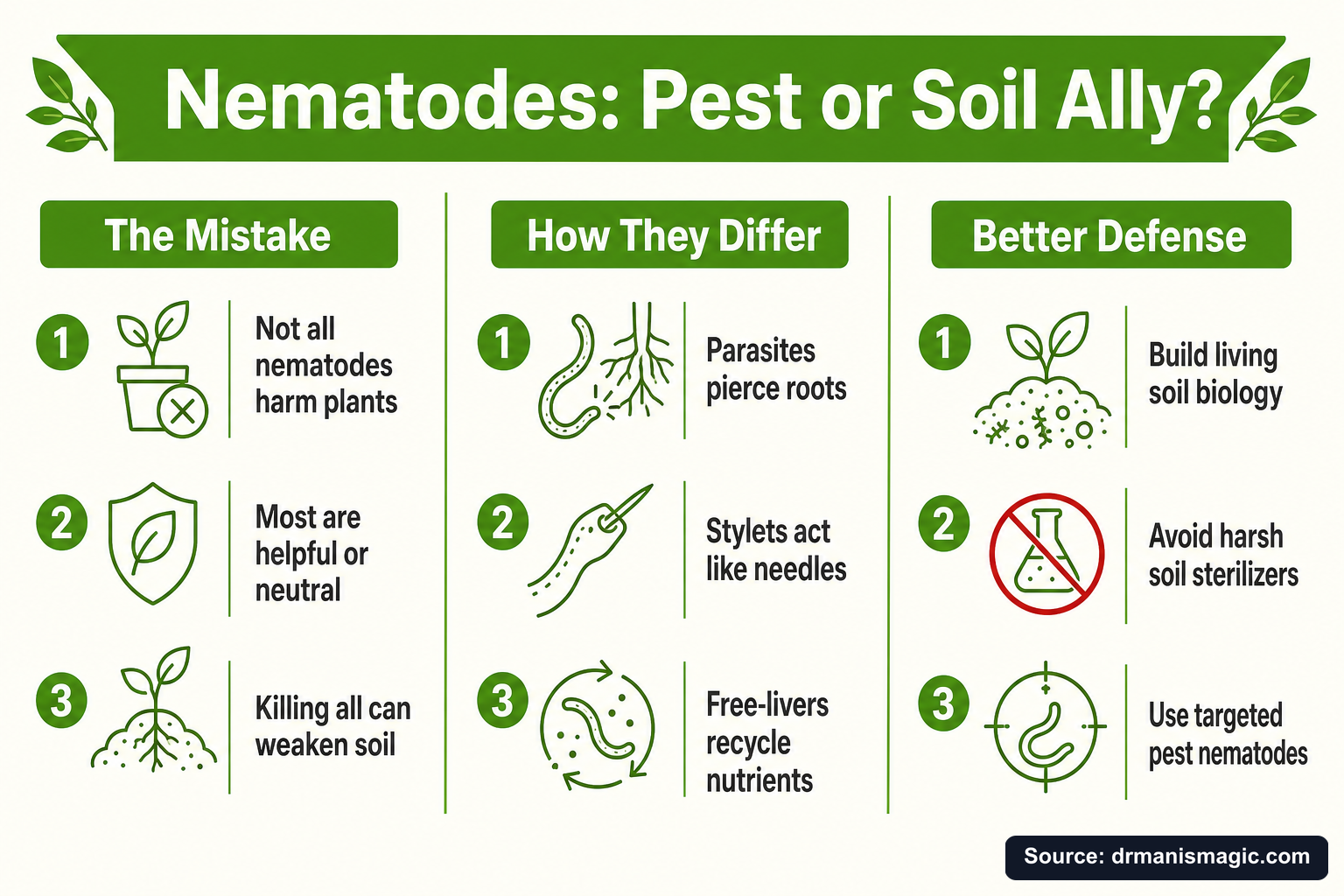
Key Takeaways
- Plant-parasitic nematodes use a needle-like mouthpart called a stylet to feed on living root tissue, causing galls, stunting, and wilting.
- Free-living nematodes eat bacteria, fungi, algae, and other tiny organisms, and they help release nutrients your plants can actually use.
- Most nematodes in healthy soil are beneficial or neutral. They are indicators of a living, thriving soil food web.
- Killing all nematodes with soil sterilization or harsh chemicals destroys the very biology that keeps your plants resilient and well-fed.
- Entomopathogenic nematodes are a third category sold specifically to kill harmful insects like fungus gnats, grubs, and fleas. They do not harm plants, earthworms, or beneficial microbes.
- The best long-term defense against plant-parasitic nematodes is a healthy, living soil with a thriving microbial community, not a chemical scorched-earth approach.
- The Three Plant Pillars framework, developed and tested at US Citrus Nursery, gives your soil the biology it needs to keep nematode populations naturally balanced.

What Exactly Is a Nematode, and Why Should You Care?
Quick Answer: Nematodes are microscopic roundworms that live in almost every soil on earth. They are not insects or worms you can see. Most are harmless or helpful. Only a small group, called plant-parasitic nematodes, damages roots. Understanding which type you have changes everything about how you respond.
Nematodes are tiny. Truly tiny. Most are less than one millimeter long. You could fit thousands of them in a single teaspoon of healthy garden soil. They are not insects. They are not earthworms. They are their own category of microscopic roundworm, and they have been living in soil for hundreds of millions of years.
Here is the number that should stop you from reaching for the nematicide spray: scientists estimate that beneficial and neutral nematodes outnumber plant-parasitic ones by a ratio of roughly 90 to 10 in most healthy soils. According to the University of California IPM program, plant-parasitic nematodes are just one functional group among many, and their damage is most severe in soils that have already been weakened by compaction, poor drainage, and depleted biology.
That last part is important. The soils most vulnerable to nematode damage are the same soils that have been stripped of their living microbial community. Sterile soil. Dead soil. The kind that results from years of salt-based synthetic fertilizers and broad-spectrum pesticides. The solution, it turns out, is not to kill more things. It is to bring the soil back to life.
What Is the Real Difference Between Parasitic and Free-Living Nematodes?
Quick Answer: The key difference is their mouthpart and what they eat. Plant-parasitic nematodes have a hollow, needle-like stylet they use to pierce and drain living root cells. Free-living nematodes lack this stylet and instead feed on bacteria, fungi, algae, protozoa, or other nematodes. One group attacks your plants. The other group feeds your plants by recycling nutrients through the soil food web.
Think of it like this. Imagine two different workers showing up to your garden. One has a sharp syringe and is here to drain your plants. The other has a tiny broom and shovel and is here to break down organic matter, release nitrogen, and keep the bacterial population in check. Same general shape. Completely different job. Completely different outcome for your plants.
The mouthpart tells the whole story. Plant-parasitic nematodes have a stylet, a hollow spear they drive into root cells to suck out the contents. Free-living nematodes have simple, unarmed mouths or mouths designed for chewing bacteria and fungi. That structural difference is the dividing line between pest and ally.
| Feature | Plant-Parasitic Nematodes | Free-Living Nematodes |
|---|---|---|
| Mouthpart | Hollow stylet (needle-like) | No stylet; simple or chewing mouthparts |
| Food source | Living root cells and plant tissue | Bacteria, fungi, algae, protozoa, other nematodes, organic matter |
| Effect on plants | Damage roots, block nutrient uptake, cause galls and wilting | Indirectly feed plants by releasing nutrients during feeding |
| Common examples | Root-knot (Meloidogyne), cyst (Heterodera), lesion (Pratylenchus) | Bacterivores, fungivores, omnivores, predators |
| Visible symptoms | Root galls, stubby roots, yellowing, wilting, stunted growth | None (beneficial, invisible activity below soil) |
| Soil food web role | Disrupt plant health and weaken roots | Regulate microbial populations, cycle nutrients, indicate soil health |
| Ecology indicator | High populations suggest stressed, disturbed soil | Diverse populations signal healthy, structured soil food web |
| Management response | Soil testing, resistant varieties, biological suppression, crop rotation | Protect and encourage with live microbes and organic inputs |
What Do Free-Living Nematodes Actually Do for Your Soil?
Quick Answer: Free-living nematodes are nutrient recyclers. When they graze on bacteria and fungi, they release excess nitrogen and other minerals in forms plant roots can absorb directly. They also regulate bacterial populations, which stimulates faster microbial turnover and keeps the soil food web humming. A healthy population of free-living nematodes means your soil is alive and working for you.
Picture a tiny cow grazing in a pasture. The cow eats grass. It releases waste. That waste feeds the soil. The soil grows more grass. The whole system loops back on itself. Free-living nematodes do something very similar, except they are grazing on bacteria and fungi instead of grass.
Here is the mechanism in plain English. Bacteria and fungi are full of nitrogen. When a nematode eats them, it uses some of that nitrogen for its own body. But it cannot use all of it. The leftover nitrogen gets released into the soil in a form called ammonium, which plant roots can pick up almost immediately. Researchers at University of Maryland Extension describe this process as the "microbial loop," and it is one of the primary ways nitrogen moves from organic matter into living plants without any synthetic fertilizer involved.
Free-living nematodes also fall into different feeding guilds, meaning different groups do different jobs:
- Bacterivores eat bacteria. They respond quickly when fresh organic matter is added to soil, signaling that decomposition is happening fast.
- Fungivores eat fungi. They are active when fungal decomposition channels are working, which happens more in drier soils with woody organic matter.
- Omnivores eat a mix of things. Their presence suggests a more mature, complex, less-disturbed soil food web.
- Predators eat other nematodes and tiny soil animals. Their presence signals a highly structured, well-developed soil ecosystem.
The more diverse your nematode community, the healthier your soil. Scientists actually use nematode population profiles to measure soil health. When you see mostly bacterivores and fungivores, your soil is actively processing nutrients. When you see omnivores and predators too, your soil has a fully built-out ecosystem. That is the invisible architecture of a thriving garden.
See also: Why Most Fertilizers Are Actually Salt in Disguise
What Are Entomopathogenic Nematodes, and Are They Safe for Your Plants?
Quick Answer: Entomopathogenic nematodes are a third category entirely. They are beneficial nematodes sold specifically to kill soil-dwelling insects like fungus gnats, grubs, fleas, and weevils. They do not have a stylet, so they cannot attack plant roots. They are completely safe for plants, earthworms, mycorrhizal fungi, and beneficial soil bacteria. They are a biological pest control tool, not a plant threat.
This is the category that confuses people the most. You buy a packet of beneficial nematodes at the garden center to fight fungus gnats. Then you read an article about how nematodes destroy roots. Now you are panicking, wondering if you just bought something that will wreck your houseplants.
You did not. Here is why.
Entomopathogenic nematodes like Steinernema and Heterorhabditis species work by entering the bodies of insect larvae through natural openings. Once inside, they release a bacteria partner that kills the insect host. They are microscopic assassins, but they are programmed to hunt insects, not plants. They have no stylet. They cannot pierce root tissue. They will not touch your earthworms, your mycorrhizae, or your bacteria. In fact, they work best in soils that already have a healthy microbial community supporting them.
Think of them as the special ops unit of your soil army. They have one mission. Everything else in the soil ecosystem stays safe.
How Do Plant-Parasitic Nematodes Actually Damage Your Plants?
Quick Answer: Plant-parasitic nematodes drive their stylet into root cells and withdraw the cell contents, essentially draining the root from the inside. This creates galls (lumps), lesions, and stubby, malformed roots. Damaged roots cannot absorb water or nutrients properly, so the plant above ground looks like it is starving or wilting even when you are watering and feeding it correctly.
The most notorious plant-parasitic nematode is the root-knot nematode, Meloidogyne species. It is the one most home gardeners encounter. When a juvenile root-knot nematode finds a young root tip, it drives its stylet in and stays there, feeding continuously while the surrounding root tissue swells into a gall. That gall is the plant's attempt to contain the damage. It does not work very well. The nematode keeps feeding, the gall grows, and the root system becomes a lumpy, dysfunctional mess.
From above ground, the symptoms look exactly like nutrient deficiency or drought stress. Yellowing leaves. Wilting in the afternoon even when the soil is moist. Stunted growth. Weak fruiting. Gardeners pour on more fertilizer. They water more. Nothing works, because the problem is underground and the roots are too damaged to absorb anything properly.
Here is the root-cause insight that changes how you think about this: root-knot nematodes thrive in soils that are warm, sandy, and biologically depleted. They struggle in soils with a diverse, active microbial community, because certain bacteria and fungi produce compounds that suppress them, parasitize their eggs, and compete with them for resources. A living soil is the best natural defense you have.
Why Does Killing All Nematodes Make Things Worse?
Quick Answer: When you sterilize soil or use broad-spectrum nematicides, you kill beneficial nematodes along with the harmful ones. You also destroy the bacteria, fungi, and protozoa that free-living nematodes depend on and interact with. The result is a biologically empty soil that plant-parasitic nematodes, which are faster to recolonize than their predators and competitors, will reclaim within weeks. You create a vacuum that the pest fills faster than the good guys.
This is one of the cruelest tricks that sterile growing conditions play on gardeners. You steam-sterilize your potting mix. You fumigate your garden bed. Everything dies. It feels clean and safe. Then, a few weeks later, the plant-parasitic nematodes are back. How? Because they arrived on a new plant, on a tool, on a boot, or they survived in a pocket of untreated soil. And this time, there are no predatory nematodes, no bacteria making suppressive compounds, no fungi colonizing the root zone. The pest walks into an empty house.
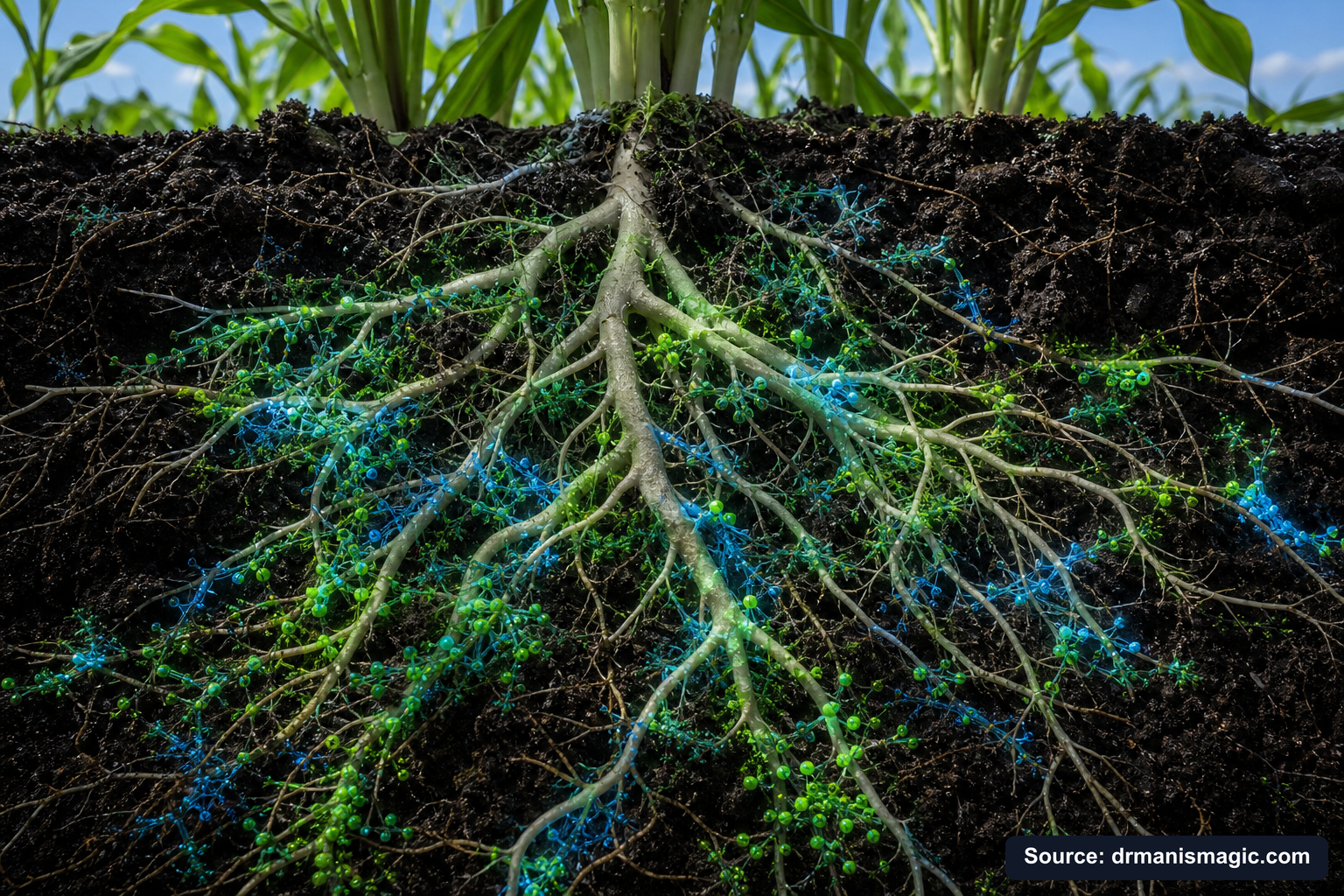
Dr. Mani Skaria, the plant pathologist and founder of our nursery, spent decades studying exactly this dynamic in citrus trees. The trees that bounced back fastest from pest and disease pressure were always the ones growing in biologically rich soil. Not the ones in sterilized potting mix. Not the ones drenched in synthetic inputs. The living soil trees.
That is the foundation of the Three Plant Pillars. You need mineral-based soil that drains and breathes, live microbials that build and maintain the food web, and organic fertilizer that feeds the whole system without burning it. You can explore the full Three Plant Pillars system here and see how each piece fits together.
You Never Had a Brown Thumb.
You were handed the wrong tools. This free guide hands you the right ones.
You watered it. You fed it. It died anyway.
It was never you. It was the dirt, the salt food, and the bad advice.
This guide shows you what really went wrong, and how to fix it for good.
- Why your plants really died, and why it was never your fault
- The salt hiding in your plant food that quietly burns the roots
- The hidden killer in almost every bag of store soil
- The tiny helpers that grow a whole forest for free
- The rescue trick that brings a half dead plant back to life

What Are the Signs You Have Plant-Parasitic Nematodes vs. a Healthy Nematode Population?
Quick Answer: Plant-parasitic nematodes leave physical evidence on roots: galls (bumps), lesions (dark sunken spots), stubby or forked roots, or roots that look like they stopped growing. Free-living nematodes leave no visible marks. If your plant looks starved or wilted despite good care and you see swollen or deformed roots when you unpot, that is the signal to test for plant-parasitic nematodes specifically, not to kill everything in the soil.
Here is a quick decision guide to help you figure out what you are dealing with:
- Pull the plant or dig up a small root sample. Look closely at the fine roots. Are there bumpy galls, dark lesions, or unusually stubby, forked tips? That points toward plant-parasitic nematodes.
- Check for wilting patterns. Does your plant wilt in the afternoon even when the soil feels moist? That is a classic sign of damaged roots that cannot move water properly.
- Look at the whole picture. Is growth stunted across multiple plants in the same bed? Did a previous crop of tomatoes, peppers, or squash struggle in the same spot? Root-knot nematodes persist in the soil and hit the same families of plants repeatedly.
- Get a soil test if you are unsure. University extension labs in most states can test a soil sample and identify which nematode species are present and at what population levels. This tells you whether you have a problem worth treating or a healthy population worth protecting.
If your roots look clean and white with no galls, and your plant is just underperforming, nematodes are almost certainly not your enemy. The problem is more likely in the soil biology, the fertilizer type, or the soil structure itself. Those are the Three Plant Pillars issues, and they are fixable.
How Do Nematodes Connect to the Bigger Soil Food Web?
Quick Answer: Nematodes are one link in a chain that includes bacteria, fungi, protozoa, arthropods, earthworms, and plant roots. Free-living nematodes graze on bacteria and fungi, releasing nutrients and stimulating microbial turnover. Predatory nematodes control populations of harmful ones. The whole chain depends on organic matter inputs and a living, undisturbed soil environment. Disrupt one link and the whole system weakens.
Your soil is not dirt. It is a city. A living, breathing, constantly active city where billions of organisms are eating, reproducing, dying, and recycling around the clock. Nematodes are one floor of that city, but they connect to every other floor.
Here is how the connections work:
| Organism | What It Eats | What It Releases for Plants | What Disrupts It |
|---|---|---|---|
| Bacteria | Organic matter, root sugars | Nitrogen, enzymes, growth hormones | Salt-based fertilizers, herbicides |
| Fungi (including mycorrhizae) | Organic matter, root sugars | Phosphorus, water, structural soil glue (glomalin) | Synthetic fungicides, compaction |
| Protozoa | Bacteria | Nitrogen (excess from bacterial digestion) | Pesticides, fumigation |
| Free-living nematodes (bacterivores/fungivores) | Bacteria and fungi | Nitrogen, phosphorus (released as they graze) | Nematicides, sterilization, salt inputs |
| Predatory nematodes | Other nematodes, protozoa | Nutrient cycling, population balance | Fumigation, soil disturbance |
| Entomopathogenic nematodes | Insect larvae | Pest suppression (indirect plant benefit) | Dry soil, UV exposure, wrong temperature |
| Plant-parasitic nematodes | Living root cells | Nothing (removes plant resources) | Suppressed by biological diversity, resistant varieties |
Notice the pattern. The organisms that help your plants thrive are all connected to one another. Bacteria feed nematodes. Nematodes release nitrogen. Fungi extend the root network. Protozoa recycle bacterial nutrients. When you wipe out one layer, the others destabilize. That is why a garden that gets drenched in herbicides, fungicides, and salt-based fertilizers year after year starts falling apart. The city stops functioning. The supply chains break down. And your plants slowly starve even when you are pouring money and effort into them.
This is also why Plant Super Boost is formulated to contain the full spectrum of living organisms, not just a single bacterial strain. It includes over 2,000 species of bacteria, 400 to 500 fungi including mycorrhizae, plus protozoa and beneficial nematodes. Because rebuilding the city means restoring all the workers, not just one department.
Why Do Most Store-Bought Microbe Products Fail to Help?
Quick Answer: Most commercial microbe products are either dried powders made from lab-grown single strains that rarely survive rehydration, or liquid compost teas that have already gone anaerobic and smell like sewage by the time they reach you. Dead microbes cannot rebuild your soil food web. The only thing that works is genuinely live, full-spectrum biology delivered in a stabilized form that keeps the organisms active all the way to your plant's roots.
This is where gardeners get burned over and over. They buy a bottle with a label listing a dozen bacterial species and impressive colony-forming unit counts. They pour it on their plants with hope. Nothing changes. So they conclude that microbes do not really matter. But that is the wrong conclusion. The right conclusion is that dead microbes do not matter.
Here is what happens to most products on the shelf:
- Dried powder products contain bacterial spores that were once alive. The hope is they reactivate when you add water. In our testing across dozens of batches at US Citrus Nursery, we saw no measurable plant response. The reactivation rate is simply too low to make a difference in the soil.
- Liquid products made from compost extracts can be powerful when fresh. But fresh means less than 24 hours old with active aeration. By the time the bottle ships, sits in a warehouse, rides in a hot truck, and reaches your doorstep, the microbes have gone anaerobic. The bottle may fizz when you open it. It almost certainly smells awful. That smell is death, not life.
- Lactobacillus-based products are vigorous and do stay alive, but lactobacillus is an aggressive colonizer that outcompetes the beneficial organisms your soil needs. It belongs in yogurt, not in your garden beds.
Plant Super Boost is different because of how it is made. Our production partner, a world-renowned compostologist with experience advising royal families and large-scale agricultural operations, developed a proprietary all-natural stabilization technique. It keeps the full spectrum of microbes from fresh, hand-crafted compost alive and active without going anaerobic. That is why it smells earthy, not foul. That is why, under a microscope, you can actually watch the microbes moving in a single drop of the product. They are alive. And live microbes are the only kind that rebuild your soil food web and suppress the conditions that allow plant-parasitic nematodes to take over.
See also: The Hidden Reason Synthetic Fertilizers Cause Root Rot
How Do You Rebuild Soil Biology After Nematode Damage or Chemical Overuse?
Quick Answer: Rebuilding soil biology after damage requires stopping the inputs that killed it, reintroducing a full-spectrum live microbial inoculant, feeding the new biology with organic matter and organic fertilizer, and giving it time. There is no single-application fix. The organisms need to eat, reproduce, and establish communities. But when you give them the right conditions, the recovery is real and lasting.
If your soil has been hit hard by fumigation, synthetic fertilizers, or broad-spectrum pesticides, the nematode community and the rest of the food web will be in rough shape. Here is a practical recovery checklist:
- Stop the damage first. Remove or stop any salt-based fertilizers, synthetic fungicides, herbicides, or broad-spectrum pesticides. You cannot rebuild a house while someone is still knocking down the walls.
- Improve the physical soil structure. Compacted, waterlogged, or oxygen-starved soil cannot support a healthy microbial community or a healthy nematode population. If you are in containers, consider switching to a mineral-based soil that provides lasting drainage and aeration without decomposing. Our Super Soil was engineered exactly for this purpose, using mineral-rich sandy loam from the Rio Grande Valley that does not break down, compact, or steal oxygen from roots.
- Inoculate with live, full-spectrum microbes. Apply a genuine live microbial product monthly. This reintroduces bacteria, fungi, protozoa, and beneficial nematodes as a community, not as isolated strains.
- Feed the biology with organic inputs. Organic fertilizer feeds both plants and the microbes that support them. Salt-based synthetic fertilizers kill the biology you are trying to rebuild. Use slow-release organic options that work with the microbes, not against them.
- Add organic matter. Compost, mulch, or organic top-dressing gives the microbial community something to eat and build with. This is how the food web regenerates from the bottom up.
- Be patient and consistent. Biology takes time. You will not see a transformed soil food web in two weeks. But within a month, you will see the plants responding. Within a season, the soil structure improves. Within a year, you have a genuinely living system that fights problems on its own.
- Test, do not guess. If you suspect plant-parasitic nematodes specifically, send a soil sample to your state university extension lab. Know what you are dealing with before you treat. Most university extension programs offer nematode testing for a small fee, and it will save you from treating the wrong problem with the wrong solution.
You can get the full foundation in place with the Free Plant Care Field Guide, which walks you through the Three Plant Pillars step by step. No jargon. No guesswork. Just the system that has worked on over 250,000 trees in South Texas and on every type of plant our customers grow across the country.

The Real Cost of Getting This Wrong
Here is the thing about time that most people do not fully feel until it is too late. You can earn more money. You cannot earn more time. The number one thing people tell Dr. Mani Skaria when they come to us is some version of this: they want to see their trees bear fruit in their lifetime. Not someday. In their lifetime. That urgency is real and it is primal. We were made to tend gardens. The drive to grow something, to nurture something, to taste something you grew with your own hands, it never goes away.
When you spend months or years fighting plant-parasitic nematodes with the wrong approach, sterilizing soil that then gets recolonized, pouring salt-based fertilizers that kill the biology you need, buying dried microbial powders that do nothing, you are not just losing money. You are losing seasons. You are losing the years when those trees and gardens could have been thriving, feeding you, and rewarding you for the care you put in.
The old way is a slow drain. A little worse each season. A little more frustrating each year. Until one day you decide you just do not have a green thumb and you give up. But the truth is, your thumb was never the problem. The system you were handed was the problem. The synthetic salt fertilizers, the sterile potting mixes, the dead microbe products, the scorched-earth approach to soil pests. None of it works with nature. All of it works against it.
The Three Plant Pillars work with nature. Mineral soil that breathes. Live microbes that build and protect. Organic fertilizer that feeds without burning. When all three are in place, the soil food web comes alive. Free-living nematodes return to their jobs. Beneficial bacteria crowd out the pathogens. Mycorrhizal fungi extend the root network. And plant-parasitic nematodes, without a depleted, defenseless host, lose their foothold.
That is not a promise we invented. It is what 30 years of growing in South Texas, across 250,000 trees, across countless gardens and houseplants and orchards, keeps proving over and over again.
If you are ready to stop guessing and start building, explore the Three Plant Pillars system and see the full Dr. Mani's Magic line. Everything is made in the USA, backed by a 30-day money-back guarantee, and formulated with zero synthetic salts, zero PFAS, and zero biosludge. Real products. Real biology. Real results. Your plants are waiting.
Frequently Asked Questions
Most gardeners hear the word "nematode" and panic. But that panic leads to the wrong move almost every time. These questions come up again and again from real plant owners who want to protect their roots without wrecking their soil. Get these answers right, and your whole approach to soil health changes for the better.
What is the difference between free-living and parasitic nematodes?
Free-living nematodes eat bacteria, fungi, and algae in the soil. They help break down organic matter and release nutrients your plants can actually use. Parasitic nematodes are different. They use a tiny needle-like mouthpart to feed directly on root tissue. They cause swelling, stunting, and wilting. The key difference is simple: one group feeds your soil, the other attacks your roots. Most nematodes in healthy soil are the good kind.
What do free-living nematodes eat?
Free-living nematodes feed on bacteria, fungi, algae, and dead organic matter. When they eat, they release nitrogen and other nutrients right into the soil in a form your plants can absorb fast. Think of them as tiny nutrient recyclers. They also improve soil structure. A thriving population of free-living nematodes is actually a sign that your soil food web is alive and working. That is exactly what the Three Plant Pillars are designed to build and protect.
What kills nematodes instantly, and should you actually do it?
Boiling water, soil baking at 140 degrees Fahrenheit, and chemical nematicides can kill nematodes fast. But here is the problem. They kill everything else too, including the beneficial bacteria, fungi, and mycorrhizae your plants depend on. After that wipeout, harmful nematodes bounce back first because the biology that kept them in check is gone. At Dr. Mani's Magic, we tested this lesson across 250,000 trees. The better answer is building living soil, not scorching it.
What are the most common plant-parasitic nematodes gardeners should know about?
The ones you are most likely to run into are root-knot nematodes, lesion nematodes, cyst nematodes, stubby-root nematodes, and reniform nematodes. Root-knot nematodes are the most widespread. They cause those knobby galls on roots that look so alarming. All of these types do their worst damage in soil that is already weak, compacted, and stripped of beneficial biology. Healthy, living soil is your first and best line of defense against all of them.
How do you tell if your plant actually has a nematode problem?
Pull the plant and look at the roots. Root-knot nematodes leave behind small, hard galls or swellings on the roots. The plant above ground will look wilted, stunted, or yellowed even when you are watering and feeding it correctly. Lesion nematodes cause dark, dead patches on roots instead of galls. If you see healthy white roots with no swelling or discoloration, nematodes are probably not your problem. Soil compaction and poor drainage often mimic the same symptoms.
Can beneficial nematodes hurt your plants or helpful microbes?
No. Entomopathogenic nematodes, the kind sold to fight fungus gnats, grubs, and fleas, do not harm plant roots, earthworms, or beneficial microbes. They are hunters that target specific insects in the soil. They are a smart, natural tool that fits right into the Three Plant Pillars approach. You get pest control without killing the living biology your plants need. That is the kind of solution Dr. Mani built his entire system around: work with nature, not against it.
What is the best long-term protection against harmful nematodes?
Build living soil. Harmful nematodes thrive in dead, compacted, chemically burned soil. When your soil has a strong microbial community, including bacteria, fungi, and mycorrhizae, it naturally keeps nematode populations balanced. That is exactly what the Three Plant Pillars do. Mineral-based soil gives roots room to breathe. Live microbes create a thriving soil food web. Organic fertilizer feeds the whole system without salt damage. We proved this across 250,000 trees in South Texas. It works.
About the Author
Dr. Mani Skaria, PhD
Dr. Mani Skaria, PhD, is a plant pathologist and the scientific founder of Dr. Mani's Magic. He earned his doctorate at Purdue University and spent 48 years studying how plants, soil, and living microbes work together, including his years as Professor Emeritus at Texas A&M and as a member of the USDA NAREEE Advisory Board. He invented micro-budding, a method for growing healthier, stronger trees, and has grown more than 250,000 trees on the family farm in Hargill, Texas - US Citrus Nursery. His life's work takes real lab science and practical experience and turns it into simple, safe, organic plant care anyone can use at home.


