


Why Diversity of Nematodes Matters for Soil and Plant Health | Dr. Mani's Magic
Why Nematode Diversity Matters: What Tiny Soil Animals Tell You About Your Plant's Hidden World
You pull a struggling plant out of its pot. The roots look brown. Mushy in spots. You sniff the soil and it smells wrong. Sour, almost rotten. You've watered right. You've fed it. You've done everything the bag told you to do. So why is it dying?
Here's what nobody told you. Beneath every healthy plant — every lush lawn, every fruit-heavy tree, every thriving garden bed — there is an invisible civilization doing the real work. Billions of bacteria. Miles of fungal threads. Tiny single-celled hunters called protozoa. And threading through all of it, moving like living sensors through the dark: nematodes. Most people have never heard of them. The ones who have usually think nematodes are the enemy. That's exactly the wrong idea. And that wrong idea may be costing you your plants.
At our US Citrus Nursery in South Texas, Dr. Mani Skaria and our team have grown over 250,000 trees. We've seen what healthy soil does for a plant. We've also seen what dead soil does. The difference comes down to biology — and nematodes sit right at the heart of it. Once you understand why nematode diversity matters, you'll never look at your soil the same way again.

Organic Fertilizer | Crab, Kelp & Amino Acids
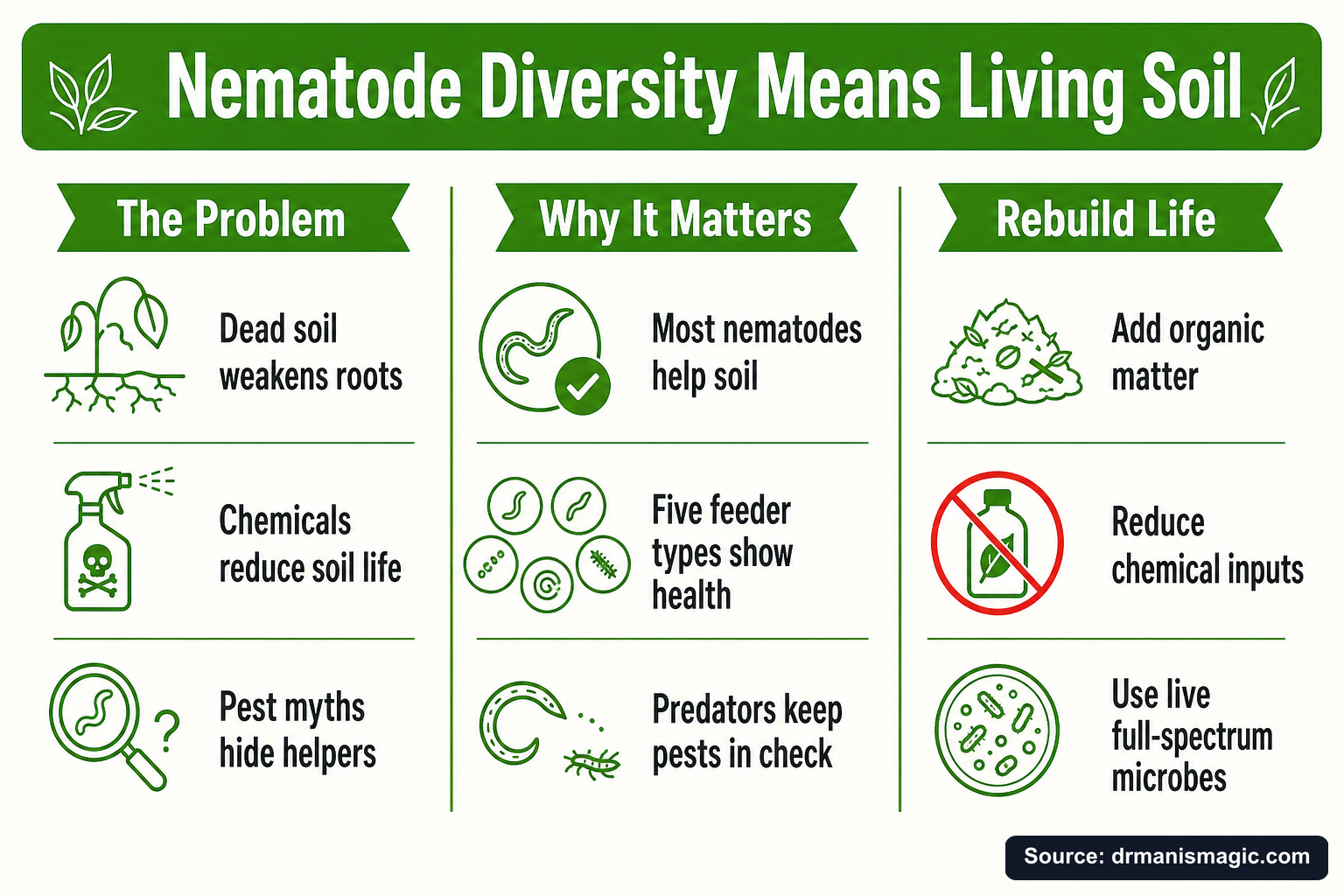
Key Takeaways
- Most nematodes are not pests. The majority are beneficial free-living organisms that help your soil cycle nutrients and stay healthy.
- A diverse nematode community is a sign of a thriving soil food web — with active bacteria, fungi, protozoa, and higher predators all working together.
- Different nematode types (bacterial-feeders, fungal-feeders, predators, omnivores, plant-parasites) each tell you something different about your soil's condition.
- Pesticides, synthetic fertilizers, fungicides, and herbicides all damage nematode diversity and collapse the soil food web over time.
- You can rebuild nematode diversity by restoring microbial life, adding organic matter, reducing chemical inputs, and applying live full-spectrum microbials.
- The Three Plant Pillars — mineral soil, live microbials, and organic fertilizer — create the exact conditions nematodes and the whole soil food web need to thrive.
- Live, stabilized microbials matter because dried or dead products fail to restore the biology your soil desperately needs.
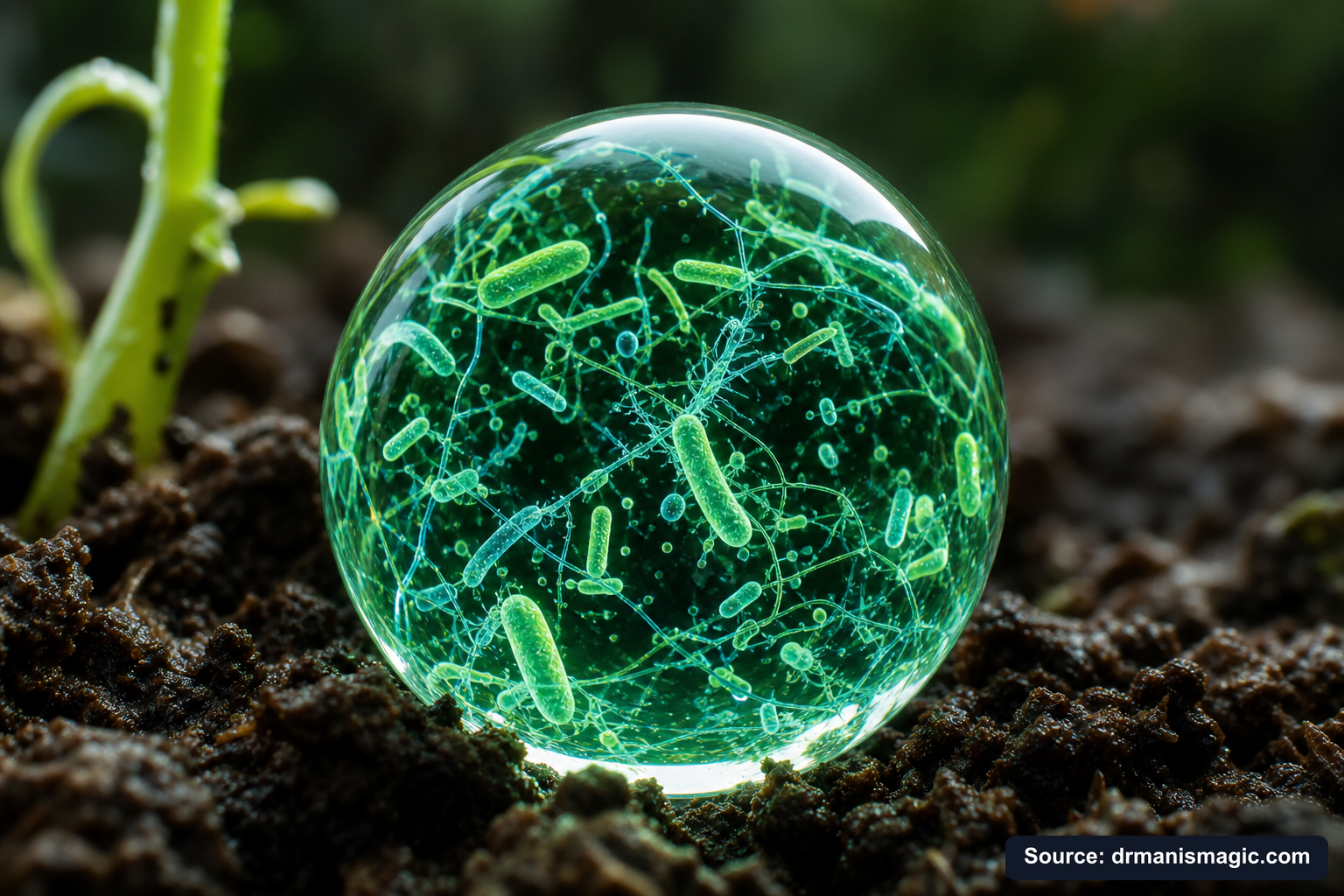
What Exactly Are Soil Nematodes, and Are They Good or Bad?
Quick Answer: Most soil nematodes are beneficial. They are tiny roundworms that live in soil water films and play critical roles in nutrient cycling, microbial population control, and soil health signaling. Only a small fraction of nematode species actually harm plants. A diverse nematode community almost always means healthier soil and stronger plants.
Nematodes are microscopic roundworms. So small you cannot see a single one with your naked eye. But they are everywhere. A single teaspoon of healthy garden soil can contain hundreds to thousands of them.
They live in thin films of water that coat soil particles. They swim through those films, eating, hunting, reproducing. They have been doing this for hundreds of millions of years — long before we started worrying about our lawns.
Here is the part that surprises most people. The University of Wisconsin-Madison Extension explains it clearly: the overwhelming majority of nematodes in your soil are free-living, not plant-parasitic. They feed on bacteria, fungi, algae, and each other. They are part of the engine that powers your soil food web. (University of Wisconsin-Madison Extension: Nematodes as Indicators of Soil Health)
The ones that attack plant roots? Those are a specific group. They are the minority. But because they get all the press — all the scary gardening articles — most people think every nematode is the enemy. That's like thinking every insect in your garden is a pest. It's just not true.
The real story is much more interesting. And much more useful to you.
What Are the Different Types of Nematodes in Soil?
Quick Answer: Soil nematodes fall into five main groups based on what they eat: bacterial-feeders, fungal-feeders, plant-parasites, omnivores, and predators. Each group plays a different role in the soil food web. Together, a balanced mix of all five signals a healthy, functioning, resilient soil ecosystem.
Think of your soil as a city. Every city needs workers, managers, cleaners, and security. Nematodes fill all those roles.
Here is a plain-English breakdown of each type and what their presence tells you:
| Nematode Type | What They Eat | Role in Soil | What Their Presence Signals |
|---|---|---|---|
| Bacterial-feeders | Bacteria | Graze on bacteria, releasing nutrients (especially nitrogen) into the soil | Active decomposition; often higher in disturbed or nitrogen-rich soils |
| Fungal-feeders | Fungi | Graze on fungal threads; regulate fungal populations; support carbon cycling | More complex, mature soil with active fungal networks; healthier long-term structure |
| Plant-parasites | Plant roots | Pierce and feed on root cells; can cause galls, root damage, and yield loss | Soil food web is weak, disturbed, or missing predators to keep them in check |
| Omnivores | Bacteria, fungi, protozoa, small nematodes | Flexible feeders; regulate multiple populations at once | Higher food web complexity; sign of a maturing, more stable system |
| Predators | Other nematodes and small soil animals | Top-level regulators; keep pest species and imbalanced populations in check | Most mature, stable, and resilient soil ecosystems; excellent indicator of soil health |
Virginia Tech's soil health research team describes how the presence of higher-trophic nematodes — omnivores and predators — is one of the clearest signs of a structured, stable soil food web. When you see them, your soil is doing well. When they disappear, something is wrong. (Virginia Tech Extension: Nematodes as Soil Health Indicators)
This is why diversity matters so much. One type alone cannot tell you much. But all five groups present and balanced? That is a soil food web firing on all cylinders.
Why Does Nematode Diversity Matter for Plant Health?
Quick Answer: Nematode diversity signals that your soil food web is complex and balanced. Diverse nematodes drive nutrient cycling, regulate microbial populations, suppress pest species, and keep nitrogen and carbon moving efficiently to plant roots. Plants in diverse-nematode soils grow stronger, resist disease better, and need fewer chemical rescues.
Here is something that will change how you think about gardening forever.
You have probably heard that plants feed on nutrients. Nitrogen. Phosphorus. Potassium. That's true. But most of those nutrients don't just float free in the soil waiting to be absorbed. They are locked up. Tied to organic matter, held in microbial bodies, or bound to soil particles.
So how do they get released?
This is where nematodes earn their place. When a bacterial-feeding nematode grazes on bacteria, it releases nitrogen in a plant-available form. Literally. The nematode eats the bacteria, digests what it needs, and excretes the rest — which your plant roots can absorb directly. Scientists call this "mineralization." We call it nature's fertilizer factory.
The same happens when fungal-feeders graze on fungal threads. They unlock carbon and other nutrients that were tied up in the fungal biomass. All of this cycling happens constantly, invisibly, just beneath your feet.
Now here is the kicker. When you have a diverse community of nematodes — bacterial-feeders AND fungal-feeders AND predators AND omnivores — all working together, the nutrient cycling becomes incredibly efficient. Nothing gets wasted. Nitrogen doesn't leach away. Carbon stays in the soil. Minerals get passed along the food chain until they reach your plant's roots.
That is why a plant growing in living, biologically active soil looks so different from one sitting in dead potting mix. Same sunlight. Same water. Completely different results.
And here is what almost nobody talks about. When predatory nematodes are present in good numbers, they actually suppress plant-parasitic nematodes. They eat them. They outcompete them. A diverse soil food web is its own pest control system. When the food web collapses — when diversity disappears — plant-parasitic nematodes have no natural enemies. They explode. Your roots suffer.
This is exactly why Dr. Mani spent decades studying what makes plants thrive in nature without any human help. The answer kept coming back to the same invisible world underground. The Three Plant Pillars — mineral soil, live microbials, and organic fertilizer — were built specifically to recreate and protect that world.
How Do Nematodes Connect to Bacteria, Fungi, Protozoa, and the Whole Soil Food Web?
Quick Answer: Nematodes sit just above bacteria, fungi, and protozoa in the soil food chain. They graze on these microbes, which releases nutrients and controls microbial populations. Without nematodes, microbial populations either explode or collapse. With them, the whole system stays in balance and nutrients flow steadily to plant roots.
Picture the soil food web like a real food chain — but underground and microscopic.
At the base: bacteria and fungi. They are the decomposers. They break down dead leaves, old roots, and organic matter into simpler compounds. They are the first workers in the city.
One level up: protozoa and nematodes. They graze on bacteria and fungi. This grazing is not destruction — it is regulation. It keeps bacterial and fungal populations from growing out of control. And every time they eat and excrete, they release plant-available nutrients.
One more level up: predatory nematodes, microarthropods, and other small soil animals. They eat the grazers. They keep the whole middle layer balanced.
Each layer depends on the one below it. And each layer feeds the one above it. Pull any piece out and the whole system gets wobbly.
td>Bacterial-feeding nematodes
| Organism | What It Does | What Happens Without It |
|---|---|---|
| Beneficial bacteria | Break down organic matter; fix nitrogen; suppress pathogens; release nutrients | Nutrient lockup; disease pressure increases; soil becomes inert |
| Mycorrhizal fungi | Extend root reach by up to 100x; deliver water and phosphorus; build soil aggregates via glomalin | Roots starve for phosphorus; soil compacts; drought stress spikes |
| Protozoa | Graze on bacteria; release nitrogen in plant-available form; regulate bacterial populations | Bacterial populations go unchecked or crash; nutrient cycling slows |
| Graze on bacteria; mineralize nitrogen; regulate microbial populations | Bacterial blooms or crashes; nitrogen cycling stalls | |
| Fungal-feeding nematodes | Graze on fungi; release carbon and nutrients; support fungal turnover | Fungal overgrowth or collapse; carbon cycling disrupted |
| Predatory nematodes | Eat plant-parasitic nematodes and other grazers; regulate food web balance | Plant-parasitic nematodes multiply unchecked; root damage increases |
| Omnivorous nematodes | Flexible feeding; regulate multiple populations; indicator of mature soil | Less food web resilience; system less able to self-correct after disturbance |
Notice something? Nematodes do not work alone. They work because bacteria and fungi are thriving. And bacteria and fungi thrive because the soil structure supports them. Which is exactly why mineral-based soil — Pillar One — matters so much. Roots need to breathe. Microbes need space and oxygen. When soil compacts into a soggy, airless sludge, the whole food web suffocates from the bottom up.
See also: The Hidden Reason Synthetic Fertilizers Cause Root Rot
What Damages or Destroys Nematode Diversity in Your Soil?
Quick Answer: Synthetic herbicides, salt-based fertilizers, broad-spectrum pesticides, fungicides, soil fumigants, and compaction all damage or destroy nematode diversity. They collapse the lower food web layers that nematodes depend on. Once diversity drops, plant-parasitic nematodes face no competition and pest pressure explodes.
This is where the story gets uncomfortable. Because the most popular gardening products on the market today are actively working against the soil food web you need.
Salt-based synthetic fertilizers are the biggest culprit. When you pour salty fertilizer into your soil, the salt draws water out of microbial cells through osmosis. Bacteria, fungi, protozoa — they die. And when the base of the food web dies, nematodes lose their food source. Bacterial-feeders and fungal-feeders disappear first. Then predators have nothing to eat. The whole pyramid collapses. The only ones left standing? Plant-parasitic nematodes. They feed on roots, not on the microbes that just got wiped out.
Synthetic herbicides like glyphosate disrupt microbial communities in ways we are still learning about. Broad-spectrum pesticides kill beneficial soil insects and microarthropods along with the target pests. Synthetic fungicides wipe out mycorrhizal fungi — the very fungi that fungal-feeding nematodes depend on, and that your plant roots need desperately.
And then there is the soil itself. Most potting mixes are loaded with pine bark and wood chips that break down fast. As they decompose, they compact. Oxygen disappears. The soil becomes waterlogged and anaerobic. Beneficial aerobic microbes cannot survive without oxygen. The food web collapses before a nematode even has a chance.
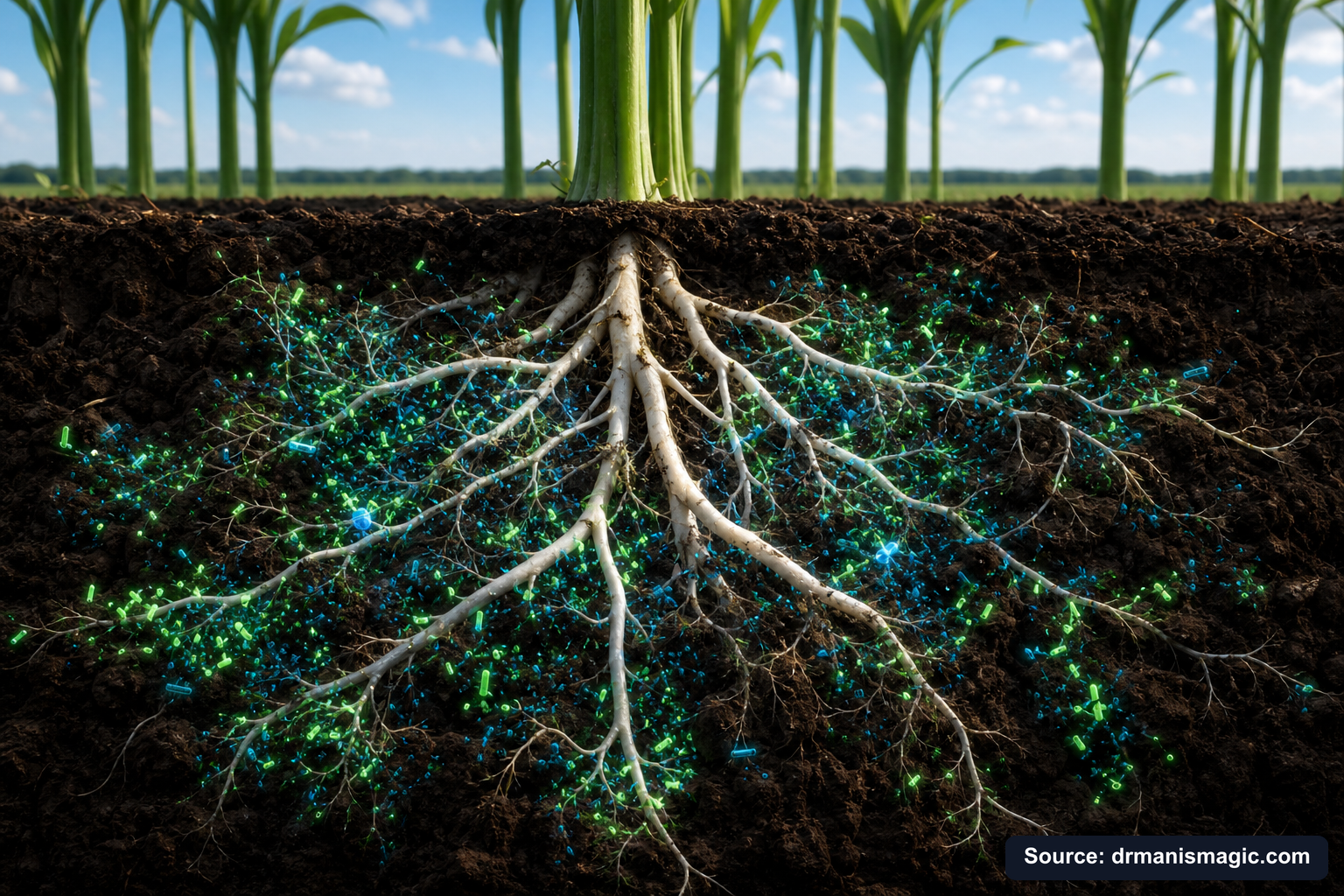
After growing 250,000 trees at US Citrus Nursery, we learned this the hard way. Every time we used standard commercial inputs, we got standard commercial results — which is to say, disappointing ones. The trees that thrived were always the ones with living soil beneath them.
See also: Why Most Fertilizers Are Actually Salt in Disguise
You Never Had a Brown Thumb.
You were handed the wrong tools. This free guide hands you the right ones.
You watered it. You fed it. It died anyway.
It was never you. It was the dirt, the salt food, and the bad advice.
This guide shows you what really went wrong, and how to fix it for good.
- Why your plants really died, and why it was never your fault
- The salt hiding in your plant food that quietly burns the roots
- The hidden killer in almost every bag of store soil
- The tiny helpers that grow a whole forest for free
- The rescue trick that brings a half dead plant back to life

What Does Your Nematode Community Actually Tell You About Your Soil?
Quick Answer: Your nematode community acts like a report card for your soil food web. Mostly bacterial-feeders means active but simple decomposition. Mostly plant-parasites means the food web is weak and pests are winning. High diversity including omnivores and predators means your soil is mature, resilient, and functioning well. Each community tells a different story.
Imagine if your soil could talk. If it could say: "I'm healthy" or "I'm stressed" or "I'm in trouble."
It actually can. You just have to know how to listen. Nematode communities are your soil's voice.
Scientists at Virginia Tech describe nematodes as "bioindicators" — living gauges that reflect the health of the whole soil food web. You don't need to run an expensive soil test to use this idea. You can watch for practical signs instead.
Here is how to read what you're seeing:
| What the Community Looks Like | What It Means | What to Do Next |
|---|---|---|
| Mostly bacterial-feeders; few other types | Soil is disturbed or recently enriched; fast but simple nutrient cycling; food web is not fully developed yet | Add organic matter; reduce disturbance; build toward fungal-energy channel diversity |
| Mostly plant-parasites; few free-living types | Food web is weak or collapsed; predators are absent; plant roots are at risk | Stop broad chemical inputs immediately; restore biology with live microbials; add compost |
| Mix of bacterial-feeders and fungal-feeders | Soil has both fast and slow nutrient cycling channels active; good sign of developing food web | Keep building; add mycorrhizal fungi; maintain organic matter inputs |
| Presence of omnivores and predators alongside feeders | Mature, complex, resilient soil food web; excellent biological pest suppression; efficient nutrient cycling | Maintain practices; avoid chemical disruption; continue organic inputs |
| Very few nematodes of any type | Soil biology severely depleted; likely from fumigation, heavy chemical use, or compaction | Full soil recovery protocol needed — see checklist below |
The practical takeaway is this. You don't need a microscope. Watch your plants. Watch how water moves through your soil. Watch whether disease keeps coming back despite your best efforts. Those are the signs that your soil food web — and its nematode community — needs help.
How Do You Rebuild Nematode Diversity and a Damaged Soil Food Web?
Quick Answer: Rebuilding nematode diversity requires restoring the food web from the bottom up. Stop chemical inputs that kill microbes. Improve soil structure. Add organic matter and compost. Introduce live, full-spectrum microbials. Plant living roots. Give it time and consistent care. Recovery is possible but takes repeated effort, especially in containers and heavily damaged soils.
Here is the honest truth. You cannot buy a bottle of nematodes and fix your soil overnight. That is not how biological recovery works.
Nematodes depend on bacteria. Bacteria depend on fungi. Fungi depend on soil structure. Everything depends on everything else. You have to rebuild from the foundation up.
The good news? It works. We have seen it happen over and over at US Citrus Nursery. Trees that looked like they were finished — yellowing, weak, barely hanging on — came back to full health once the biology underneath them was restored.
Here is the recovery protocol we have seen work:
- Stop the damage first. Eliminate or dramatically reduce synthetic herbicides, salt-based fertilizers, broad-spectrum pesticides, and synthetic fungicides. You cannot rebuild what you keep destroying. This is the hardest step for most people because they feel like they are doing something wrong by not spraying. You are actually doing something right.
- Fix the soil structure. If you are growing in containers, get out of compacting organic potting mixes. Mineral-based soil that drains well and holds oxygen is the foundation that all biology needs. Roots need to breathe. Microbes need oxygen. No amount of microbials will survive in waterlogged, airless sludge.
- Add organic matter. Compost, mulch, aged leaf litter. This is the food source for the bacteria and fungi that nematodes depend on. Without organic matter, you are trying to run a restaurant with no kitchen.
- Introduce live, full-spectrum microbials. Not dried powder. Not smelly, anaerobic compost tea that's been sitting for days. Genuinely live biology — bacteria, fungi, mycorrhizae, protozoa, and yes, nematodes — that is stabilized and active at the moment of application. This is where most gardeners make their biggest mistake, and we'll explain exactly why in the next section.
- Plant living roots. Living roots feed microbes. They pump sugars into the soil constantly. Cover crops, companion plants, even a few weeds you tolerate temporarily — all of these contribute carbon and biological activity to the recovery.
- Keep moisture consistent but not saturated. Nematodes move through water films in soil. Too dry and they cannot move. Too wet and oxygen disappears and the food web suffocates. Consistent, appropriate moisture is critical.
- Be patient and keep applying. Recovery does not happen in a week. Especially in containers and in soils that have been chemically damaged for years. Monthly applications of live microbials, consistent organic matter additions, and reduced chemical inputs over a full growing season — that is what real recovery looks like. The plants will tell you when it's working.
We want to be direct about something. You can get money back. You cannot get time back. Every season you spend fighting your soil instead of working with it is time you will not recover. The plants you wanted to see fruit on in your lifetime are not getting any younger. Neither are you. The best time to start rebuilding your soil food web was last year. The second best time is right now.
Why Do Most Microbial Products Fail to Restore Soil Biology?
Quick Answer: Most microbial products either use lab-grown, dried microbes that fail to reactivate in soil, or compost-tea liquids that go anaerobic and lose effectiveness before they reach you. Neither restores the full-spectrum, live biology your soil food web needs. Dead or dying microbes cannot rebuild a nematode community. Only genuinely live biology works.
This is the part of the story that most companies do not want you to know.
Walk into any garden center. You'll see shelves of microbial products. Bottles, powders, packets. All promising to restore your soil biology. Most of them don't work. Not because the microbes aren't real. But because by the time that product reaches your soil, the microbes are dead.
Here is how it usually happens:
The dried powder problem. Many products grow bacteria in giant factory vats, then dry them into powder. The hope is that spores will reactivate when water is added. In our experience — and we have tested dozens of these products at US Citrus Nursery — they simply do not deliver results. The drying process kills most of the organisms, and the surviving spores struggle to reactivate in the complex, competitive environment of real soil.
The smelly liquid problem. Some products are brewed from compost or earthworm castings — which is a good instinct. Fresh compost tea, applied within 24 hours of brewing, can be genuinely effective. But most bottled versions have been sitting for days, weeks, or months. Without active aeration, they go anaerobic. The microbes die and begin to ferment. The telltale sign? The bottle smells terrible. Sometimes it even fizzes when you open it. That fizz is gas from fermentation. The microbes are dying, not thriving.
See also: Why Dead Microbe Products Fail in Real Gardens
Fresh compost — steaming hot, teeming with life — is the gold standard. The steam itself is evidence of biological activity. Temperatures inside an active compost pile can exceed 140 degrees Fahrenheit. That heat is microbial metabolism at work. But most gardeners cannot maintain a proper compost pile, turn it regularly, brew it into tea, and apply it within the narrow window when it is still alive.
That is exactly the problem Dr. Mani set out to solve.
Through a providential meeting with a world-renowned compostologist who had advised farming practices for royal families and governments — and who was later blacklisted by big chemical companies for his success with large citrus groves — Dr. Mani gained access to a proprietary, all-natural stabilization technique. This technique captures the full-spectrum biology of fresh compost: over 2,000 species of bacteria, 400 to 500 species of fungi including mycorrhizae, plus protozoa and nematodes. And it keeps them alive without going anaerobic.
No stench. No fermentation. Just living biology, stable and ready to work the moment it hits your soil.
You can even take a drop of Plant Super Boost and look at it under a microscope. You will see movement. Actual living microbes, active and ready. That is something no dried powder and no smelly anaerobic liquid can offer.
Live Microbes vs. Dead Microbe Products: What's the Real Difference?
Quick Answer: Live, stabilized full-spectrum microbials actively restore soil biology and begin working immediately. Dried lab powders and anaerobic liquids deliver dead or dying organisms that cannot rebuild the soil food web. The difference shows up in your plants within weeks: one approach builds biology, the other wastes your time and money.
Let's put this comparison side by side so it's completely clear:
| Product Type | Viability When Applied | Microbial Spectrum | Odor | Does It Work? |
|---|---|---|---|---|
| Dried lab powder (bacteria) | Very low — most spores fail to reactivate | Narrow — only selected species | Low or neutral | No results in our testing across dozens of batches |
| Rehydrated dry powder | Very low — same problem as above | Narrow | Low or neutral | Not effective in real growing conditions |
| Compost tea — fresh under 24 hours | Moderate — requires immediate use and active aeration | Partial — depends on compost quality | Earthy, mild | Yes, but only in a very short window; not practical for most gardeners |
| Compost tea — older than 24 hours | Low — gone anaerobic; most microbes dying | Partial | Strong, foul smell; may fizz | Reduced effectiveness; some humic and fulvic acid benefit remains |
| Lactobacillus-based products | High — but the wrong organisms | Single species dominance | Sour, like yogurt | No — lactobacillus overtakes beneficial microbes; belongs in yogurt, not soil |
| Plant Super Boost (stabilized, full-spectrum) | High — visibly active under microscope | 2,000+ bacteria species; 400-500 fungi including mycorrhizae; protozoa; nematodes | Earthy, mild — no stench | Yes — harvested from real compost, stabilized by natural method; delivers the full food web |
Zero PFAS. Zero biosludge. Zero synthetic salts. That is the standard Dr. Mani set from day one. Because what you put in your soil eventually ends up in your food, your water, and your family's bodies. That matters.
And if you want to protect that invisible world beneath your plants — the bacteria, the fungi, the protozoa, and the nematodes doing all the real work — you need to feed it with fertilizer that works with biology, not against it. Salt-based synthetic fertilizers kill the very organisms you are trying to build. Organic, slow-release fertilizer from sources like crab, kelp, and amino acids feeds the food web instead. Crab, Kelp and Amino Acids is our Pillar Three — the organic fertilizer that completes the system.
What Can You Do Right Now to Start Building a Healthier Soil Food Web?
Quick Answer: Start by stopping what is killing your soil biology. Then add mineral-based soil for structure, introduce live full-spectrum microbials monthly, and feed with organic fertilizer. These three steps — the Three Plant Pillars — create the exact conditions that beneficial nematodes and the whole soil food web need to thrive and protect your plants.
You now know something most gardeners never learn. Your soil is a living ecosystem. Nematodes are not the enemy — they are the messengers. They are telling you, right now, whether your soil food web is healthy, damaged, or recovering.
The question is what you do with that information.
You do not need a soil science degree. You do not need expensive equipment. You need three things working together — and those three things are exactly what the Three Plant Pillars are built around.
Mineral-based soil that breathes and drains, so roots get oxygen and microbes have a home. Live, full-spectrum microbials that restore the whole food web — bacteria, fungi, protozoa, and nematodes — not just a handful of dried species from a factory. And organic fertilizer that feeds the whole system slowly and gently, without burning roots or killing the biology you just spent time rebuilding.
When those three things are in place, something shifts. The soil starts doing the work. The food web rebuilds. Nematode diversity returns. Predators show up and keep plant-parasites in check. Nutrients start cycling the way they were always meant to cycle. And your plants — whether it's a lemon tree in a pot on your patio, tomatoes in your backyard, flowers in your front beds, or grass you want to walk on barefoot — they respond.
They get stronger. Greener. More resilient. They start looking the way you always pictured them.
That is not magic. It is biology. And it has been working for hundreds of millions of years — long before the first synthetic fertilizer was ever sold.
If you want to see what genuinely live, full-spectrum soil biology can do for your plants, our Free Plant Care Field Guide walks you through the complete Three Plant Pillars system, step by step, in plain language you can follow today. No guesswork. No jargon. Just the foundation your plants were always meant to grow in.
Frequently Asked Questions
Most gardeners have never thought twice about nematodes. But once you understand what they do underground, everything about your plants starts to make more sense. These questions come straight from real growers who wanted to know why their soil was struggling and what they could do about it.
Are nematodes in soil good or bad for my plants?
Most nematodes are good. The overwhelming majority of nematodes in your soil feed on bacteria, fungi, and other tiny organisms. They help cycle nutrients and keep your soil food web running. Only a small group of nematodes actually attack plant roots. A healthy, diverse nematode population is a sign your soil is alive and working the way it should.
Why does nematode diversity matter so much?
Think of nematode diversity like a team. Different types do different jobs. Some eat bacteria. Some eat fungi. Some hunt other tiny creatures. When all those types are present together, your soil food web stays balanced and strong. When diversity drops, the whole system weakens. Your plants feel it fast. Roots suffer. Growth slows. That is when problems start showing up that no fertilizer can fix.
What kills beneficial nematodes in my soil?
Synthetic fertilizers, pesticides, herbicides, and fungicides are the biggest culprits. These chemical inputs do not just target pests. They wipe out the beneficial biology your soil depends on. We have seen this firsthand growing over 250,000 trees at our US Citrus Nursery in South Texas. Dead soil produces struggling plants. Every time. The chemicals look like a shortcut but they cost you far more in the long run.
How do I know if my soil nematode community is healthy?
Healthy soil gives you clues. Roots look white and firm. Soil smells earthy, not sour or rotten. Water drains well but the soil still holds some moisture. Plants grow steadily without constant intervention. When nematode diversity is low, you often see the opposite. Brown mushy roots, foul-smelling soil, and plants that stall no matter what you feed them. Your soil is telling you something. Learn to listen.
Can I rebuild nematode diversity after using chemicals?
Yes, and it starts with restoring microbial life. Nematodes follow the food. When you bring back live bacteria and fungi, beneficial nematodes return and multiply. That is exactly why Dr. Mani created Plant Super Boost, a live microbial product with stabilized bacteria, fungi, and mycorrhizae. It does not smell. It does not rot. It delivers real, living biology straight to your roots and gives the whole soil food web a reason to come back to life.
How do the Three Plant Pillars support nematode health?
The Three Plant Pillars create the exact environment nematodes need to thrive. Mineral-based Super Soil gives them room to move through well-drained, oxygen-rich soil. Live microbials from Plant Super Boost give them a food source and a community to be part of. Organic fertilizer from our Crab, Kelp, and Amino Acids blend feeds the whole system slowly and cleanly, without salt-based chemical burns that wipe out soil life. All three pillars work together. Miss one and the system breaks down.
Do I need to add nematodes directly to my soil to fix it?
Not necessarily. The goal is to create conditions where beneficial nematodes can survive and multiply on their own. That means stopping the chemical inputs that kill them, adding organic matter, and introducing live full-spectrum microbials. When the soil food web comes back to life, nematode diversity follows naturally. You do not have to force it. You just have to stop fighting nature and start working with it. That is the whole idea behind Dr. Mani's Magic.
About the Author
Ron Skaria, MD
Ron Skaria, MD, is the co-founder of Dr. Mani's Magic and the son of Dr. Mani. He trained as a medical doctor at Baylor College of Medicine, did his residency at UT Health Science Center - San Antonio and fellowship training at Texas Tech University. He now works full time on the family farm at US Citrus and US Citrus Nursery in Hargill, Texas, building Dr. Mani's Magic alongside his dad. He wrote the Brown Thumb Field Guide to put his father's 48 years of plant science into plain words any gardener can use. His belief is simple. You never had a brown thumb. You just never had the right help.


