


The Soil Food Web Explained: How Invisible Microbes Feed Your Plants
The Soil Food Web Explained: How Invisible Microbes Feed Your Plants
Understanding the bacteria, fungi, and organisms that make healthy gardens possible—and why most soil is missing them.
Key Takeaways
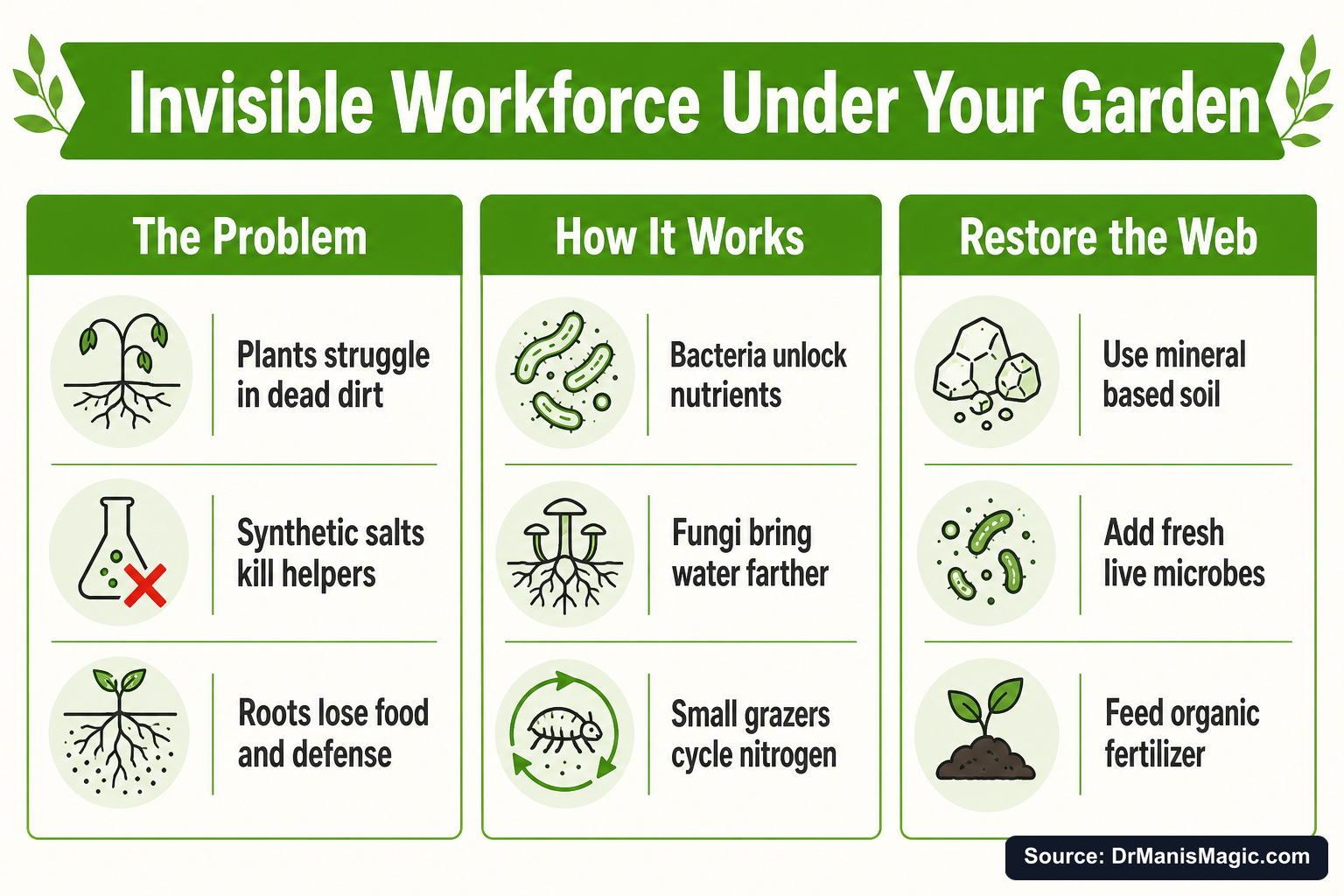
- Healthy soil is a living ecosystem, not inert dirt. Billions of bacteria, fungi, protozoa, and nematodes work together to feed plants naturally.
- The soil food web cycles nutrients, suppresses disease, and builds root systems without synthetic fertilizers.
- Salt-based fertilizers and synthetic chemicals kill beneficial soil microbes, leaving plants dependent on continuous chemical inputs.
- Most commercial microbial products contain dead or dormant organisms that never reactivate in soil.
- Damaged soil can recover with live microbial inoculation, organic matter, and consistent biological management.
- The Three Plant Pillars—mineral-based soil, live microbes, and organic fertilizer—create the foundation every plant needs to thrive
What Is the Soil Food Web?
Definition: The soil food web is the complete community of living organisms beneath the soil surface—bacteria, fungi, protozoa, nematodes, arthropods, and earthworms—that cycle nutrients, build soil structure, and support plant health.

Plant Super Boost

The soil food web functions like an underground city. Each organism plays a specific role:
| Organism | Role in Soil | Key Function |
|---|---|---|
| Bacteria | Factory workers | Break down organic matter, fix nitrogen, unlock minerals |
| Fungi | Engineers and builders | Extend root reach, transport water and nutrients, create soil structure |
| Protozoa | Managers | Graze on bacteria, release plant-available nutrients |
| Nematodes | Pest control and nutrient cycling | Hunt harmful insects, release nutrients when grazing |
| Arthropods | Shredders | Break down large organic matter into smaller pieces |
| Earthworms | Heavy equipment | Create air channels, produce nutrient-rich castings |
Plant roots act as the coordinator. They release sugars (exudates) that attract the specific microbes they need, creating a partnership that has sustained forests and grasslands for millions of years without human intervention.
Why This Matters: Research from Penn State, University of Minnesota, and Colorado State confirms that soil biology drives nutrient cycling, water retention, disease suppression, and root development. The microbes are not optional—they are the system itself.
The Role of Soil Bacteria
Quick Answer: Soil bacteria are the primary decomposers and nutrient processors in the soil food web. A single teaspoon of healthy soil contains 100 million to 1 billion bacteria that break down organic matter, fix atmospheric nitrogen, and unlock minerals for plant uptake.
What Bacteria Do for Your Plants
Bacteria concentrate in the rhizosphere—the thin zone of soil directly surrounding plant roots. This is where the most important exchanges happen:
- Nitrogen fixation: Certain bacteria convert atmospheric nitrogen into forms plants can absorb
- Mineral solubilization: Bacteria dissolve locked-up phosphorus and other nutrients
- Disease suppression: Beneficial bacteria outcompete pathogens and produce antimicrobial compounds
- Organic matter decomposition: Bacteria break down dead plant material into plant-available nutrients
The Exchange: Plants feed bacteria sugars through root exudates. In return, bacteria deliver nutrients and protection. This symbiosis is one of the most efficient nutrient delivery systems in nature.
The Role of Mycorrhizal Fungi
Quick Answer: Mycorrhizal fungi are beneficial fungi that form partnerships with plant roots, extending the root system's reach by up to 100 times. They transport water and nutrients from distances plant roots cannot access alone.
How Fungi Differ from Bacteria
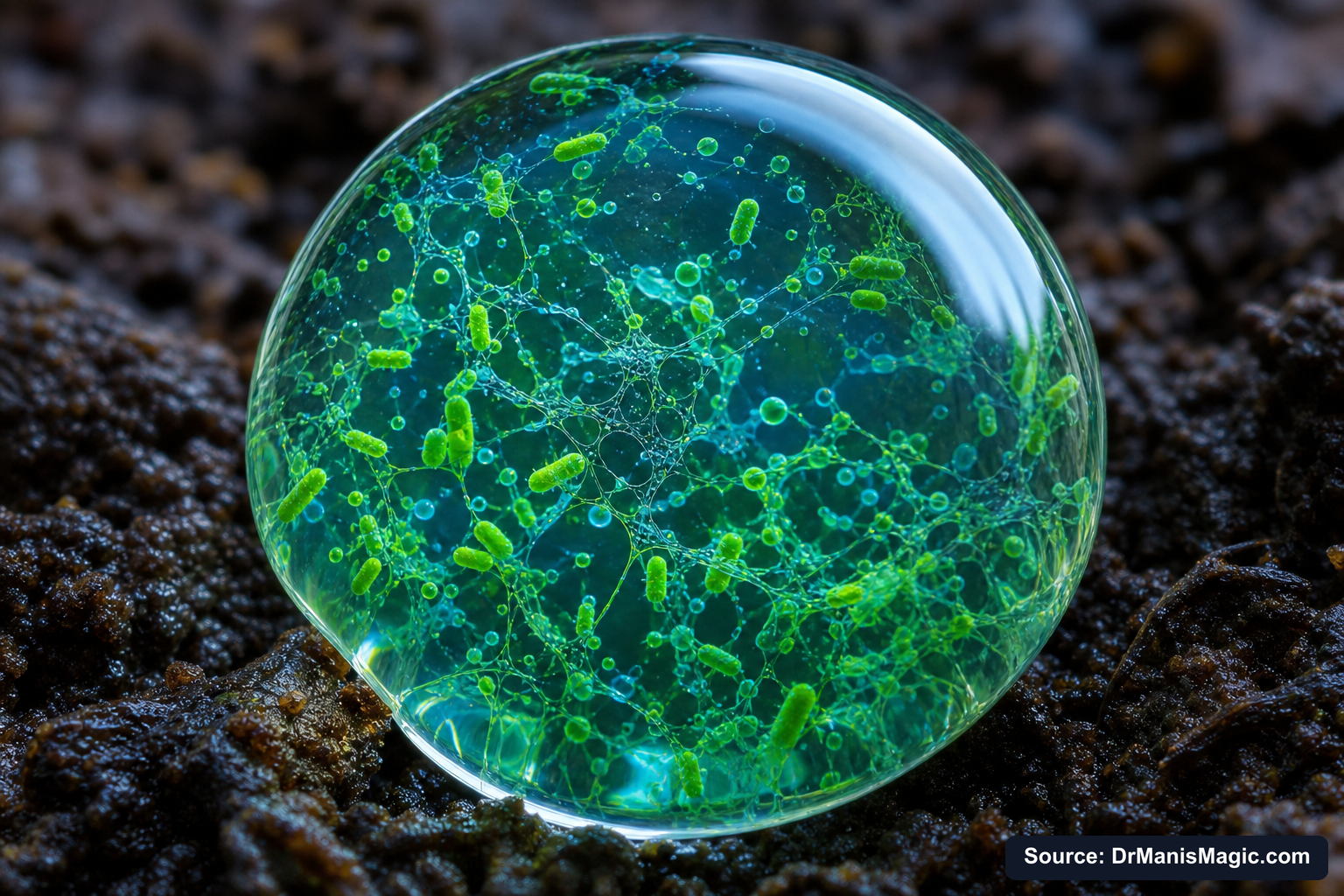
While bacteria cluster close to roots, fungi send thread-like structures called hyphae far through the soil—sometimes extending several feet in every direction. These fungal networks:
- Increase root surface area dramatically for water and nutrient absorption
- Transport phosphorus and micronutrients from distant soil regions
- Improve drought tolerance by accessing water beyond the root zone
- Produce glomalin, a sticky protein that binds soil particles into aggregates, creating the pore structure roots need to breathe
Visual Indicator: Pull a healthy weed from the ground. The fuzzy white threads clinging to the roots are mycorrhizal fungi—the reason weeds grow so aggressively.
Types of Beneficial Soil Fungi
| Fungal Type | Primary Function |
|---|---|
| Mycorrhizal fungi | Partner with roots, extend nutrient and water access |
| Saprophytic fungi | Decompose woody material, bark, and tough organic matter |
| Trichoderma | Suppress root pathogens, promote plant growth |
Protozoa and Nematodes: The Nutrient Release System
Quick Answer: Protozoa and beneficial nematodes are grazers that eat bacteria and fungi, releasing plant-available nitrogen as a byproduct. This grazing cycle is one of the primary ways plants receive nutrients in natural ecosystems.
The Grazing Cycle Explained
Bacteria and fungi store nutrients inside their cells. When protozoa consume bacteria:
- The protozoan absorbs what it needs
- Excess nutrients—especially nitrogen—are released as waste
- These nutrients become immediately available to plant roots
- The cycle continues as bacterial populations regenerate
University of Minnesota research identifies this grazing cycle as a primary mechanism for natural plant nutrition. The plant does not need synthetic fertilizer—it needs a functioning food web where organisms eat each other and release nutrients continuously.
Beneficial Nematodes as Pest Control
Beneficial nematodes (distinct from harmful root-knot nematodes) hunt soil-dwelling pests:
- Grubs
- Fungus gnat larvae
- Root weevils
- Other harmful soil insects
This biological pest control operates continuously in healthy soil without chemical intervention.
Arthropods and Earthworms: The Physical Engineers
Quick Answer: Arthropods shred organic matter into smaller pieces for bacterial decomposition, while earthworms create air channels and produce castings that are among the most nutrient-rich soil amendments available.
Earthworms as Soil Health Indicators
Earthworms require living soil to survive. Their presence indicates:
- Active biological communities
- Adequate organic matter
- Appropriate moisture levels
- Low chemical contamination
Simple Test: Dig a shoebox-sized hole 6 inches deep in your garden. Healthy soil should contain several earthworms. Finding none suggests the soil biology needs attention.
What Earthworm Castings Provide
Earthworm castings contain:
- 5x more nitrogen than surrounding soil
- 7x more phosphorus
- 11x more potassium
- Beneficial bacteria and enzymes
- Humic acids that improve nutrient availability
Can Soil Become Biologically Dead?
Quick Answer: Yes. Soil can become functionally dead when synthetic chemicals, salt-based fertilizers, and environmental disturbance eliminate the microbial communities that make it productive. Signs include lack of earthworms, poor structure, absence of earthy smell, and declining plant health.
What Kills Soil Biology
| Factor | How It Damages Biology |
|---|---|
| Salt-based synthetic fertilizers | Osmotic stress dehydrates and kills bacteria and fungi |
| Synthetic herbicides (glyphosate) | Disrupts microbial communities and nutrient cycling |
| Broad-spectrum pesticides | Kills beneficial organisms along with pests |
| Synthetic fungicides | Eliminates beneficial fungi including mycorrhizae |
| Soil fumigation | Sterilizes all biological activity |
| Construction disturbance | Destroys fungal networks and soil structure |
| Tillage | Breaks fungal hyphae and disrupts community structure |
The Salt Problem in Conventional Fertilizers
Most synthetic fertilizers sold at retail stores are salt-based. When applied:
- Salt concentration increases around roots
- Osmotic pressure pulls water out of bacterial cells
- Microbes dehydrate and die
- Nutrient cycling slows
- Plants become dependent on continuous fertilizer applications
- Soil biology degrades further with each application cycle
This creates a dependency loop where damaged biology requires more chemical inputs, which causes more biological damage.
Signs Your Soil Is Alive vs. Dead
| Indicator | Living Soil | Dead or Damaged Soil |
|---|---|---|
| Smell | Earthy, sweet (geosmin from actinomycetes) | No smell, chemical smell, or sour/rotten |
| Structure | Crumbles gently, holds shape when squeezed | Powdery, dustite, or compacted |
| Earthworms | Present in 6-inch dig test | Absent |
| Root appearance | White, firm, with fuzzy fungal threads | Brown, mushy, bare |
| Plant health | Vigorous growth, natural pest resistance | Yellowing, slow growth, disease susceptibility |
Do Commercial Microbial Products Work?
Quick Answer: Most commercial microbial products fail to deliver live, functioning organisms. Dried powders rarely reactivate successfully, and liquid products often contain dead microbes that went anaerobic before shipping. Genuine effectiveness requires organisms that are alive at the time of application.
The Problem with Common Microbial Product Types
| Product Type | How Made | Microbes Alive at Application? | Effectiveness |
|---|---|---|---|
| Dry powder (lab-grown) | Bacteria dried into spores | Rarely—spore reactivation unreliable | Minimal |
| Rehydrated powder in liquid | Dried powder added to water | Low—same reactivation problem | Minimal |
| Compost tea (fresh, <24 hours) | Aerated brew from compost | Moderate—time-sensitive | Good when fresh |
| Compost tea (old, >24 hours) | Same, gone anaerobic | Very low—microbes dying | Poor |
| Live, stabilized full-spectrum | Harvested from active compost | High—visibly alive under microscope | Proven results |
The Smell Test: Anaerobic (dead) microbial products smell foul—like sewage or rot. Living microbial products smell earthy, like healthy forest soil.
Why Dried Products Fail
You cannot reliably revive dried microorganisms in a new soil environment. The organisms must:
- Survive the drying process
- Remain viable during storage and shipping
- Reactivate when applied to foreign soil conditions
- Establish populations despite competition from existing organisms
Most dried products fail at multiple steps in this chain.
What Makes Plant Super Boost Different
Quick Answer: Plant Super Boost delivers genuinely live, full-spectrum soil microbes stabilized through a natural process that prevents anaerobic death during storage. It contains over 2,000 bacterial strains, 400-500 fungal species including mycorrhizae, plus protozoa and beneficial nematodes.
How Plant Super Boost Is Produced
Unlike factory-grown and dried products, Plant Super Boost microbes are:
- Harvested from real, active compost—not grown in industrial vats
- Stabilized using an all-natural technique developed by a world-renowned compostologist
- Maintained in an aerobic state that prevents die-off during storage
- Verifiable as alive under microscope examination
What Plant Super Boost Contains
- 2,000+ bacterial strains
- 400-500 fungal species including multiple mycorrhizal varieties
- Protozoa for nutrient cycling
- Beneficial nematodes for pest suppression
Verification
Lab analysis and microscopy confirm live, active organisms. The product has been tested on over 250,000 trees at US Citrus Nursery in South Texas.
The Three Plant Pillars Framework
Quick Answer: The Three Plant Pillars are the foundational requirements for plant health: mineral-based soil that maintains structure, live microbial communities that cycle nutrients, and organic fertilizer that feeds plants without damaging biology. This framework was developed from 40+ years of horticultural research and application.
Pillar One: Mineral-Based Soil
Conventional potting mixes use bark, sawdust, and organic materials that:
- Decompose over time
- Compact and restrict oxygen
- Create conditions for root rot
Mineral-based soil made from silica-rich sandy loam:
- Maintains structure indefinitely
- Allows proper drainage and aeration
- Provides stable root environment for years
Pillar Two: Live Microbials
The complete soil food web—bacteria, fungi, protozoa, nematodes—working together to:
- Cycle nutrients continuously
- Suppress disease naturally
- Extend root access to water and minerals
- Build soil structure
Pillar Three: Organic Fertilizer
Slow-release nutrients from natural sources (crab meal, kelp, amino acids) that:
- Feed plants gradually and completely
- Do not burn or kill soil biology
- Avoid salt accumulation
- Work with rather than against the soil food web
How to Restore Damaged or Dead Soil
Quick Answer: Soil biology can recover with consistent effort over 1-3 growing seasons. The process requires stopping chemical damage, adding organic matter, inoculating with live microbes, and maintaining living root systems.
Step-by-Step Soil Restoration
-
Stop the damage — Eliminate or reduce salt-based fertilizers, synthetic herbicides, and broad-spectrum pesticides
-
Test pH and salt levels — High salt or extreme pH prevents biological recovery
-
Flush accumulated salts — Deep, slow watering pushes excess salts below the root zone
-
Add finished compost — Introduces organic matter and some biological activity
-
Inoculate with live microbes — Apply genuinely live, full-spectrum microbial products monthly
-
Mulch the surface — Holds moisture, moderates temperature, feeds surface biology
-
Maintain living roots — Cover crops and perennials keep the rhizosphere active
-
Minimize tillage — Tillage destroys fungal networks
-
Switch to organic fertilizer — Feeds plants without damaging biology
-
Be consistent — Signs of improvement appear within one growing season; full recovery takes 1-3 years
Timeline for Soil Recovery
| Timeframe | Expected Signs |
|---|---|
| 1-3 months | Improved soil smell, better water infiltration |
| 3-6 months | Earthworms returning, visible root improvement |
| 6-12 months | Plant vigor improving, reduced disease pressure |
| 1-3 years | Full biological function restored, self-sustaining nutrient cycling |
When to Use Microbial Inoculation
| Situation | Does Inoculation Help? | Recommended Action |
|---|---|---|
| Sterile potting mix | Yes, strongly | Inoculate at planting and monthly |
| Transplanting high-value plants | Yes | Apply at root zone during transplant |
| Soil treated with herbicides/fungicides | Yes | Inoculate repeatedly, add compost |
| New construction site | Yes, strongly | Inoculate, mulch, reduce compaction |
| Salt buildup from fertilizers | Yes, after flushing | Flush first, then inoculate |
| Healthy native garden bed | Beneficial but less urgent | Focus on compost, inoculate seasonally |
Frequently Asked Questions
What is the soil food web?
The soil food web is the complete community of organisms living in soil—bacteria, fungi, protozoa, nematodes, arthropods, and earthworms—that work together to cycle nutrients, build soil structure, and support plant health. It functions as a self-sustaining ecosystem that feeds plants naturally when intact.
Why do plants in pots struggle after the first year?
Container potting mixes start sterile with no microbial life. Initial nutrients run out, and without soil biology to cycle nutrients, plants have no natural food source. Adding live microbes and organic fertilizer restores the missing biological function.
Do mycorrhizal fungi products actually work?
Effectiveness depends entirely on whether the fungi are alive at application. Dried powder products rarely reactivate successfully. Liquid products that smell foul contain dead organisms. Only products with verifiably live microbes at application provide meaningful benefits.
How do I know if my soil is alive or dead?
Living soil smells earthy (from geosmin produced by bacteria), crumbles gently with good structure, contains earthworms, and supports plants with white, healthy roots. Dead soil has no smell or smells sour, is either dusty or compacted, lacks earthworms, and produces brown, bare roots.
Can salt-based fertilizers kill soil microbes?
Yes. Salt creates osmotic stress that pulls water out of bacterial and fungal cells, causing them to dehydrate and die. Repeated application of salt-based fertilizers progressively degrades soil biology and creates dependency on continuous chemical inputs.
How long does it take to restore dead soil?
Signs of improvement appear within one growing season. Full biological recovery in heavily damaged soil takes 1-3 years of consistent effort: stopping chemical damage, adding organic matter, inoculating with live microbes, and maintaining living root systems.
What is the difference between beneficial and harmful nematodes?
Beneficial nematodes hunt soil pests like grubs and fungus gnat larvae. Harmful nematodes (root-knot nematodes) attack plant roots. A balanced soil food web contains beneficial nematodes that help control pest populations naturally.
Why do forest trees thrive without fertilizer?
Forests have intact soil food webs. Bacteria and fungi break down organic matter and cycle nutrients. Protozoa and nematodes graze on microbes and release plant-available nutrients. Mycorrhizal fungi extend root systems. The system is self-sustaining and feeds plants continuously without external inputs.
What are the Three Plant Pillars?
The Three Plant Pillars are the foundational requirements for plant health: mineral-based soil that maintains structure long-term, live microbial communities that cycle nutrients and suppress disease, and organic fertilizer that feeds plants without damaging biology.
How do bacteria fix nitrogen from the air?
Certain soil bacteria contain nitrogenase enzymes that convert atmospheric nitrogen (N₂) into ammonia (NH₃), which plants can absorb. This biological nitrogen fixation provides free nitrogen to plants without synthetic fertilizer inputs.
What is glomalin and why does it matter?
Glomalin is a sticky protein produced by mycorrhizal fungi that binds soil particles into aggregates. These aggregates create pore space for air and water movement. Without glomalin, soil compacts and roots cannot breathe properly.
Can I make my own compost tea?
Compost tea can provide beneficial microbes when used fresh (within 24 hours of brewing) and properly aerated. However, tea that sits too long goes anaerobic, killing the beneficial organisms. Maintaining proper aeration and timing is challenging without specialized equipment.
Why does my microbial product smell bad?
A foul smell indicates anaerobic conditions—the microbes have run out of oxygen and are dying or dead. Living microbial products smell earthy, like healthy forest soil. Bad-smelling products will not provide the biological benefits advertised.
What should I look for in a microbial product?
Look for products that are demonstrably alive (not dried and rehydrated), smell earthy rather than foul, contain multiple organism types (bacteria, fungi, protozoa), and come from actual compost rather than laboratory fermentation.
How often should I apply microbial inoculants?
For containers and disturbed soil, monthly application during the growing season helps establish and maintain populations. Healthy garden beds with organic management can be inoculated seasonally or when transplanting.
Do earthworms mean my soil is healthy?
Earthworms require living soil biology, adequate organic matter, and low chemical contamination to survive. Their presence strongly indicates functional soil biology. Absence of earthworms in garden soil suggests biological damage.
What kills beneficial fungi in soil?
Synthetic fungicides eliminate beneficial fungi along with pathogens. Tillage breaks fungal networks. Salt-based fertilizers create osmotic stress. Soil fumigation sterilizes all fungal life. Reducing these inputs allows fungal populations to recover.
Can I use Plant Super Boost with chemical fertilizers?
For best results, transition away from salt-based fertilizers when using live microbial products. Salt damages the organisms you are introducing. If you must use chemical fertilizers temporarily, space applications and flush with water between.
What is the rhizosphere?
The rhizosphere is the narrow zone of soil immediately surrounding plant roots where most biological activity concentrates. Plants release sugars through their roots that attract and feed beneficial microbes in this zone.
Why do weeds grow so aggressively?
Weeds typically have strong mycorrhizal partnerships that extend their effective root systems dramatically. The fuzzy white threads visible on weed roots are fungal hyphae providing water and nutrients from distances the roots could not reach alone.
Start Building Your Soil's Invisible Workforce

A thriving garden is the visible result of an invisible workforce doing its job underground. Every healthy garden starts with living soil. By restoring the soil food web through live microbial inoculation, organic fertilization, and mineral-based soil structure, you give your plants the foundation they need to thrive — the way nature intended.
Explore Dr. Mani's Magic Plant Super Boost


